
The Vietnam War Through Notes and Songs From


- Slides: 97
The Vietnam War Through Notes and Songs From the Divided House Anthology
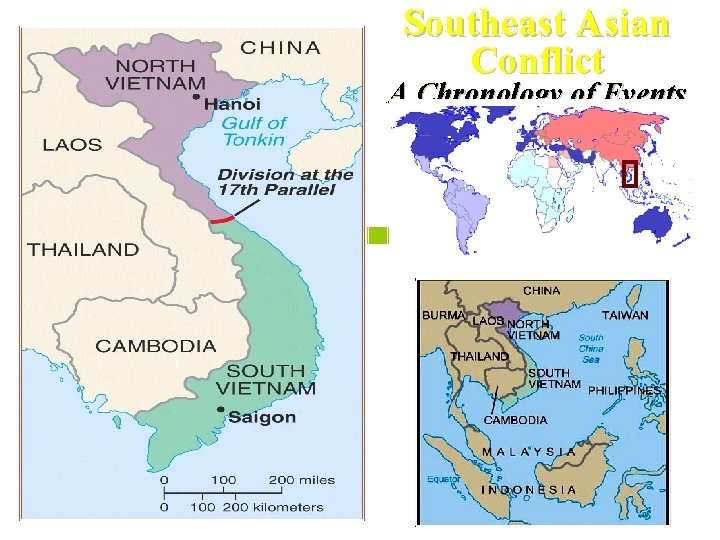
Southeast Asian Conflict A Chronology of Events
Notes p p p American involvement in Vietnam began in 1950 when the US provided massive amounts of economic and military support to the French in order to help them regain control of Vietnam after WWII. The French ruled Indochina from the late 1800’s until Japan gained control during WWII. After WWII the Vietnamese worked for their independence. The Indochina communist party was formed and staged revolts under Ho Chi Minh. n The Vietminh was established – goal: Vietnam’s independence.
A New Vietnam? p September 2, 1945 – Ho Chi Minh declared Vietnam independent. (Minh’s declaration of independence is ironically almost identical to the US Declaration of Independence. ) French troops quickly moved to reoccupy Vietnam. p p May 1954 – After the Vietnamese victory at Dien Bien Phu the French were forced out of Vietnam. The Geneva Accords were held to determine what would happen in Vietnam was temporarily divided along the 17 th parallel. n n p Communist Ho Chi Minh controlled the north from Hanoi. Nationalist (anti-communist) Ngo Dinh Diem controlled the south from Saigon. An election to reunify the country was called for in 1956, but it never happened because the anti-communist countries of the world were afraid Uncle Ho (as the N. Vietnamese referred to him) would be elected to rule the country. Ho implemented land reform that made his strict regime very popular with the peasants.
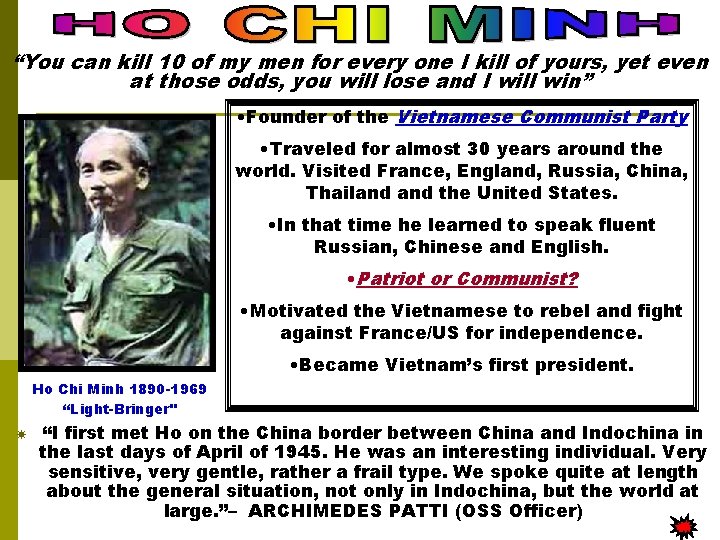
“You can kill 10 of my men for every one I kill of yours, yet even at those odds, you will lose and I will win” • Founder of the Vietnamese Communist Party • Traveled for almost 30 years around the world. Visited France, England, Russia, China, Thailand the United States. • In that time he learned to speak fluent Russian, Chinese and English. • Patriot or Communist? • Motivated the Vietnamese to rebel and fight against France/US for independence. • Became Vietnam’s first president. Ho Chi Minh 1890 -1969 “Light-Bringer" “I first met Ho on the China border between China and Indochina in the last days of April of 1945. He was an interesting individual. Very sensitive, very gentle, rather a frail type. We spoke quite at length about the general situation, not only in Indochina, but the world at large. ”– ARCHIMEDES PATTI (OSS Officer)
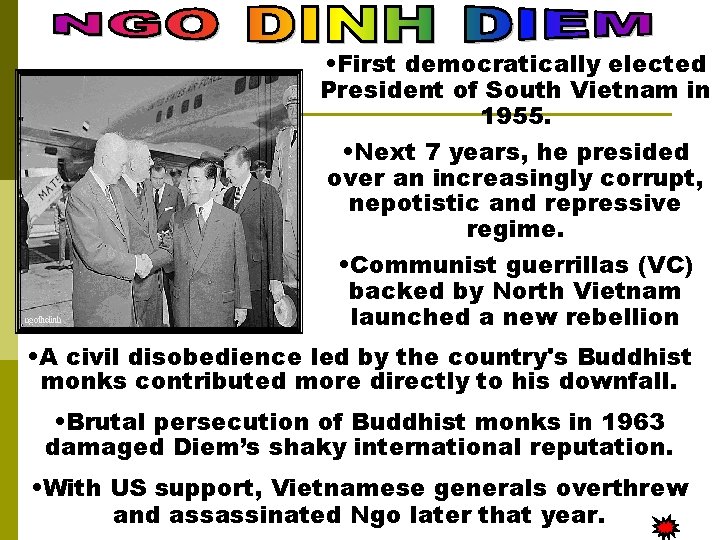
• First democratically elected President of South Vietnam in 1955. • Next 7 years, he presided over an increasingly corrupt, nepotistic and repressive regime. • Communist guerrillas (VC) backed by North Vietnam launched a new rebellion • A civil disobedience led by the country's Buddhist monks contributed more directly to his downfall. • Brutal persecution of Buddhist monks in 1963 damaged Diem’s shaky international reputation. • With US support, Vietnamese generals overthrew and assassinated Ngo later that year.
Problems in the South p p p Diem, a catholic, angered many South Vietnamese by restricting the country’s majority religion, Buddhism. Diem was Harvard educated and hand chosen to rule by Kennedy. Many people in his country saw him as westernized with little respect for the ancient culture of the Vietnamese people. By 1957 a communist opposition group known as the Vietcong began attacks on the southern government in which thousands of officials were assassinated. Ho Chi Minh supported the Vietcong (VC) (which became the National Liberation Front) via a network of paths and tunnels known as the Ho Chi Minh trail.
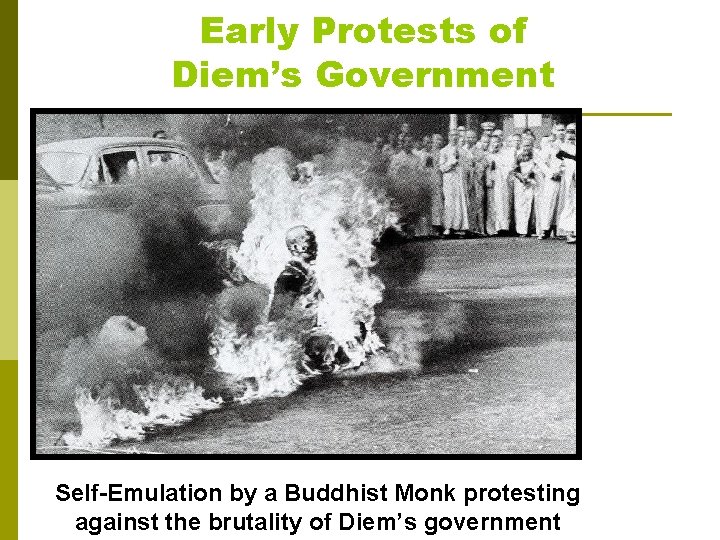
Early Protests of Diem’s Government Self-Emulation by a Buddhist Monk protesting against the brutality of Diem’s government
American Action p Kennedy sent thousands of military leaders to help train the South Vietnamese troops. n n p The Diem administration attempted land reform to please the peasants. They instituted the strategic hamlet program in which all villagers moved to protected areas and formed cooperative farms. The program caused resentment however, because people did not want to move away from their ancestral homelands. Diem intensified his attacks on Buddhist, who began to publicly burn themselves to death in protest. November 1, 1963 – Diem’s regime was toppled and he was assassinated by a US backed military coup. (Kennedy was assassinated days later. )
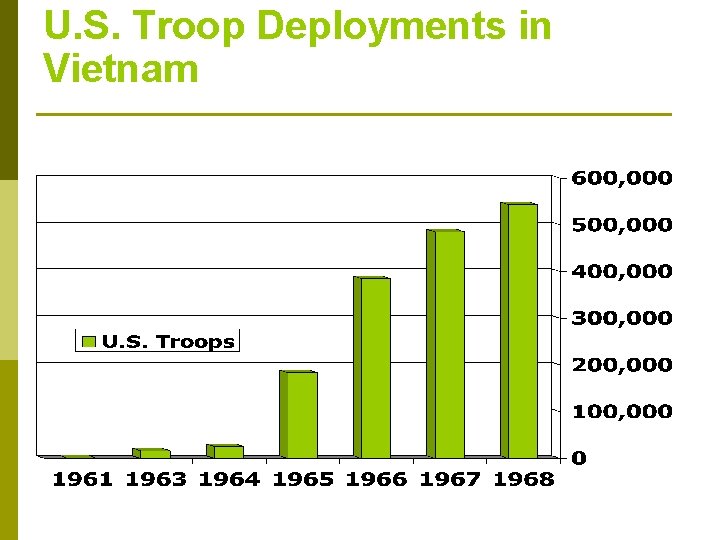
Johnson expands the conflict LBJ, like Kennedy, did not want to seem soft on communism p The Gulf of Tonkin Resolution p n On August 2 1964 a North Vietnamese patrol boat fired a torpedo at an American destroyer (USS Maddox). The torpedo missed its target but the Maddox returned fire and heavily damaged the patrol boat. Two days later the Maddox reported enemy torpedoes but had not seen nor heard them. This alleged attack prompted Johnson to launch bombing strikes on the N. Vietnamese. Congress granted the “Tonkin Gulf Resolution” which did not declare war but did grant Johnson broad military power in Vietnam. Combat troops began arriving in Vietnam shortly there after and by 1967 there were over 400, 000 US troops in Vietnam.
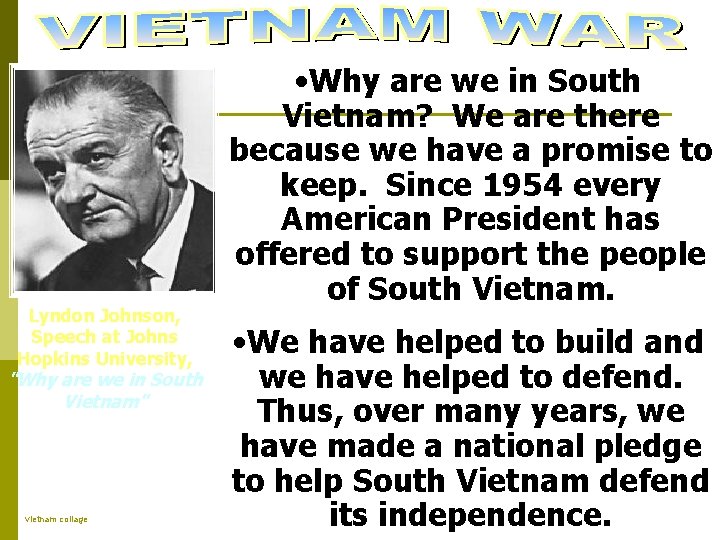
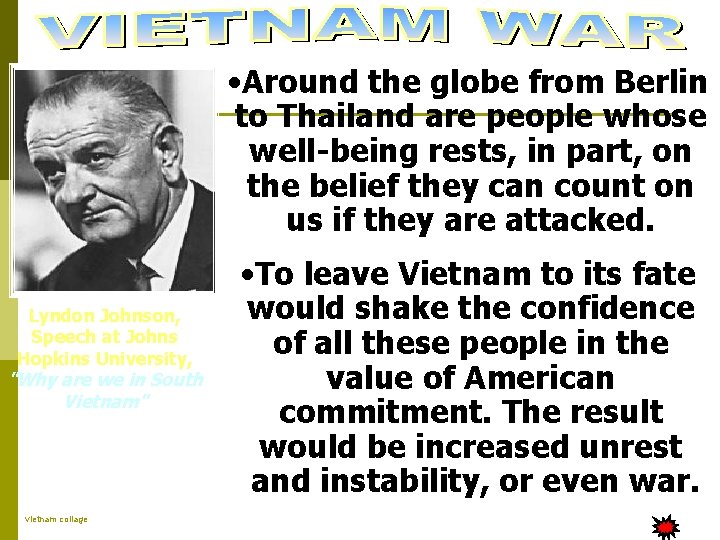
Lyndon Johnson, Speech at Johns Hopkins University, "Why are we in South Vietnam" vietnam collage • Why are we in South Vietnam? We are there because we have a promise to keep. Since 1954 every American President has offered to support the people of South Vietnam. • We have helped to build and we have helped to defend. Thus, over many years, we have made a national pledge to help South Vietnam defend its independence.
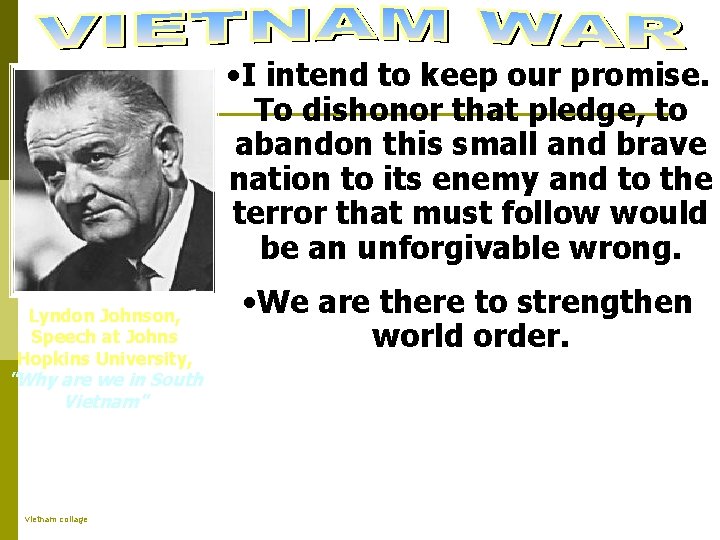
• I intend to keep our promise. To dishonor that pledge, to abandon this small and brave nation to its enemy and to the terror that must follow would be an unforgivable wrong. Lyndon Johnson, Speech at Johns Hopkins University, "Why are we in South Vietnam" vietnam collage • We are there to strengthen world order.
• Around the globe from Berlin to Thailand are people whose well-being rests, in part, on the belief they can count on us if they are attacked. Lyndon Johnson, Speech at Johns Hopkins University, "Why are we in South Vietnam" vietnam collage • To leave Vietnam to its fate would shake the confidence of all these people in the value of American commitment. The result would be increased unrest and instability, or even war.
1964 Gulf of Tonkin Resolution Passed by Congress 5 Aug 1964 – Radically altered the War in Southeast Asia – Gave President Johnson a “blank check”: “To take all necessary steps to repel armed attack against US forces”, including force, to assist South Vietnam and any member of SEATO”
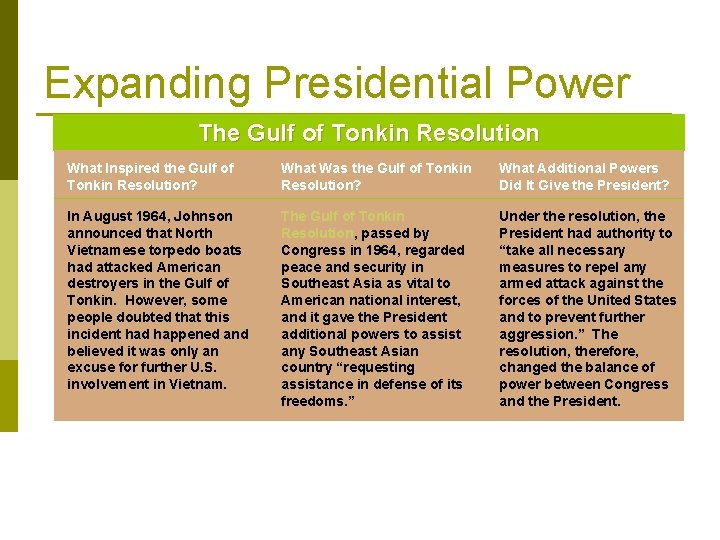
Expanding Presidential Power The Gulf of Tonkin Resolution What Inspired the Gulf of Tonkin Resolution? What Was the Gulf of Tonkin Resolution? What Additional Powers Did It Give the President? In August 1964, Johnson announced that North Vietnamese torpedo boats had attacked American destroyers in the Gulf of Tonkin. However, some people doubted that this incident had happened and believed it was only an excuse for further U. S. involvement in Vietnam. The Gulf of Tonkin Resolution, passed by Congress in 1964, regarded peace and security in Southeast Asia as vital to American national interest, and it gave the President additional powers to assist any Southeast Asian country “requesting assistance in defense of its freedoms. ” Under the resolution, the President had authority to “take all necessary measures to repel any armed attack against the forces of the United States and to prevent further aggression. ” The resolution, therefore, changed the balance of power between Congress and the President.
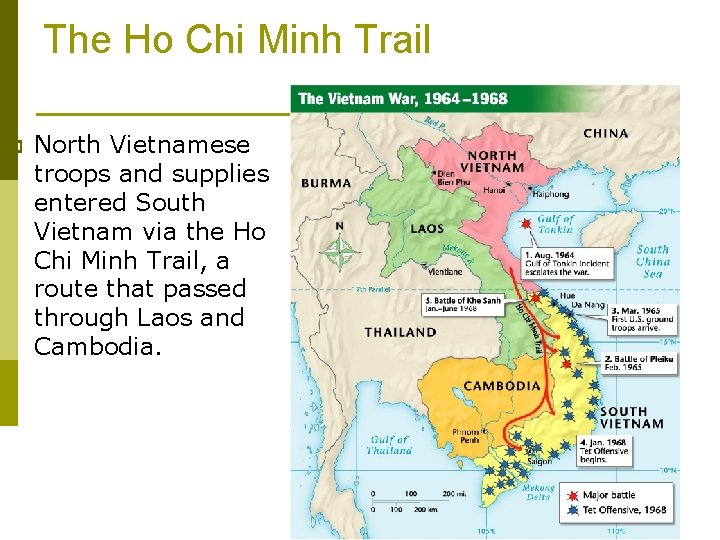
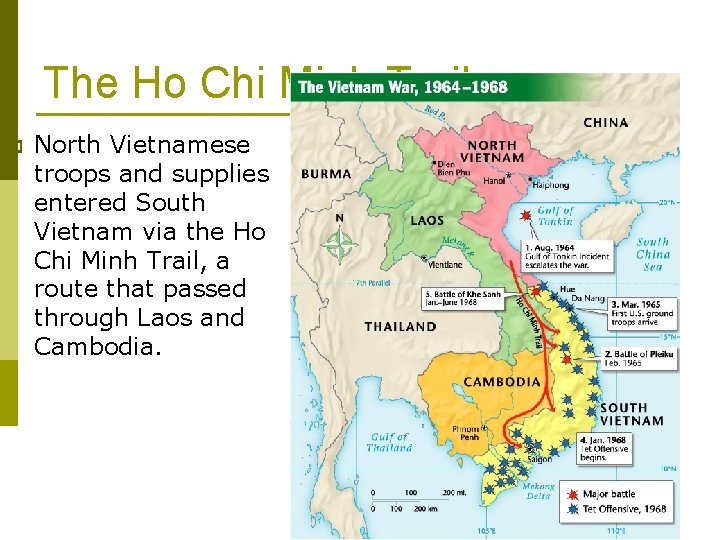
The Ho Chi Minh Trail p North Vietnamese troops and supplies entered South Vietnam via the Ho Chi Minh Trail, a route that passed through Laos and Cambodia.
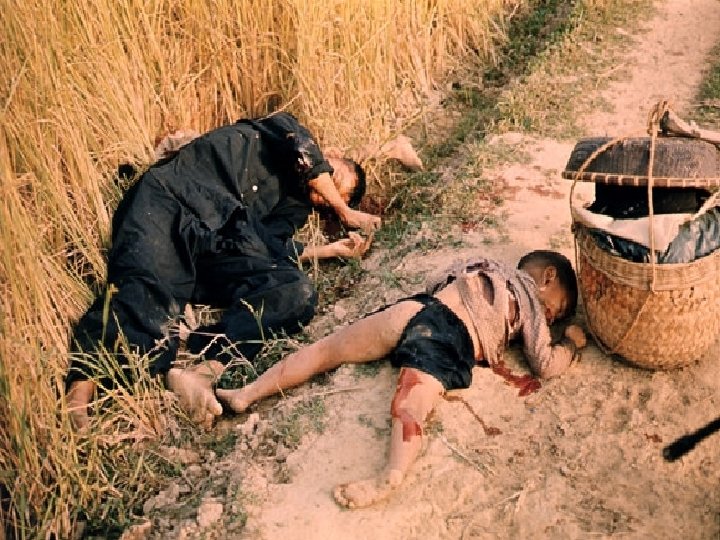
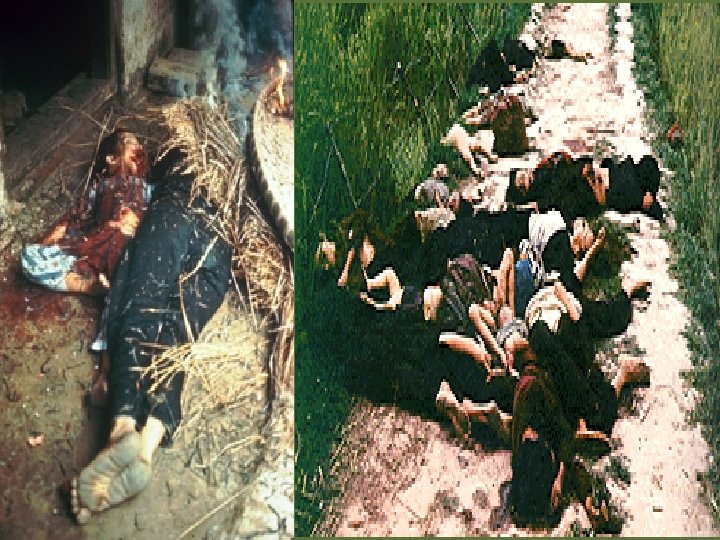
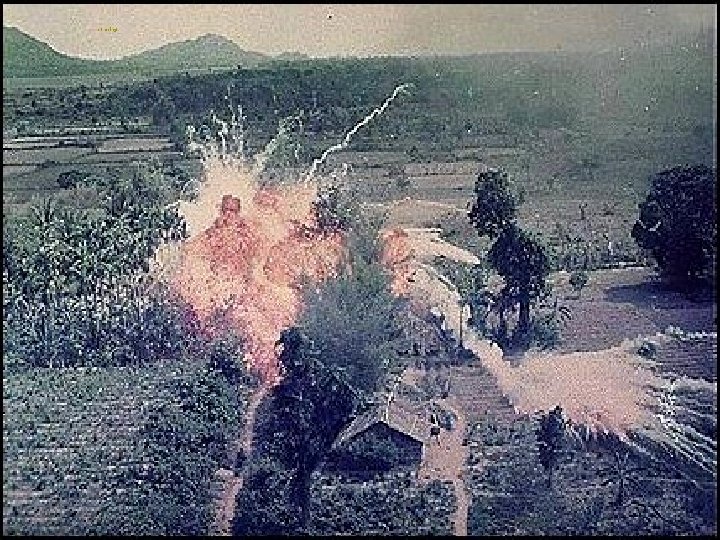
Fighting in the Jungle p p p An elusive enemy – The Vietnamese knew the land well. They used tactics such as hit and run ambushes and booby traps. The Vietnamese were hard to find and fight. The VC saw the war as a battle for their very existence. Hearts and Minds – Americans were trying to win support of the S. Vietnamese while they used things like n Agent Orange – a leaf killing toxic agent that was supposed to force the VC out of their jungle hiding spots. Often harmed civilians, crops, and US soldiers. n Napalm – a gasoline based bomb that set fire to the jungle. Used for the same reasons Agent Orange is used. n Search and destroy –missions that uprooted civilians with suspected ties to the VC, killing their livestock, and burning villages
The Ho Chi Minh Trail p North Vietnamese troops and supplies entered South Vietnam via the Ho Chi Minh Trail, a route that passed through Laos and Cambodia.
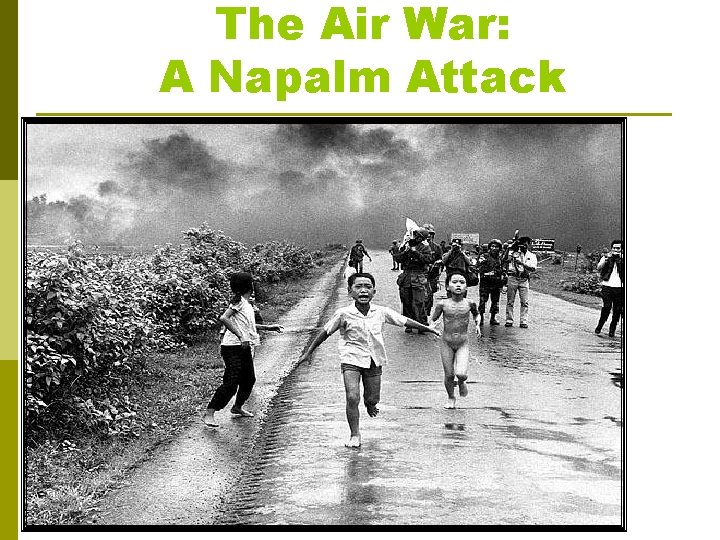
The Air War: A Napalm Attack
The Draft p p All males over 18 were screened (unless they had a medical exemption) and everyone 18 -26 could be called into service. Many Americans began to find ways to avoid the draft. n Sought medical exemptions n Conscientious objector. n Joined Nat’l Guard or Coast Guard for non-Vietnam stations. n College deferment (most college attendees were white middle to upper class males) - Many poor/minority soldiers. Almost 80% of American soldiers at the time came from lower economic levels. p MLK lashed out at the “cruel irony” of black dying for their country (disproportionate levels) that still treated them as second-class citizens.
U. S. Troop Deployments in Vietnam
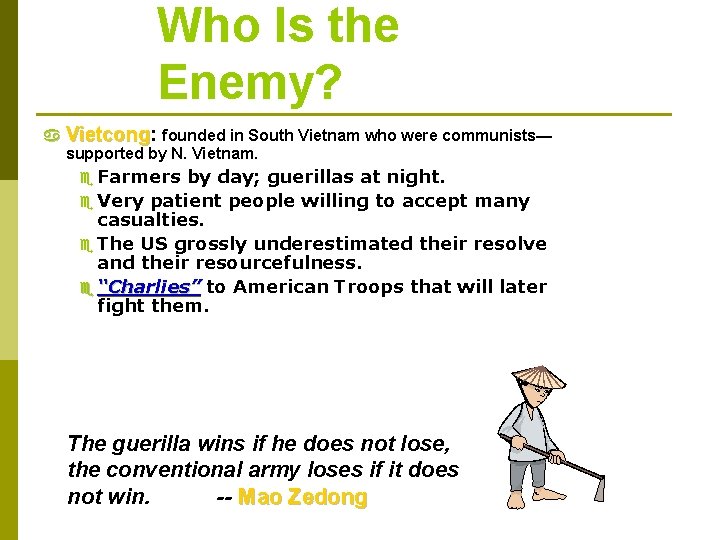
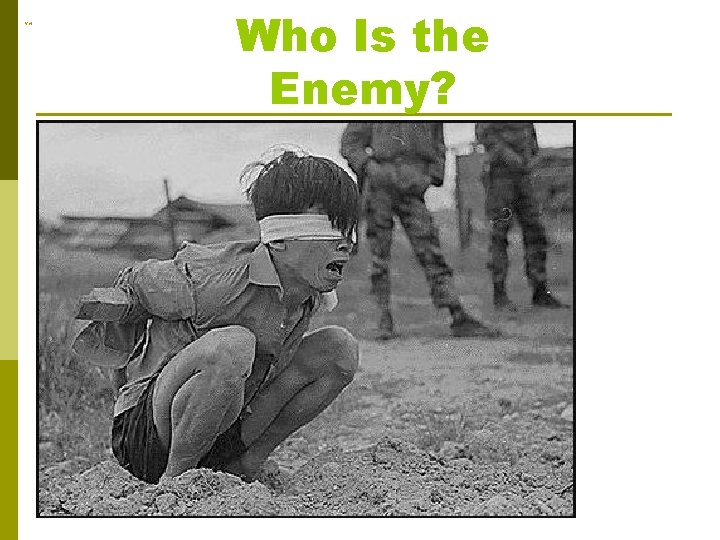
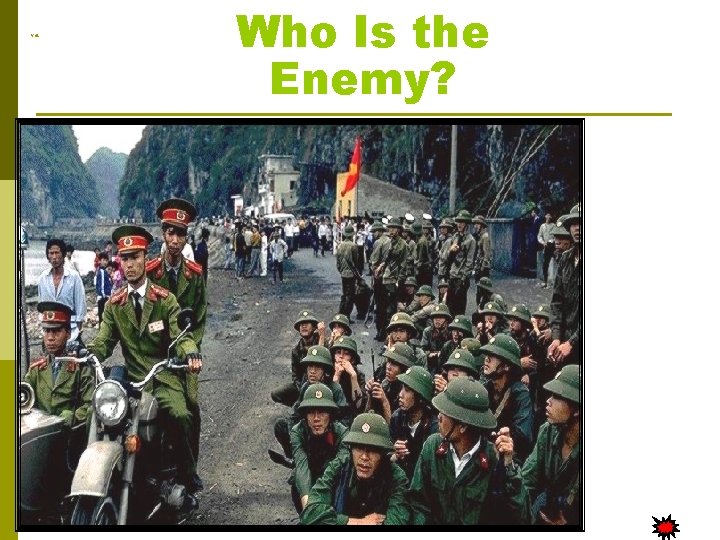
Who Is the Enemy? a Vietcong: Vietcong founded in South Vietnam who were communists— supported by N. Vietnam. e Farmers by day; guerillas at night. e Very patient people willing to accept many casualties. e The US grossly underestimated their resolve and their resourcefulness. e “Charlies” to American Troops that will later fight them. The guerilla wins if he does not lose, the conventional army loses if it does not win. -- Mao Zedong
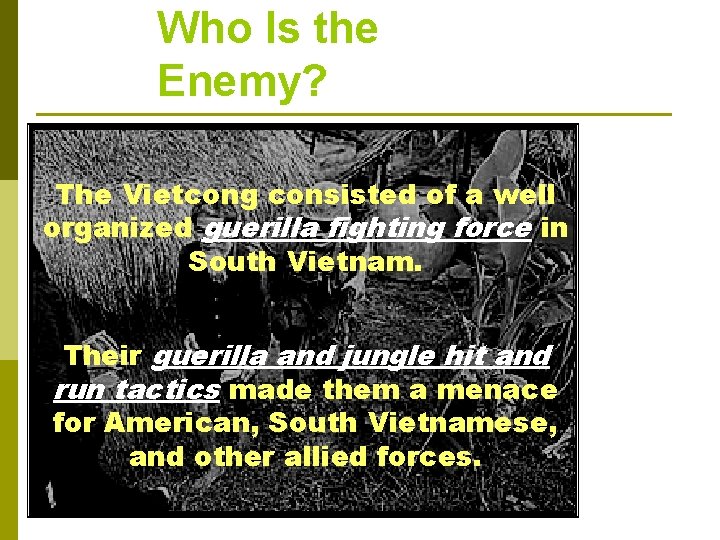
Who Is the Enemy? The Vietcong consisted of a well organized guerilla fighting force in South Vietnam. Their guerilla and jungle hit and run tactics made them a menace for American, South Vietnamese, and other allied forces.
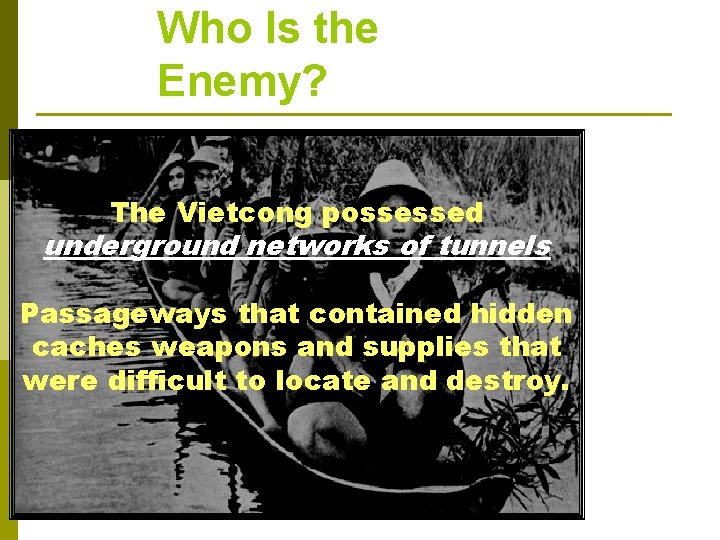
Who Is the Enemy? The Vietcong possessed underground networks of tunnels Passageways that contained hidden caches weapons and supplies that were difficult to locate and destroy.
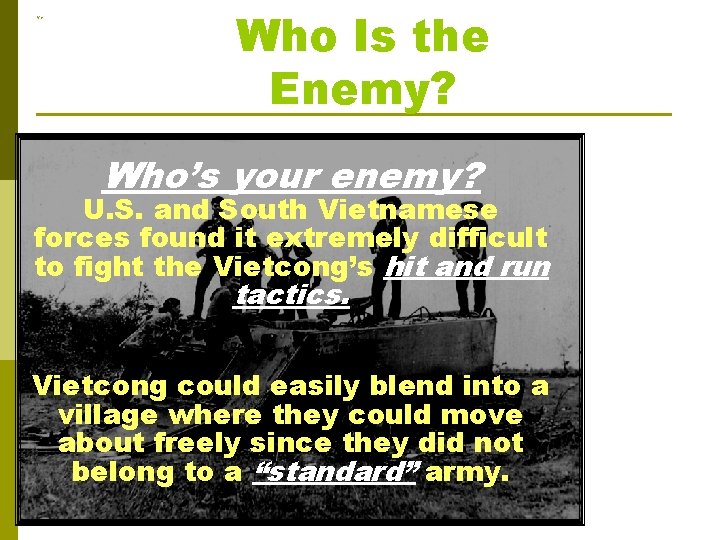
vc Who Is the Enemy? Who’s your enemy? U. S. and South Vietnamese forces found it extremely difficult to fight the Vietcong’s hit and run tactics. Vietcong could easily blend into a village where they could move about freely since they did not belong to a “standard” army.
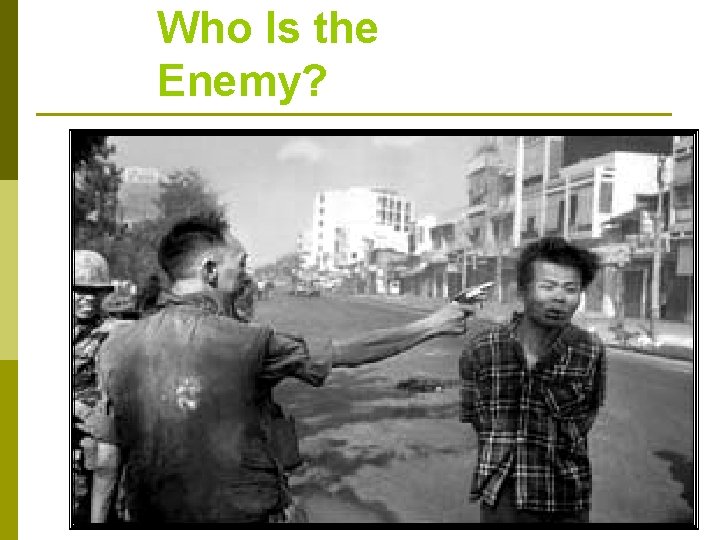
Who Is the Enemy?
vc 1 Who Is the Enemy?
vc 2 Who Is the Enemy?
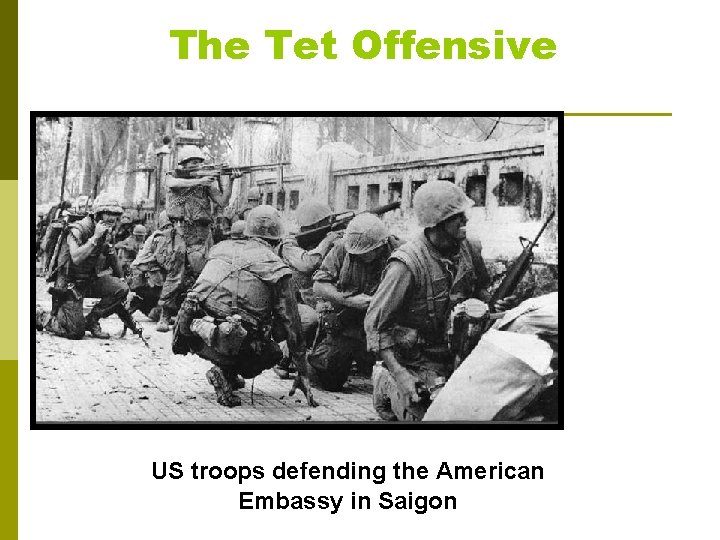
The Tet Offensive p p January 30, 1968 – The Vietnamese New Year known as Tet. There was a weeklong truce proclaimed in order to celebrate the New Year. Many Vietnamese took advantage of this time to bury the dead. Vietcong agents filled several coffins with weapons and launched an overwhelming attack on 100 towns and villages in South Vietnam, 12 air force bases, and the US embassy in Saigon, which killed 5 Americans. The Tet Offensive continued for a month before the US and S. Vietnamese troops regained control of the area. In the end from a military strategy the US and RVN (S. Vietnamese Army) won the battle, however it was a psychological defeat, which would produce a credibility gap for the US government and change public support for the war.
The Tet Offensive US troops defending the American Embassy in Saigon
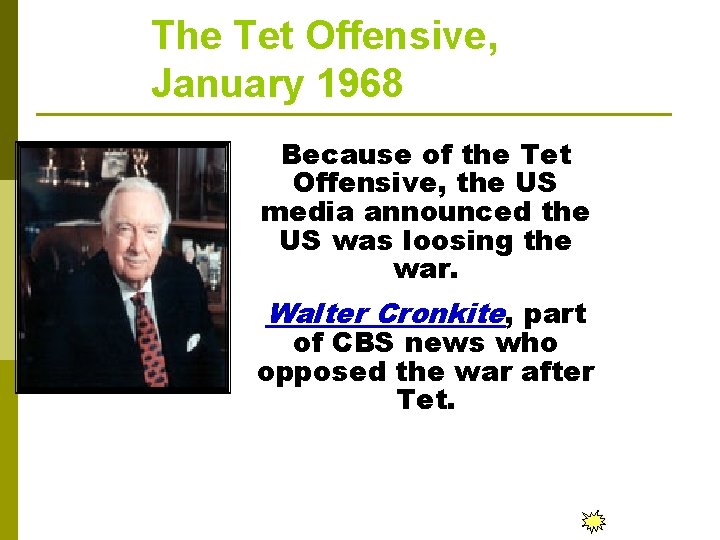
The Tet Offensive, January 1968 Because of the Tet Offensive, the US media announced the US was loosing the war. Walter Cronkite, part of CBS news who opposed the war after Tet.
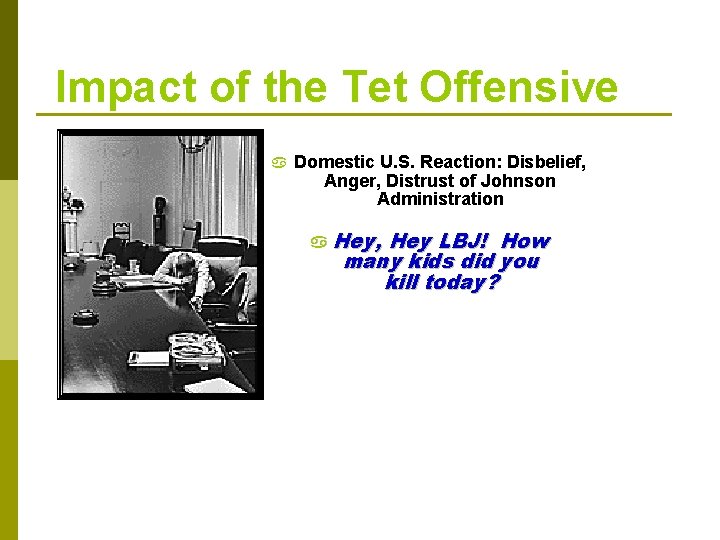
Impact of the Tet Offensive a Domestic U. S. Reaction: Disbelief, Anger, Distrust of Johnson Administration a Hey, Hey LBJ! How many kids did you kill today?
Impact of the Tet Offensive
The Beginning of the End p p p 1968 Johnson seeks negotiations to end the war. n In the same year Johnson said he would not run for reelection 1968 Richard Nixon (Rep. ) is elected President Dec. 31 1970 Congress repealed the Tonkin Gulf Resolution March 29, 1973 the last US combat forces left Vietnam (VIETNAMIZATION) April 30 1975 – N. Vietnam captures S. Vietnam and despite promises not to seek retaliation millions are either killed, imprisoned or flee the country. War Powers Act – President must inform Congress within 48 hours of sending troops anywhere. Troops may remain in a region only 90 days with out Congressional approval or declaration of war.
Vietnam Music from wars previous to Vietnam were battlefield anthems. In contrast, Vietnam war music provided escape from wars terrors and the day to day grind of war. p Nearly 90% of the American soldiers in Vietnam were under 23 years old. p The younger soldiers in Vietnam sometimes wore beads and peace symbols on their uniforms. p
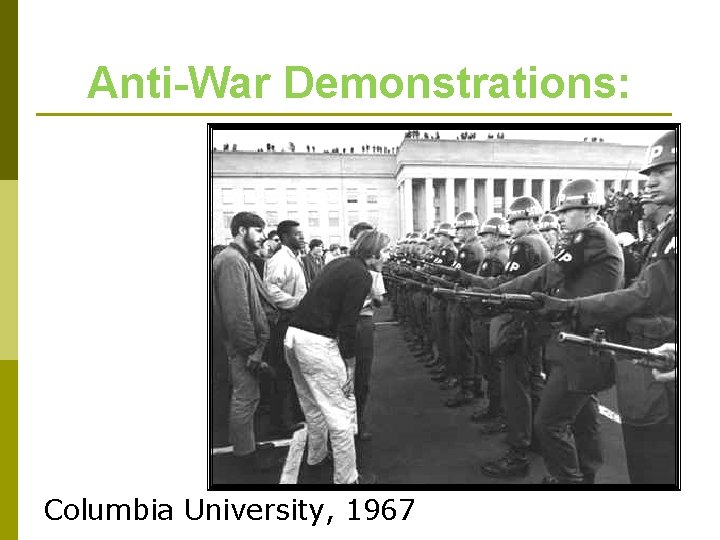
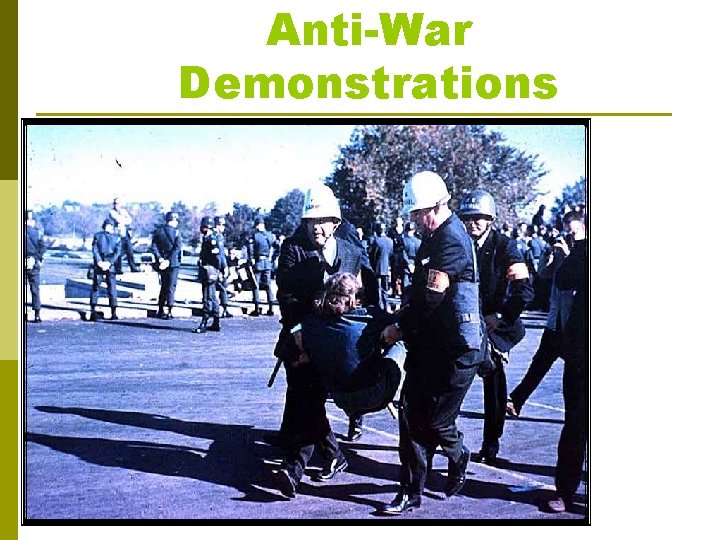
Anti-War Demonstrations: Columbia University, 1967
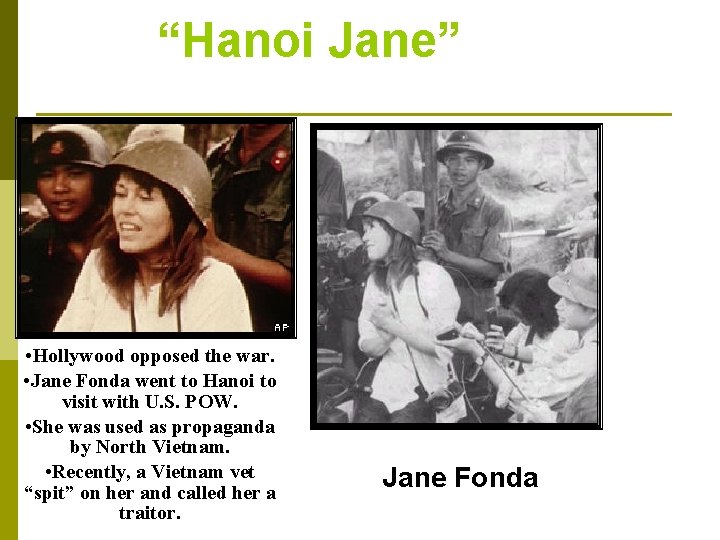
“Hanoi Jane” • Hollywood opposed the war. • Jane Fonda went to Hanoi to visit with U. S. POW. • She was used as propaganda by North Vietnam. • Recently, a Vietnam vet “spit” on her and called her a traitor. Jane Fonda
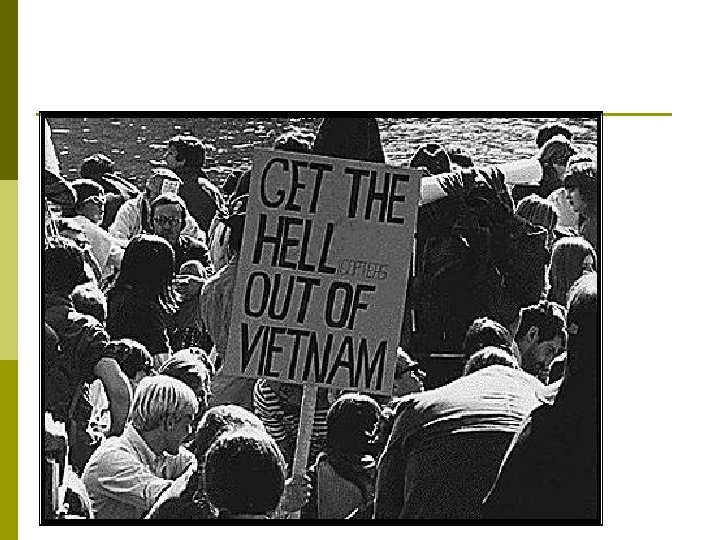
Anti-War Demonstrations
Vietnam Rock music became an important force in the late 1960’s and early 1970’s largely due to music that CONDEMED the Government! p American rock music about Vietnam had a wide range of sentiments from Pro War Songs such as “ THE BALLAD OF THE GREEN BERET” to anti war songs such as the “I FEEL LIKE I’M FIXIN TO DIE” rag. p
JFK’s Assassination became a defining moment in which Americans began to question authority. p Pete Seeger the writer of “Where have all the flowers Gone? ” had been question by the House Un American Activities Committee in the 1950’s. p After promising in his election campaign not to deploy thousands of soldiers to Vietnam LBJ used the Gulf of Tonkin Resolution to open the door to deploy thousands of Americans to Vietnam. p American music culture had recently been transformed during the mid-1960’s by the arrival of the Beatles. p
Whose to Blame? By the End of 1965, President LBJ had deployed 184, 000 Am troops to Vietnam. p The Song Universal Solider not only blamed the generals for the war, but also the ordinary fighting man. p
I Ain’t Marching Anymore is in clear defiance of the Vietnam War. p By Phil Ochs p
LBJ Told a Nation
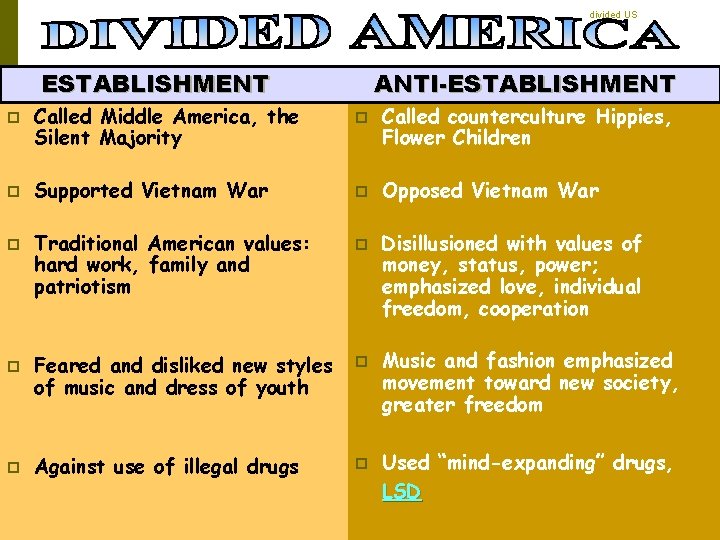
divided US ESTABLISHMENT p p p Called Middle America, the Silent Majority Supported Vietnam War Traditional American values: hard work, family and patriotism ANTI-ESTABLISHMENT p p p Feared and disliked new styles of music and dress of youth p Against use of illegal drugs p Called counterculture Hippies, Flower Children Opposed Vietnam War Disillusioned with values of money, status, power; emphasized love, individual freedom, cooperation Music and fashion emphasized movement toward new society, greater freedom Used “mind-expanding” drugs, LSD
Mc. Guire’s Eve of Destruction p Expressed a sense of General Frustration about social issues in the mid 1960’s.
Home Sick p The song California Dreamin’ pre-empted a counter culture rebellion which alarmed older Americans who were already worried about Communism and moral decay
Psychedelic Rock p Two songs that symbolized the Psychedelic culture that spoke about mind expansion and exotic mysteries n n Incense and Peppermints White Rabbit
Jazz The Old Father of Jazz Louie Armstrong, was responsible for a serene and reassuring song called “What a Wonderful World”. p While “The Ballad of the Green Beret by Staff Sgt. Barry Sadler in 1966 was the last song to celebrate America’s military in Vietnam. p
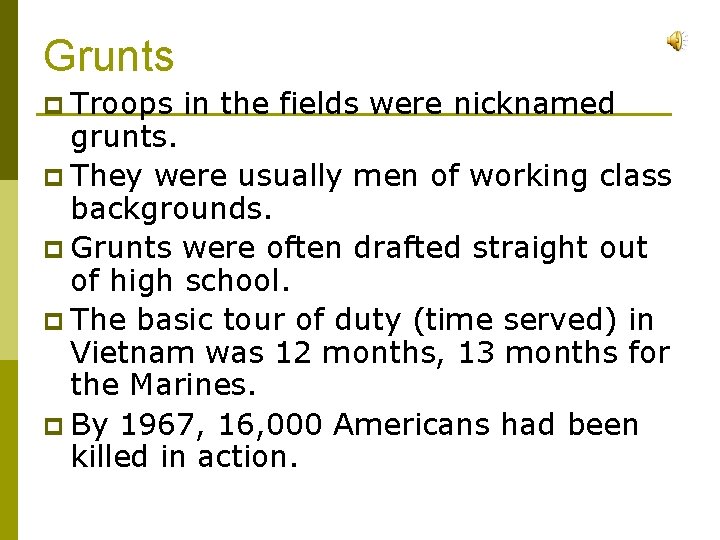
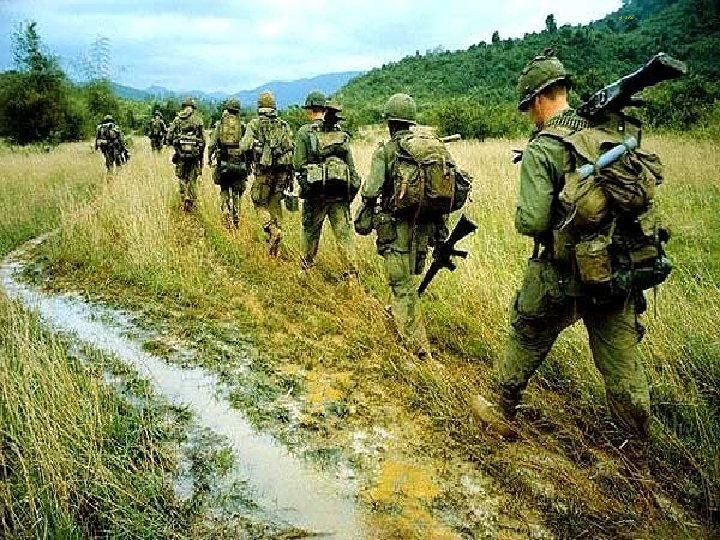
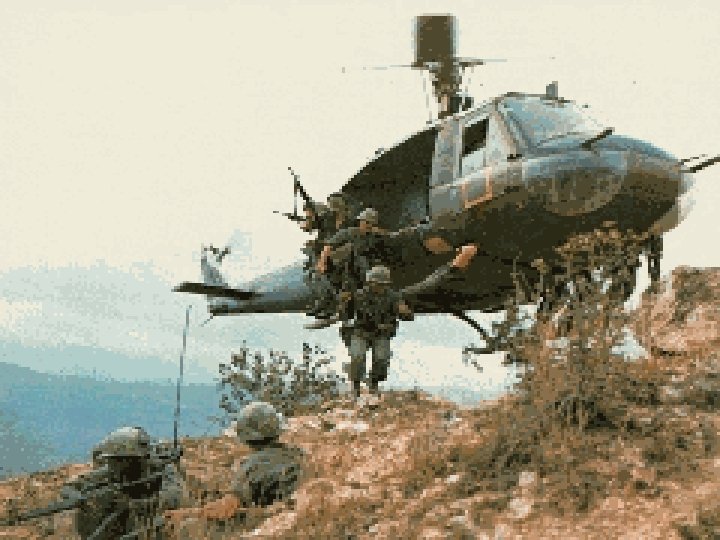
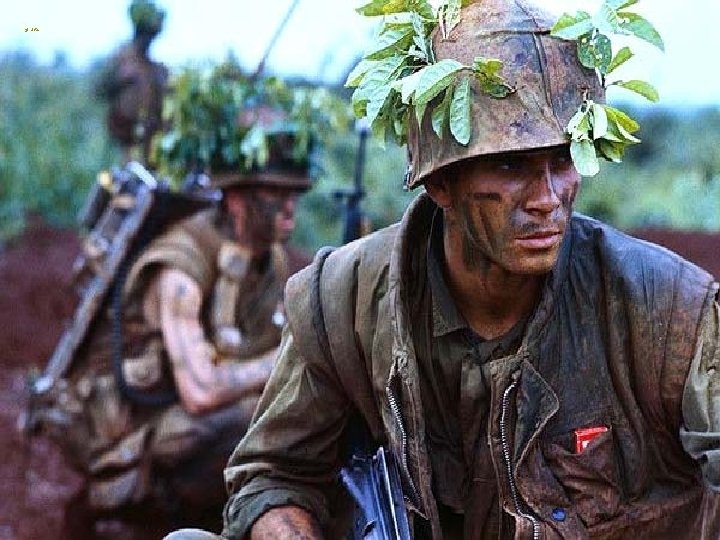
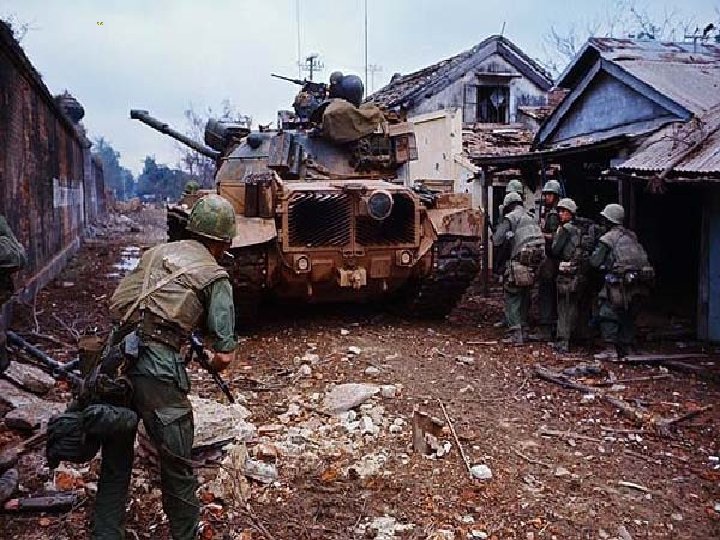
Grunts p Troops in the fields were nicknamed grunts. p They were usually men of working class backgrounds. p Grunts were often drafted straight out of high school. p The basic tour of duty (time served) in Vietnam was 12 months, 13 months for the Marines. p By 1967, 16, 000 Americans had been killed in action.
grunts
grunts
tet
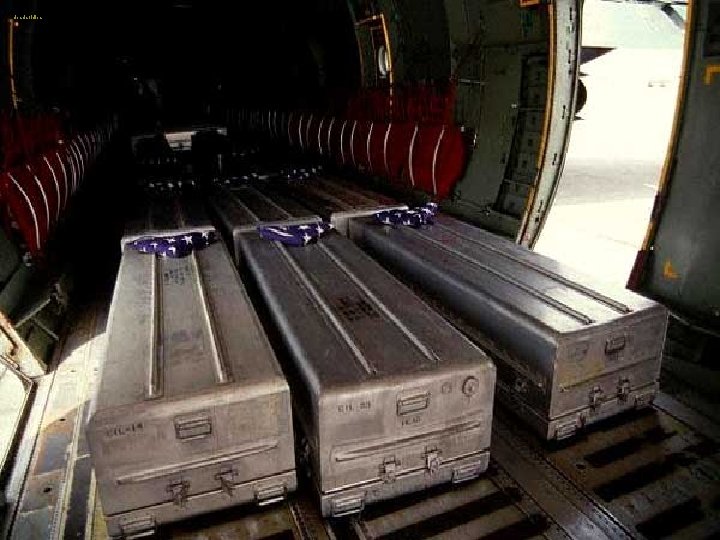
dead soldiers
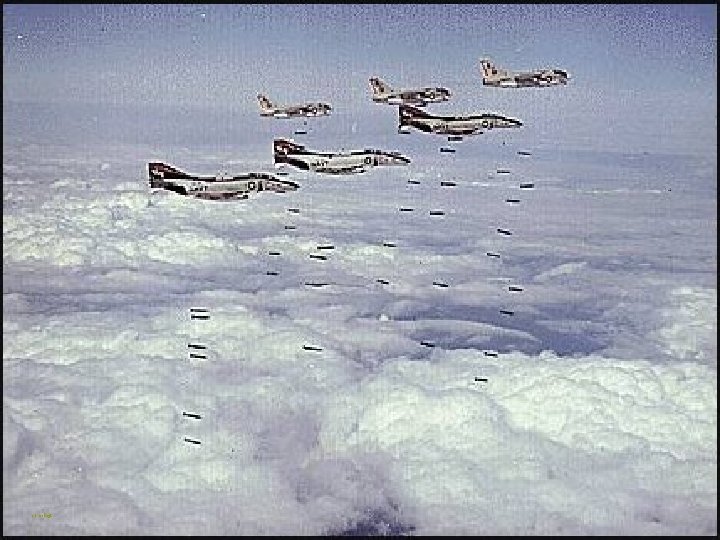
bombing
bombing
We Gotta Get Outta Here was banned from South Vietnam’s radio waves because of it’s anti-war message. p The communist controled N. Vietnamese station, Radio Hanoi, was often more popular with GI’s because it mixed hard rock with Anti-American propaganda hosted by deejay, Hanoi Hannah. p
Some pro-war advocates believed rock and roll contributed to the usages of drugs and the STD rates among US troops. p The new availability of cassette tapes gave troops the opportunity to listen to any type of music they wanted. p The #14 hit in 1968 “Sky Pilot” depicted the duality of an army chaplain preaching Christianity to soldiers in wartime. p
More Homesick Some songs became popular with GI’s because they reminded them of home and family. p Cocker’s “With a Little Help from my Friends” in 1968 has a special meaning for units of American troops facing enemy fire in the Vietnam jungles. p
Homesick Wooly Bully p Good Vibrations p Closer to Home p American Pie p Brown Eyed Girl p Time of the Season p Green Eyed Lady p
More Psychedelic Rock p Two more psychedelic drug songs that became popular on the home front and with GI’s oversees were n n p White Rabbit A Whiter Shade of Pale Every six months US troops were given a week’s worth of rest and relaxation, which they often spent in nightclubs listening to Asian versions of American and British music.
Soldiers Sent to Vietnam p African American soldiers were sent to Vietnam in disproportionate numbers.
One of My Favorites Front line soldiers in this era were all male. And often missed their female counterparts back home. American Woman p
Hey, LBJ How Many Kids Did you Kill today. The Tet Offensive in 1968 convinced many US troops and Americans back home that the war was doomed to failure. p By 1968 the assassinations of Dr. King and Robert F. Kennedy and the political demise of President Lyndon B. Johnson caused many Americans to question the US Governments role in Vietnam. p Nixon Becomes President p
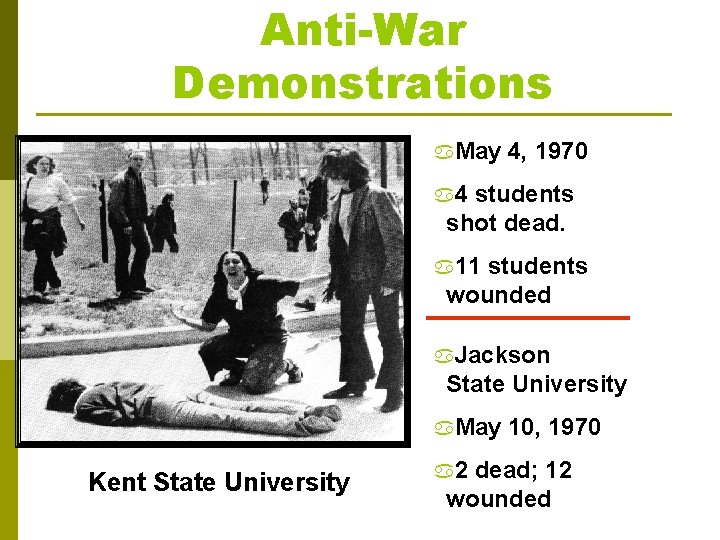
WAR The largest anti-war demonstration was 11 -15 -1965 when 250, 000 participants marched on Washington D. C. p When President Nixon announced the US was expanding the war into the neighboring country of Cambodia a new round of demonstrations resulted across the US, resulting in the shooting deaths of four students at Kent State University. p The Rhythm and Blues Hit “War” condemned the destruction of innocent lives. p
Anti-War Demonstrations a. May 4, 1970 a 4 students shot dead. a 11 students wounded a. Jackson State University a. May Kent State University a 2 10, 1970 dead; 12 wounded
The Start of the End Marvin Gaye’s “What’s Going On” was another more reflective plea for peace. p By 1971 the US public was tired of the Vietnam war. President Nixon began to slowly withdraw US troops from Vietnam and turn over the protection of the South Vietnamese to South Vietnamese forces. p
Last War Song! p Going Up Country
Baez’s The Night They Drove Old Dixie Down reached back to the Civil War for its theme of wartime suffering and quiet endurance. p By 1972 there were only 24, 000 US troops stationed in South Vietnam. p By January of 1973 the US government and the North Vietnamese government had reached an agreement to bring US POW’s home. p By April 1975 South Vietnam fell to the communist North Vietnamese. p
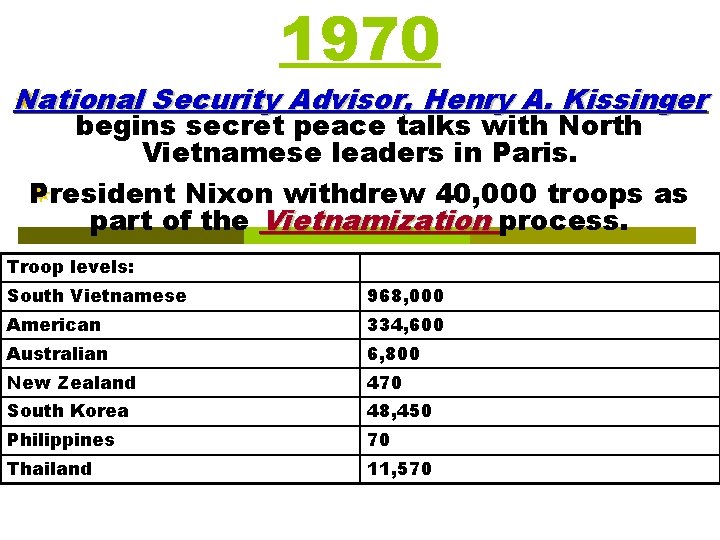
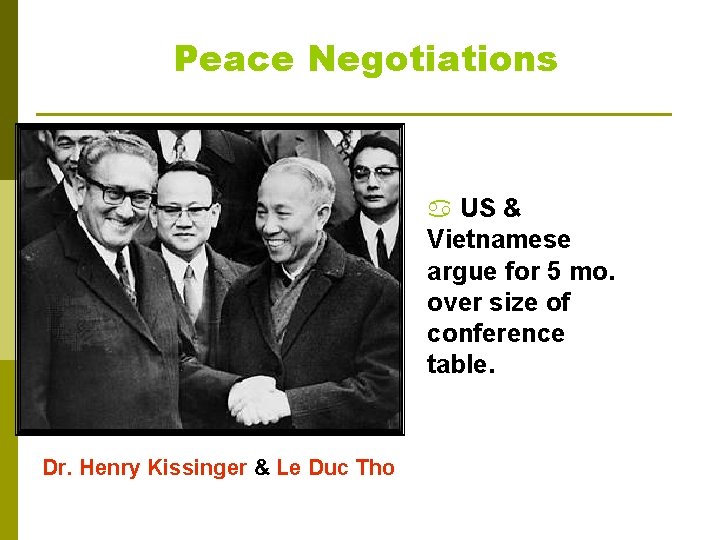
1970 National Security Advisor, Henry A. Kissinger begins secret peace talks with North Vietnamese leaders in Paris. President Nixon withdrew 40, 000 troops as part of the Vietnamization process. Troop levels: South Vietnamese 968, 000 American 334, 600 Australian 6, 800 New Zealand 470 South Korea 48, 450 Philippines 70 Thailand 11, 570
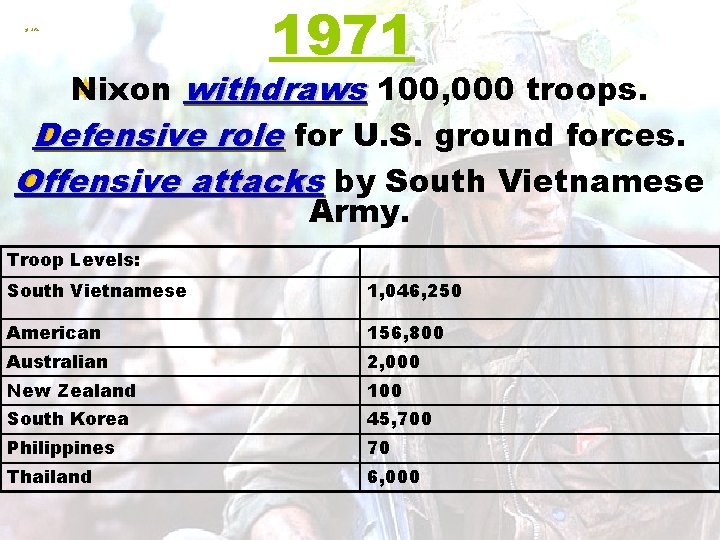
grunts 1971 ixon withdraws 100, 000 troops. N Defensive role for U. S. ground forces. Offensive attacks by South Vietnamese Army. Troop Levels: South Vietnamese 1, 046, 250 American 156, 800 Australian 2, 000 New Zealand 100 South Korea 45, 700 Philippines 70 Thailand 6, 000
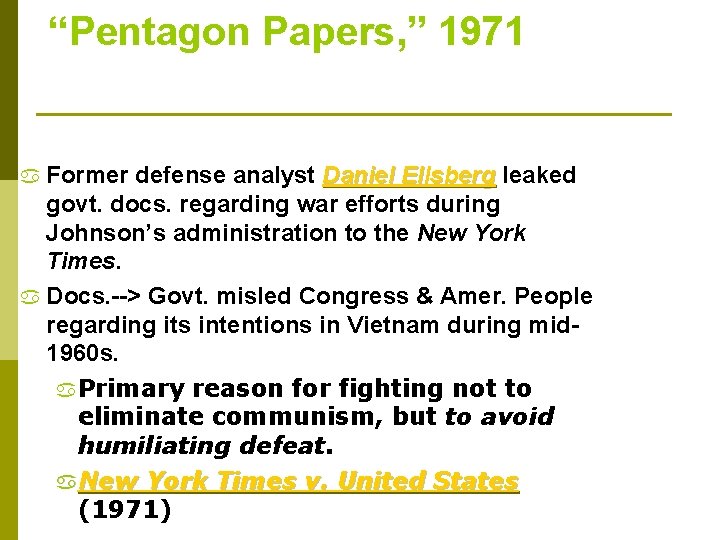
“Pentagon Papers, ” 1971 a Former defense analyst Daniel Ellsberg leaked govt. docs. regarding war efforts during Johnson’s administration to the New York Times. a Docs. --> Govt. misled Congress & Amer. People regarding its intentions in Vietnam during mid 1960 s. a Primary reason for fighting not to eliminate communism, but to avoid humiliating defeat. a New York Times v. United States (1971)
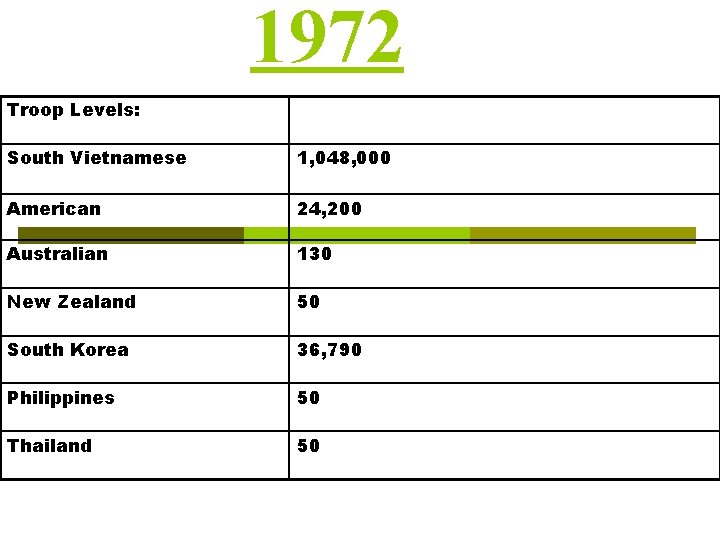
1972 Troop Levels: South Vietnamese 1, 048, 000 American 24, 200 Australian 130 New Zealand 50 South Korea 36, 790 Philippines 50 Thailand 50
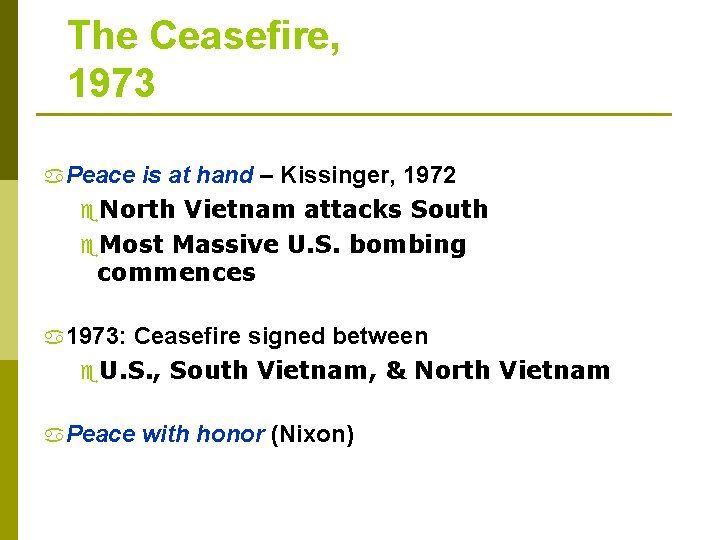
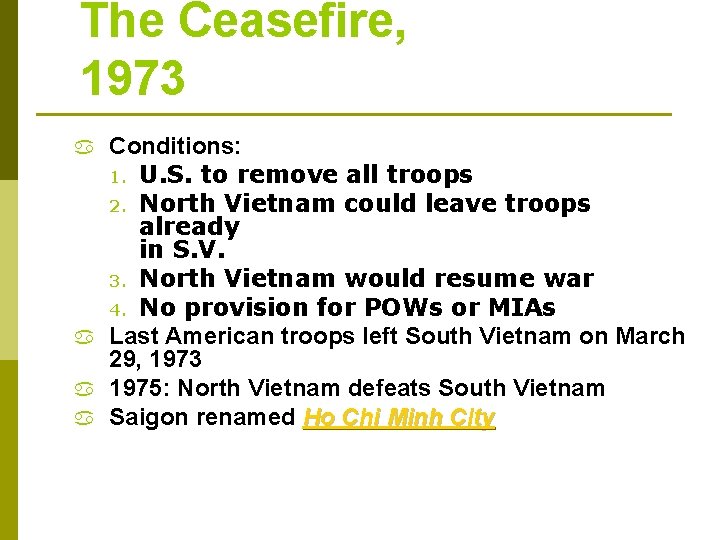
The Ceasefire, 1973 a Peace is at hand – Kissinger, 1972 e. North Vietnam attacks South e. Most Massive U. S. bombing commences a 1973: Ceasefire signed between e. U. S. , South Vietnam, & North Vietnam a Peace with honor (Nixon)
Nixon Ends the War p 1 -23 -1973
Peace Negotiations a US & Vietnamese argue for 5 mo. over size of conference table. Dr. Henry Kissinger & Le Duc Tho
The Ceasefire, 1973 Conditions: 1. U. S. to remove all troops 2. North Vietnam could leave troops already in S. V. 3. North Vietnam would resume war 4. No provision for POWs or MIAs a Last American troops left South Vietnam on March 29, 1973 a 1975: North Vietnam defeats South Vietnam a Saigon renamed Ho Chi Minh City a
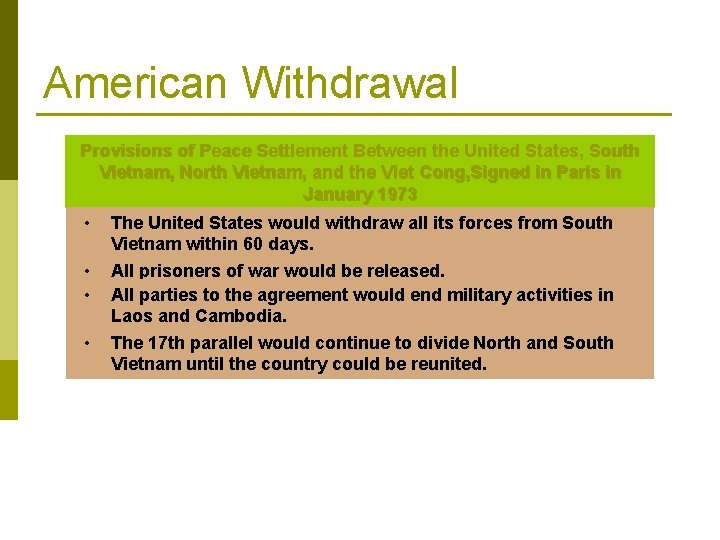
American Withdrawal Provisions of Peace Settlement Between the United States, South Vietnam, North Vietnam, and the Viet Cong, Signed in Paris in January 1973 • • The United States would withdraw all its forces from South Vietnam within 60 days. All prisoners of war would be released. All parties to the agreement would end military activities in Laos and Cambodia. The 17 th parallel would continue to divide North and South Vietnam until the country could be reunited.
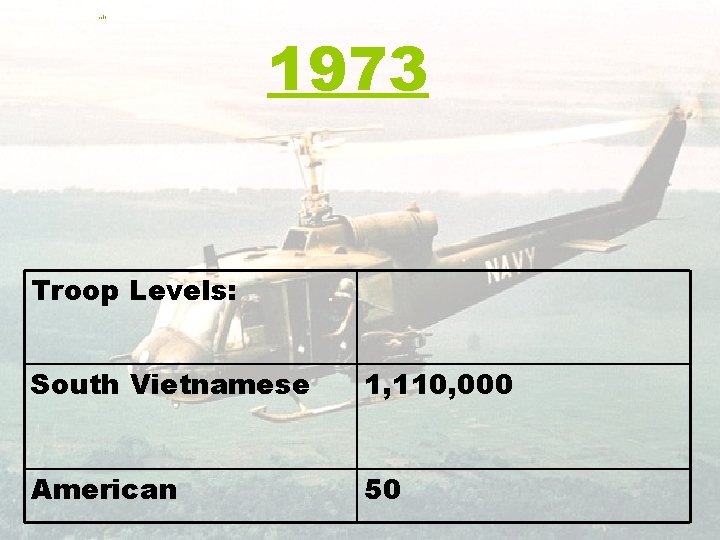
helo 1973 Troop Levels: South Vietnamese 1, 110, 000 American 50
1974 v. Nixon’s impeachment hearings/Resignation v. South braces for huge Communist invasion.
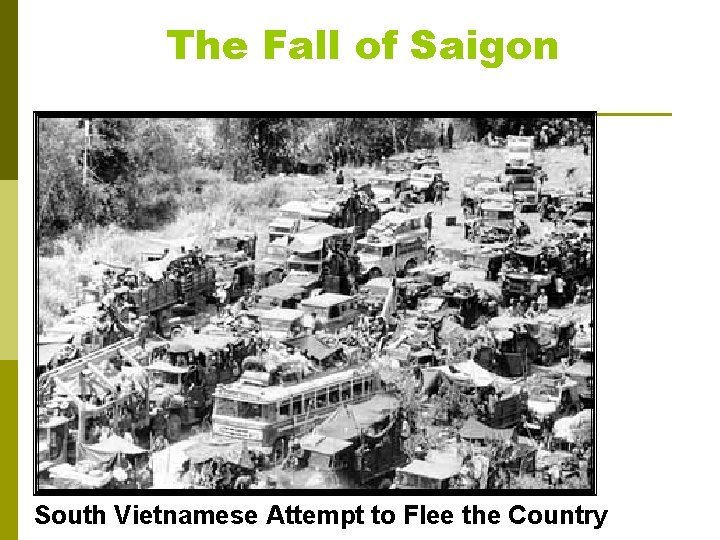
The Fall of Saigon South Vietnamese Attempt to Flee the Country
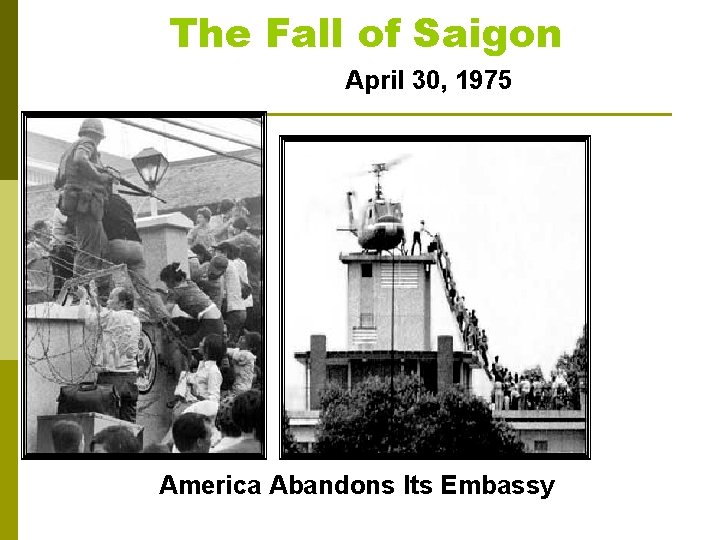
The Fall of Saigon April 30, 1975 America Abandons Its Embassy
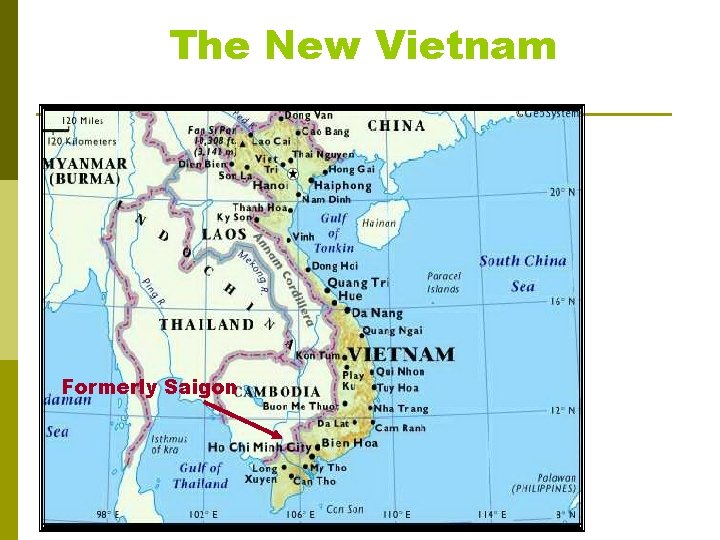
The New Vietnam Formerly Saigon
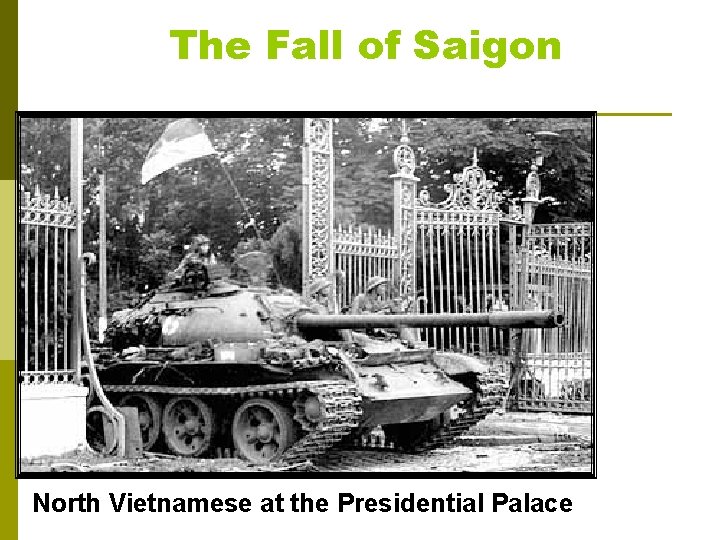
The Fall of Saigon North Vietnamese at the Presidential Palace
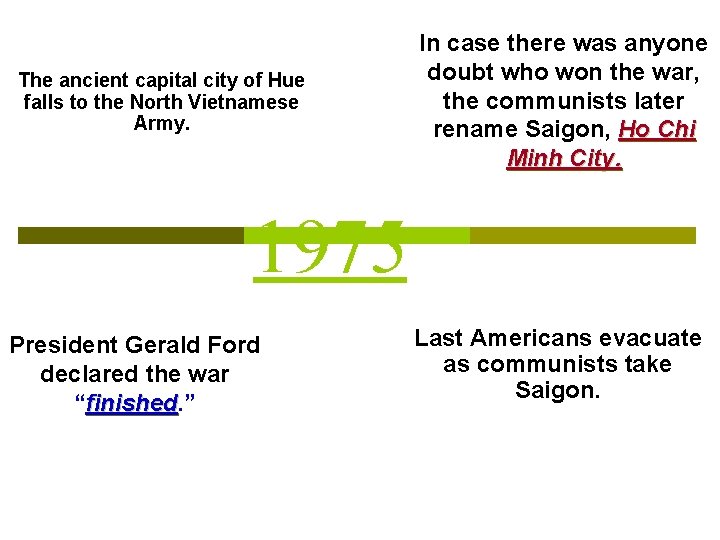
The ancient capital city of Hue falls to the North Vietnamese Army. In case there was anyone doubt who won the war, the communists later rename Saigon, Ho Chi Minh City. 1975 President Gerald Ford declared the war “finished. ” finished Last Americans evacuate as communists take Saigon.
Aftermath of the War in Asia South Vietnam Falls p After American forces had withdrawn, North Vietnam attacked strategic cities in South Vietnam, ending with its capital, Saigon. p Following a last-minute evacuation of both American soldiers and Vietnamese refugees, South Vietnam surrendered in April 1975, and Vietnam became unified under a Communist government. Southeast Asia After the War p In April 1975, Cambodia fell to the Khmer Rouge, a Communist force led by Pol Pot. The Khmer Rouge killed a quarter of the Cambodian population, claiming they were “tainted” with Western ways. p Vietnam’s new leaders forced hundreds of thousands of Vietnamese into “reeducation camps”; refugees from Vietnam, Cambodia, and newly Communist Laos fled their home countries.
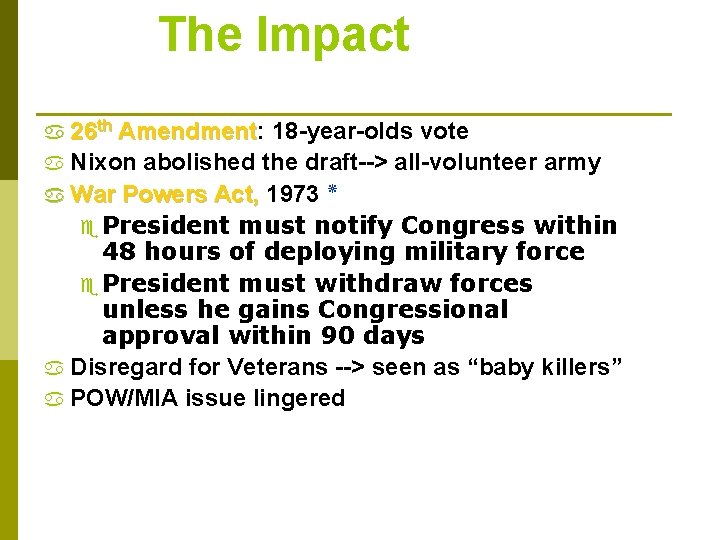
The Impact a 26 th Amendment: Amendment 18 -year-olds vote a Nixon abolished the draft--> all-volunteer army a War Powers Act, 1973 ٭ e President must notify Congress within 48 hours of deploying military force e President must withdraw forces unless he gains Congressional approval within 90 days a Disregard for Veterans --> seen as “baby killers” a POW/MIA issue lingered
The Legacy of the War p p With a cost of at least $150 billion, and hundreds of thousands of American soldiers killed or wounded, the Vietnam War was the longest and least successful war in American history. Thousands of American soldiers who did not return home after the war were listed as POWs (prisoners of war) or MIAs (missing in action). Many remain unaccounted for today. In Vietnam, millions were dead or wounded, many of them civilians. The war also heavily damaged the landscape of Vietnam. In 1994, the United States lifted its trade embargo against Vietnam; in 1995, full diplomatic relations were restored.
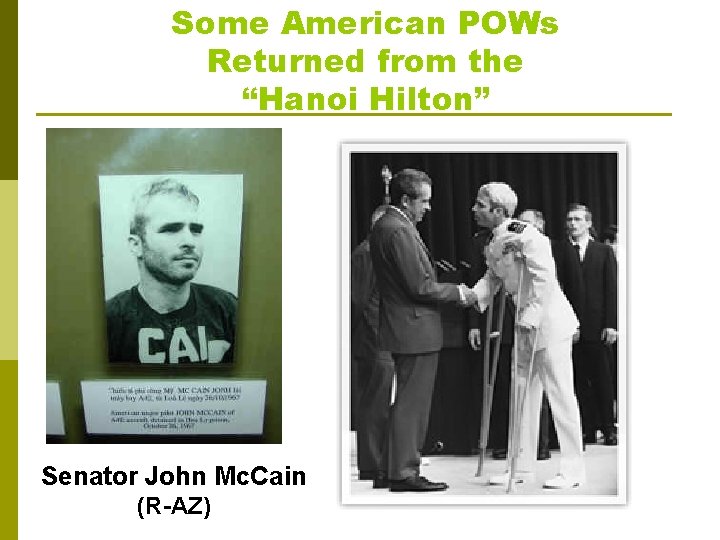
Some American POWs Returned from the “Hanoi Hilton” Senator John Mc. Cain (R-AZ)
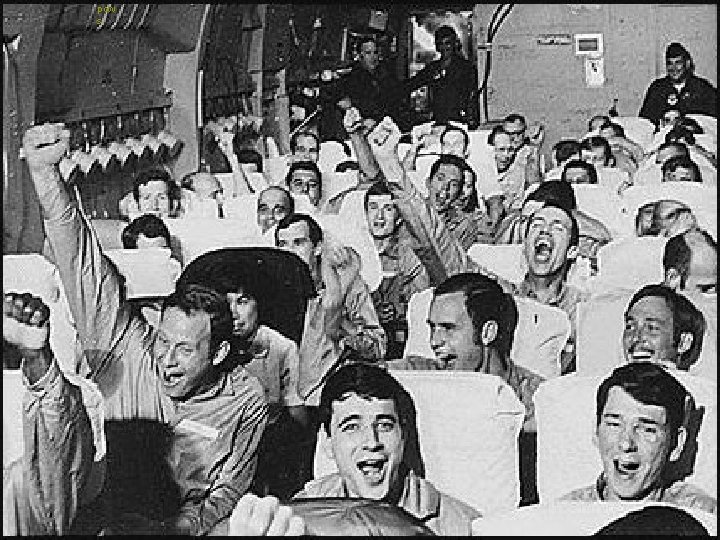
pow s
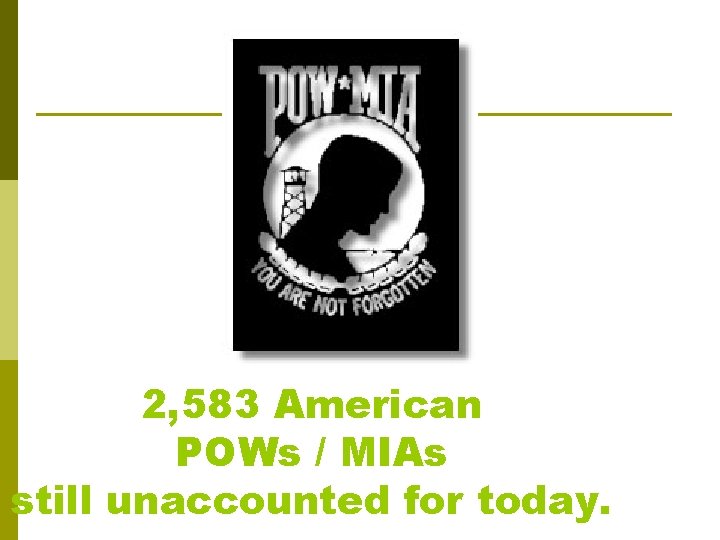
2, 583 American POWs / MIAs still unaccounted for today.
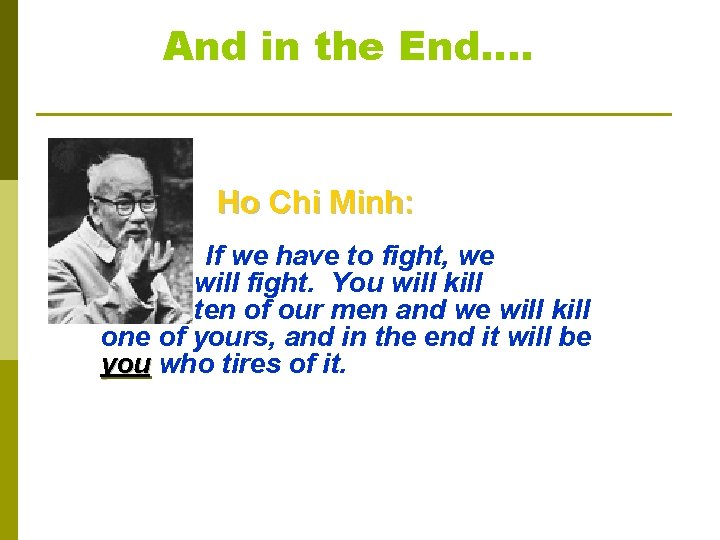
And in the End…. Ho Chi Minh: If we have to fight, we will fight. You will kill ten of our men and we will kill one of yours, and in the end it will be you who tires of it.
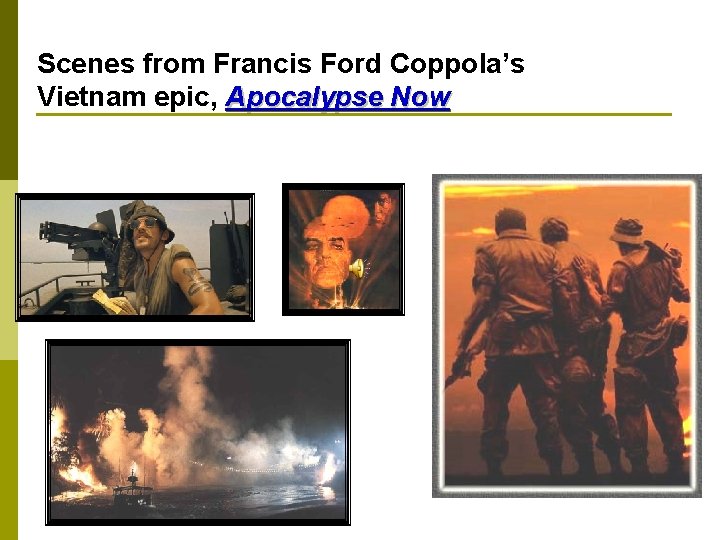
Scenes from Francis Ford Coppola’s Vietnam epic, Apocalypse Now