
The Vietnam War Between 1964 and 1975 a
The Vietnam War
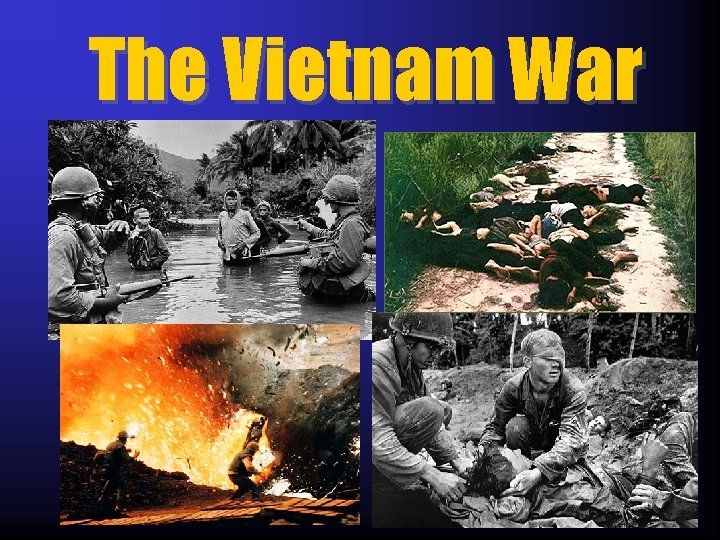
• Between 1964 and 1975 a total of 2. 7 million Americans served in Vietnam--58, 000 were killed and over 300, 000 were wounded. More than a million Vietnamese soldiers and half a million civilians died. • When the war ended, President Richard Nixon claimed the U. S. had achieved "peace with honor. " But soon the North Vietnamese overran and unified the country, causing nearly 7 million South Vietnamese to become refugees. • The war was profoundly divisive and disillusioning for the American people. How did the United States get into the Vietnam quagmire, and why was it a tragic failure?
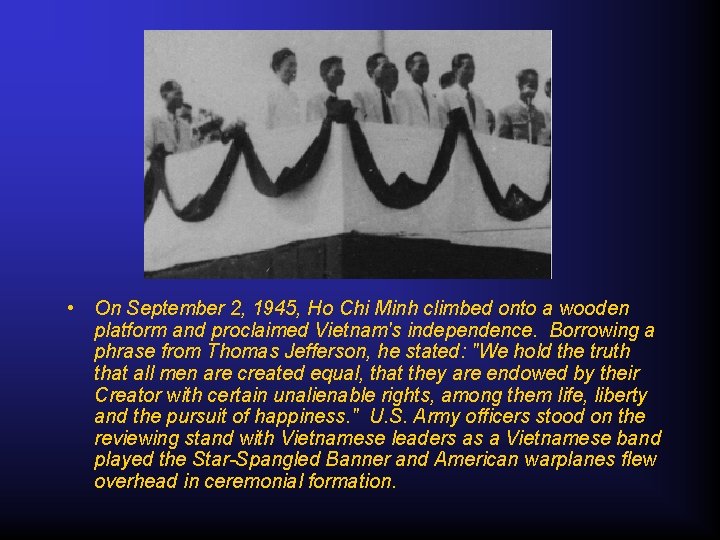
• On September 2, 1945, Ho Chi Minh climbed onto a wooden platform and proclaimed Vietnam's independence. Borrowing a phrase from Thomas Jefferson, he stated: "We hold the truth that all men are created equal, that they are endowed by their Creator with certain unalienable rights, among them life, liberty and the pursuit of happiness. " U. S. Army officers stood on the reviewing stand with Vietnamese leaders as a Vietnamese band played the Star-Spangled Banner and American warplanes flew overhead in ceremonial formation.
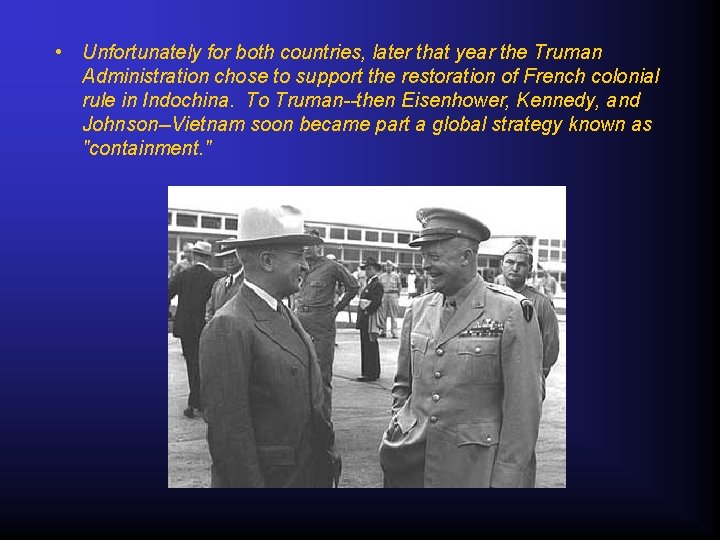
• Unfortunately for both countries, later that year the Truman Administration chose to support the restoration of French colonial rule in Indochina. To Truman--then Eisenhower, Kennedy, and Johnson--Vietnam soon became part a global strategy known as "containment. "
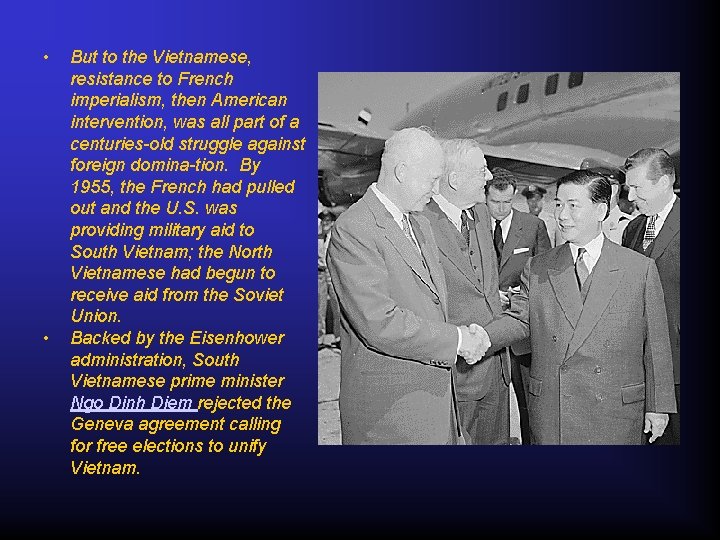
• • But to the Vietnamese, resistance to French imperialism, then American intervention, was all part of a centuries-old struggle against foreign domina-tion. By 1955, the French had pulled out and the U. S. was providing military aid to South Vietnam; the North Vietnamese had begun to receive aid from the Soviet Union. Backed by the Eisenhower administration, South Vietnamese prime minister Ngo Dinh Diem rejected the Geneva agreement calling for free elections to unify Vietnam.
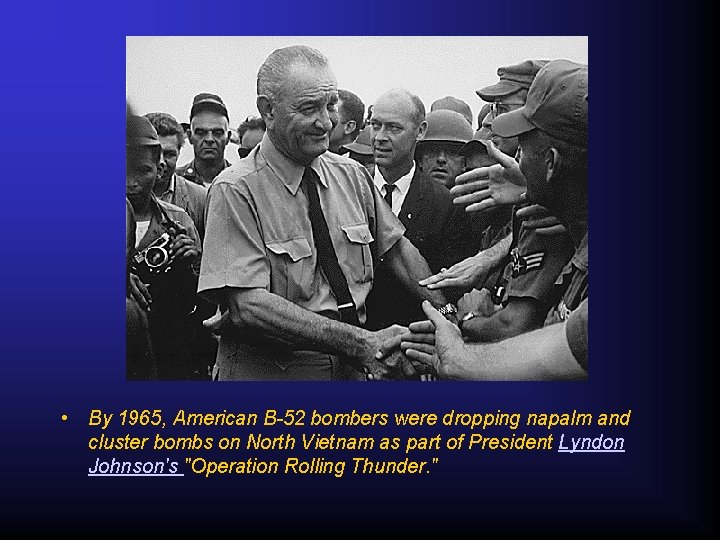
• By 1965, American B-52 bombers were dropping napalm and cluster bombs on North Vietnam as part of President Lyndon Johnson's "Operation Rolling Thunder. "
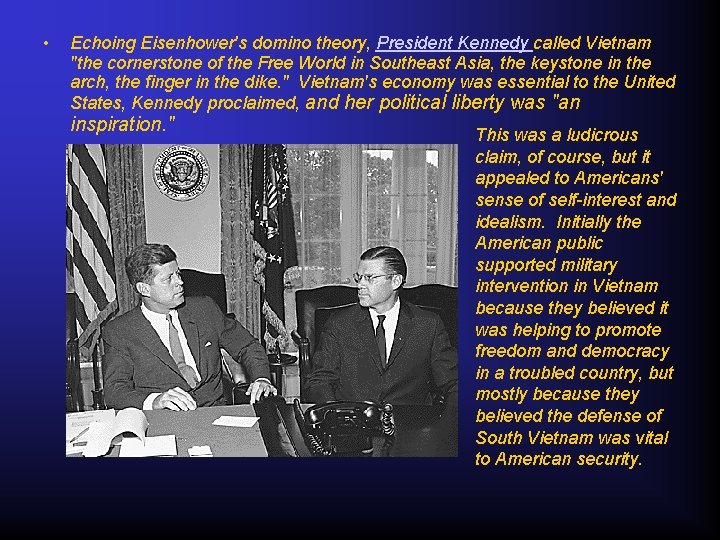
• Echoing Eisenhower's domino theory, President Kennedy called Vietnam "the cornerstone of the Free World in Southeast Asia, the keystone in the arch, the finger in the dike. " Vietnam's economy was essential to the United States, Kennedy proclaimed, and her political liberty was "an inspiration. " This was a ludicrous claim, of course, but it appealed to Americans' sense of self-interest and idealism. Initially the American public supported military intervention in Vietnam because they believed it was helping to promote freedom and democracy in a troubled country, but mostly because they believed the defense of South Vietnam was vital to American security.
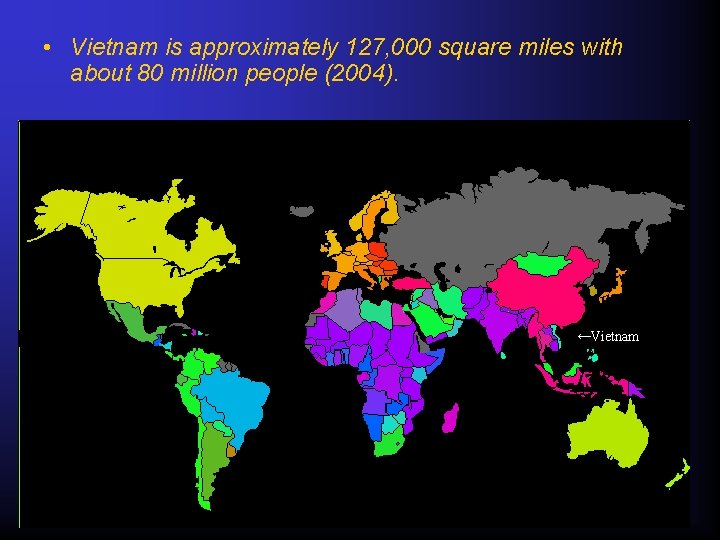
• Vietnam is approximately 127, 000 square miles with about 80 million people (2004). ←Vietnam
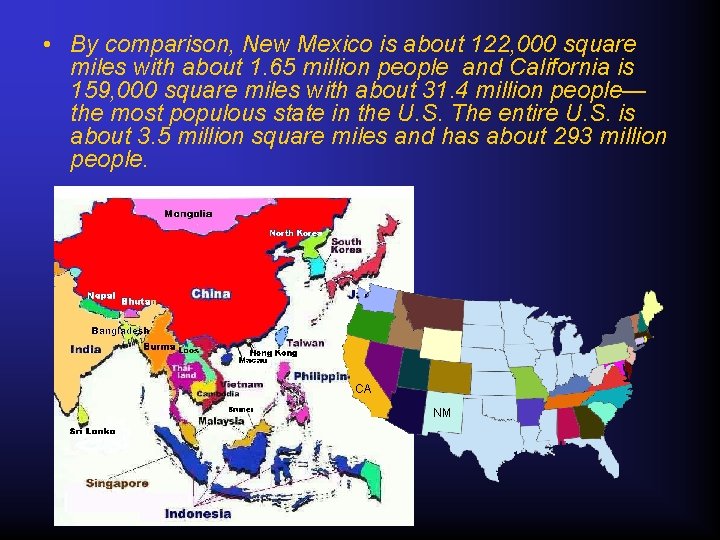
• By comparison, New Mexico is about 122, 000 square miles with about 1. 65 million people and California is 159, 000 square miles with about 31. 4 million people— the most populous state in the U. S. The entire U. S. is about 3. 5 million square miles and has about 293 million people. CA NM
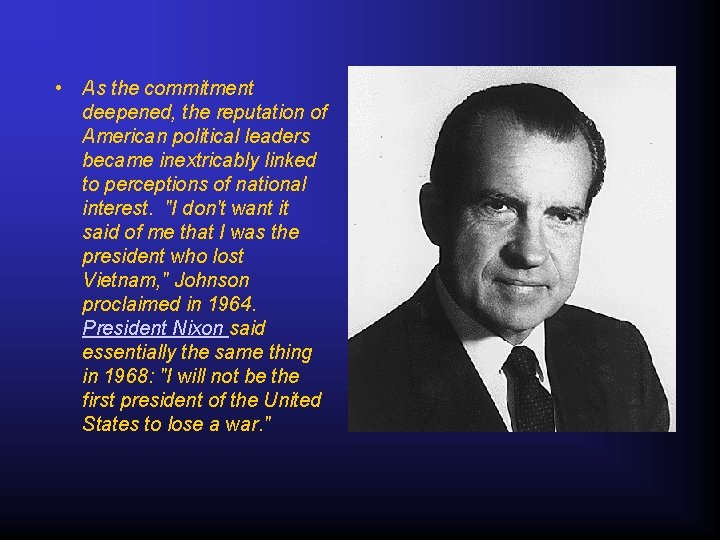
• As the commitment deepened, the reputation of American political leaders became inextricably linked to perceptions of national interest. "I don't want it said of me that I was the president who lost Vietnam, " Johnson proclaimed in 1964. President Nixon said essentially the same thing in 1968: "I will not be the first president of the United States to lose a war. "
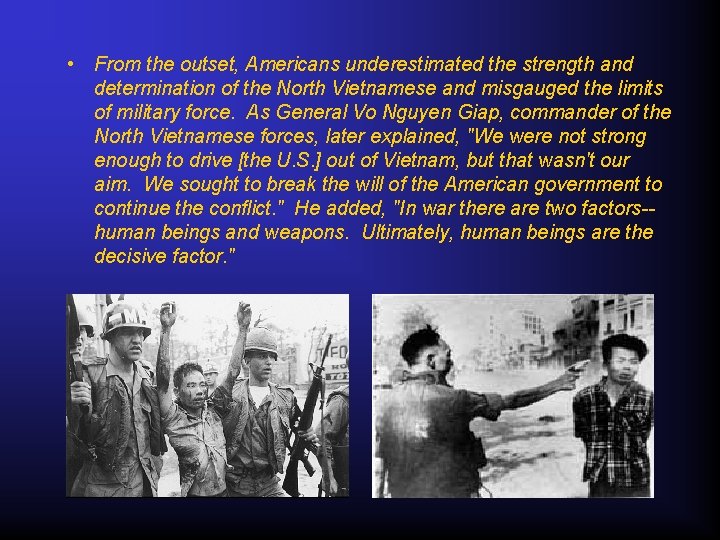
• From the outset, Americans underestimated the strength and determination of the North Vietnamese and misgauged the limits of military force. As General Vo Nguyen Giap, commander of the North Vietnamese forces, later explained, "We were not strong enough to drive [the U. S. ] out of Vietnam, but that wasn't our aim. We sought to break the will of the American government to continue the conflict. " He added, "In war there are two factors-human beings and weapons. Ultimately, human beings are the decisive factor. "
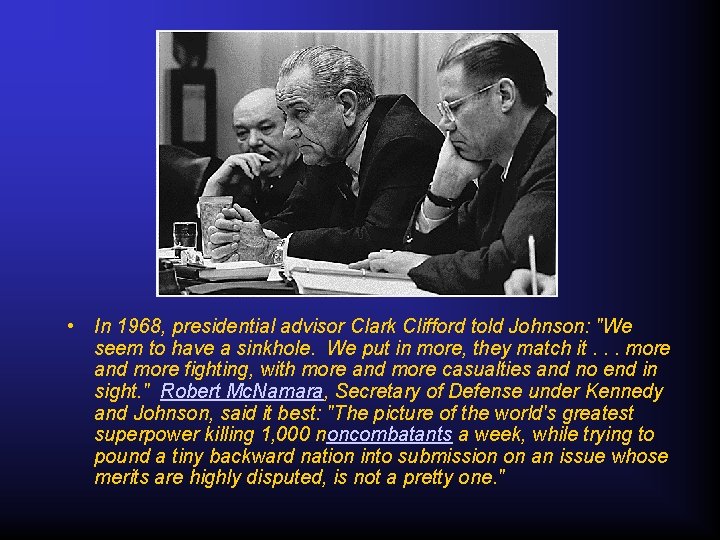
• In 1968, presidential advisor Clark Clifford told Johnson: "We seem to have a sinkhole. We put in more, they match it. . . more and more fighting, with more and more casualties and no end in sight. " Robert Mc. Namara, Secretary of Defense under Kennedy and Johnson, said it best: "The picture of the world's greatest superpower killing 1, 000 noncombatants a week, while trying to pound a tiny backward nation into submission on an issue whose merits are highly disputed, is not a pretty one. "
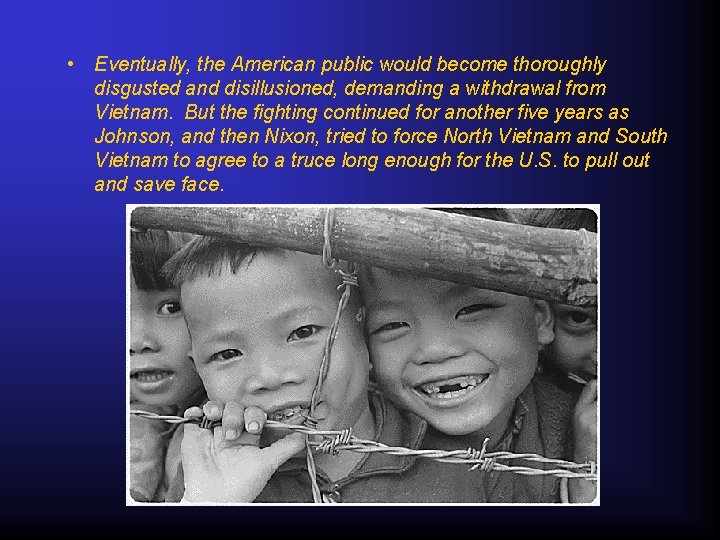
• Eventually, the American public would become thoroughly disgusted and disillusioned, demanding a withdrawal from Vietnam. But the fighting continued for another five years as Johnson, and then Nixon, tried to force North Vietnam and South Vietnam to agree to a truce long enough for the U. S. to pull out and save face.
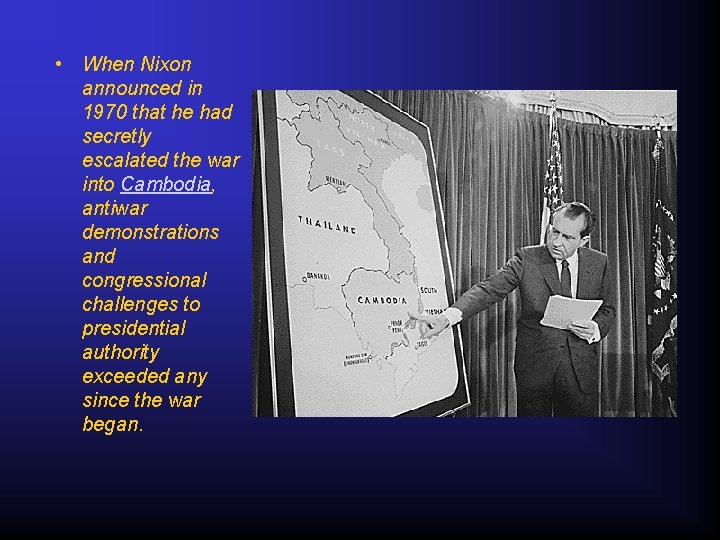
• When Nixon announced in 1970 that he had secretly escalated the war into Cambodia, antiwar demonstrations and congressional challenges to presidential authority exceeded any since the war began.
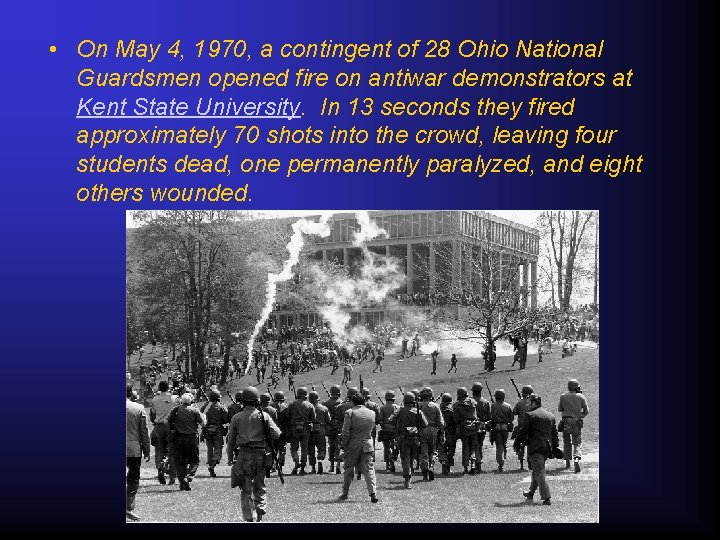
• On May 4, 1970, a contingent of 28 Ohio National Guardsmen opened fire on antiwar demonstrators at Kent State University. In 13 seconds they fired approximately 70 shots into the crowd, leaving four students dead, one permanently paralyzed, and eight others wounded.
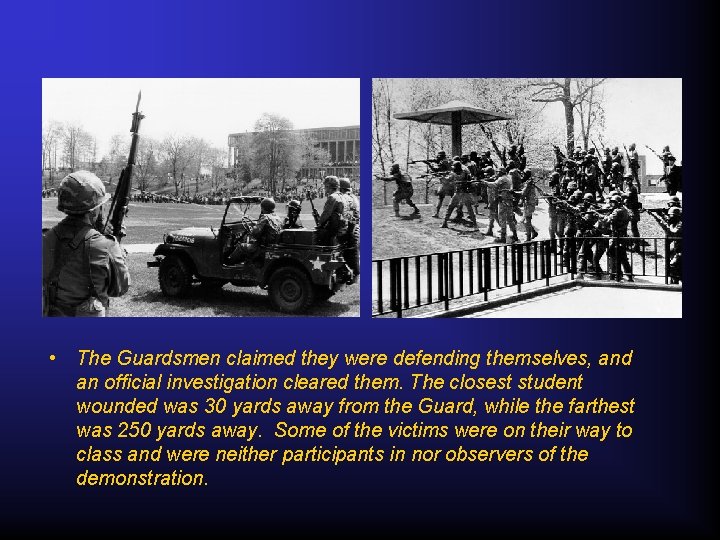
• The Guardsmen claimed they were defending themselves, and an official investigation cleared them. The closest student wounded was 30 yards away from the Guard, while the farthest was 250 yards away. Some of the victims were on their way to class and were neither participants in nor observers of the demonstration.
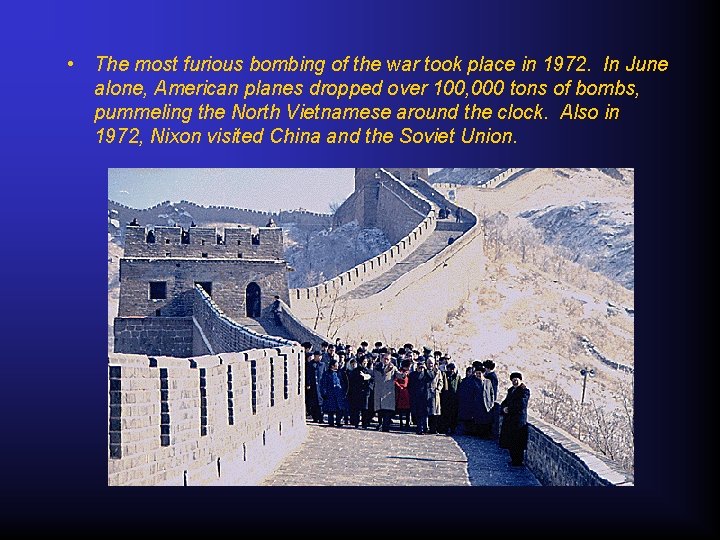
• The most furious bombing of the war took place in 1972. In June alone, American planes dropped over 100, 000 tons of bombs, pummeling the North Vietnamese around the clock. Also in 1972, Nixon visited China and the Soviet Union.
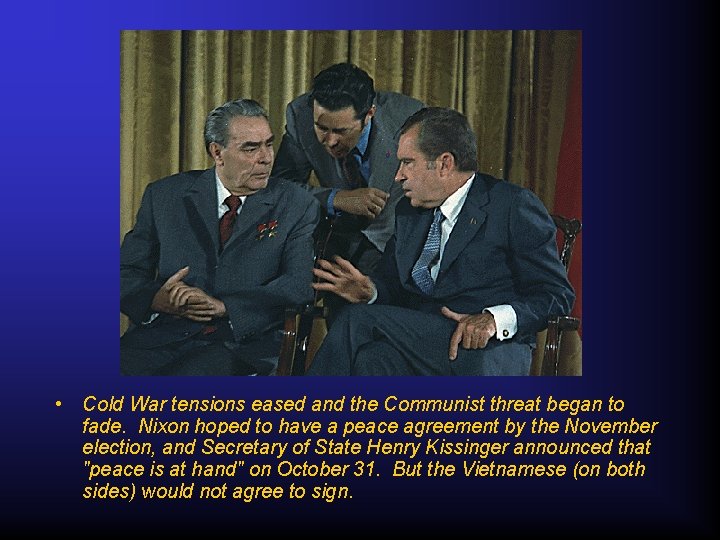
• Cold War tensions eased and the Communist threat began to fade. Nixon hoped to have a peace agreement by the November election, and Secretary of State Henry Kissinger announced that "peace is at hand" on October 31. But the Vietnamese (on both sides) would not agree to sign.
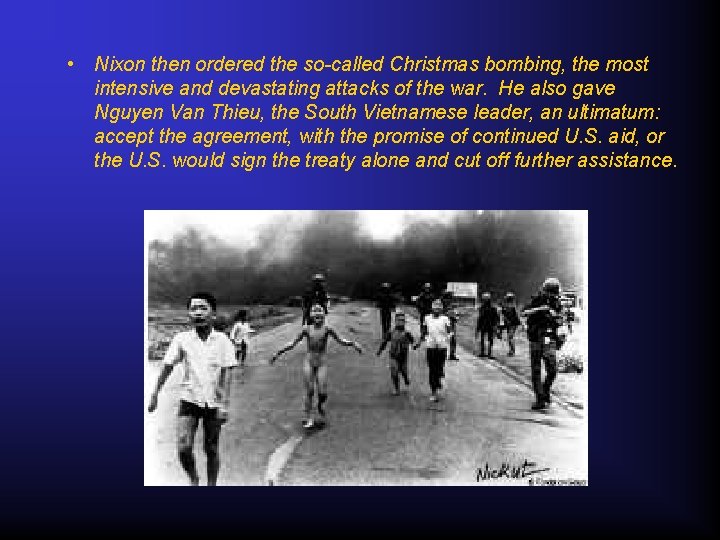
• Nixon then ordered the so-called Christmas bombing, the most intensive and devastating attacks of the war. He also gave Nguyen Van Thieu, the South Vietnamese leader, an ultimatum: accept the agreement, with the promise of continued U. S. aid, or the U. S. would sign the treaty alone and cut off further assistance.
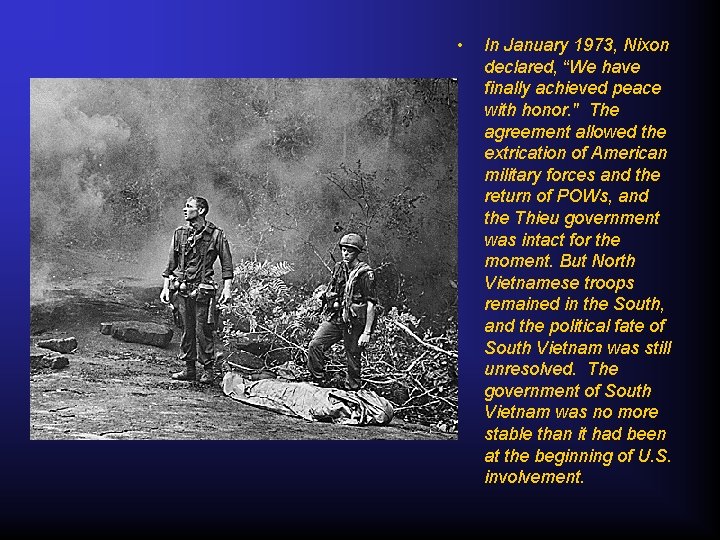
• In January 1973, Nixon declared, “We have finally achieved peace with honor. " The agreement allowed the extrication of American military forces and the return of POWs, and the Thieu government was intact for the moment. But North Vietnamese troops remained in the South, and the political fate of South Vietnam was still unresolved. The government of South Vietnam was no more stable than it had been at the beginning of U. S. involvement.
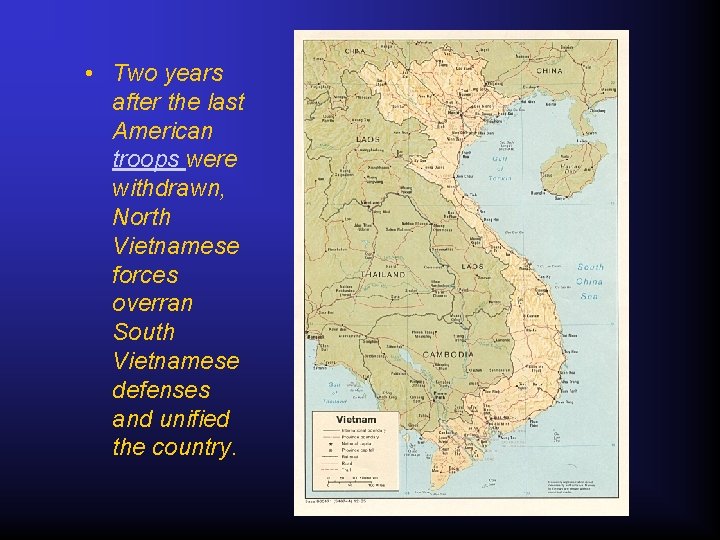
• Two years after the last American troops were withdrawn, North Vietnamese forces overran South Vietnamese defenses and unified the country.
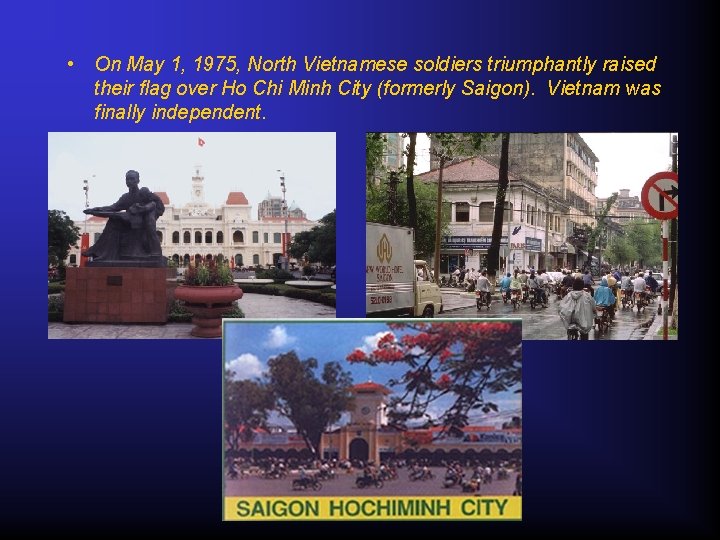
• On May 1, 1975, North Vietnamese soldiers triumphantly raised their flag over Ho Chi Minh City (formerly Saigon). Vietnam was finally independent.
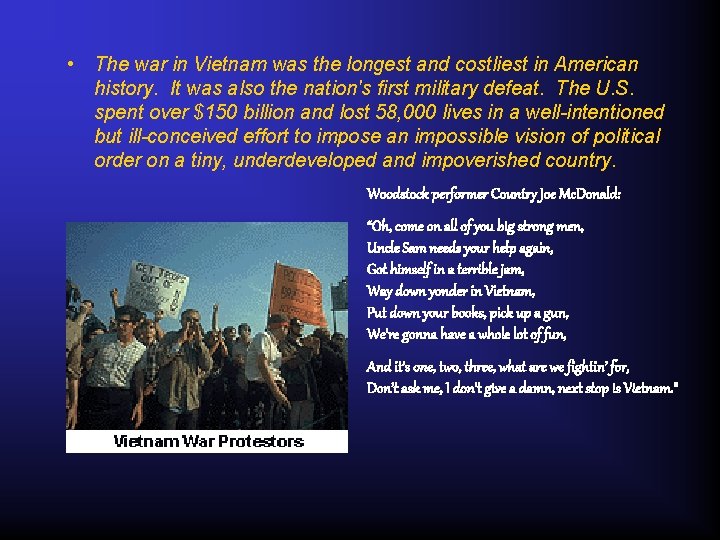
• The war in Vietnam was the longest and costliest in American history. It was also the nation's first military defeat. The U. S. spent over $150 billion and lost 58, 000 lives in a well-intentioned but ill-conceived effort to impose an impossible vision of political order on a tiny, underdeveloped and impoverished country. Woodstock performer Country Joe Mc. Donald: “Oh, come on all of you big strong men, Uncle Sam needs your help again, Got himself in a terrible jam, Way down yonder in Vietnam, Put down your books, pick up a gun, We’re gonna have a whole lot of fun, And it’s one, two, three, what are we fightin’ for, Don’t ask me, I don’t give a damn, next stop is Vietnam. ”
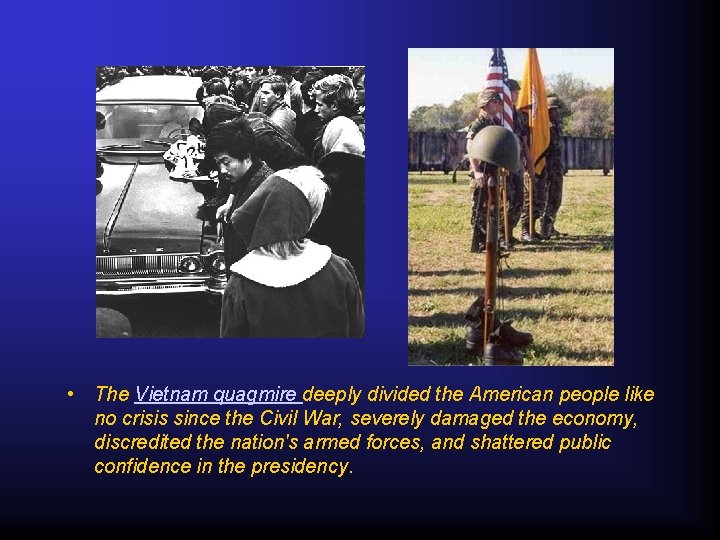
• The Vietnam quagmire deeply divided the American people like no crisis since the Civil War, severely damaged the economy, discredited the nation's armed forces, and shattered public confidence in the presidency.
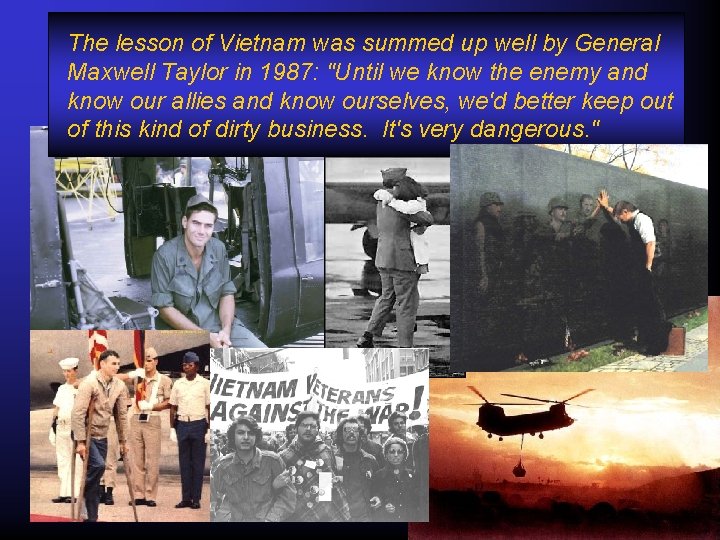
The lesson of Vietnam was summed up well by General Maxwell Taylor in 1987: "Until we know the enemy and know our allies and know ourselves, we'd better keep out of this kind of dirty business. It's very dangerous. "
- Slides: 25