
The Victorian Era Overview of an Era We
- Slides: 16
The Victorian Era Overview of an Era
"We are of the time of chivalry. . We are of the age of steam. " -William Makepeace Thackery N O T E S
Rule Britannia? Between 1800 & 1850: • population doubled from nine to eighteen million • Britain became the richest country on earth – first urban, industrial society in history By 1890: • 1 in 4 people on the earth were under British rule N O T E S
General Overview The Victorian Era was marked by: • • • Rapid growth of industry Rise to power of the industrial middle class Enormous increase in population Tendency of the new science to undermine deeply held religious convictions Science as reflected in literature caused a growing disillusionment with the traditional moral values. T A K E N O T E S
(continued) • Throughout the 30’s, 40’s, and 50’s, an increasing number of able writers turned their attention to current social evils. 1. 2. 3. Plight of the poor Evils of child labor Incessant conflict of middle class & working class T A K E N O T E S
Industrialization • Land owning aristocracy lost power • The insecure, “ever expanding” urban middle class gained power 1. Businessmen 2. Professionals T A K E N O T E S • Millions of rural workers forced into poverty
Morals during Victorian Period • • • Rooted in Religion Social acceptance depended on conformity to rigid ideals Education instilled moral and religious principles T A K E N O T E S
We Are Not Amused… Victoria and the Victorians N O T E S
“… the head of our morality” During the tumultuous time, The Queen ultimately came to represent: • England & Empire • Stability & Continuity • Duty, Family, & Propriety • A stern, conservative, durable symbol of her dynamic, aggressively businesslike realm. N O T E S
An Exception to Her own Rule: • Victoria herself was study in contradiction; a publicly projected image that held a privately unfulfilled ideal : 1. World’s most powerful woman, but did not support the “mad, wicked folly of Women’s Rights”. 2. Her face was known around the world, but she lived in constant seclusion 3. Held as an icon of motherhood, but hated pregnancy, childbirth and babies N O T E S
What is a Victorian? • The adjective "Victorian" was first used in 1851 to celebrate the nation's mounting pride in its N institutions and commercial success. O • This historical/literary period is defined by the duration of a monarch’s rule, rather than any one N O unifying idea as was the case with the T E Romantics. S
Society • • Class distinction was apparent / social status was important. Social pressure dictated individual behavior / virtues 1. 2. 3. 4. 5. Hard work, sobriety, thrift, and poetry were valued. Regular church attendance Support of missions and charities Proper dress and etiquette were carefully observed Obedience to authority was very important (Queen, parents) T A K E N O T E S
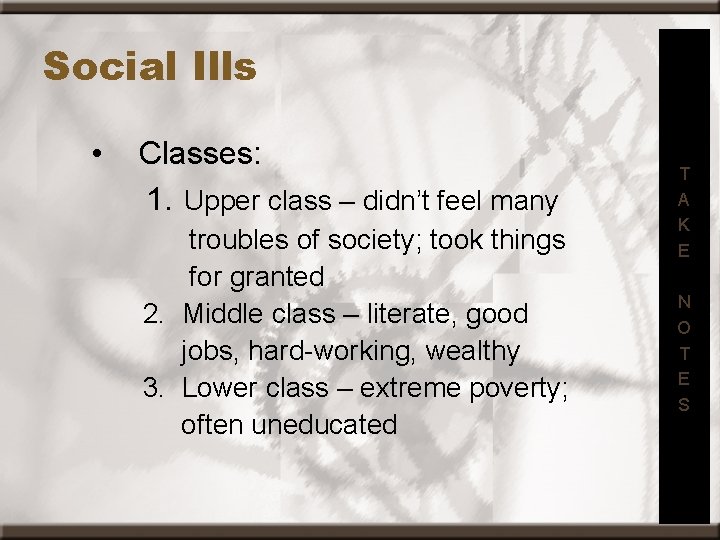
Social Ills • Classes: 1. Upper class – didn’t feel many troubles of society; took things for granted 2. Middle class – literate, good jobs, hard-working, wealthy 3. Lower class – extreme poverty; often uneducated T A K E N O T E S
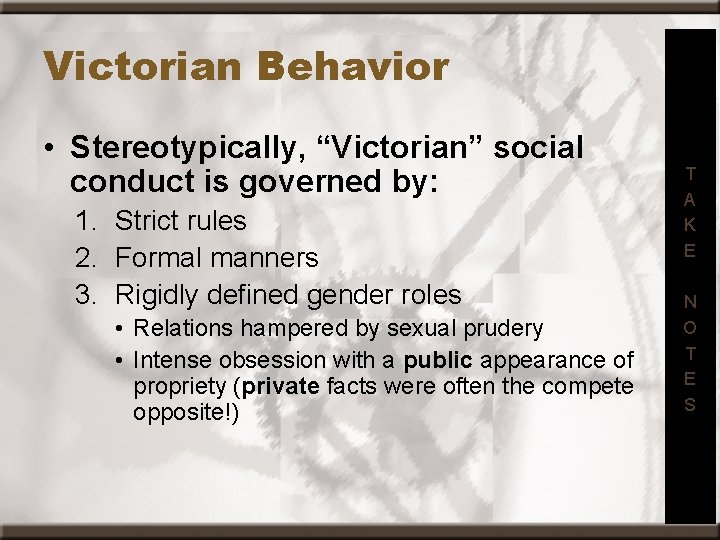
Victorian Behavior • Stereotypically, “Victorian” social conduct is governed by: 1. Strict rules 2. Formal manners 3. Rigidly defined gender roles • Relations hampered by sexual prudery • Intense obsession with a public appearance of propriety (private facts were often the compete opposite!) T A K E N O T E S
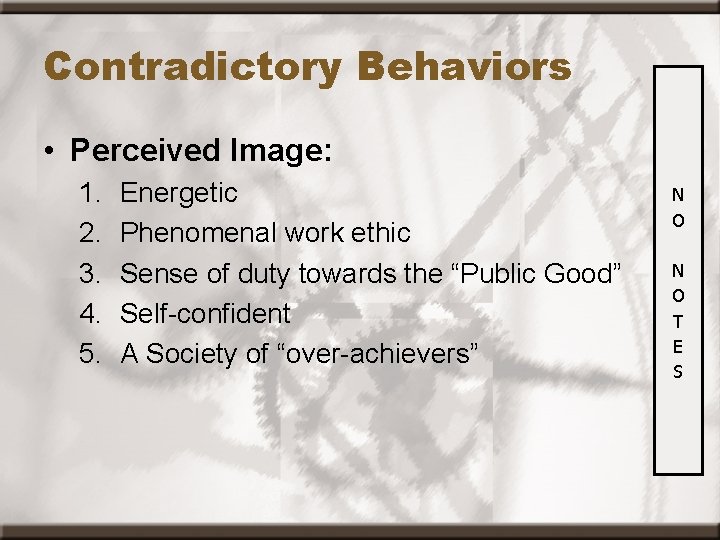
Contradictory Behaviors • Perceived Image: 1. 2. 3. 4. 5. Energetic Phenomenal work ethic Sense of duty towards the “Public Good” Self-confident A Society of “over-achievers” N O T E S
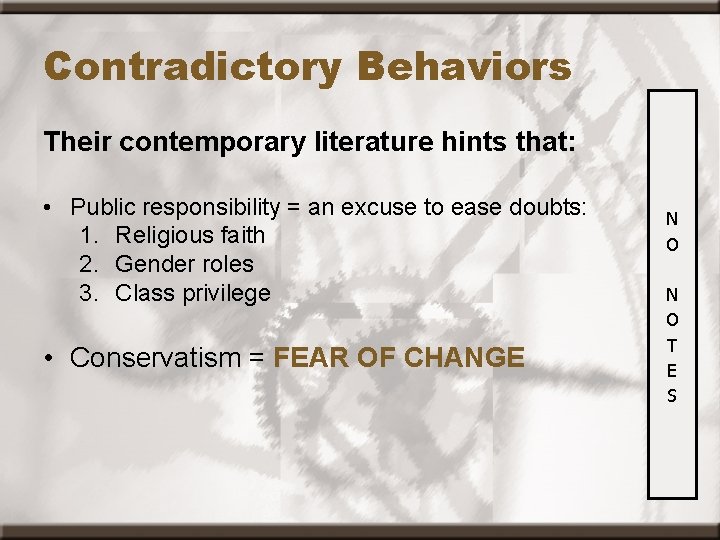
Contradictory Behaviors Their contemporary literature hints that: • Public responsibility = an excuse to ease doubts: 1. Religious faith 2. Gender roles 3. Class privilege • Conservatism = FEAR OF CHANGE N O T E S