
The Vertex Tracker in the ILD Concept Parameters
![Requirements for the Vertex Tracker Asymptotic I. P. Resolution [ a ] Technology (pitch,](https://slidetodoc.com/presentation_image_h2/85dac2e9183c97247f8a640b9a177631/image-2.jpg "Requirements for the Vertex Tracker Asymptotic I. P. Resolution [ a ] Technology (pitch,")
- Slides: 16
The Vertex Tracker in the ILD Concept Parameters and Optimisation M Battaglia UC Berkeley and LBNL M Winter, A Besson, D Grandjean, R De Masi IPHC Strasbourg Y Sugimoto KEK ILD Meeting, DESY Zeuthen, January 14, 2008
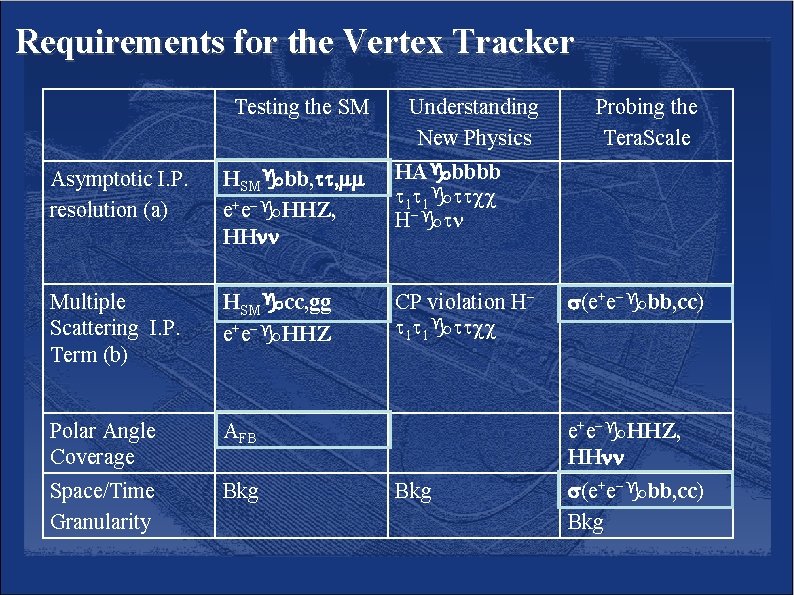
Requirements for the Vertex Tracker Asymptotic I. P. Resolution [ a ] Technology (pitch, S/N) Geometry (Rin, Rout) Multiple Scattering Technology (thickness) Geometry (Rin, NLayers) I. P. Term [ b] Polar Angle Coverage Space / Time Granularity Technology (r/o electronics) Geometry (z. Layers) Technology (pitch, r/o architecture, r/o time) Geometry (Rin)
Requirements for the Vertex Tracker Testing the SM Understanding New Physics Asymptotic I. P. resolution (a) HSMgbb, tt, mm e+e-g. HHZ, HHnn HAgbbbb t 1 t 1 gttcc H-gtn Multiple Scattering I. P. Term (b) HSMgcc, gg e+e-g. HHZ CP violation Ht 1 t 1 gttcc Polar Angle Coverage AFB Space/Time Granularity Bkg Probing the Tera. Scale s(e+e-gbb, cc) e+e-g. HHZ, HHnn Bkg s(e+e-gbb, cc) Bkg
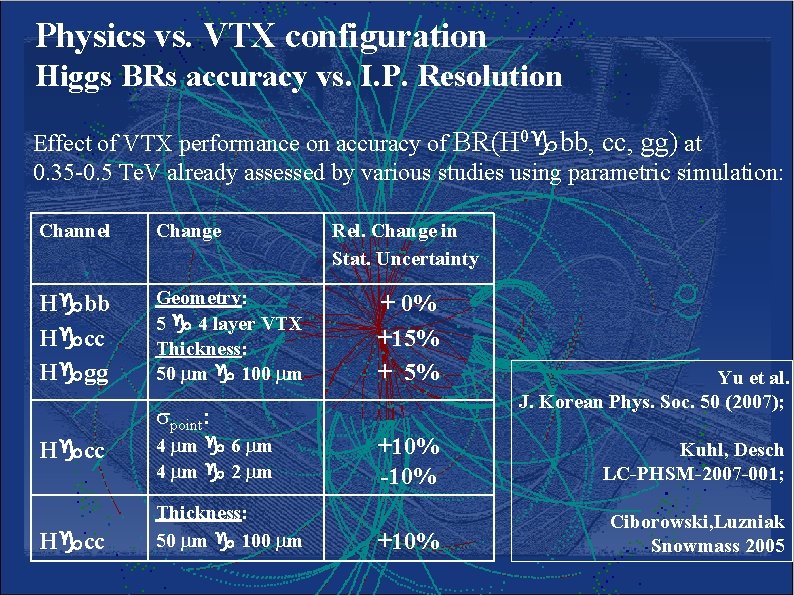
Physics vs. VTX configuration Higgs BRs accuracy vs. I. P. Resolution Effect of VTX performance on accuracy of BR(H 0 gbb, cc, gg) at 0. 35 -0. 5 Te. V already assessed by various studies using parametric simulation: Channel Change Hgbb Hgcc Hggg Geometry: 5 g 4 layer VTX Thickness: 50 mm g 100 mm spoint: Hgcc 4 mm g 6 mm 4 mm g 2 mm Thickness: 50 mm g 100 mm Rel. Change in Stat. Uncertainty + 0% +15% + 5% Yu et al. J. Korean Phys. Soc. 50 (2007); +10% -10% Kuhl, Desch LC-PHSM-2007 -001; +10% Ciborowski, Luzniak Snowmass 2005
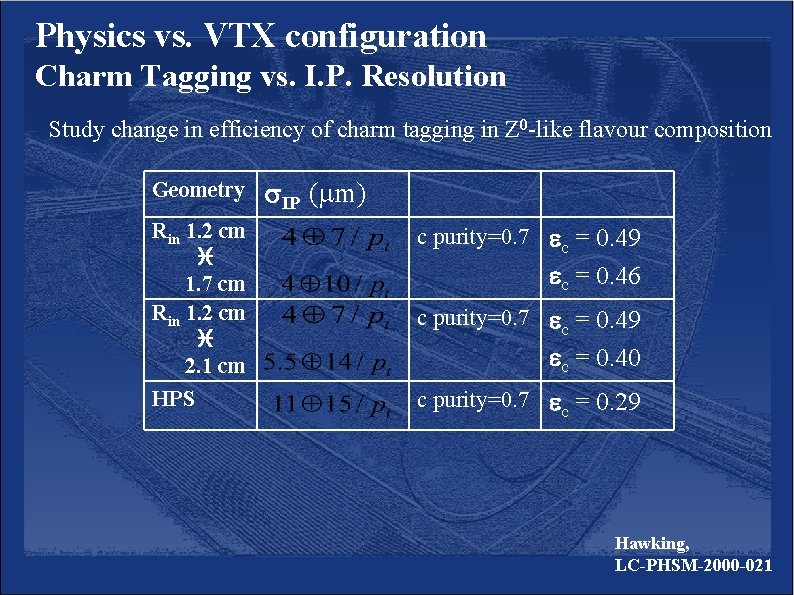
Physics vs. VTX configuration Charm Tagging vs. I. P. Resolution Study change in efficiency of charm tagging in Z 0 -like flavour composition Geometry s. IP (mm) Rin 1. 2 cm i 1. 7 cm Rin 1. 2 cm i 2. 1 cm c purity=0. 7 ec = 0. 49 HPS c purity=0. 7 ec = 0. 29 ec = 0. 46 c purity=0. 7 ec = 0. 49 ec = 0. 40 Hawking, LC-PHSM-2000 -021
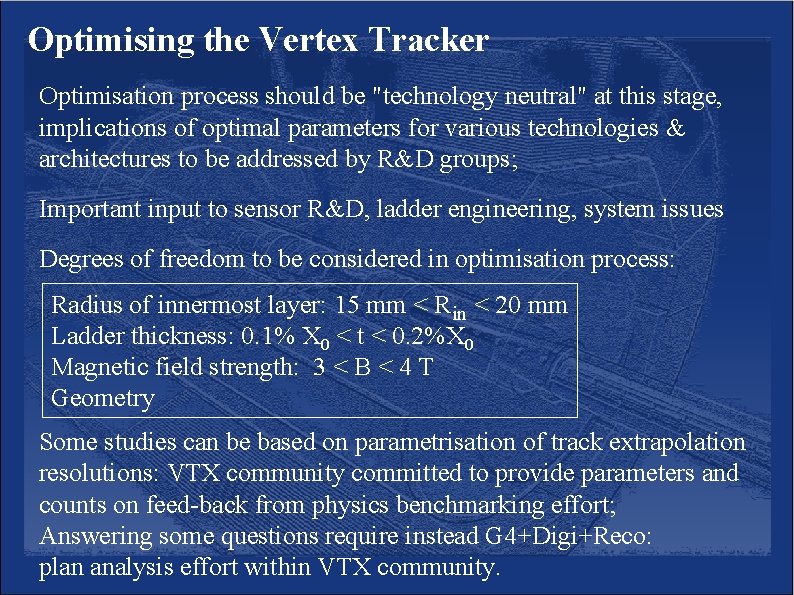
Optimising the Vertex Tracker Optimisation process should be "technology neutral" at this stage, implications of optimal parameters for various technologies & architectures to be addressed by R&D groups; Important input to sensor R&D, ladder engineering, system issues Degrees of freedom to be considered in optimisation process: Radius of innermost layer: 15 mm < Rin < 20 mm Ladder thickness: 0. 1% X 0 < t < 0. 2%X 0 Magnetic field strength: 3 < B < 4 T Geometry Some studies can be based on parametrisation of track extrapolation resolutions: VTX community committed to provide parameters and counts on feed-back from physics benchmarking effort; Answering some questions require instead G 4+Digi+Reco: plan analysis effort within VTX community.
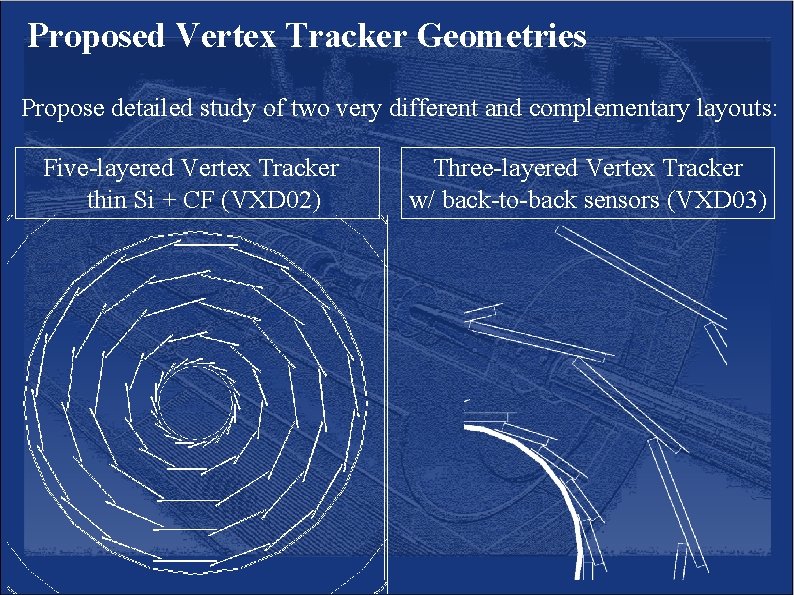
Proposed Vertex Tracker Geometries Propose detailed study of two very different and complementary layouts: Five-layered Vertex Tracker thin Si + CF (VXD 02) Three-layered Vertex Tracker w/ back-to-back sensors (VXD 03)
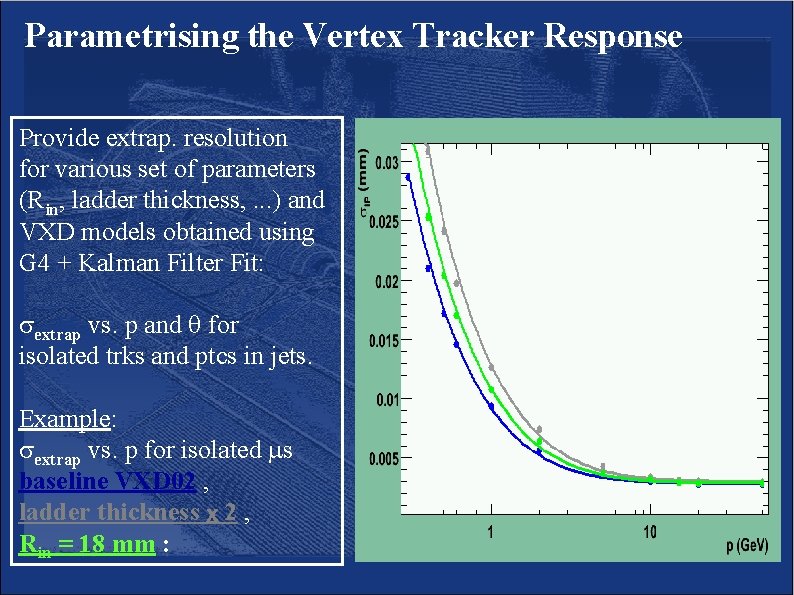
Parametrising the Vertex Tracker Response Provide extrap. resolution for various set of parameters (Rin, ladder thickness, . . . ) and VXD models obtained using G 4 + Kalman Filter Fit: sextrap vs. p and q for isolated trks and ptcs in jets. Example: sextrap vs. p for isolated ms baseline VXD 02 , ladder thickness x 2 , Rin = 18 mm :
Performance beyond Gaussian Resolutions Earlier results show physics reach to depend very smoothly on variations in a and b; Parametric fast simulation studies do not address effect of non-Gaussian tails; such effects originate from patrec failures and local distortions or misalignments; Important to start addressing these issues within current effort on analyses based on G 4+Digi+Reco; g clarify effect of occupancy on mistag rate, define stability constraints for engineering design.
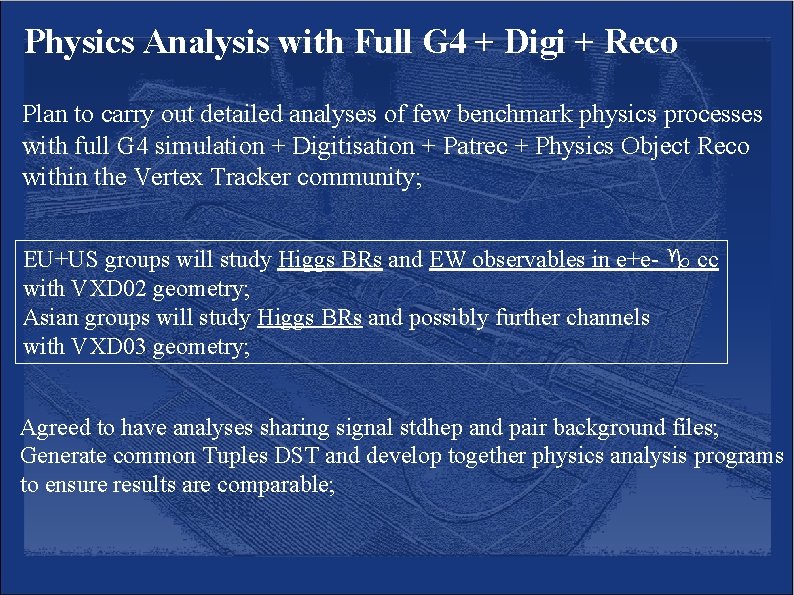
Physics Analysis with Full G 4 + Digi + Reco Plan to carry out detailed analyses of few benchmark physics processes with full G 4 simulation + Digitisation + Patrec + Physics Object Reco within the Vertex Tracker community; EU+US groups will study Higgs BRs and EW observables in e+e- g cc with VXD 02 geometry; Asian groups will study Higgs BRs and possibly further channels with VXD 03 geometry; Agreed to have analyses sharing signal stdhep and pair background files; Generate common Tuples DST and develop together physics analysis programs to ensure results are comparable;
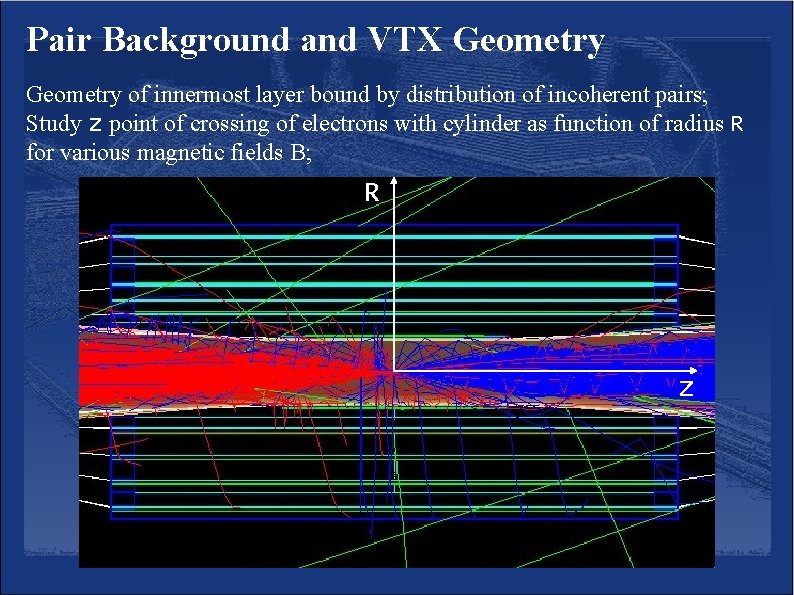
Pair Background and VTX Geometry of innermost layer bound by distribution of incoherent pairs; Study z point of crossing of electrons with cylinder as function of radius R for various magnetic fields B; R z
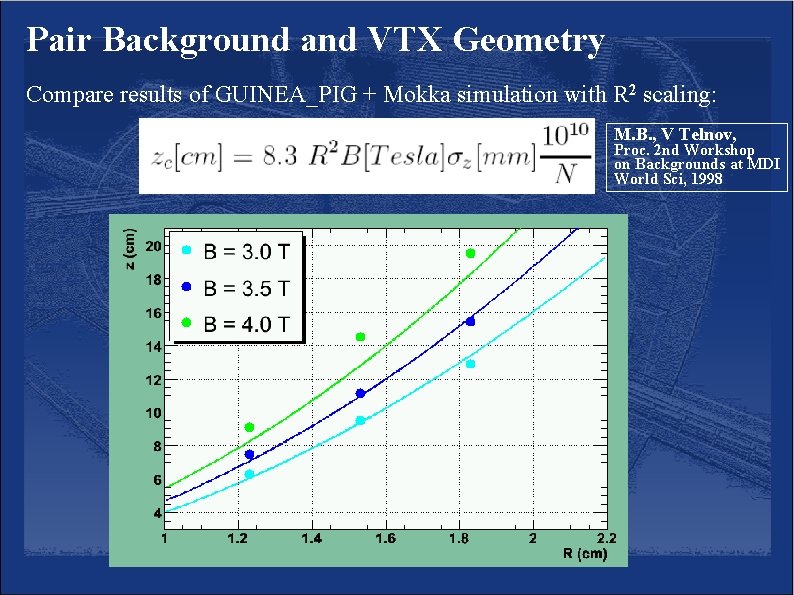
Pair Background and VTX Geometry Compare results of GUINEA_PIG + Mokka simulation with R 2 scaling: M. B. , V Telnov, Proc. 2 nd Workshop on Backgrounds at MDI World Sci, 1998
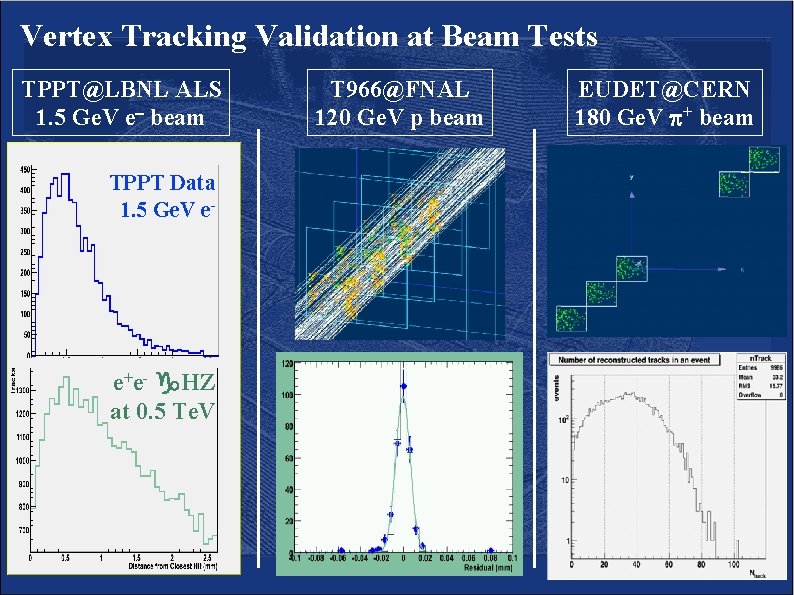
Vertex Tracking Validation at Beam Tests TPPT@LBNL ALS 1. 5 Ge. V e- beam TPPT Data 1. 5 Ge. V e- e+e- g. HZ at 0. 5 Te. V T 966@FNAL 120 Ge. V p beam EUDET@CERN 180 Ge. V p+ beam
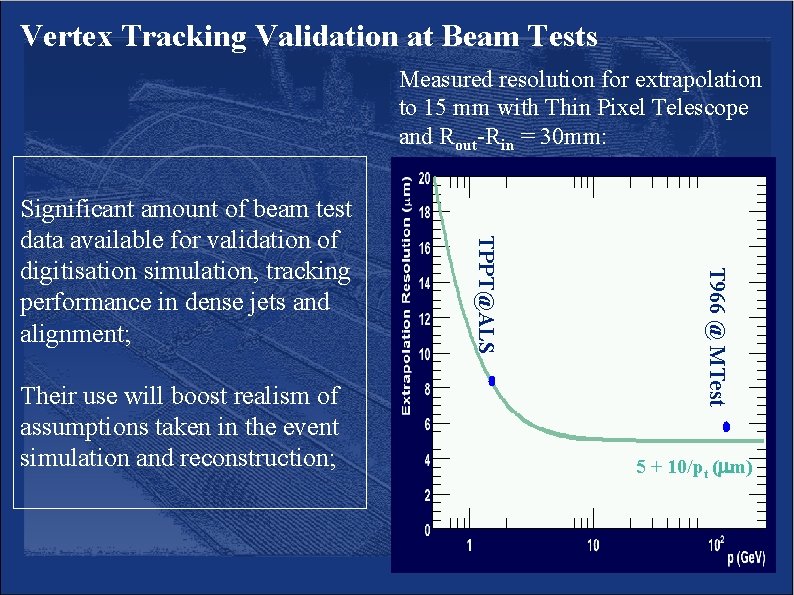
Vertex Tracking Validation at Beam Tests Measured resolution for extrapolation to 15 mm with Thin Pixel Telescope and Rout-Rin = 30 mm: T 966 @ MTest Their use will boost realism of assumptions taken in the event simulation and reconstruction; TPPT@ALS Significant amount of beam test data available for validation of digitisation simulation, tracking performance in dense jets and alignment; 5 + 10/pt (mm)
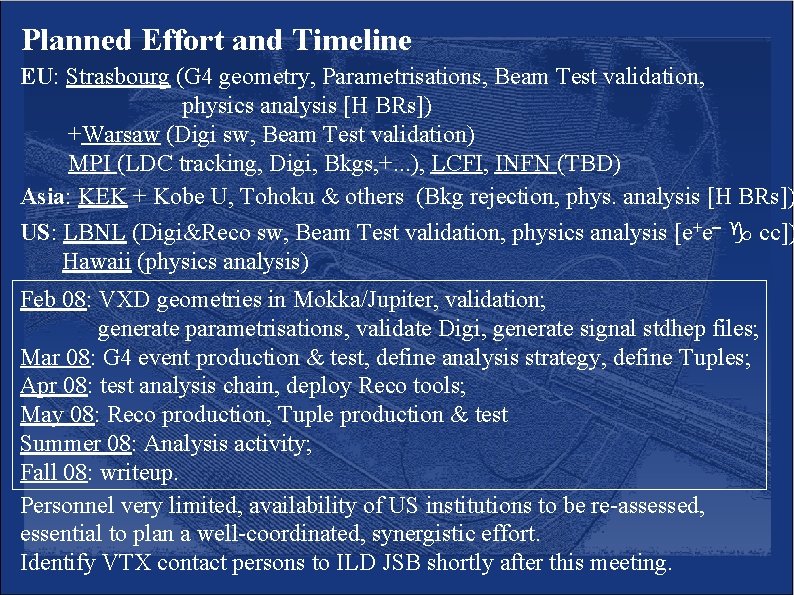
Planned Effort and Timeline EU: Strasbourg (G 4 geometry, Parametrisations, Beam Test validation, physics analysis [H BRs]) +Warsaw (Digi sw, Beam Test validation) MPI (LDC tracking, Digi, Bkgs, +. . . ), LCFI, INFN (TBD) Asia: KEK + Kobe U, Tohoku & others (Bkg rejection, phys. analysis [H BRs]) US: LBNL (Digi&Reco sw, Beam Test validation, physics analysis [e+e- g cc]) Hawaii (physics analysis) Feb 08: VXD geometries in Mokka/Jupiter, validation; generate parametrisations, validate Digi, generate signal stdhep files; Mar 08: G 4 event production & test, define analysis strategy, define Tuples; Apr 08: test analysis chain, deploy Reco tools; May 08: Reco production, Tuple production & test Summer 08: Analysis activity; Fall 08: writeup. Personnel very limited, availability of US institutions to be re-assessed, essential to plan a well-coordinated, synergistic effort. Identify VTX contact persons to ILD JSB shortly after this meeting.
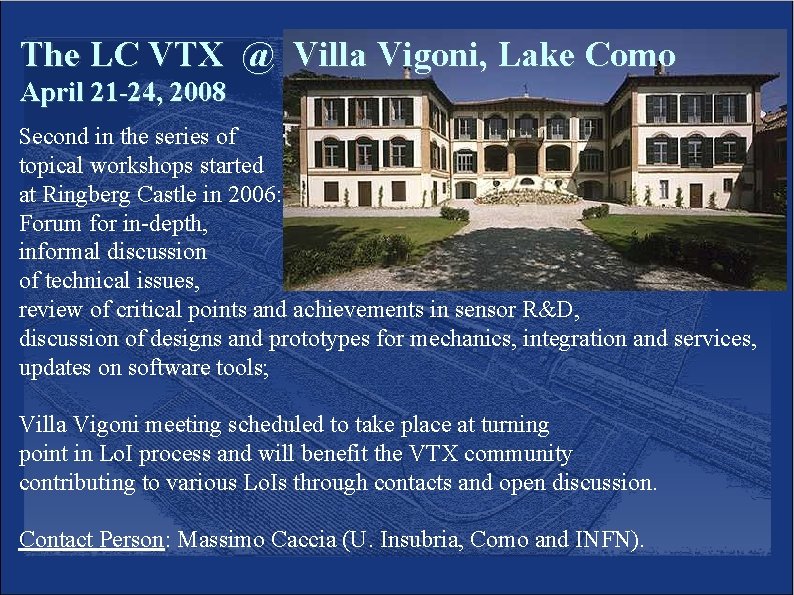
The LC VTX @ Villa Vigoni, Lake Como April 21 -24, 2008 Second in the series of topical workshops started at Ringberg Castle in 2006: Forum for in-depth, informal discussion of technical issues, review of critical points and achievements in sensor R&D, discussion of designs and prototypes for mechanics, integration and services, updates on software tools; Villa Vigoni meeting scheduled to take place at turning point in Lo. I process and will benefit the VTX community contributing to various Lo. Is through contacts and open discussion. Contact Person: Massimo Caccia (U. Insubria, Como and INFN).