
The Vertebrates Three reasons why the vertebrates are
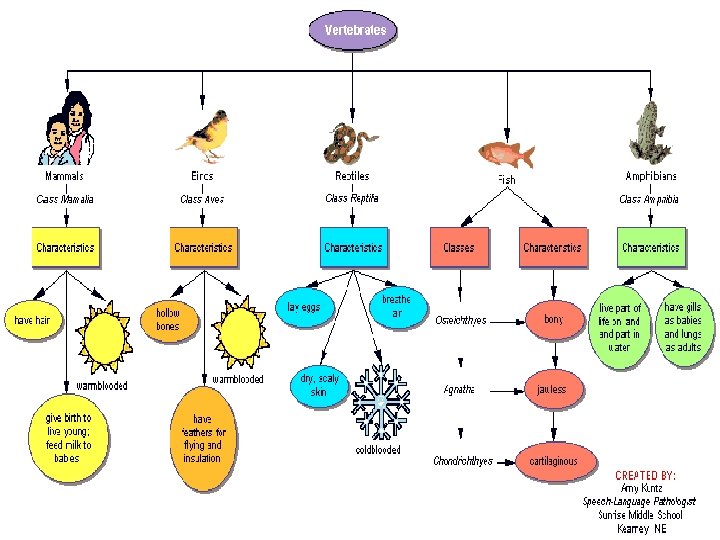
The Vertebrates Three reasons why the vertebrates are grouped together. A. Notochord flexible, rod-like structure along backside…. . turns into a backbone B. Dorsal nerve chord bundle of nerves lying above notochord……becomes spinal cord with brain C. Gill slits paired openings behind mouth…. in fish, they become gills. In addition to notochord, dorsal nerve chord and gill slits, all vertebrates have vertebrate, skull and an endoskeleton (inside) Vertebrates are either warm or cold-blooded 1. Warm-blooded – Body temperature stays the same everyday 2. Cold-blooded – Body temperature changes with the environment
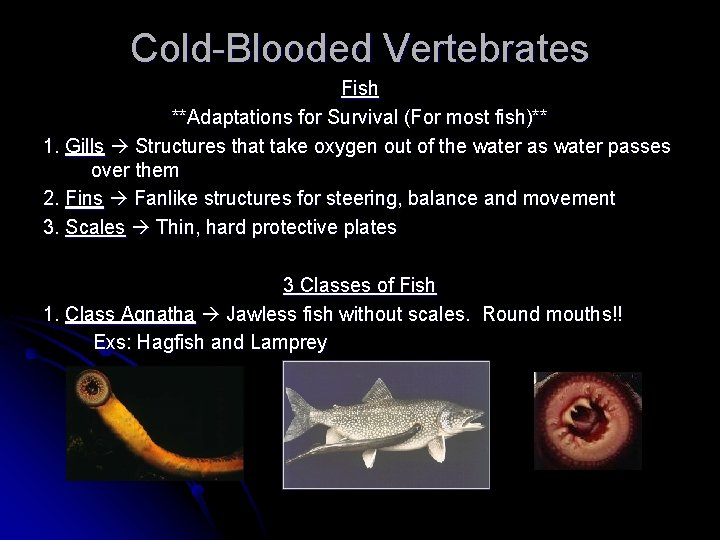
Cold-Blooded Vertebrates Fish **Adaptations for Survival (For most fish)** 1. Gills Structures that take oxygen out of the water as water passes over them 2. Fins Fanlike structures for steering, balance and movement 3. Scales Thin, hard protective plates 3 Classes of Fish 1. Class Agnatha Jawless fish without scales. Round mouths!! Exs: Hagfish and Lamprey
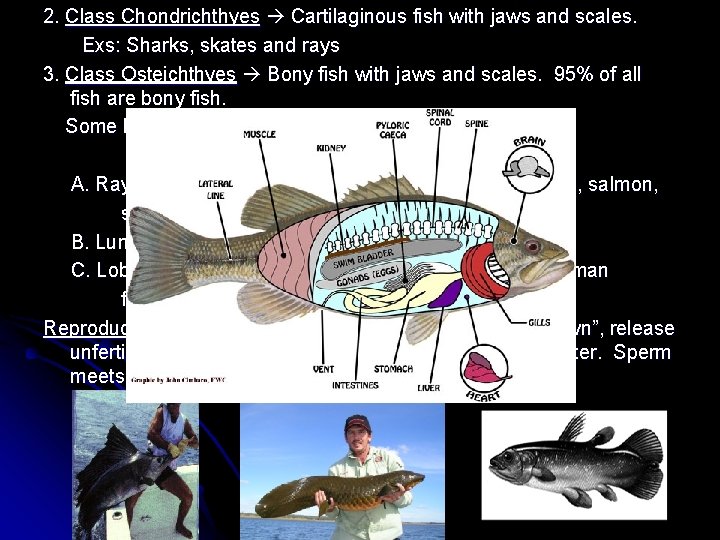
2. Class Chondrichthyes Cartilaginous fish with jaws and scales. Exs: Sharks, skates and rays 3. Class Osteichthyes Bony fish with jaws and scales. 95% of all fish are bony fish. Some have a swim bladder for floating and sinking 3 groups of Bony Fish A. Ray-finned fish – Have fins with bones in them…. Tuna, salmon, swordfish, bass, etc. B. Lungfish – rare; have both lungs and gills C. Lobe-finned fish – Very rare; have fins that are like human flesh……. . Do they still exist? ? Reproduction – Mostly External Fertilization. Females “spawn”, release unfertilized eggs in water and males release sperm in water. Sperm meets egg outside of body.

Amphibians Comes form the word Amphibious…. . ”Double-life”. They spend part of their life in water and part on land. Exs. : Frogs, salamanders, toads Cold-blooded vertebrates that can shut down in really hot or cold weather. Hibernation Period of inactivity in cold weather Estivation Period of inactivity in hot weather Frogs Broad bodies; no neck or tails, 4 legs. Their tongue is attached to the front of their mouth, allowing it to flip out and catch insects. Instead of ears they have tympanic membranes. Their skin is usually thin and smooth breathe right through skin!! Reproduction – Most frogs lay fertilized eggs (internal fertilization first!) in water and a tadpole develops. Over time, the tadpole loses it’s gills and tail, replacing it with lungs and legs. Metamorphosis – a series of extreme changes from larvae to adult.
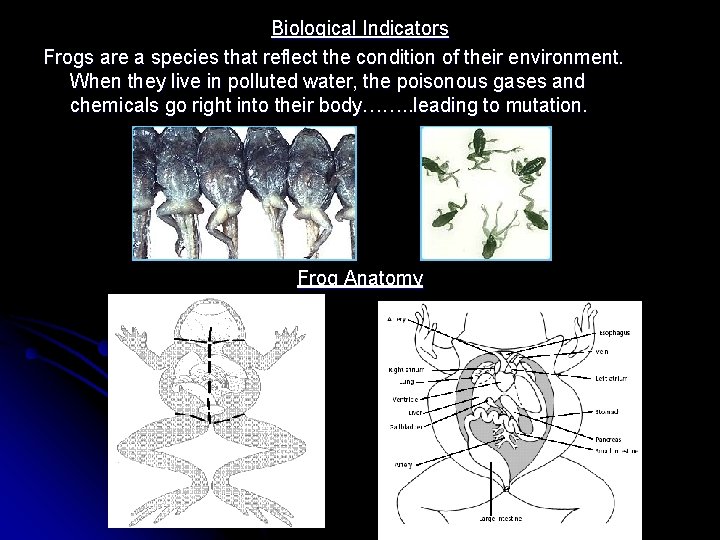
Biological Indicators Frogs are a species that reflect the condition of their environment. When they live in polluted water, the poisonous gases and chemicals go right into their body……. . leading to mutation. Frog Anatomy
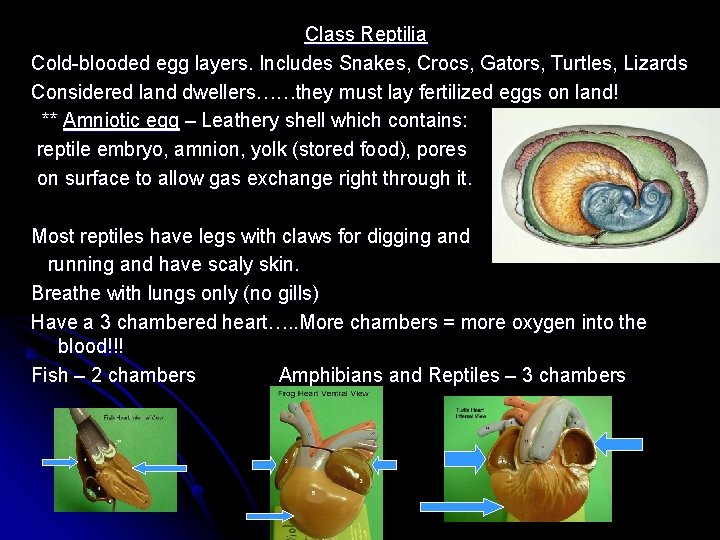
Class Reptilia Cold-blooded egg layers. Includes Snakes, Crocs, Gators, Turtles, Lizards Considered land dwellers……they must lay fertilized eggs on land! ** Amniotic egg – Leathery shell which contains: reptile embryo, amnion, yolk (stored food), pores on surface to allow gas exchange right through it. Most reptiles have legs with claws for digging and running and have scaly skin. Breathe with lungs only (no gills) Have a 3 chambered heart…. . More chambers = more oxygen into the blood!!! Fish – 2 chambers Amphibians and Reptiles – 3 chambers
Warm-Blooded Vertebrates Birds True land animals that lay fertilized eggs on land. They usually incubate (warm) eggs and nurture (feed) their young. Are they related to reptiles and dinosaurs? ? ? Scales on their legs might support theory of some connection. Most fly, which is a “fuel” burning activity. Two things that allow this are: 1. Constantly eating 2. 4 chambered heart to get maximum oxygen into the body **Hummingbird heart beats 1000 times a minute!!** Bird adaptations for flying: 1. feathers on specialized limbs 2. powerful muscles controlling hollow bones 3. air sacs, which fill with air and keep internal organs cool and provide oxygen to bird
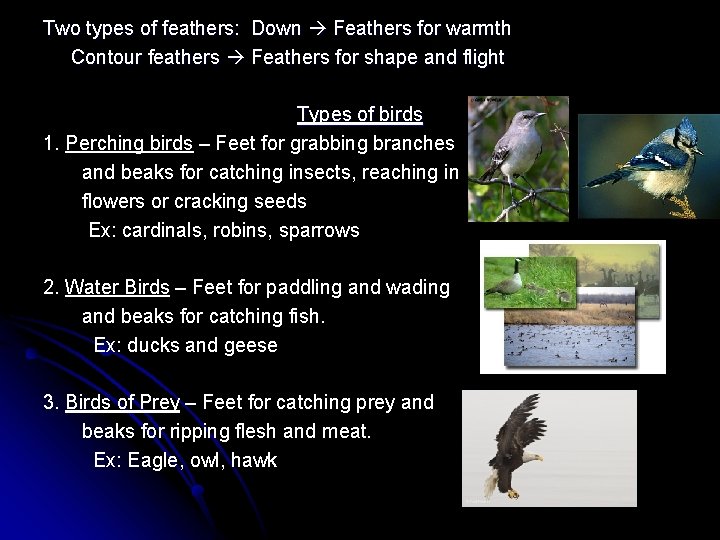
Two types of feathers: Down Feathers for warmth Contour feathers Feathers for shape and flight Types of birds 1. Perching birds – Feet for grabbing branches and beaks for catching insects, reaching in flowers or cracking seeds Ex: cardinals, robins, sparrows 2. Water Birds – Feet for paddling and wading and beaks for catching fish. Ex: ducks and geese 3. Birds of Prey – Feet for catching prey and beaks for ripping flesh and meat. Ex: Eagle, owl, hawk
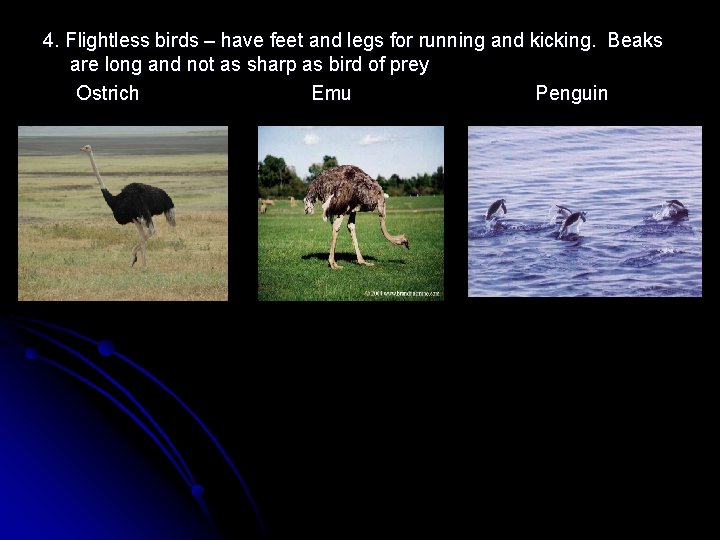
4. Flightless birds – have feet and legs for running and kicking. Beaks are long and not as sharp as bird of prey Ostrich Emu Penguin
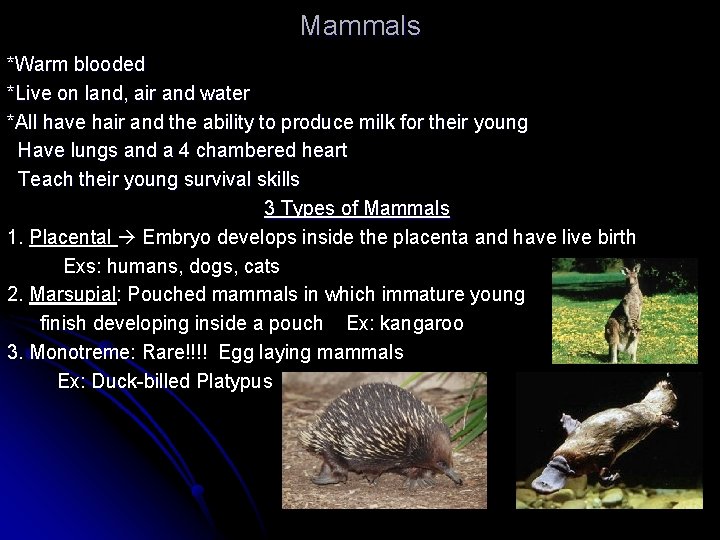
Mammals *Warm blooded *Live on land, air and water *All have hair and the ability to produce milk for their young Have lungs and a 4 chambered heart Teach their young survival skills 3 Types of Mammals 1. Placental Embryo develops inside the placenta and have live birth Exs: humans, dogs, cats 2. Marsupial: Pouched mammals in which immature young finish developing inside a pouch Ex: kangaroo 3. Monotreme: Rare!!!! Egg laying mammals Ex: Duck-billed Platypus
Quiz Time! 1. What is the name of the phylum containing all the animals with backbones? 2. What structure turns into our backbone as we develop from embryo to baby? 3. Class Osteichthyes is commonly called what kind of fish? 4. A swim bladder allows some fish to do what? 5. What does spawning mean? 6. What does metamorphosis mean? 7. A reptile lays fertilized eggs where? 8. A reptile has a 3 chambered heart. A fish has a 2 chambered heart. Who has the more efficient heart? 9. What is estivation? 10. What 2 traits do birds of prey have? 11. What’s the difference between down and contour feathers? 12. Name 2 perching birds. 13. How does a Monotreme have offspring? 14. What does it mean to be a Placental mammal?
WORD BANK #1 FISH AMPHIBIANS REPTILES BIRDS WORD BANK #2 LAMPREY SALAMANDER HUMAN DUCK-BILLED PLATYPUS HAWK OPOSSUM SHARK SALMON SEA TURTLE CARDINAL DUCK MAMMALS
- Slides: 13