
The Vertebrata I Introduction to the Fishes Traditional
The Vertebrata I Introduction to the Fishes
Traditional organization of Vertebrate Taxonomy AGNATHA -Jawless Fishes CHONDRICHTHYES -Sharks, skates, rays and chimeras OSTEICHTHYES -Bony Fishes AMPHIBIA -Amphibians REPTILIA -Reptiles MAMMALIA -Mammals AVES -Birds
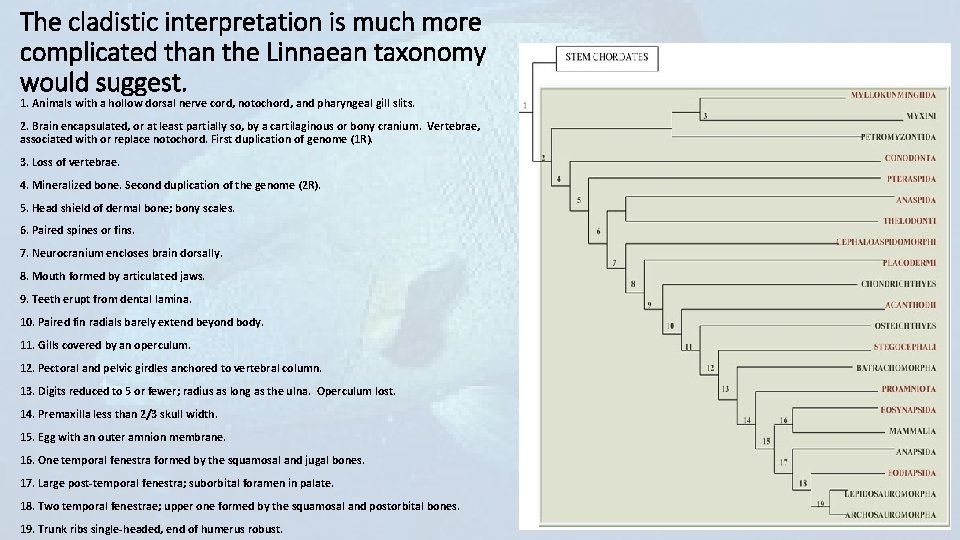
The cladistic interpretation is much more complicated than the Linnaean taxonomy would suggest. 1. Animals with a hollow dorsal nerve cord, notochord, and pharyngeal gill slits. 2. Brain encapsulated, or at least partially so, by a cartilaginous or bony cranium. Vertebrae, associated with or replace notochord. First duplication of genome (1 R). 3. Loss of vertebrae. 4. Mineralized bone. Second duplication of the genome (2 R). 5. Head shield of dermal bone; bony scales. 6. Paired spines or fins. 7. Neurocranium encloses brain dorsally. 8. Mouth formed by articulated jaws. 9. Teeth erupt from dental lamina. 10. Paired fin radials barely extend beyond body. 11. Gills covered by an operculum. 12. Pectoral and pelvic girdles anchored to vertebral column. 13. Digits reduced to 5 or fewer; radius as long as the ulna. Operculum lost. 14. Premaxilla less than 2/3 skull width. 15. Egg with an outer amnion membrane. 16. One temporal fenestra formed by the squamosal and jugal bones. 17. Large post-temporal fenestra; suborbital foramen in palate. 18. Two temporal fenestrae; upper one formed by the squamosal and postorbital bones. 19. Trunk ribs single-headed, end of humerus robust.
Vertebrates include all animals that possess a vertebral column and their descendants.
Common characters of Vertebrata • Skeleton composed of cartilage or mineral tissue composed of hydroxyapatite in form of bone (with collagen matrix), dentine, and enamel • Bilateral symmetry • Head with multiple sense organs • Brain and spinal cord (CNS, central nervous system) • Skeleton supporting base of brain and body axis, usually elaborated more fully • Segmented body axis with muscles • Paired appendages 1 • Mouth, stomach, and gut • Heart and circulatory system ventral to CNS • Pharyngeal pouches with aortic arches (gill apparatus 2) 1 in all jawed vertebrates and some extinct agnathans 2 gill apparatus in embryonic stages of amniotes David Polly (2013)
Eon Era Cenozoic P h a n e r o z o i c Mesozoic Paleozoic Period ended (MYA): began (MYA): Holocene 0 0. 0115 Pleistocene 0. 0115 1. 806 Pliocene 1. 806 5. 332 Miocene 5. 332 23. 03 Oligocene 23. 03 33. 9 Eocene 33. 9 55. 8 Paleocene 55. 8 65. 5 Cretaceous 65. 5 ± 0. 3 145. 5 ± 4. 0 Jurassic 145. 5 ± 4. 0 199. 6 ± 0. 6 Triassic 199. 6 ± 0. 6 251. 0 ± 0. 4 Permian 251. 0 ± 0. 4 299. 0 ± 0. 8 Carboniferous 299. 0 ± 0. 8 359. 2 ± 2. 5 Devonian 359. 2 ± 2. 5 416. 0 ± 2. 8 Silurian 416. 0 ± 2. 8 443. 7 ± 1. 5 Ordovician 443. 7 ± 1. 5 488. 3 ± 1. 7 Cambrian 488. 3 ± 1. 7 542. 0 ± 1. 0 Vertebrates span the entire Phanerozoic
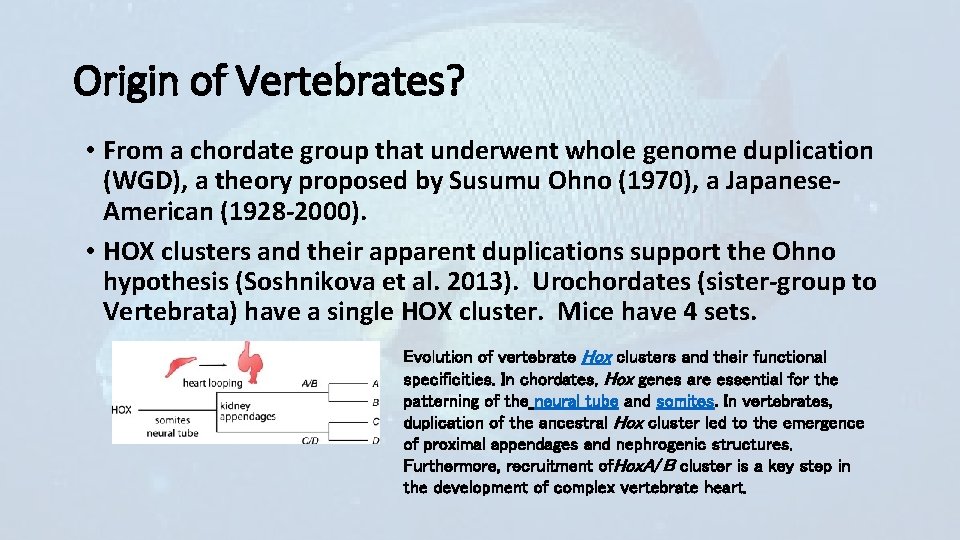
Origin of Vertebrates? • From a chordate group that underwent whole genome duplication (WGD), a theory proposed by Susumu Ohno (1970), a Japanese. American (1928 -2000). • HOX clusters and their apparent duplications support the Ohno hypothesis (Soshnikova et al. 2013). Urochordates (sister-group to Vertebrata) have a single HOX cluster. Mice have 4 sets. Evolution of vertebrate Hox clusters and their functional specificities. In chordates, Hox genes are essential for the patterning of the neural tube and somites. In vertebrates, duplication of the ancestral Hox cluster led to the emergence of proximal appendages and nephrogenic structures. Furthermore, recruitment of. Hox. A/B cluster is a key step in the development of complex vertebrate heart.

Cyclostomata (Dumeril 1806) • Superclasses of the Cyclostomata are monophyletic as supported by molecular evidence (Stock and Whitt 1992, Kuraku et al. 1999, Delarbre et al. 2002, Furlong and Holland 2002, Mallatt and Sullivan 2002, and Heimberg et al. 2010) and morphological/developmental studies (Ota et al. 2007 and 2011, and Oisi et al. 2013). • They lack jaws and paired appendages. • Myxinomorphi (Nelson 2006) • Petromyzontomorphi (Nelson 2006)
Superclass Myxinomorphi (Nelson 2006) • Agnathans that have no vertebrae (now interpret that they lost their vertebrae) • Name is reference to the production of slime mucus = μύξα (myxa) • Hagfish have four short tentacles that surround a jawless mouth containing denticles • They are predators of benthic worms (polychaetes) and many other invertebrates, feed on carrion, and can absorb food across their skin and gills • Extinct agnathans (e. g. Myllokuminngia) have been assigned to this subclass, but may be stem vertebrates
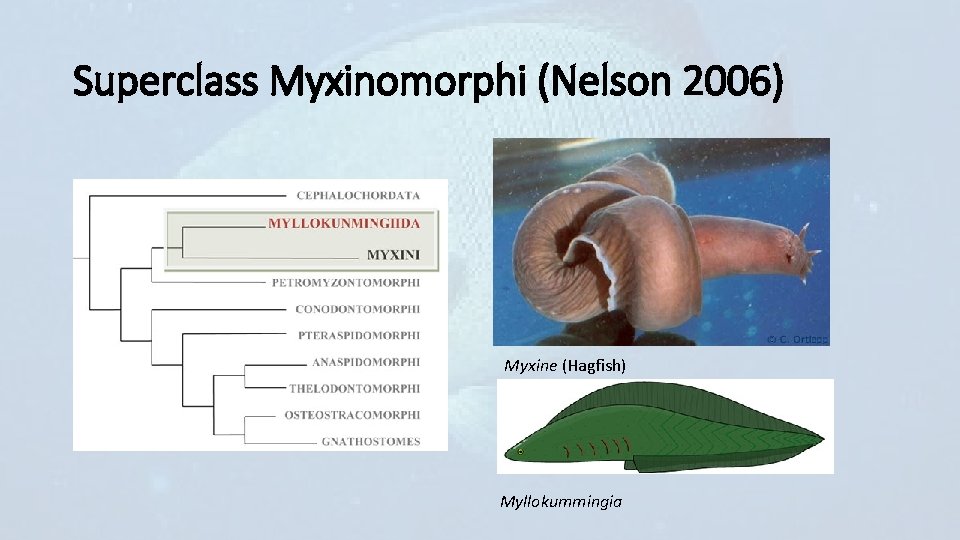
Superclass Myxinomorphi (Nelson 2006) Myxine (Hagfish) Myllokummingia
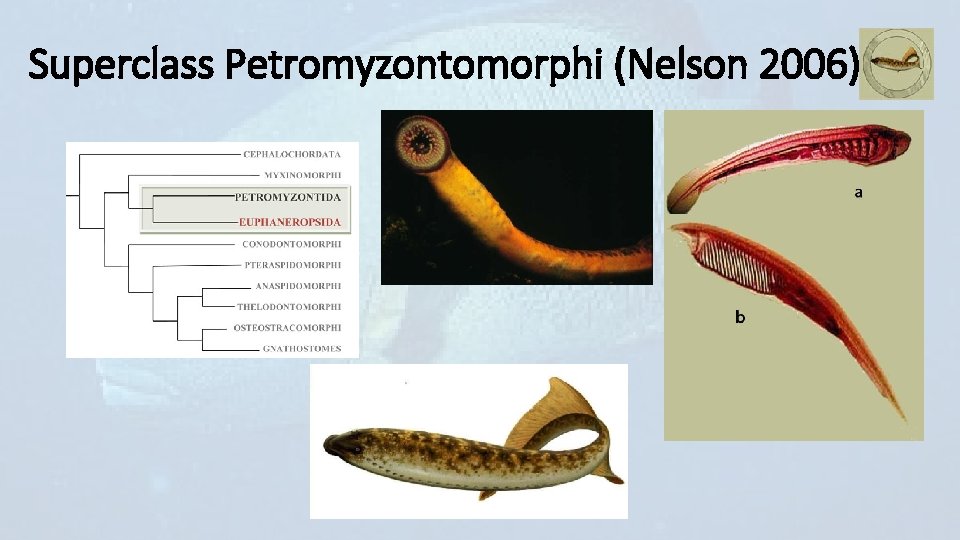
Superclass Petromyzontomorphi (Nelson 2006)
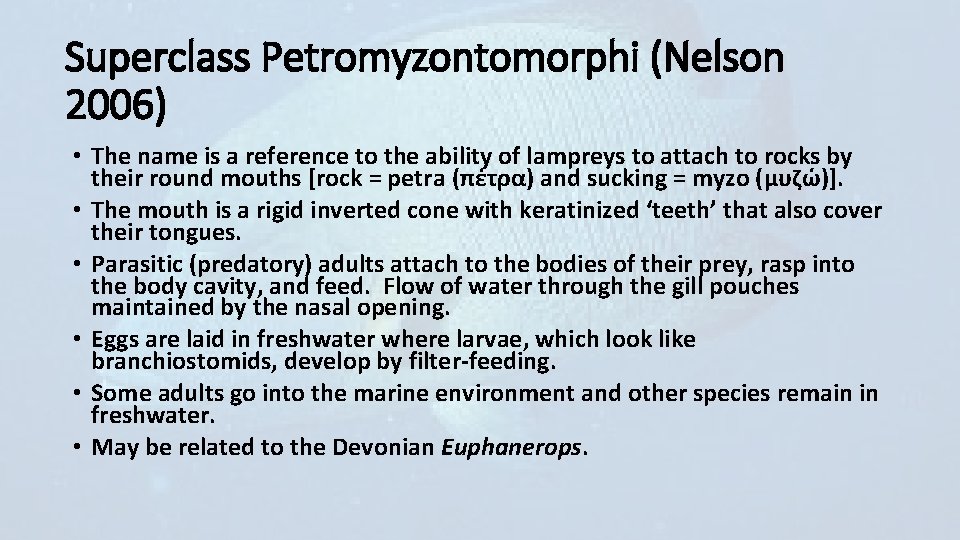
Superclass Petromyzontomorphi (Nelson 2006) • The name is a reference to the ability of lampreys to attach to rocks by their round mouths [rock = petra (πέτρα) and sucking = myzo (μυζώ)]. • The mouth is a rigid inverted cone with keratinized ‘teeth’ that also cover their tongues. • Parasitic (predatory) adults attach to the bodies of their prey, rasp into the body cavity, and feed. Flow of water through the gill pouches maintained by the nasal opening. • Eggs are laid in freshwater where larvae, which look like branchiostomids, develop by filter-feeding. • Some adults go into the marine environment and other species remain in freshwater. • May be related to the Devonian Euphanerops.
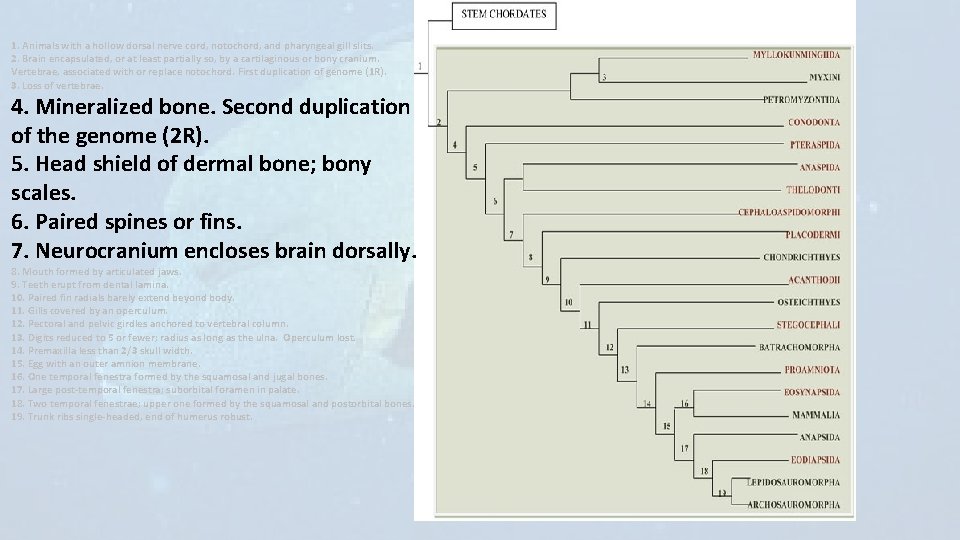
1. Animals with a hollow dorsal nerve cord, notochord, and pharyngeal gill slits. 2. Brain encapsulated, or at least partially so, by a cartilaginous or bony cranium. Vertebrae, associated with or replace notochord. First duplication of genome (1 R). 3. Loss of vertebrae. 4. Mineralized bone. Second duplication of the genome (2 R). 5. Head shield of dermal bone; bony scales. 6. Paired spines or fins. 7. Neurocranium encloses brain dorsally. 8. Mouth formed by articulated jaws. 9. Teeth erupt from dental lamina. 10. Paired fin radials barely extend beyond body. 11. Gills covered by an operculum. 12. Pectoral and pelvic girdles anchored to vertebral column. 13. Digits reduced to 5 or fewer; radius as long as the ulna. Operculum lost. 14. Premaxilla less than 2/3 skull width. 15. Egg with an outer amnion membrane. 16. One temporal fenestra formed by the squamosal and jugal bones. 17. Large post-temporal fenestra; suborbital foramen in palate. 18. Two temporal fenestrae; upper one formed by the squamosal and postorbital bones. 19. Trunk ribs single-headed, end of humerus robust.
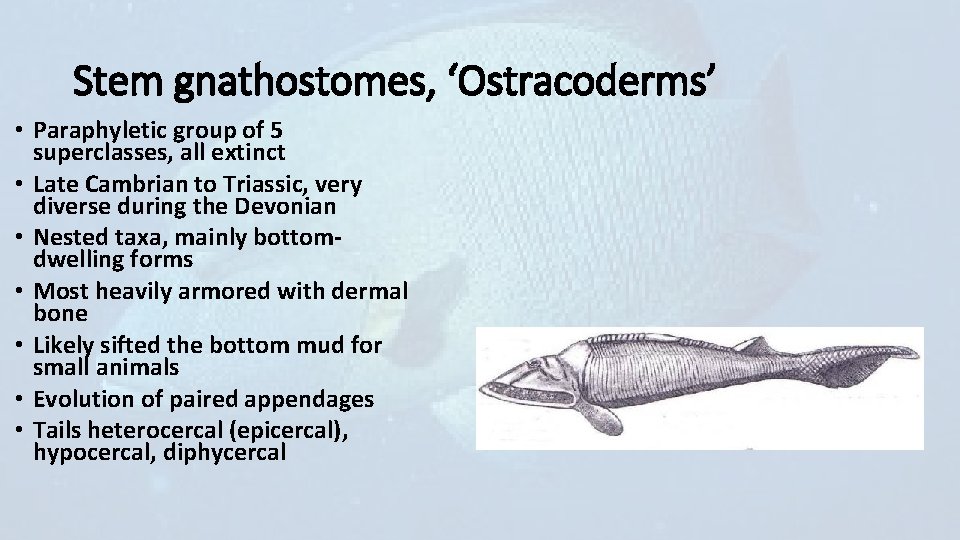
Stem gnathostomes, ‘Ostracoderms’ • Paraphyletic group of 5 superclasses, all extinct • Late Cambrian to Triassic, very diverse during the Devonian • Nested taxa, mainly bottomdwelling forms • Most heavily armored with dermal bone • Likely sifted the bottom mud for small animals • Evolution of paired appendages • Tails heterocercal (epicercal), hypocercal, diphycercal
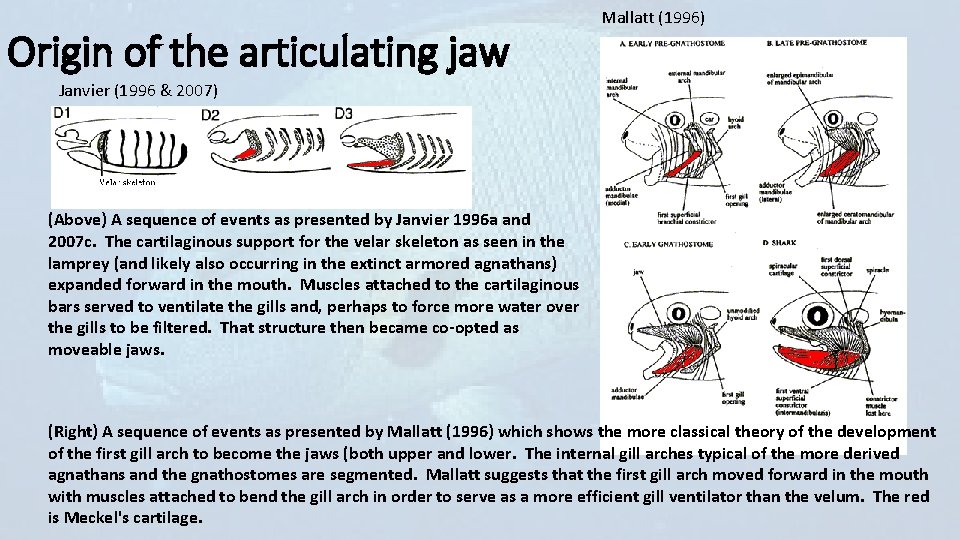
Origin of the articulating jaw Mallatt (1996) Janvier (1996 & 2007) (Above) A sequence of events as presented by Janvier 1996 a and 2007 c. The cartilaginous support for the velar skeleton as seen in the lamprey (and likely also occurring in the extinct armored agnathans) expanded forward in the mouth. Muscles attached to the cartilaginous bars served to ventilate the gills and, perhaps to force more water over the gills to be filtered. That structure then became co-opted as moveable jaws. (Right) A sequence of events as presented by Mallatt (1996) which shows the more classical theory of the development of the first gill arch to become the jaws (both upper and lower. The internal gill arches typical of the more derived agnathans and the gnathostomes are segmented. Mallatt suggests that the first gill arch moved forward in the mouth with muscles attached to bend the gill arch in order to serve as a more efficient gill ventilator than the velum. The red is Meckel's cartilage.
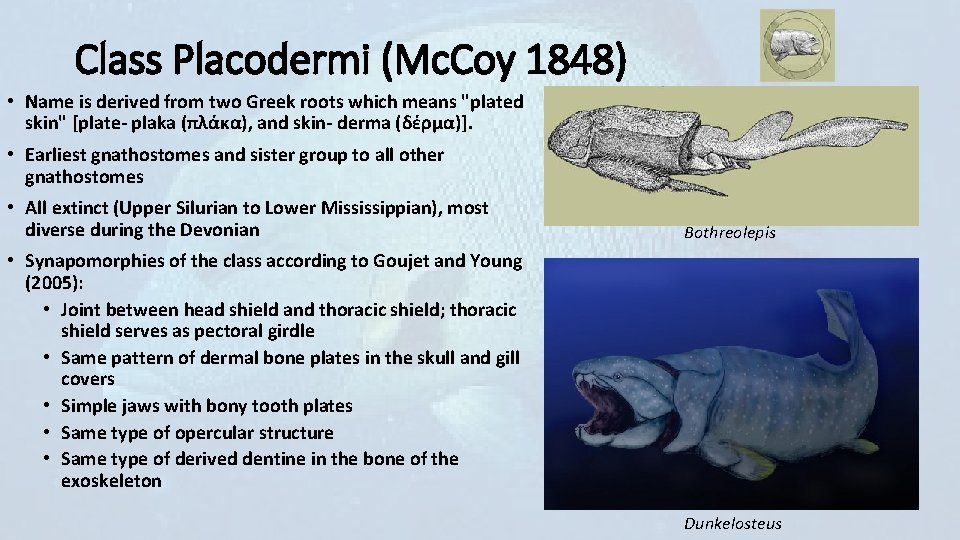
Class Placodermi (Mc. Coy 1848) • Name is derived from two Greek roots which means "plated skin" [plate- plaka (πλάκα), and skin- derma (δέρμα)]. • Earliest gnathostomes and sister group to all other gnathostomes • All extinct (Upper Silurian to Lower Mississippian), most diverse during the Devonian Bothreolepis • Synapomorphies of the class according to Goujet and Young (2005): • Joint between head shield and thoracic shield; thoracic shield serves as pectoral girdle • Same pattern of dermal bone plates in the skull and gill covers • Simple jaws with bony tooth plates • Same type of opercular structure • Same type of derived dentine in the bone of the exoskeleton Dunkelosteus
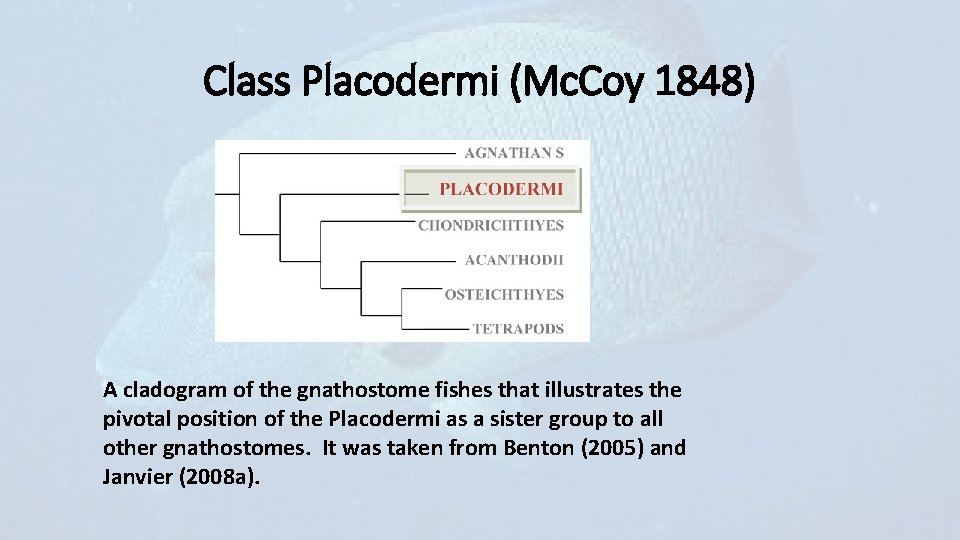
Class Placodermi (Mc. Coy 1848) A cladogram of the gnathostome fishes that illustrates the pivotal position of the Placodermi as a sister group to all other gnathostomes. It was taken from Benton (2005) and Janvier (2008 a).
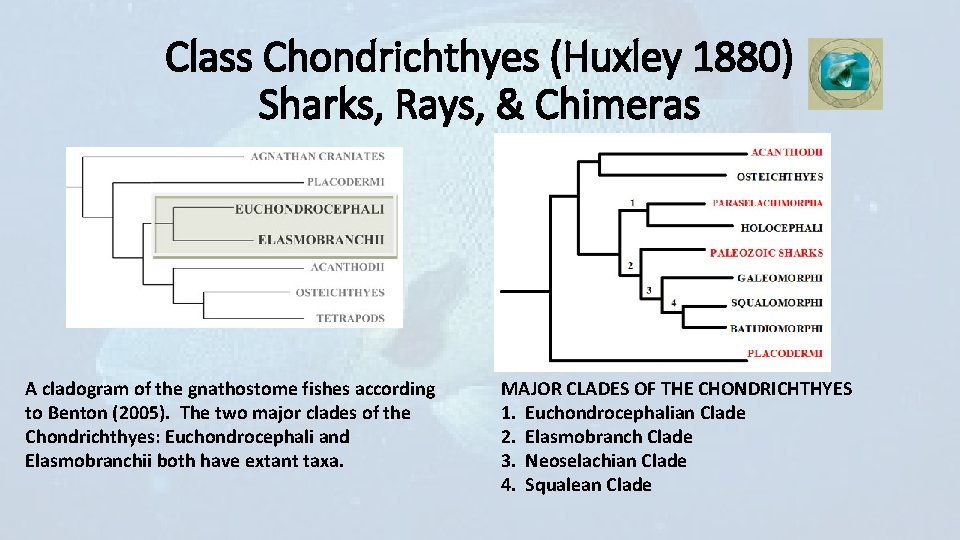
Class Chondrichthyes (Huxley 1880) Sharks, Rays, & Chimeras A cladogram of the gnathostome fishes according to Benton (2005). The two major clades of the Chondrichthyes: Euchondrocephali and Elasmobranchii both have extant taxa. MAJOR CLADES OF THE CHONDRICHTHYES 1. Euchondrocephalian Clade 2. Elasmobranch Clade 3. Neoselachian Clade 4. Squalean Clade
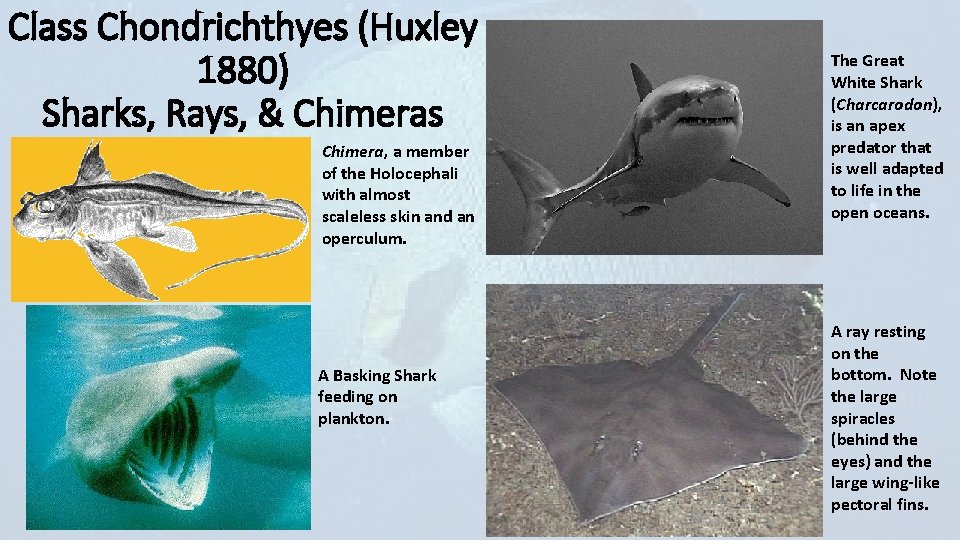
Class Chondrichthyes (Huxley 1880) Sharks, Rays, & Chimeras Chimera, a member of the Holocephali with almost scaleless skin and an operculum. A Basking Shark feeding on plankton. The Great White Shark (Charcarodon), is an apex predator that is well adapted to life in the open oceans. A ray resting on the bottom. Note the large spiracles (behind the eyes) and the large wing-like pectoral fins.
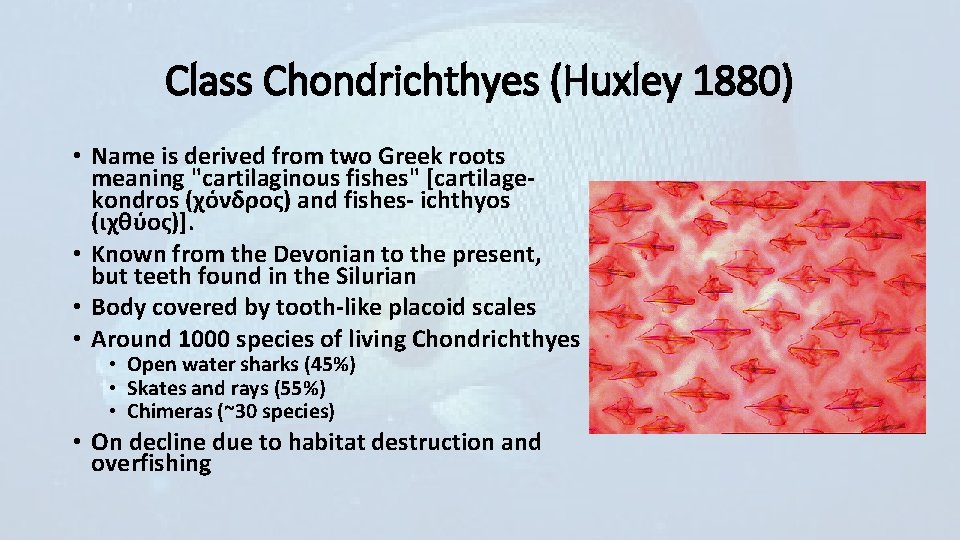
Class Chondrichthyes (Huxley 1880) • Name is derived from two Greek roots meaning "cartilaginous fishes" [cartilage- kondros (χόνδρος) and fishes- ichthyos (ιχθύος)]. • Known from the Devonian to the present, but teeth found in the Silurian • Body covered by tooth-like placoid scales • Around 1000 species of living Chondrichthyes • Open water sharks (45%) • Skates and rays (55%) • Chimeras (~30 species) • On decline due to habitat destruction and overfishing
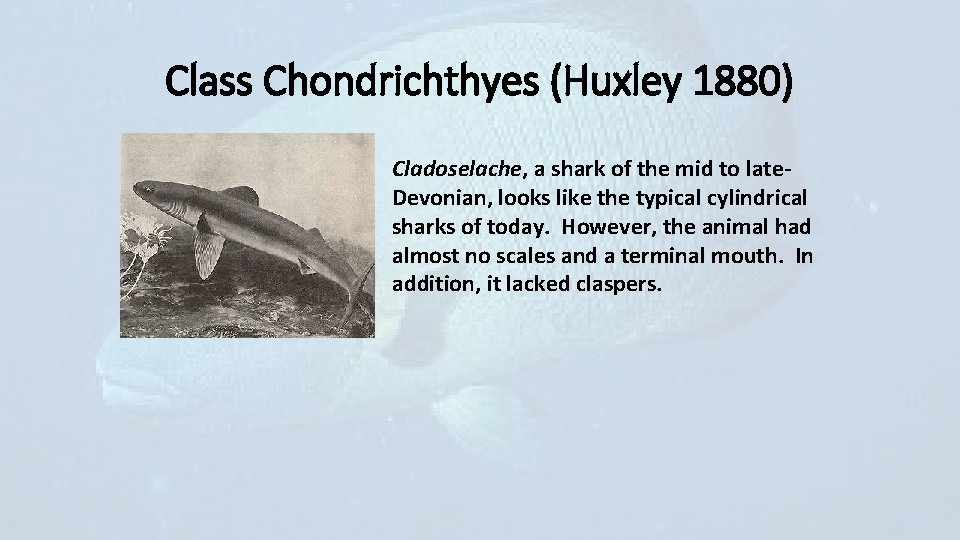
Class Chondrichthyes (Huxley 1880) Cladoselache, a shark of the mid to late. Devonian, looks like the typical cylindrical sharks of today. However, the animal had almost no scales and a terminal mouth. In addition, it lacked claspers.
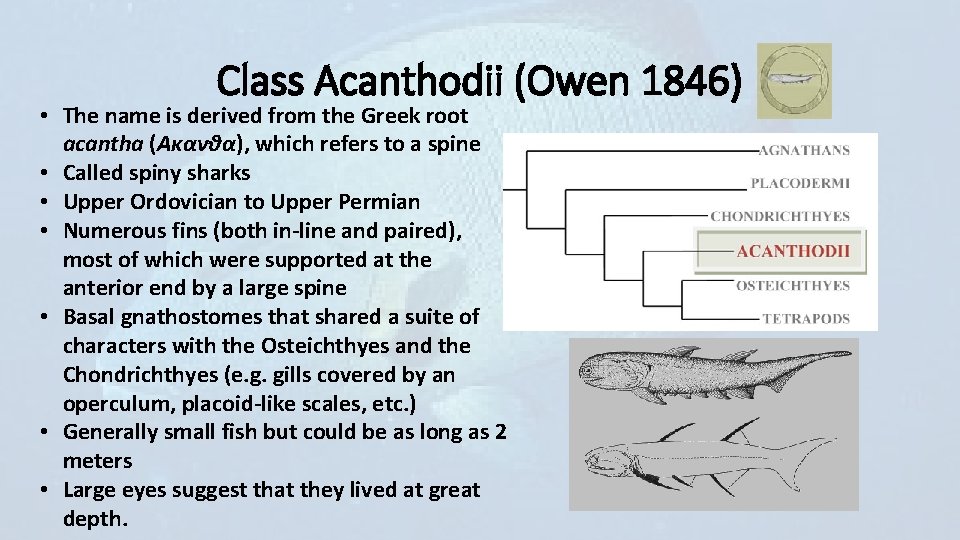
Class Acanthodii (Owen 1846) • The name is derived from the Greek root acantha (Ακανθα), which refers to a spine • Called spiny sharks • Upper Ordovician to Upper Permian • Numerous fins (both in-line and paired), most of which were supported at the anterior end by a large spine • Basal gnathostomes that shared a suite of characters with the Osteichthyes and the Chondrichthyes (e. g. gills covered by an operculum, placoid-like scales, etc. ) • Generally small fish but could be as long as 2 meters • Large eyes suggest that they lived at great depth.
Acanthodian questions • Some have placed it in the Chondrichthyes (spiny sharks) • Some have placed it in the Osteichthyes • They appeared in the Silurian and might be sisters to all other taxa with jaws • Most likely, they are sisters to the Osteichthyes
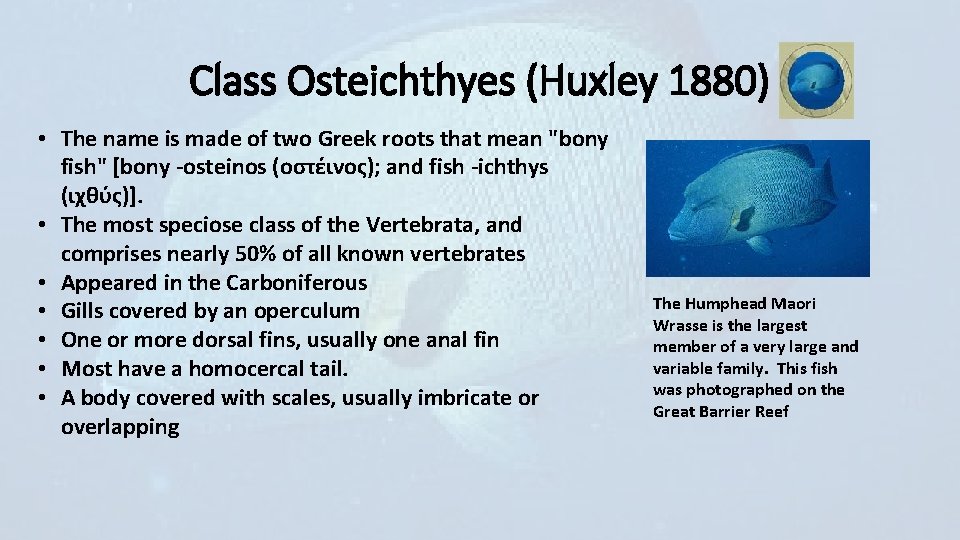
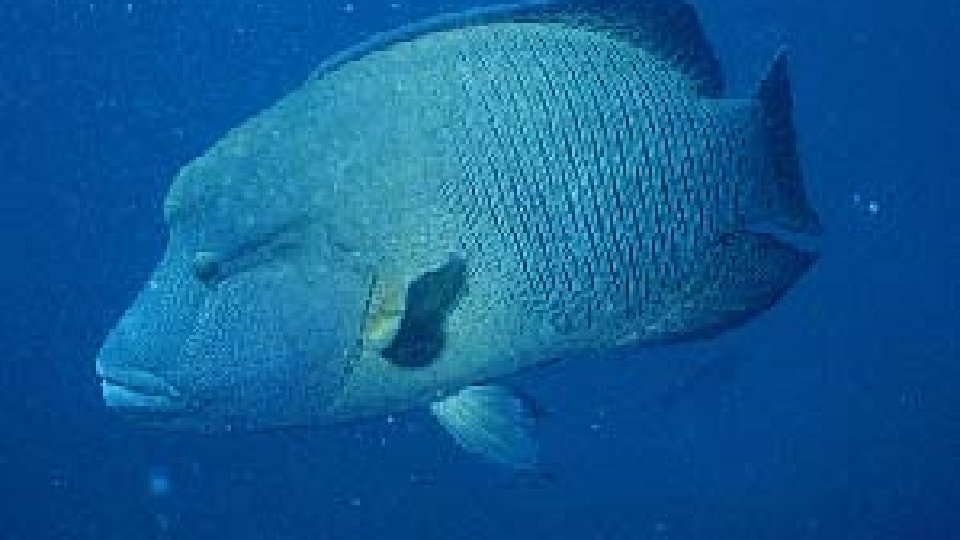
Class Osteichthyes (Huxley 1880) • The name is made of two Greek roots that mean "bony fish" [bony -osteinos (οστέινος); and fish -ichthys (ιχθύς)]. • The most speciose class of the Vertebrata, and comprises nearly 50% of all known vertebrates • Appeared in the Carboniferous • Gills covered by an operculum • One or more dorsal fins, usually one anal fin • Most have a homocercal tail. • A body covered with scales, usually imbricate or overlapping The Humphead Maori Wrasse is the largest member of a very large and variable family. This fish was photographed on the Great Barrier Reef
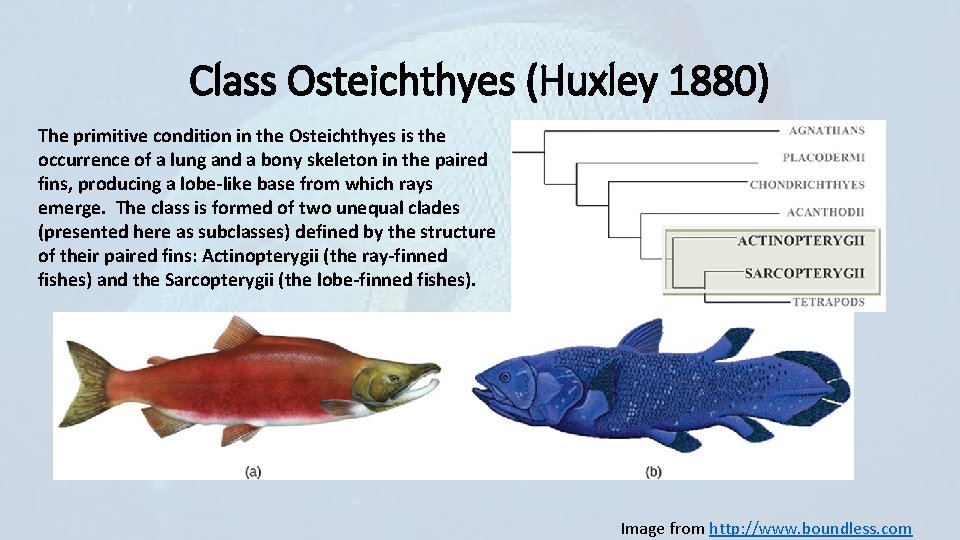
Class Osteichthyes (Huxley 1880) The primitive condition in the Osteichthyes is the occurrence of a lung and a bony skeleton in the paired fins, producing a lobe-like base from which rays emerge. The class is formed of two unequal clades (presented here as subclasses) defined by the structure of their paired fins: Actinopterygii (the ray-finned fishes) and the Sarcopterygii (the lobe-finned fishes). Image from http: //www. boundless. com
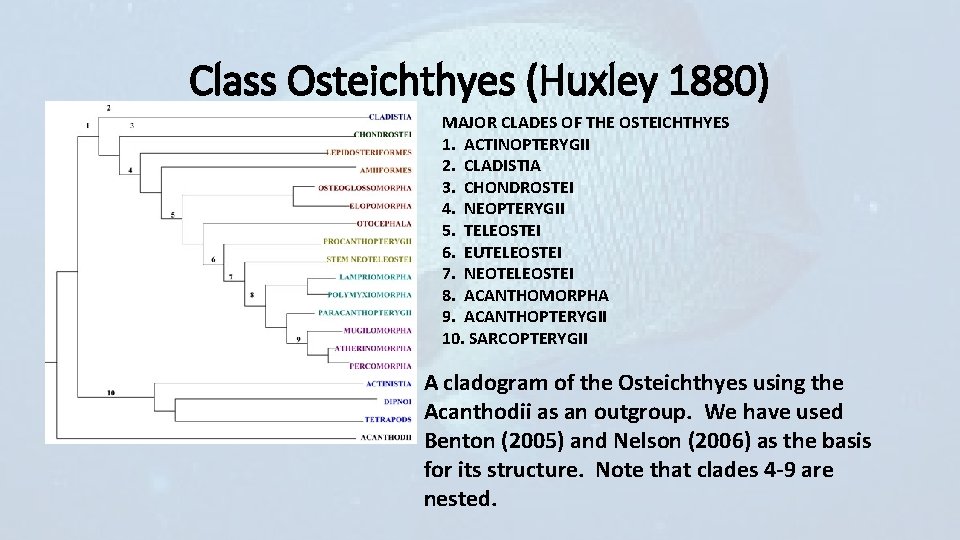
Class Osteichthyes (Huxley 1880) MAJOR CLADES OF THE OSTEICHTHYES 1. ACTINOPTERYGII 2. CLADISTIA 3. CHONDROSTEI 4. NEOPTERYGII 5. TELEOSTEI 6. EUTELEOSTEI 7. NEOTELEOSTEI 8. ACANTHOMORPHA 9. ACANTHOPTERYGII 10. SARCOPTERYGII A cladogram of the Osteichthyes using the Acanthodii as an outgroup. We have used Benton (2005) and Nelson (2006) as the basis for its structure. Note that clades 4 -9 are nested.
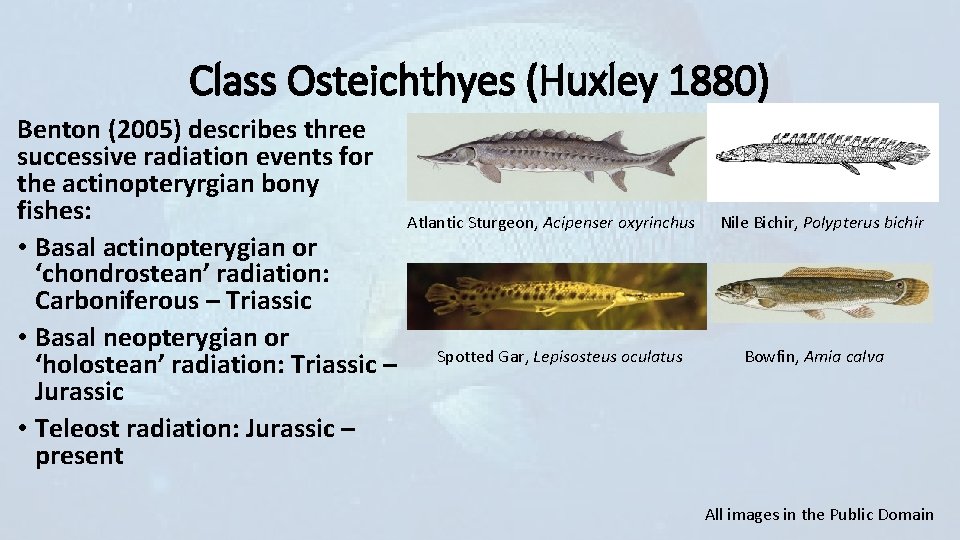
Class Osteichthyes (Huxley 1880) Benton (2005) describes three successive radiation events for the actinopteryrgian bony fishes: Atlantic Sturgeon, Acipenser oxyrinchus • Basal actinopterygian or ‘chondrostean’ radiation: Carboniferous – Triassic • Basal neopterygian or ‘holostean’ radiation: Triassic – Spotted Gar, Lepisosteus oculatus Jurassic • Teleost radiation: Jurassic – present Nile Bichir, Polypterus bichir Bowfin, Amia calva All images in the Public Domain
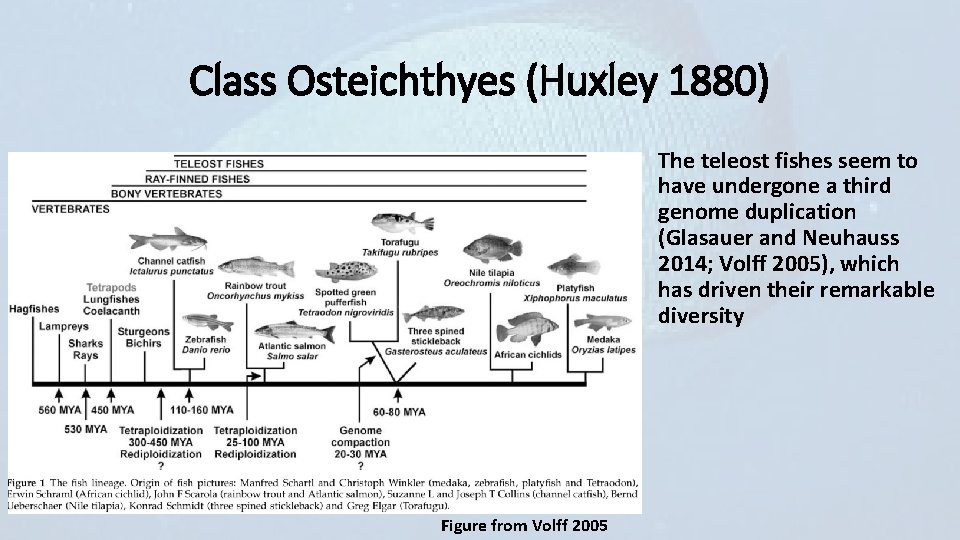
Class Osteichthyes (Huxley 1880) The teleost fishes seem to have undergone a third genome duplication (Glasauer and Neuhauss 2014; Volff 2005), which has driven their remarkable diversity Figure from Volff 2005
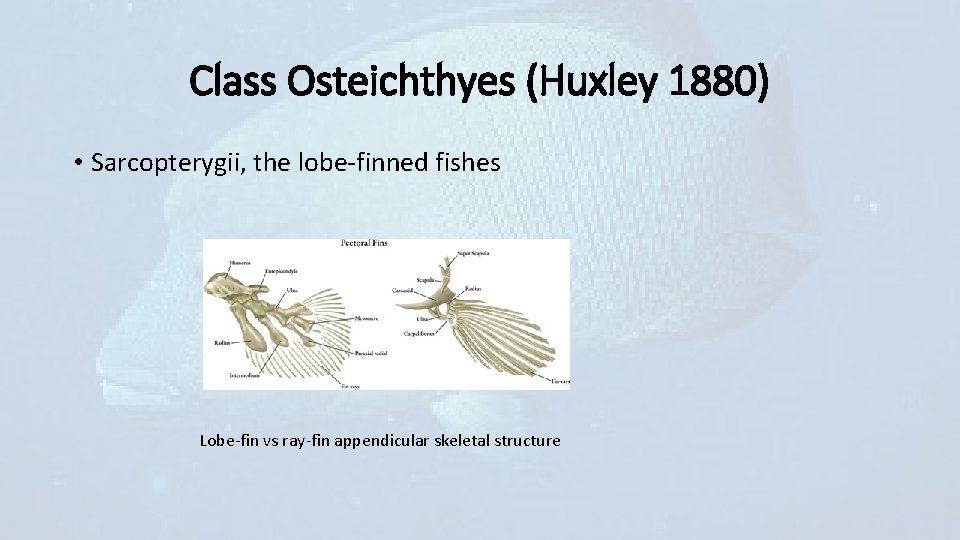
Class Osteichthyes (Huxley 1880) • Sarcopterygii, the lobe-finned fishes Lobe-fin vs ray-fin appendicular skeletal structure
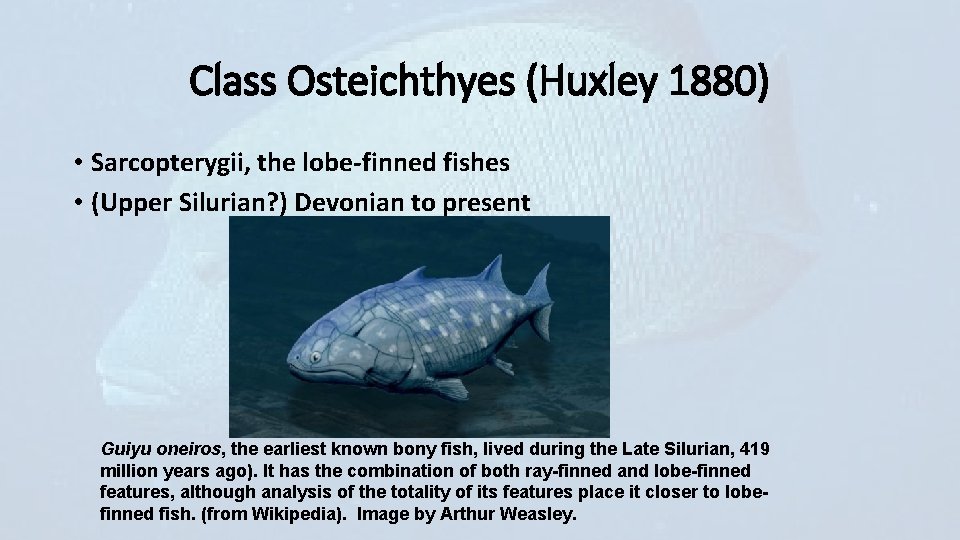
Class Osteichthyes (Huxley 1880) • Sarcopterygii, the lobe-finned fishes • (Upper Silurian? ) Devonian to present Guiyu oneiros, the earliest known bony fish, lived during the Late Silurian, 419 million years ago). It has the combination of both ray-finned and lobe-finned features, although analysis of the totality of its features place it closer to lobefinned fish. (from Wikipedia). Image by Arthur Weasley.
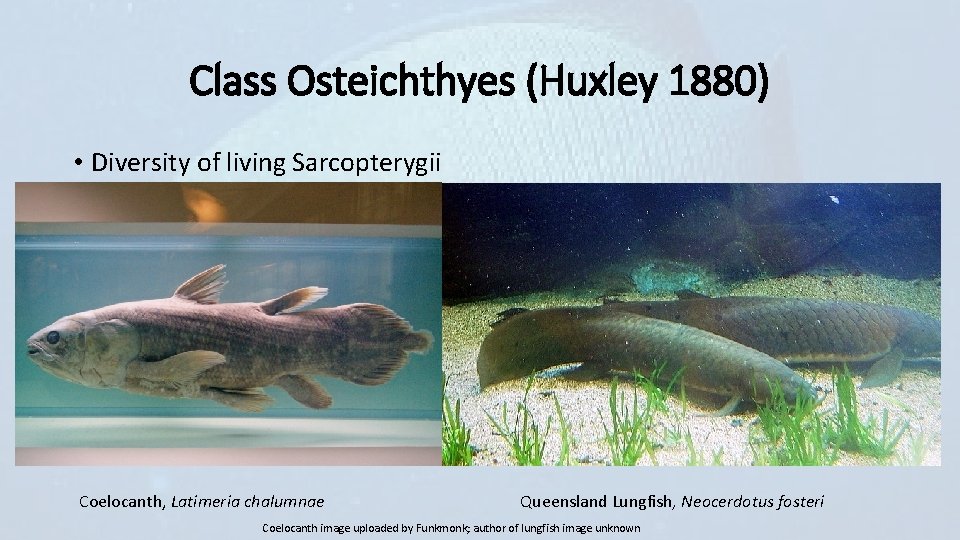
Class Osteichthyes (Huxley 1880) • Diversity of living Sarcopterygii Coelocanth, Latimeria chalumnae Queensland Lungfish, Neocerdotus fosteri Coelocanth image uploaded by Funkmonk; author of lungfish image unknown
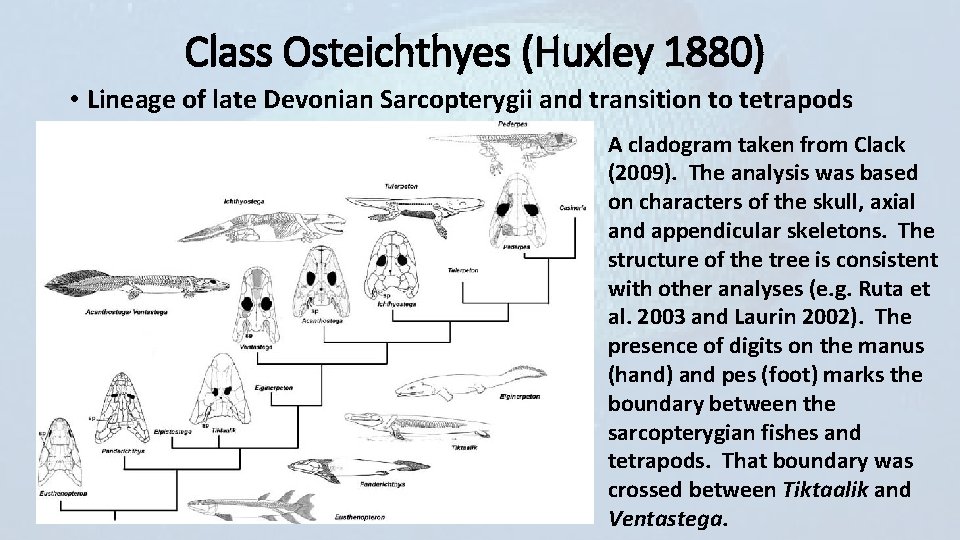
Class Osteichthyes (Huxley 1880) • Lineage of late Devonian Sarcopterygii and transition to tetrapods A cladogram taken from Clack (2009). The analysis was based on characters of the skull, axial and appendicular skeletons. The structure of the tree is consistent with other analyses (e. g. Ruta et al. 2003 and Laurin 2002). The presence of digits on the manus (hand) and pes (foot) marks the boundary between the sarcopterygian fishes and tetrapods. That boundary was crossed between Tiktaalik and Ventastega.
- Slides: 33