
The versatility of waterbased inks history and future
The versatility of water-based inks – history and future Sector Group Printing Inks German Paint and Printing Ink Association (Vd. L)
Overview History of water-based printing inks Composition of water-based printing inks Application methods and product ranges Advantages of water-based printing inks Summary and conclusion drupa 2016 Slide 2

Overview History of water-based printing inks Composition of water-based printing inks Application methods and product ranges Advantages of water-based printing inks Summary and conclusion drupa 2016 Slide 3

History of water-based inks Evolution Applications 1890 Aniline printing inks (solvent) Wrapping paper 1938 First water-based printing inks on protein-based, natural resins Cardboard and industrial paper sacks 1950 Start of polymer chemistry: modified natural resins Cardboard and industrial paper sacks 1980 Start of acrylat chemistry: Resins and dispersions Cardboard and industrial paper sacks 1990 Emission regulations: Increased demand for water-based inks! Wrapping paper, gift wraps, envelopes napkins, bakery bags, liquid food packaging, simple film printing 2015 self-crosslinking systems/hybrid Quality film printing drupa 2016 Slide 4

Water-based inks today Current applications of water-based inks Flexography: Rotogravure: Image source: Follmann Gmb. H & Co. KG Image source: Doneck Network drupa 2016 Slide 5
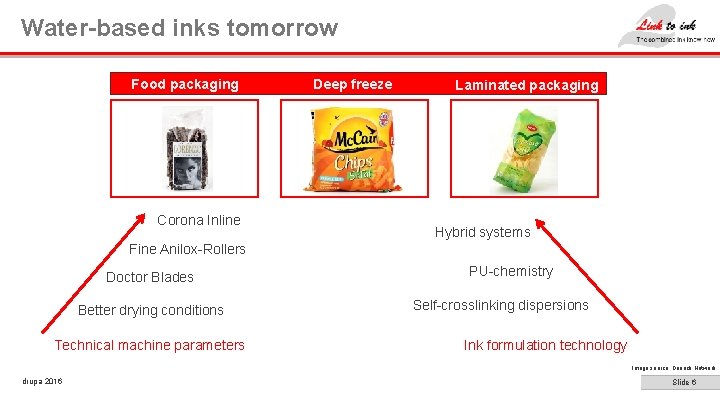
Water-based inks tomorrow Food packaging Corona Inline Deep freeze Laminated packaging Hybrid systems Fine Anilox-Rollers Doctor Blades Better drying conditions Technical machine parameters PU-chemistry Self-crosslinking dispersions Ink formulation technology Image source: Doneck Network drupa 2016 Slide 6
Overview History of water-based printing inks Composition of water-based printing inks Application methods and product ranges Advantages of water-based printing inks Summary and conclusion drupa 2016 Slide 7
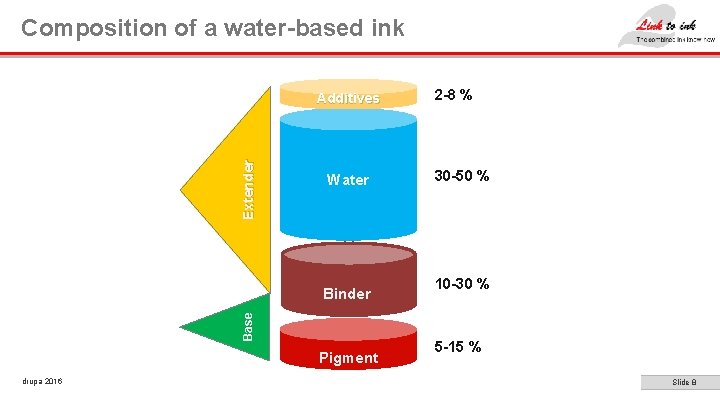
Composition of a water-based ink Extender Additives Water Base Binder Pigment drupa 2016 2 -8 % 30 -50 % 10 -30 % 5 -15 % Slide 8
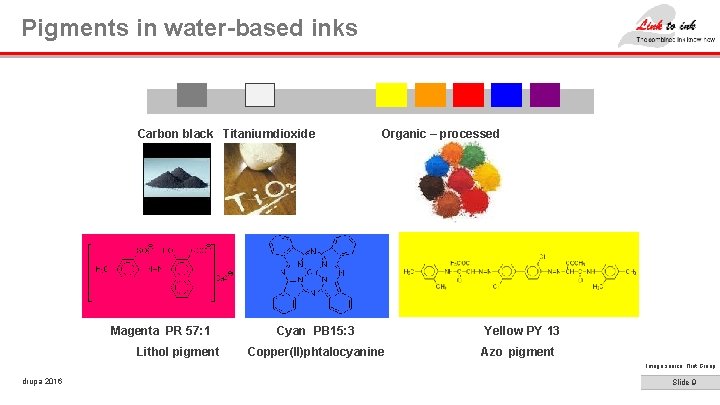
Pigments in water-based inks Carbon black Titaniumdioxide Magenta PR 57: 1 Lithol pigment Organic – processed Cyan PB 15: 3 Copper(II)phtalocyanine Yellow PY 13 Azo pigment Image source: Flint Group drupa 2016 Slide 9
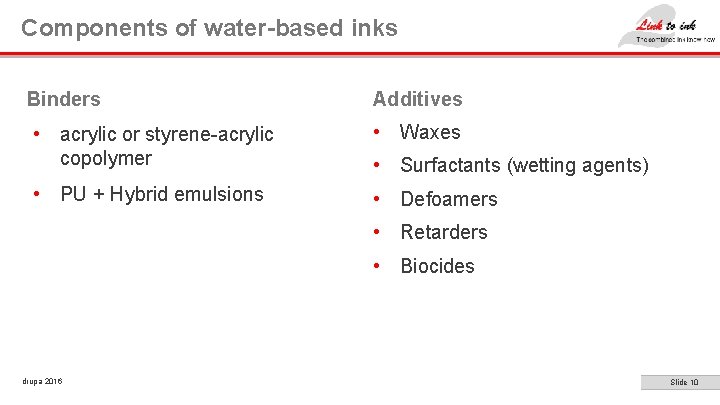
Components of water-based inks Binders Additives • acrylic or styrene-acrylic copolymer • Waxes • PU + Hybrid emulsions • Defoamers • Surfactants (wetting agents) • Retarders • Biocides drupa 2016 Slide 10
Overview History of water-based printing inks Composition of water-based printing inks Application methods and product ranges Advantages of water-based printing inks Summary and conclusion drupa 2016 Slide 11
Application Methods • Flexography • Rotogravure Both printing technologies cover a broad variety of different application areas with specific ink series. drupa 2016 Slide 12
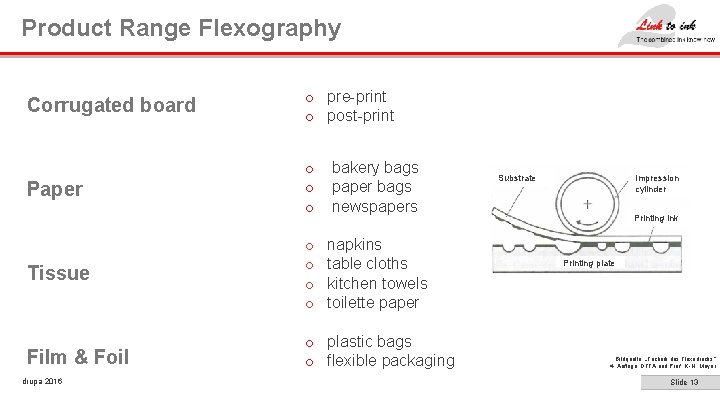
Product Range Flexography Corrugated board o pre-print o post-print Paper o o o bakery bags paper bags newspapers Tissue o o napkins table cloths kitchen towels toilette paper Film & Foil o plastic bags o flexible packaging drupa 2016 Substrate Impression cylinder Printing ink Printing plate Bildquelle: „Technik des Flexodrucks“, 4. Auflage, DFTA und Prof. K. -H. Meyer Slide 13
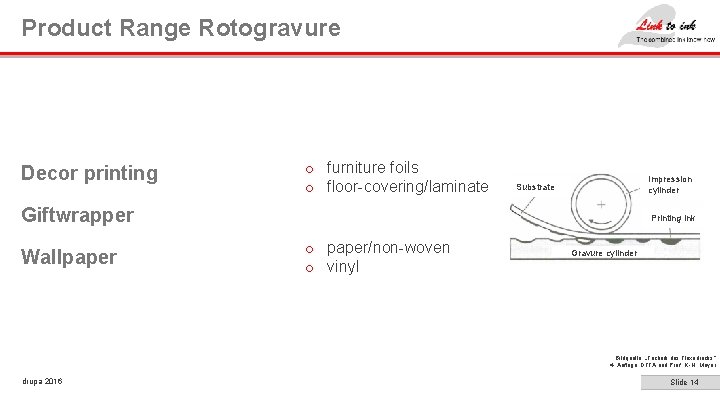
Product Range Rotogravure Decor printing o furniture foils o floor-covering/laminate Impression cylinder Substrate Giftwrapper Wallpaper Printing ink o paper/non-woven o vinyl Gravure cylinder Bildquelle: „Technik des Flexodrucks“, 4. Auflage, DFTA und Prof. K. -H. Meyer drupa 2016 Slide 14
Primer & Coatings • Primer • Effect Coatings o matt & gloss laquers • Functional Coatings o antislip coatings o barrier coatings drupa 2016 Slide 15
Overview History of water-based printing inks Composition of water-based printing inks Application methods and product ranges Advantages of water-based printing inks Summary and conclusion drupa 2016 Slide 16

Broad Technical scope Absorbent substrates Non Absorbent substrates • Good print hold out, cost effectiveness, excellent printability characterize waterbased inks. Traditional limitations are being overcome e. g. high speed printing, chemical resistances. • • Can be used advantageously in combination with other ink technologies and print techniques in a wide range of applications. Market requirements for technical performance can be achieved, eg printing speed, print resistance, bond strength. Water-based inks gain ground as a complementing technology in this application field. • Technology is characterised by High colour strength coloured bases. Consequently low ink film weights can be applied with associated advantages. drupa 2016 Slide 17
Socially and Environmentally responsible Environmental profile Workplace safety • VOC emissions are very low. • • Waste water produced can be readily cleaned limiting the impact of water consumption. Water-based inks are non flammable and do not require special workplace precautions relating to flammability. • Solvent contents are reduced to a minimum - need for surveillance of workers health with respect to solvent exposure is low. • Work to develop monomers produced from bio-reactors is well advanced, leading to a possibility to decrease dependence of fossil fuel based feedstocks in the future. drupa 2016 Slide 18
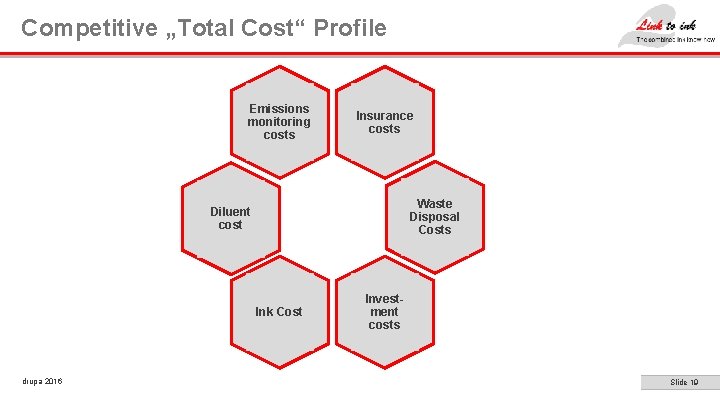
Competitive „Total Cost“ Profile Emissions monitoring costs Insurance costs Waste Disposal Costs Diluent cost Ink Cost drupa 2016 Investment costs Slide 19
Overview History of water-based printing inks Composition of water-based printing inks Application methods and product ranges Advantages of water-based printing inks Summary and conclusion drupa 2016 Slide 20
Summary and conclusion Water-based inks gain in importance: • Modern ink formulations and adjusted printing/technical parameters open up a broad variety of applications. • Water-based inks are in accordance with Eu. PIA Exclusion Policy and can fulfill regulatory requirements for food packaging if neccessary. • Main applications are flexo and gravure printing with a large product range including laminated food packaging. • Water-based inks offer a positive environmental profile. • Due to their composition handling of waterbased inks is non-critical. • Total cost profile is competitive. drupa 2016 Slide 21
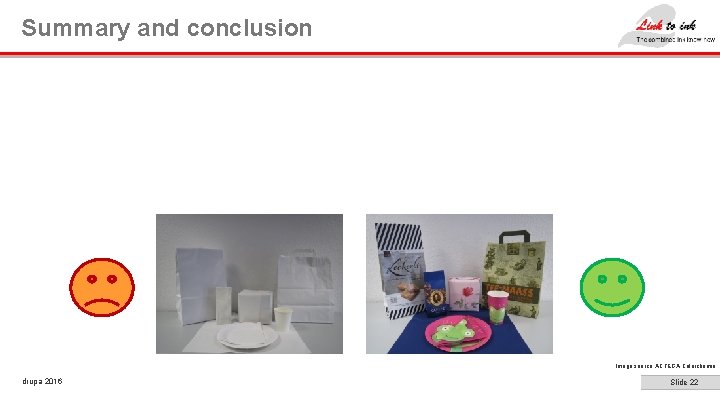
Summary and conclusion Water-based inks are already being used widely due to their strengths today. In the future they will take their rightful place in each application. Image source: ACTEGA Colorchemie drupa 2016 Slide 22
Thank you for your attention! Sector Group Printing Inks German Paint and Printing Ink Association Mainzer Landstraße 55 60329 Frankfurt am Main Germany Phone: E-Mail: Web: © Sector Group Printing Inks of the German Paint and Printing Ink Association (Vd. L) +49 69 2556 -1411 vdl@vci. de www. druckfarben-vdl. de Image source front page: https: //de. fotolia. com
- Slides: 23