
The VBMAPP Conducting the Assessment and Identifying Intervention
The VB-MAPP: Conducting the Assessment and Identifying Intervention Priorities Mark L. Sundberg, Ph. D. , BCBA-D (www. marksundberg. com)
The Importance of Assessment • • • Assessment (analysis) drives the intervention An initial assessment provides a baseline (operant skill level) On-going assessment provides tracking and outcome data On-going assessment can guide program adjustments The failure to conduct an adequate assessment can result in an inappropriate and ineffective daily curriculum for a child, as well as a waste of valuable time and resources
What Should be Assessed for Children with Autism? • It is essential to identify a child’s existing verbal, nonverbal, and social skills (e. g. , mands, echoics, listener skills, peer initiation) • It is also essential to identify the language, social, behavioral, and learning barriers that are preventing more effective skill acquisition • Most common language assessment tools for children with autism fail to provide this necessary information (Esch, La. Londe, & Esch, 2010) • For example, 28 out of 30 assessments fail to assess a child’s mand repertoire (Esch et al, 2010), and none provide a barriers assessment
The Value of a Criterion-Referenced Assessment • Norm-referenced vs. criterion-referenced • A norm-referenced tests ranks and sorts students using percentile measures relative to a large sample of same-aged peers (e. g. , IQ tests, SAT, PPVT, “Bell curve”) • A criterion-referenced test provides a measure of a student’s mastery of a pre-determined group of skills (e. g. , math skills) • A criterion-referenced test provides specific information as to what a student (or professional) can or cannot do in a certain domain (e. g. , manding, tacting, national board medical exam, BACB exam) • A criterion-referenced assessment provides the operant level (baseline) of a domain of skills for an individual learner, and can directly point to intervention needs and priorities
A Behavioral Approach to Assessment for Children with Autism • Basic behavioral concepts and principles allow professionals to identify and quantify learning, as well as barriers (e. g. , motivation, reinforcement, stimulus control, discrimination, generalization) • Behavioral analyses of typical human development provide a frame of reference for an assessment (e. g. , Bijou & Baer, Schlinger, 1996, Novak & Pelaez, 2003) • Skinner’s (1957) analysis of verbal behavior provides a behavioral framework of language and social behavior that can be used to identify skills and deficits in a manner that other theories of language do not (Sundberg & Michael, 2001)
Verbal Behavior Milestones Assessment and Placement Program: The VB-MAPP • Based on the concepts and principles of behavior analysis and Skinner’s (1957) analysis of verbal behavior • Based on typical social and linguistic developmental milestones • Represents an on-going 35 -year refinement and progression of a behavioral approach to language and social skill assessment (Sundberg, 1980, 1983; Sundberg, 1990; Partington & Sundberg, 1998) • The VB-MAPP has been heavily influenced by my mentors, Jack Michael and Joe Spradlin
The Value of Skinner’s Analysis of Language • Expands and clearly delineates the traditional categories of expressive and receptive language • “Expressive language” is expanded across the verbal operants • • • echoic (motor imitation, copying-a-text) mand tact intraverbal textual transcriptive • “Receptive language” is expanded to four distinct repertoires • • listener discriminations (receptive language) audience participation mediator of reinforcement emotional responder

Verbal Behavior Milestones Assessment and Placement Program: The VB-MAPP • There are five components of the VB-MAPP • The VB-MAPP: Milestones Assessment measures 16 domains with 170 language, learning, and social milestones, across 3 developmental levels (0 -18 months, 18 -30 months, 30 -48 months) • The VB MAPP: Barriers Assessment examines 24 common learning and language barriers faced by children with autism • The VB MAPP: Transition Assessment is a summary assessment of 18 domains and can serve as a guide for planning a child’s educational needs
Verbal Behavior Milestones Assessment and Placement Program: The VB-MAPP • The VB-MAPP: Supporting Skills and Task Analysis provides a checklist of hundreds of additional skills that may not warrant milestone status, but support the development of each of the domains (e. g. , mands for attention, tacts of auditory stimuli) • In addition, this section contains a task analysis of the 170 milestones, which is valuable for those progressing at a slower rate • The VB-MAPP: Placement and IEP Goals provides recommendations for program development for children based on their VB-MAPP profiles, and their specific scores for each of the 170 milestones and the 24 Barriers • Also contains over 200 IEP objectives directly linked to the milestones and barriers assessments
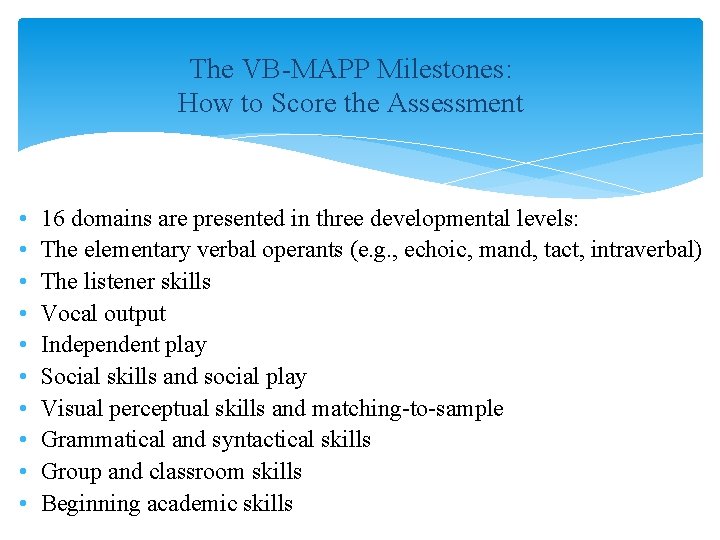
The VB-MAPP Milestones: How to Score the Assessment • • • 16 domains are presented in three developmental levels: The elementary verbal operants (e. g. , echoic, mand, tact, intraverbal) The listener skills Vocal output Independent play Social skills and social play Visual perceptual skills and matching-to-sample Grammatical and syntactical skills Group and classroom skills Beginning academic skills
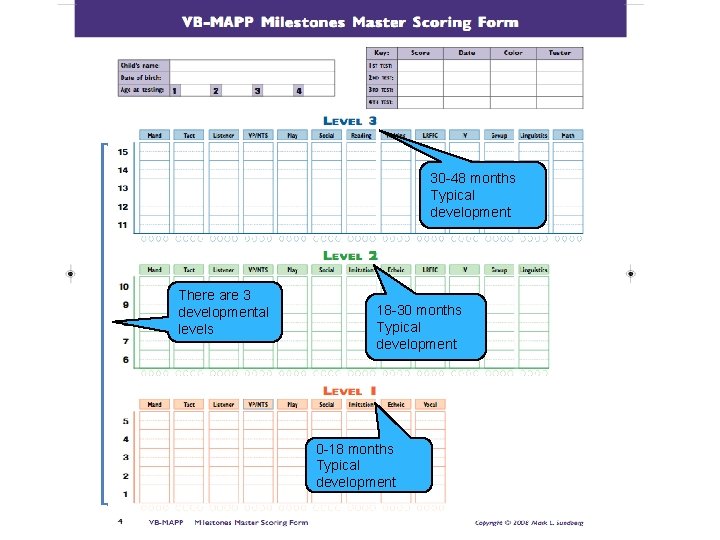
30 -48 months Typical development There are 3 developmental levels 18 -30 months Typical development 0 -18 months Typical development
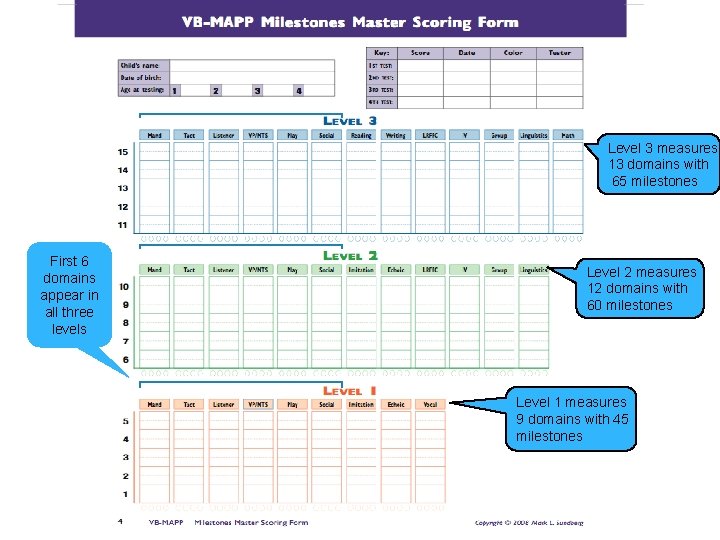
Level 3 measures 13 domains with 65 milestones First 6 domains appear in all three levels Level 2 measures 12 domains with 60 milestones Level 1 measures 9 domains with 45 milestones
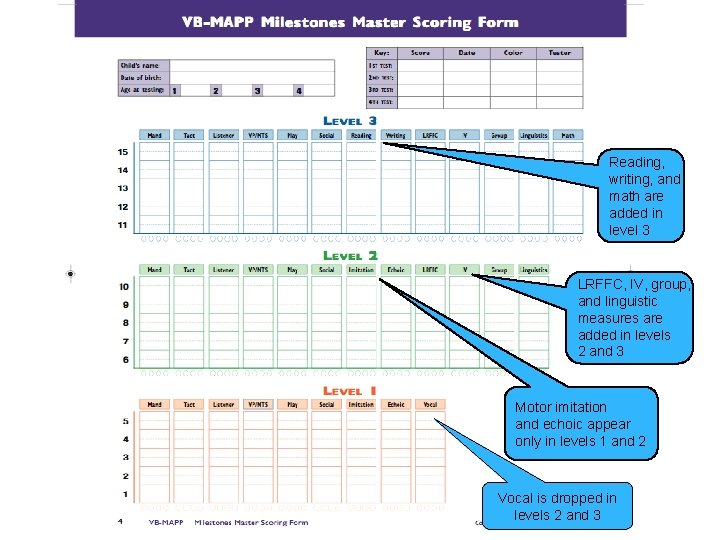
Reading, writing, and math are added in level 3 LRFFC, IV, group, and linguistic measures are added in levels 2 and 3 Motor imitation and echoic appear only in levels 1 and 2 Vocal is dropped in levels 2 and 3

Sophie A. 7/1/11 3 yrs. MS 7/23/14 Enter tester(s) Enter the child’s personal information How to score the cells: Mand Level 1 Enter date Enter color
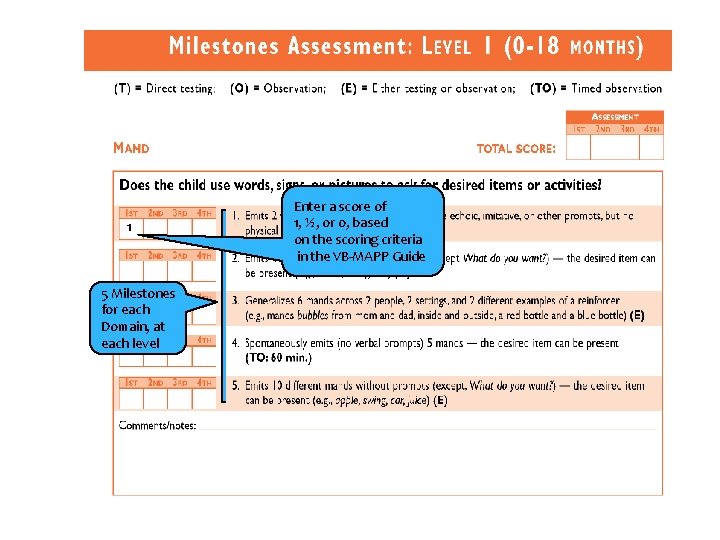
1 5 Milestones for each Domain, at each level Enter a score of 1, ½, or 0, based on the scoring criteria in the VB-MAPP Guide
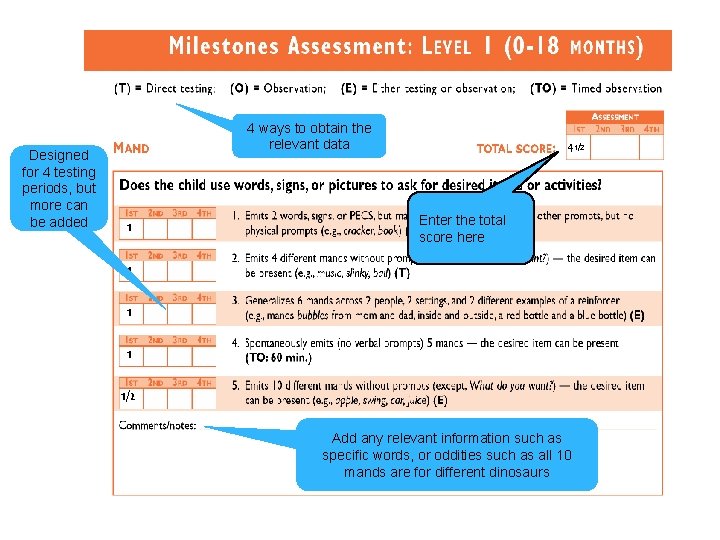
Designed for 4 testing periods, but more can be added 4 ways to obtain the relevant data 1 41/2 Enter the total score here 1 1/2 Add any relevant information such as specific words, or oddities such as all 10 mands are for different dinosaurs
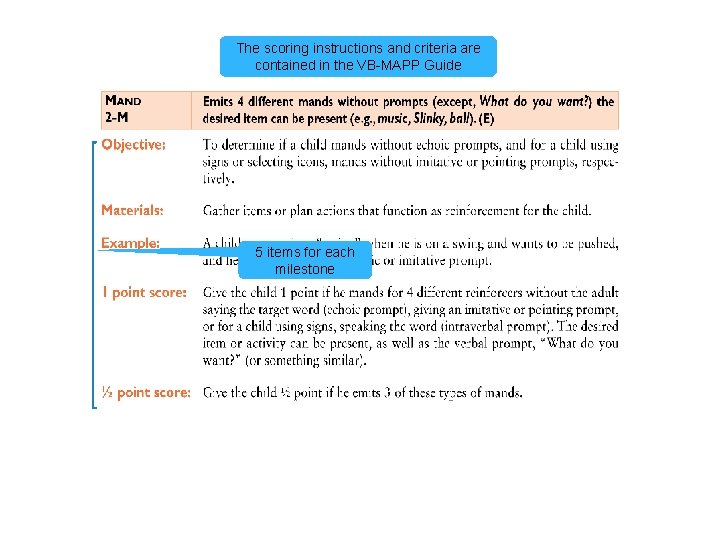
The scoring instructions and criteria are contained in the VB-MAPP Guide 5 items for each milestone
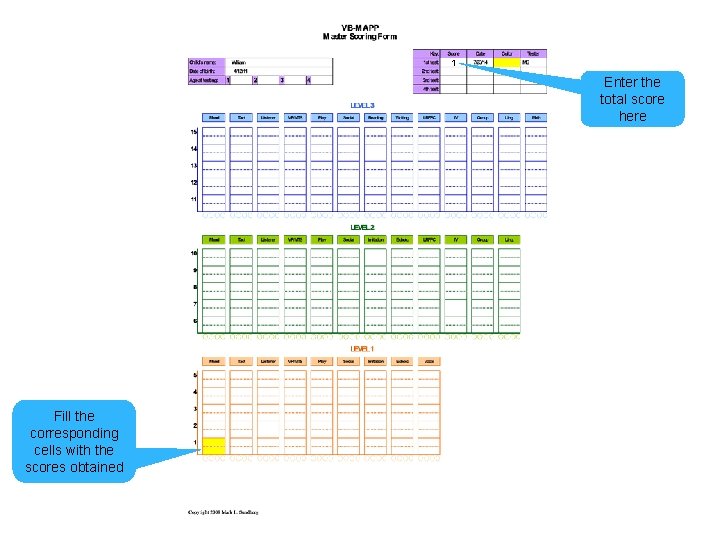
1 Enter the total score here Fill the corresponding cells with the scores obtained
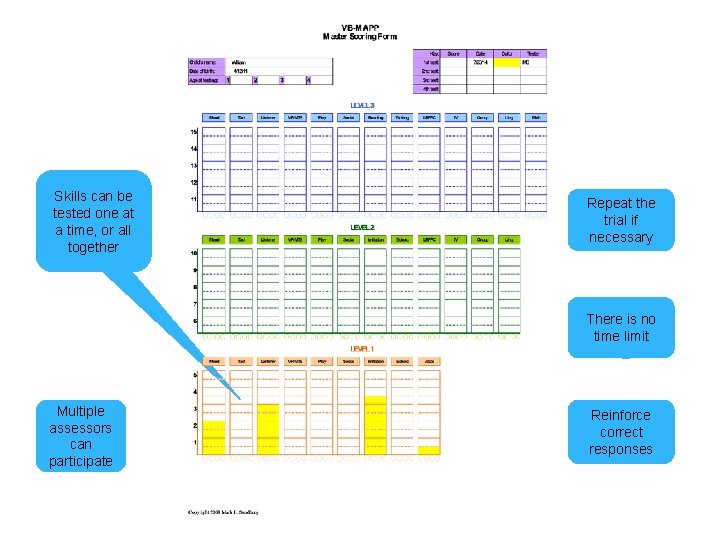
Skills can be tested one at a time, or all together Repeat the trial if necessary There is no time limit Multiple assessors can participate Reinforce correct responses
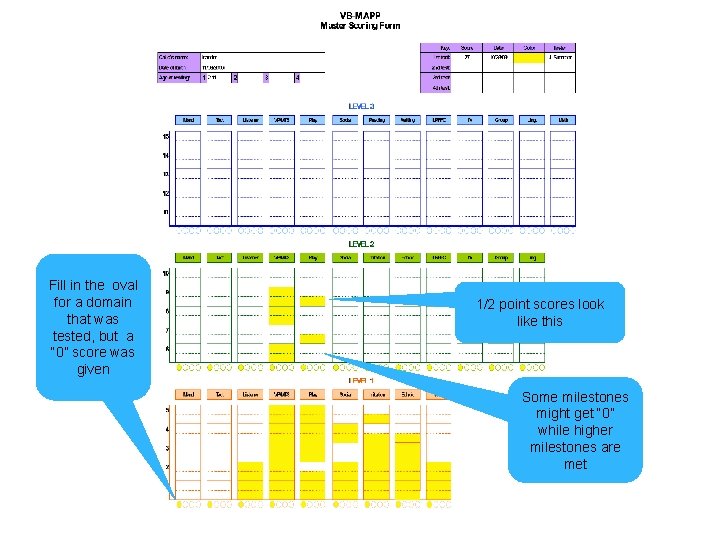
Fill in the oval for a domain that was tested, but a “ 0” score was given 1/2 point scores look like this Some milestones might get “ 0” while higher milestones are met
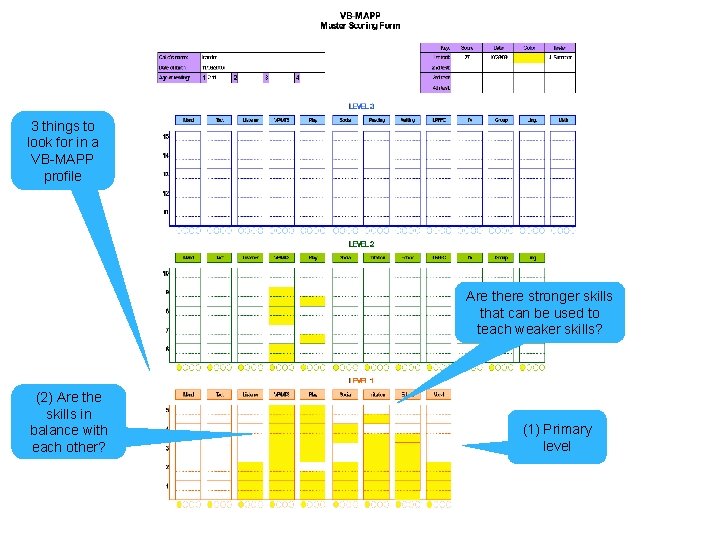
3 things to look for in a VB-MAPP profile Are there stronger skills that can be used to teach weaker skills? (2) Are the skills in balance with each other? (1) Primary level
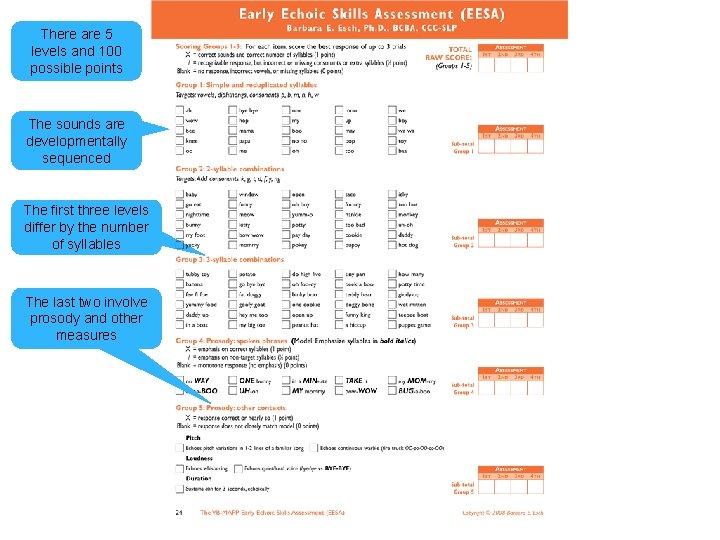
There are 5 levels and 100 possible points The sounds are developmentally sequenced The first three levels differ by the number of syllables The last two involve prosody and other measures
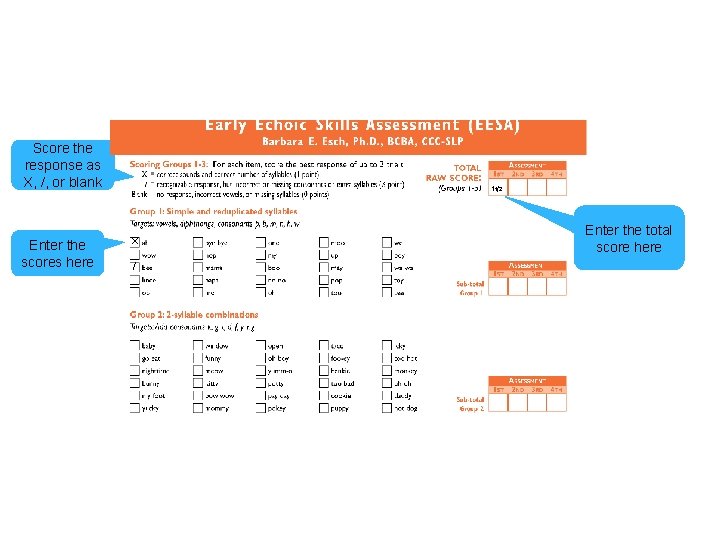
Score the response as X, /, or blank Enter the scores here 11/2 X / Enter the total score here
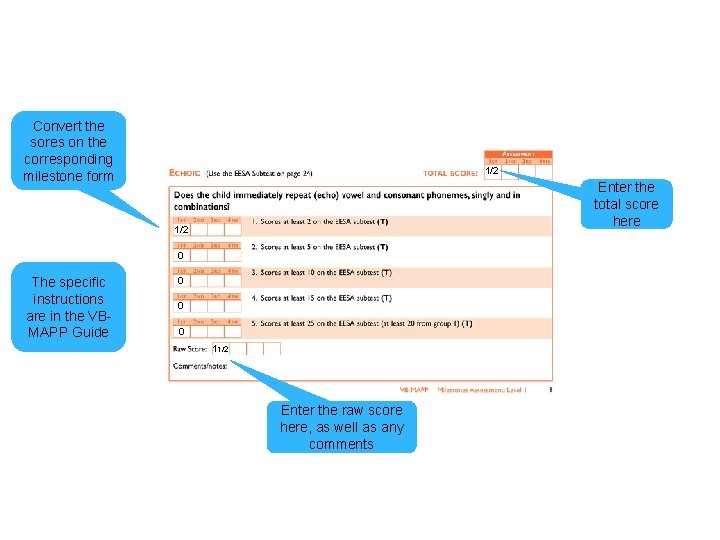
Convert the sores on the corresponding milestone form 1/2 Enter the total score here 1/2 0 The specific instructions are in the VBMAPP Guide 0 0 0 11/2 Enter the raw score here, as well as any comments
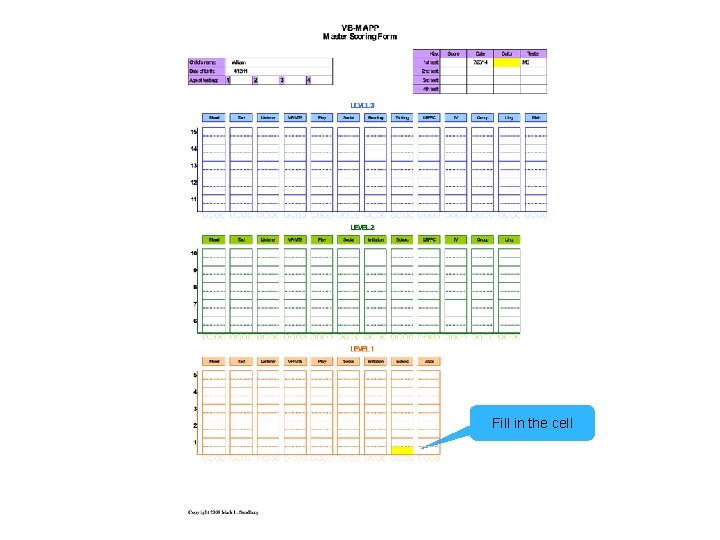
Fill in the cell
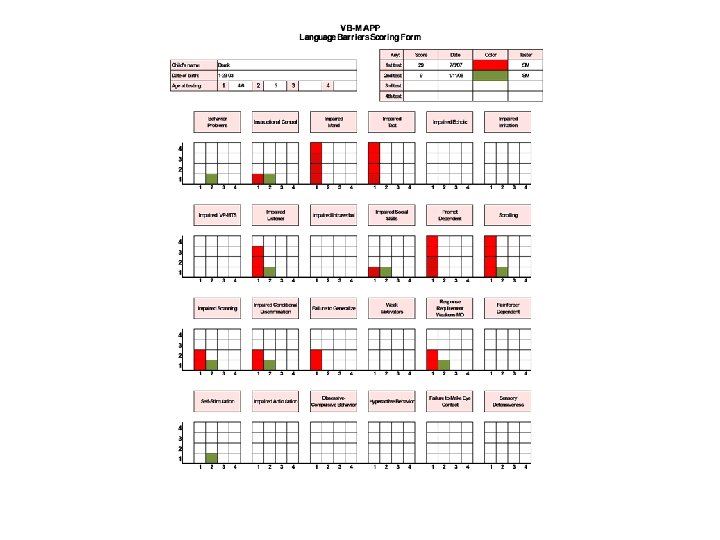
The VB-MAPP Barriers Assessment • It is important to find out what a child can do (The VB-MAPP Milestones Assessment), but also important to know problems, challenges, and barriers he faces • The VB-MAPP Barriers Assessment is a tool that is designed to identify and score 24 different learning and language acquisition barriers • Once a specific barrier has been identified, a more detailed descriptive and/or functional analysis of that problem is required • An individualized functional or descriptive analysis will be necessary to determine the nature of the problem for a specific child, and what intervention program might be appropriate
The VB-MAPP Barriers Assessment • There are several different types of barriers that can affect learning and language development • Strong and persistent negative behaviors that impede teaching and learning (e. g. , non-compliance, tantrums, aggression, SIB) • Verbal operants or related skills that are absent, weak, or in some way impaired (e. g. , echolalia, rote intraverbals, “mands” that are really tacts) • Social behavior and the speaker-listener dyad can also become impaired for a variety of reasons (e. g. , limited motivation for social interaction, impaired mands, impaired listener skills)
The VB-MAPP Barriers Assessment • Fundamental barriers to learning that must be analyzed and ameliorated (e. g. , the failure to generalize, weak motivators, prompt dependency) • Specific behaviors that can compete with learning (e. g. , selfstimulation, hyperactive behavior, or sensory defensiveness) • Problems related to physical, medical, or biological barriers that must be overcome or accounted for in some way (e. g. , articulation or motor imitation errors may be due to physical limitations, matching errors may be due to visual limitations, listener errors may be related to hearing problems, poor performance may be due to illness, sleep deprivation, severe allergies, pain, etc. )
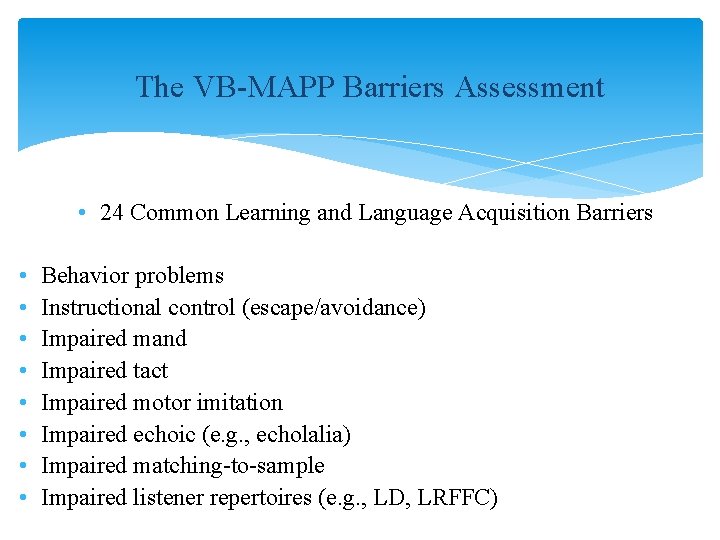
The VB-MAPP Barriers Assessment • 24 Common Learning and Language Acquisition Barriers • • Behavior problems Instructional control (escape/avoidance) Impaired mand Impaired tact Impaired motor imitation Impaired echoic (e. g. , echolalia) Impaired matching-to-sample Impaired listener repertoires (e. g. , LD, LRFFC)
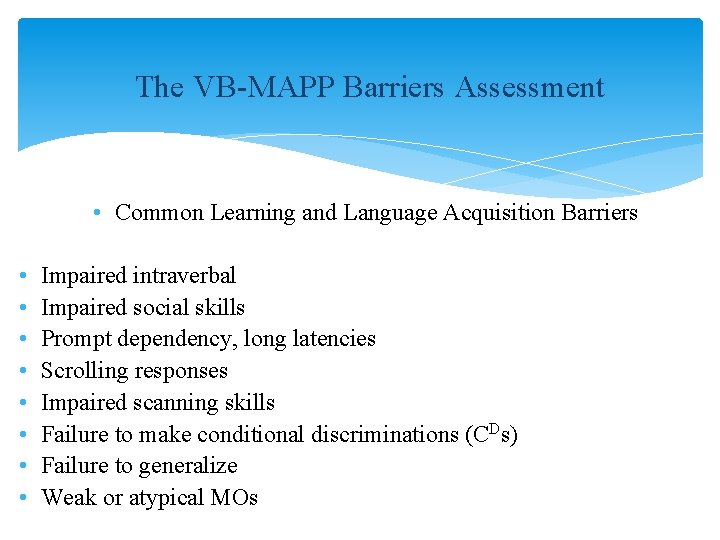
The VB-MAPP Barriers Assessment • Common Learning and Language Acquisition Barriers • • Impaired intraverbal Impaired social skills Prompt dependency, long latencies Scrolling responses Impaired scanning skills Failure to make conditional discriminations (CDs) Failure to generalize Weak or atypical MOs
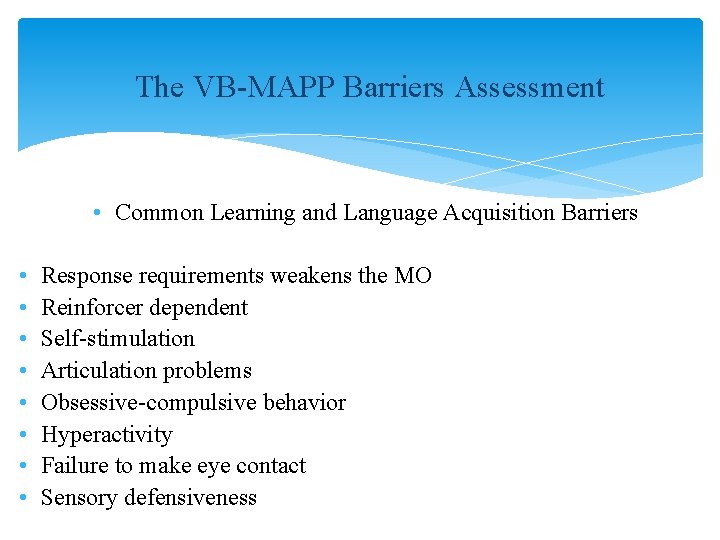
The VB-MAPP Barriers Assessment • Common Learning and Language Acquisition Barriers • • Response requirements weakens the MO Reinforcer dependent Self-stimulation Articulation problems Obsessive-compulsive behavior Hyperactivity Failure to make eye contact Sensory defensiveness
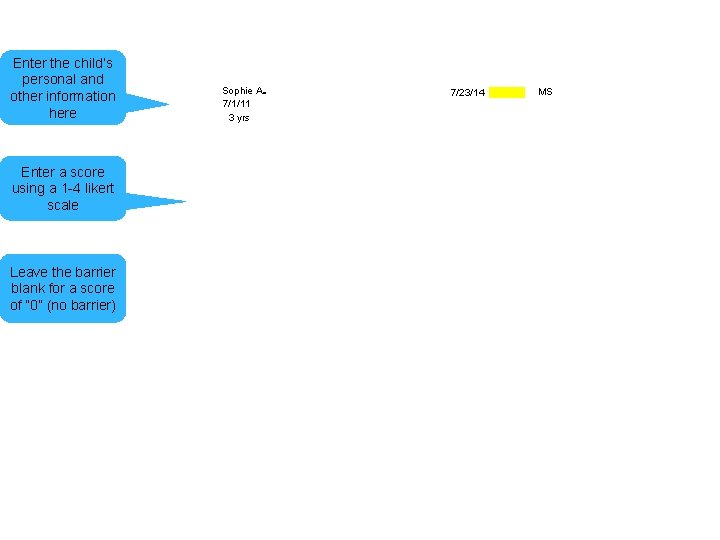
Enter the child’s personal and other information here Enter a score using a 1 -4 likert scale Leave the barrier blank for a score of “ 0” (no barrier) . Sophie A 7/1/11 3 yrs 7/23/14 MS
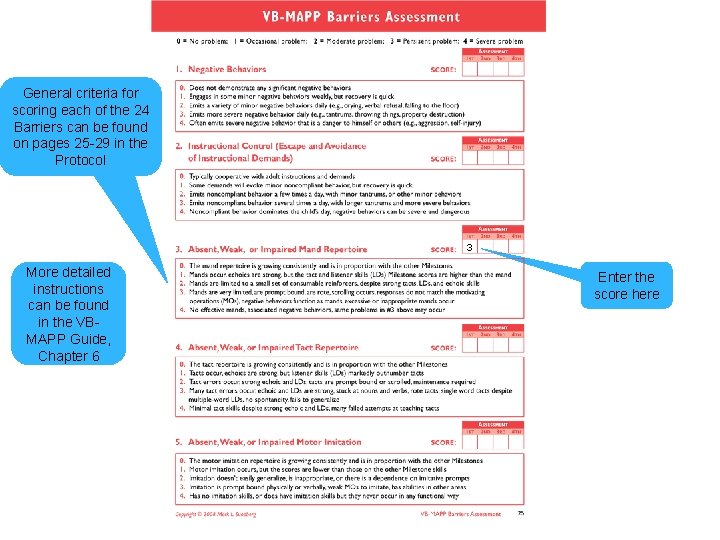
General criteria for scoring each of the 24 Barriers can be found on pages 25 -29 in the Protocol 3 More detailed instructions can be found in the VBMAPP Guide, Chapter 6 Enter the score here
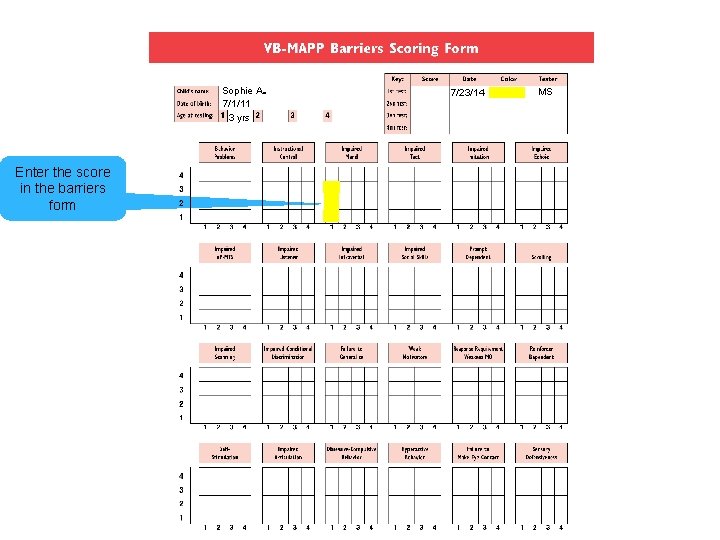
. Sophie A 7/1/11 3 yrs Enter the score in the barriers form 7/23/14 MS
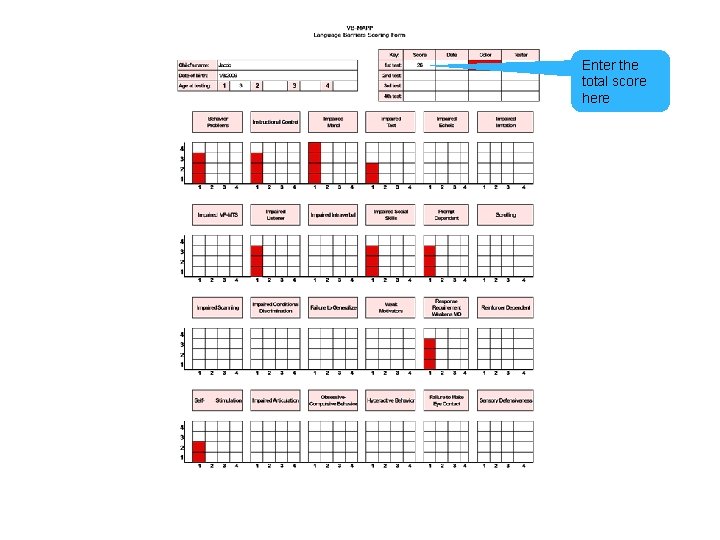
Enter the total score here
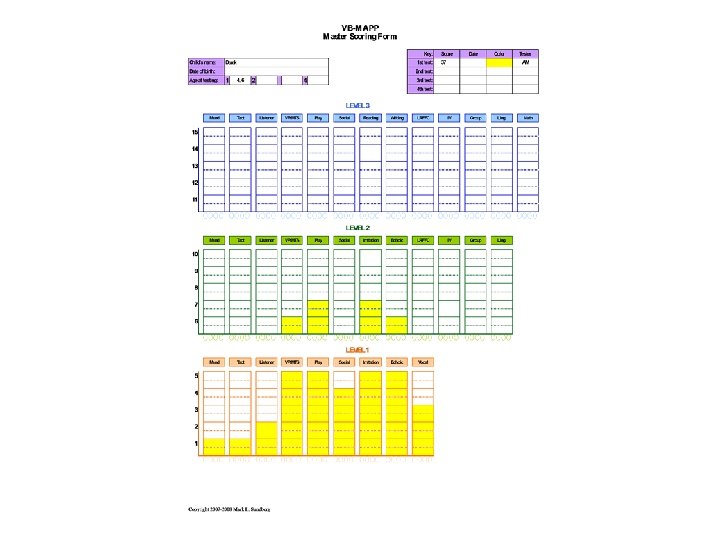
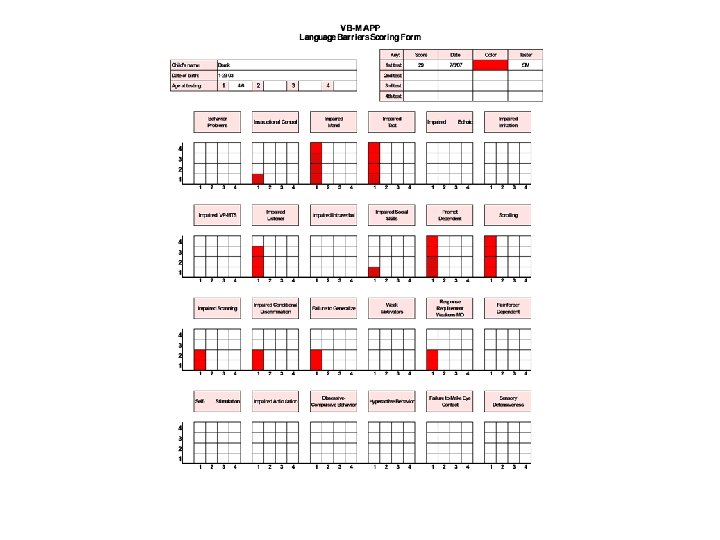
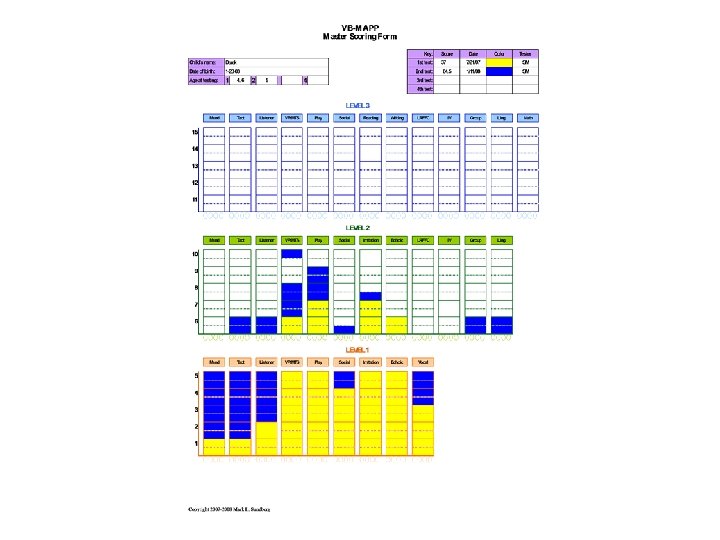
The VB-MAPP Transition Assessment • A common goal for many educators and parents of children with special needs is to integrate the child into a mainstream setting • There are many different levels of integration and the Transition Assessment was designed to identify the skills that increase the probability that a child will be successful in a less restrictive setting • No single skill will be a good determiner of success, but a collective body of skills can help educators and parents make decisions • The VB-MAPP Transition Assessment provides a tool to help determine if a child has the necessary prerequisite skills to learn in a less restrictive classroom environment • There are 18 skill areas on the Transition Assessment
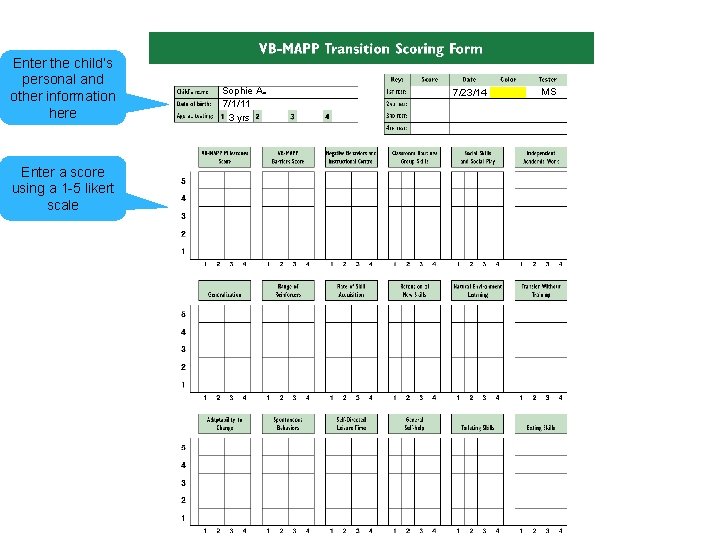
Enter the child’s personal and other information here Enter a score using a 1 -5 likert scale . Sophie A 7/1/11 3 yrs 7/23/14 MS
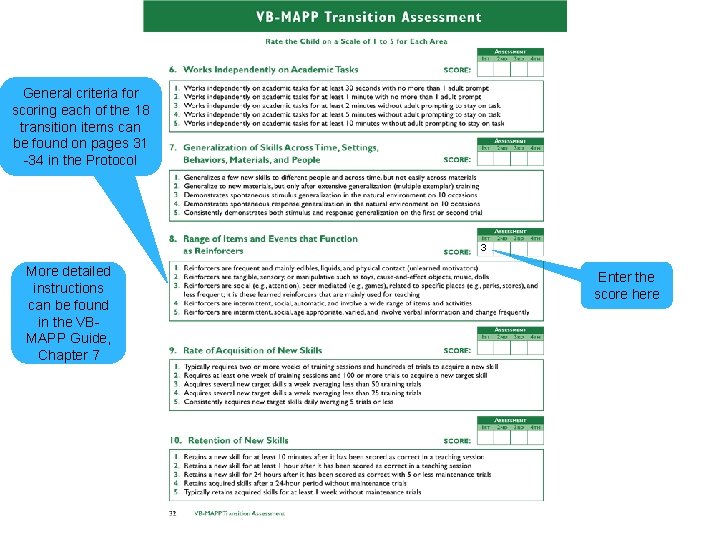
General criteria for scoring each of the 18 transition items can be found on pages 31 -34 in the Protocol 3 More detailed instructions can be found in the VBMAPP Guide, Chapter 7 Enter the score here
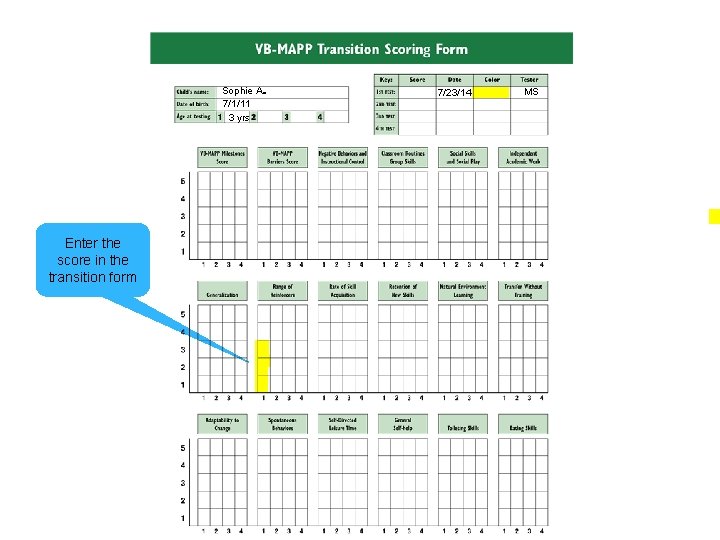
. Sophie A 7/1/11 3 yrs Enter the score in the transition form 7/23/14 MS

Enter the total score here
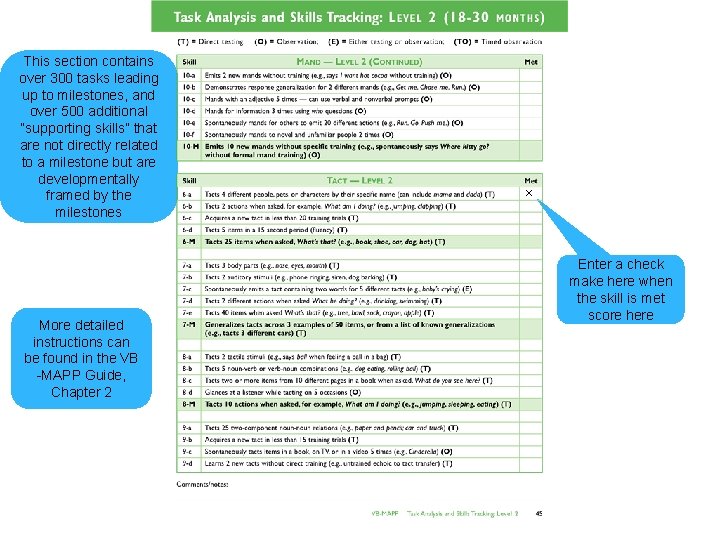
This section contains over 300 tasks leading up to milestones, and over 500 additional “supporting skills” that are not directly related to a milestone but are developmentally framed by the milestones More detailed instructions can be found in the VB -MAPP Guide, Chapter 2 X Enter a check make here when the skill is met score here
6 -a, 6 -c, & 6 -d are supporting skills; 6 -b is part of the milestones task analysis
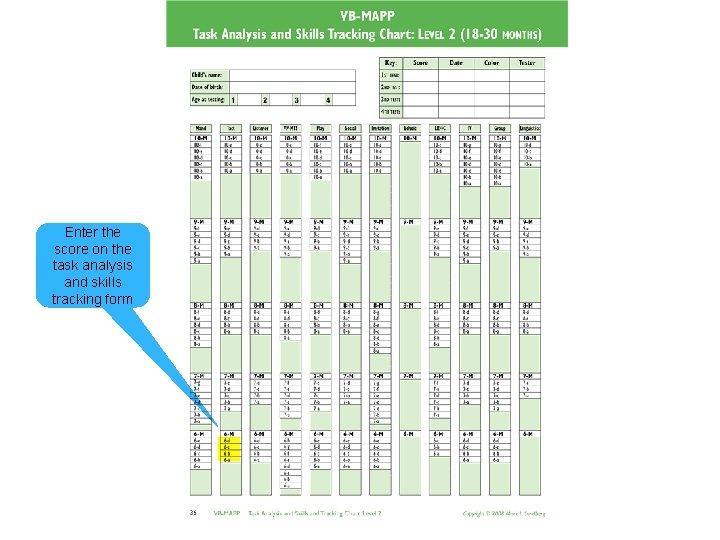
Enter the score on the task analysis and skills tracking form

The VB-MAPP Placement and IEP Goals • The placement section (VB-MAPP Guide, chapters 8 -10) contains an interpretation and suggestions for programming for all 170 milestones • It also contains over 200 template IEP goals covering all 170 milestones
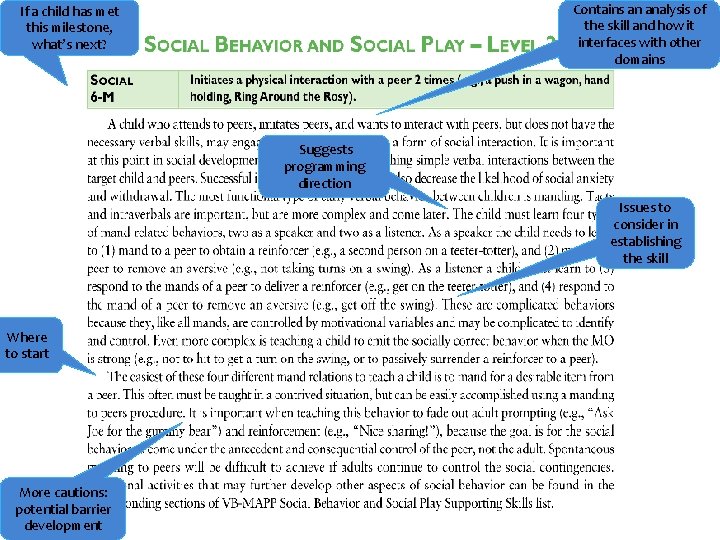
Contains an analysis of the skill and how it interfaces with other domains If a child has met this milestone, what’s next? Suggests programming direction Issues to consider in establishing the skill Where to start More cautions: potential barrier development
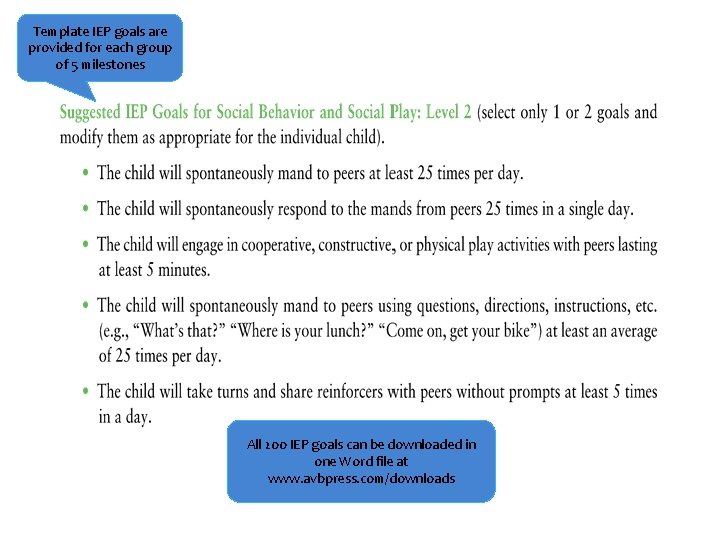
Template IEP goals are provided for each group of 5 milestones All 200 IEP goals can be downloaded in one Word file at www. avbpress. com/downloads


Conclusions • Behavior analysis has much to offer autism assessment and treatment • Skinner’s analysis of verbal behavior is a powerful tool • Assessment is essential for an effective and efficient intervention program • The VB-MAPP can provide important direction for any style of intervention program
Conclusions • Skinner (1978) stated • “Verbal Behavior…will, I believe, prove to be my most important work” (p. 122)
- Slides: 56