
The Various Models of Bilingual Education Valerie Sun

The Various Models of Bilingual Education Valerie Sun, Ed. D. Candidate E-mail: valsun@gmail. com �Twitter: @Mlle. Val. Sunshine
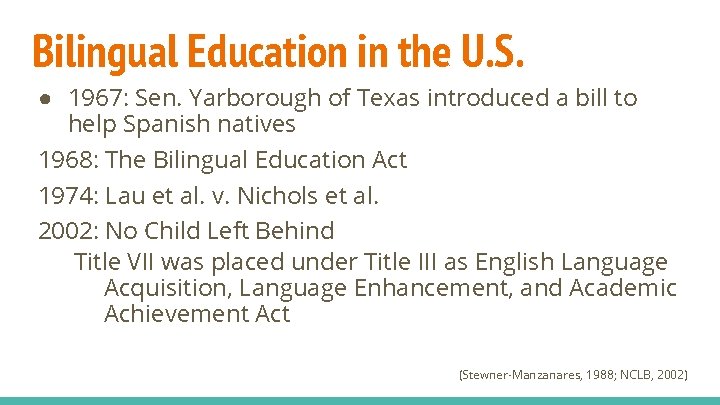
Bilingual Education in the U. S. ● 1967: Sen. Yarborough of Texas introduced a bill to help Spanish natives 1968: The Bilingual Education Act 1974: Lau et al. v. Nichols et al. 2002: No Child Left Behind Title VII was placed under Title III as English Language Acquisition, Language Enhancement, and Academic Achievement Act (Stewner-Manzanares, 1988; NCLB, 2002)
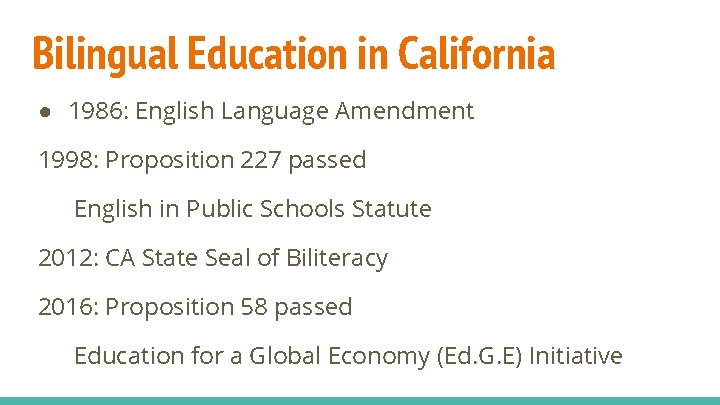
Bilingual Education in California ● 1986: English Language Amendment 1998: Proposition 227 passed English in Public Schools Statute 2012: CA State Seal of Biliteracy 2016: Proposition 58 passed Education for a Global Economy (Ed. G. E) Initiative
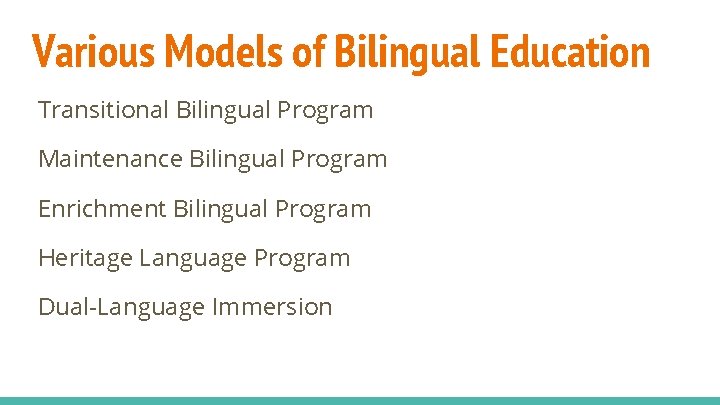
Various Models of Bilingual Education Transitional Bilingual Program Maintenance Bilingual Program Enrichment Bilingual Program Heritage Language Program Dual-Language Immersion
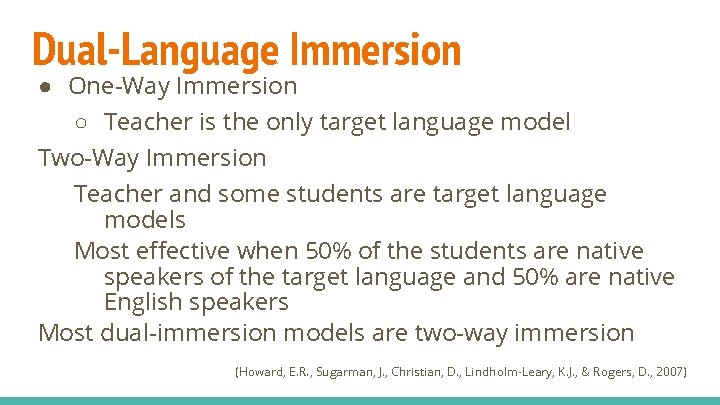
Dual-Language Immersion ● One-Way Immersion ○ Teacher is the only target language model Two-Way Immersion Teacher and some students are target language models Most effective when 50% of the students are native speakers of the target language and 50% are native English speakers Most dual-immersion models are two-way immersion (Howard, E. R. , Sugarman, J. , Christian, D. , Lindholm-Leary, K. J. , & Rogers, D. , 2007)

Dual-Immersion 50: 50 Model Target language and English share an equal amount of instructional minutes from kindergarten to 6 th grade Students learn in the target language and English Ideally, two teachers – one for each language Various models available Rollercoaster model Side by side model Daily or weekly exchanges (Howard, E. R. , Sugarman, J. , Christian, D. , Lindholm-Leary, K. J. , & Rogers, D. , 2007)
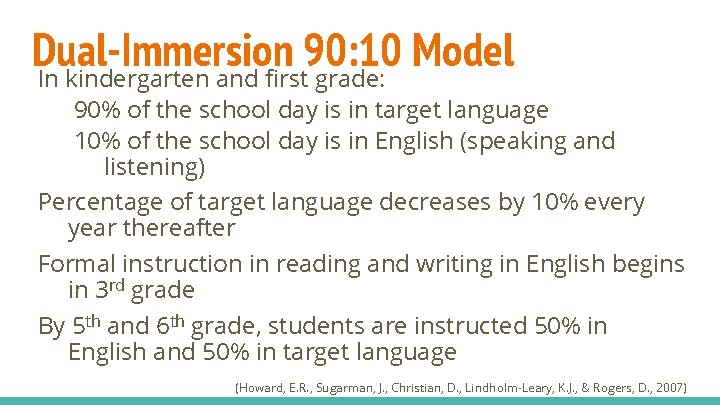
Dual-Immersion 90: 10 Model In kindergarten and first grade: 90% of the school day is in target language 10% of the school day is in English (speaking and listening) Percentage of target language decreases by 10% every year thereafter Formal instruction in reading and writing in English begins in 3 rd grade By 5 th and 6 th grade, students are instructed 50% in English and 50% in target language (Howard, E. R. , Sugarman, J. , Christian, D. , Lindholm-Leary, K. J. , & Rogers, D. , 2007)
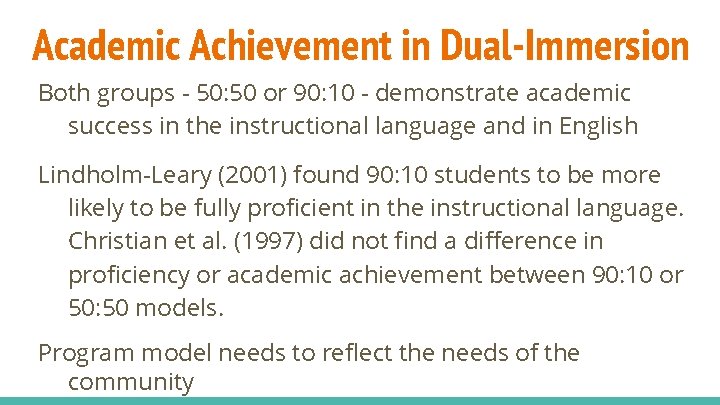
Academic Achievement in Dual-Immersion Both groups - 50: 50 or 90: 10 - demonstrate academic success in the instructional language and in English Lindholm-Leary (2001) found 90: 10 students to be more likely to be fully proficient in the instructional language. Christian et al. (1997) did not find a difference in proficiency or academic achievement between 90: 10 or 50: 50 models. Program model needs to reflect the needs of the community

Thank you! Valerie Sun, Ed. D. Candidate E-mail: valsun@gmail. com �Twitter: @Mlle. Val. Sunshine
- Slides: 9