
The value of ocean observations on coupled climate
The value of ocean observations on coupled climate models Tamaryn Morris South African Weather Service tamaryn. morris@weathersa. co. za
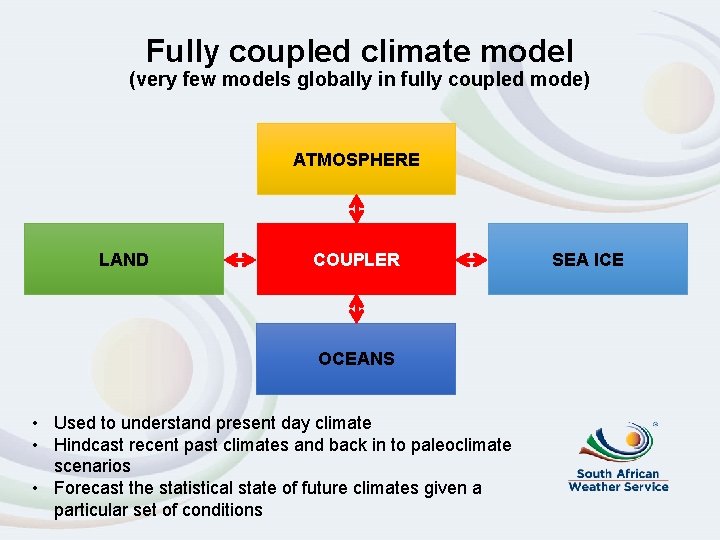
Fully coupled climate model (very few models globally in fully coupled mode) ATMOSPHERE LAND COUPLER OCEANS • Used to understand present day climate • Hindcast recent past climates and back in to paleoclimate scenarios • Forecast the statistical state of future climates given a particular set of conditions SEA ICE
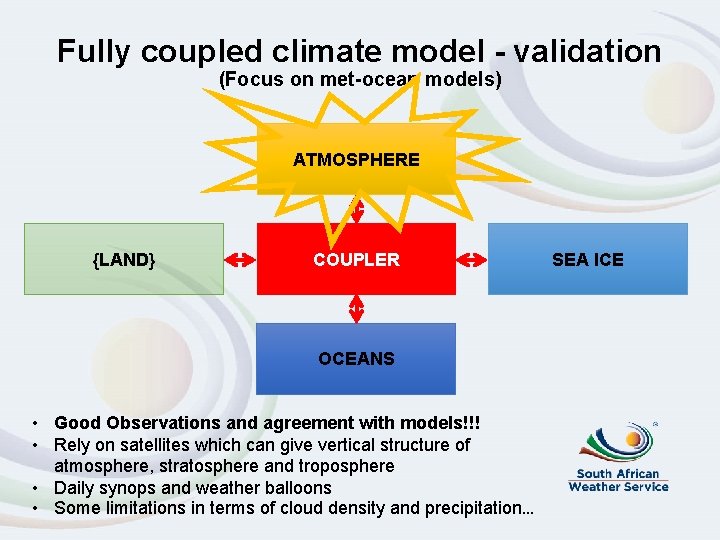
Fully coupled climate model - validation (Focus on met-ocean models) ATMOSPHERE {LAND} COUPLER OCEANS • Good Observations and agreement with models!!! • Rely on satellites which can give vertical structure of atmosphere, stratosphere and troposphere • Daily synops and weather balloons • Some limitations in terms of cloud density and precipitation… SEA ICE
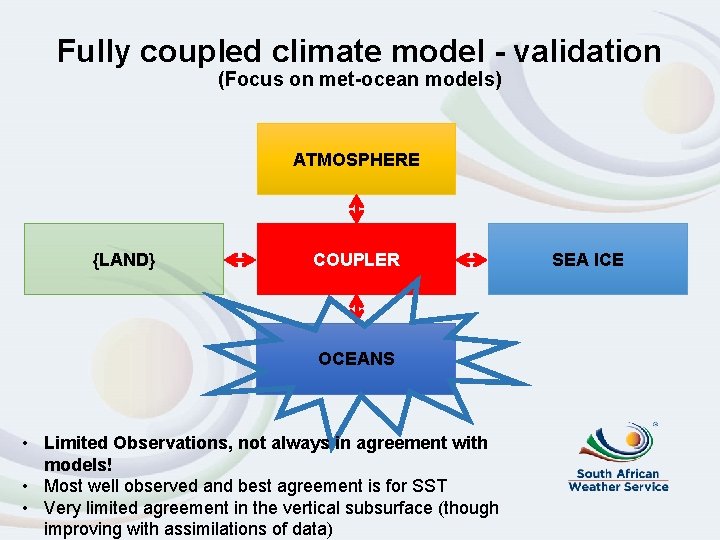
Fully coupled climate model - validation (Focus on met-ocean models) ATMOSPHERE {LAND} COUPLER OCEANS • Limited Observations, not always in agreement with models! • Most well observed and best agreement is for SST • Very limited agreement in the vertical subsurface (though improving with assimilations of data) SEA ICE
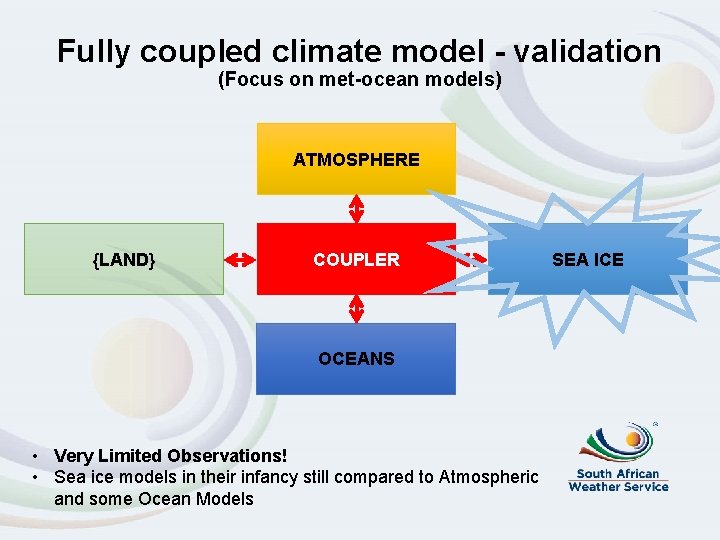
Fully coupled climate model - validation (Focus on met-ocean models) ATMOSPHERE {LAND} COUPLER OCEANS • Very Limited Observations! • Sea ice models in their infancy still compared to Atmospheric and some Ocean Models SEA ICE
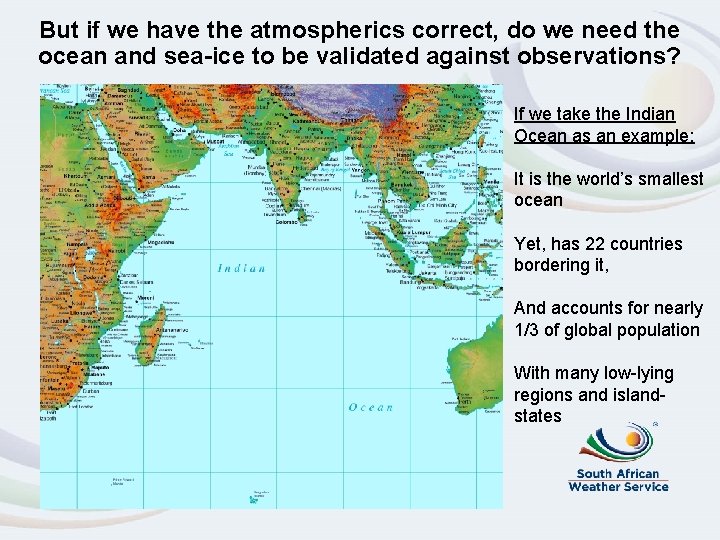
But if we have the atmospherics correct, do we need the ocean and sea-ice to be validated against observations? If we take the Indian Ocean as an example: It is the world’s smallest ocean Yet, has 22 countries bordering it, And accounts for nearly 1/3 of global population With many low-lying regions and islandstates
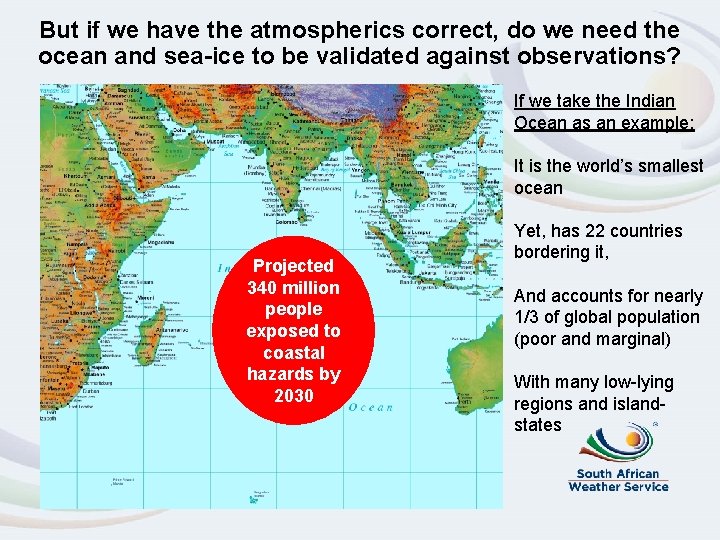
But if we have the atmospherics correct, do we need the ocean and sea-ice to be validated against observations? If we take the Indian Ocean as an example: It is the world’s smallest ocean Projected 340 million people exposed to coastal hazards by 2030 Yet, has 22 countries bordering it, And accounts for nearly 1/3 of global population (poor and marginal) With many low-lying regions and islandstates
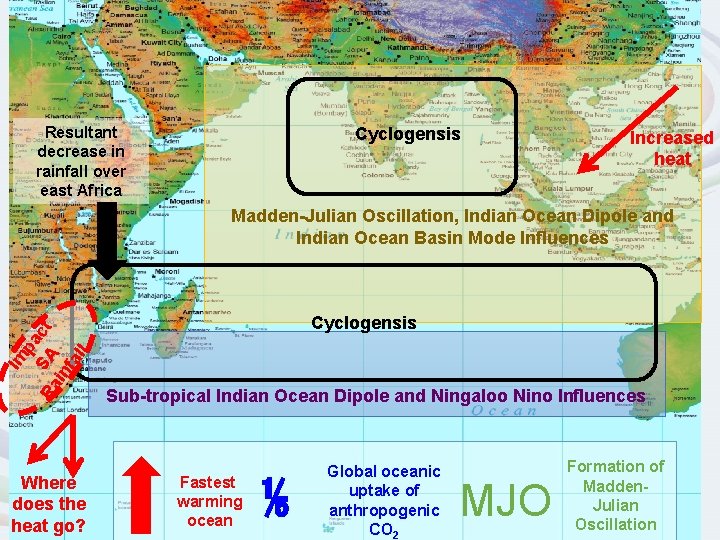
Resultant decrease in rainfall over east Africa Cyclogensis Increased heat Im pa Ra SA ct in fa ll Madden-Julian Oscillation, Indian Ocean Dipole and Indian Ocean Basin Mode Influences Where does the heat go? Cyclogensis Sub-tropical Indian Ocean Dipole and Ningaloo Nino Influences Fastest warming ocean ⅕ Global oceanic uptake of anthropogenic CO 2 MJO Formation of Madden. Julian Oscillation
Implications to the Indian Ocean region Far reaching impacts from Indian Ocean surface warming trend: ü Influencing Pacific and North Atlantic Climate ü Droughts in West Sahel and Mediterranean State-of-the-art models not reproducing ocean processes correctly, causing adverse predictions of monsoons Due to decrease in rainfall over east African, predicted increase in under-nourished people in east Africa region by 50 % by 2030 What else could happen? Will there be an increase of cyclones in the Indian Ocean? Will there be an increase in frequency of storm surges in the Indian Ocean? Where does all that excess heat go? West? South? And this is just for the Indian Ocean. What of Atlantic, Pacific and Southern Oceans? ? ?
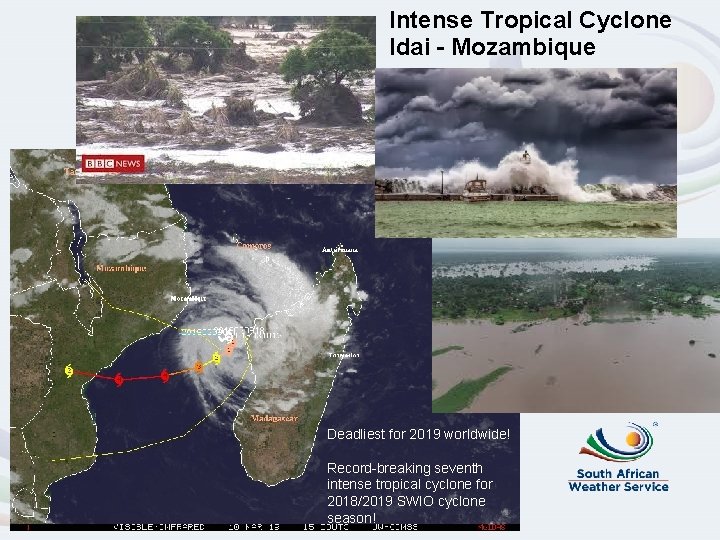
Intense Tropical Cyclone Idai – Mozambique Deadliest for 2019 worldwide! Record-breaking seventh intense tropical cyclone for 2018/2019 SWIO cyclone season!
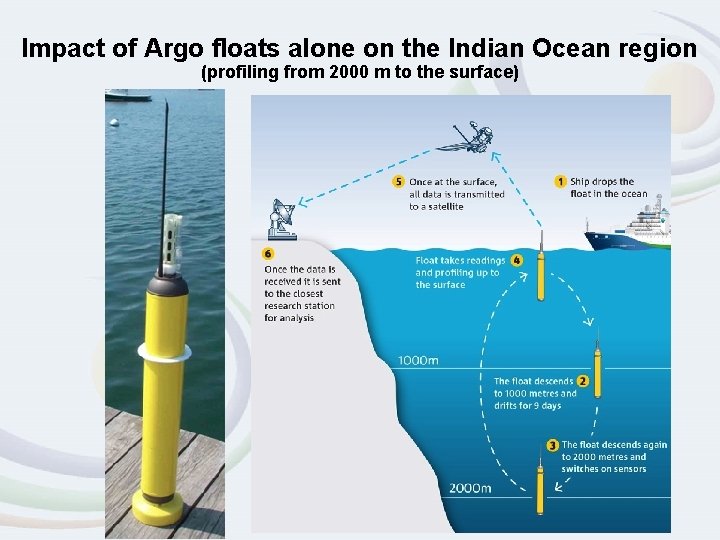
Impact of Argo floats alone on the Indian Ocean region (profiling from 2000 m to the surface)
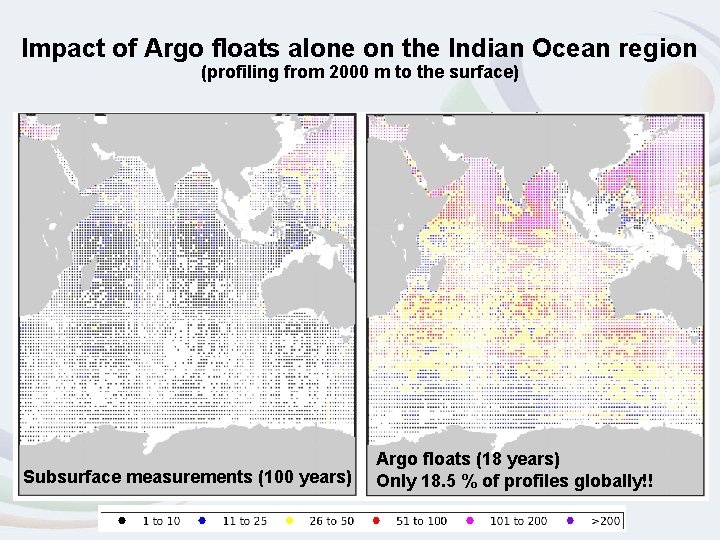
Impact of Argo floats alone on the Indian Ocean region (profiling from 2000 m to the surface) Subsurface measurements (100 years) Argo floats (18 years) Only 18. 5 % of profiles globally!!
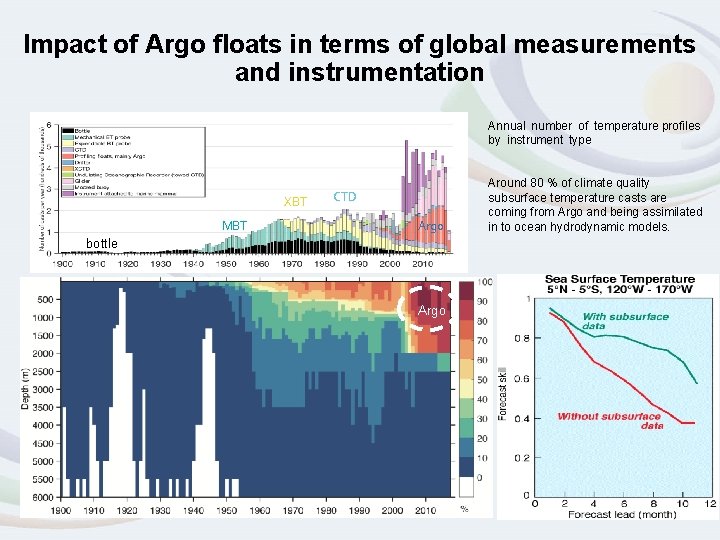
Impact of Argo floats in terms of global measurements and instrumentation Annual number of temperature profiles by instrument type XBT MBT CTD Argo bottle Argo Around 80 % of climate quality subsurface temperature casts are coming from Argo and being assimilated in to ocean hydrodynamic models.
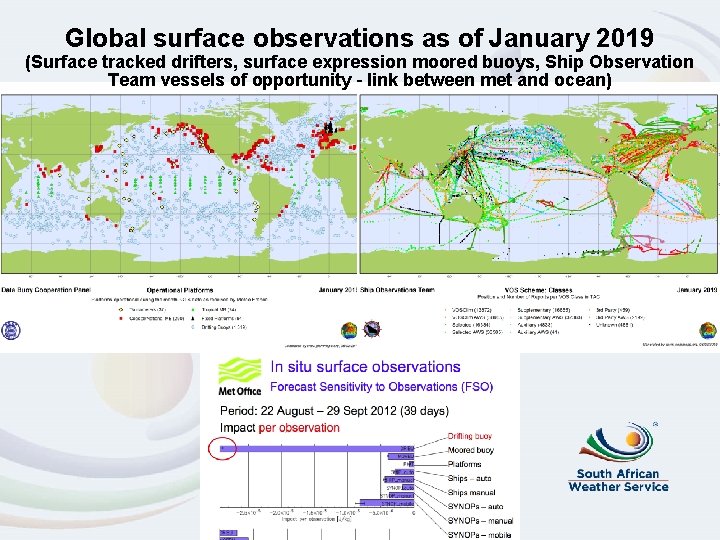
Global surface observations as of January 2019 (Surface tracked drifters, surface expression moored buoys, Ship Observation Team vessels of opportunity – link between met and ocean)
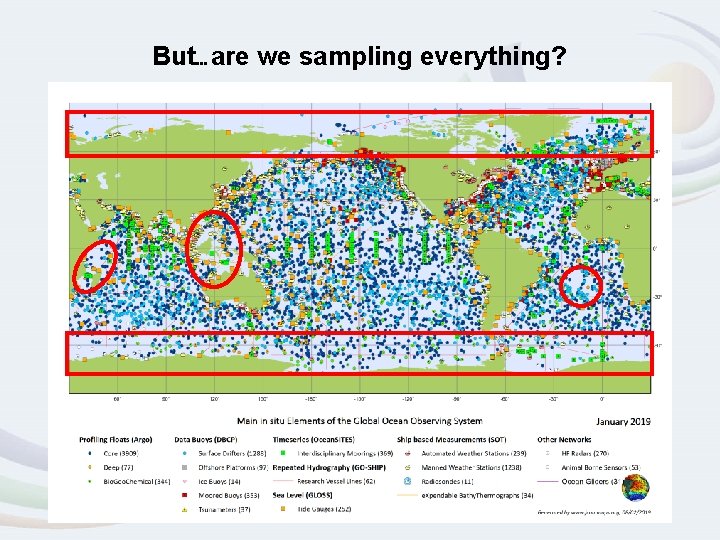
But…are we sampling everything?
So what can we as SAWS do? • Stay current, stay involved with ocean observation programs (get MORE involved), contribute knowledge, assist with deployments where possible, procure new instruments • Ice-observation buoys in the Marginal Ice Zone, Southern Ocean • Become knowledgeable with data assimilation techniques in to ocean numerical models • Validate! • Integrate these data in to climate coupled models
- Slides: 16