
The Value of Human Capital in Healthcare Agenda
- Slides: 19
The Value of Human Capital in Healthcare
Agenda Our agenda today is about providing a strong business case for change and clearly defining the future state of <Insert Company Name>Human Capital. A future state that aligns people, processes and technology activities to achieve results.
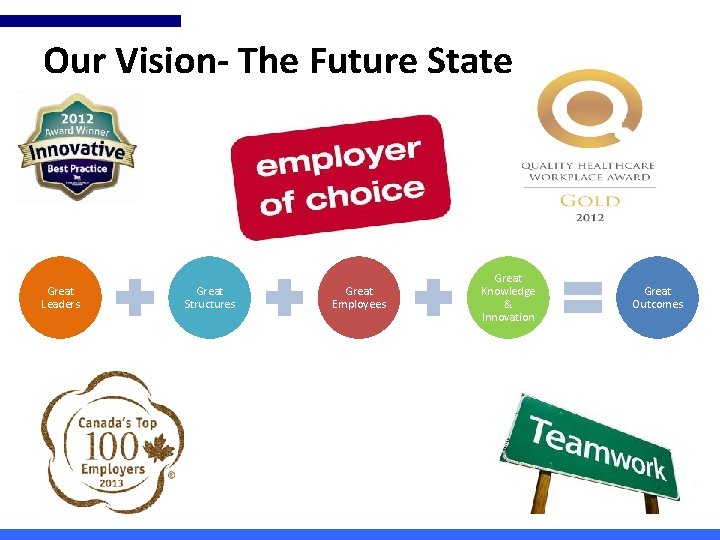
Our Vision- The Future State Great Leaders Great Structures Great Employees Great Knowledge & Innovation Great Outcomes
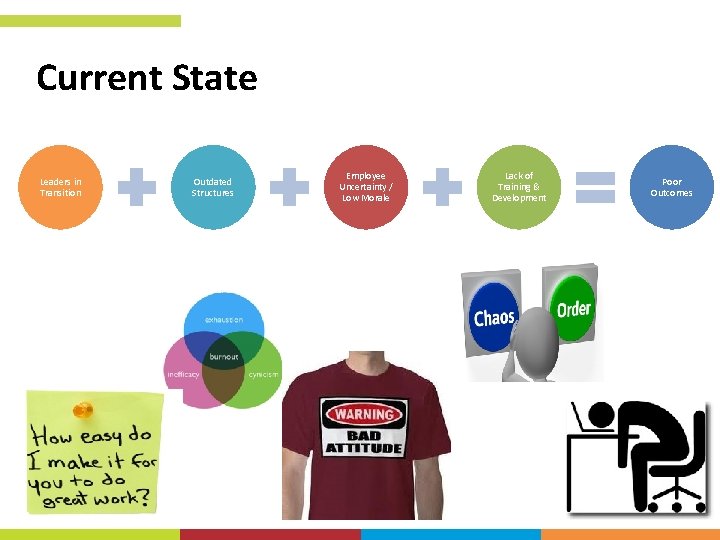
Current State Leaders in Transition Outdated Structures Outdated structures Employee Uncertainty / Low Morale Lack of Training & Development Poor Outcomes
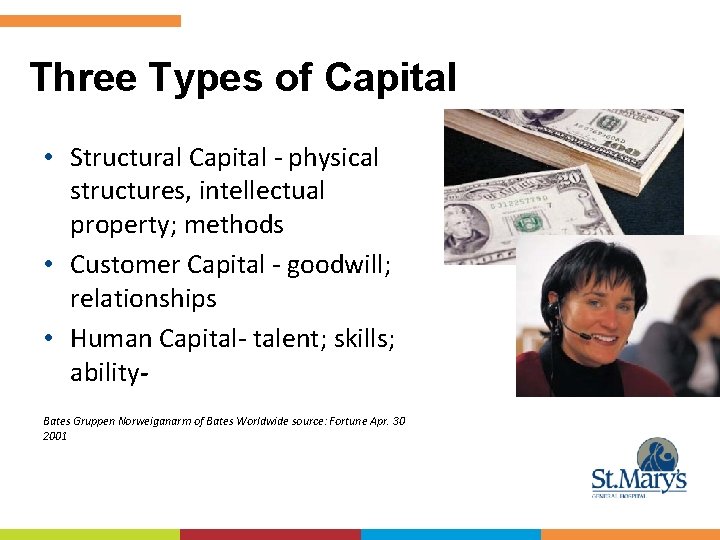
Three Types of Capital • Structural Capital - physical structures, intellectual property; methods • Customer Capital - goodwill; relationships • Human Capital- talent; skills; ability. Bates Gruppen Norweiganarm of Bates Worldwide source: Fortune Apr. 30 2001
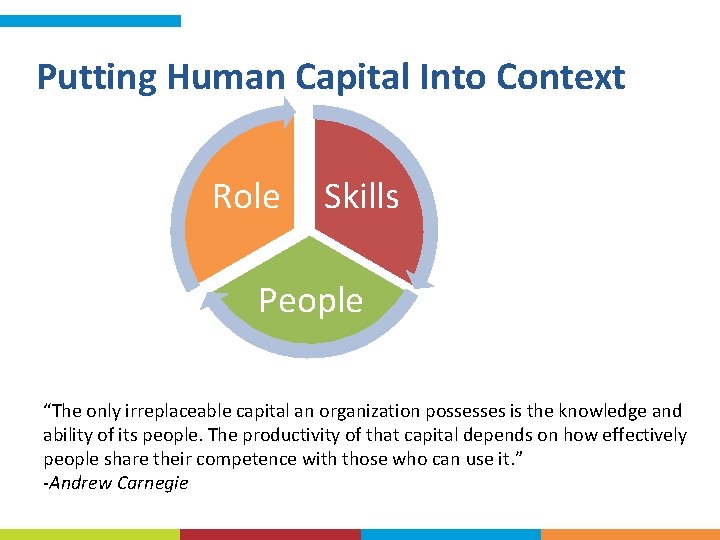
Putting Human Capital Into Context Role Skills People “The only irreplaceable capital an organization possesses is the knowledge and ability of its people. The productivity of that capital depends on how effectively people share their competence with those who can use it. ” -Andrew Carnegie
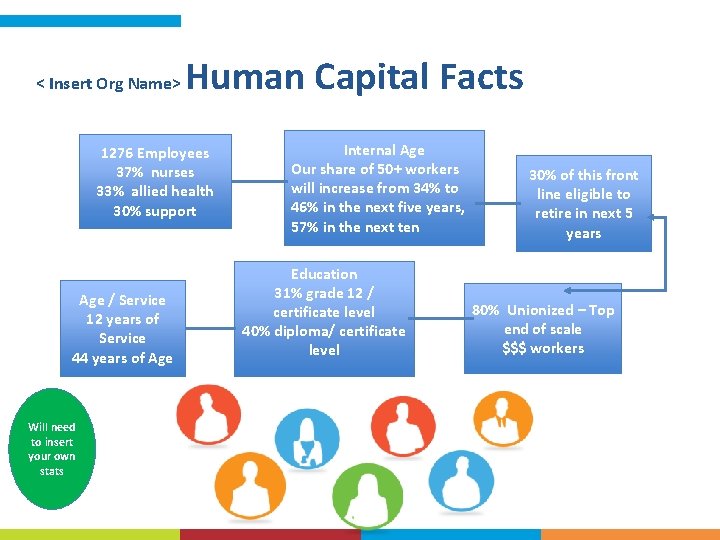
< Insert Org Name> Human Capital Facts 1276 Employees 37% nurses 33% allied health 30% support Age / Service 12 years of Service 44 years of Age Will need to insert your own stats Internal Age Our share of 50+ workers will increase from 34% to 46% in the next five years, 57% in the next ten Education 31% grade 12 / certificate level 40% diploma/ certificate level 30% of this front line eligible to retire in next 5 years 80% Unionized – Top end of scale $$$ workers
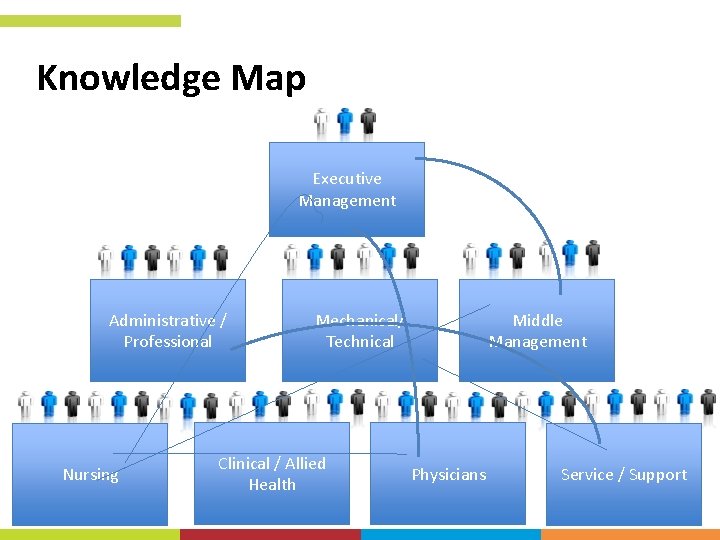
Knowledge Map Executive Management Administrative / Professional Nursing Middle Management Mechanical/ Technical Clinical / Allied Health Physicians Service / Support
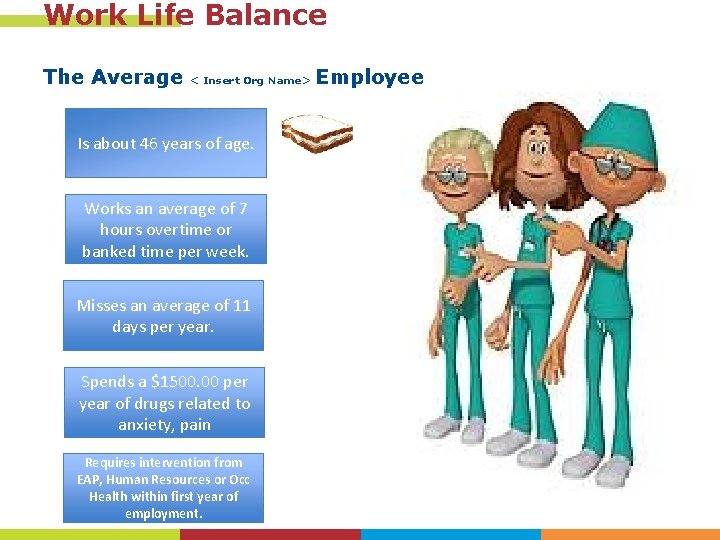
Work Life Balance The Average < Insert Org Name> Is about 46 years of age. Works an average of 7 hours overtime or banked time per week. Misses an average of 11 days per year. Spends a $1500. 00 per year of drugs related to anxiety, pain Requires intervention from EAP, Human Resources or Occ Health within first year of employment. Employee
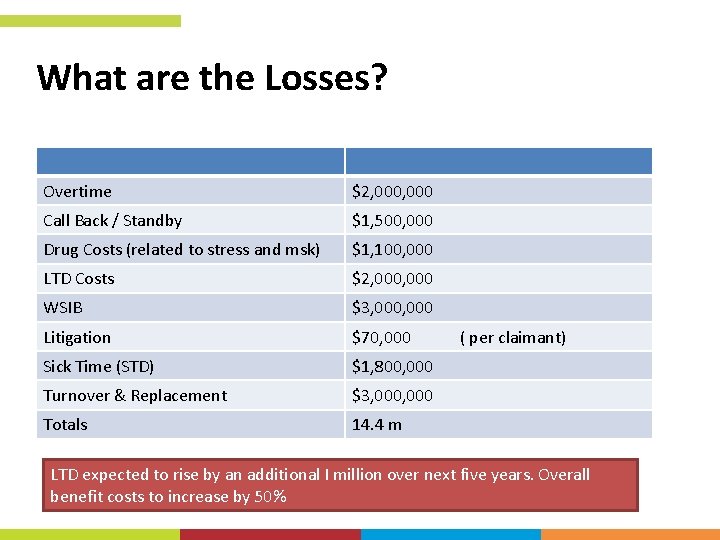
What are the Losses? Overtime $2, 000 Call Back / Standby $1, 500, 000 Drug Costs (related to stress and msk) $1, 100, 000 LTD Costs $2, 000 WSIB $3, 000 Litigation $70, 000 Sick Time (STD) $1, 800, 000 Turnover & Replacement $3, 000 Totals 14. 4 m ( per claimant) LTD expected to rise by an additional I million over next five years. Overall benefit costs to increase by 50%
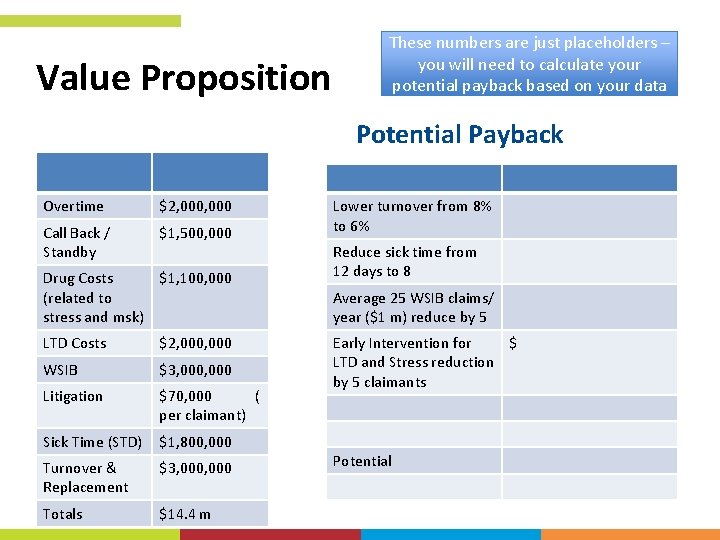
Value Proposition These numbers are just placeholders – you will need to calculate your potential payback based on your data Potential Payback Overtime $2, 000 Call Back / Standby $1, 500, 000 Lower turnover from 8% to 6% Drug Costs $1, 100, 000 (related to stress and msk) Average 25 WSIB claims/ year ($1 m) reduce by 5 LTD Costs $2, 000 WSIB $3, 000 Litigation $70, 000 ( per claimant) Sick Time (STD) $1, 800, 000 Turnover & Replacement $3, 000 Totals $14. 4 m Reduce sick time from 12 days to 8 Early Intervention for $ LTD and Stress reduction by 5 claimants Potential
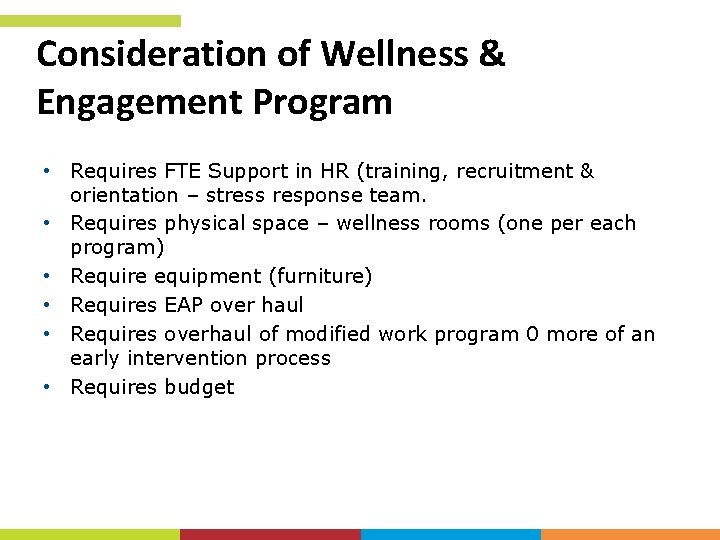
Consideration of Wellness & Engagement Program • Requires FTE Support in HR (training, recruitment & orientation – stress response team. • Requires physical space – wellness rooms (one per each program) • Require equipment (furniture) • Requires EAP over haul • Requires overhaul of modified work program 0 more of an early intervention process • Requires budget
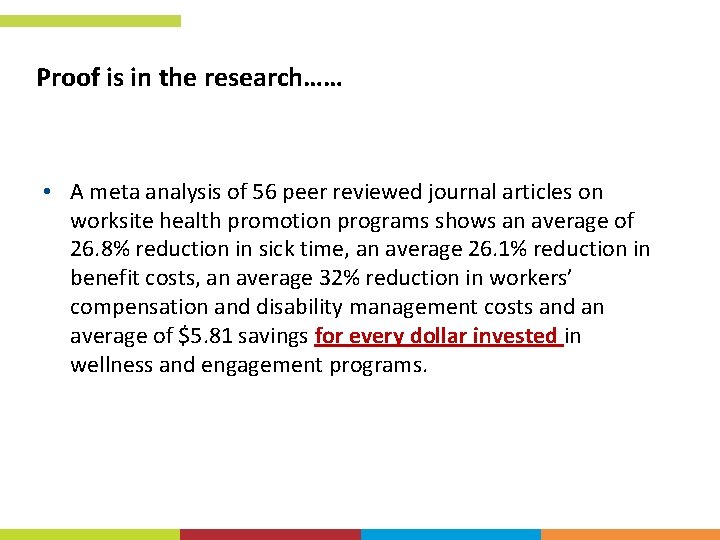
Proof is in the research…… • A meta analysis of 56 peer reviewed journal articles on worksite health promotion programs shows an average of 26. 8% reduction in sick time, an average 26. 1% reduction in benefit costs, an average 32% reduction in workers’ compensation and disability management costs and an average of $5. 81 savings for every dollar invested in wellness and engagement programs.
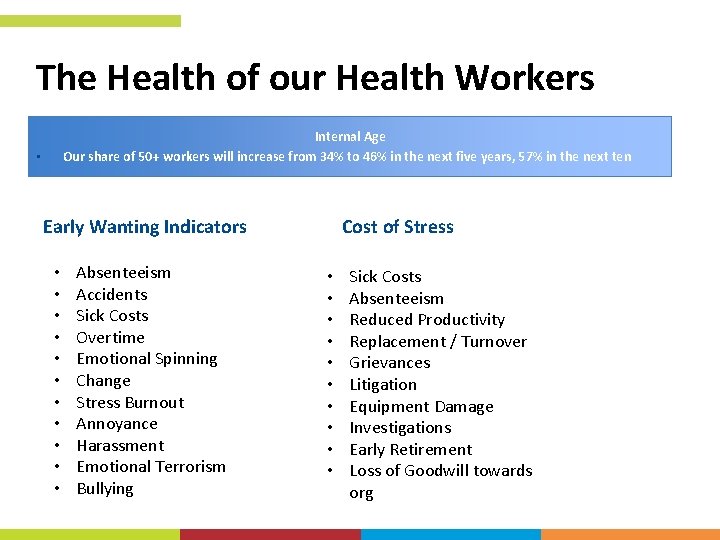
The Health of our Health Workers Internal Age Our share of 50+ workers will increase from 34% to 46% in the next five years, 57% in the next ten • Early Wanting Indicators • • • Absenteeism Accidents Sick Costs Overtime Emotional Spinning Change Stress Burnout Annoyance Harassment Emotional Terrorism Bullying Cost of Stress • • • Sick Costs Absenteeism Reduced Productivity Replacement / Turnover Grievances Litigation Equipment Damage Investigations Early Retirement Loss of Goodwill towards org
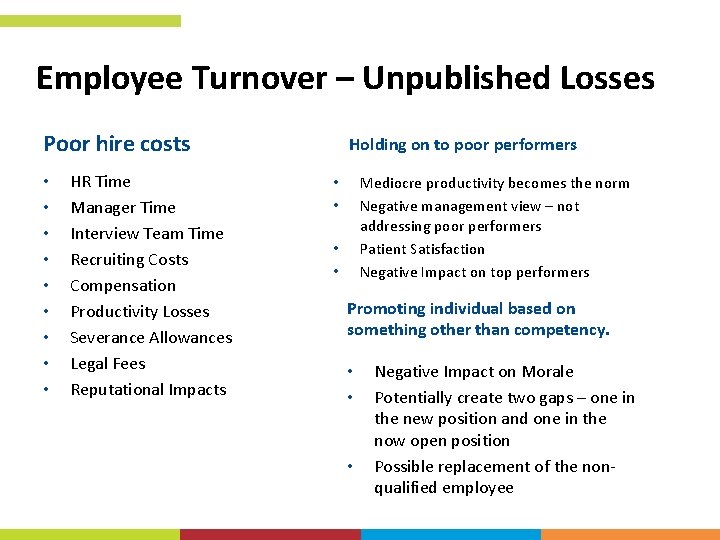
Employee Turnover – Unpublished Losses Poor hire costs • • • HR Time Manager Time Interview Team Time Recruiting Costs Compensation Productivity Losses Severance Allowances Legal Fees Reputational Impacts Holding on to poor performers Mediocre productivity becomes the norm Negative management view – not addressing poor performers Patient Satisfaction Negative Impact on top performers • • Promoting individual based on something other than competency. • • • Negative Impact on Morale Potentially create two gaps – one in the new position and one in the now open position Possible replacement of the nonqualified employee
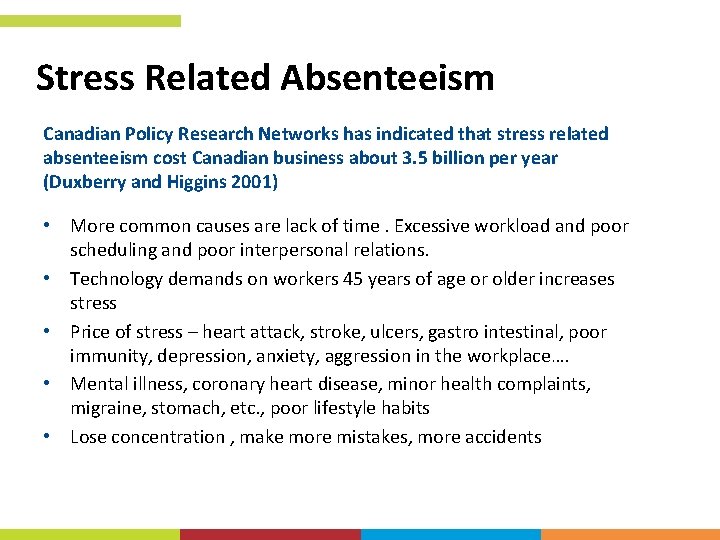
Stress Related Absenteeism Canadian Policy Research Networks has indicated that stress related absenteeism cost Canadian business about 3. 5 billion per year (Duxberry and Higgins 2001) • More common causes are lack of time. Excessive workload and poor scheduling and poor interpersonal relations. • Technology demands on workers 45 years of age or older increases stress • Price of stress – heart attack, stroke, ulcers, gastro intestinal, poor immunity, depression, anxiety, aggression in the workplace…. • Mental illness, coronary heart disease, minor health complaints, migraine, stomach, etc. , poor lifestyle habits • Lose concentration , make more mistakes, more accidents
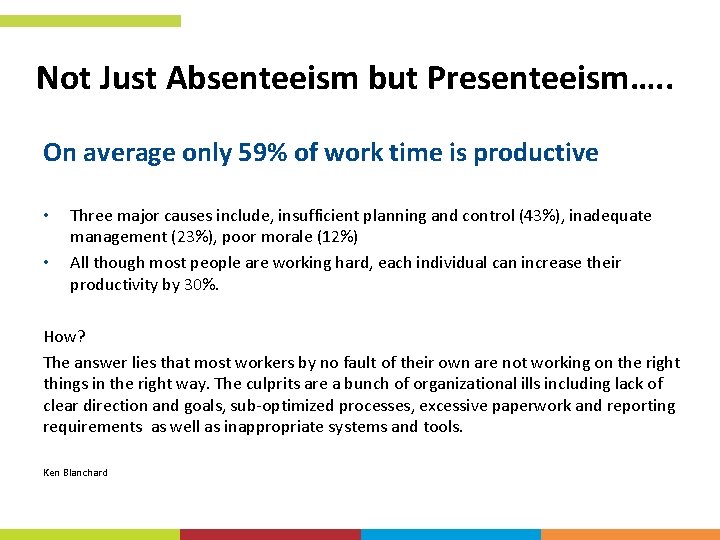
Not Just Absenteeism but Presenteeism…. . On average only 59% of work time is productive • • Three major causes include, insufficient planning and control (43%), inadequate management (23%), poor morale (12%) All though most people are working hard, each individual can increase their productivity by 30%. How? The answer lies that most workers by no fault of their own are not working on the right things in the right way. The culprits are a bunch of organizational ills including lack of clear direction and goals, sub-optimized processes, excessive paperwork and reporting requirements as well as inappropriate systems and tools. Ken Blanchard
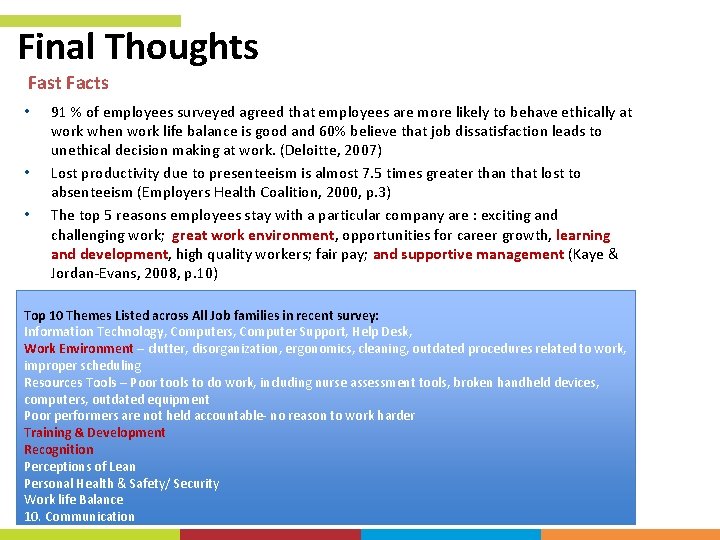
Final Thoughts Fast Facts • • • 91 % of employees surveyed agreed that employees are more likely to behave ethically at work when work life balance is good and 60% believe that job dissatisfaction leads to unethical decision making at work. (Deloitte, 2007) Lost productivity due to presenteeism is almost 7. 5 times greater than that lost to absenteeism (Employers Health Coalition, 2000, p. 3) The top 5 reasons employees stay with a particular company are : exciting and challenging work; great work environment, opportunities for career growth, learning and development, high quality workers; fair pay; and supportive management (Kaye & Jordan-Evans, 2008, p. 10) Top 10 Themes Listed across All Job families in recent survey: Information Technology, Computers, Computer Support, Help Desk, Work Environment – clutter, disorganization, ergonomics, cleaning, outdated procedures related to work, improper scheduling Resources Tools – Poor tools to do work, including nurse assessment tools, broken handheld devices, computers, outdated equipment Poor performers are not held accountable- no reason to work harder Training & Development Recognition Perceptions of Lean Personal Health & Safety/ Security Work life Balance 10. Communication
Questions Thank you Human Resources