
The value of formative feedback in simulation the
The value of formative feedback in simulation – the learning gain for students Ashley Spriggs, Bournemouth University Simon Bettles, University of Surrey Dawn Morley, University of Surrey d. morley@surrey. ac. uk 12/21/2021 CEL assessment conference 1
The value of formative feedback to accelerate learning and empower self regulation 1. Helps clarify what good performance is 2. Facilitates the development of self assessment (reflection) in learning. 3. Delivers high quality information to students about their learning 4. Encourages teacher and peer dialogue learning 5. Encourages positive motivational beliefs and self esteem 6. Provides opportunities to close the gap between current and desired performance 7. Provides information to teachers that can be used to help shape learning. (Nicol and Mac. Farlane 2006) 12/21/2021 CEL assessment conference
Debriefing – a unique formative assessment • “is the most important aspect of simulated learning” (Waznonis 2014, p. 459) • Incorporates feedback and reflection with emphasis on effecting immediate and long term change – feedforward and sustainable feedback skills (Waznonis 2014, Tutticci et al 2017) • Research on debriefing practice is scant, not evidence based and has great variability (Waznonis 2014) 12/21/2021 CEL assessment conference 3
Therapeutic Communications in Adult Nursing • Year 2 adult nursing students (291; Feb: 66, April: 109/30, June: 62/24) • Simulation of admission assessment (SU/C offer feedback) • Simulation of i. SBAR handover (to peers/clinical team/academic) • Debrief follows both assessment and handover • Summative assessment is a critical reflection of either simulation activity • Peer feedback aids/feeds into assessment 12/21/2021 CEL assessment conference 4
Debriefing Students complete a self evaluation form independently then their peers (from sub group) add further comments. 1. What I did well 2. What I could have done better 3. Points from their peers Feedback is also given from: • SU/C • Clinical staff • Academic • 3 rd Year student nurses 12/21/2021 CEL assessment conference 5
Evaluation • Students appear to enjoy the day • Appreciate the safe environment • Value the debrief and discussion session • Use the feedback to inform their critical reflection in the summative assessment 12/21/2021 CEL assessment conference 6
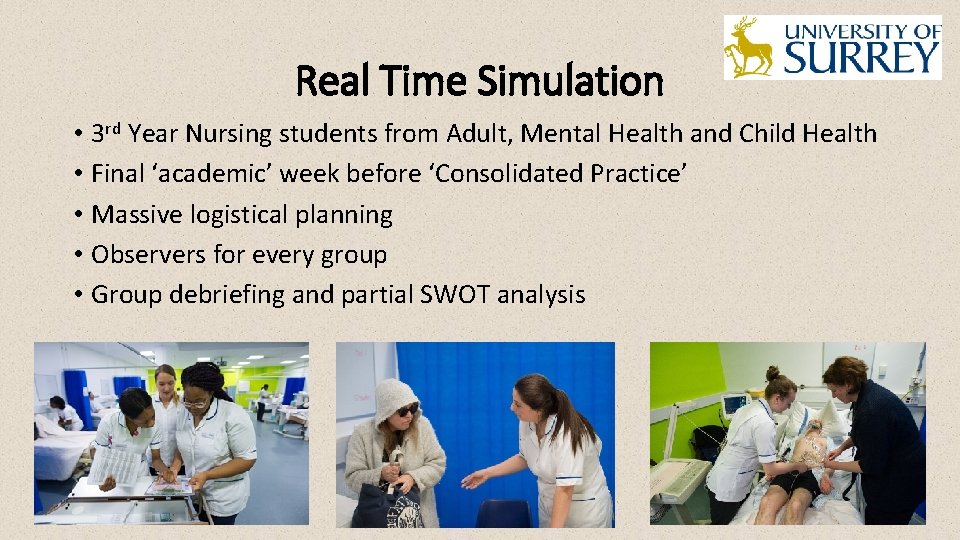
Real Time Simulation • 3 rd Year Nursing students from Adult, Mental Health and Child Health • Final ‘academic’ week before ‘Consolidated Practice’ • Massive logistical planning • Observers for every group • Group debriefing and partial SWOT analysis 12/21/2021 CEL assessment conference 7
Debriefing Each ward team taken off with observer. They had a free flowing guide to the debrief: 1. How did it go? 2. What did you learn? 3. What actions can you take to prepare yourself for placements in year 3 and into registration? After discussion students asked to complete a partial SWOT analysis and an evaluation 12/21/2021 CEL assessment conference 8
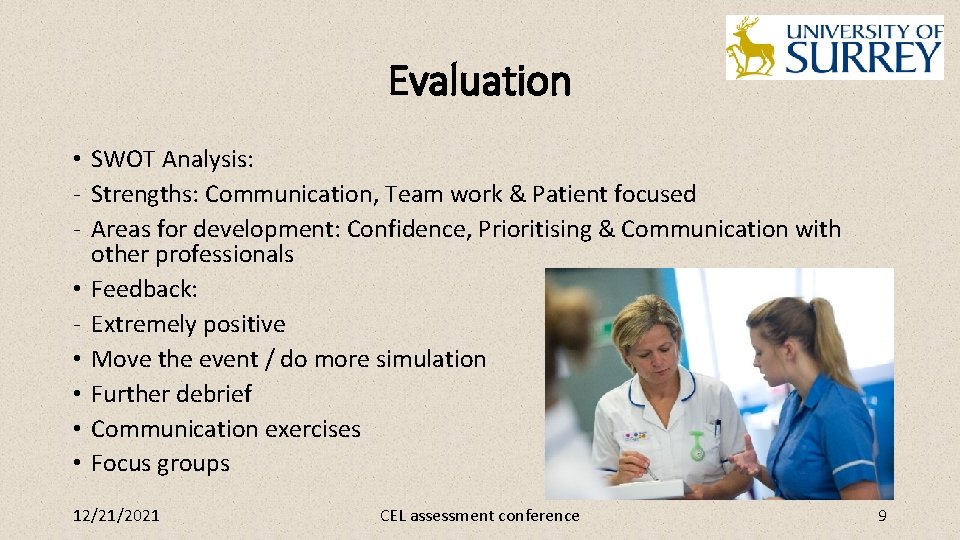
Evaluation • SWOT Analysis: - Strengths: Communication, Team work & Patient focused - Areas for development: Confidence, Prioritising & Communication with other professionals • Feedback: - Extremely positive • Move the event / do more simulation • Further debrief • Communication exercises • Focus groups 12/21/2021 CEL assessment conference 9
Are we maximising the opportunity for effective formative feedback in simulated learning? 12/21/2021 CEL assessment conference 10
References Carless, D. , Salter, D. , Yang, M. and Lam, J. , 2011. Developing sustainable feedback practices. Assessment and Evaluation in Higher Education, 34 (1), 79 -89. Nicol, D. and Mac. Farlane-Dick, D. , 2006. Formative assessment and self regulated learning: A model and seven principles of good feedback practice. Studies in Higher Education, 31 (2), 199 -218. Tutticci, N. , Ryan, M. , Coyer, F. and Lewis, P. A. , 2017. Collaborative facilitation of debrief after high fidelity simulation and its implications for reflective thinking: student experiences. Studies in High Education, DOI: 10. 1080/03075079. 2017. 1281238 Waznonis, A. R. , 2014. Methods and Evaluations for Simulation Debriefing in Nursing Education. Journal of Nursing Education, 53 (8), 459 -465
- Slides: 11