
The Value of Automatic Reinforcement Mark L Sundberg
The Value of Automatic Reinforcement Mark L. Sundberg
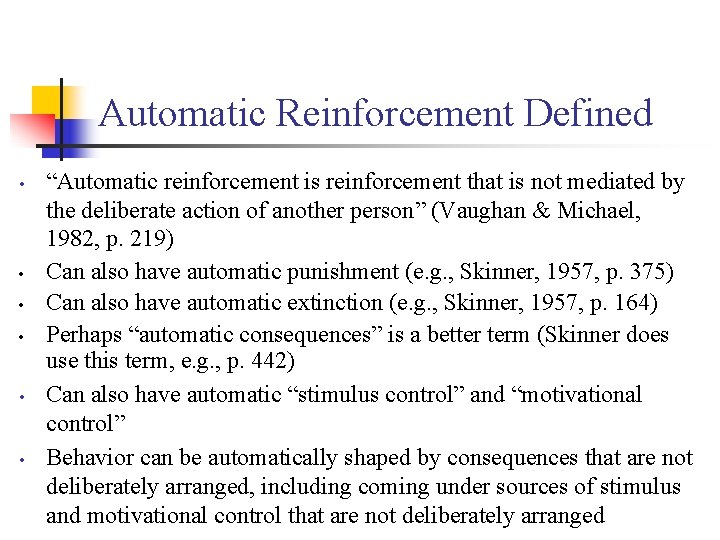
Automatic Reinforcement Defined • • • “Automatic reinforcement is reinforcement that is not mediated by the deliberate action of another person” (Vaughan & Michael, 1982, p. 219) Can also have automatic punishment (e. g. , Skinner, 1957, p. 375) Can also have automatic extinction (e. g. , Skinner, 1957, p. 164) Perhaps “automatic consequences” is a better term (Skinner does use this term, e. g. , p. 442) Can also have automatic “stimulus control” and “motivational control” Behavior can be automatically shaped by consequences that are not deliberately arranged, including coming under sources of stimulus and motivational control that are not deliberately arranged
Automatic Reinforcement Defined • Skinner’s usage of “automatic” is simply to counteract “any tendency to restrict the concept of reinforcement, extinction, motivation, etc. , to those occasions upon which it has been deliberately arranged by another person or group” (Vaughan & Michael, 1982, p. 218)
Automatic Reinforcement Defined Skinner presents two types of automatic reinforcement (1957, pp. 164 -166; 438 -446) • Practical: The reinforcement is provided by the physical environment (“the producing response operates on the surrounding world”) • Artistic/Autistic: The reinforcement is provided by the response product emanating from the behavior. (“The producing response operates on the behaver directly”)
Automatic Reinforcement Defined • • • Practical: The producing response operates on the surrounding world, and behavior is shaped and automatically comes under the relevant stimulus control Grab toy—have toy in hand Push door – it opens Turn on faucet--water comes out Climb steps--get to the top Turn and look--see things Self-mand (e. g. , “I need to get back on task”) Self-tact (e. g. , “Greg! That’s his name”) Self-echoic (e. g. , “ 454 -8798, 454 -8798”) Self-intraverbal (e. g. , Problem solving, thinking)
Automatic Reinforcement Defined • • Artistic/Autistic: The producing response operates on the behaver directly, and behavior is shaped and automatically comes under the relevant antecedent control Rocking, finger flicking/tapping, foot tapping, hair twirling, humming, visual patterns, hand ringing, exercise, masturbation, scratch to remove an itch (automatic negative reinforcement), SIB, aggression (e. g. , Iwata, et al. ) Mannerisms, posture, gestures, rap singer’s movements, noise making, babbling, dress, jewelry, cars, hair style (Farrah Fawcett’s 1960’s feathered hair) (Freud’s “Identification” concept) Verbal response forms that match caretaker’s or others of value, including accents, intonation, prosody, syntax and grammar; also singing, fun words, verbal perseveration, delayed echolalia, obsessions
Automatic Reinforcement Defined • • • Summary: Behavior can be shaped, maintained, or eliminated by automatic contingencies that are not directly set up or mediated by other persons. These contingences can be very efficient and even more precise then those formally arranged “The exquisite subtlety of our verbal repertoires is shaped by contingencies of automatic reinforcement. . . one need not wait for the lumbering machinery of social reinforcement to swing into action” (Palmer, 1996, p. 290) “Money grades and honors must be husbanded carefully, but the automatic reinforcement of being right and moving forward are inexhaustible” (Skinner, 1968, p. 158)
Current Study • • • Purpose of the current study: Replicate and extend the finding from the previous studies on automatic reinforcement Examine the circumstances where pairing does not work Examine the temporary nature of pairing Identify how automatically reinforced behavior comes under stimulus or motivational sources of control
Method • • • Participants: Three typically developing female children served as participants; Bella, 11 months old, Samantha, 20 months old, Isabella 23 months old at the start of the study Setting and Materials: The study was conducted at the home of the first and second authors. Training sessions were typically conducted once per week, and lasted from approximately 60 to 150 minutes. A variety of toys and age appropriate materials were used Experimental Design: A within subject, multiple baseline, with replication across subjects was used
Method • • Dependent Variables • Emission of the targeted vocal response topographies and the antecedent and consequential sources of control of those responses Independent Variables • Pairing a neutral vocal stimulus with an assumed form of reinforcement. Approximately 100 sounds or words were pairing with various forms of reinforcement over 10 session with the three participants
Method • • • Procedure: Baseline (pre-pairing) was taken on the forms, frequency and functional types of vocal responses emitted by each child. Words that were not emitted during baseline, and if possible, never heard by the mother or godmother were targeted Activities and items were selected by observing each child and attempting to identify what seemed to function as reinforcement at the moment. In addition, particular items and activities were used that were known to function as reinforcement in the past (e. g. , water play) Following a brief baseline a target vocal stimulus was presented just prior to the delivery of the assumed form of reinforcement (pairing). The number of parings differed for each word (see Tables)
Method • • Following the pairing condition the adult simply stopped interacting with the child, often moving away (post-pairing). The child stayed in the same setting with the same materials present Target vocal responses were recorded during and after pairing, and scored as echoic, mand, tact, intraverbal, automatically reinforced, or multiply controlled
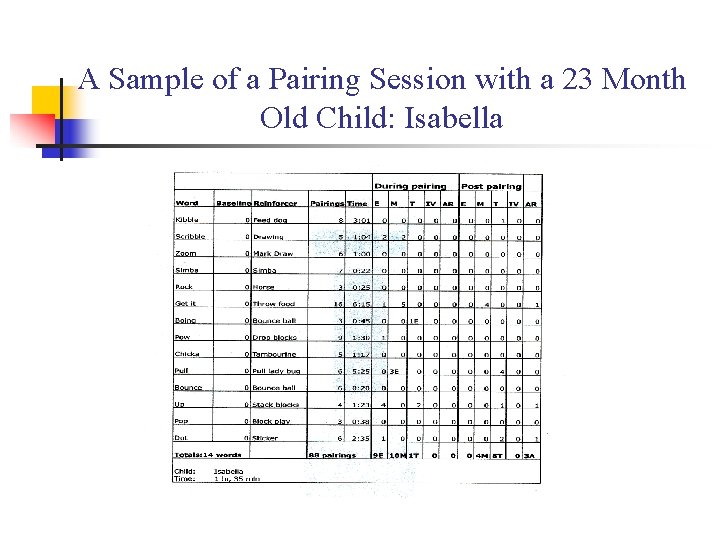
A Sample of a Pairing Session with a 23 Month Old Child: Isabella
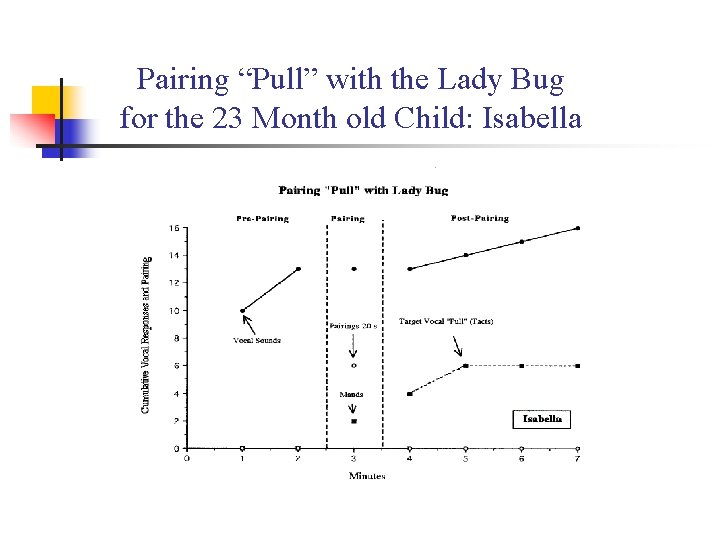
Pairing “Pull” with the Lady Bug for the 23 Month old Child: Isabella
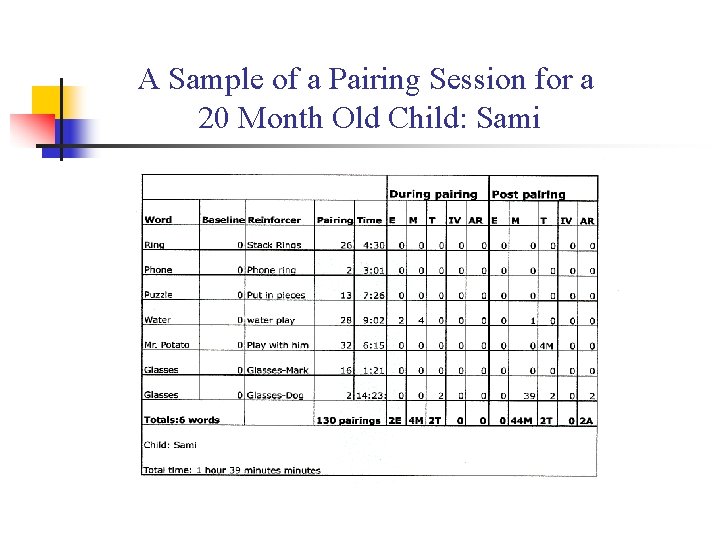
A Sample of a Pairing Session for a 20 Month Old Child: Sami
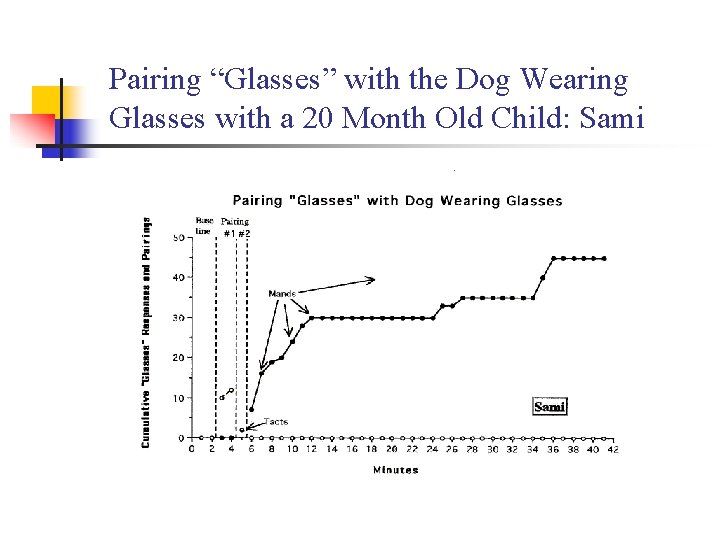
Pairing “Glasses” with the Dog Wearing Glasses with a 20 Month Old Child: Sami
Discussion • • • Pairing worked best with powerful forms of reinforcement Once a child moved to another activity the probability of emitting vocal responses related to a previous pairing was low, except… The pairings related to strongest forms of reinforcement resulted in the emission of the response later in the evening at the children’s home, in the car, or in other settings (e. g. , “Get it, ” “Boat” “Water”) Words that were not targeted, but occurred during the session and were indirectly paired with reinforcement occurred Pronunciation of a word was automatically shaped to a correct form (e. g. , “Aggie” became “Maggie” by the third session) Sami emitted “Aggie” many times at home after the second session and while in the car. Maggie occurred mostly as a mand, but also as a tact, and as automatically reinforced behavior
Discussion • • Sami tried to get her cat to “get it” (unprompted generalization) The type of automatic reinforcement that occurred most were selfverbal responses It was easiest to bring the responses under MO sources of control. Mands were the overall highest type of verbal operant that emerged from pairing Discriminative stimulus control emerged due to pairing. The relevant SDs evoked both verbal and nonverbal behavior (“Maggie Get it” and reaching, taking and throwing food to the dog). SD control was also observed to emerge without pairing (e. g. , form ball, door frame)
Discussion • • • It was possible for a stranger to get successful pairing, if the MO related to the form of reinforcement was strong It was very difficult to catch on video the targeted automatically reinforced responses, but all parents noted the occurrences of certain words at home It is easy to identify the sources of control related to mand, echoics, and tacts, but difficult to identify the sources of control for automatically reinforced behavior that occurs in the absence of an MO or the original discriminative stimuli
Discussion • • Verbal and nonverbal behavior can be shaped, maintained, and come under relevant sources of stimulus control without mediated consequences presented by another person Even very brief stimulus-stimulus pairing can rapidly produce mands, tacts, echoics, and vocal play The results obtained by Hart & Risley reported in their book “Meaningful differences” could be due to, in part, stimulus-stimulus pairing, and automatic behavioral contingencies shaping verbal behavior and establishing sources of antecedent control (e. g. , mands and tacts) A significant proportion of language acquisition may be due to automatic contingencies (including thinking, problem solving, syntax, grammar, etc. )

Thank You!
- Slides: 21