
The Value of African Refining Pierre Reteno Ndiaye











- Slides: 30
The Value of African Refining Pierre Reteno Ndiaye President African Refiners Association SAPIA’s 20 th
Contents • Introduction to the ARA • Working Groups • Example of recent study work: “the Value of African Refining” • Questions 2 SAPIA’s 20 th
Introduction to the ARA 3 SAPIA’s 20 th
Introduction to the ARA • Created in Cape Town in 2006 • Not-for-profit, Swiss registered Association • Represents the pan-African downstream oil industry • A platform for debate and policy foundations for all downstream players – not just refiners 4 SAPIA’s 20 th
Introduction to the ARA • 37 of the 43 African operating oil refineries are members • In South Africa, Petro. SA and Engen are members • New refineries in Chad & Niger are expected to join and have already attended ARA meetings • 47 non-refining companies (i. e. importers, terminal operators, government regulators, major marketers, shippers) are Associate Members 5 SAPIA’s 20 th
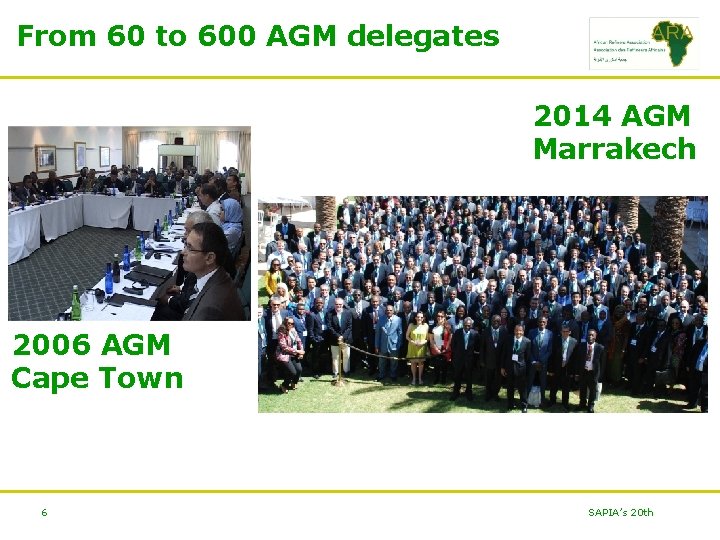
From 60 to 600 AGM delegates 2014 AGM Marrakech 2006 AGM Cape Town 6 SAPIA’s 20 th
ARA WEEK 2015 The meeting place for downstream oil in Africa 16 th – 20 th March Westin Grand Hotel, Cape Town, South Africa Ø Meet with more than 600 key players of the North and Sub-Saharan African and International downstream oil industry all in one place Ø Listen to industry professionals talking about the latest trends and innovations in the industry Ø Share experiences with pan-African and international companies Ø YOU ARE ALL INVITED! 7 SAPIA’s 20 th
Introduction to the ARA • The ARA promotes exchange of experience and best practice between all downstream stakeholders, with anti-trust provisions • The ARA strives to improve communication and cooperation between its Members and the international oil market • The ARA cooperates with relevant industry groups, governments, regulatory bodies, international agencies, International Financial Institutions, academic institutions and other NGOs 8 SAPIA’s 20 th
ARA Working Groups 9 SAPIA’s 20 th
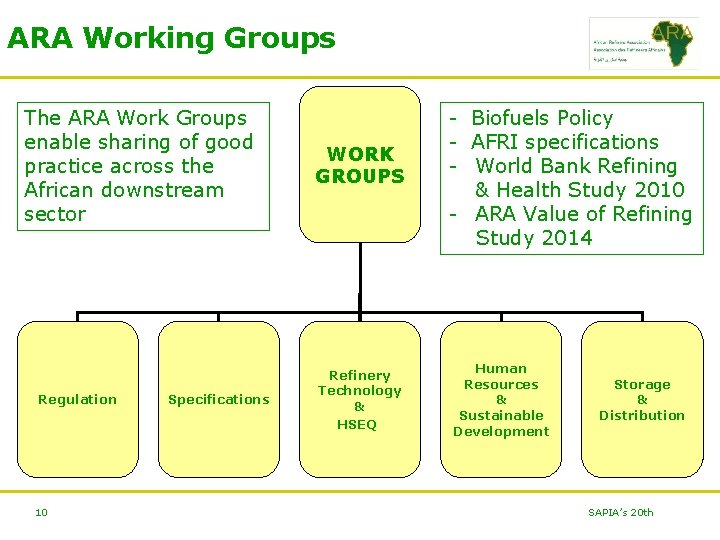
ARA Working Groups The ARA Work Groups enable sharing of good practice across the African downstream sector Regulation 10 Specifications WORK GROUPS Refinery Technology & HSEQ - Biofuels Policy - AFRI specifications - World Bank Refining & Health Study 2010 - ARA Value of Refining Study 2014 Human Resources & Sustainable Development Storage & Distribution SAPIA’s 20 th
Example: Refining Value Study “the Value of African Refining” 11 SAPIA’s 20 th
Reasons for conducting the Refining Value Study 12 SAPIA’s 20 th
Refining environment Refiners are facing increasingly tough operating conditions across the globe: Ø Refinery margins are narrow, and are expected to remain so Ø New world-scale refinery plants coming online Ø US tight oil/shale gas revolution – refining margin bonanza Ø Continuing low shipping freight rates offer new product arbitrages - from AG, India & USGC 13 SAPIA’s 20 th
African refining challenge In this environment, African refiners will struggle to secure investment unless: Ø Countries decide that refineries are part of their strategic infrastructure because of the economic and social benefits that they provide Ø Governments support refineries through incentives and/or capital increases (the state is often a major shareholder) Ø Value is generated by taking advantage of difficult product import logistics or special products to enhance refining margins Ø Governments support refinery improvements (e. g. desulphurisation and upgrading) to aid public health and to improve refining economics 14 SAPIA’s 20 th
Refineries struggle to survive “It’s official — Kenya will stop refinery operations” Standard Media Group Tuesday, December 3 rd 2013 *** “Experience of clean fuels programs … suggest…that refiners are unlikely to receive a commercial return on any such investment. ” Wood. Mackenzie: African Refining Value Study March 2014 15 SAPIA’s 20 th
The study • The ARA launched the study to quantify not only the direct, but the indirect and induced benefits of the refining industry to a local economy • This measurement to then be used to assess the degree to which any investment in a refinery is justifiable • After a competitive tender, the study was awarded to Wood Mackenzie 16 SAPIA’s 20 th
the Refining Value study 17 SAPIA’s 20 th
Object of the study • To quantifiably measure the socioeconomic impact of a refinery • To use this measurement to evaluate future investment in refining versus product import facilities • To help shape future government policy 18 SAPIA’s 20 th
Methodology Valuation of the contribution from refineries is based on the host nation’s alternative of investing in product import terminals 19 SAPIA’s 20 th
Methodology • The sub-division of Africa, rather than by North, South, East, West geography, is defined as being either well developed or less developed, based on the United Nations’ Human Development Index (HDI) • HDI is an indicator created by the UN to represent the social and economic development of a country • The refinery indicator assesses the ability to add value to crude (yields, margin, operating costs, import/export balances, employment) 20 SAPIA’s 20 th
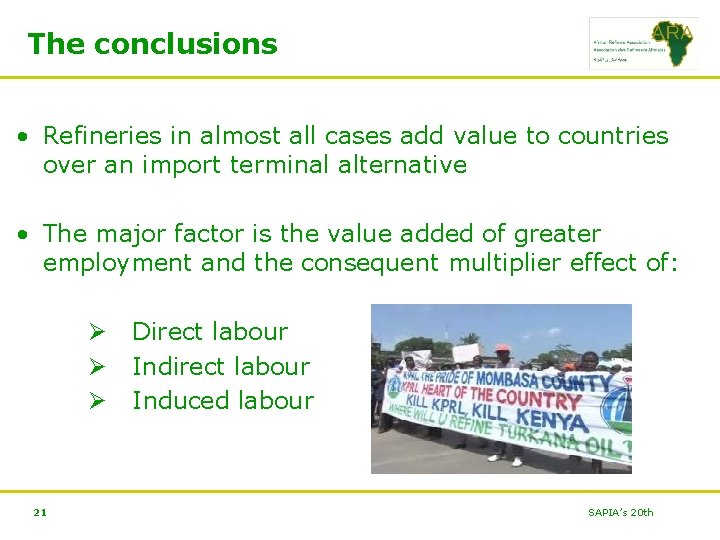
The conclusions • Refineries in almost all cases add value to countries over an import terminal alternative • The major factor is the value added of greater employment and the consequent multiplier effect of: Ø Ø Ø 21 Direct labour Induced labour SAPIA’s 20 th
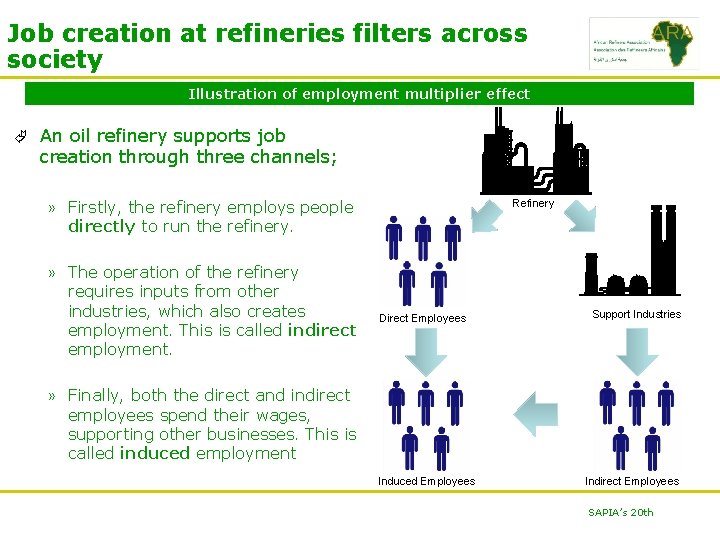
Job creation at refineries filters across society Illustration of employment multiplier effect à An oil refinery supports job creation through three channels; » Firstly, the refinery employs people directly to run the refinery. » The operation of the refinery requires inputs from other industries, which also creates employment. This is called indirect employment. Refinery Direct Employees Support Industries » Finally, both the direct and indirect employees spend their wages, supporting other businesses. This is called induced employment Induced Employees Indirect Employees SAPIA’s 20 th
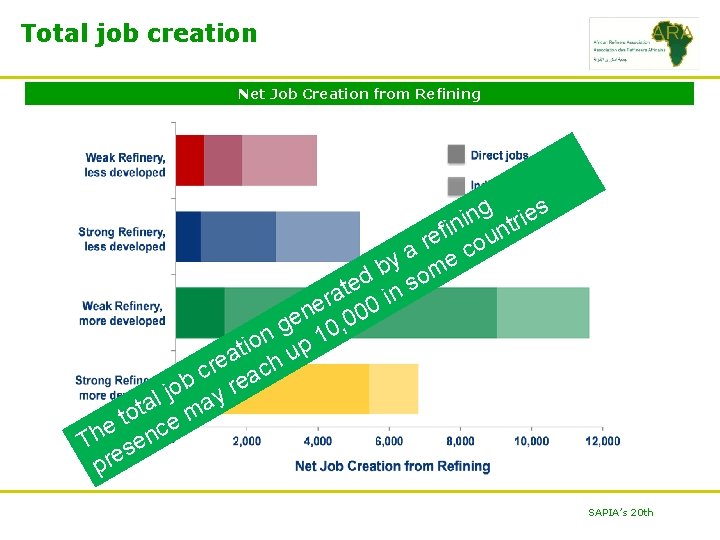
Total job creation Net Job Creation from Refining g ies n i n ntr i f re cou a y me b d so e t ra 0 in e en 0, 00 g n p 1 o i t u a e h r c eac b jo y r l a ma t o t e e c h T sen pre SAPIA’s 20 th
Some other direct benefits of a refinery Security of supply – Removes the risks of piracy, unfavourable marine conditions, trade embargos and competing markets Health benefits – Cuts CO 2 emissions generated by unnecessary tanker journeys Aids transparency – all fuels are sourced from a well -controlled entity, reducing opportunities for opaque business operations to be carried out 24 SAPIA’s 20 th
Other benefits Industrial development – Refinery output can generate chemicals and specialised products for use in other industries such as textiles, construction, electronics and machinery Facilitates tax collection – A well-controlled tax point for petroleum products allows the government to regulate tax collection more efficiently 25 SAPIA’s 20 th
Outcome of study “Even weaker refineries can provide a positive contribution to local economies” - Woodmac Strong refineries in more developed countries, such as RSA, offer the largest benefit to local economies 26 SAPIA’s 20 th
Refineries with a history of investment give higher economic benefit Added Value to Local Economies – Refineries Net of Import Terminal Netting off GVA contribution from import terminal shows weak refineries can be a net burden Weak Refinery, less developed Strong Refinery, less developed Refineries with a history of investment give a higher economic benefit than the contribution from import terminals Weak Refinery, more developed Strong Refinery, more developed - 100 - 50 100 150 200 250 300 GVA, $M/year SAPIA’s 20 th
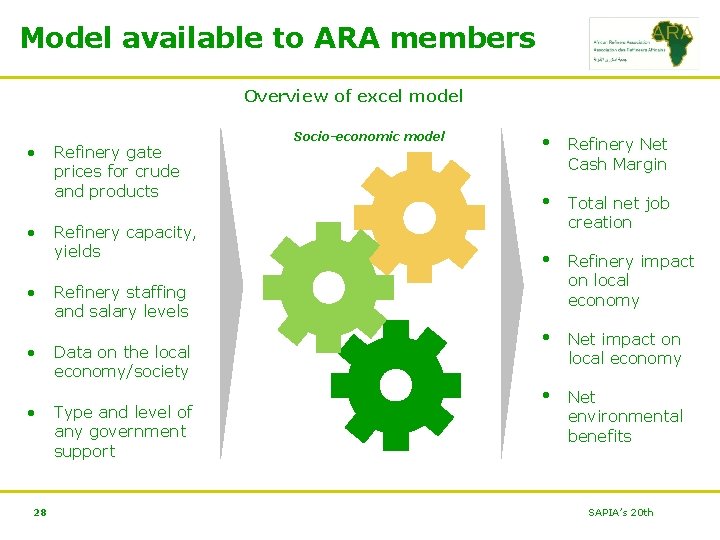
Model available to ARA members Overview of excel model • • Refinery gate prices for crude and products Refinery capacity, yields • Refinery staffing and salary levels • Data on the local economy/society • 28 Type and level of any government support Socio-economic model • Refinery Net Cash Margin • Total net job creation • Refinery impact on local economy • Net environmental benefits SAPIA’s 20 th
Cape Town 2015 • We look forward to discussing the future of African Refining with you all in CAPE TOWN during ARA WEEK 2015 in March next year 29 SAPIA’s 20 th
Questions? 30 SAPIA’s 20 th