
The Valuation Process A Discounted Cash Flow Models


- Slides: 64
The Valuation Process A. Discounted Cash Flow Models – 1. Present value of dividends (DDM) – 2. Present value of free cash flow to equity (FCFE) – 3. Present value of free cash flow (FCFF) B. Relative valuation techniques – 1. Price earnings ratio (P/E) – 2. Price cash flow ratios (P/CF) – 3. Price book value ratios (P/BV) – 4. Price sales ratio (P/S)
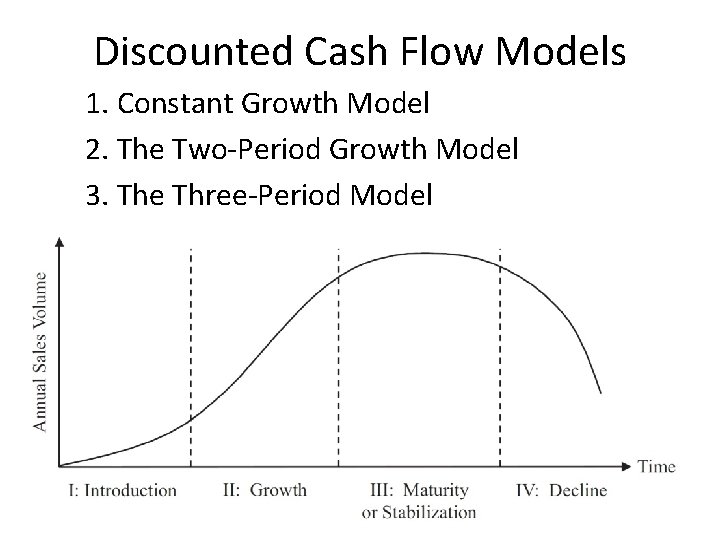
Discounted Cash Flow Models 1. Constant Growth Model 2. The Two-Period Growth Model 3. The Three-Period Model
Required Factors for the Valuation The discounted cash flow approaches are dependent on some factors, namely: • The rate of growth and the duration of growth of the cash flows • The estimate of the discount rate
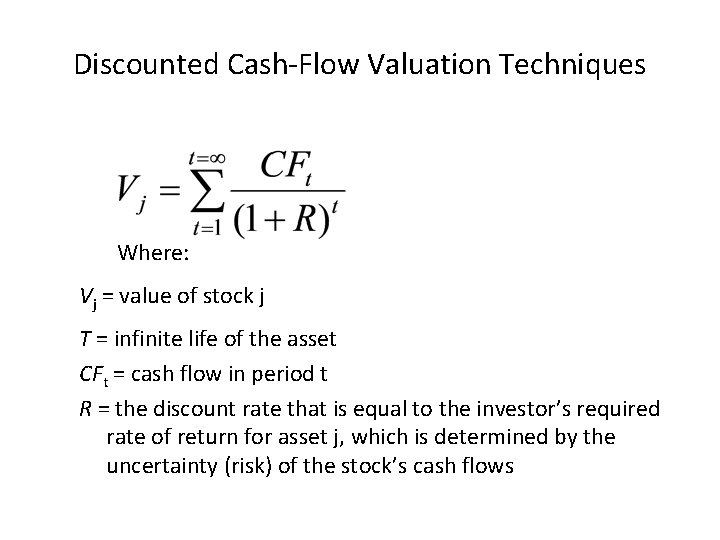
Discounted Cash-Flow Valuation Techniques Where: Vj = value of stock j T = infinite life of the asset CFt = cash flow in period t R = the discount rate that is equal to the investor’s required rate of return for asset j, which is determined by the uncertainty (risk) of the stock’s cash flows
Valuation Based on Comparable Firms • Another application of the valuation principle is the method of comparables – Estimate the value of the firm based on the value of other, comparable firms or investments that we expect will generate very similar cash flows in the future
Valuation Based on Comparable Firms • Consider the case of a new firm that is identical to an existing publicly traded firm – The Valuation Principle implies that two securities with identical cash flows must have the same price – If these firms will generate identical cash flows, we can use the market value of the existing company to determine the value of the new firm – We can adjust for scale differences using valuation multiples
Valuation Based on Comparable Firms • Consider the case of a new firm that is identical to an existing publicly traded firm – The Valuation Principle implies that two securities with identical cash flows must have the same price – If these firms will generate identical cash flows, we can use the market value of the existing company to determine the value of the new firm – We can adjust for scale differences using valuation multiples
Valuation Based on Comparable Firms • Valuation Multiples – A ratio of a firm’s value to some measure of the firm’s scale or cash flow • Price-Earnings ratio • Enterprise Value Multiples • Other multiples – Multiples of sales – Price-to-book value of equity – Industry- specific ratios
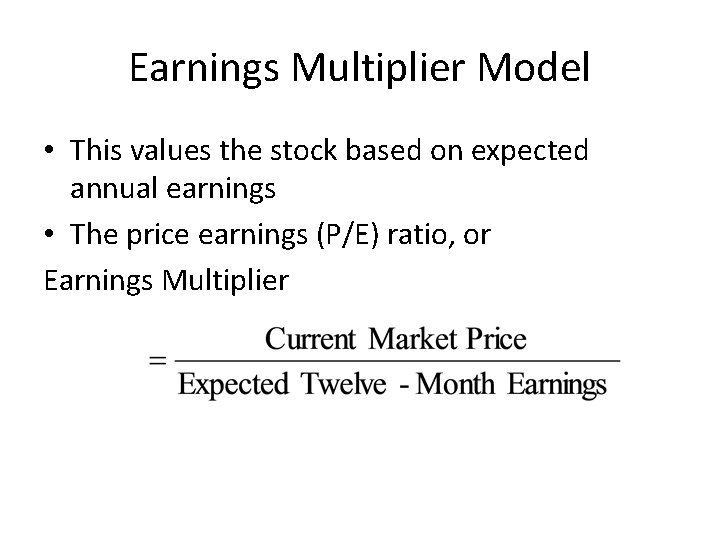
Earnings Multiplier Model • This values the stock based on expected annual earnings • The price earnings (P/E) ratio, or Earnings Multiplier
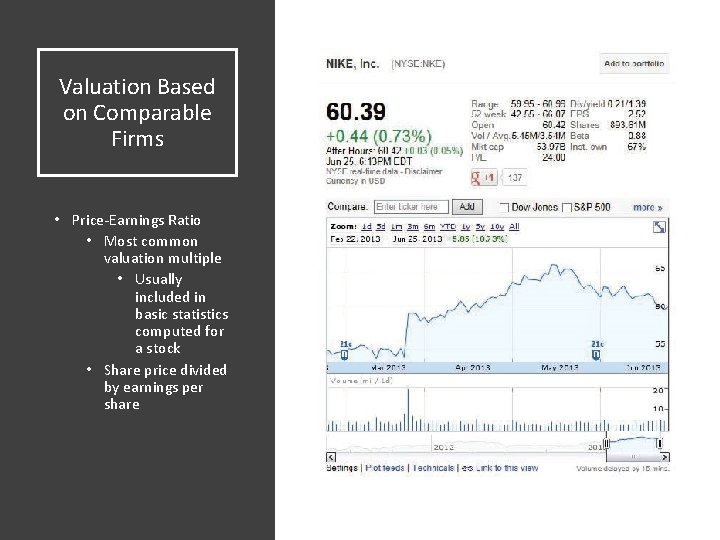
Valuation Based on Comparable Firms • Price-Earnings Ratio • Most common valuation multiple • Usually included in basic statistics computed for a stock • Share price divided by earnings per share
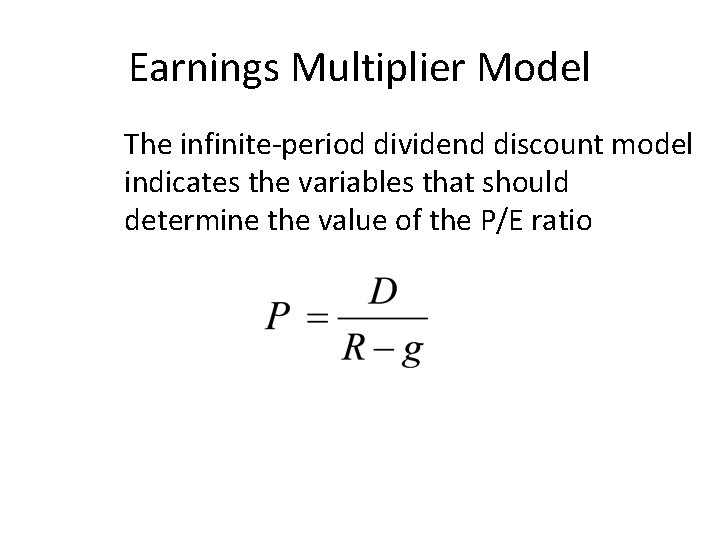
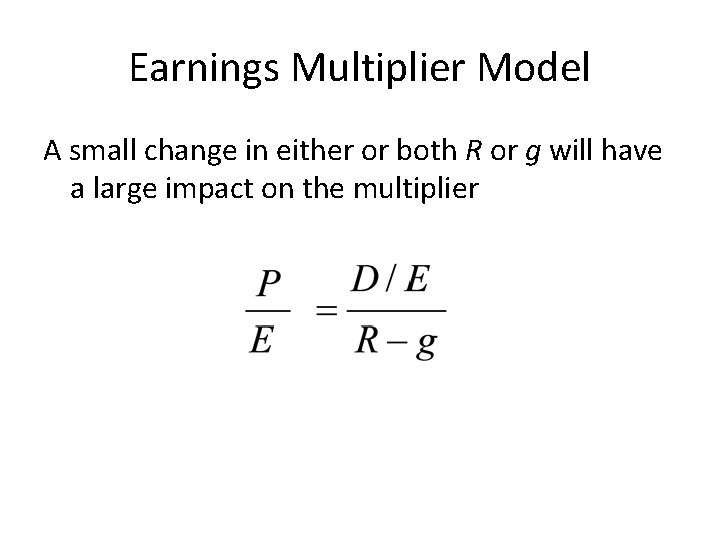
Earnings Multiplier Model The infinite-period dividend discount model indicates the variables that should determine the value of the P/E ratio
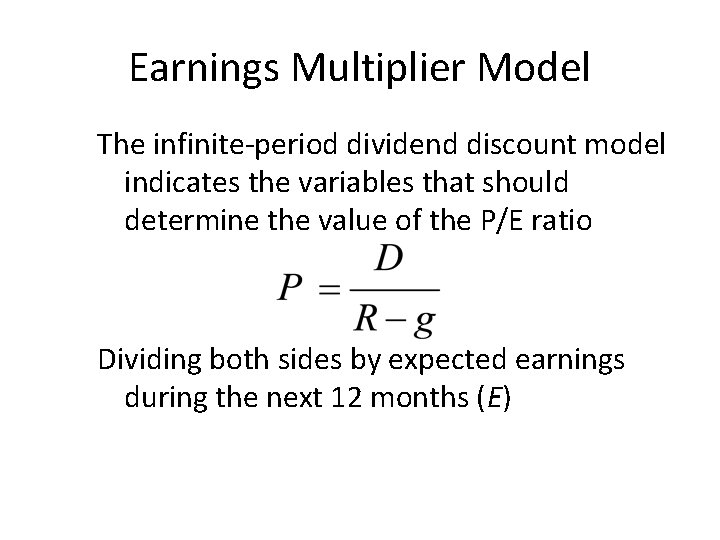
Earnings Multiplier Model The infinite-period dividend discount model indicates the variables that should determine the value of the P/E ratio Dividing both sides by expected earnings during the next 12 months (E)
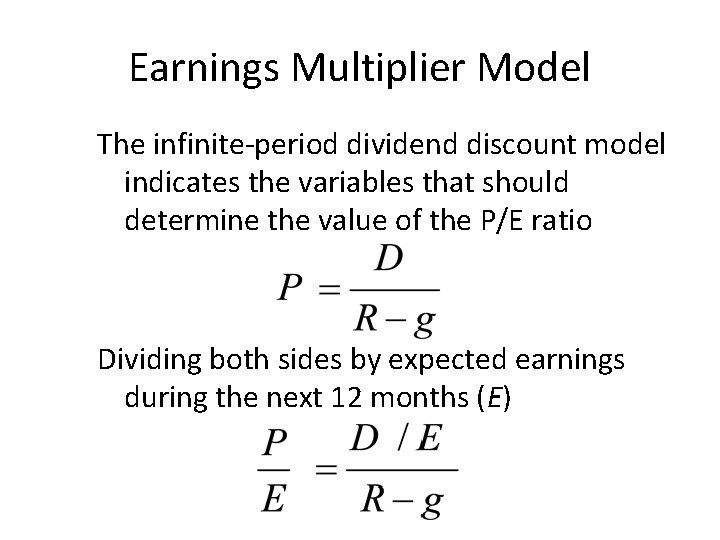
Earnings Multiplier Model The infinite-period dividend discount model indicates the variables that should determine the value of the P/E ratio Dividing both sides by expected earnings during the next 12 months (E)
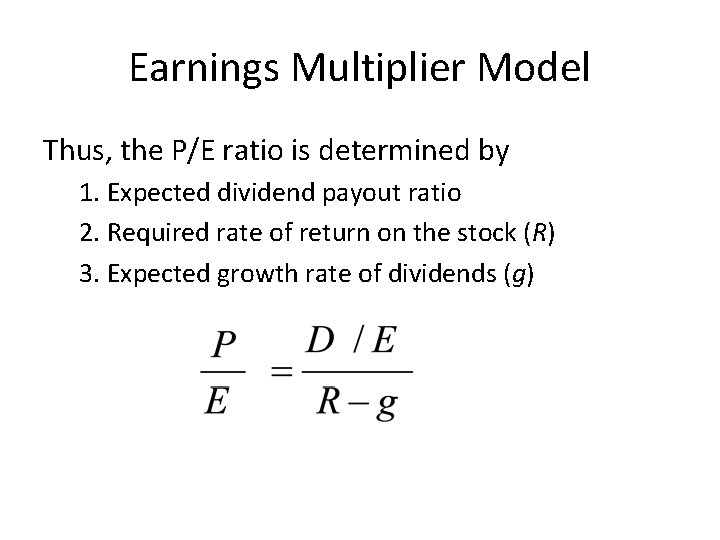
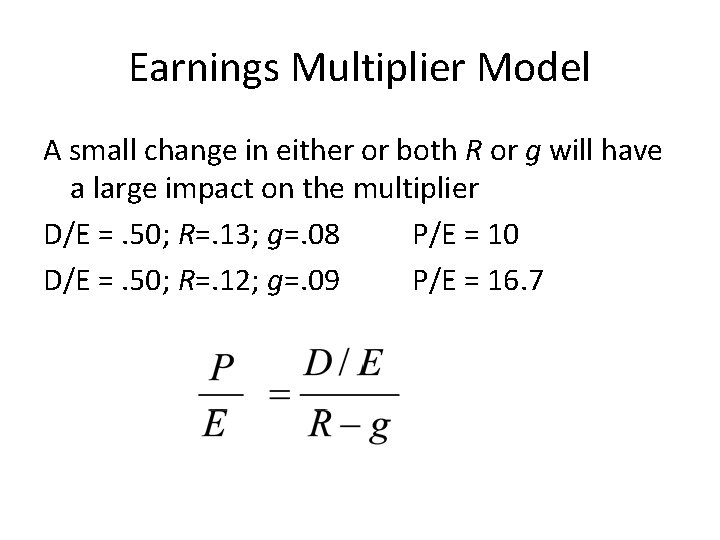
Earnings Multiplier Model Thus, the P/E ratio is determined by 1. Expected dividend payout ratio 2. Required rate of return on the stock (R) 3. Expected growth rate of dividends (g)
Example Valuation Using the Price-Earnings Ratio Problem: • Suppose furniture manufacturer Herman Miller, Inc. , has earnings per share of $1. 38. • If the average P/E of comparable furniture stocks is 21. 3, estimate a value for a share of Herman Miller stock using the P/E as a valuation multiple. • What are the assumptions underlying this estimate?
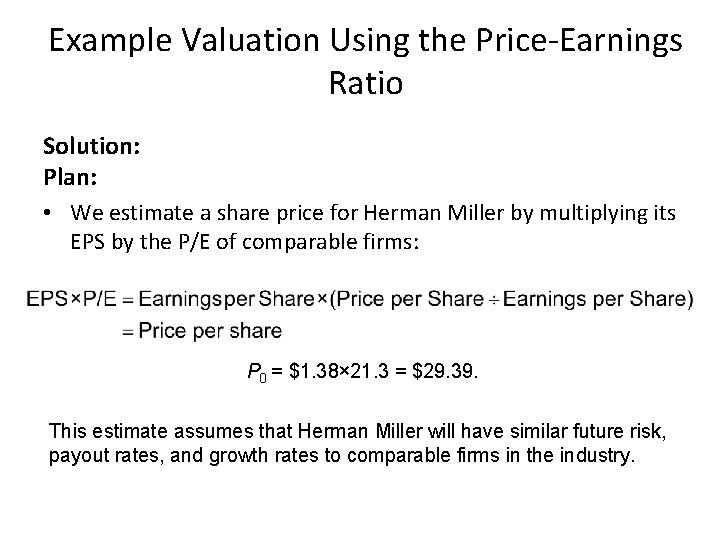
Example Valuation Using the Price-Earnings Ratio Solution: Plan: • We estimate a share price for Herman Miller by multiplying its EPS by the P/E of comparable firms: P 0 = $1. 38× 21. 3 = $29. 39. This estimate assumes that Herman Miller will have similar future risk, payout rates, and growth rates to comparable firms in the industry.
Example Valuation Using the Price-Earnings Ratio Evaluate: • Although valuation multiples are simple to use, they rely on some very strong assumptions about the similarity of the comparable firms to the firm you are valuing. • It is important to consider whether these assumptions are likely to be reasonable—and thus to hold—in each case.
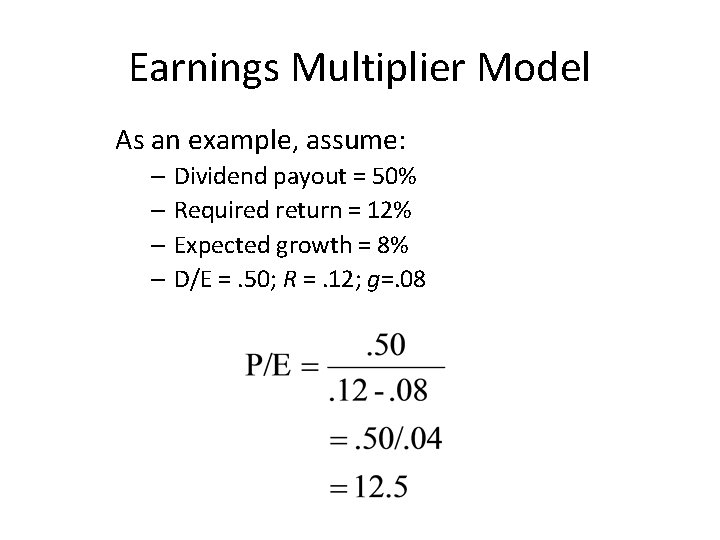
Earnings Multiplier Model As an example, assume: – Dividend payout = 50% – Required return = 12% – Expected growth = 8% – D/E =. 50; R =. 12; g=. 08
Earnings Multiplier Model As an example, assume: – Dividend payout = 50% – Required return = 12% – Expected growth = 8% – D/E =. 50; R =. 12; g=. 08
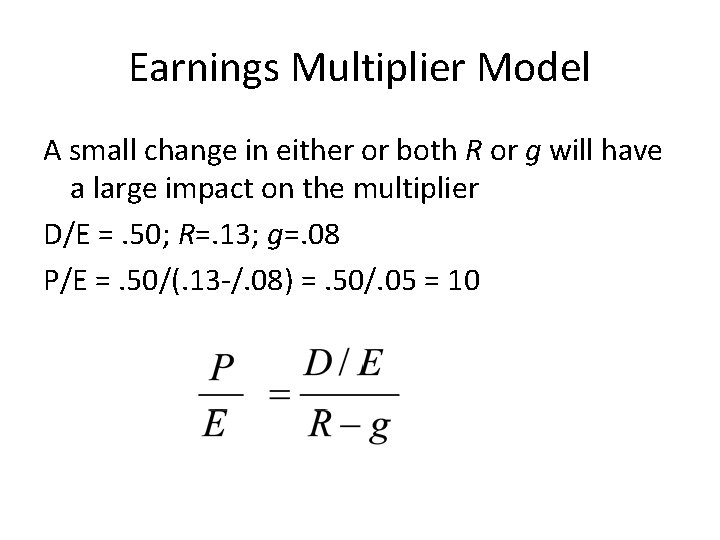
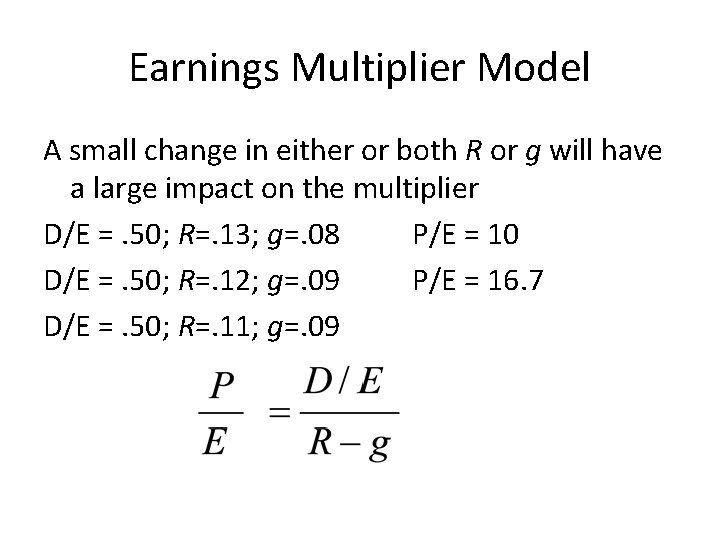
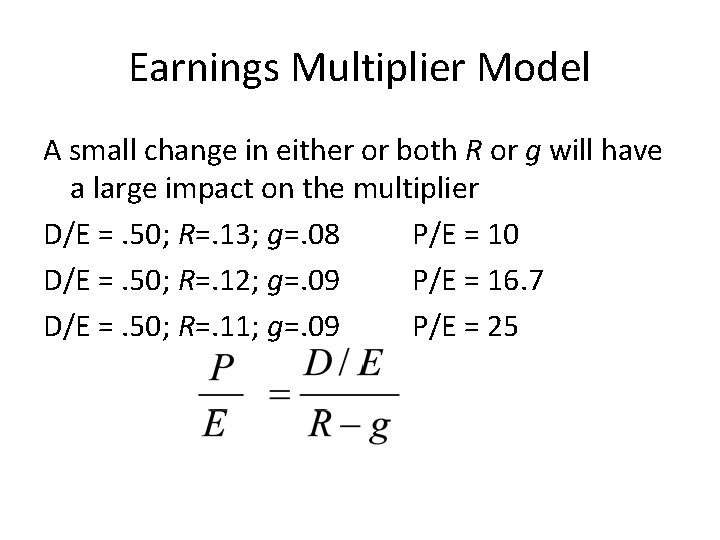
Earnings Multiplier Model A small change in either or both R or g will have a large impact on the multiplier
Earnings Multiplier Model A small change in either or both R or g will have a large impact on the multiplier D/E =. 50; R=. 13; g=. 08 P/E =. 50/(. 13 -/. 08) =. 50/. 05 = 10
Earnings Multiplier Model A small change in either or both R or g will have a large impact on the multiplier D/E =. 50; R=. 13; g=. 08 P/E = 10 D/E =. 50; R=. 12; g=. 09 P/E = 16. 7
Earnings Multiplier Model A small change in either or both R or g will have a large impact on the multiplier D/E =. 50; R=. 13; g=. 08 P/E = 10 D/E =. 50; R=. 12; g=. 09 P/E = 16. 7 D/E =. 50; R=. 11; g=. 09
Earnings Multiplier Model A small change in either or both R or g will have a large impact on the multiplier D/E =. 50; R=. 13; g=. 08 P/E = 10 D/E =. 50; R=. 12; g=. 09 P/E = 16. 7 D/E =. 50; R=. 11; g=. 09 P/E = 25
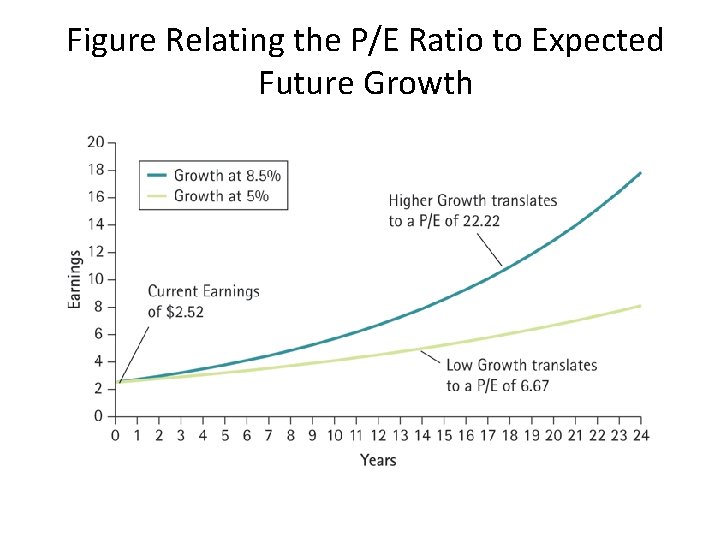
Figure Relating the P/E Ratio to Expected Future Growth
Valuation Based on Comparable Firms • We can compute a firm’s P/E ratio using: – Trailing earnings – Forward earnings • The resulting ratio is either: – Trailing P/E – Forward P/E • For valuation purposes, the forward P/E is generally preferred, as we are most concerned about future earnings
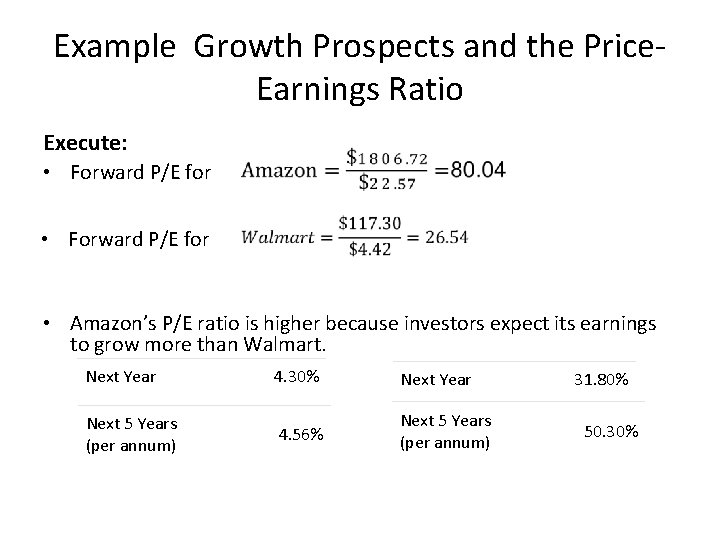
Example Growth Prospects and the Price. Earnings Ratio Problem: • Amazon. com and Walmart’s are retailers. On November 4, 2019, Amazon had a price of $1806. 72 and forward earnings per share of $22. 57. Walmart had a price of $117. 30 and forward earnings per share of $4. 42. • Calculate their forward P/E ratios and explain the difference.
Example 10. 4 Growth Prospects and the Price-Earnings Ratio (2 of 4) Solution: Plan: • We can calculate their P/E ratios by dividing each company’s price per share by its forward earnings per share. • The difference we find is most likely due to different growth expectations.
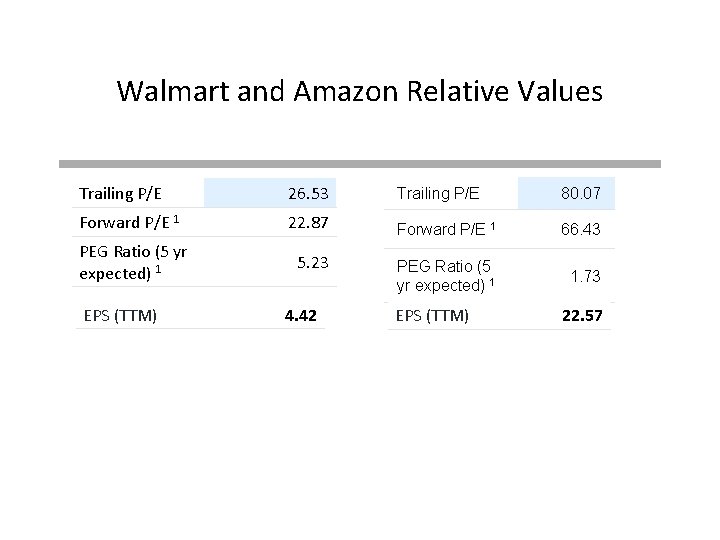
Walmart and Amazon Relative Values Trailing P/E 26. 53 Trailing P/E 80. 07 Forward P/E 1 22. 87 Forward P/E 1 66. 43 PEG Ratio (5 yr expected) 1 5. 23 PEG Ratio (5 yr expected) 1 1. 73 EPS (TTM) 4. 42 EPS (TTM) 22. 57
Example Growth Prospects and the Price. Earnings Ratio Execute: • Forward P/E for • Amazon’s P/E ratio is higher because investors expect its earnings to grow more than Walmart. Next Year Next 5 Years (per annum) 4. 30% Next Year 4. 56% Next 5 Years (per annum) 31. 80% 50. 30%
Example Growth Prospects and the Price. Earnings Ratio • Although both companies are retailers, they have very different growth prospects, as reflected in their P/E ratios. • Investors in Amazon. com are willing to pay 80. 4 times this year’s expected earnings because they are also buying the present value of high future earnings created by expected growth.
The Price-Cash Flow Ratio • Companies can manipulate earnings • Cash-flow is less prone to manipulation • Cash-flow is important for fundamental valuation and in credit analysis
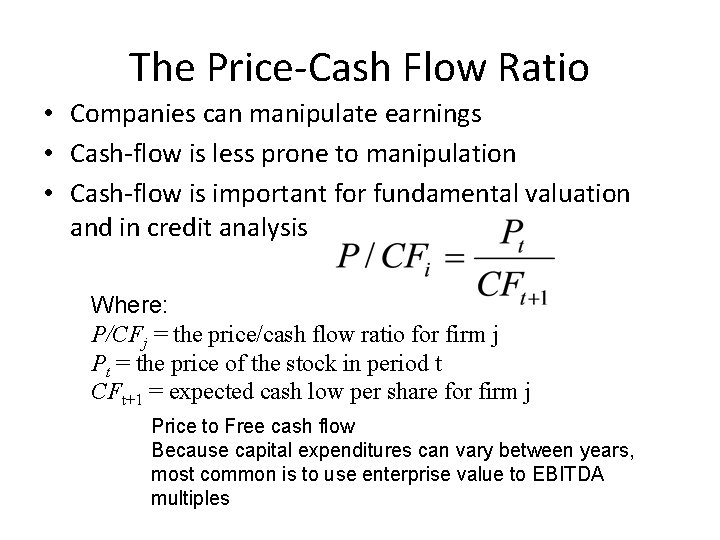
The Price-Cash Flow Ratio • Companies can manipulate earnings • Cash-flow is less prone to manipulation • Cash-flow is important for fundamental valuation and in credit analysis Where: P/CFj = the price/cash flow ratio for firm j Pt = the price of the stock in period t CFt+1 = expected cash low per share for firm j Price to Free cash flow Because capital expenditures can vary between years, most common is to use enterprise value to EBITDA multiples
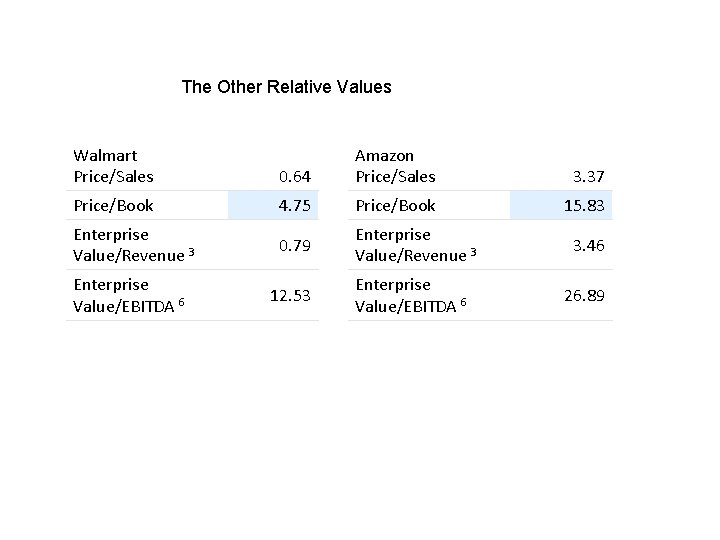
The Other Relative Values Walmart Price/Sales 0. 64 Amazon Price/Sales 3. 37 Price/Book 4. 75 Price/Book 15. 83 Enterprise Value/Revenue 3 0. 79 Enterprise Value/Revenue 3 3. 46 Enterprise Value/EBITDA 6 12. 53 Enterprise Value/EBITDA 6 26. 89
The Price-Book Value Ratio Widely used to measure bank values (most bank assets are liquid (bonds and commercial loans) Fama and French study indicated inverse relationship between P/BV ratios and excess return for a cross section of stocks
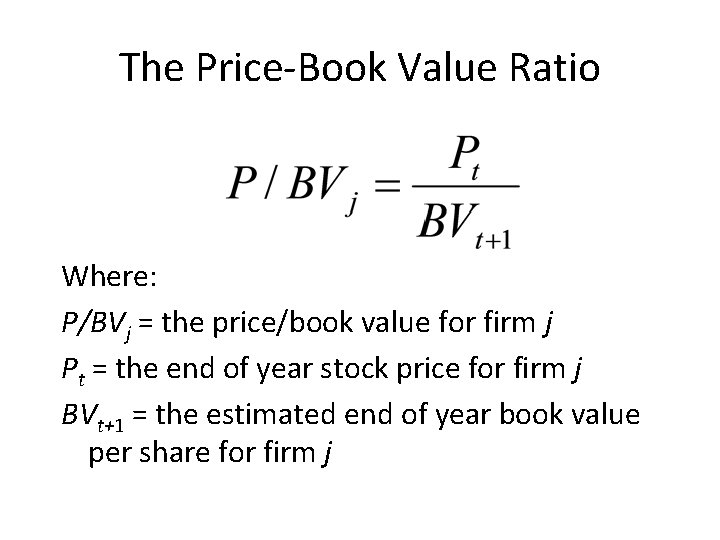
The Price-Book Value Ratio Where: P/BVj = the price/book value for firm j Pt = the end of year stock price for firm j BVt+1 = the estimated end of year book value per share for firm j
The Price-Book Value Ratio • Be sure to match the price with either a recent book value number, or estimate the book value for the subsequent year • Can derive an estimate based upon historical growth rate for the series or use the growth rate implied by the sustainable growth rate g=(ROE) X (Retention Rate)
The Price-Sales Ratio • Match the stock price with recent annual sales, or future sales per share • This ratio varies dramatically by industry • Profit margins also vary by industry • Relative comparisons using P/S ratio should be between firms in similar industries
The Price-Sales Ratio • Strong, consistent growth rate is a requirement of a growth company • Sales is subject to less manipulation than other financial data
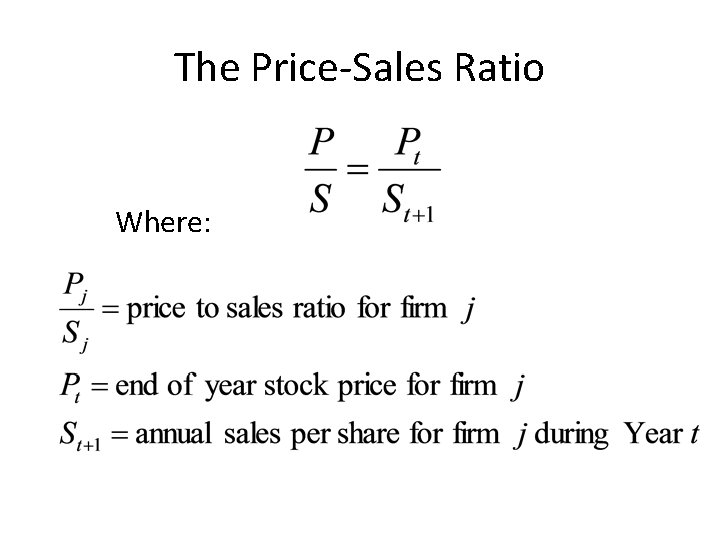
The Price-Sales Ratio Where:
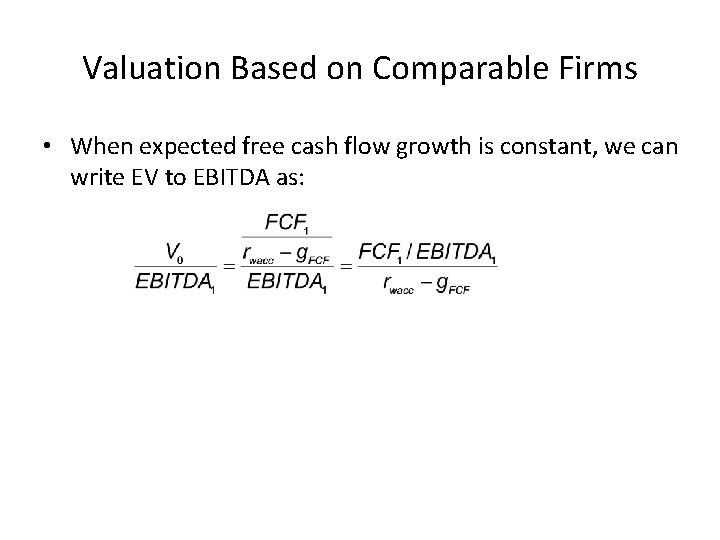
Valuation Based on Comparable Firms • When expected free cash flow growth is constant, we can write EV to EBITDA as:
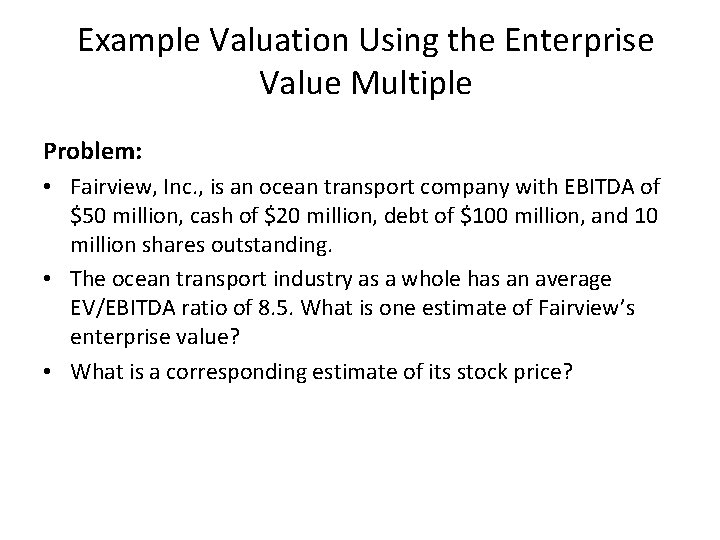
Example Valuation Using the Enterprise Value Multiple Problem: • Fairview, Inc. , is an ocean transport company with EBITDA of $50 million, cash of $20 million, debt of $100 million, and 10 million shares outstanding. • The ocean transport industry as a whole has an average EV/EBITDA ratio of 8. 5. What is one estimate of Fairview’s enterprise value? • What is a corresponding estimate of its stock price?
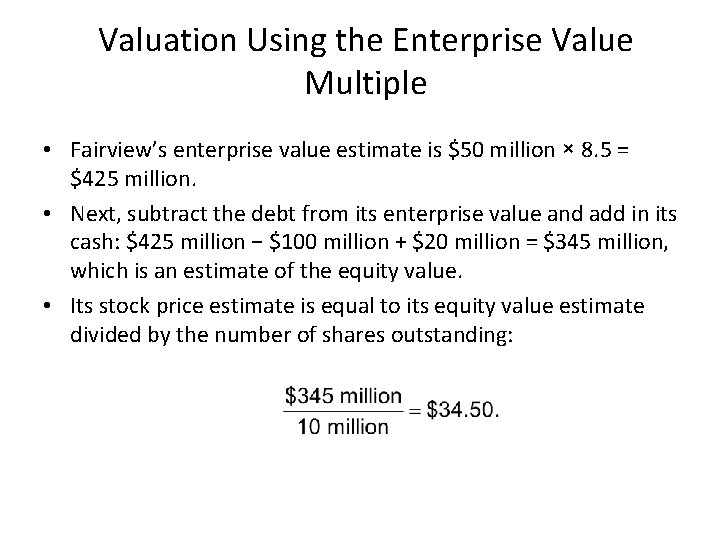
Valuation Using the Enterprise Value Multiple • Fairview’s enterprise value estimate is $50 million × 8. 5 = $425 million. • Next, subtract the debt from its enterprise value and add in its cash: $425 million − $100 million + $20 million = $345 million, which is an estimate of the equity value. • Its stock price estimate is equal to its equity value estimate divided by the number of shares outstanding:
Valuation Using the Enterprise Value Multiple Evaluate: • If we assume that Fairview should be valued similarly to the rest of the industry, then $425 million is a reasonable estimate of its enterprise value and $34. 50 is a reasonable estimate of its stock price. • However, we are relying on the assumption that Fairview’s expected free cash flow growth is similar to the industry average. If that assumption is wrong, so is our valuation.
Valuation Based on Comparable Firms • Other multiples – Multiples of sales can be useful if it is reasonable to assume margins are similar in the future – Price-to-book value of equity can be used for firms with substantial tangible assets – Some multiples are specific to an industry • e. g. Cable TV – Enterprise value per subscriber
Valuation Based on Comparable Firms • Limitations of Multiples – Firms are not identical • Usefulness of a valuation multiple will depend on the nature of the differences and the sensitivity of the multiples to the differences • Differences in multiples can be related to differences in – Expected future growth rate – Risk (cost of capital) – Differences in accounting conventions between countries
Valuation Based on Comparable Firms • Limitations of Multiples – Comparables provide only information regarding the value of the firm relative to other firms in the comparison set • Cannot help determine whether an entire industry is overvalued – Internet boom example
Valuation Based on Comparable Firms • Comparison with Discounted Cash Flow Methods – Valuation multiple does not take into account material differences between firms • Talented managers • More efficient manufacturing processes • Patents on new technology
Valuation Based on Comparable Firms • Comparison with Discounted Cash Flow Methods – Discounted cash flow methods allow us to incorporate specific information about cost of capital or future growth • Potential to be more accurate
Stock Valuation Techniques: A Final Word • No single technique provides a final answer regarding a stock’s true value • Practitioners use a combination of these approaches • Confidence comes from consistent results from a variety of these methods
Estimating the Inputs: The Required Rate of Return and The Expected Growth Rate of Valuation Variables Valuation procedure is the same for securities around the world, but the required rate of return (R) and expected growth rate of earnings (g) and other valuation variables such as book value, cash flow, and dividends differ among countries
Required Rate of Return (R) The investor’s required rate of return must be estimated regardless of the approach selected or technique applied • This will be used as the discount rate and also affects relative-valuation • This is not used for present value of free cash flow which uses the required rate of return on equity (R) • It is also not used in present value of operating cash flow which uses WACC
Required Rate of Return (R) Three factors influence an investor’s required rate of return: • The economy’s real risk-free rate (RRFR) • The expected rate of inflation (I) • A risk premium (RP)
The Economy’s Real Risk-Free Rate • Minimum rate an investor should require • Depends on the real growth rate of the economy – (Capital invested should grow as fast as the economy) • Rate is affected for short periods by tightness or ease of credit markets
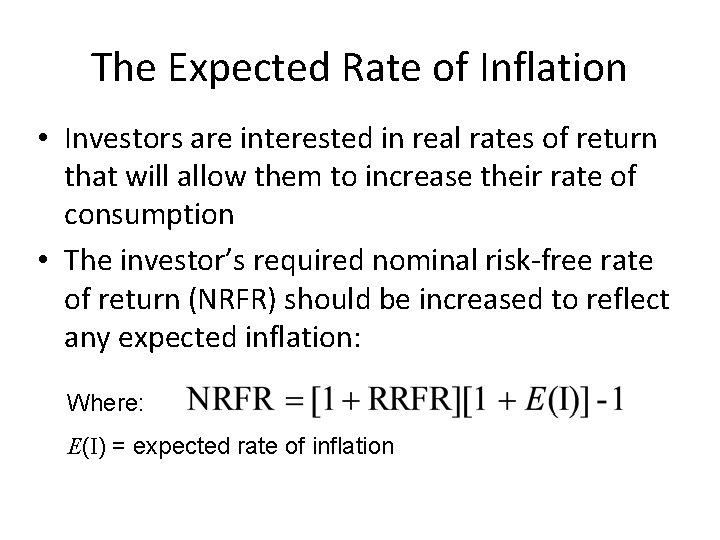
The Expected Rate of Inflation • Investors are interested in real rates of return that will allow them to increase their rate of consumption • The investor’s required nominal risk-free rate of return (NRFR) should be increased to reflect any expected inflation: Where: E(I) = expected rate of inflation
The Risk Premium • Causes differences in required rates of return on alternative investments • Explains the difference in expected returns among securities • Changes over time, both in yield spread and ratios of yields
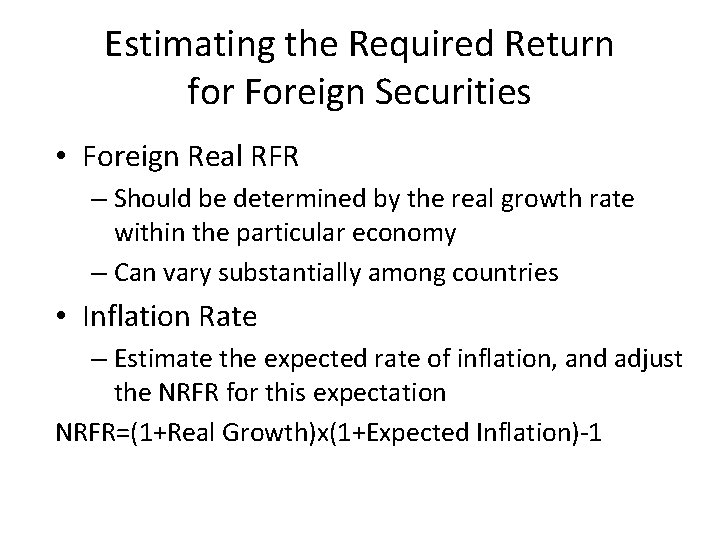
Estimating the Required Return for Foreign Securities • Foreign Real RFR – Should be determined by the real growth rate within the particular economy – Can vary substantially among countries • Inflation Rate – Estimate the expected rate of inflation, and adjust the NRFR for this expectation NRFR=(1+Real Growth)x(1+Expected Inflation)-1
Risk Premium • Must be derived for each investment in each country • The five risk components vary between countries
Risk Components • • • Business risk Financial risk Liquidity risk Exchange rate risk Country risk
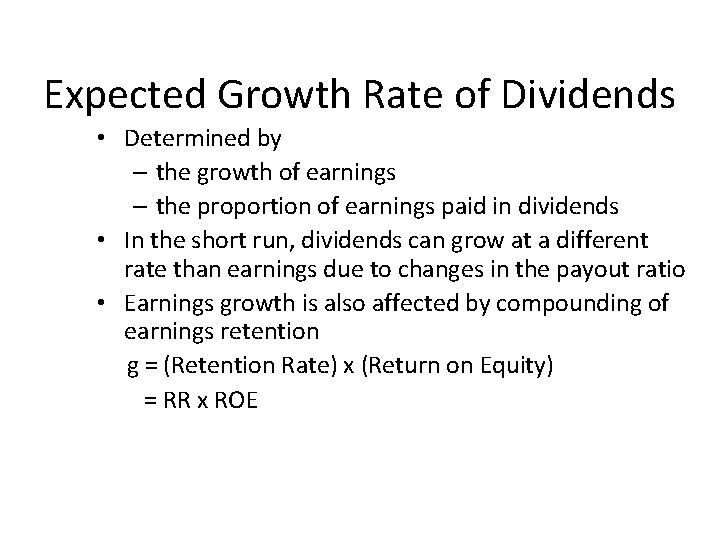
Expected Growth Rate of Dividends • Determined by – the growth of earnings – the proportion of earnings paid in dividends • In the short run, dividends can grow at a different rate than earnings due to changes in the payout ratio • Earnings growth is also affected by compounding of earnings retention g = (Retention Rate) x (Return on Equity) = RR x ROE
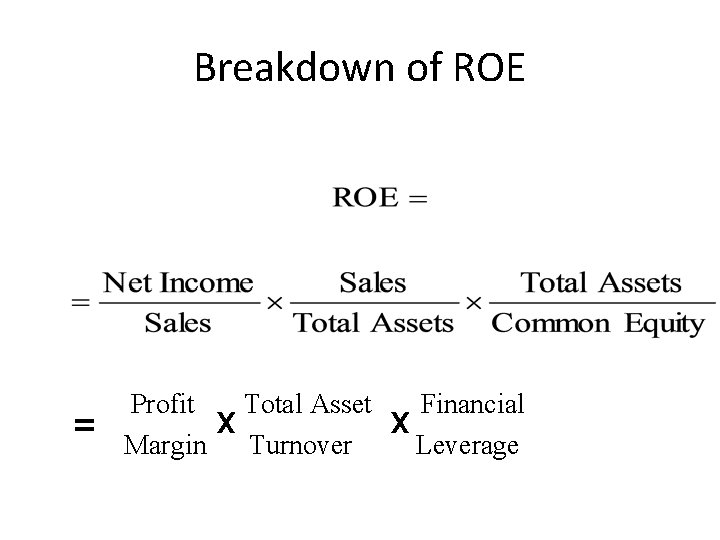
Breakdown of ROE = Profit Margin Total Asset x Turnover Financial x Leverage
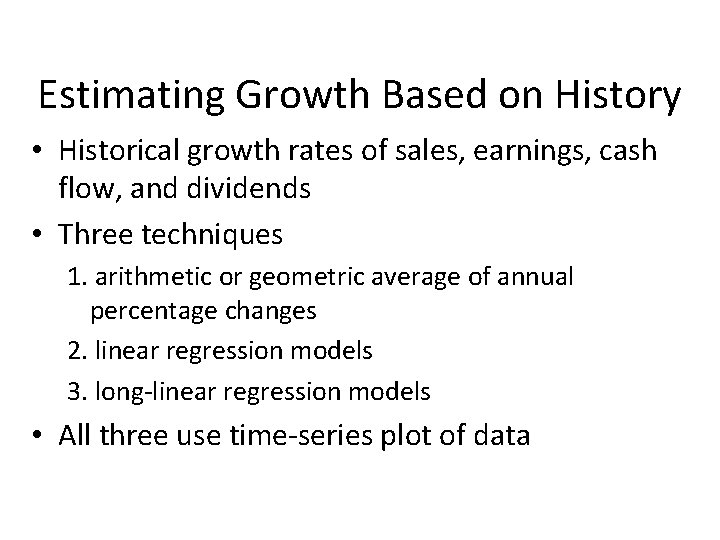
Estimating Growth Based on History • Historical growth rates of sales, earnings, cash flow, and dividends • Three techniques 1. arithmetic or geometric average of annual percentage changes 2. linear regression models 3. long-linear regression models • All three use time-series plot of data
Estimating Dividend Growth for Foreign Stocks • • Differences in accounting practices affect the components of ROE Retention Rate Net Profit Margin Total Asset Turnover Total Asset/Equity Ratio
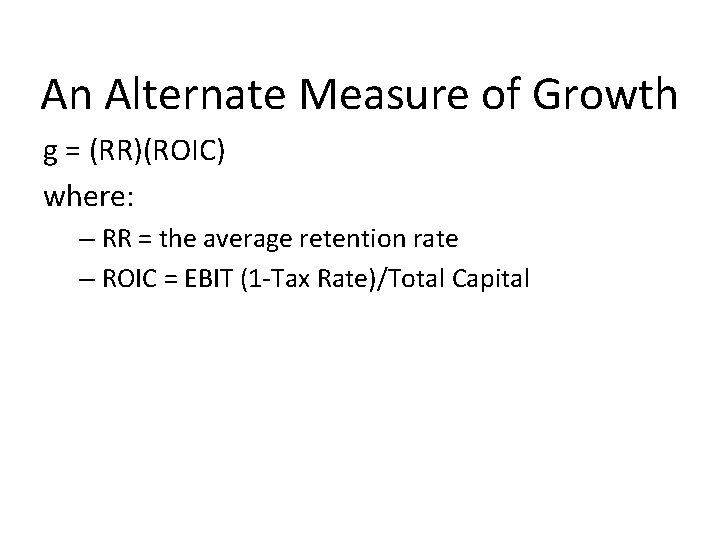
An Alternate Measure of Growth g = (RR)(ROIC) where: – RR = the average retention rate – ROIC = EBIT (1 -Tax Rate)/Total Capital