
The Validity and Reliability Study of WHO Quality
The Validity and Reliability Study of WHO Quality of Life Scale Short Form (WHOQOLBref) in Kazakh Language Baglan YERMAKHANOV *, Prof. Dr. Erdal ZORBA**, Assoc. Prof. Ph. D Mutlu TURKMEN***

INT Ø Quality of life is the general well-being of individuals and societies, outlining negative and positive features of life. It observes life satisfaction, including everything from physical health, family, education, employment, wealth, safety, security to freedom, religious beliefs, and the environment. Ø Quality of life, has been frequently researched recently. Especially in the health sciences and social sciences there’s been a growing interest on this topic.
PURPOSE § The aim of this study was to verify the validity and reliability of the Kazakhs version of WHOQOL-BREF.
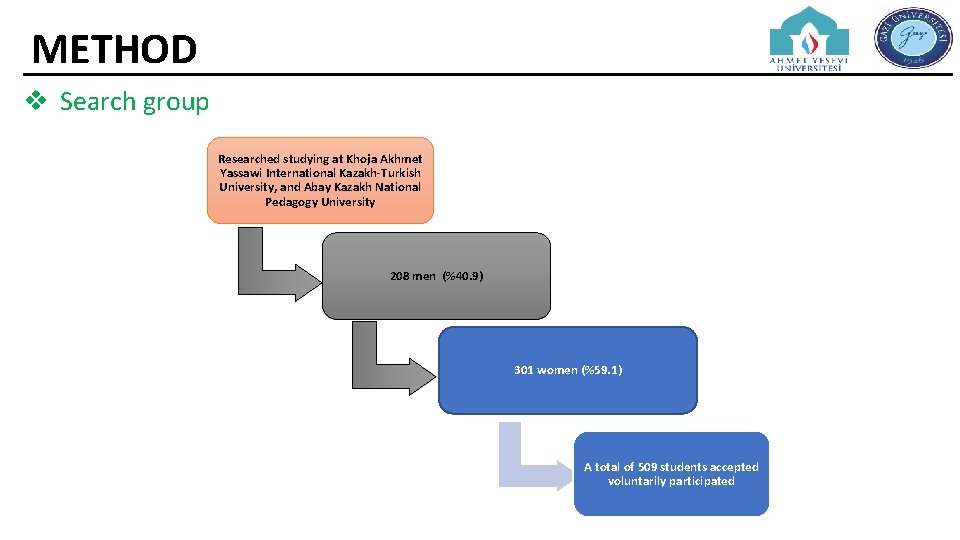
METHOD v Search group Researched studying at Khoja Akhmet Yassawi International Kazakh-Turkish University, and Abay Kazakh National Pedagogy University 208 men (%40. 9) 301 women (%59. 1) A total of 509 students accepted voluntarily participated

DATA COLLECTION v World Health Organization Quality of Life Scale Short Form(WHOQOL-BREF) § The World Health Organization Quality of Life Scale Short Form is a shortened version of the 100 -question World Health Organization Quality of Life Assesment (WHOQOL) scale prepared to evaluate how an individual perceives the quality of life. A scale of 26 subjects and 5 subscales (general health, physical health, psychological health, social relations, environment).
APPLICATION Implementation Stage Before the scales were distributed to the students, they were first informed about the purpose of the research. Accordingly, it was applied after obtaining the necessary permissions from the teachers before the classes.

Translation Stage The standard translation-back translation method proposed by Brislin (1986) was used during the translation of the scale. The original English version of the scale was examined by researchers and then academically English, and it was translated into Kazakh by three specialist psychologists, three experts in sports sciences. Turkish and Russian versions of the scale were also taken into account while translating. The items in the scale obtained were compared with each other and the items with the same translation were determined. Each translation method of the items with the same translation and the different translation was returned to English by giving it to different experts. The scale items that were translated back were compared with the original inventory items, and differences and errors were identified. Compared with the original inventory, the English translation took the final form of Kazakh inventory with the closest translations.
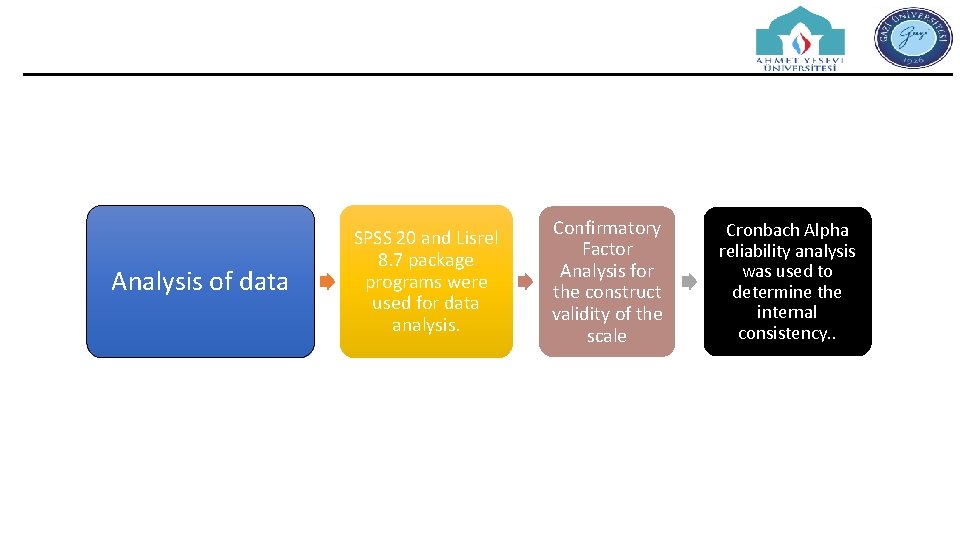
Analysis of data SPSS 20 and Lisrel 8. 7 package programs were used for data analysis. Confirmatory Factor Analysis for the construct validity of the scale Cronbach Alpha reliability analysis was used to determine the internal consistency. .
RESULTS Structure Validity of Inventory § Multiple fit indices were used for DFA; § chi-square fit value (x 2 / sd) § Goodness of Fit Index, GFI, § Comparative Fit Index, CFI § Normed Fit Index, NFI, § Root Mean Square Error of Approximation, RMSEA § Standardized Root Mean Square Residual SRMR § Root Mean Square Residuals, RMR fit indices are examined.
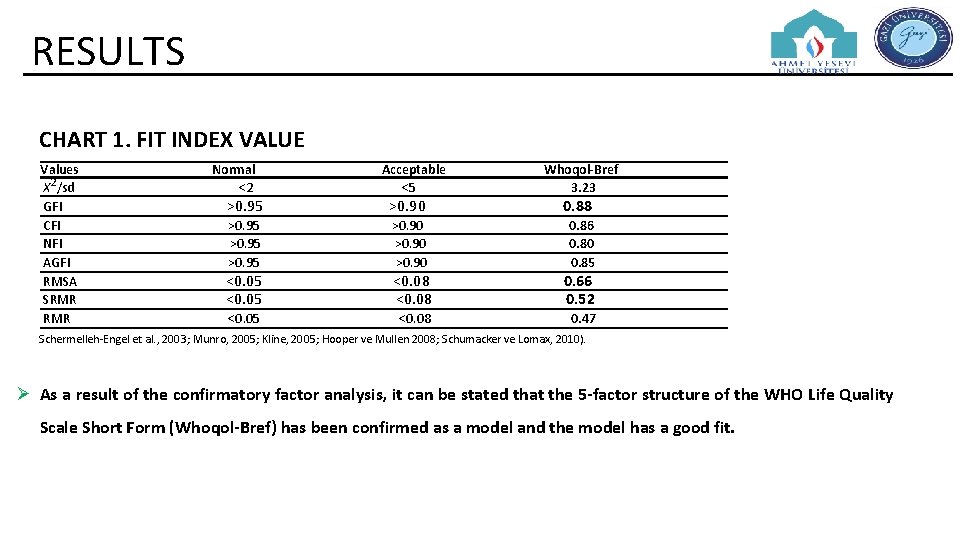
RESULTS CHART 1. FIT INDEX VALUE Values X 2/sd GFI CFI NFI AGFI RMSA SRMR Normal <2 Acceptable <5 Whoqol-Bref 3. 23 >0. 95 >0. 90 0. 88 >0. 95 >0. 90 <0. 08 0. 86 0. 80 0. 85 0. 66 0. 52 <0. 05 <0. 08 0. 47 <0. 05 Schermelleh-Engel et al. , 2003; Munro, 2005; Kline, 2005; Hooper ve Mullen 2008; Schumacker ve Lomax, 2010). Ø As a result of the confirmatory factor analysis, it can be stated that the 5 -factor structure of the WHO Life Quality Scale Short Form (Whoqol-Bref) has been confirmed as a model and the model has a good fit.
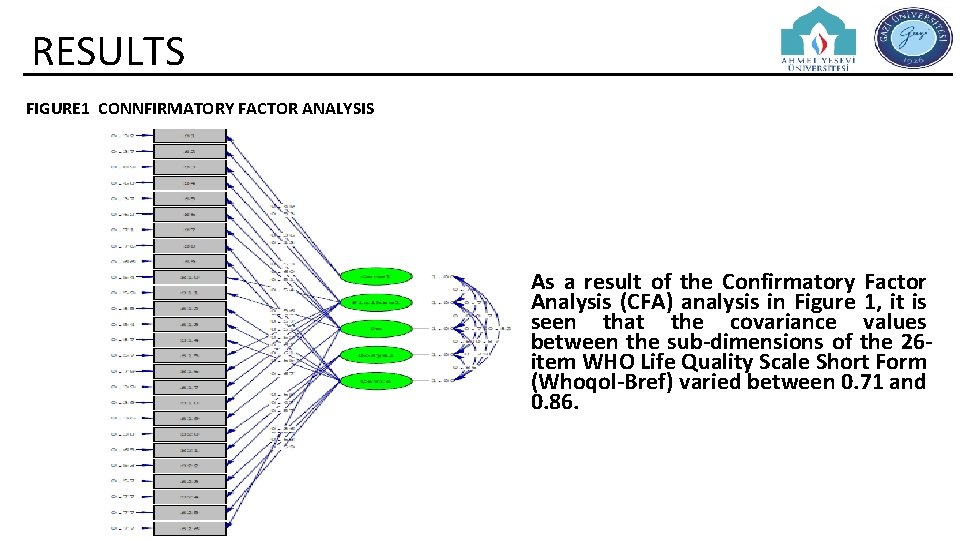
RESULTS FIGURE 1 CONNFIRMATORY FACTOR ANALYSIS As a result of the Confirmatory Factor Analysis (CFA) analysis in Figure 1, it is seen that the covariance values between the sub-dimensions of the 26 item WHO Life Quality Scale Short Form (Whoqol-Bref) varied between 0. 71 and 0. 86.
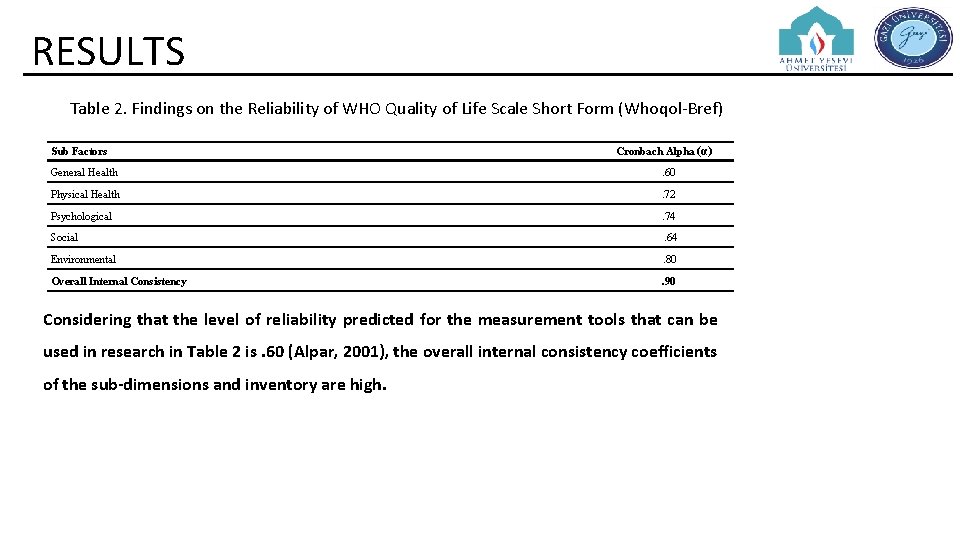
RESULTS Table 2. Findings on the Reliability of WHO Quality of Life Scale Short Form (Whoqol-Bref) Sub Factors Cronbach Alpha (α) General Health . 60 Physical Health . 72 Psychological . 74 Social . 64 Environmental . 80 Overall Internal Consistency . 90 Considering that the level of reliability predicted for the measurement tools that can be used in research in Table 2 is. 60 (Alpar, 2001), the overall internal consistency coefficients of the sub-dimensions and inventory are high.
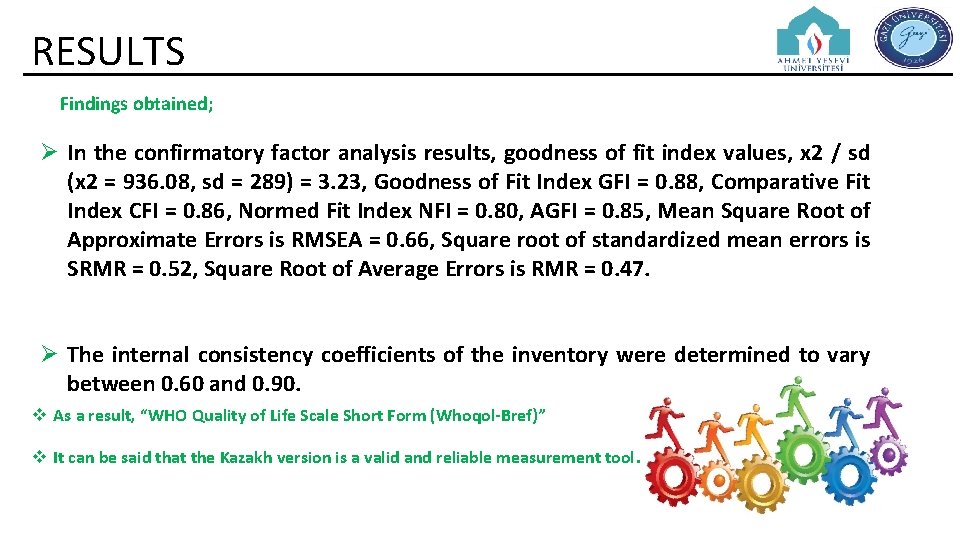
RESULTS Findings obtained; Ø In the confirmatory factor analysis results, goodness of fit index values, x 2 / sd (x 2 = 936. 08, sd = 289) = 3. 23, Goodness of Fit Index GFI = 0. 88, Comparative Fit Index CFI = 0. 86, Normed Fit Index NFI = 0. 80, AGFI = 0. 85, Mean Square Root of Approximate Errors is RMSEA = 0. 66, Square root of standardized mean errors is SRMR = 0. 52, Square Root of Average Errors is RMR = 0. 47. Ø The internal consistency coefficients of the inventory were determined to vary between 0. 60 and 0. 90. v As a result, “WHO Quality of Life Scale Short Form (Whoqol-Bref)” v It can be said that the Kazakh version is a valid and reliable measurement tool.
SUGGESTIONS Ø In the future studies, it is thought that applying the Kazakh version of WHO Quality of Life Scale Short Form (Whoqol-Bref) with confirmatory factor analysis on different samples covering different age groups and sports experience will contribute to the validity and reliability of the scale.

THANKS FOR YOUR ATTENDANCE…
- Slides: 15