
The UW Plasma Physics Group Clint Sprott Paul
- Slides: 19
The UW Plasma Physics Group Clint Sprott, Paul Terry, Ellen Zweibel, Stas Boldyrev, Dalton Schnack, Cary Forest, Stewart Prager Presented to Introductory Seminar for New Graduate Students on September 6, 2007
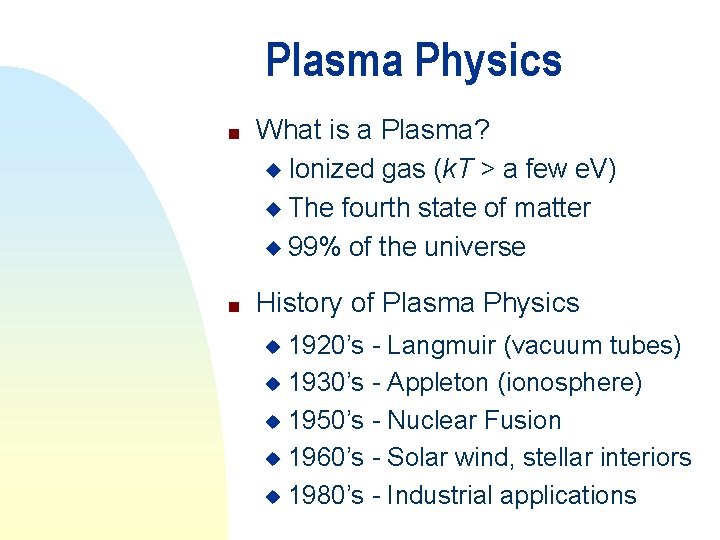
Plasma Physics n n What is a Plasma? u Ionized gas (k. T > a few e. V) u The fourth state of matter u 99% of the universe History of Plasma Physics 1920’s - Langmuir (vacuum tubes) u 1930’s - Appleton (ionosphere) u 1950’s - Nuclear Fusion u 1960’s - Solar wind, stellar interiors u 1980’s - Industrial applications u
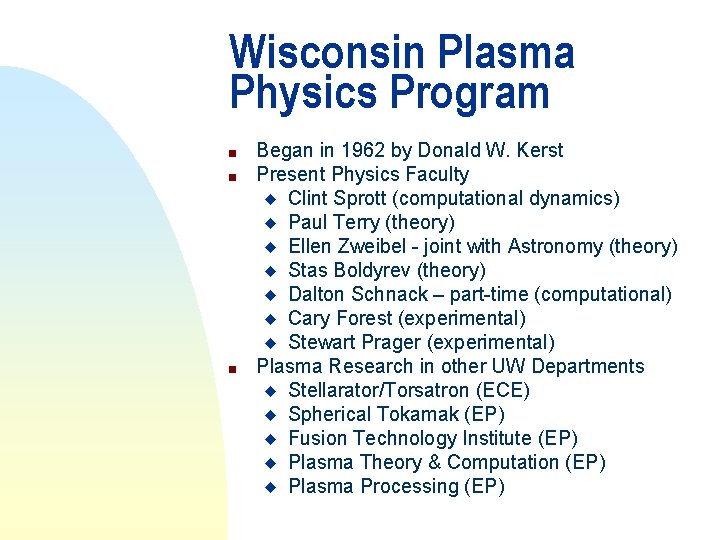
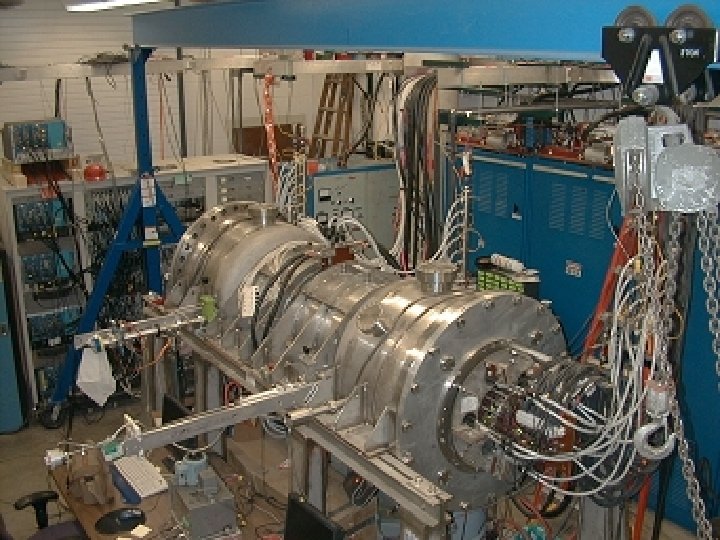
Wisconsin Plasma Physics Program n n n Began in 1962 by Donald W. Kerst Present Physics Faculty u Clint Sprott (computational dynamics) u Paul Terry (theory) u Ellen Zweibel - joint with Astronomy (theory) u Stas Boldyrev (theory) u Dalton Schnack – part-time (computational) u Cary Forest (experimental) u Stewart Prager (experimental) Plasma Research in other UW Departments u Stellarator/Torsatron (ECE) u Spherical Tokamak (EP) u Fusion Technology Institute (EP) u Plasma Theory & Computation (EP) u Plasma Processing (EP)
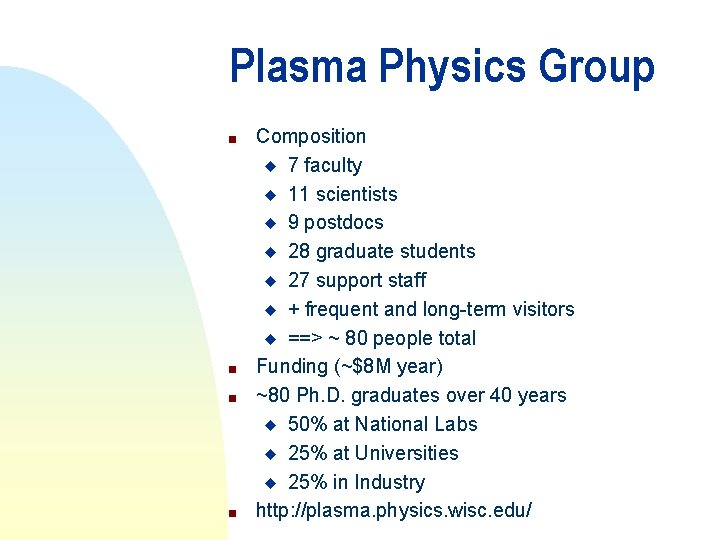
Plasma Physics Group n n Composition u 7 faculty u 11 scientists u 9 postdocs u 28 graduate students u 27 support staff u + frequent and long-term visitors u ==> ~ 80 people total Funding (~$8 M year) ~80 Ph. D. graduates over 40 years u 50% at National Labs u 25% at Universities u 25% in Industry http: //plasma. physics. wisc. edu/
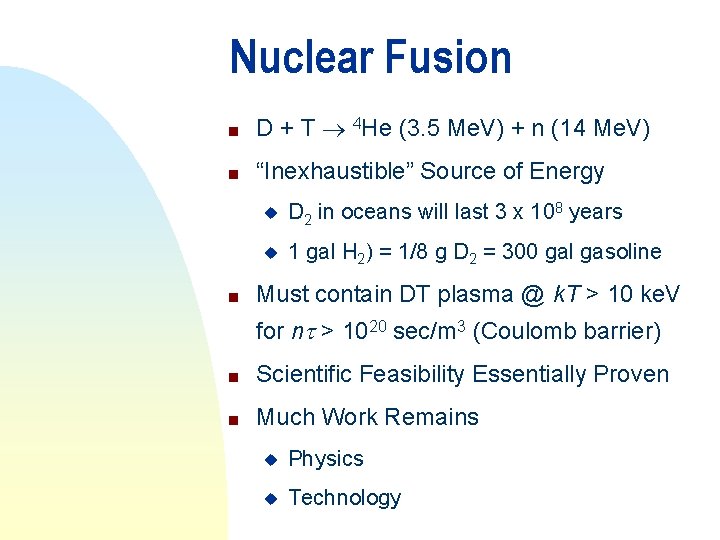
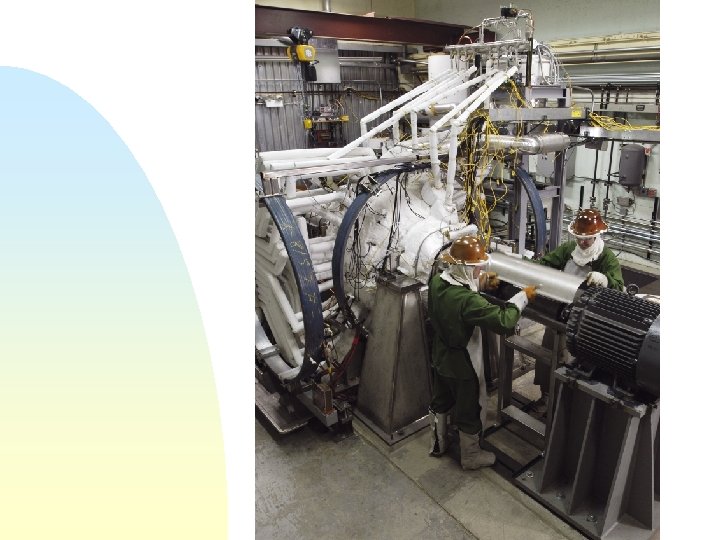
Nuclear Fusion n D + T 4 He (3. 5 Me. V) + n (14 Me. V) n “Inexhaustible” Source of Energy n u D 2 in oceans will last 3 x 10⁸ years u 1 gal H 2) = 1/8 g D 2 = 300 gal gasoline Must contain DT plasma @ k. T > 10 ke. V for n > 1020 sec/m 3 (Coulomb barrier) n Scientific Feasibility Essentially Proven n Much Work Remains u Physics u Technology
What to do if Interested n n Come around and get Acquainted Take Plasma Courses u u u u n n 525 introduction 526 plasma lab (EP) 527 confinement devices 528 plasma processing 724 waves & instabilities 725 plasma kinetic theory 726 magnetohydrodynamics Plasma Seminar: 12: 05 Mon (1227 Engr) Group Meeting: 4: 00 Thurs (5280 Ch) Summer Jobs Available Pass Qualifiers
Paul Terry
Turbulence in fusion and astrophysics Interests (organizing principles): Physics of coherent structure formation in turbulence Role of symmetry-breaking waves Role of strongly inhomogeneous background (e. g. , shear flow) Applications: Transport in fusion plasmas Interstellar medium
Ellen Zweibel
Stas Boldyrev
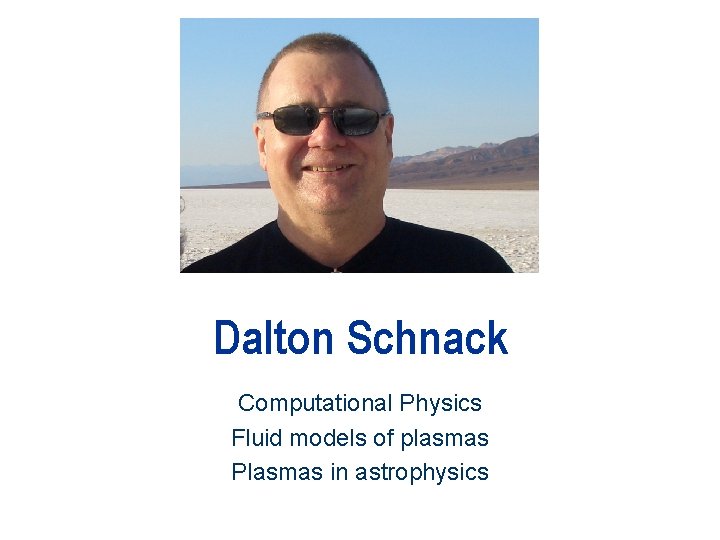
Dalton Schnack Computational Physics Fluid models of plasmas Plasmas in astrophysics
Research Interests n n n n n Magnetohydrodynamics (MHD) Extended MHD (2 -fluid/FLR effects) Fluid models for tokamak plasmas (closures) Plasma relaxation/dynamo Large scale computations for fluid plasmas MHD/RF interactions Anomalous angular momentum transport in magnetized plasmas Structure and heating of the solar corona Accretion disk coronae
Cary Forest
Stewart Prager