
THE USES AND MISUSES OF OPF IN CONGESTION
- Slides: 39
THE USES AND MISUSES OF OPF IN CONGESTION MANAGEMENT presentation by George Gross University of Illinois at Urbana-Champaign Seminar “Electric Utilities Restructuring” Institut d’Electricité Montefiore Université de Liège December 8, 1999 © Copyright George Gross, 1999
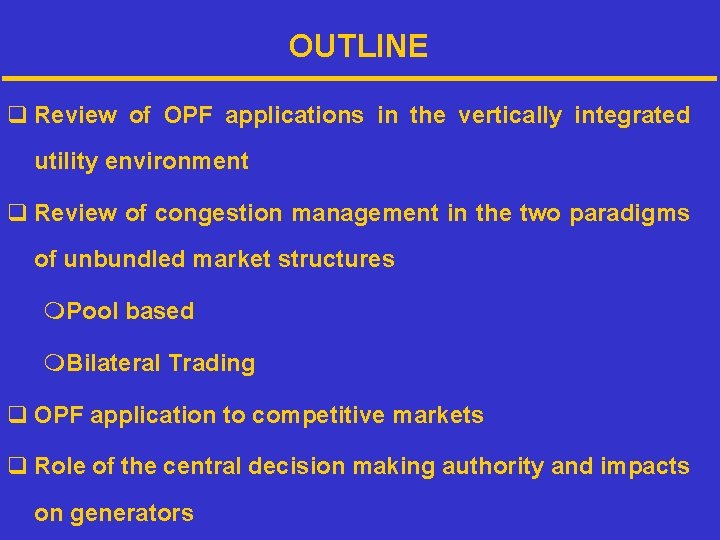
OUTLINE q Review of OPF applications in the vertically integrated utility environment q Review of congestion management in the two paradigms of unbundled market structures m. Pool based m. Bilateral Trading q OPF application to competitive markets q Role of the central decision making authority and impacts on generators
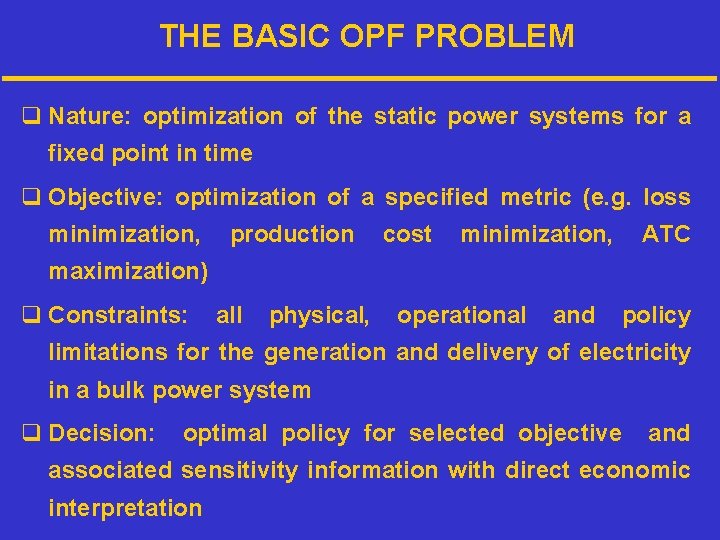
THE BASIC OPF PROBLEM q Nature: optimization of the static power systems for a fixed point in time q Objective: optimization of a specified metric (e. g. loss minimization, production cost minimization, ATC maximization) q Constraints: all physical, operational and policy limitations for the generation and delivery of electricity in a bulk power system q Decision: optimal policy for selected objective and associated sensitivity information with direct economic interpretation
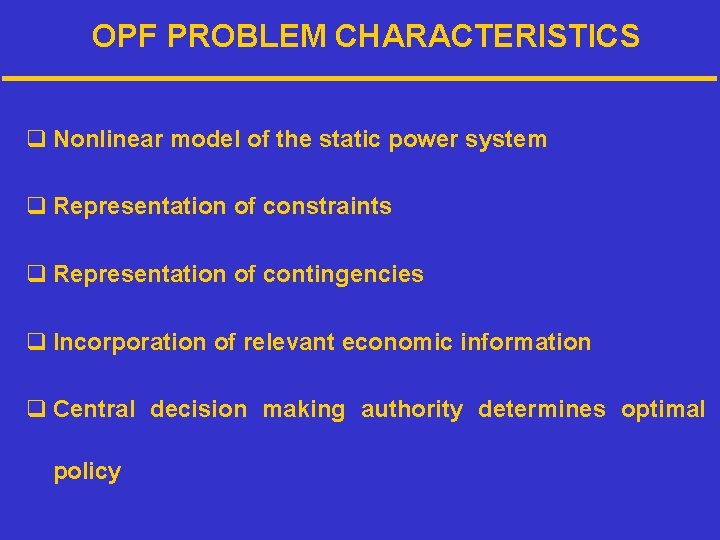
OPF PROBLEM CHARACTERISTICS q Nonlinear model of the static power system q Representation of constraints q Representation of contingencies q Incorporation of relevant economic information q Central decision making authority determines optimal policy
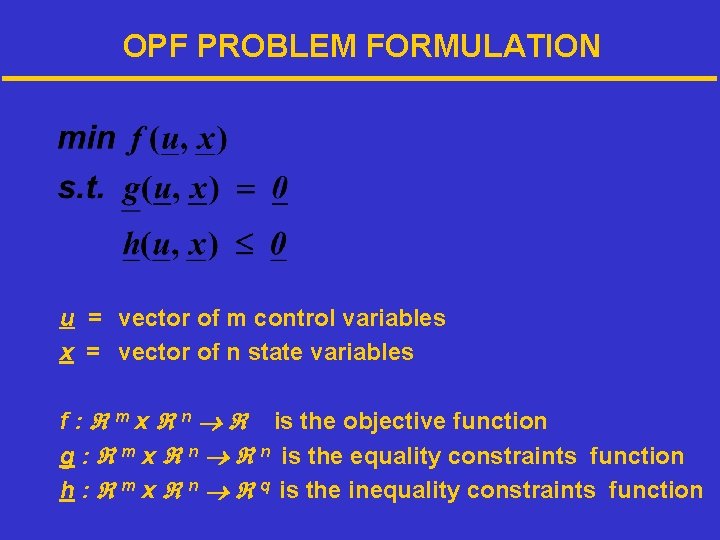
OPF PROBLEM FORMULATION u = vector of m control variables x = vector of n state variables f : m x n is the objective function g : m x n n is the equality constraints function h : m x n q is the inequality constraints function
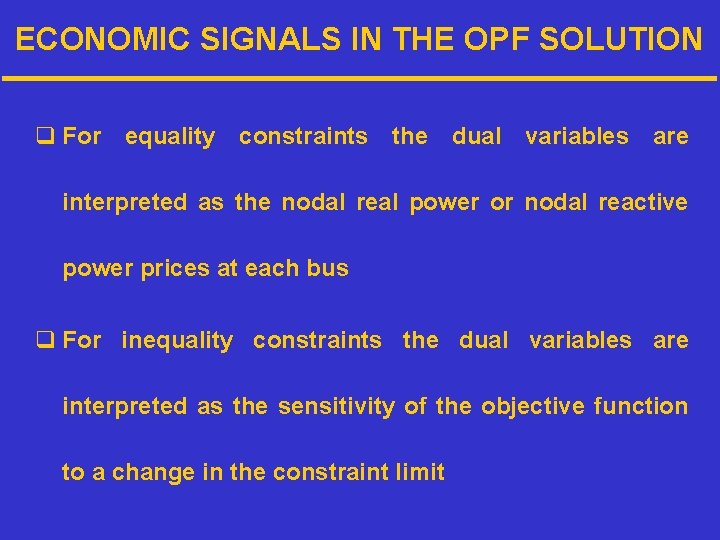
ECONOMIC SIGNALS IN THE OPF SOLUTION q For equality constraints the dual variables are interpreted as the nodal real power or nodal reactive power prices at each bus q For inequality constraints the dual variables are interpreted as the sensitivity of the objective function to a change in the constraint limit
MARKET STRUCTURE PARADIGMS q Pool model q Bilateral model
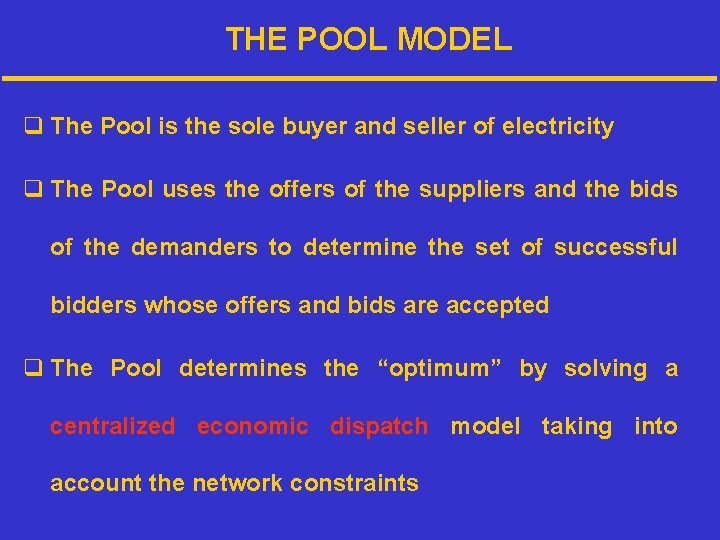
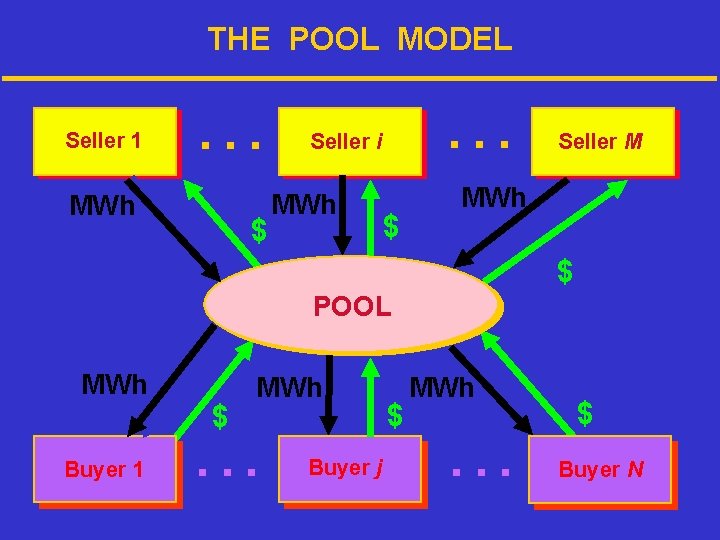
THE POOL MODEL q The Pool is the sole buyer and seller of electricity q The Pool uses the offers of the suppliers and the bids of the demanders to determine the set of successful bidders whose offers and bids are accepted q The Pool determines the “optimum” by solving a centralized economic dispatch model taking into account the network constraints
THE POOL MODEL Seller 1 . . . MWh $ . . . Seller i MWh $ Seller M MWh $ POOL MWh Buyer 1 $ MWh . . . Buyer j $ MWh . . . $ Buyer N N
CONGESTION MANAGEMENT IN THE POOL MODEL q. The Pool model considers explicitly the impacts of the transmission network constraints q. The Pool model assumes implicitly the commitment of generators which are bidding to supply power q. The determination of the economic optimum is done with the explicit consideration of congestion
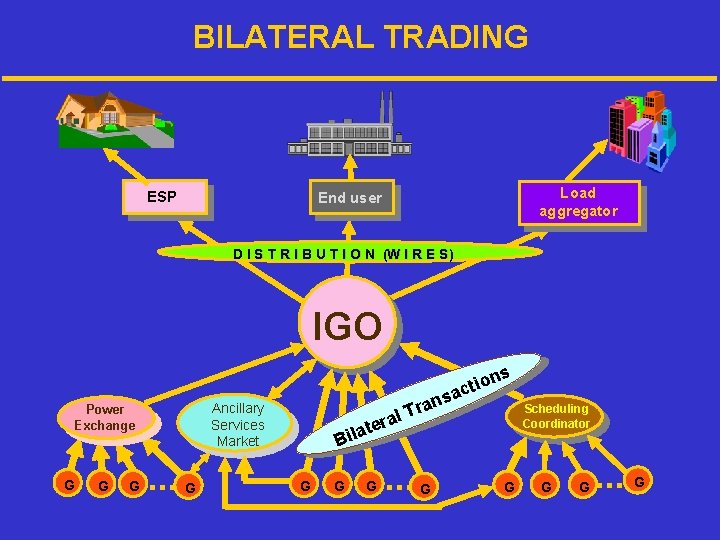
THE BILATERAL TRADING MODEL q. Players arrange the purchase and sale transactions among themselves q. Each schedule coordinator (SC) and each power exchange (PX) are responsible for ensuring supply/demand balance q. The independent system operator (ISO) has the role to facilitate the undertaking of as many of the contemplated transactions as possible subject to ensuring that no system security and physical constraints are violated
BILATERAL TRADING ESP Load aggregator End user D I S T R I B U T I O N (W I R E S) IGO s Ancillary Services Market Power Exchange G G G ion t c a . . . G G ns a r l. T Scheduling Coordinator tera Bila G G G . . . G G
BILATERAL TRADING CONGESTION MANAGEMENT q. If all contemplated transactions can be undertaken without causing any limit violations under postulated contingencies, the system is judged to be capable of accommodating these transactions and no CM is needed q. On the other hand, the presence of any violation causes transmission congestion and steps must be taken by the IGO to re-dispatch the system to remove the congestion
BILATERAL TRADING MODEL CONGESTION MANAGEMENT q Objective function: re-dispatch costs q Decision variables are incremental / decremental adjustments to the generator outputs and decremental adjustments to the loads q Constraints m transmission constraints m maximum/minimum incremental/decremental amounts bid q. OPF solution: optimal re-dispatch in generation/load increment/decrement at participating buses
ROLE OF OPF IN THE OLD REGIME q The OPF was originally developed for the vertically integrated utility (VIU) structure q In the VIU, the central decision maker is the utility that operates and controls the generation and transmission plants and has the obligation to serve load q The OPF solution makes sense in the VIU environment
KEY DIFFERENCES IN THE ROLE OF OPF IN THE POOL MODEL q The decision maker and the players are no longer the same entity q The cost is the price that the Pool has to pay to competitive supply resources q The demand at each bus may be a decision variable and as such is not fixed q The demand is expressed in the terms of willingness to pay q The objective is maximize benefits minus costs
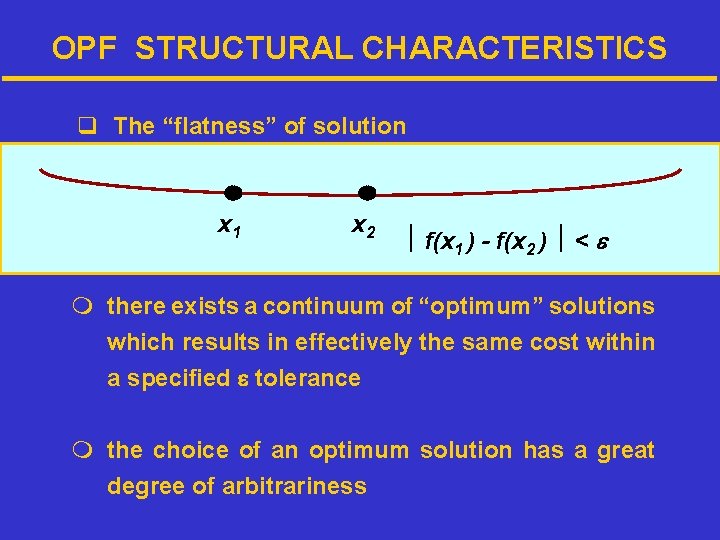
OPF STRUCTURAL CHARACTERISTICS q The “flatness” of solution x 1 x 2 f(x 1 ) - f(x 2 ) < m there exists a continuum of “optimum” solutions which results in effectively the same cost within a specified tolerance m the choice of an optimum solution has a great degree of arbitrariness
OPF STRUCTURAL CHARACTERISTICS q Different solution approaches can lead to different optima q Sensitivity of the solution to the initial point: different initial points can lead to solutions that are equally “good” q Solution may be proved to be unique only if the objective function is convex; in case of multiple minimum solutions OPF can fail in finding the “true” solution q Solution may not exist
IMPLICATIONS UNDER DIFFERENT MARKET STRUCTURE q In VIU one may favor one generating unit or another but all units are owned by the same entity and so it is purely an internal problem q In competitive markets bias for or against a given generator may result in the generator’s success or failure
IMPLICATIONS q Different optima correspond to different dual variables mnodal prices may be widely different even when the “optimal’ solutions are close mmarket signals may not be reliable
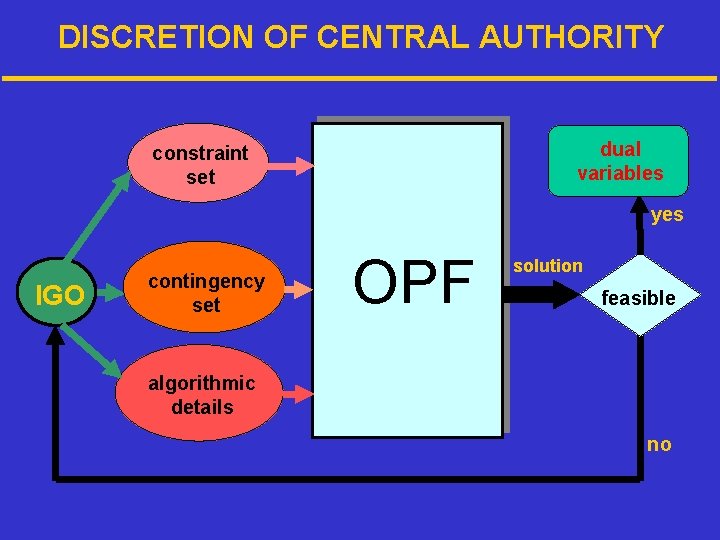
DISCRETION OF CENTRAL AUTHORITY q The central decision-making authority has many degrees of freedom in specifying the OPF model q The definition of the model has a deep impact on the optimum and on the dual variables. q The major areas under the discretion of the central authority include: mthe inclusion/exclusion of specific constraints mthe definition of the set of contingency to be applied malgorithm choice and parameters
DISCRETION OF CENTRAL AUTHORITY dual variables hconstraint n set yes IGO contingency set OPF solution feasible algorithmic details no
NUMERICAL RESULTS OF OPF APPLICATIONS TO POOL MODEL q The objective is to maximize benefits minus costs mthe loads are assumed to have fixed benefits meach generator submits a different price offer curve min effect, the objective is to minimize generation costs incurred by the Pool operator q Numerical studies are used to study anomalous results with OPF and the impacts of the discretion of the Pool operator
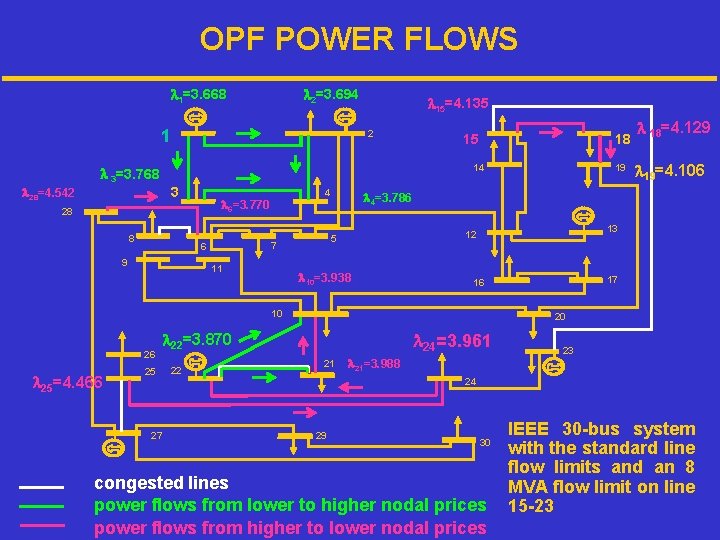
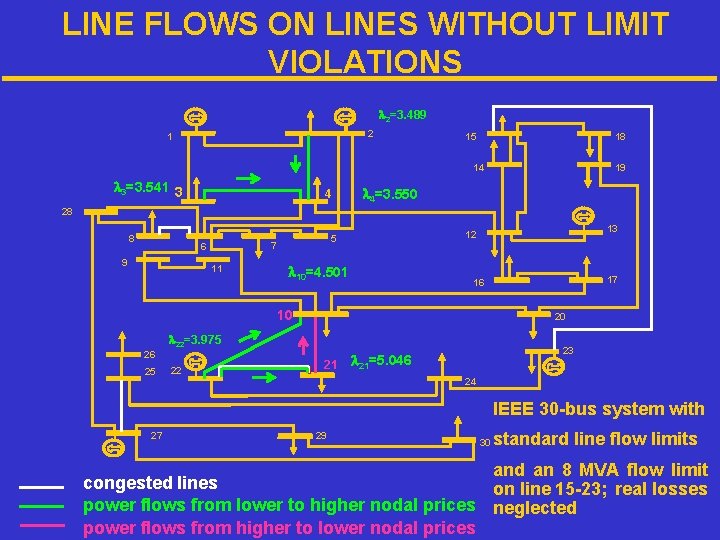
ANOMALIES IN OPF RESULTS q Power flows from a node with higher nodal price to a node with a lower nodal price q Nodal price differences between buses at ends of lines without limit violations
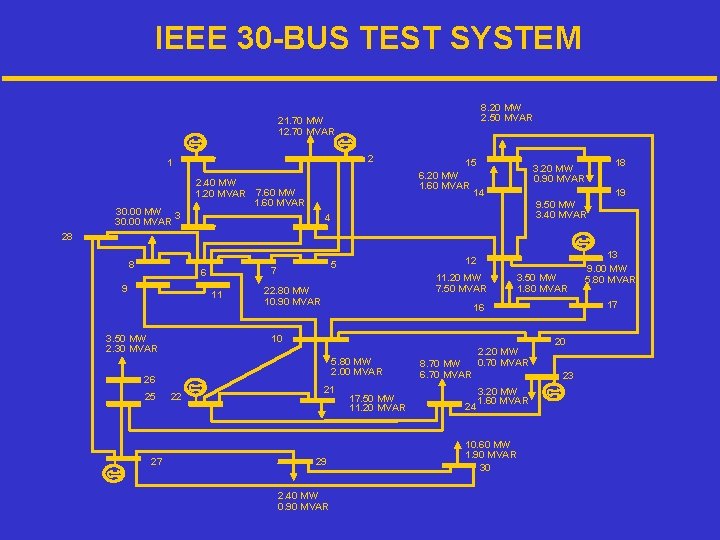
IEEE 30 -BUS TEST SYSTEM 8. 20 MW 2. 50 MVAR 21. 70 MW 12. 70 MVAR 2 1 30. 00 MW 3 30. 00 MVAR 2. 40 MW 1. 20 MVAR 7. 60 MW 1. 60 MVAR 15 6. 20 MW 1. 60 MVAR 14 3. 20 MW 0. 90 MVAR 18 19 9. 50 MW 3. 40 MVAR 4 28 8 7 6 9 11 3. 50 MW 2. 30 MVAR 27 11. 20 MW 7. 50 MVAR 22. 80 MW 10. 90 MVAR 3. 50 MW 1. 80 MVAR 5. 80 MW 2. 00 MVAR 22 21 29 2. 40 MW 0. 90 MVAR 17. 50 MW 11. 20 MVAR 8. 70 MW 6. 70 MVAR 24 2. 20 MW 0. 70 MVAR 20 23 3. 20 MW 1. 60 MVAR 10. 60 MW 1. 90 MVAR 30 13 9. 00 MW 5. 80 MVAR 17 16 10 26 25 12 5
EXAMPLES: OPF APPLICATION q IEEE 30 -bus system q All line MVA limits are enforced q Additional 8 MVA limit on line joining buses 15 and 23 q Unexpected results of OPF solution mpower flows from higher to lower priced nodes mflows on lines without limit violation
OPF POWER FLOWS l 1=3. 668 l 2=3. 694 1 l 15=4. 135 2 18 14 l 3=3. 768 3 l 28=4. 542 15 l 6=3. 770 28 8 11 13 12 l 10=3. 938 l 25=4. 466 25 27 20 l 24=3. 961 l 22=3. 870 22 17 16 10 26 l 19=4. 106 l 4=3. 786 5 7 6 9 4 19 l 18=4. 129 21 l 21=3. 988 23 24 29 30 congested lines power flows from lower to higher nodal prices power flows from higher to lower nodal prices IEEE 30 -bus system with the standard line flow limits and an 8 MVA flow limit on line 15 -23
EXAMPLE: OPF APPLICATION q Real power losses on lines are neglected q Key focus: line flows on lines without limit violations
LINE FLOWS ON LINES WITHOUT LIMIT VIOLATIONS l 2=3. 489 2 1 15 18 14 l 3=3. 541 3 4 19 l 4=3. 550 28 8 7 6 9 5 11 l 10=4. 501 13 12 10 20 l 22=3. 975 26 25 22 17 16 23 21 l 21=5. 046 24 IEEE 30 -bus system with 27 29 30 standard line flow limits and an 8 MVA flow limit congested lines on line 15 -23; real losses power flows from lower to higher nodal prices neglected power flows from higher to lower nodal prices
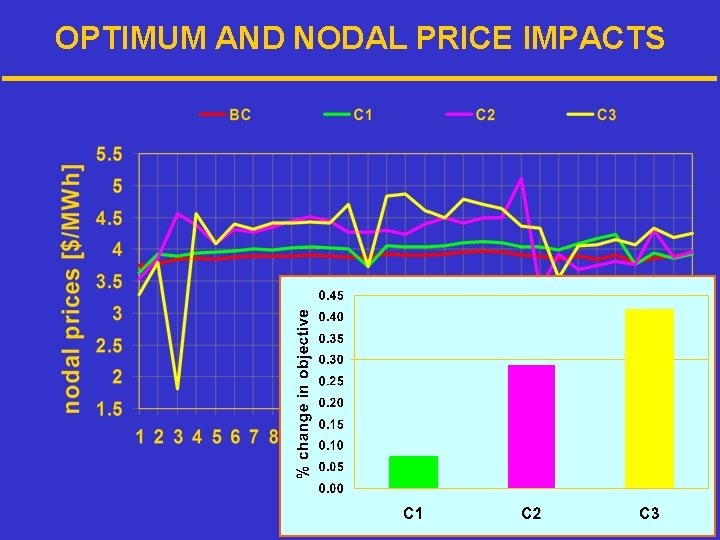
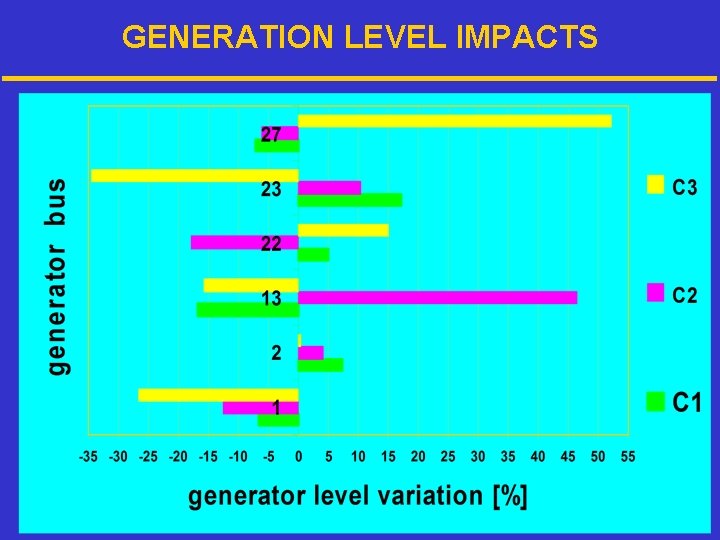
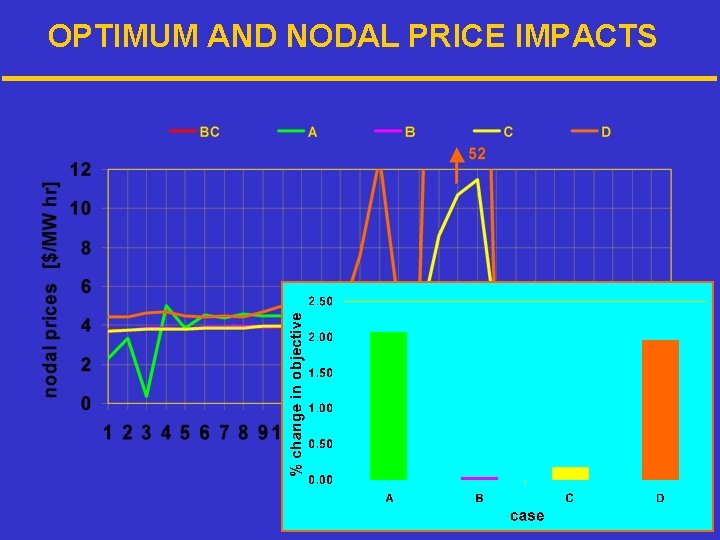
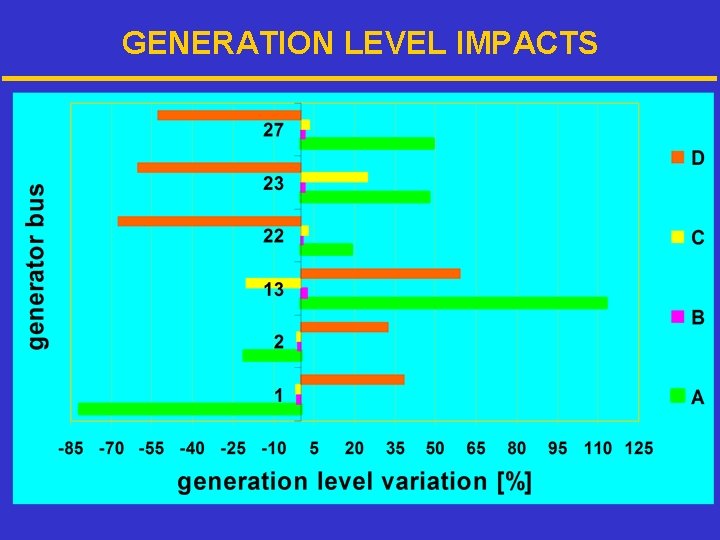
IMPACTS OF DISCRETION OF CENTRAL AUTHORITY q Nature of discretion mconsideration of line flows limits mspecification of different voltage profiles q Illustration of the volatility of dual variables mimpacts of nodal prices mallocation of generation levels among suppliers
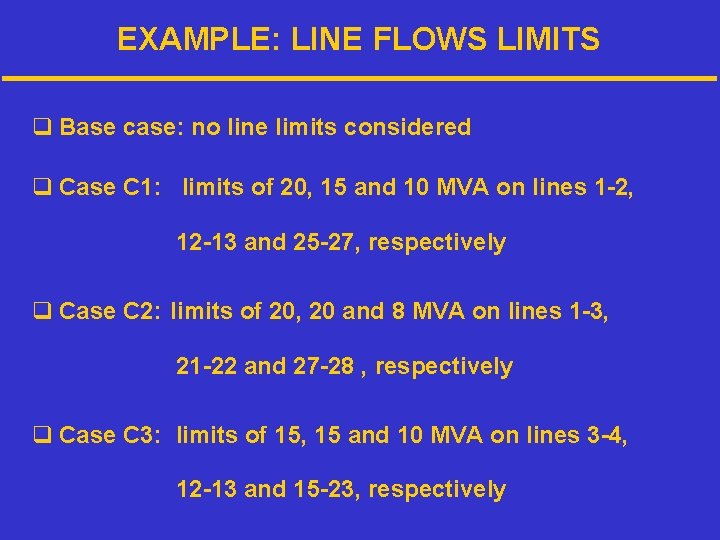
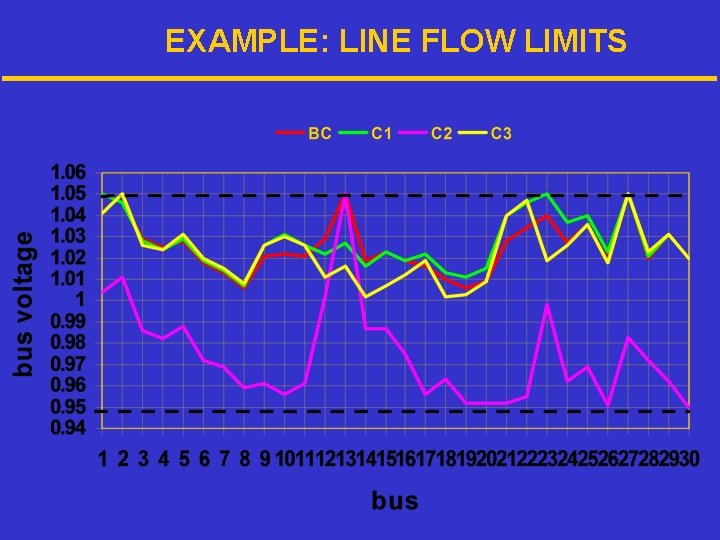
EXAMPLE: LINE FLOWS LIMITS q Base case: no line limits considered q Case C 1: limits of 20, 15 and 10 MVA on lines 1 -2, 12 -13 and 25 -27, respectively q Case C 2: limits of 20, 20 and 8 MVA on lines 1 -3, 21 -22 and 27 -28 , respectively q Case C 3: limits of 15, 15 and 10 MVA on lines 3 -4, 12 -13 and 15 -23, respectively
EXAMPLE: LINE FLOW LIMITS
OPTIMUM AND NODAL PRICE IMPACTS
GENERATION LEVEL IMPACTS
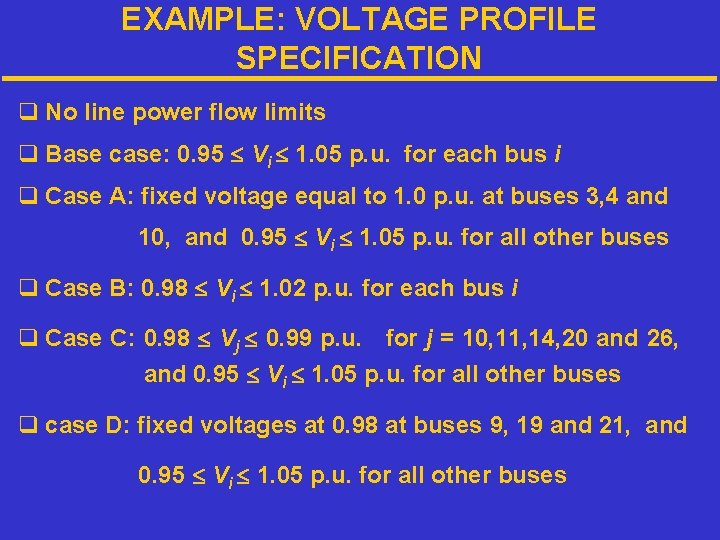
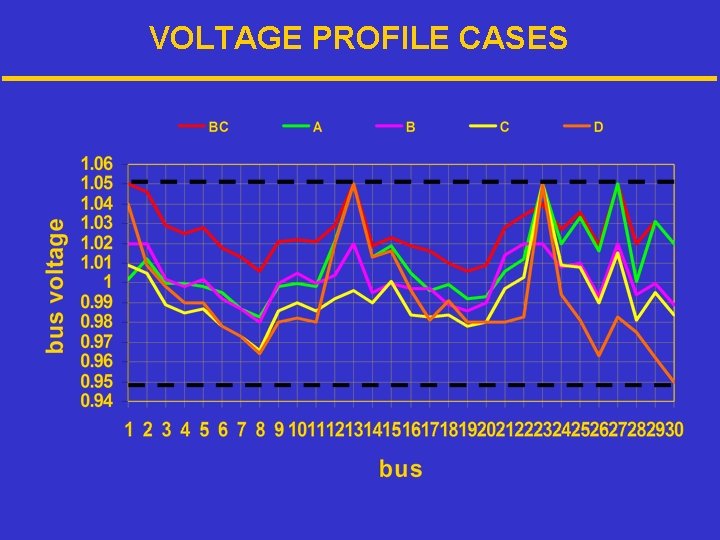
EXAMPLE: VOLTAGE PROFILE SPECIFICATION q No line power flow limits q Base case: 0. 95 Vi 1. 05 p. u. for each bus i q Case A: fixed voltage equal to 1. 0 p. u. at buses 3, 4 and 10, and 0. 95 Vi 1. 05 p. u. for all other buses q Case B: 0. 98 Vi 1. 02 p. u. for each bus i q Case C: 0. 98 Vj 0. 99 p. u. for j = 10, 11, 14, 20 and 26, and 0. 95 Vi 1. 05 p. u. for all other buses q case D: fixed voltages at 0. 98 at buses 9, 19 and 21, and 0. 95 Vi 1. 05 p. u. for all other buses
VOLTAGE PROFILE CASES
OPTIMUM AND NODAL PRICE IMPACTS
GENERATION LEVEL IMPACTS
CONCLUDING REMARKS q The OPF tool is applicable in a central decision making environment q The discretion of the central decision making authority in OPF applications in unbundled electricity markets has broad economic impacts, which are especially significant for generators q The flat nature of the objective function, particularly in the neighborhood of the optimum, implies a great degree of arbitrariness in the choice of the optimum q An improved understanding of the anomalous results and more effective application of OPF in unbundled markets are necessary for the OPF to gain acceptance