
The Use of Visual Diaries to Elicit Insights



- Slides: 21
The Use of Visual Diaries to Elicit Insights into Everyday Life Dr Wendy Martin (Brunel University London) Dr Katy Pilcher (Aston University)
Focus of Presentation December 2020 o To highlight the context of the ESRC research project: Photographing everyday life: ageing, lived experiences, time and space o To explore methodological issues around researching everyday life o To outline the research design – why visual diaries? o To consider opportunities / limitations of visual diaries o To highlight the focus and purpose of participatory photographic exhibition – disseminating social science data via arts and humanities Brunel University London Presentation Title 2
Open Access Paper December 2020 Issues of collaboration, representation, meaning and emotions: utilising participant-led visual diaries to capture the everyday lives of people in mid to later life Katy Pilcher, Wendy Martin and Veronika Williams 2015 International Journal of Social Research Methodology Brunel University London Presentation Title 3
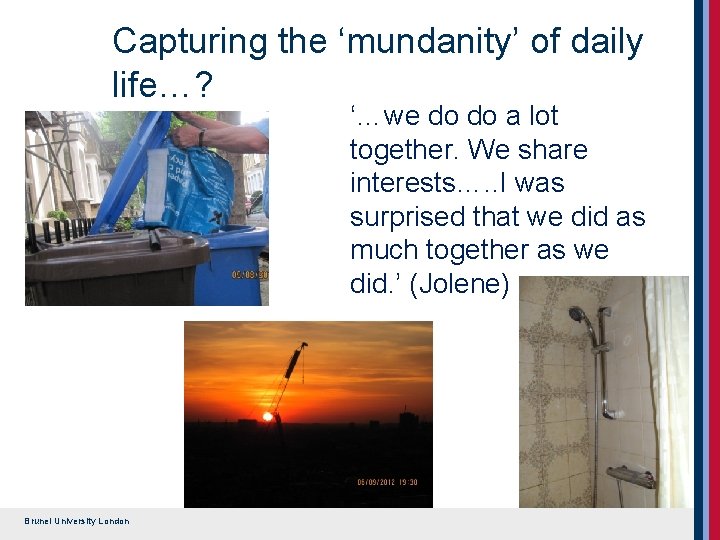
Focus on daily life o Situated within daily life: ordinary, mundane, day to day, habitual, routines o Make visible rhythms, patterns and tempospatial textures that underlie habitual / routinised everyday lives o Habitual practices as ‘natural’; the body taken for granted; defined by its absence Brunel University London
Researching daily life o. Methodological / theoretical questions: how can we research daily life? o. Use of photography to render daily routines visible ‘that our minds have failed to consciously register as we go about our lives’ (Chaplin, 2004) Brunel University London
Aims of research project q. To explore the method of photography as a means to map, explore and document the daily and lived experiences and meanings of people in mid to later life q. To reveal important insights and theoretical understandings about the everyday lives of men and women aged 50 years and over with different daily routines q. To explore the possibilities and dilemmas of the use of photography as a means to explore the daily lives of people in mid to later life q. To make visible and provide novel insights into the ordinary and day to day lives of people in mid to later life Brunel University London
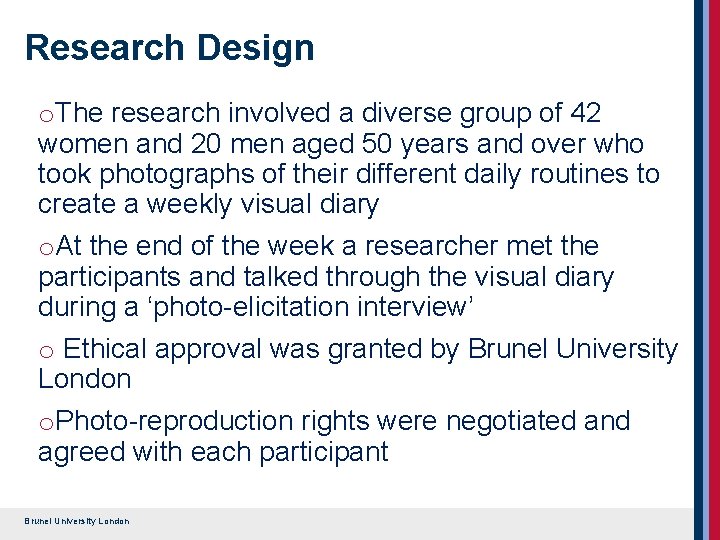
Research Design o. The research involved a diverse group of 42 women and 20 men aged 50 years and over who took photographs of their different daily routines to create a weekly visual diary o. At the end of the week a researcher met the participants and talked through the visual diary during a ‘photo-elicitation interview’ o Ethical approval was granted by Brunel University London o. Photo-reproduction rights were negotiated and agreed with each participant Brunel University London
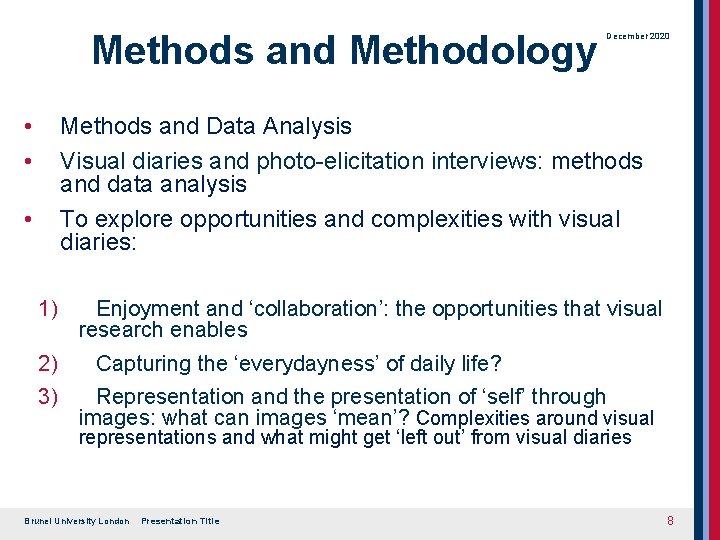
Methods and Methodology • • December 2020 Methods and Data Analysis Visual diaries and photo-elicitation interviews: methods and data analysis To explore opportunities and complexities with visual diaries: • 1) 2) 3) Enjoyment and ‘collaboration’: the opportunities that visual research enables Capturing the ‘everydayness’ of daily life? Representation and the presentation of ‘self’ through images: what can images ‘mean’? Complexities around visual representations and what might get ‘left out’ from visual diaries Brunel University London Presentation Title 8
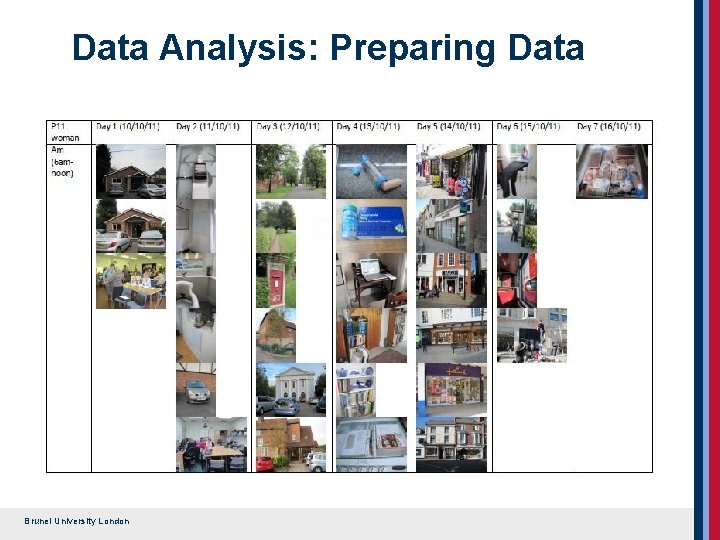
Visual Diaries and Photo-elicitation interviews q Research Design: Initial meeting to explain camera operation; participants create a visual diary for one week to show their daily lives/routines; followed by a photo-elicitation interview to discuss their images. q Ethics – consent forms, copyright - photographic reproduction rights form, pseudonyms, deleted photos. Brunel University London
Data Analysis: Preparing Data Brunel University London
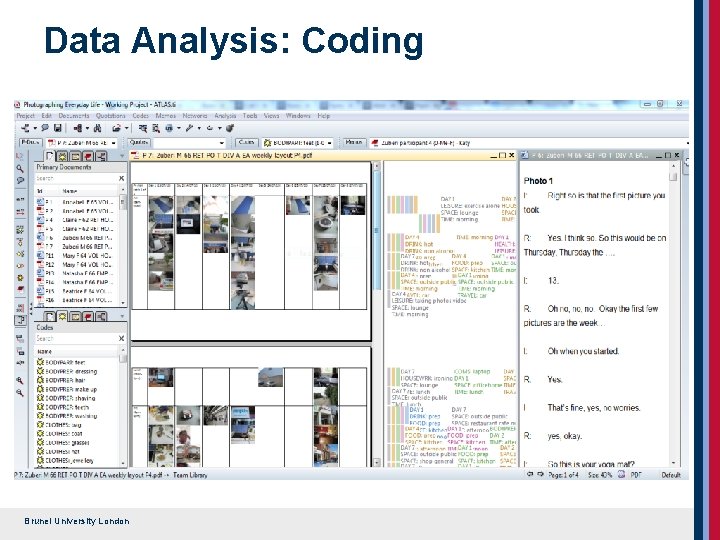
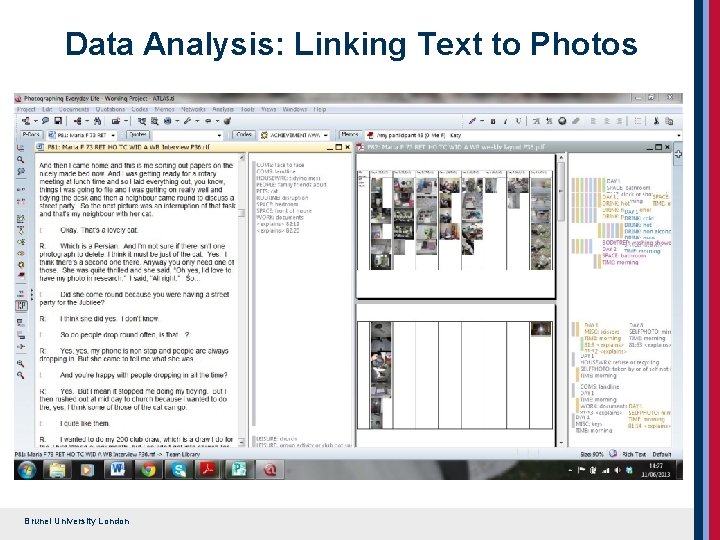
Data Analysis: Coding Screen shot of Atlas Ti software with working project open Brunel University London
Data Analysis: Linking Text to Photos Brunel University London
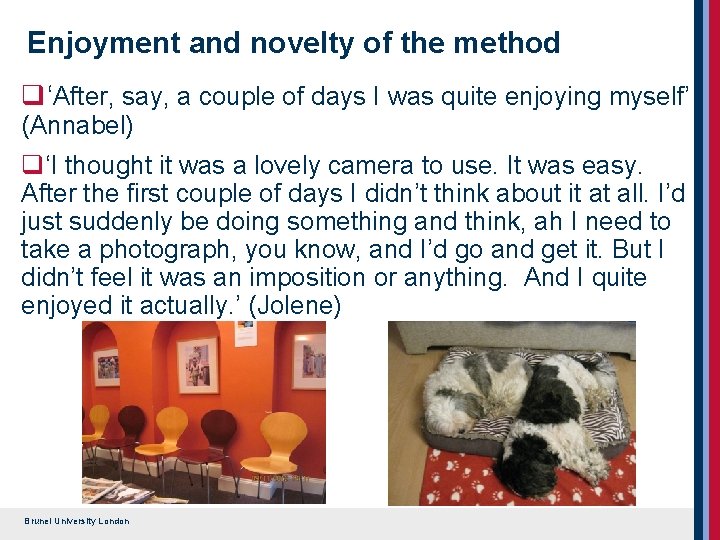
Enjoyment and novelty of the method q‘After, say, a couple of days I was quite enjoying myself’ (Annabel) q‘I thought it was a lovely camera to use. It was easy. After the first couple of days I didn’t think about it at all. I’d just suddenly be doing something and think, ah I need to take a photograph, you know, and I’d go and get it. But I didn’t feel it was an imposition or anything. And I quite enjoyed it actually. ’ (Jolene) Brunel University London
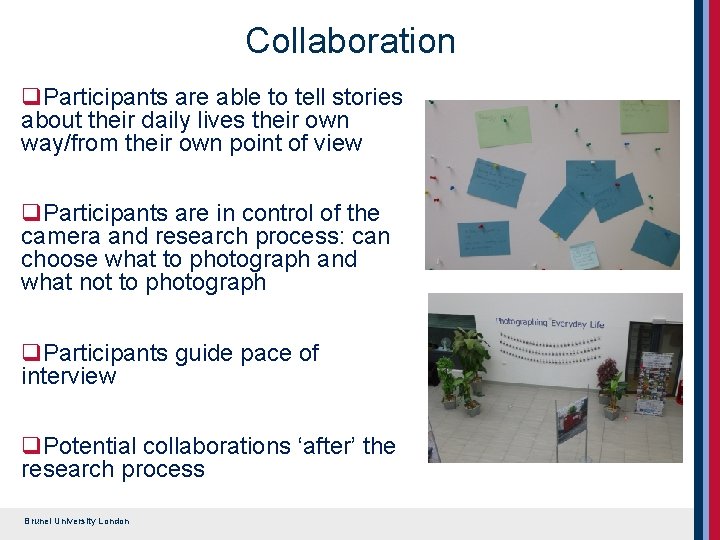
Collaboration q. Participants are able to tell stories about their daily lives their own way/from their own point of view q. Participants are in control of the camera and research process: can choose what to photograph and what not to photograph q. Participants guide pace of interview q. Potential collaborations ‘after’ the research process Brunel University London
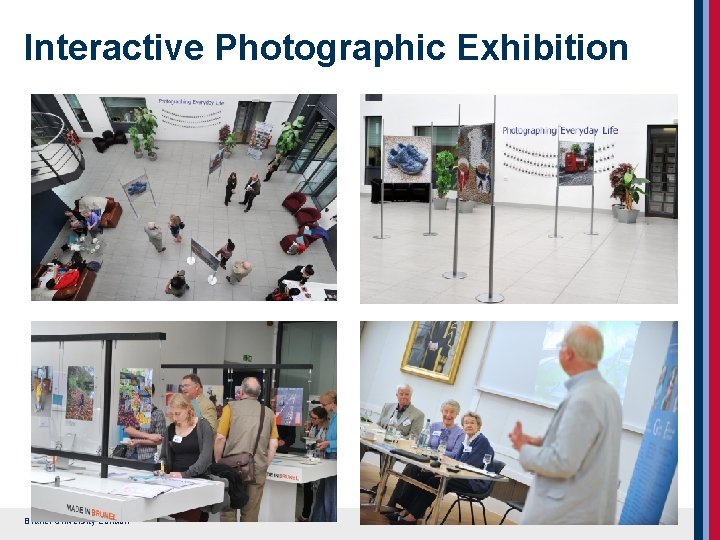
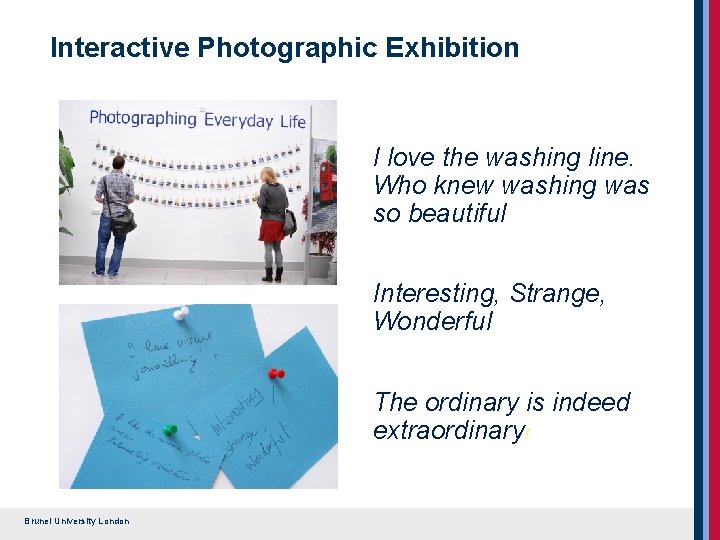
Interactive Photographic Exhibition Brunel University London
Interactive Photographic Exhibition I love the washing line. Who knew washing was so beautiful Interesting, Strange, Wonderful The ordinary is indeed extraordinary! Brunel University London
Capturing the ‘mundanity’ of daily life…? ‘…we do do a lot together. We share interests…. . I was surprised that we did as much together as we did. ’ (Jolene) Brunel University London
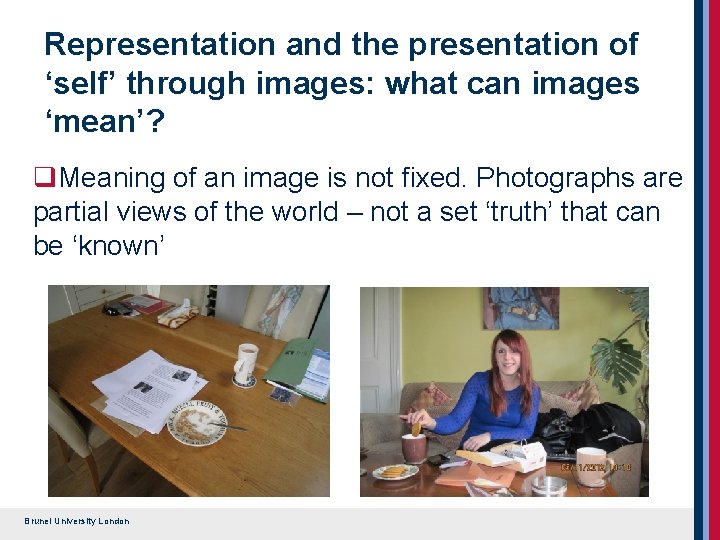
Representation and the presentation of ‘self’ through images: what can images ‘mean’? q. Meaning of an image is not fixed. Photographs are partial views of the world – not a set ‘truth’ that can be ‘known’ Brunel University London
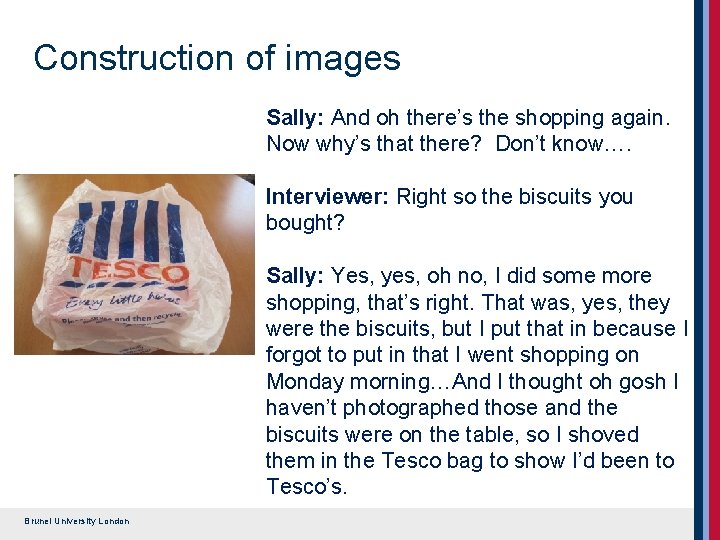
Construction of images Sally: And oh there’s the shopping again. Now why’s that there? Don’t know…. Interviewer: Right so the biscuits you bought? Sally: Yes, yes, oh no, I did some more shopping, that’s right. That was, yes, they were the biscuits, but I put that in because I forgot to put in that I went shopping on Monday morning…And I thought oh gosh I haven’t photographed those and the biscuits were on the table, so I shoved them in the Tesco bag to show I’d been to Tesco’s. Brunel University London
Can we capture ‘dailyness’ through visual diaries? q. Visual diaries are very particular ways of representing the self/identity/daily routines q‘I did find myself thinking about what to record and then whether that’s actually bad in this case because you tend to leave out the dross, as it were……. There’s no photographs of stacking the dishwasher or cooking the food or things like that which get done everyday. ’ (Phillip) Brunel University London
Concluding remarks q. Photographs produce unique interview encounters – difficult to replicate but also can uncover things that might not be elicited through other methods. q. Opportunities for enjoyment, novelty, reflection and collaboration. q. Issues with representation q. Can we photograph the mundane/ordinary? E. g. mess and dirt? Or even things that are so normal/routinised that people do not think to take photographs of them? q. Potential for challenging stereotypical images of mid to later life? All photographs are copyright of Dr Wendy Martin, Brunel University London