
THE USE OF RESTORATIVE JUSTICE TO RESOLVE CONFLICT





- Slides: 52
THE USE OF RESTORATIVE JUSTICE TO RESOLVE CONFLICT IN SCHOOLS Workshop presented by: Marie F. Penny
Objectives Ø Develop practices that bring cultural awareness to restorative programming Ø Explore ways restorative principles can promote reconciliation between diversity groups Ø Learning an intentional and effective process for dialogue
Goal To explore practices that bring cultural awareness to restorative programming and ways restorative principles can promote reconciliation between diversity groups. Ø
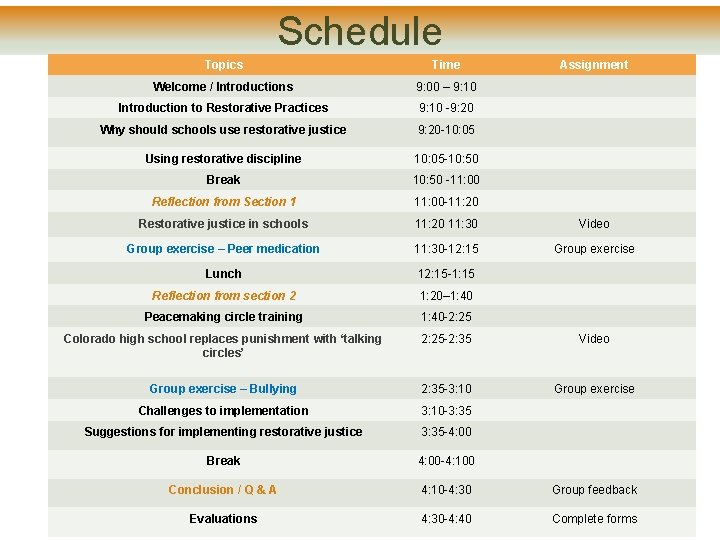
Schedule Topics Time Assignment Welcome / Introductions 9: 00 – 9: 10 Introduction to Restorative Practices 9: 10 -9: 20 Why should schools use restorative justice 9: 20 -10: 05 Using restorative discipline 10: 05 -10: 50 Break 10: 50 -11: 00 Reflection from Section 1 11: 00 -11: 20 Restorative justice in schools 11: 20 11: 30 Video Group exercise – Peer medication 11: 30 -12: 15 Group exercise Lunch 12: 15 -1: 15 Reflection from section 2 1: 20– 1: 40 Peacemaking circle training 1: 40 -2: 25 Colorado high school replaces punishment with ‘talking circles’ 2: 25 -2: 35 Video Group exercise – Bullying 2: 35 -3: 10 Group exercise Challenges to implementation 3: 10 -3: 35 Suggestions for implementing restorative justice 3: 35 -4: 00 Break 4: 00 -4: 100 Conclusion / Q & A 4: 10 -4: 30 Group feedback Evaluations 4: 30 -4: 40 Complete forms
Check - In What do you know about Restorative Justice? Lets think about a time in our life when we have caused harm or when someone harmed us. What was done or not done to make it right?
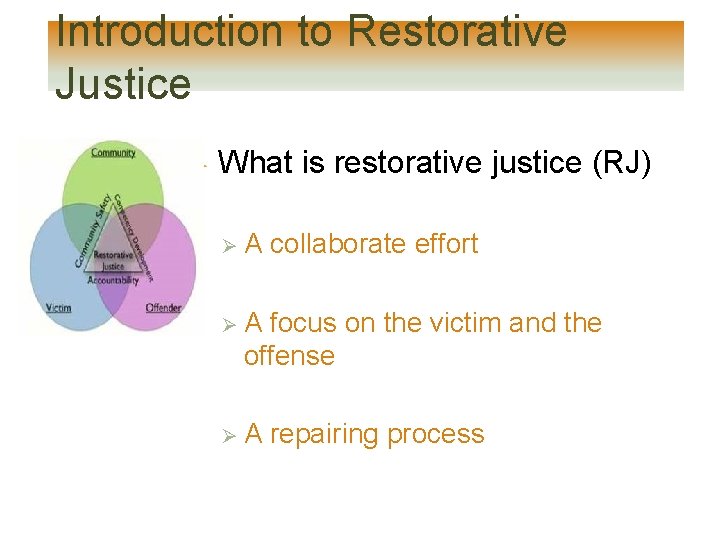
Introduction to Restorative Justice Ø What is restorative justice (RJ) Ø A collaborate effort Ø A focus on the victim and the offense Ø A repairing process
Why should schools use restorative justice Ø Bring more satisfaction to both parties Ø Promotes dialogue on prominent issues Ø Promotes school safety, problem-solving and accountability Ø More success of students completing punishment (Teasley, 2014) Ø Research supported
Effectiveness Ø Reductions in recidivism (Bergseth & Bouffard, 2007; Rodriquez, 2007) Ø Offenders and victims can heal damaged relationships Ø Offenders can accept responsibility for their crimes and understand the wrongfulness of their acts
Why Restorative Justice Ø Restorative Justice also teaches: Ø Responsibility Ø Accountability Ø Self control
Appreciative Dreaming What might your classroom or school be like if Restorative Justice was a way of life here? Ø
Using restorative discipline Ø Ø The idea into building social capital This can be done by incorporating the most popular means of discipline which are: Ø Mediation Ø Peacemaking Circles Ø Community boards (Payne & Welch, 2013)
Mediation “Peer mediation is the most common and broadly accepted model nation wide” (Baemore & Umbreit, 2001) Ø Ø Allows all parties to talk about the issues Ø Promotes a win-win situation Ø Help find solutions to avoid subsequent conflicts
Mediation Ø The benefits of mediation are: Ø Helps to resolve student conflicts Ø Teaches students essential life skills Ø Motivates students to resolve their conflicts collaboratively
Mediation Ø Benefits cont’d: Ø Can be used as a teaching tool to solve interpersonal conflict Ø Empowers students to resolve conflicts by doing it themselves in a supervised setting Ø Increased self-esteem
Mediation Ø Benefits cont’d. Ø Provides greater insight that most conflicts results from misperception, misunderstanding, and legitimately differing needs Ø Challenge students to be their best Ø Increases more educational time due to less conflict
Video Restorative justice in schools https: //www. youtube. com/watch? v=Nmp. Gg 8 D y-K 4
Scenario Exercise Ø Ø Use the handout in your package titled: Resolving conflict with a peer mediation program Choose one of the four scenarios amongst group and come up with a solution using the mediation technique
Incorporating Restorative Principles When using restorative principles to promote reconciliation, understanding and cultural awareness, keep in mind that certain elements should be practiced. Ø
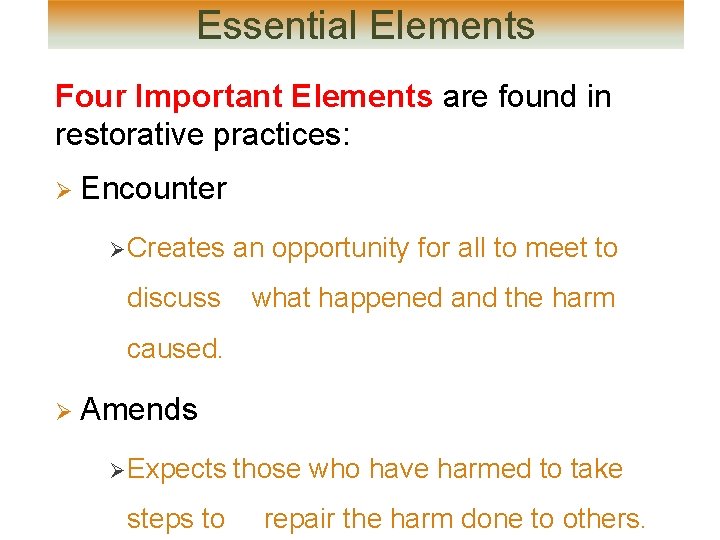
Essential Elements Four Important Elements are found in restorative practices: Ø Encounter Ø Creates an opportunity for all to meet to discuss what happened and the harm caused. Ø Amends Ø Expects those who have harmed to take steps to repair the harm done to others.
Essential Elements Ø Reintegration Ø Seeks to restore everyone to whole, contributing members of society. Ø Inclusion Ø Provides opportunities for all to collaborate in creating a resolution.
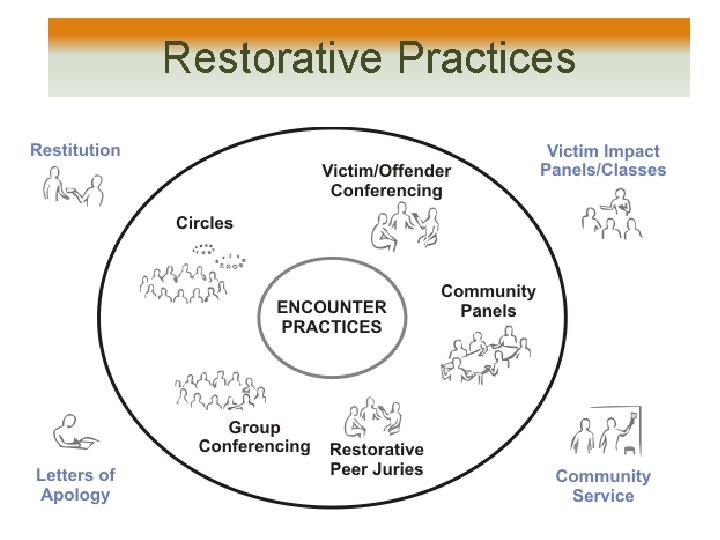
Restorative Practices
Peacemaking circle Ø What is peacemaking circles: ØA method for solving problems. Ø “A form of dispute resolution that offers an alternative structure of communication broadly adaptable to an array of contexts” (Price & Dunnigan, 1995).
Peacemaking Circles Ø The purpose of the circles is to promote: Ø Youth development Ø Emotional healing Ø Conflict resolution Ø Effective dialogue Ø Team building Ø Collaboration
Peacemaking Circles Ø Benefits: Ø Joy Ø A sense of trust and respect Ø Feeling safe with one another Ø Freedom to express emotions Ø Cultivating empathy Ø A community of support Ø The skill of problem solving
Peacemaking Circles Ø Circles give emotional literacy development by: Ø Improved capacity to listen Ø Anger and conflict management Ø More sensitivity to others
Peacemaking Circles Ø When practicing circles, 5 simple guidelines should be practiced: Ø Speak from the heart Ø Listen from the heart Ø Speak spontaneously Ø Speak leanly Ø Keep confidentiality
Peacemaking Circles Ø In addition to the guidelines, it is good practice to always follow four rituals of: Ø Opening and closing in a good way Ø Having a talking piece Ø Following the set guidelines Ø And utilizing keepers
Peacemaking Circle In essence, when peace circles are implemented, they will enhance the formation of positive relationships in families, communities, and systems building a stronger community of unity. Ø
Circle Questions Ø What happened Ø What were you thinking at the time Ø What have you thought about since Ø Who do you think has been affected by what you did Ø What do you need to do to make things right Ø How can we make sure this doesn’t happen again
Video Ø Ø Colorado high school replaces punishment with ‘talking circles’ https: //www. youtube. com/watch? v=g 8_9 4 O 4 Ex. SA
Group assignment Ø Using the handout: Circle activity Ø Select a keeper and a victim from the group. Ø Follow the instructions on the handout titled: circle activity Ø Be ready for open discussion in 20 minutes
Community Boards Ø “Volunteers from your community who meet face to face in conferences with the victim, juvenile and parents or guardians. ” (White 2015) Ø These community members decide what consequences the juvenile will face.
Community Boards Ø Purpose Ø To give the victim a voice and, to the extent possible, and to allow a juvenile to make amends to those who were harmed Ø It also enables the juvenile to make better choices Ø Goals of community boards Ø Restitution Ø Community service Ø Family engagement
Community Boards Ø Ø Ø Repair the harm done to the community Give the juvenile, family & victim a sense of belonging to a caring community Enhance public safety by keeping the child from returning to crime
Community Boards Ø Ø Involve community members in applying criminal justice in a restorative practice Community boards may have the power to impose restitution or community service fitting to the harm that was imposed on the offender.
Restitution Ø Ø “For restitution to be restorative, it must ensure the offender’s payment of restitution to the victim and increase the offenders competency For juveniles who often cannot pay, they can work to repair the harm caused” (Burke, 2013)
Community Service Ø Ø “For community service to be restorative, it must be linked to the crime or be chosen by the victim In addition, it should increase the competency of the offender by considering the offender’s strengths, interest, and skills” (Burke, 2013)
Family engagement & empowerment Ø Ø Family members attend the conference alongside the victim and offender to offer support. Family members can also participate in the peace circle exercises
Challenges to implementation Ø What we have discussed thus far sounds great - we can’t wait to get started implementing restorative practices in our schools but there are challenges which include but is not limited to: ØCost ØDedication ØSocio-legal issues (Frey, Fisher, & Smith, 2013)
Cost Ø Presents conceptual and practical problems Ø Costs will vary with the location and size of the programs Ø Can be lower than the traditional system (Burke, 2013)
Dedication Ø Ø Implementing restorative practices in schools require training and dedication from administrators, teachers, students, and community members Policies and guidelines need to be established and set forth along with the dedication of seeing each method carefully through for each individual case
Socio-Legal Issues Ø Rights versus responsibilities Ø Norm-value explication Ø Fairness and justice Ø Discretion
Implementing Restorative Justice Ø Ø As with any program there are challenges but restorative justice in schools have proven over time to be successful in reducing harm to others and promoting accountability When implementing restorative justice in schools, several support systems should be in place in order for the system to be successful
Implementing Ø Along with several support systems, there should also be three (3) core principles always in place (Pavelka, 2013) Ø Repair harm Ø Reduce risk Ø Empower community
Repair Harm Ø Wrongdoers are held accountable and are encouraged to make positive changes in hopes of bringing healing to the victim and the community
Reduce Risk Ø Over practice and time, the community will learn how to manage and reduce risk providing a more safer and peaceful environment.
Empower Schools and communities work collaborate in addressing the impact of the wrongdoing and the reparation giving students active participation and empowerment. Ø
Conclusion Ø Ø Ø Ultimately restorative justice is something that has an opportunity to change schools for the better over a long term Peace circles form as one of the best tools when implementing restorative practices Restorative justice has challenges but can be successful in promoting a safer environment
Restorative practices re-affirm relationships in schools by Ø Teaching social emotional learning Ø Producing peaceable schools Ø Building community Ø Creating school-wide expectations
Questions
Thank You Ø Please complete the evaluation forms in your packet. Ø Honest responses in reference to this workshop will be beneficial.
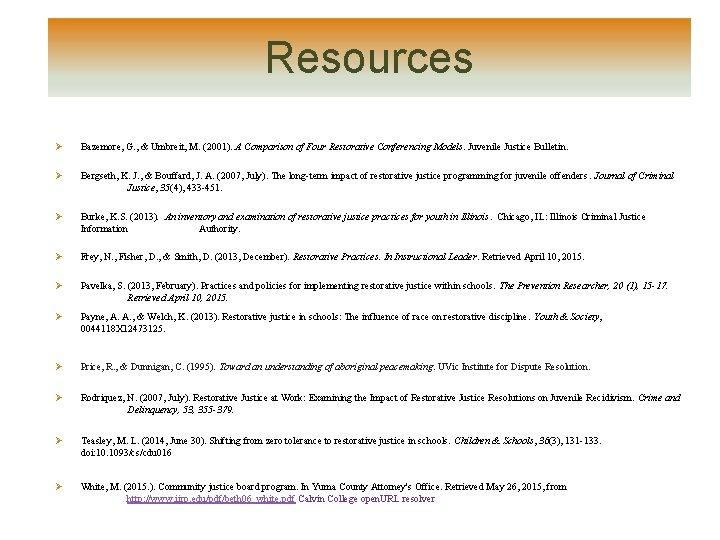
Resources Ø Bazemore, G. , & Umbreit, M. (2001). A Comparison of Four Restorative Conferencing Models. Juvenile Justice Bulletin. Ø Bergseth, K. J. , & Bouffard, J. A. (2007, July). The long-term impact of restorative justice programming for juvenile offenders. Journal of Criminal Justice, 35(4), 433 -451. Ø Burke, K. S. (2013). An inventory and examination of restorative justice practices for youth in Illinois. Chicago, IL: Illinois Criminal Justice Information Authority. Ø Frey, N. , Fisher, D. , & Smith, D. (2013, December). Restorative Practices. In Instructional Leader. Retrieved April 10, 2015. Ø Pavelka, S. (2013, February). Practices and policies for implementing restorative justice within schools. The Prevention Researcher, 20 (1), 15 -17. Retrieved April 10, 2015. Ø Payne, A. A. , & Welch, K. (2013). Restorative justice in schools: The influence of race on restorative discipline. Youth & Society, 0044118 X 12473125. Ø Price, R. , & Dunnigan, C. (1995). Toward an understanding of aboriginal peacemaking. UVic Institute for Dispute Resolution. Ø Rodriquez, N. (2007, July). Restorative Justice at Work: Examining the Impact of Restorative Justice Resolutions on Juvenile Recidivism. Crime and Delinquency, 53, 355 -379. Ø Teasley, M. L. (2014, June 30). Shifting from zero tolerance to restorative justice in schools. Children & Schools, 36(3), 131 -133. doi: 10. 1093/cs/cdu 016 Ø White, M. (2015. ). Community justice board program. In Yuma County Attorney's Office. Retrieved May 26, 2015, from http: //www. iirp. edu/pdf/beth 06_white. pdf Calvin College open. URL resolver