
The use of Reflective Silver on Gemini Mirrors
- Slides: 17
The use of Reflective Silver on Gemini Mirrors Thomas Schneider OPTI 521 Tutorial
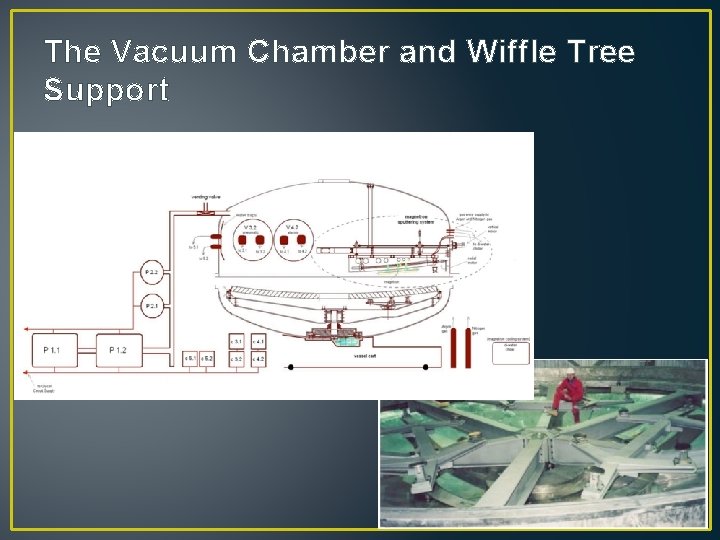
The Vacuum Chamber • Vacuum chamber is 9 m by 6 m, with a total volume of 150 cubic meters • Roughing pumps begin the pumping process, with cryopumps taking over and bring the vacuum to 10 E-6 Torr • The mirror is supported on a wiffle tree inside of the vacuum chamber
The Vacuum Chamber and Wiffle Tree Support
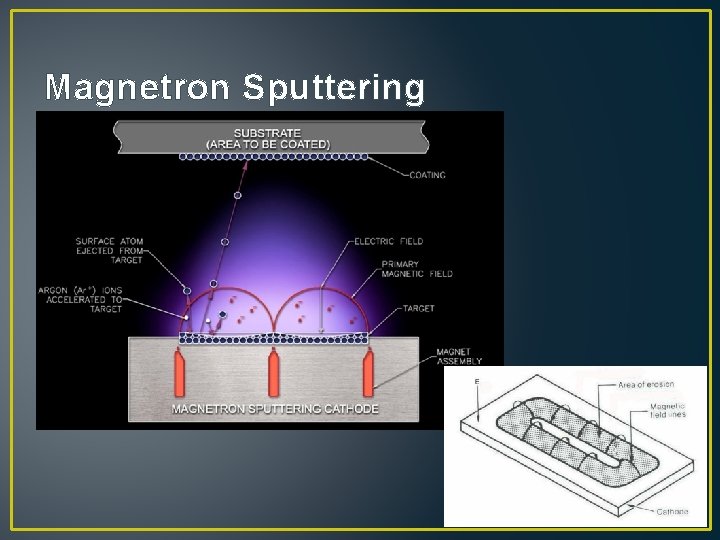
Magnetrons • The magnetrons consists of a water cooled cathode which is sputtered, and a counter electrode as an anode • A series of neodymium magnets behind the target lengthen the effective ionization area • The electron trap creates high specific ionization (high plasma density), the plasma accelerates towards the cathode and the impulse energy is transferred to, knocking target particles out of their lattice bond • The three targets (cathodes) are made from 99. 999% pure Silver, Nickel Chromium, and Silicon Nitrate
Magnetron Sputtering
Mirror Stripping • After the mirror is lowered into the washcart, stripping can begin • The mirror is first washed with neutral soap to remove any debris or contamination • Solutions of potassium hydroxide, hydrochloric acid, cupric sulfate pentahydrate, nitric acid, and ceric ammonium nitrate are used to strip the coating
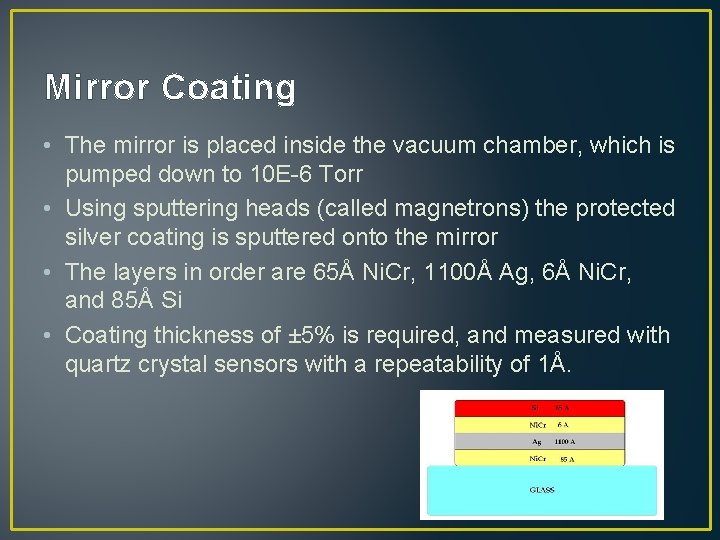
Mirror Coating • The mirror is placed inside the vacuum chamber, which is pumped down to 10 E-6 Torr • Using sputtering heads (called magnetrons) the protected silver coating is sputtered onto the mirror • The layers in order are 65Å Ni. Cr, 1100Å Ag, 6Å Ni. Cr, and 85Å Si • Coating thickness of ± 5% is required, and measured with quartz crystal sensors with a repeatability of 1Å.
Quality Control • Several tests are used to determine the quality of the coating • Measurements of 470 nm, 530 nm, 650 nm, 880 nm, and 2. 2µm wavelengths with a handheld reflectometer • Pinhole test • <5 pinholes of 10µm and <5 pinholes under 5µm per square inch • Scotch tape test • Need Crystal Clear Scotch tape and witness sample
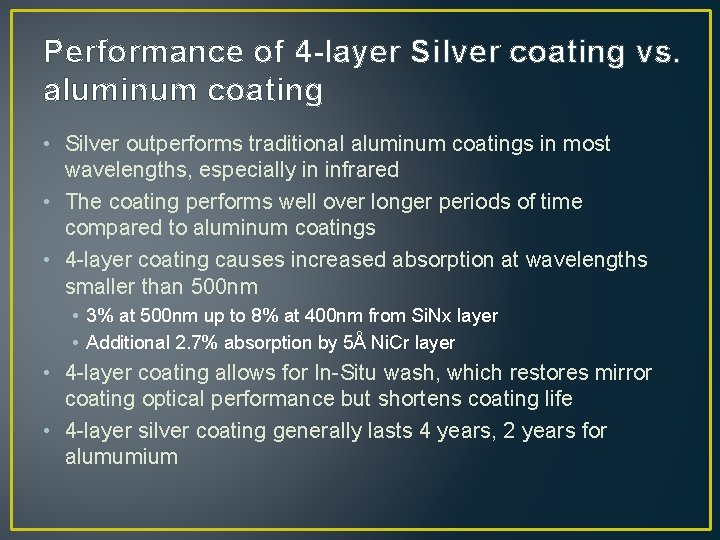
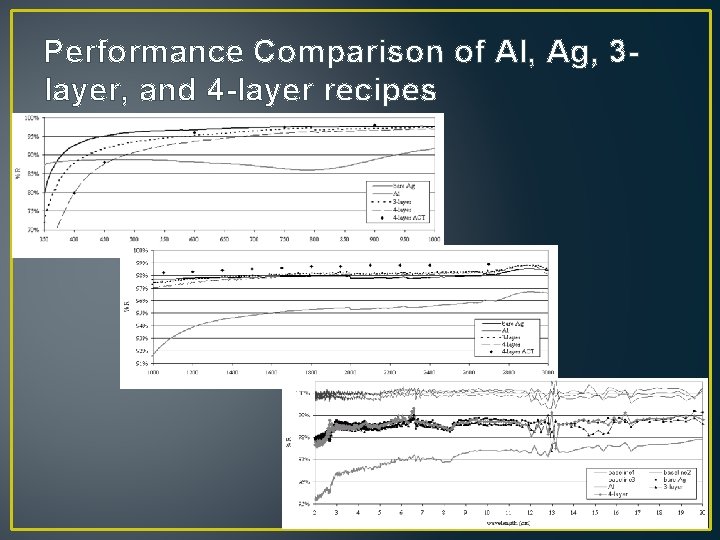
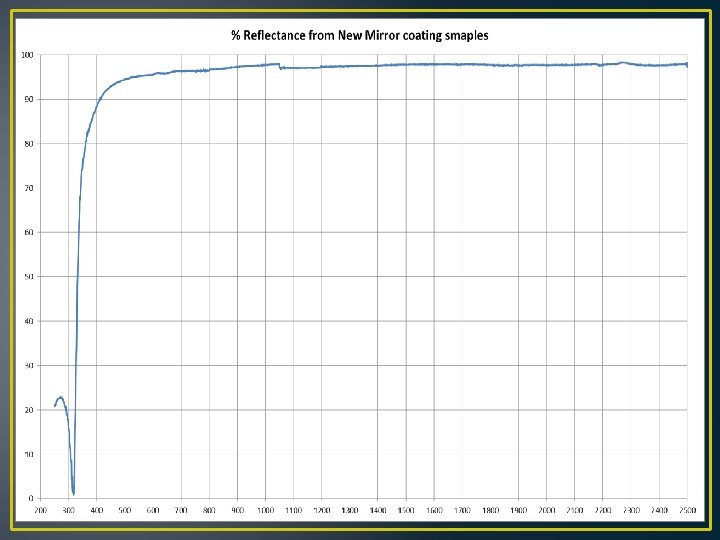
Performance of 4 -layer Silver coating vs. aluminum coating • Silver outperforms traditional aluminum coatings in most wavelengths, especially in infrared • The coating performs well over longer periods of time compared to aluminum coatings • 4 -layer coating causes increased absorption at wavelengths smaller than 500 nm • 3% at 500 nm up to 8% at 400 nm from Si. Nx layer • Additional 2. 7% absorption by 5Å Ni. Cr layer • 4 -layer coating allows for In-Situ wash, which restores mirror coating optical performance but shortens coating life • 4 -layer silver coating generally lasts 4 years, 2 years for alumumium
Performance Comparison of Al, Ag, 3 layer, and 4 -layer recipes
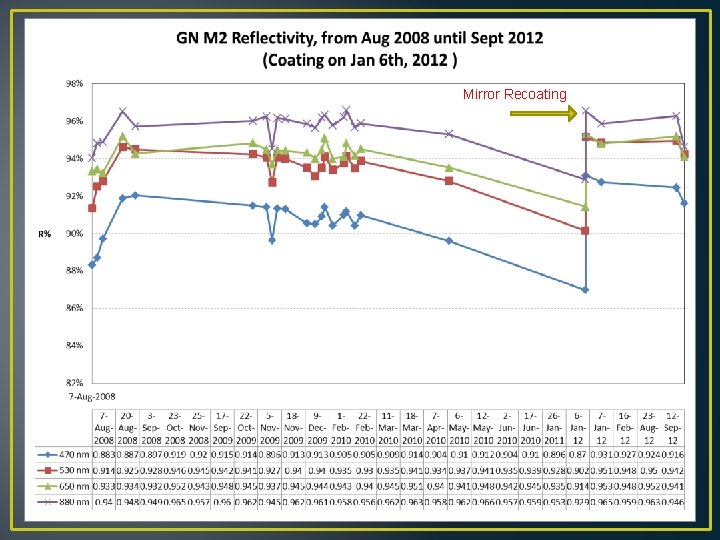
Mirror Recoating
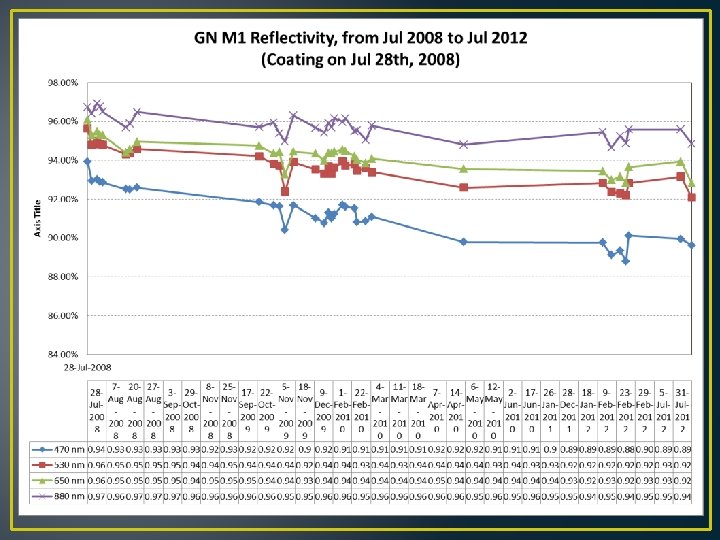
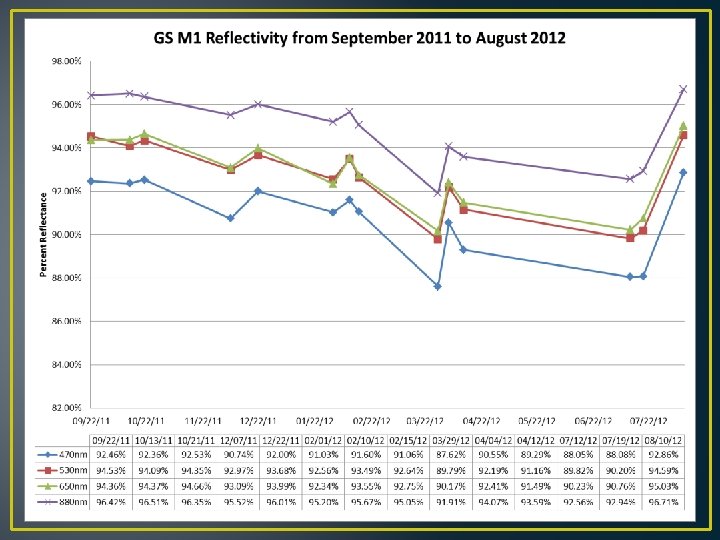
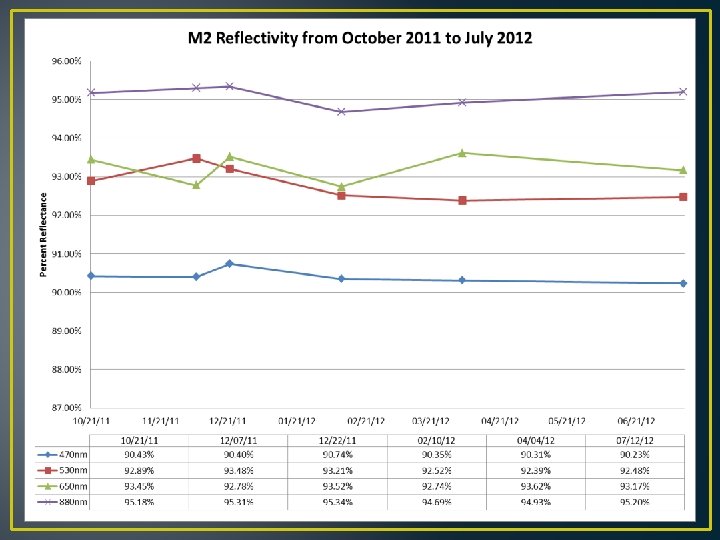
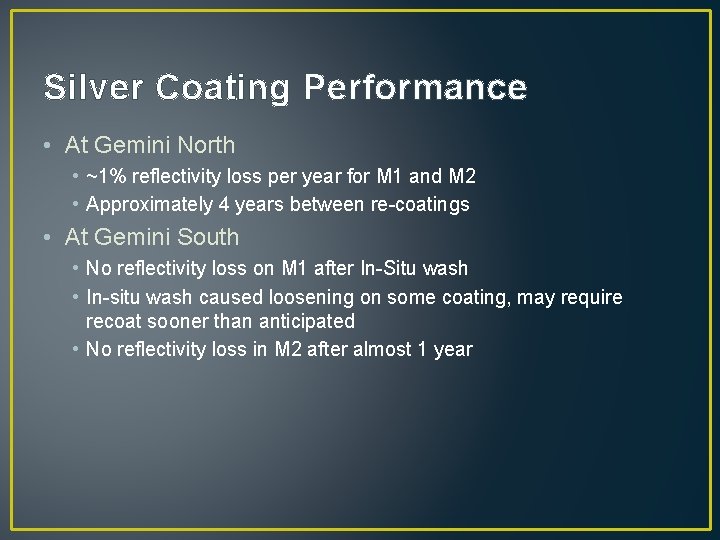
Silver Coating Performance • At Gemini North • ~1% reflectivity loss per year for M 1 and M 2 • Approximately 4 years between re-coatings • At Gemini South • No reflectivity loss on M 1 after In-Situ wash • In-situ wash caused loosening on some coating, may require recoat sooner than anticipated • No reflectivity loss in M 2 after almost 1 year
Mahalos • Thanks to everyone that showed up • A Special thanks to Tomi and Maxime have done on this subject