
The Use of Passive Samplers to Monitor Organic
- Slides: 43
The Use of Passive Samplers to Monitor Organic Contaminants at Superfund Sediment Sites: Concepts, Samplers, Methods & Applications Robert M Burgess Office of Research and Development, NHEERL, Atlantic Ecology Division Narragansett, Rhode Island 02882 burgess. robert@epa. gov & Marc S Greenberg Office of Solid Waste and Emergency Response OSRTI/TIFSD/Environmental Response Team Edison, New Jersey greenberg. marc@epa. gov 26 August 2013
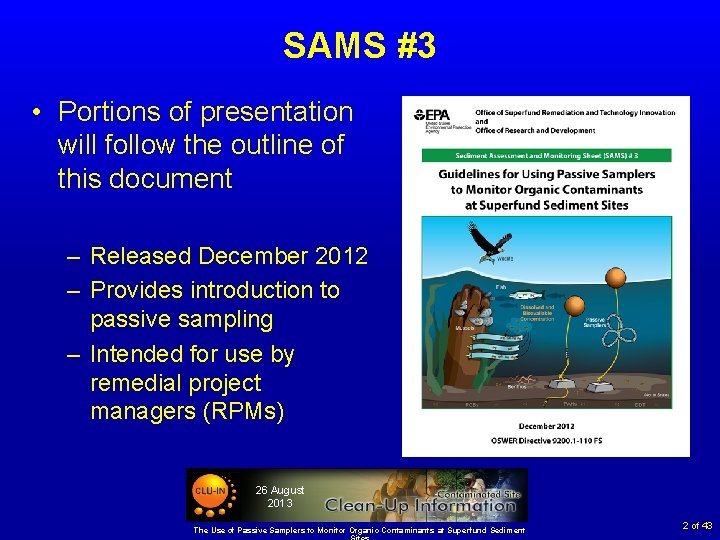
SAMS #3 • Portions of presentation will follow the outline of this document – Released December 2012 – Provides introduction to passive sampling – Intended for use by remedial project managers (RPMs) 26 August 2013 The Use of Passive Samplers to Monitor Organic Contaminants at Superfund Sediment 2 of 43
Outline • Why use passive samplers and what they tell us • Types of passive samplers and how they work • Selecting, preparing, deploying, recovering, and storing passive samplers • Analyzing passive sampler data and a brief case study • Scientific challenges in using passive samplers • US EPA contacts working with passive samplers • Application at Superfund Sites • Summary 26 August 2013 The Use of Passive Samplers to Monitor Organic Contaminants at Superfund Sediment Sites 3 of 43
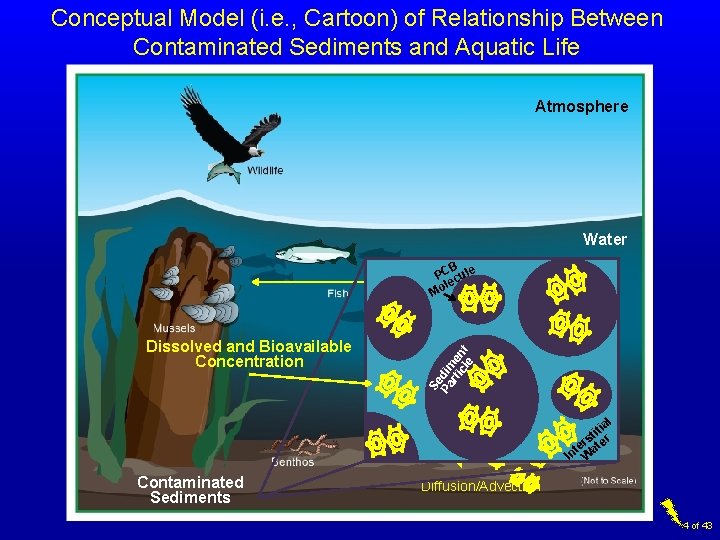
Conceptual Model (i. e. , Cartoon) of Relationship Between Contaminated Sediments and Aquatic Life Atmosphere Water Dissolved and Bioavailable Concentration Se Pa dim rti en cl t e B Dissolved and Bioavailable PC cule e l Concentration Mo al iti t s r er ate t In W Contaminated Sediments Diffusion/Advection 4 of 43
Introduction • How to determine or measure dissolved and bioavailable concentrations in the water column and interstitial waters? – Why not continue to use conventional sampling methods? Some problems: – Water Column Is√ there another sampling method for collecting • Logistically and technically difficult to collectand large volumes of surface water and measuring dissolved bioavailable extract contaminants? • Several artifacts including losses to filters and surfaces and contamination by colloids and small particles reduce accuracy of analysis • Analytical detection limits are often not sufficiently low √– Interstitial Water • Centrifuge or squeeze interstitial water results in limited volumes • Similar artifacts as water column • Collecting large volumes of interstitial waters is logistically challenging, scientifically dodgy and generally expensive 26 August 2013 The Use of Passive Samplers to Monitor Organic Contaminants at Superfund Sediment 5 of 43
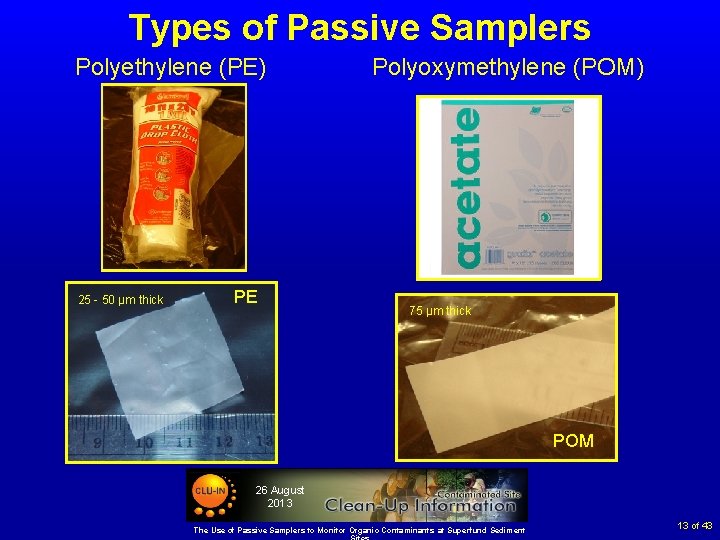
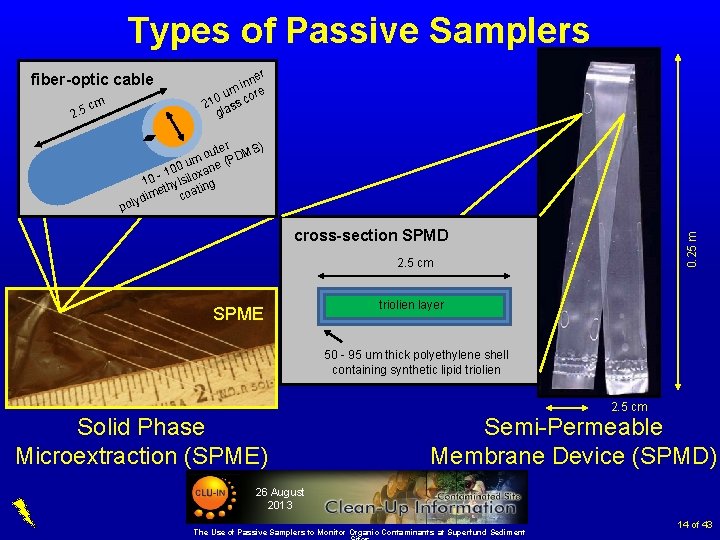
Introduction • Passive sampling – Developed in the 1980 s • Analytical chemistry, food sciences, pharmaceuticals – Used in environmental sciences since the early 1990 s • Water column, soils, groundwater, sediments – Consist of an organic phase (i. e. , simple organic film or polymer) which accumulates contaminants from the dissolved phase • • Polyethylene (PE) Polyoxymethylene (POM) Solid phase micro-extraction (SPME) Semi-permeable membrane devices (SPMDs) 26 August 2013 The Use of Passive Samplers to Monitor Organic Contaminants at Superfund Sediment 6 of 43
Introduction • Types of contaminants sampled – Hydrophobic or Nonionic Organic Contaminants • Low water solubility • Highly lipiphillic and bioaccumulating (medium to large KOWs) • Contaminants of Concern (e. g. , PCBs, PAHs, Chlorinated pesticides, Dioxins/Furans) – Not Metals • Methods are under-development • Not as advanced or established as methods for hydrophobic organic contaminants 26 August 2013 The Use of Passive Samplers to Monitor Organic Contaminants at Superfund Sediment 7 of 43
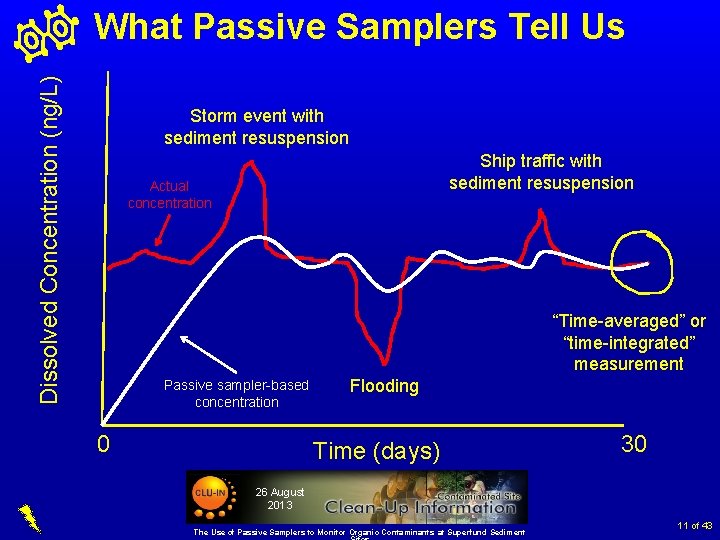
Why Use Passive Samplers? The Advantages √ • Analytically √ • Representativeness of data – Passive samplers accumulate contaminants over time during their deployment – Detection limits are less of a problem – Passive samplers are deployed in the environment for prolonged periods of time – “Time-averaged” or “time-integrated” measurement – Reflects representative concentrations at a site rather than “snap -shot” of conditions 26 August 2013 The Use of Passive Samplers to Monitor Organic Contaminants at Superfund Sediment 8 of 43
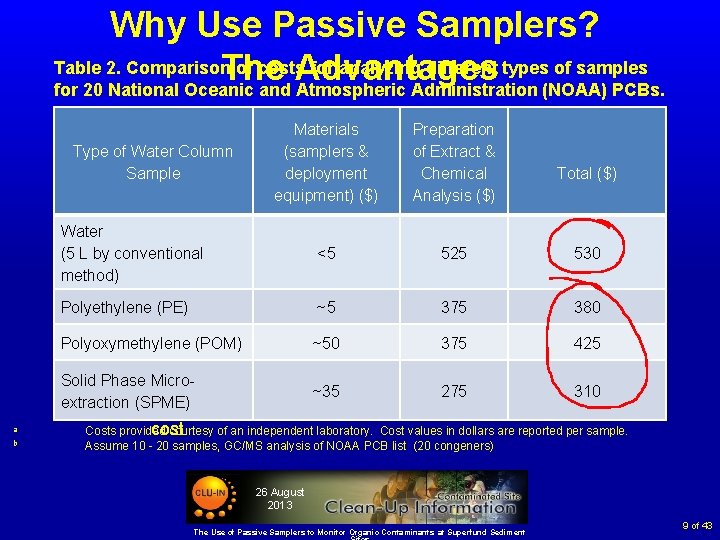
Why Use Passive Samplers? Table 2. Comparison of costs for analyzing different types of samples The Advantages for 20 National Oceanic and Atmospheric Administration (NOAA) PCBs. • Expense Materials Preparation – of. Preparation passive samplers is (samplersanalysis & of of Extract & Type Water Columnand chemical about less than the conventional method Sample$100 - $200 deployment Chemical Total ($) equipment) ($) Analysis ($) • As commercial laboratories establish experience with extracting Water and analyzing passive samplers – the prices are likely to drop 530 (5 L by conventional <5 525 method) • Extraction/analyses of passive samplers is less challenging tissue samples 375 Polyethylenethan (PE) sediment/soil or~5 380 Polyoxymethylene (POM) ~50 – Passive samplers are inexpensive 375 425 Solid Phase Micro 310 ~35 275 extraction • (SPME) If lost during deployment (e. g. , storm, vandalism) not a great a b cost Costs provided courtesy of an independent laboratory. Cost values in dollars are reported per sample. Assume 10 - 20 samples, GC/MS analysis of NOAA PCB list (20 congeners) 26 August 2013 The Use of Passive Samplers to Monitor Organic Contaminants at Superfund Sediment 9 of 43
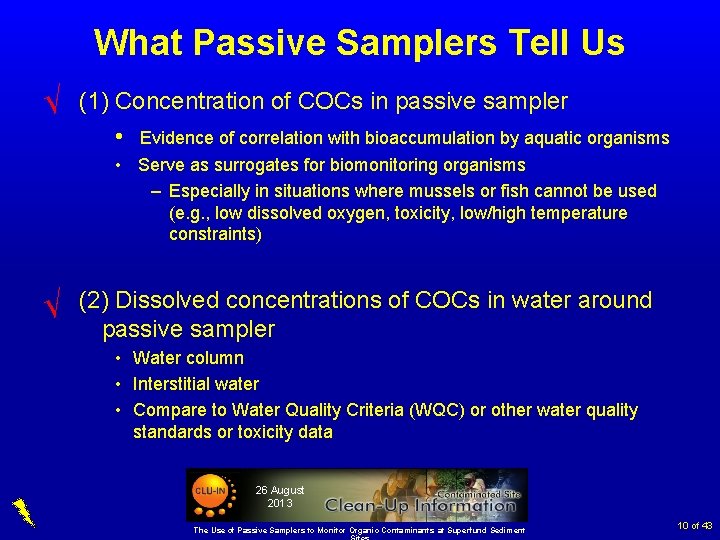
What Passive Samplers Tell Us √ (1) Concentration of COCs in passive sampler • Evidence of correlation with bioaccumulation by aquatic organisms • Serve as surrogates for biomonitoring organisms – Especially in situations where mussels or fish cannot be used (e. g. , low dissolved oxygen, toxicity, low/high temperature constraints) √ (2) Dissolved concentrations of COCs in water around passive sampler • Water column • Interstitial water • Compare to Water Quality Criteria (WQC) or other water quality standards or toxicity data 26 August 2013 The Use of Passive Samplers to Monitor Organic Contaminants at Superfund Sediment 10 of 43
Dissolved Concentration (ng/L) What Passive Samplers Tell Us Storm event with sediment resuspension Ship traffic with sediment resuspension Actual concentration “Time-averaged” or “time-integrated” measurement Passive sampler-based concentration 0 Flooding Time (days) 30 26 August 2013 The Use of Passive Samplers to Monitor Organic Contaminants at Superfund Sediment 11 of 43
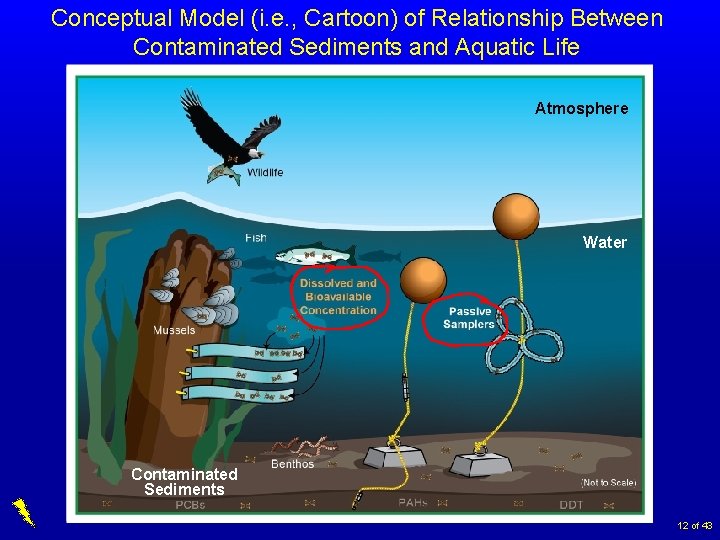
Conceptual Model (i. e. , Cartoon) of Relationship Between Contaminated Sediments and Aquatic Life Atmosphere Water Dissolved and Bioavailable Concentration Contaminated Sediments 12 of 43
Types of Passive Samplers Polyethylene (PE) 25 - 50 µm thick PE Polyoxymethylene (POM) 75 µm thick POM 26 August 2013 The Use of Passive Samplers to Monitor Organic Contaminants at Superfund Sediment 13 of 43
Types of Passive Samplers fiber-optic cable 2. 5 cm er inn m e 0 u s cor 1 2 as gl r ) ute DMS o um e (P 100 iloxan 10 hyls ing t t ime coa lyd po 0. 25 m cross-section SPMD 2. 5 cm SPME triolien layer 50 - 95 um thick polyethylene shell containing synthetic lipid triolien Solid Phase Microextraction (SPME) 2. 5 cm Semi-Permeable Membrane Device (SPMD) 26 August 2013 The Use of Passive Samplers to Monitor Organic Contaminants at Superfund Sediment 14 of 43
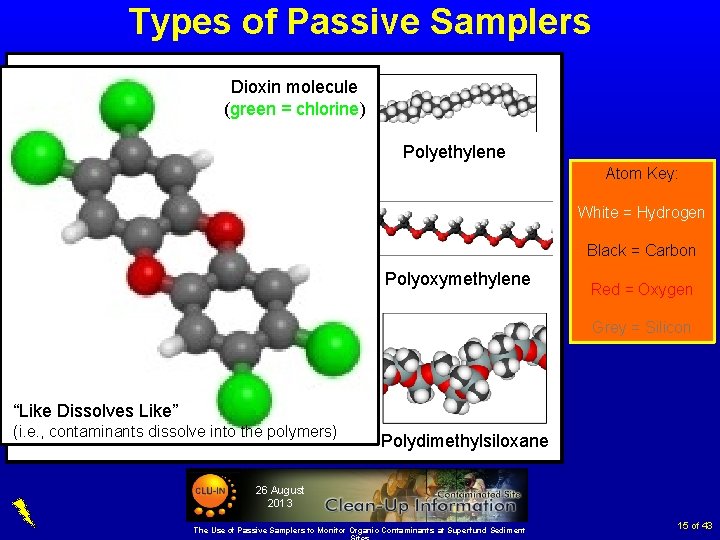
Types of Passive Samplers Dioxin molecule (green = chlorine) Polyethylene Atom Key: White = Hydrogen Black = Carbon Polyoxymethylene Red = Oxygen Grey = Silicon “Like Dissolves Like” (i. e. , contaminants dissolve into the polymers) Polydimethylsiloxane 26 August 2013 The Use of Passive Samplers to Monitor Organic Contaminants at Superfund Sediment 15 of 43
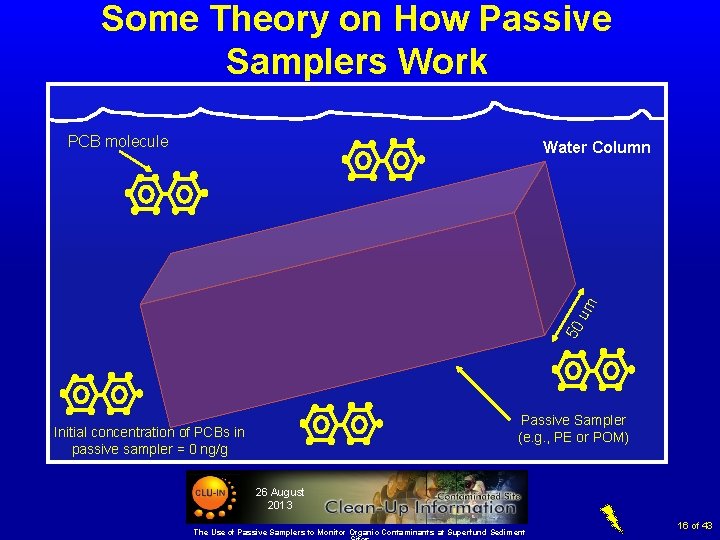
Some Theory on How Passive Samplers Work PCB molecule 50 um Water Column Passive Sampler (e. g. , PE or POM) Initial concentration of PCBs in passive sampler = 0 ng/g 26 August 2013 The Use of Passive Samplers to Monitor Organic Contaminants at Superfund Sediment 16 of 43
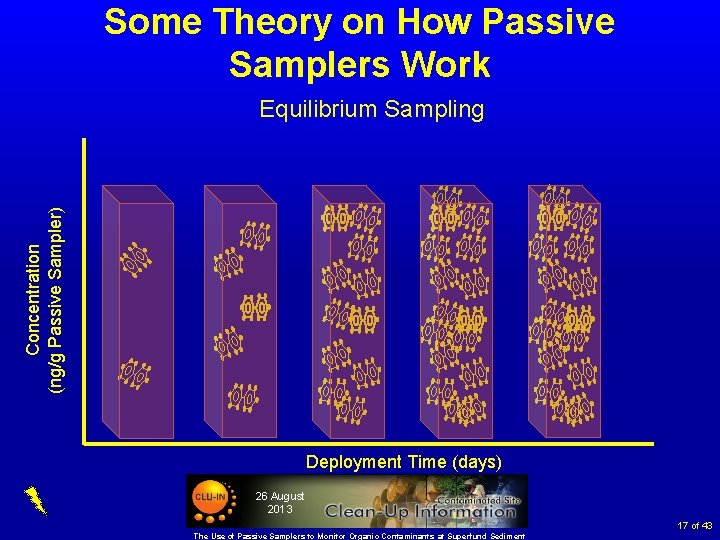
Some Theory on How Passive Samplers Work Concentration (ng/g Passive Sampler) Equilibrium Sampling Deployment Time (days) 26 August 2013 17 of 43 The Use of Passive Samplers to Monitor Organic Contaminants at Superfund Sediment
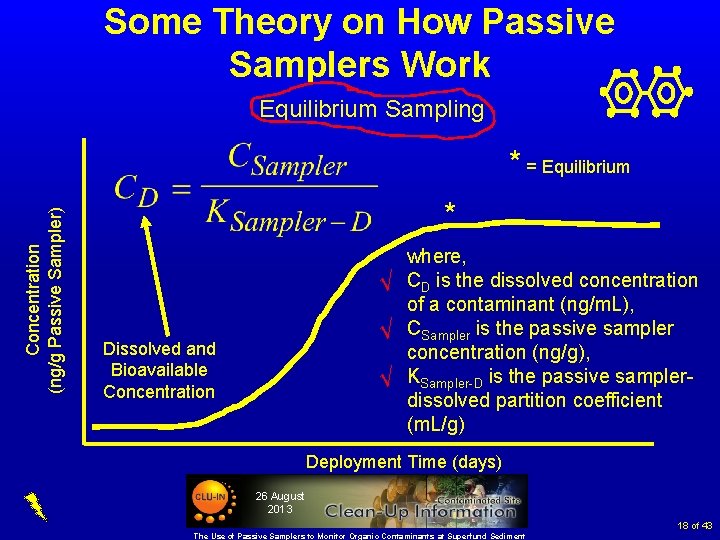
Some Theory on How Passive Samplers Work Equilibrium Sampling Concentration (ng/g Passive Sampler) * = Equilibrium * √ √ Dissolved and Bioavailable Concentration √ where, CD is the dissolved concentration of a contaminant (ng/m. L), CSampler is the passive sampler concentration (ng/g), KSampler-D is the passive samplerdissolved partition coefficient (m. L/g) Deployment Time (days) 26 August 2013 18 of 43 The Use of Passive Samplers to Monitor Organic Contaminants at Superfund Sediment
Preparing, Deploying, Recovering, and Storing Passive Samplers • General guidance presented today (SAMS #3 document) • Society of Environmental Toxicology and Chemistry (SETAC) – Pellston Technical Workshop on passive sampling (Fall 2012) – Series of scientific papers to be published in 2014 including practical guidance for field deployments (e. g. , QA/QC) • Strategic Environmental Research and Development Program (SERDP) and Environmental Security Technology Certification Program (ESTCP) – Funding project developing specific guidance using passive samplers at contaminated sites (due late 2014/early 2015) – Published as a U. S. EPA document – Contents: SOPs for field deployment/recovery, chemical analysis, QA/QC considerations – Designed for use by contractors and contract laboratories √ 26 August 2013 The Use of Passive Samplers to Monitor Organic Contaminants at Superfund Sediment 19 of 43
Preparing, Deploying, Recovering, and Storing Passive Samplers • Samplers must be free of contaminants prior to deployment – Samplers soaked in organic solvent to remove organic contaminants & soaked in deionized water to remove organic solvent from polymer structure – Samplers wrapped in aluminum foil, placed into a plastic bag, and stored at - 4ºC until deployment – Samplers transported to the field in clean ice-filled cooler(s) 26 August 2013 20 of 43 The Use of Passive Samplers to Monitor Organic Contaminants at Superfund Sediment
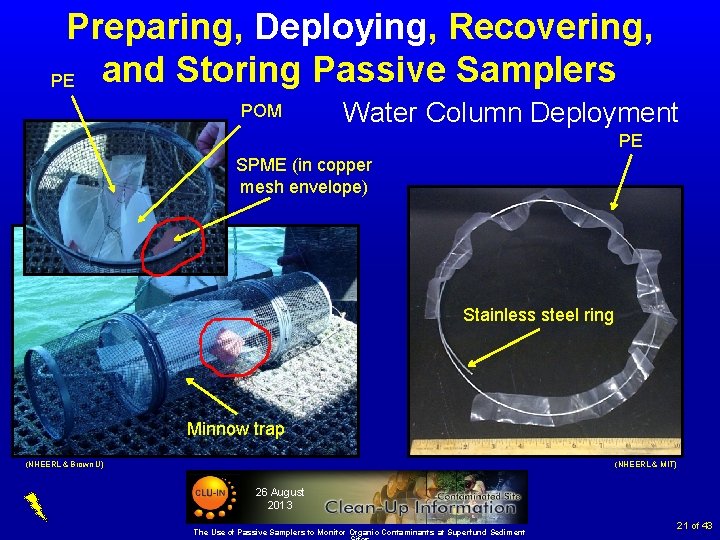
Preparing, Deploying, Recovering, PE and Storing Passive Samplers POM Water Column Deployment PE SPME (in copper mesh envelope) Stainless steel ring Minnow trap (NHEERL & Brown U) (NHEERL & MIT) 26 August 2013 The Use of Passive Samplers to Monitor Organic Contaminants at Superfund Sediment 21 of 43
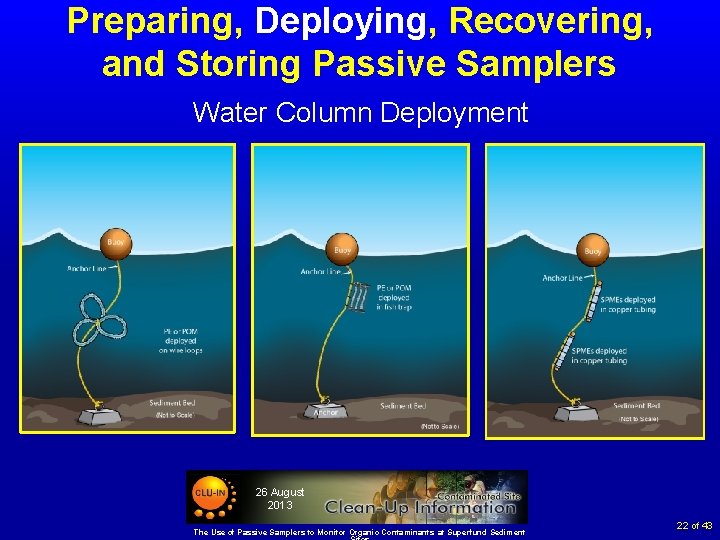
Preparing, Deploying, Recovering, and Storing Passive Samplers Water Column Deployment 26 August 2013 The Use of Passive Samplers to Monitor Organic Contaminants at Superfund Sediment 22 of 43
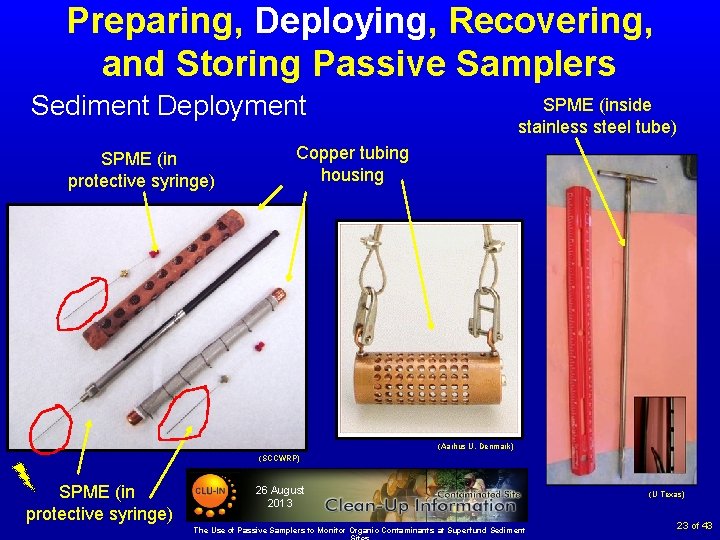
Preparing, Deploying, Recovering, and Storing Passive Samplers Sediment Deployment SPME (in protective syringe) SPME (inside stainless steel tube) Copper tubing housing (Aarhus U, Denmark) (SCCWRP) SPME (in protective syringe) 26 August 2013 The Use of Passive Samplers to Monitor Organic Contaminants at Superfund Sediment (U Texas) 23 of 43
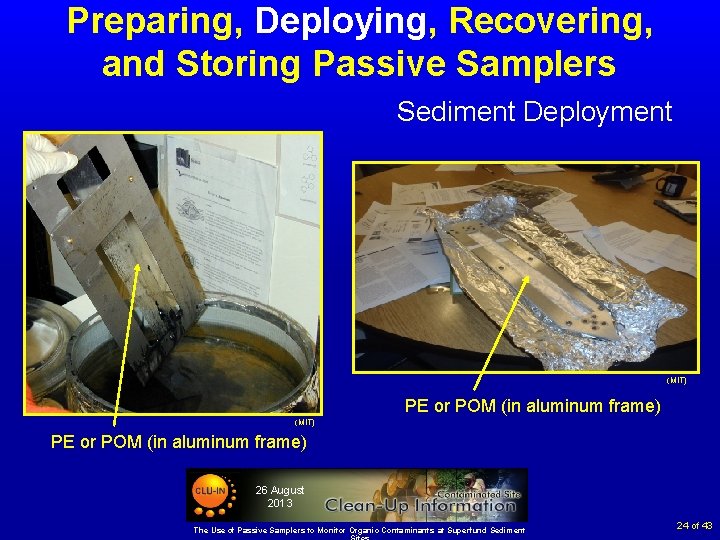
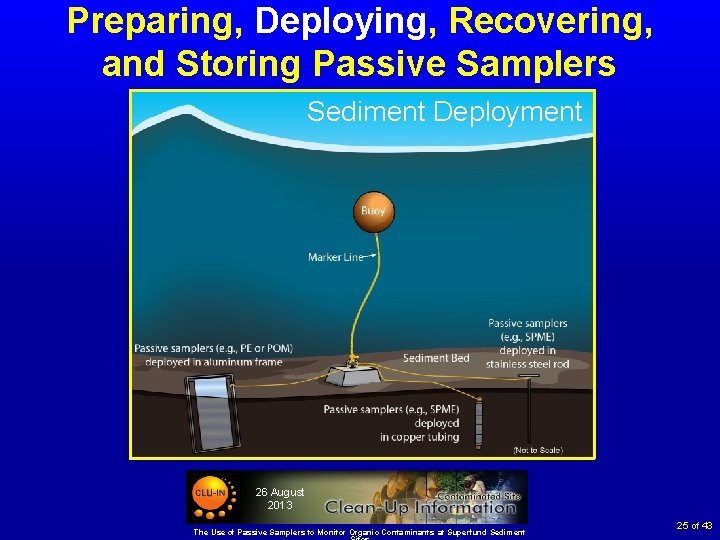
Preparing, Deploying, Recovering, and Storing Passive Samplers Sediment Deployment (MIT) PE or POM (in aluminum frame) 26 August 2013 The Use of Passive Samplers to Monitor Organic Contaminants at Superfund Sediment 24 of 43
Preparing, Deploying, Recovering, and Storing Passive Samplers Sediment Deployment 26 August 2013 The Use of Passive Samplers to Monitor Organic Contaminants at Superfund Sediment 25 of 43
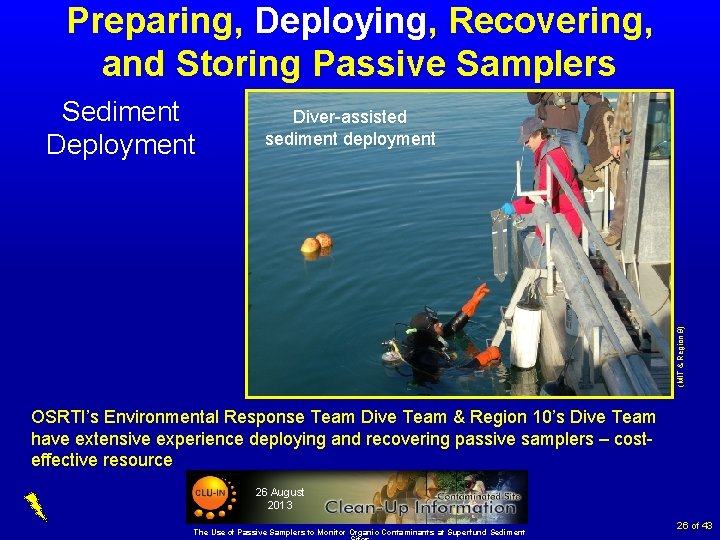
Preparing, Deploying, Recovering, and Storing Passive Samplers Diver-assisted sediment deployment (MIT & Region 9) Sediment Deployment OSRTI’s Environmental Response Team Dive Team & Region 10’s Dive Team have extensive experience deploying and recovering passive samplers – costeffective resource 26 August 2013 The Use of Passive Samplers to Monitor Organic Contaminants at Superfund Sediment 26 of 43
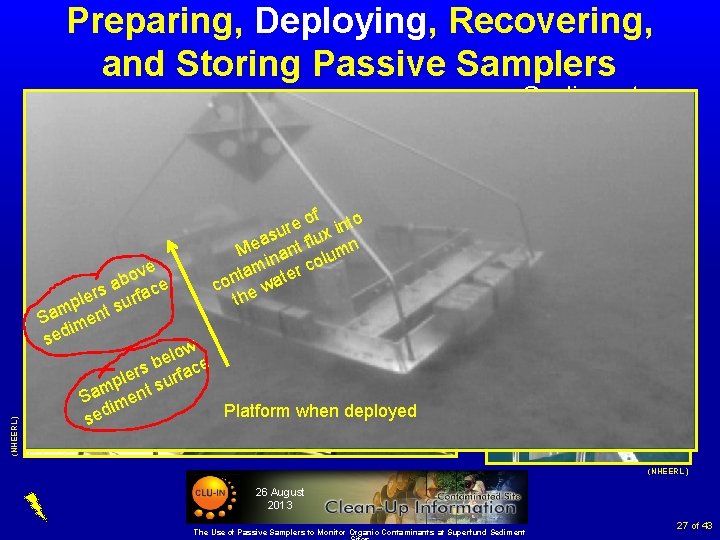
Preparing, Deploying, Recovering, and Storing Passive Samplers Sediment Deployment SPME in copper tubing PE and POM (in aluminum frames) (NHEERL ) of nto e r u lux i s a Me nant f lumn i co m r a t e t con e wa th ve o b a ce s r a f e r l mp nt su a S ime sed ow l e rs b rface e l mp nt su a S ime Platform when deployed sed (NHEERL ) 26 August 2013 The Use of Passive Samplers to Monitor Organic Contaminants at Superfund Sediment 27 of 43
Preparing, Deploying, Recovering, and Storing Passive Samplers • After the deployment period (~ 28 days) – Samplers removed from deployment gear (e. g. , stainless steel rings, copper tubing, minnow cages, frames) – Samplers wiped clean with laboratory tissue and/or quickly rinsed with clean water – Samplers wrapped in aluminum foil or placed in clean glass jars (with teflon-lined lids) and returned to the laboratory in a clean cooler(s) on ice (as soon as possible) – Samplers stored at - 4ºC in the dark until organic solvent extraction and chemical analyses are performed 26 August 2013 The Use of Passive Samplers to Monitor Organic Contaminants at Superfund Sediment 28 of 43
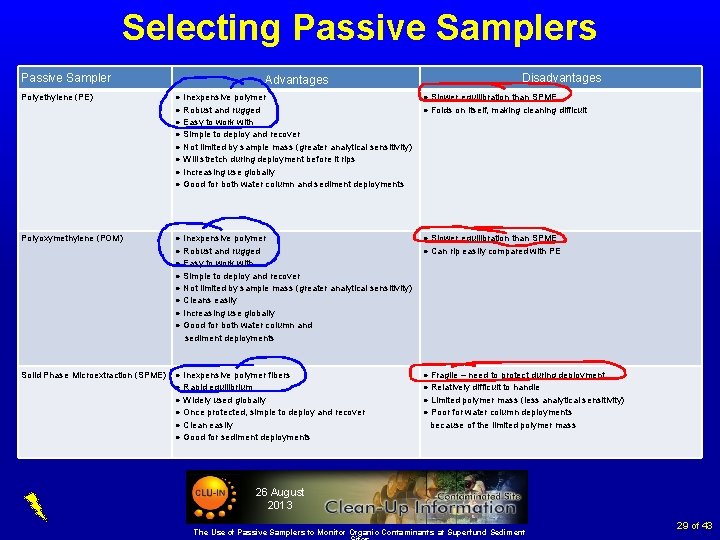
Selecting Passive Samplers Passive Sampler Advantages Disadvantages Polyethylene (PE) ● Inexpensive polymer ● Robust and rugged ● Easy to work with ● Simple to deploy and recover ● Not limited by sample mass (greater analytical sensitivity) ● Will stretch during deployment before it rips ● Increasing use globally ● Good for both water column and sediment deployments ● Slower equilibration than SPME ● Folds on itself, making cleaning difficult Polyoxymethylene (POM) ● Inexpensive polymer ● Robust and rugged ● Easy to work with ● Simple to deploy and recover ● Not limited by sample mass (greater analytical sensitivity) ● Cleans easily ● Increasing use globally ● Good for both water column and sediment deployments ● Slower equilibration than SPME ● Can rip easily compared with PE Solid Phase Microextraction (SPME) ● Inexpensive polymer fibers ● Rapid equilibrium ● Widely used globally ● Once protected, simple to deploy and recover ● Clean easily ● Good for sediment deployments ● Fragile – need to protect during deployment ● Relatively difficult to handle ● Limited polymer mass (less analytical sensitivity) ● Poor for water column deployments because of the limited polymer mass 26 August 2013 The Use of Passive Samplers to Monitor Organic Contaminants at Superfund Sediment 29 of 43
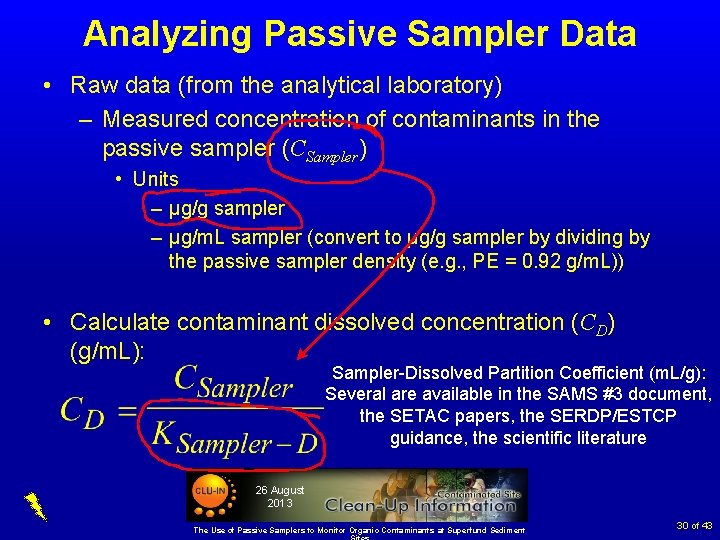
Analyzing Passive Sampler Data • Raw data (from the analytical laboratory) – Measured concentration of contaminants in the passive sampler (CSampler) • Units – µg/g sampler – µg/m. L sampler (convert to µg/g sampler by dividing by the passive sampler density (e. g. , PE = 0. 92 g/m. L)) • Calculate contaminant dissolved concentration (CD) (g/m. L): Sampler-Dissolved Partition Coefficient (m. L/g): Several are available in the SAMS #3 document, the SETAC papers, the SERDP/ESTCP guidance, the scientific literature 26 August 2013 The Use of Passive Samplers to Monitor Organic Contaminants at Superfund Sediment 30 of 43
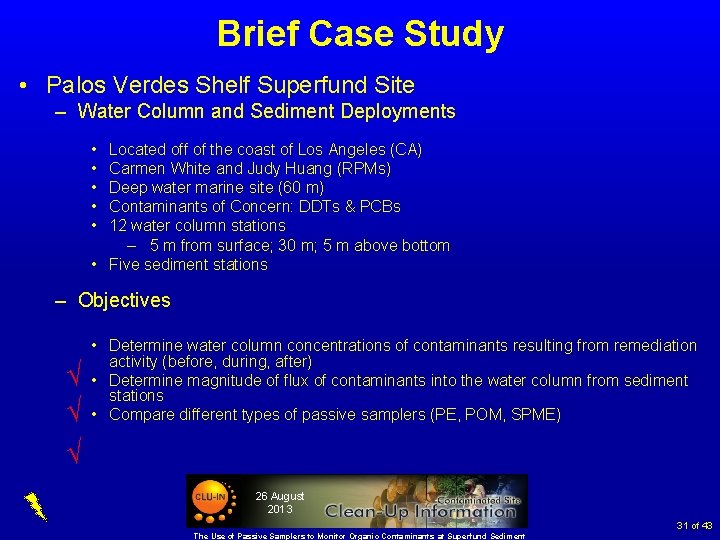
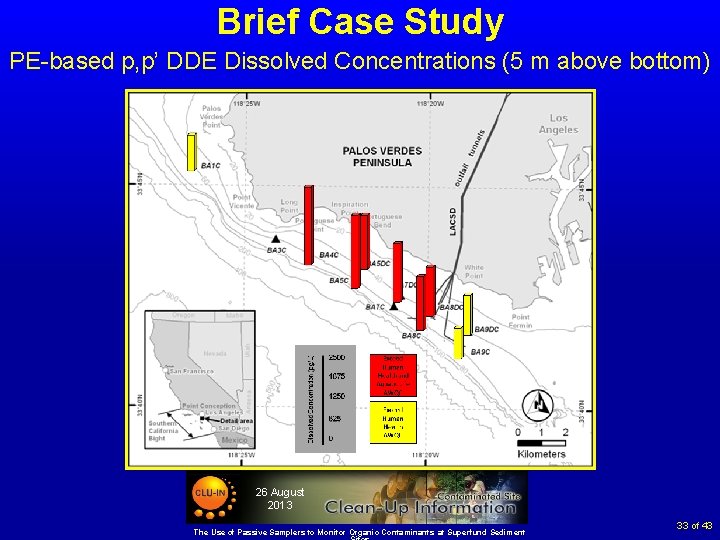
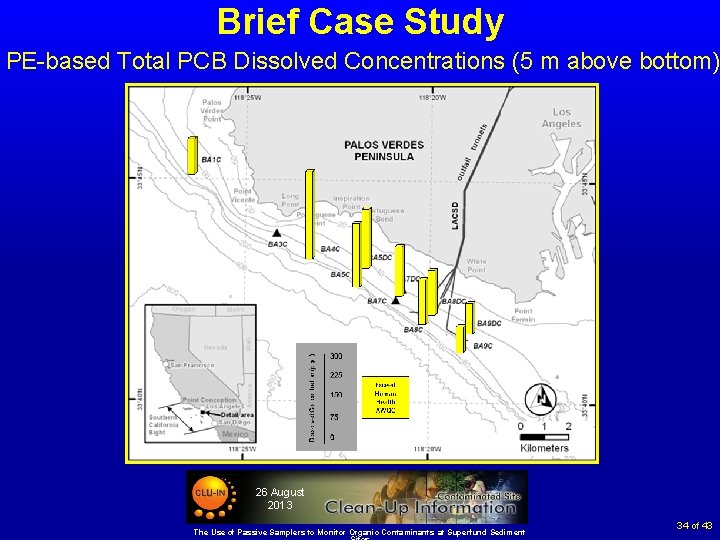
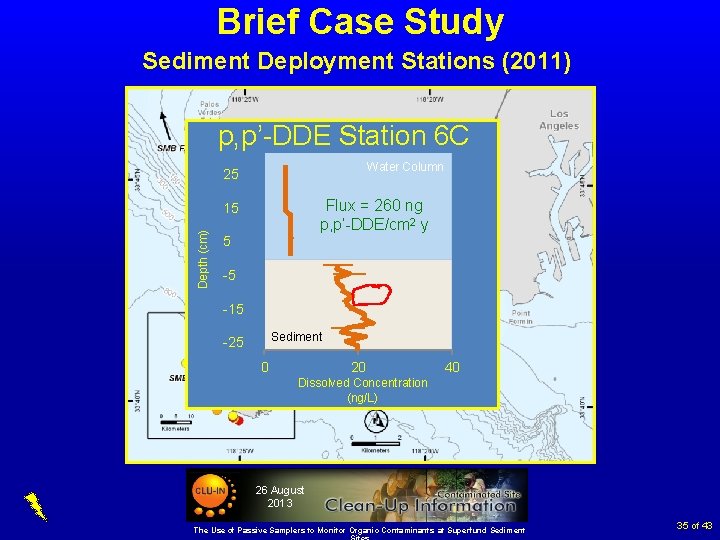
Brief Case Study • Palos Verdes Shelf Superfund Site – Water Column and Sediment Deployments • • • Located off of the coast of Los Angeles (CA) Carmen White and Judy Huang (RPMs) Deep water marine site (60 m) Contaminants of Concern: DDTs & PCBs 12 water column stations – 5 m from surface; 30 m; 5 m above bottom • Five sediment stations – Objectives √ √ √ • Determine water column concentrations of contaminants resulting from remediation activity (before, during, after) • Determine magnitude of flux of contaminants into the water column from sediment stations • Compare different types of passive samplers (PE, POM, SPME) 26 August 2013 31 of 43 The Use of Passive Samplers to Monitor Organic Contaminants at Superfund Sediment
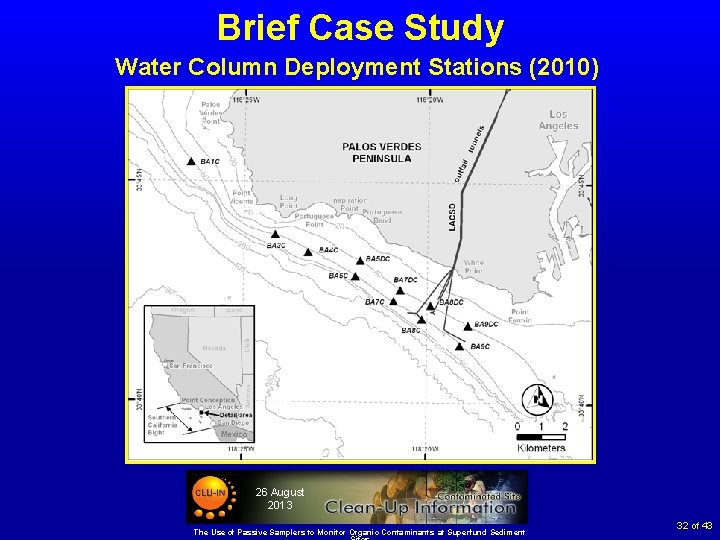
Brief Case Study Water Column Deployment Stations (2010) 26 August 2013 The Use of Passive Samplers to Monitor Organic Contaminants at Superfund Sediment 32 of 43
Brief Case Study PE-based p, p’ DDE Dissolved Concentrations (5 m above bottom) 26 August 2013 The Use of Passive Samplers to Monitor Organic Contaminants at Superfund Sediment 33 of 43
Brief Case Study PE-based Total PCB Dissolved Concentrations (5 m above bottom) 26 August 2013 The Use of Passive Samplers to Monitor Organic Contaminants at Superfund Sediment 34 of 43
Brief Case Study Sediment Deployment Stations (2011) p, p’-DDE Station 6 C Water Column 25 Flux = 260 ng p, p’-DDE/cm 2 y Depth (cm) 15 5 -5 -15 Sediment -25 0 20 40 Dissolved Concentration (ng/L) 26 August 2013 The Use of Passive Samplers to Monitor Organic Contaminants at Superfund Sediment 35 of 43
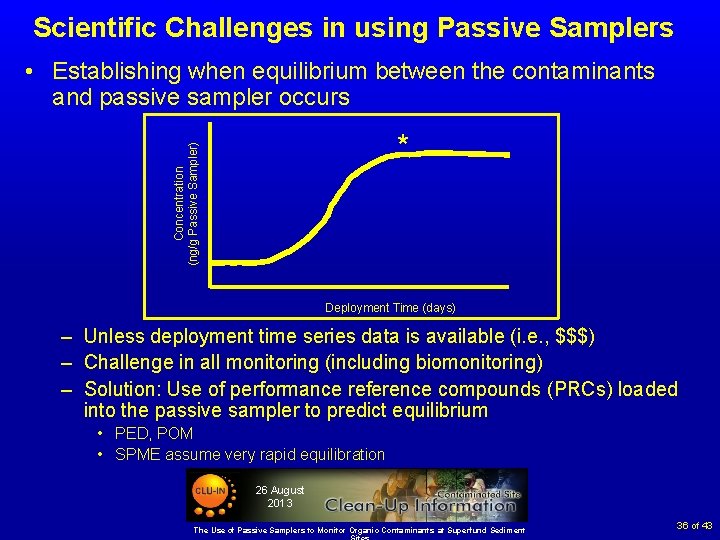
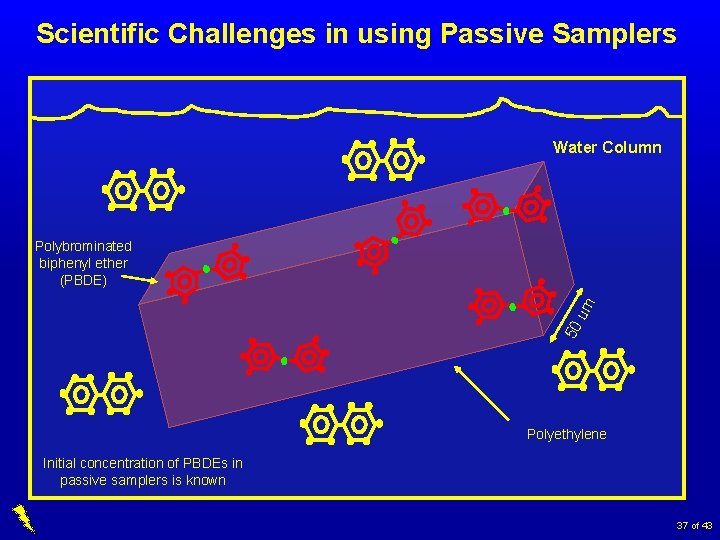
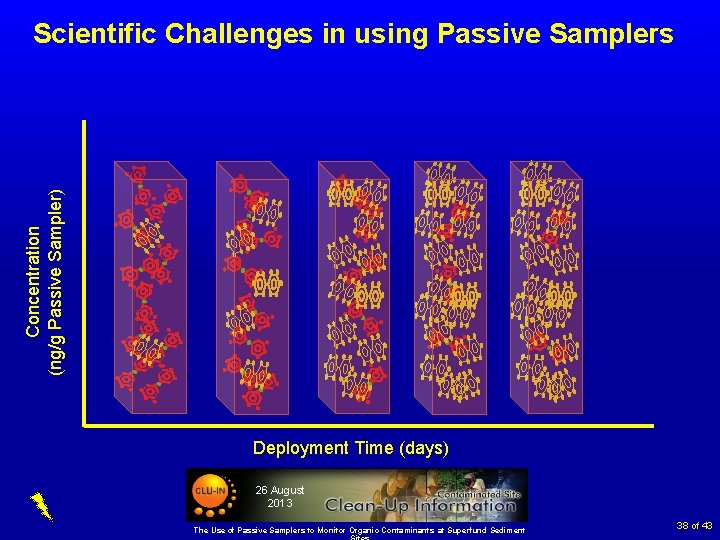
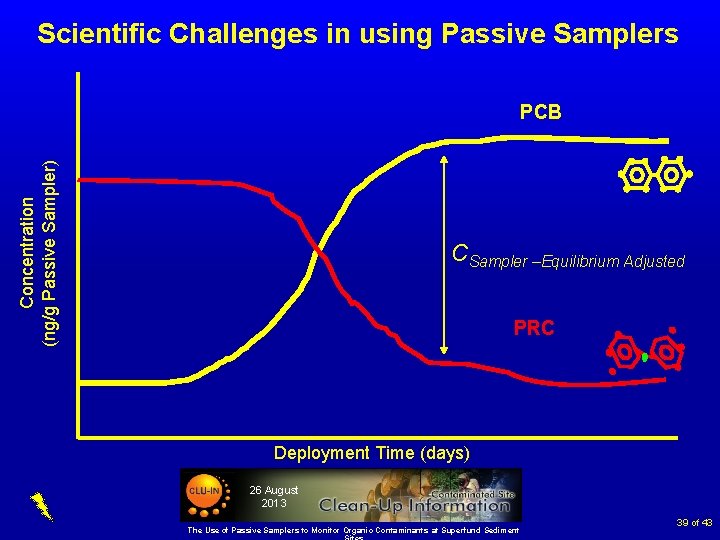
Scientific Challenges in using Passive Samplers • Establishing when equilibrium between the contaminants and passive sampler occurs Concentration (ng/g Passive Sampler) * Deployment Time (days) – Unless deployment time series data is available (i. e. , $$$) – Challenge in all monitoring (including biomonitoring) – Solution: Use of performance reference compounds (PRCs) loaded into the passive sampler to predict equilibrium • PED, POM • SPME assume very rapid equilibration 26 August 2013 The Use of Passive Samplers to Monitor Organic Contaminants at Superfund Sediment 36 of 43
Scientific Challenges in using Passive Samplers Water Column 50 um Polybrominated biphenyl ether (PBDE) Polyethylene Initial concentration of PBDEs in passive samplers is known 37 of 43
Concentration (ng/g Passive Sampler) Scientific Challenges in using Passive Samplers Deployment Time (days) 26 August 2013 The Use of Passive Samplers to Monitor Organic Contaminants at Superfund Sediment 38 of 43
Scientific Challenges in using Passive Samplers Concentration (ng/g Passive Sampler) PCB CSampler –Equilibrium Adjusted PRC Deployment Time (days) 26 August 2013 The Use of Passive Samplers to Monitor Organic Contaminants at Superfund Sediment 39 of 43
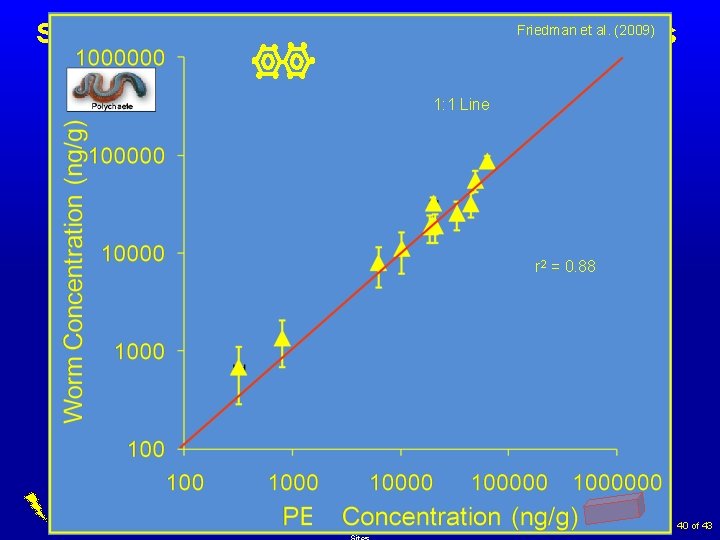
Friedman et al. (2009) Scientific Challenges in using Passive Samplers • Relating passive sampler uptake of contaminants to 1: 1 Line animal bioaccumulation Passive Sampler (e. g. , PE or POM) ? = Mussels – Critical for determining how to interpret passiver 2 sampler data = 0. 88 – Dataset comparing passive sampler uptake to animal bioaccumulation is being established – Solution: Generate general linear models: Animal Concentration (ng/g) = ά + β*Sampler Concentration (ng/g) 26 August 2013 The Use of Passive Samplers to Monitor Organic Contaminants at Superfund Sediment 40 of 43
US EPA Contacts Working with Passive Samplers Name Robert Burgess Office and Location ORD/NHEERL/AED-Narragansett, RI e-mail burgess. robert@epa. gov Lawrence Burkhard ORD/NHEERL/MED-Duluth, MN burkhard. lawrence@epa. gov Mark Cantwell ORD/NHEERL/AED-Narragansett, RI cantwell. mark@epa. gov Bruce Duncan Region 10 – Seattle, WA duncan. bruce@epa. gov Marc Greenberg OSWER/OSRTI/ERT-Edison, NJ greenberg. marc@epa. gov Judy Huang Region 9 - San Francisco, CA huang. judy@epa. gov Matthew Lambert OSWER/OSRTI/Washington, DC lambert. matthew@epa. gov Marc Mills ORD/NRMRL/ LRPCD-Cincinnati, OH mills. marc@epa. gov ORD/NRMRL/ LRPCD-Cincinnati, OH schubauer-berigan. joseph@epa. gov Region 10 - Seattle, WA sheldrake. sean@epa. gov Region 9 - San Francisco, CA thompson. rachelle@epa. gov Joseph Schubauer-Berigan Sean Sheldrake Rachelle Thompson 26 August 2013 The Use of Passive Samplers to Monitor Organic Contaminants at Superfund Sediment 41 of 43
Summary • Passive sampling is a scientifically sound and cost-effective approach for monitoring contaminant concentrations √ – water column – sediment interstitial waters • Passive samplers provide information on: √ – Dissolved and bioavailable contaminant concentrations – Sampler uptake may serve as a surrogate for animal bioaccumulation • Applications include: √ – Monitoring water column and interstitial water concentrations before, during and after remediation – Determining sources of contaminants released from sediments to the water column (e. g. , site model development) – For many applications, passive sampling is the future of environmental sampling 26 August 2013 The Use of Passive Samplers to Monitor Organic Contaminants at Superfund Sediment 42 of 43
Acknowledgements • OSWER, specifically OSRTI (e. g. , S. Ells, M. Lambert) • L. Fernandez (U. S. EPA/Northeastern Univ. ) & M. Perron (U. S. EPA) • Y. Burhan (Tetra Tech) • Reviewers of the SAMS document • Sources of photographs in the SAMS document • See SAMS document for more specifics 26 August 2013 The Use of Passive Samplers to Monitor Organic Contaminants at Superfund Sediment 43 of 43