
The use of forms of address in French
- Slides: 26
The use of forms of address in French blogs and Internet Forums Eva Havu University of Helsinki
1. Introduction • French: two address pronouns “pronouns of power and solidarity” (Brown and Gilman 1960) • vous (V): formal interactions, distance between interlocutors, neutral • tu (T): informal and familiar interactions, solidarity • T spread in certain non-hierarchical contexts • colleagues, common activities, age groups… (cf. Lévy 2006, Havu 2013) • But: Internet Forums discussing the use of forms of address: preference for very traditional habits (Havu 2019) • Media discourse?
1. Introduction • French written and oral media discourse for “average” readers/listeners: V • leading (national) newspapers, magazines, television and radio channels => V neutral: inclusion of all (active and non active) participants => T too familiar: exclusion of participants • Specialized media (shared interests): T often usual • cf. Williams & van Compernolle 2009; Coveney 2010… • Computer-Mediated Communication (CMC): specialized but still different • lack of information about interlocutor (age, social status, profession, special interests…) => criteria for choice of pronoun? • Each online community, “clan” with “communication agreement” (Lévy 2006) • Replaces traditional conventions
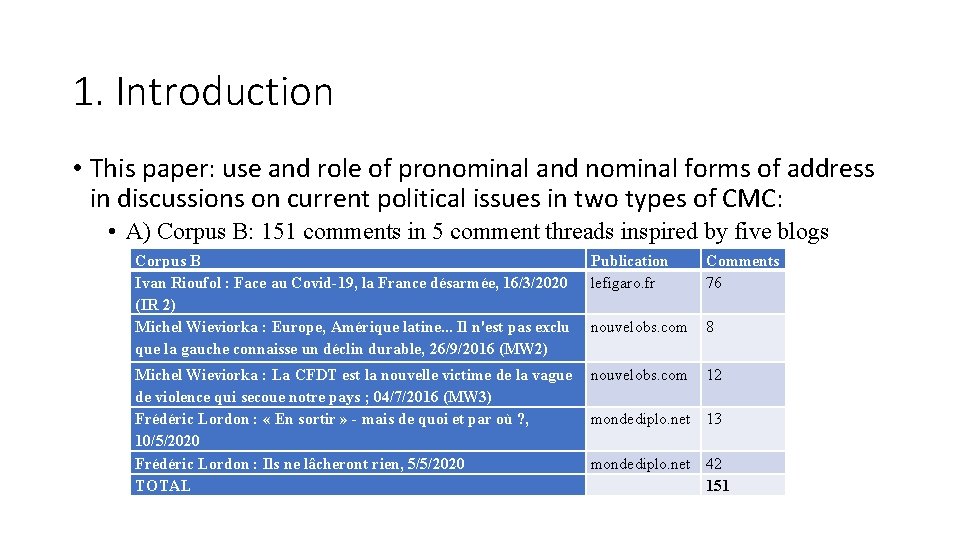
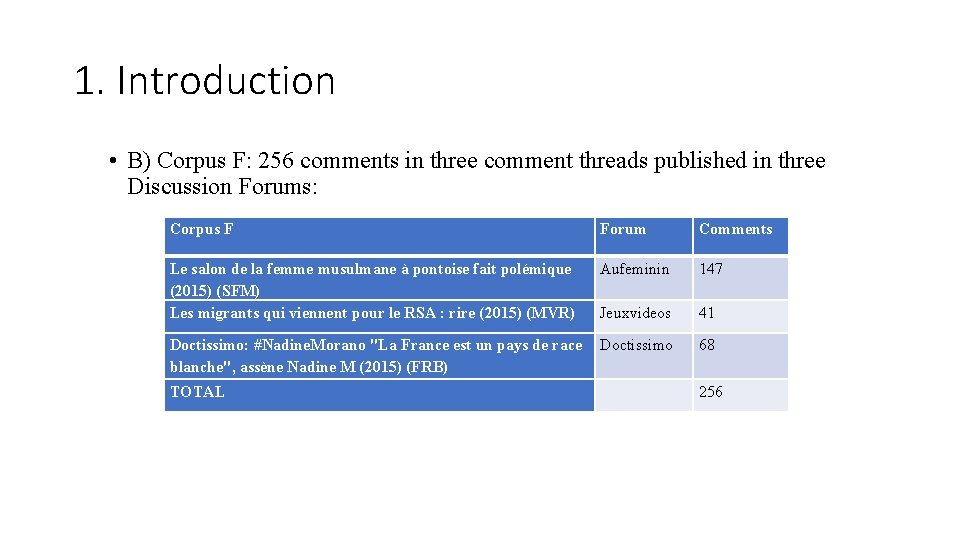
1. Introduction • This paper: use and role of pronominal and nominal forms of address in discussions on current political issues in two types of CMC: • A) Corpus B: 151 comments in 5 comment threads inspired by five blogs Corpus B Ivan Rioufol : Face au Covid-19, la France désarmée, 16/3/2020 (IR 2) Michel Wieviorka : Europe, Amérique latine. . . Il n'est pas exclu que la gauche connaisse un déclin durable, 26/9/2016 (MW 2) Publication lefigaro. fr Comments 76 nouvelobs. com 8 Michel Wieviorka : La CFDT est la nouvelle victime de la vague de violence qui secoue notre pays ; 04/7/2016 (MW 3) Frédéric Lordon : « En sortir » - mais de quoi et par où ? , 10/5/2020 Frédéric Lordon : Ils ne lâcheront rien, 5/5/2020 TOTAL nouvelobs. com 12 mondediplo. net 13 mondediplo. net 42 151
1. Introduction • B) Corpus F: 256 comments in three comment threads published in three Discussion Forums: Corpus F Forum Comments Le salon de la femme musulmane à pontoise fait polémique (2015) (SFM) Les migrants qui viennent pour le RSA : rire (2015) (MVR) Aufeminin 147 Jeuxvideos 41 Doctissimo: #Nadine. Morano "La France est un pays de race blanche", assène Nadine M (2015) (FRB) Doctissimo 68 TOTAL 256
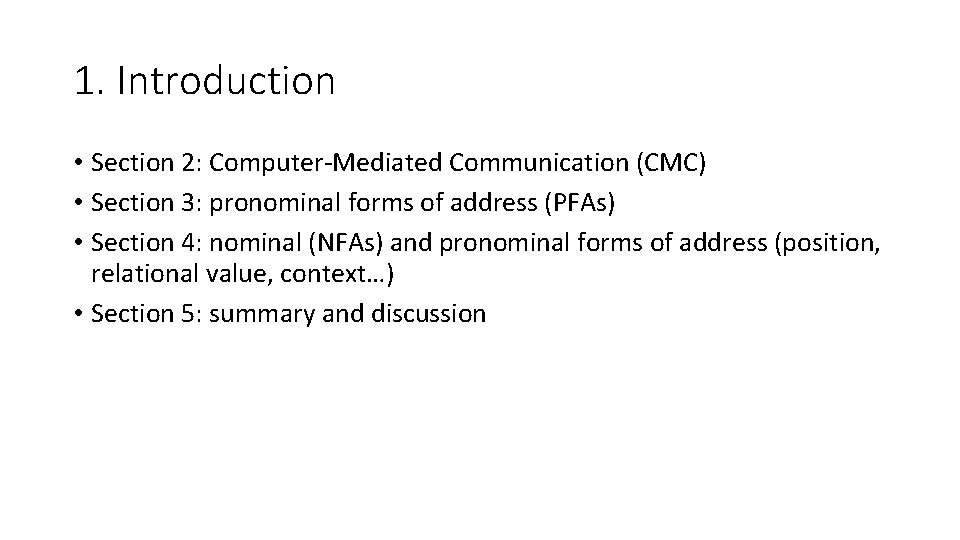
1. Introduction • Section 2: Computer-Mediated Communication (CMC) • Section 3: pronominal forms of address (PFAs) • Section 4: nominal (NFAs) and pronominal forms of address (position, relational value, context…) • Section 5: summary and discussion
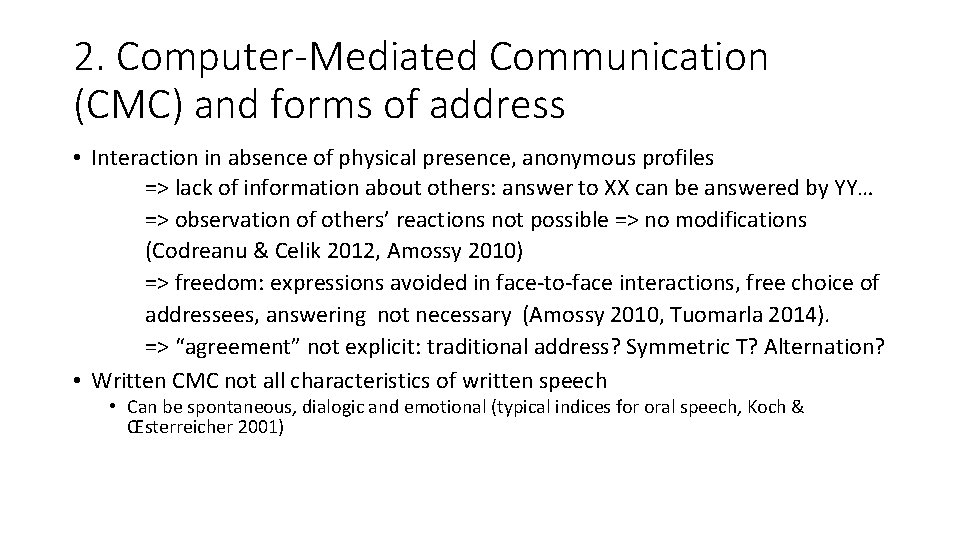
2. Computer-Mediated Communication (CMC) and forms of address • Interaction in absence of physical presence, anonymous profiles => lack of information about others: answer to XX can be answered by YY… => observation of others’ reactions not possible => no modifications (Codreanu & Celik 2012, Amossy 2010) => freedom: expressions avoided in face-to-face interactions, free choice of addressees, answering not necessary (Amossy 2010, Tuomarla 2014). => “agreement” not explicit: traditional address? Symmetric T? Alternation? • Written CMC not all characteristics of written speech • Can be spontaneous, dialogic and emotional (typical indices for oral speech, Koch & Œsterreicher 2001)
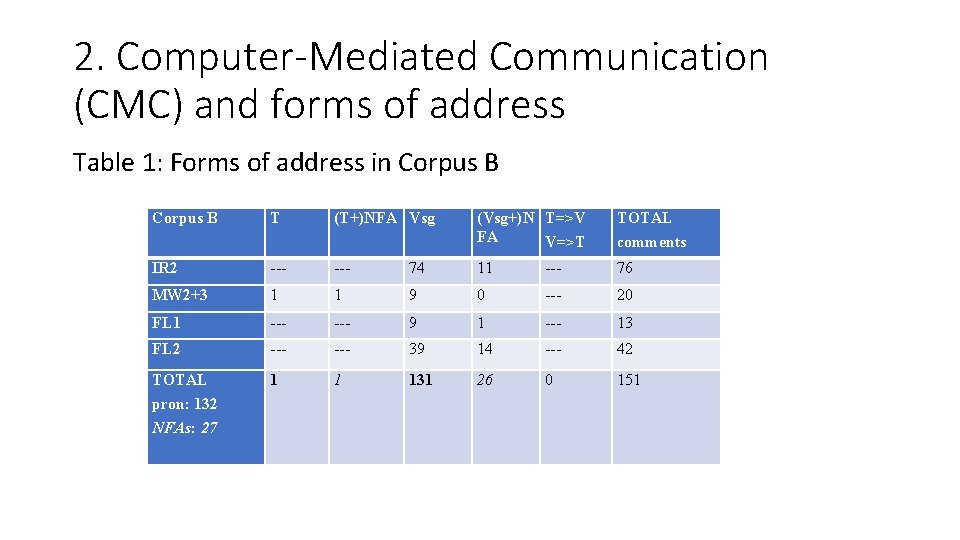
2. Computer-Mediated Communication (CMC) and forms of address Table 1: Forms of address in Corpus B T (T+)NFA Vsg (Vsg+)N T=>V FA V=>T TOTAL comments IR 2 --- 74 11 --- 76 MW 2+3 1 1 9 0 --- 20 FL 1 --- 9 1 --- 13 FL 2 --- 39 14 --- 42 TOTAL 1 1 131 26 0 151 pron: 132 NFAs: 27
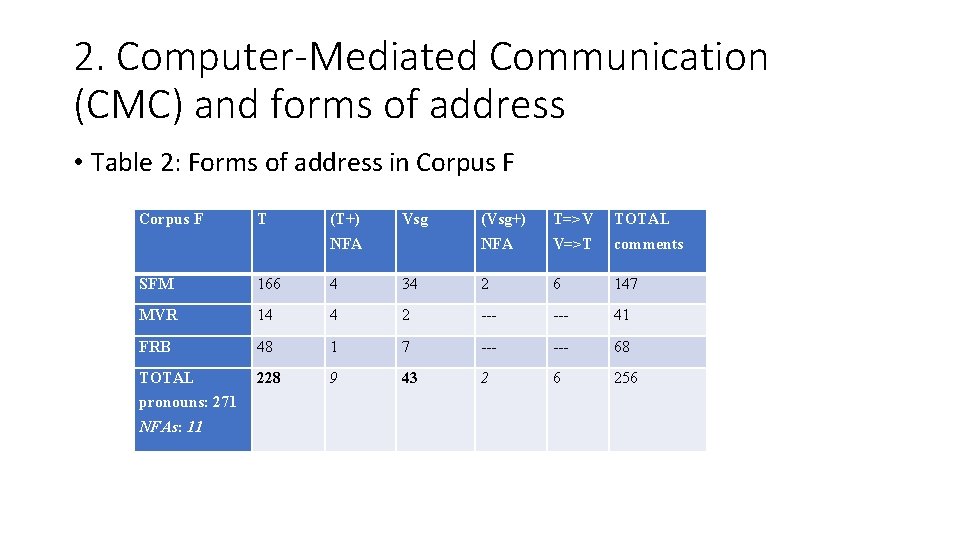
2. Computer-Mediated Communication (CMC) and forms of address • Table 2: Forms of address in Corpus F T (T+) Vsg NFA (Vsg+) T=>V TOTAL NFA V=>T comments SFM 166 4 34 2 6 147 MVR 14 4 2 --- 41 FRB 48 1 7 --- 68 TOTAL 228 9 43 2 6 256 pronouns: 271 NFAs: 11
2. Computer-Mediated Communication (CMC) and forms of address (Fa) • Fas not only designate/ identify addressee, indicate degree of politeness or social distance between interlocutors, reveal “communication agreement”, but also have: • Relational value: expression of emotions, indication of convergence or divergence, negotiation of identities (Fracchiolla et al. 2010, Kerbrat-Orecchioni 2010, Urbain 2014) => Relationship between interlocutors: not only FA, but constructed in discourse, situational (Urbain 2014). • Vous and madame neutral/formal forms of address, but can mark a conflictual situation: television debate between Sarkozy and Royal (May 2007): Sarkozy uses them dexterously to express his disagreement/contempt (Fracchiolla et al. 2010)
2. Computer-Mediated Communication (CMC) and forms of address • Numerous studies on hate speech, polemic interactions: terminological classifications for negative exchanges (Amossy 2011) • This study: not affective terms in special, but all forms of address => classification of the relational value of FAs : conflictual and constructive. • Conflictual (polemic, pejorative…) speech acts: e. g. insults, contempt, irony, sarcasm, provocation, reproach, negative critic (cf. Barbeau & Moïse 2020) • Constructive speech acts: e. g. greetings, encouragements, wishes, expressions of agreement… (also “neutral”, conventional, usages: Bonjour Madame, vous allez bien? )
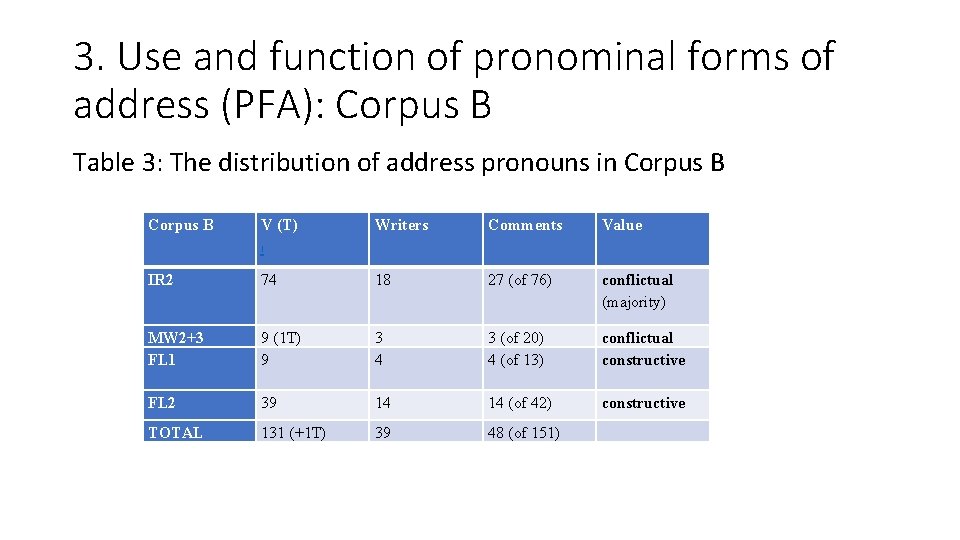
3. Use and function of pronominal forms of address (PFA): Corpus B Table 3: The distribution of address pronouns in Corpus B V (T) Writers Comments Value [ IR 2 74 18 27 (of 76) conflictual (majority) MW 2+3 FL 1 9 (1 T) 9 3 4 3 (of 20) 4 (of 13) conflictual constructive FL 2 39 14 14 (of 42) constructive TOTAL 131 (+1 T) 39 48 (of 151)
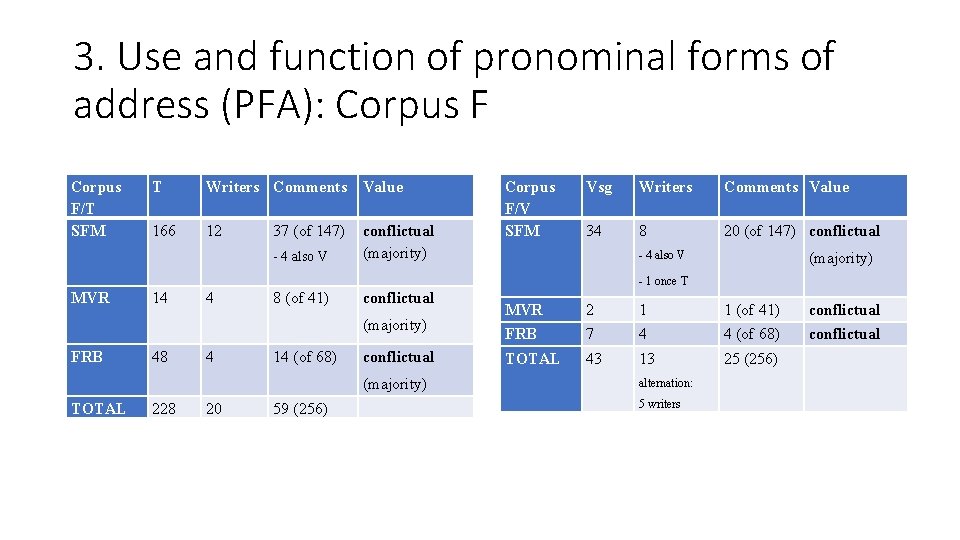
3. Use and function of pronominal forms of address (PFA): Corpus F/T SFM T Writers Comments Value 166 12 37 (of 147) - 4 also V conflictual (majority) Corpus F/V SFM Vsg Writers Comments Value 34 8 20 (of 147) conflictual - 4 also V (majority) - 1 once T MVR 14 4 8 (of 41) conflictual (majority) FRB 48 4 14 (of 68) conflictual (majority) TOTAL 228 20 59 (256) MVR 2 1 1 (of 41) conflictual FRB 7 4 4 (of 68) conflictual TOTAL 43 13 25 (256) alternation: 5 writers
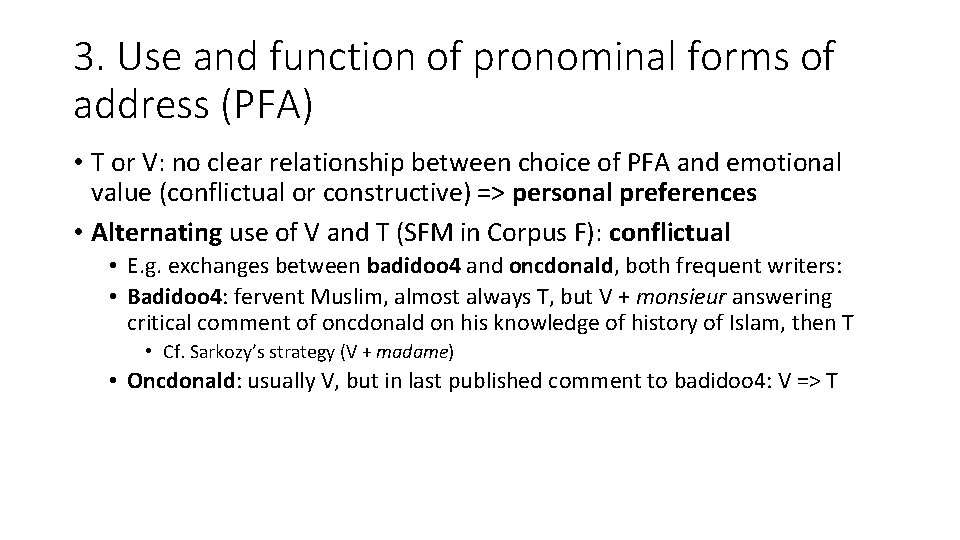
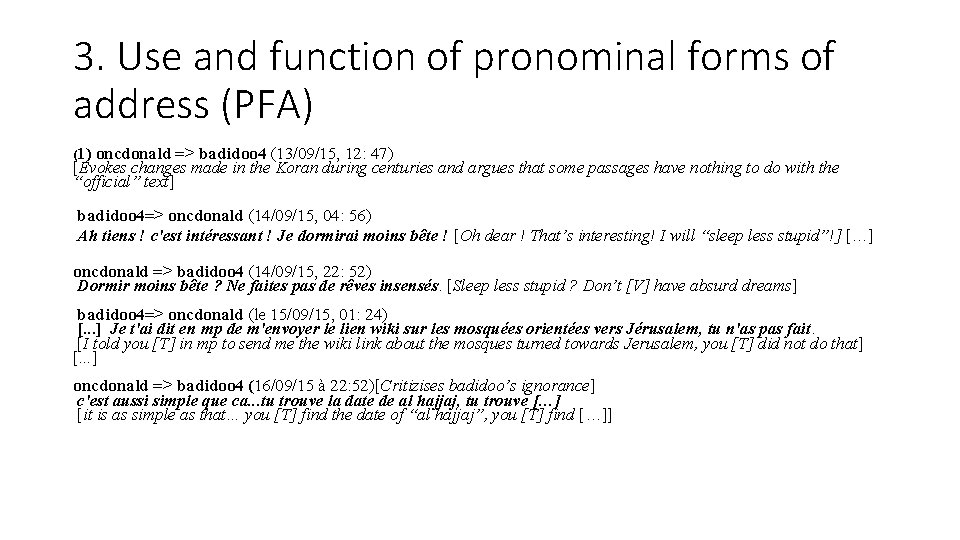
3. Use and function of pronominal forms of address (PFA) • T or V: no clear relationship between choice of PFA and emotional value (conflictual or constructive) => personal preferences • Alternating use of V and T (SFM in Corpus F): conflictual • E. g. exchanges between badidoo 4 and oncdonald, both frequent writers: • Badidoo 4: fervent Muslim, almost always T, but V + monsieur answering critical comment of oncdonald on his knowledge of history of Islam, then T • Cf. Sarkozy’s strategy (V + madame) • Oncdonald: usually V, but in last published comment to badidoo 4: V => T
3. Use and function of pronominal forms of address (PFA) (1) oncdonald => badidoo 4 (13/09/15, 12: 47) [Evokes changes made in the Koran during centuries and argues that some passages have nothing to do with the “official” text] badidoo 4=> oncdonald (14/09/15, 04: 56) Ah tiens ! c'est intéressant ! Je dormirai moins bête ! [Oh dear ! That’s interesting! I will “sleep less stupid”!] […] oncdonald => badidoo 4 (14/09/15, 22: 52) Dormir moins bête ? Ne faites pas de rêves insensés. [Sleep less stupid ? Don’t [V] have absurd dreams] badidoo 4=> oncdonald (le 15/09/15, 01: 24) [. . . ] Je t'ai dit en mp de m'envoyer le lien wiki sur les mosquées orientées vers Jérusalem, tu n'as pas fait. [I told you [T] in mp to send me the wiki link about the mosques turned towards Jerusalem, you [T] did not do that] [. . . ] oncdonald => badidoo 4 (16/09/15 à 22: 52)[Critizises badidoo’s ignorance] c'est aussi simple que ca. . . tu trouve la date de al hajjaj, tu trouve […] [it is as simple as that… you [T] find the date of “al hajjaj”, you [T] find […]]
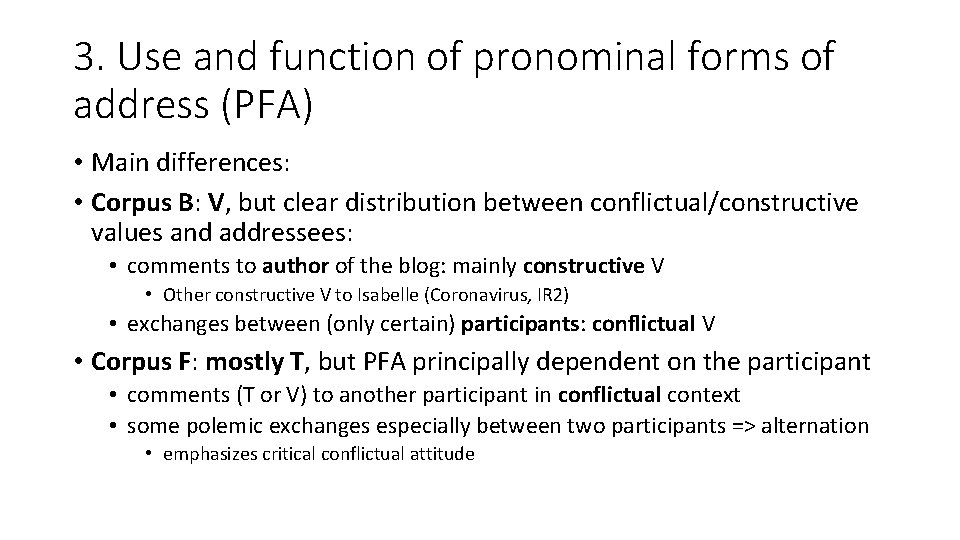
3. Use and function of pronominal forms of address (PFA) • Main differences: • Corpus B: V, but clear distribution between conflictual/constructive values and addressees: • comments to author of the blog: mainly constructive V • Other constructive V to Isabelle (Coronavirus, IR 2) • exchanges between (only certain) participants: conflictual V • Corpus F: mostly T, but PFA principally dependent on the participant • comments (T or V) to another participant in conflictual context • some polemic exchanges especially between two participants => alternation • emphasizes critical conflictual attitude
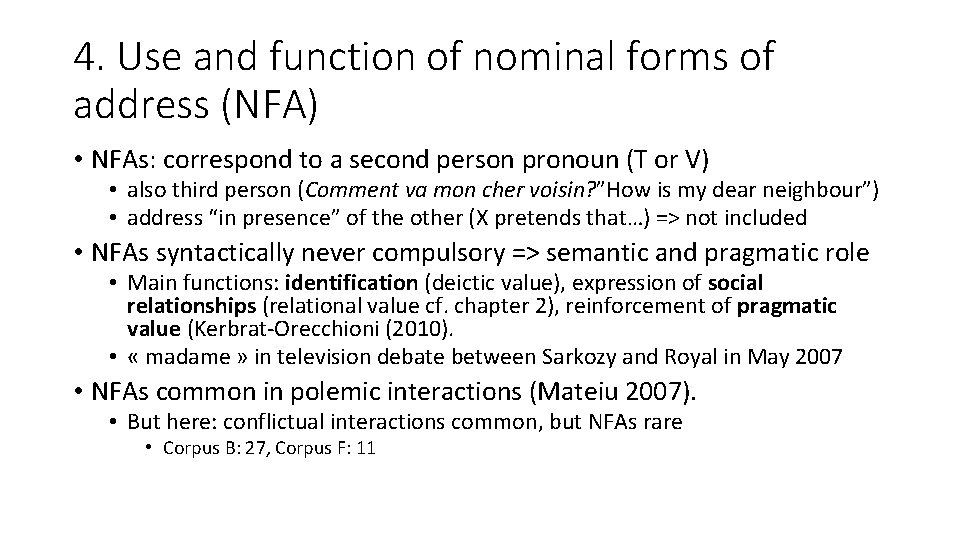
4. Use and function of nominal forms of address (NFA) • NFAs: correspond to a second person pronoun (T or V) • also third person (Comment va mon cher voisin? ”How is my dear neighbour”) • address “in presence” of the other (X pretends that…) => not included • NFAs syntactically never compulsory => semantic and pragmatic role • Main functions: identification (deictic value), expression of social relationships (relational value cf. chapter 2), reinforcement of pragmatic value (Kerbrat-Orecchioni (2010). • « madame » in television debate between Sarkozy and Royal in May 2007 • NFAs common in polemic interactions (Mateiu 2007). • But here: conflictual interactions common, but NFAs rare • Corpus B: 27, Corpus F: 11
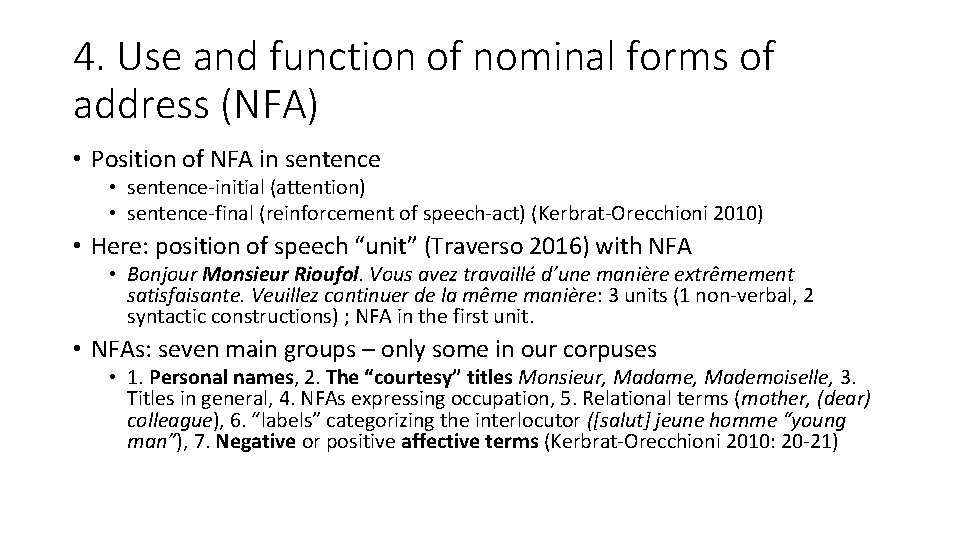
4. Use and function of nominal forms of address (NFA) • Position of NFA in sentence • sentence-initial (attention) • sentence-final (reinforcement of speech-act) (Kerbrat-Orecchioni 2010) • Here: position of speech “unit” (Traverso 2016) with NFA • Bonjour Monsieur Rioufol. Vous avez travaillé d’une manière extrêmement satisfaisante. Veuillez continuer de la même manière: 3 units (1 non-verbal, 2 syntactic constructions) ; NFA in the first unit. • NFAs: seven main groups – only some in our corpuses • 1. Personal names, 2. The “courtesy” titles Monsieur, Madame, Mademoiselle, 3. Titles in general, 4. NFAs expressing occupation, 5. Relational terms (mother, (dear) colleague), 6. “labels” categorizing the interlocutor ([salut] jeune homme “young man”), 7. Negative or positive affective terms (Kerbrat-Orecchioni 2010: 20 -21)
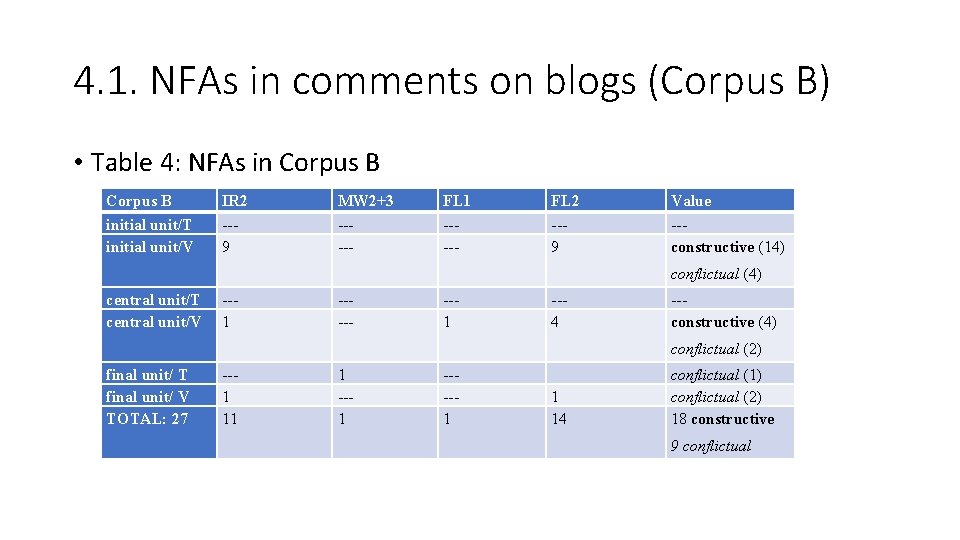
4. 1. NFAs in comments on blogs (Corpus B) • Table 4: NFAs in Corpus B initial unit/T initial unit/V IR 2 --9 MW 2+3 ----- FL 1 ----- FL 2 --9 Value --constructive (14) conflictual (4) central unit/T central unit/V --1 ----- --1 --4 --constructive (4) conflictual (2) final unit/ T final unit/ V TOTAL: 27 --1 11 1 ----1 1 14 conflictual (1) conflictual (2) 18 constructive 9 conflictual
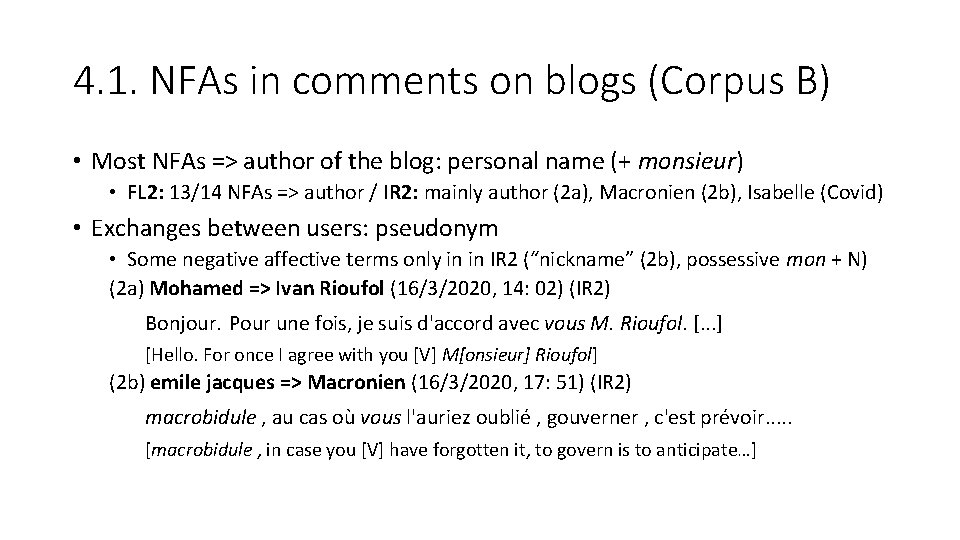
4. 1. NFAs in comments on blogs (Corpus B) • Most NFAs => author of the blog: personal name (+ monsieur) • FL 2: 13/14 NFAs => author / IR 2: mainly author (2 a), Macronien (2 b), Isabelle (Covid) • Exchanges between users: pseudonym • Some negative affective terms only in in IR 2 (“nickname” (2 b), possessive mon + N) (2 a) Mohamed => Ivan Rioufol (16/3/2020, 14: 02) (IR 2) Bonjour. Pour une fois, je suis d'accord avec vous M. Rioufol. [. . . ] [Hello. For once I agree with you [V] M[onsieur] Rioufol] (2 b) emile jacques => Macronien (16/3/2020, 17: 51) (IR 2) macrobidule , au cas où vous l'auriez oublié , gouverner , c'est prévoir. . . [macrobidule , in case you [V] have forgotten it, to govern is to anticipate…]
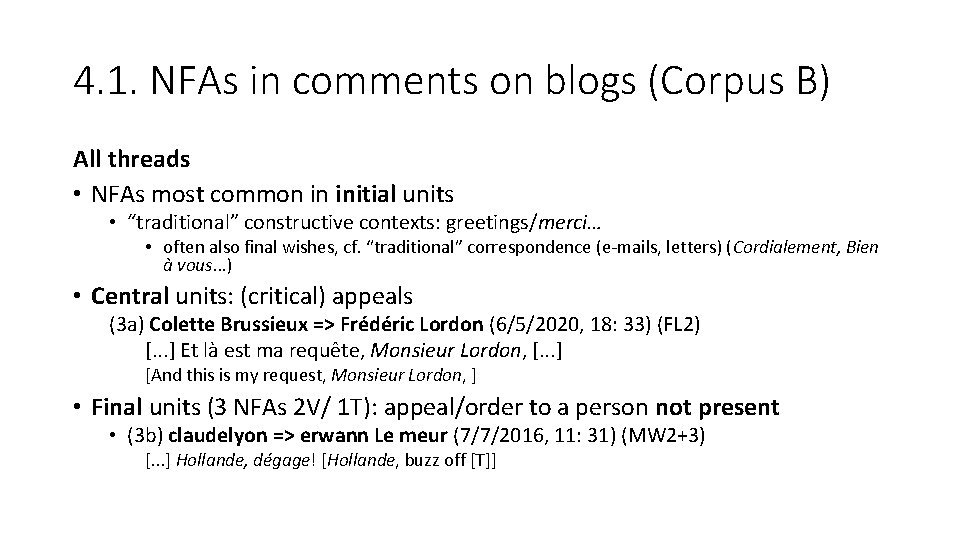
4. 1. NFAs in comments on blogs (Corpus B) All threads • NFAs most common in initial units • “traditional” constructive contexts: greetings/merci… • often also final wishes, cf. “traditional” correspondence (e-mails, letters) (Cordialement, Bien à vous…) • Central units: (critical) appeals (3 a) Colette Brussieux => Frédéric Lordon (6/5/2020, 18: 33) (FL 2) [. . . ] Et là est ma requête, Monsieur Lordon, [. . . ] [And this is my request, Monsieur Lordon, ] • Final units (3 NFAs 2 V/ 1 T): appeal/order to a person not present • (3 b) claudelyon => erwann Le meur (7/7/2016, 11: 31) (MW 2+3) [. . . ] Hollande, dégage! [Hollande, buzz off [T]]
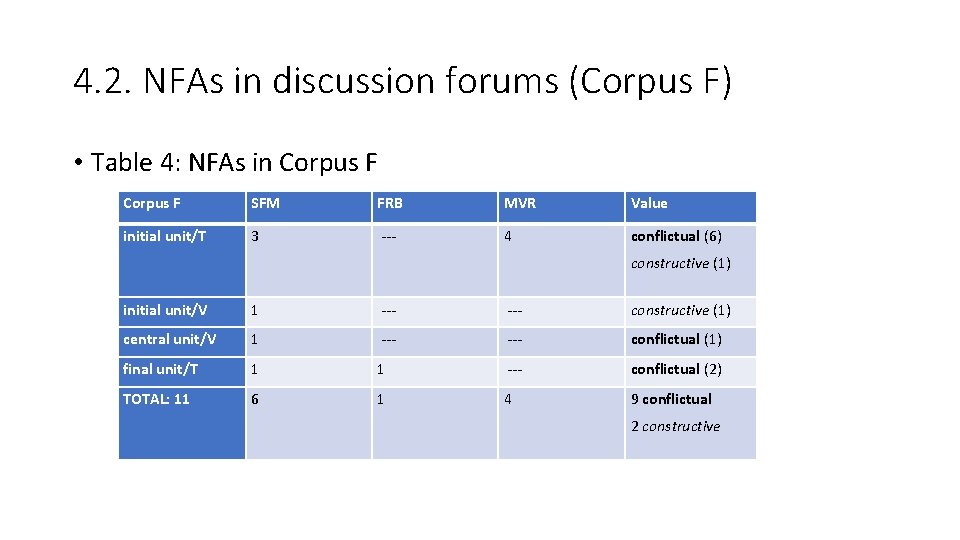
4. 2. NFAs in discussion forums (Corpus F) • Table 4: NFAs in Corpus F SFM FRB MVR Value initial unit/T 3 --- 4 conflictual (6) constructive (1) initial unit/V 1 --- constructive (1) central unit/V 1 --- conflictual (1) final unit/T 1 1 --- conflictual (2) TOTAL: 11 6 1 4 9 conflictual 2 constructive
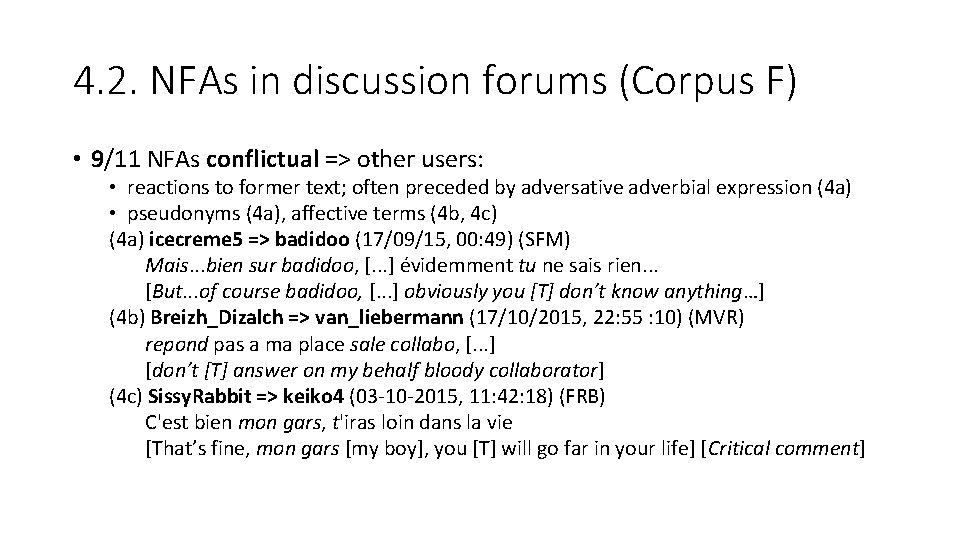
4. 2. NFAs in discussion forums (Corpus F) • 9/11 NFAs conflictual => other users: • reactions to former text; often preceded by adversative adverbial expression (4 a) • pseudonyms (4 a), affective terms (4 b, 4 c) (4 a) icecreme 5 => badidoo (17/09/15, 00: 49) (SFM) Mais. . . bien sur badidoo, [. . . ] évidemment tu ne sais rien. . . [But. . . of course badidoo, [. . . ] obviously you [T] don’t know anything…] (4 b) Breizh_Dizalch => van_liebermann (17/10/2015, 22: 55 : 10) (MVR) repond pas a ma place sale collabo, [. . . ] [don’t [T] answer on my behalf bloody collaborator] (4 c) Sissy. Rabbit => keiko 4 (03 -10 -2015, 11: 42: 18) (FRB) C'est bien mon gars, t'iras loin dans la vie [That’s fine, mon gars [my boy], you [T] will go far in your life] [Critical comment]
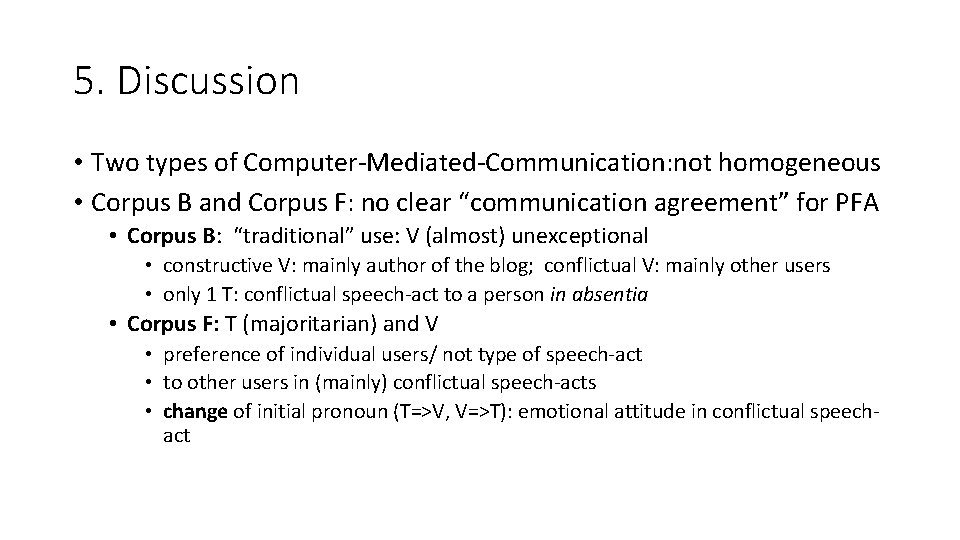
5. Discussion • Two types of Computer-Mediated-Communication: not homogeneous • Corpus B and Corpus F: no clear “communication agreement” for PFA • Corpus B: “traditional” use: V (almost) unexceptional • constructive V: mainly author of the blog; conflictual V: mainly other users • only 1 T: conflictual speech-act to a person in absentia • Corpus F: T (majoritarian) and V • preference of individual users/ not type of speech-act • to other users in (mainly) conflictual speech-acts • change of initial pronoun (T=>V, V=>T): emotional attitude in conflictual speechact
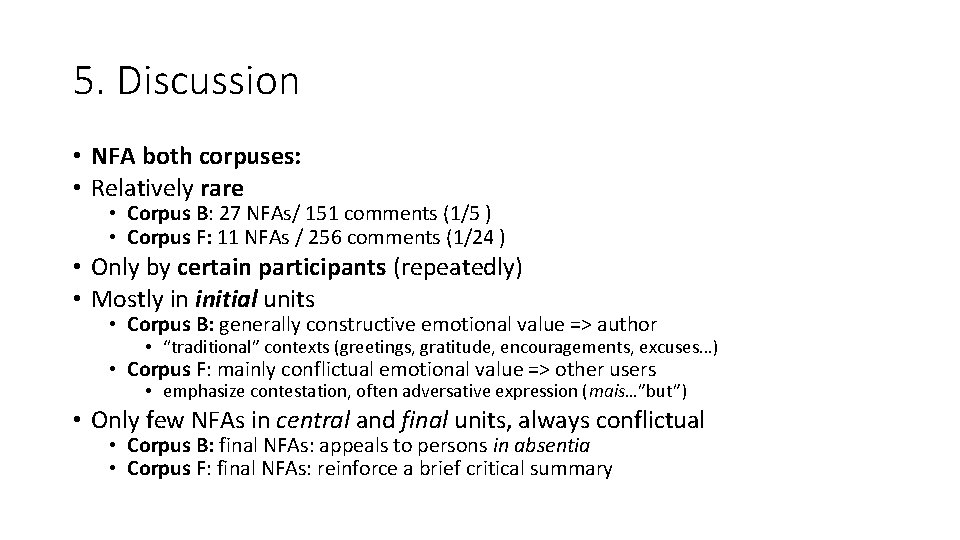
5. Discussion • NFA both corpuses: • Relatively rare • Corpus B: 27 NFAs/ 151 comments (1/5 ) • Corpus F: 11 NFAs / 256 comments (1/24 ) • Only by certain participants (repeatedly) • Mostly in initial units • Corpus B: generally constructive emotional value => author • “traditional” contexts (greetings, gratitude, encouragements, excuses…) • Corpus F: mainly conflictual emotional value => other users • emphasize contestation, often adversative expression (mais…”but”) • Only few NFAs in central and final units, always conflictual • Corpus B: final NFAs: appeals to persons in absentia • Corpus F: final NFAs: reinforce a brief critical summary
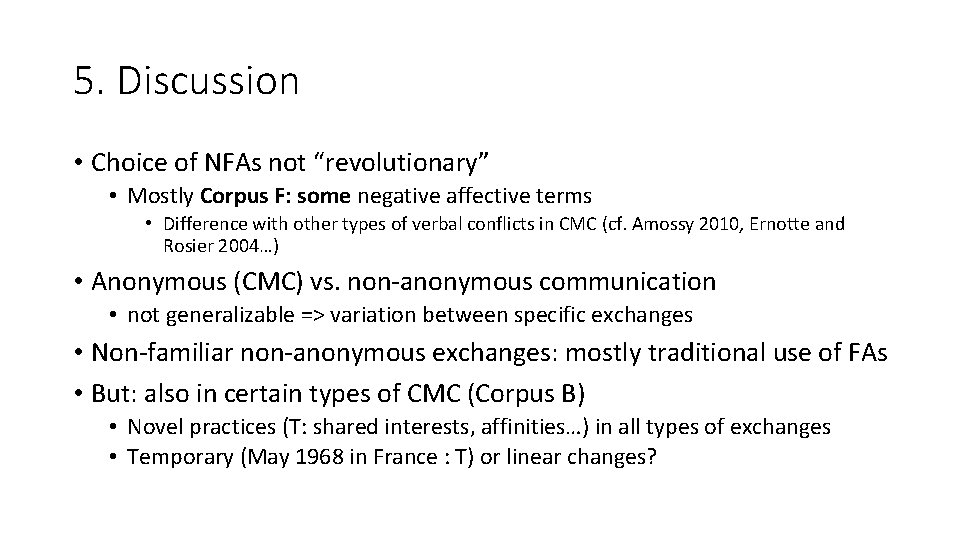
5. Discussion • Choice of NFAs not “revolutionary” • Mostly Corpus F: some negative affective terms • Difference with other types of verbal conflicts in CMC (cf. Amossy 2010, Ernotte and Rosier 2004…) • Anonymous (CMC) vs. non-anonymous communication • not generalizable => variation between specific exchanges • Non-familiar non-anonymous exchanges: mostly traditional use of FAs • But: also in certain types of CMC (Corpus B) • Novel practices (T: shared interests, affinities…) in all types of exchanges • Temporary (May 1968 in France : T) or linear changes?