
The Use of Force by Private Security Companies
The Use of Force by Private Security Companies Mark Blaine 22 October 2018 © The content of this presentation is unclassified Source: UNODC Global Maritime Crime Programme Handbook
Contents § Introduction § Selected Definitions § Creating Use of Force Policy § General Principles of the Use of Force § General principles of Self Defence § Use of Force other than Self Defence § Operations in the Land Environment § Reporting and Recording Incidents § Private Security in the Maritime Domain § Conclusion
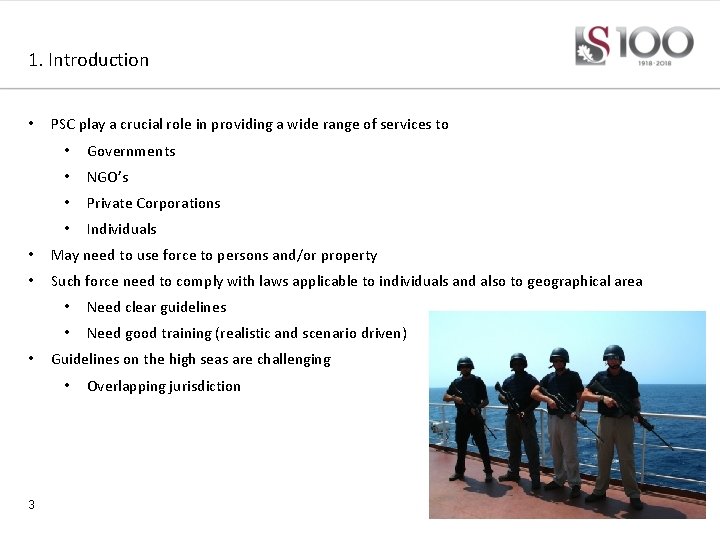
1. Introduction • PSC play a crucial role in providing a wide range of services to • Governments • NGO’s • Private Corporations • Individuals • May need to use force to persons and/or property • Such force need to comply with laws applicable to individuals and also to geographical area • • Need clear guidelines • Need good training (realistic and scenario driven) Guidelines on the high seas are challenging • 3 Overlapping jurisdiction
Selected Definitions • Private Security Company (PSC) • • Privately Contracted Security Personnel (PCSP) • • 4 The State of registry or licence of a vessel Home State • • Persons employed in the maritime domain (through direct hire or some other form of contractual relationship with a shipping or associated company) whose security duties include the carriage and/or control of weapons and the use of force aboard or from vessels Flag State • • Persons employed (through direct hire or under some other form of contractual relationship) whose duties include the carriage and/or control of weapons and the use of force Privately Contracted Armed Security Personnel (PCASP) • • Any private sector company whose business activities include protecting people, property, and information, conducting investigations, and otherwise safeguarding an organisation’s assets. The State of nationality of a client, a PSC, PCASP Territorial State • The State in which a PSCP is located at a given time
Selected Definitions and Abbreviations • National Waters • • International Waters • • Force that is intended or likely to cause death, or serious injury, regardless of whether death or serious injury results Excessive Force • 5 Use of Force Deadly Force • • A member of the assigned PSC team designated by the contractor as Team Leadewr, and identified as such to the appropriate authorities Uo. F • • Waters to seaward of the territorial seas Team Leader • • Waters subject to the territorial sovereignty of Coastal States (include internal waters, territorial seas and archipelagic waters Any force that is not reasonable and necessary to deter, neutralise or stop a threat
2. Creating Use of Force Policy • • • 6 Uo. F policies to be developed as part of planning process Identifies the circumstances and limitations that govern the use of force by PSC Need to be approved by a competent authority (could be national governments) Legal parameters of Uo. F Policy • Comply with ALL laws and regulations of ALL jurisdictions to be encountered • Cannot interfere with the right to self defence • Not a blanket immunity to clients or PSC Annex A in handbook provides a menu for Uo. F policies Checklist for Creation of Uo. F Policy 1. Analyse contract 2. Analyse security environment 3. Analyse risks 4. Determine levels of force that may be required 5. Analyse applicable legal regimes 6. Analyse limitations on the use of force 7. Assess problem areas 8. Prepare the draft Uo. F policy 9. Approval 10. Distribution
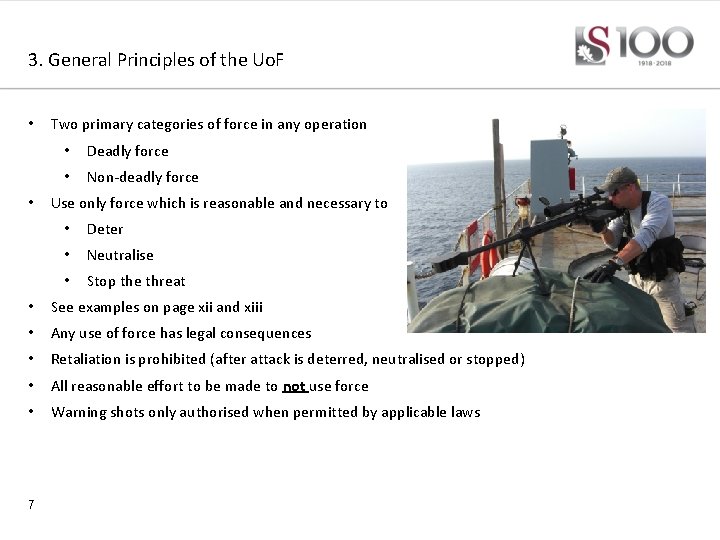
3. General Principles of the Uo. F • • Two primary categories of force in any operation • Deadly force • Non-deadly force Use only force which is reasonable and necessary to • Deter • Neutralise • Stop the threat • See examples on page xii and xiii • Any use of force has legal consequences • Retaliation is prohibited (after attack is deterred, neutralised or stopped) • All reasonable effort to be made to not use force • Warning shots only authorised when permitted by applicable laws 7

4. General Principles of Self Defence • Two categories • Individual Self-defence • Defence of Others • Self defence must be proportionate to the threat • No Uo. F policy can restrict the right to self defence • The extent of the right or obligation to protect others will differ from jurisdiction to jurisdiction • Command Control • PSC personnel must comply with direction of the on-scene authority 8
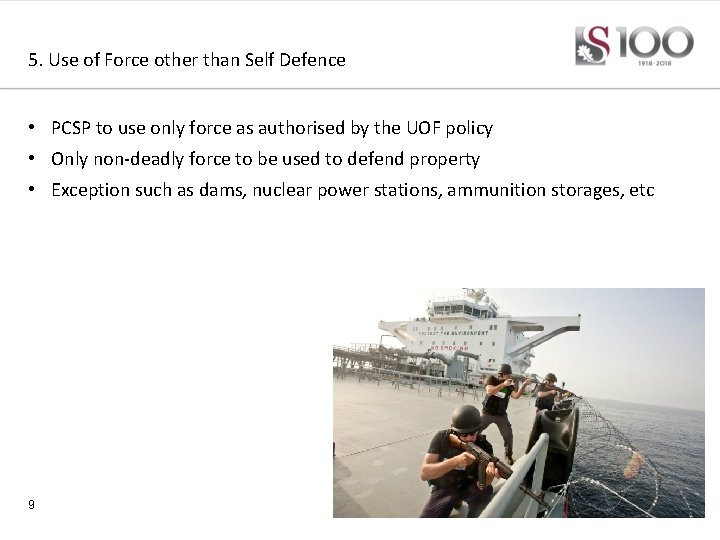
5. Use of Force other than Self Defence • PCSP to use only force as authorised by the UOF policy • Only non-deadly force to be used to defend property • Exception such as dams, nuclear power stations, ammunition storages, etc 9
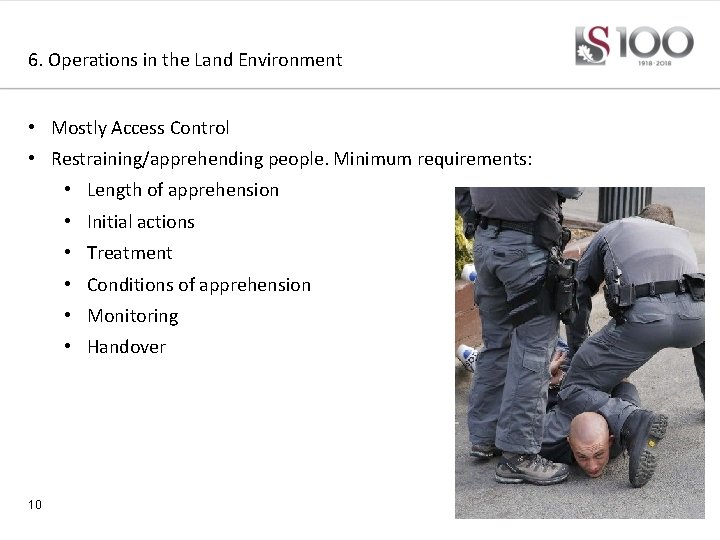
6. Operations in the Land Environment • Mostly Access Control • Restraining/apprehending people. Minimum requirements: • Length of apprehension • Initial actions • Treatment • Conditions of apprehension • Monitoring • Handover 10
7. Reporting and Recording Incidents • During/after each security incident • Record the incident • Provide record • Provide lessons learnt • Report the incident • Especially when force was used • Handling and treatment of persons involved • Where possible evidence should not be disturbed • Persons to be handed to law enforcement personnel as soon as possible • Subsequent investigation of the incident 11
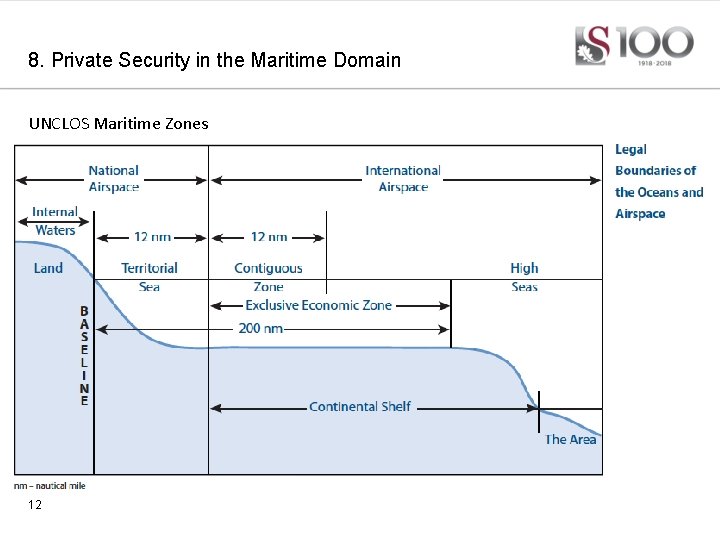
8. Private Security in the Maritime Domain UNCLOS Maritime Zones 12
8. Private Security in the Maritime Domain • 13 Territorial Seas • Up to 12 nm • Coastal state has sovereignty • Broad prescriptive and enforcement jurisdiction • Innocent passage by foreign vessels • No conduct prejudicial to good order, peace and security • Mere act of carrying weapons not considered prejudicial • No practice or exercise whilst on innocent passage • Weapons to be secured below deck • Transit to roadstead, anchorage may not be considered innocent passage • Coastal states may restrict or prohibit carrying of arms
8. Private Security in the Maritime Domain • • 14 Contiguous zone • Up to 24 nm • Coastal States may enforce customs, fiscal, immigration and sanitary laws • Carriage and display of arms normally permitted • Some States may restrict possession or carriage or arms Legal Jurisdiction in Maritime Zones • Flag state law ALWAYS applies to a ship • Other laws will apply as ship/persons enter and leave zones of littoral states
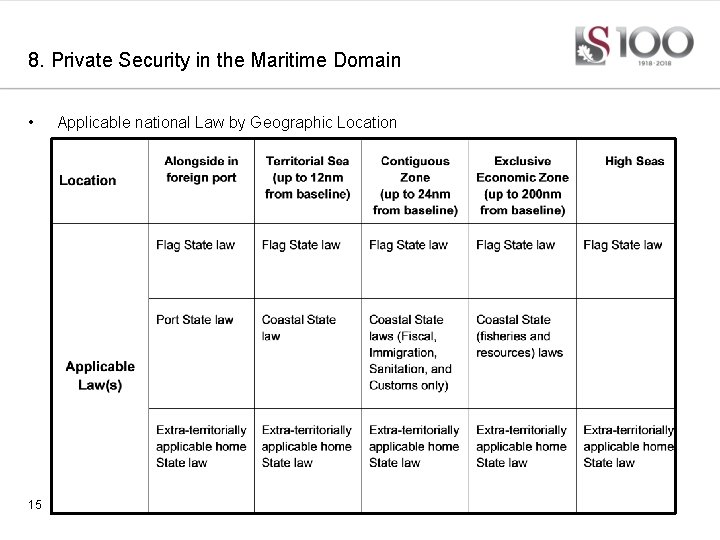
8. Private Security in the Maritime Domain • 15 Applicable national Law by Geographic Location
8. Private Security in the Maritime Domain • 16 Command Control of Vessels • Masters remain responsible for safety of people, property and objects under their control • Masters have authority over all persons onboard • PCASP remain under the authority of the Master • PSC Team Leader answerable to the Master • PSC Team Leader and Master to agree in advance on general conditions, requirements and circumstances governing response to and management of use of force incidents • During security situation, PSC Team Leader to advise the Master of intention to invoke Uo. F policy • Each PCASP responsible for own decisions to use force
8. Private Security in the Maritime Domain • 17 Command Control of Vessels • Master may order cease fire, but may not limit right of self defence • Master may direct PCASP to apprehend a person iaw the law • Must comply with Uo. F policy • Master to ensure proper detaining and accommodation • Action will remain under Flag State and territorial State laws for proper treatment • Right to apprehend includes right to search individual for security reasons • Use of restraints may be authorised
9. Conclusion • PSC play a crucial role in providing a wide range of services • Guidelines on the high seas are challenging • • 18 Creation and guidance in Uo. F policies are crucial General principles for the use of force and in self defence Important to adequately record and report all incidents Maritime domain is complex Master remains in command throughout Suspects to be treated in accordance with law Handbook is a great tool for planning and execution
- Slides: 18