
The Use of Flight Simulation to Analyze Aircraft


- Slides: 39
The Use of Flight Simulation to Analyze Aircraft Design and Performance Douglas L. Wilson – Chief Test Pilot Abraham Gutierrez – Chief Systems Engineer Anh Huy Nguyen – Chief Flight Engineer Advisor – Basil Philip Sponsor: Dr. Ron O. Stearman
Objectives § Look into the background of two crashes - Mooney 305 -1998 Cessna 172 H-2000 § Conduct Several Test - Flight Simulator (X-Planes) Real Test (Cessna 172 H or similar version) § Perform Test Runs - Weather Conditions Plane configurations § Determine if Phugoid Mode can be - Demonstrate Mooney 305 Flight Simulator Abraham Gutierrez Anh Huy Nguyen Douglas Wilson
Background § Mooney Rocket 305 - Engine modification to the Mooney M 20 K Modified engine caused the aircraft to enter a phugoid mode § Cessna 172 H - Engine Power - Flap Settings Abraham Gutierrez Anh Huy Nguyen Douglas Wilson
Presentation Outline § Outline -Mooney 305 ü Crash Report ü Timeline of the crash ü Comparison ü 305 Rocket Airplane ü What is Phugoid Mode? ü Phugoid Mode Analysis ü Future Work -Cessna 172 H ü ü ü ü Flight Testing Data Conversion Preliminary Results Proposed Flight Test Flight Simulation Cost Analysis Time Analysis Acknowledgements -Cessna 172 H ü Cessna specifications ü Performance ü Weight and Balance ü Cessna Crash ü NTSB Investigation ü Suggested Causes Abraham Gutierrez Anh Huy Nguyen Douglas Wilson
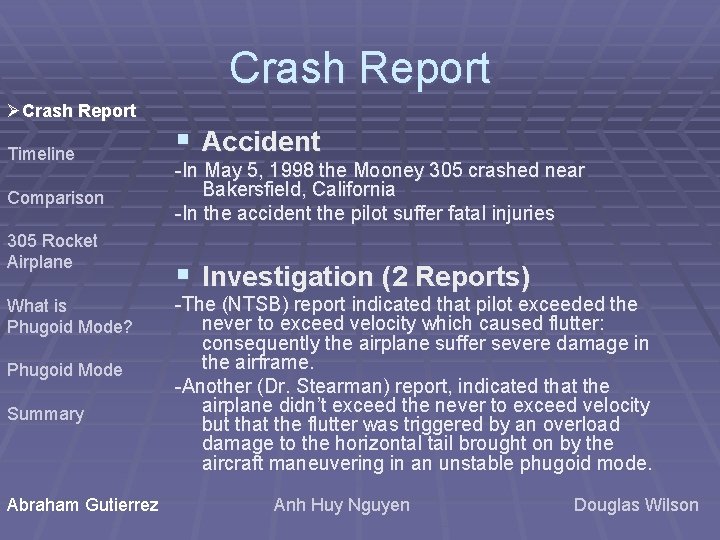
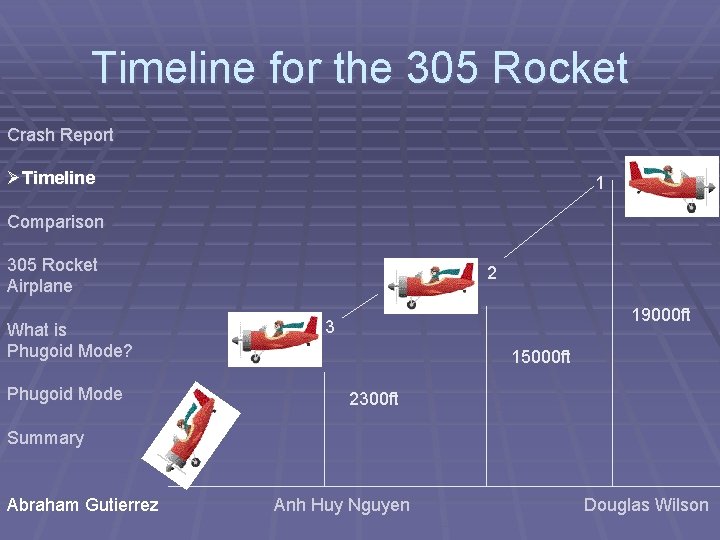
Crash Report ØCrash Report Timeline Comparison 305 Rocket Airplane What is Phugoid Mode? Phugoid Mode Summary Abraham Gutierrez § Accident -In May 5, 1998 the Mooney 305 crashed near Bakersfield, California -In the accident the pilot suffer fatal injuries § Investigation (2 Reports) -The (NTSB) report indicated that pilot exceeded the never to exceed velocity which caused flutter: consequently the airplane suffer severe damage in the airframe. -Another (Dr. Stearman) report, indicated that the airplane didn’t exceed the never to exceed velocity but that the flutter was triggered by an overload damage to the horizontal tail brought on by the aircraft maneuvering in an unstable phugoid mode. Anh Huy Nguyen Douglas Wilson
Timeline for the 305 Rocket Crash Report ØTimeline 1 Comparison 305 Rocket Airplane What is Phugoid Mode? Phugoid Mode 2 19000 ft 3 15000 ft 2300 ft Summary Abraham Gutierrez Anh Huy Nguyen Douglas Wilson
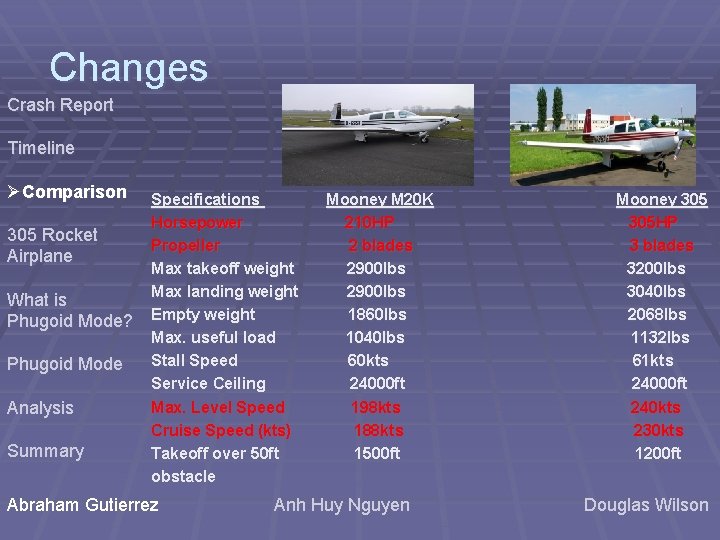
Changes Crash Report Timeline ØComparison 305 Rocket Airplane What is Phugoid Mode? Phugoid Mode Analysis Summary Specifications Mooney M 20 K Mooney 305 Horsepower 210 HP 305 HP Propeller 2 blades 3 blades Max takeoff weight 2900 lbs 3200 lbs Max landing weight 2900 lbs 3040 lbs Empty weight 1860 lbs 2068 lbs Max. useful load 1040 lbs 1132 lbs Stall Speed 60 kts 61 kts Service Ceiling 24000 ft Max. Level Speed 198 kts 240 kts Cruise Speed (kts) 188 kts 230 kts Takeoff over 50 ft 1500 ft 1200 ft obstacle Abraham Gutierrez Anh Huy Nguyen Douglas Wilson
305 Rocket Airplane Crash Report Timeline Comparison Ø 305 Rocket Airplane What is Phugoid Mode? Phugoid Mode Analysis Summary Abraham Gutierrez § Mooney 305 -The Mooney 305 is a modification of the Mooney M 20 K. In which 45 percent more horsepower and a new propeller was added to the airframe of the Mooney M 20 K -The Federal Aviation Administration awarded the certificates § Mooney 305 Autopilot -Insufficient testing -The autopilot was not modify -If a control system fails during a phugoid mode then accident like the on in Bakersfield can occur. Anh Huy Nguyen Douglas Wilson
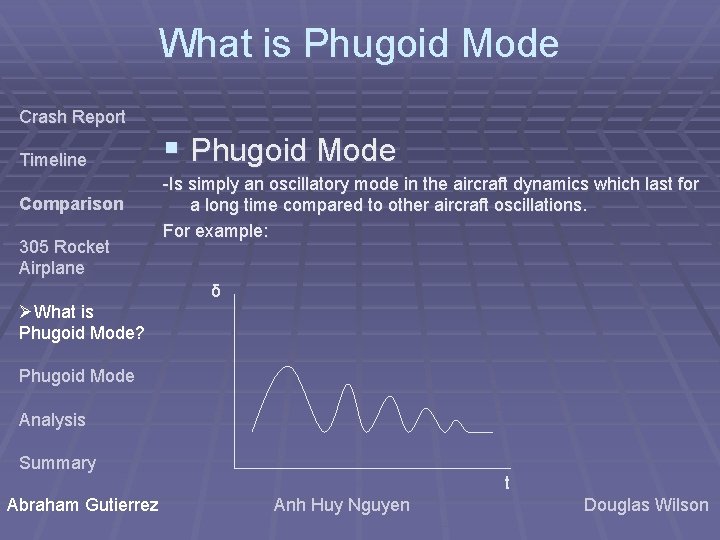
What is Phugoid Mode Crash Report Timeline Comparison 305 Rocket Airplane ØWhat is Phugoid Mode? § Phugoid Mode -Is simply an oscillatory mode in the aircraft dynamics which last for a long time compared to other aircraft oscillations. For example: δ Phugoid Mode Analysis Summary Abraham Gutierrez t Anh Huy Nguyen Douglas Wilson
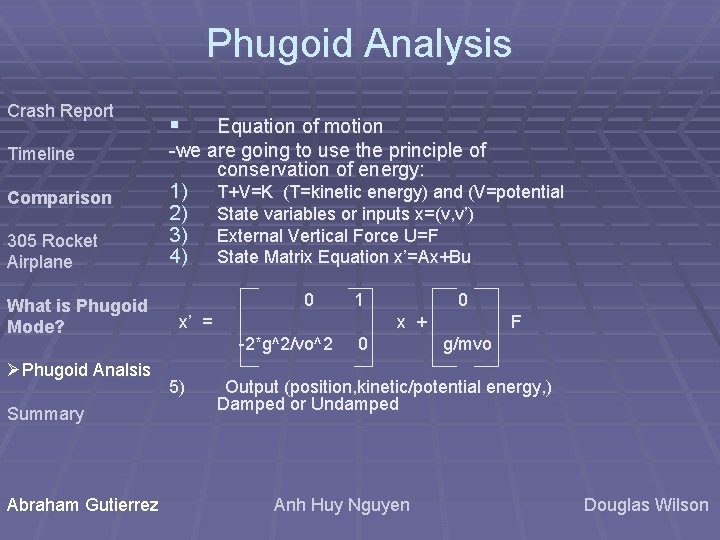
Phugoid Analysis Crash Report Timeline Comparison 305 Rocket Airplane What is Phugoid Mode? ØPhugoid Analsis Summary Abraham Gutierrez § Equation of motion -we are going to use the principle of conservation of energy: 1) 2) 3) 4) T+V=K (T=kinetic energy) and (V=potential State variables or inputs x=(v, v’) External Vertical Force U=F State Matrix Equation x’=Ax+Bu 0 1 x’ = x + -2*g^2/vo^2 5) 0 0 F g/mvo Output (position, kinetic/potential energy, ) Damped or Undamped Anh Huy Nguyen Douglas Wilson
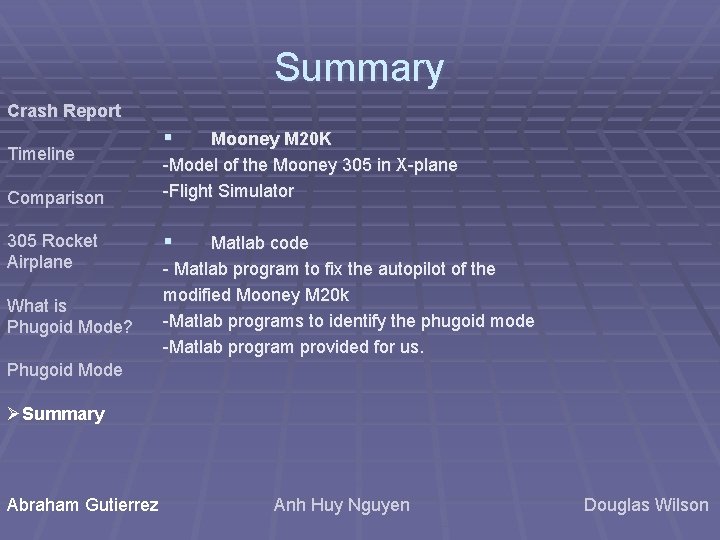
Summary Crash Report Timeline Comparison 305 Rocket Airplane What is Phugoid Mode? § Mooney M 20 K -Model of the Mooney 305 in X-plane -Flight Simulator § Matlab code - Matlab program to fix the autopilot of the modified Mooney M 20 k -Matlab programs to identify the phugoid mode -Matlab program provided for us. Phugoid Mode ØSummary Abraham Gutierrez Anh Huy Nguyen Douglas Wilson
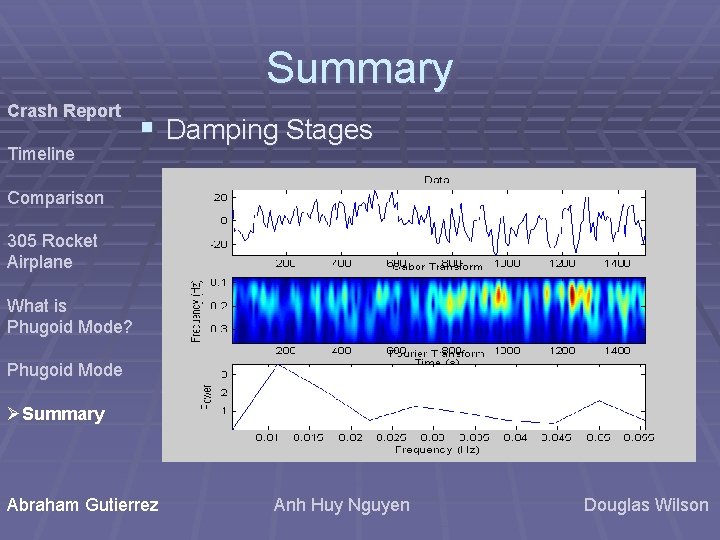
Summary Crash Report Timeline § Damping Stages Comparison 305 Rocket Airplane What is Phugoid Mode? Phugoid Mode ØSummary Abraham Gutierrez Anh Huy Nguyen Douglas Wilson
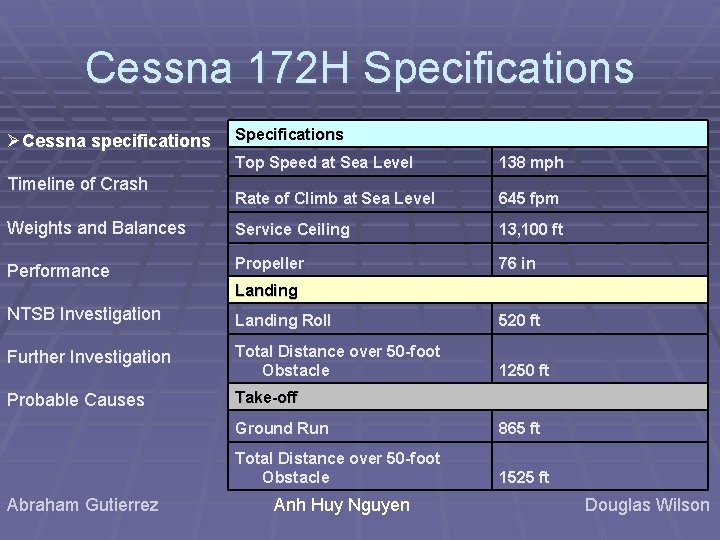
Cessna 172 H Specifications Top Speed at Sea Level 138 mph Rate of Climb at Sea Level 645 fpm Weights and Balances Service Ceiling 13, 100 ft Performance Propeller 76 in Landing NTSB Investigation Landing Roll 520 ft Further Investigation Total Distance over 50 -foot Obstacle 1250 ft Probable Causes Take-off Ground Run 865 ft Total Distance over 50 -foot Obstacle 1525 ft ØCessna specifications Timeline of Crash Abraham Gutierrez Anh Huy Nguyen Douglas Wilson
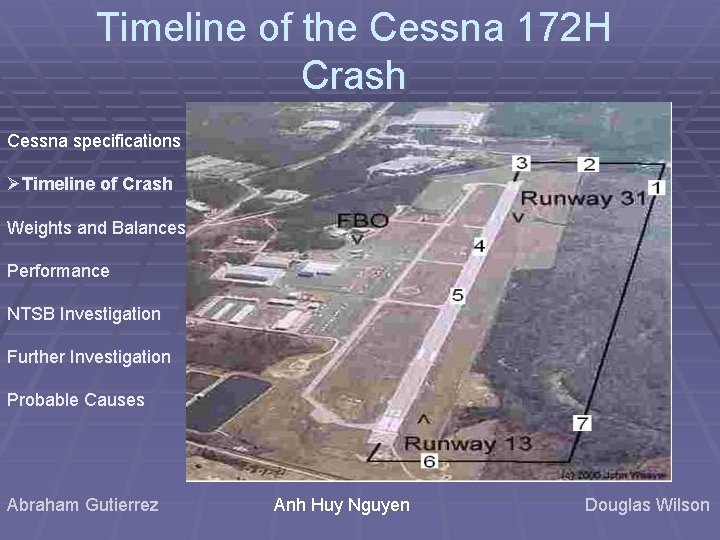
Timeline of the Cessna 172 H Crash Cessna specifications ØTimeline of Crash Weights and Balances Performance NTSB Investigation Further Investigation Probable Causes Abraham Gutierrez Anh Huy Nguyen Douglas Wilson
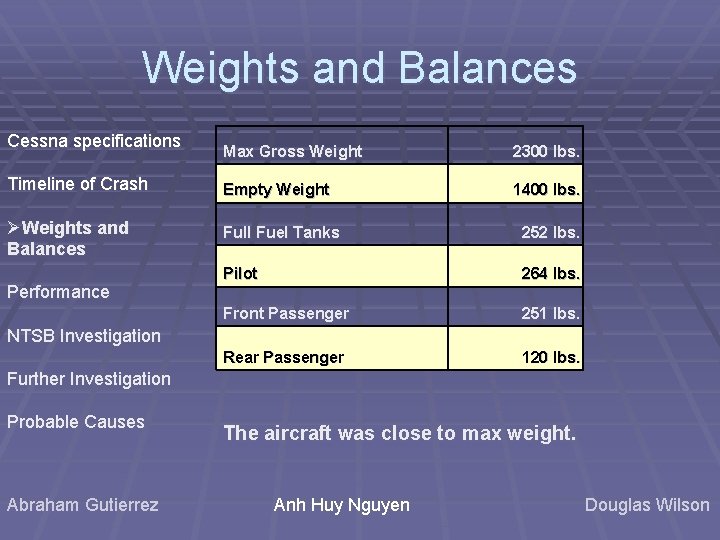
Weights and Balances Cessna specifications Max Gross Weight 2300 lbs. Timeline of Crash Empty Weight 1400 lbs. ØWeights and Balances Full Fuel Tanks 252 lbs. Pilot 264 lbs. Front Passenger 251 lbs. Rear Passenger 120 lbs. Performance NTSB Investigation Further Investigation Probable Causes Abraham Gutierrez The aircraft was close to max weight. Anh Huy Nguyen Douglas Wilson
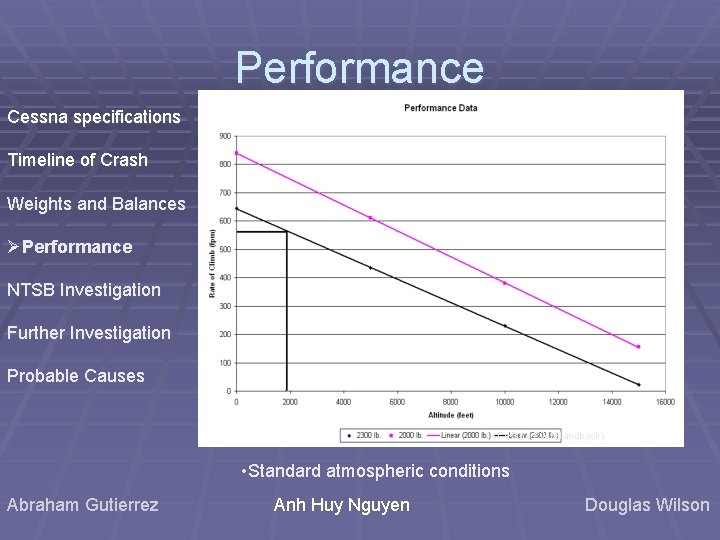
Performance Cessna specifications Timeline of Crash Weights and Balances ØPerformance NTSB Investigation Further Investigation Probable Causes (Cessna Pilot Handbook) • Standard atmospheric conditions Abraham Gutierrez Anh Huy Nguyen Douglas Wilson
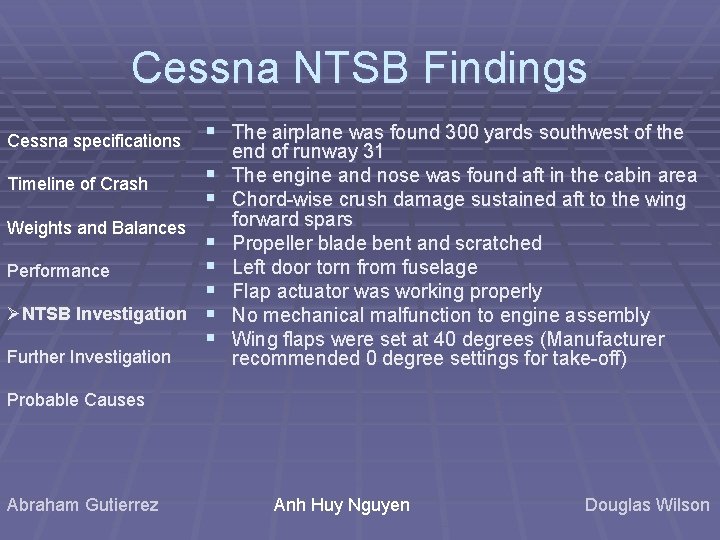
Cessna NTSB Findings Cessna specifications Timeline of Crash Weights and Balances Performance ØNTSB Investigation Further Investigation § The airplane was found 300 yards southwest of the § § § § end of runway 31 The engine and nose was found aft in the cabin area Chord-wise crush damage sustained aft to the wing forward spars Propeller blade bent and scratched Left door torn from fuselage Flap actuator was working properly No mechanical malfunction to engine assembly Wing flaps were set at 40 degrees (Manufacturer recommended 0 degree settings for take-off) Probable Causes Abraham Gutierrez Anh Huy Nguyen Douglas Wilson
Further Investigation Cessna specifications Timeline of Crash Weights and Balances Performance NTSB Investigation § At impact the tachometer was stuck at 1500 RPM § If this was the correct engine output, the aircraft would not be able to maintain a climb attitude. ØFurther Investigation Probable Causes Abraham Gutierrez Anh Huy Nguyen Douglas Wilson
Probable Causes Cessna specifications Timeline of Crash Weights and Balances Performance NTSB Investigation Further Investigation § Pilot attempted a touch-andgo landing and left the flaps down at 40 degrees § Engine malfunction during take-off that resulted in a partial or total power loss ØProbable Causes Abraham Gutierrez Anh Huy Nguyen Douglas Wilson
ØFlight Testing Data Conversion Preliminary Results Proposed Flight Test Flight Simulation Cost Analysis Flight Testing § Test SP 4 -E 101 § February 22, 2004 § Georgetown Municipal Airport (KGTU) § Weather Conditions Time Analysis Acknowledgements Abraham Gutierrez Anh Huy Nguyen Douglas Wilson
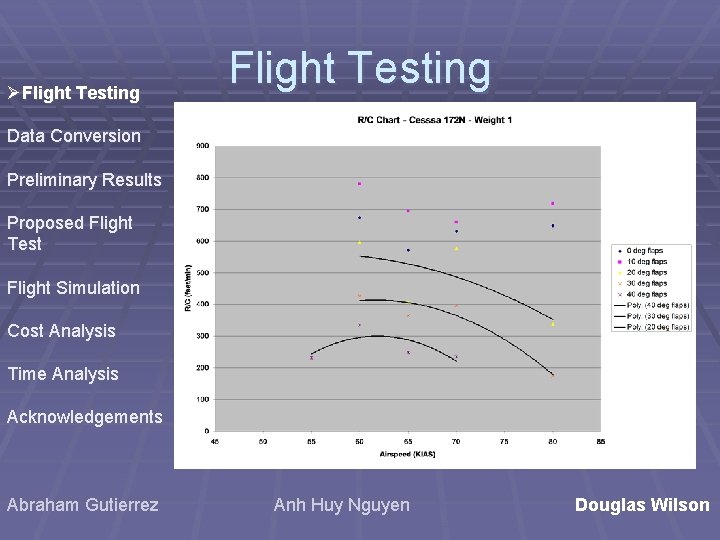
ØFlight Testing Data Conversion Preliminary Results Proposed Flight Test Flight Simulation Cost Analysis Time Analysis Acknowledgeme nts Abraham Gutierrez Flight Testing § Cessna 739 ZY § 172 N model § 160 HP (O-320 engine) § Tests performed § 2 weights § 2 altitudes § 5 flap settings Anh Huy Nguyen Douglas Wilson
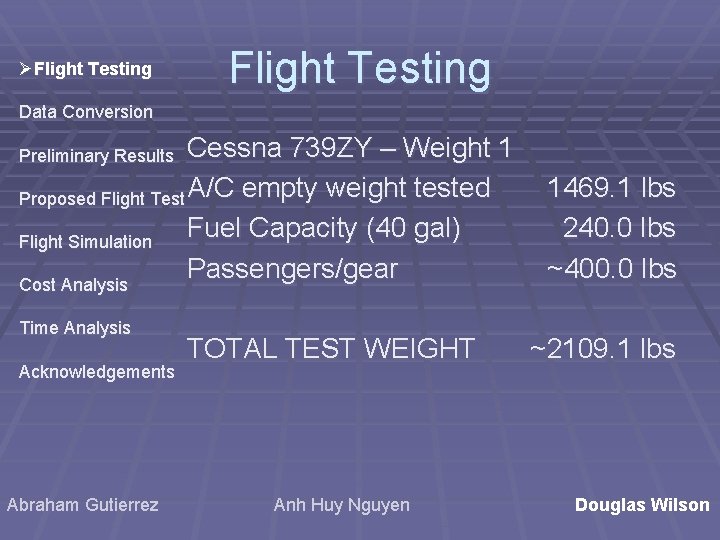
ØFlight Testing Data Conversion Cessna 739 ZY – Weight 1 Proposed Flight Test A/C empty weight tested Fuel Capacity (40 gal) Flight Simulation Passengers/gear Cost Analysis Preliminary Results Time Analysis Acknowledgements Abraham Gutierrez TOTAL TEST WEIGHT Anh Huy Nguyen 1469. 1 lbs 240. 0 lbs ~400. 0 lbs ~2109. 1 lbs Douglas Wilson
ØFlight Testing Data Conversion Preliminary Results Proposed Flight Test Flight Simulation Cost Analysis Time Analysis Acknowledgements Abraham Gutierrez Anh Huy Nguyen Douglas Wilson
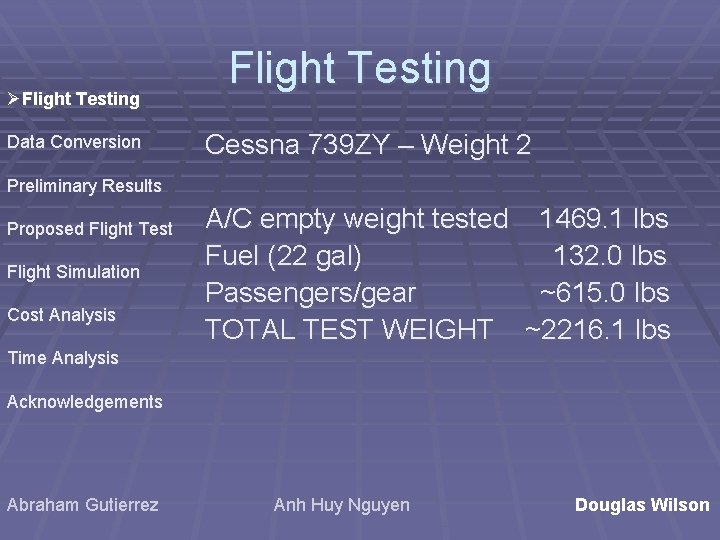
ØFlight Testing Data Conversion Flight Testing Cessna 739 ZY – Weight 2 Preliminary Results Proposed Flight Test Flight Simulation Cost Analysis A/C empty weight tested 1469. 1 lbs Fuel (22 gal) 132. 0 lbs Passengers/gear ~615. 0 lbs TOTAL TEST WEIGHT ~2216. 1 lbs Time Analysis Acknowledgements Abraham Gutierrez Anh Huy Nguyen Douglas Wilson
ØFlight Testing Data Conversion Preliminary Results Proposed Flight Test Flight Simulation Cost Analysis Time Analysis Acknowledgements Abraham Gutierrez Anh Huy Nguyen Douglas Wilson
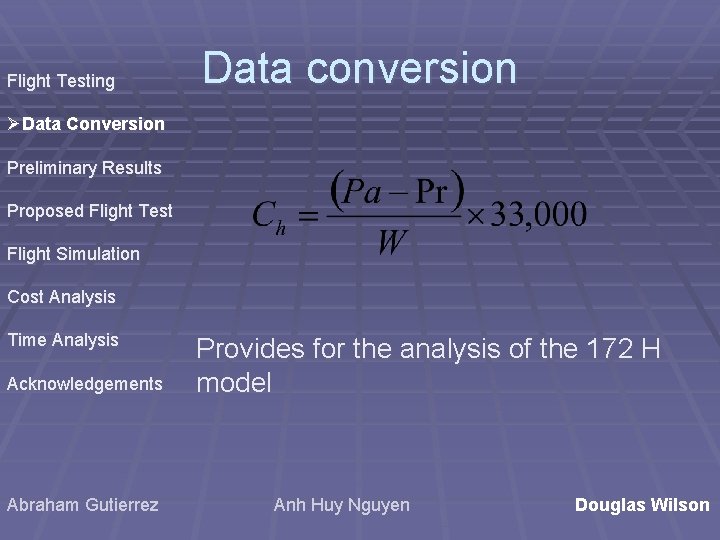
Flight Testing Data conversion ØData Conversion Preliminary Results Proposed Flight Test Flight Simulation Cost Analysis Time Analysis Acknowledgements Abraham Gutierrez Provides for the analysis of the 172 H model Anh Huy Nguyen Douglas Wilson
Flight Testing Preliminary Results 172 H Conversion Data Conversion ØPreliminary Results Proposed Flight Test Flight Simulation Cost Analysis Time Analysis Acknowledgements Abraham Gutierrez Anh Huy Nguyen Douglas Wilson
Flight Testing Proposed Flight Test Data Conversion Preliminary Results ØProposed Flight Test Flight Simulation Cost Analysis § Cessna 172 E model § O-300 engine § 2300 lb gross take-off weight § 42 gal max fuel capacity § 40 degree flap settings § Cruise prop installed on the A/C Time Analysis Acknowledgements Abraham Gutierrez Anh Huy Nguyen Douglas Wilson
Flight Testing Data Conversion Preliminary Results Proposed Flight Test ØFlight Simulation Cost Analysis Time Analysis Acknowledgements Abraham Gutierrez Flight Simulation § Mooney Simulations § Performed at WRW Laboratories § X-Plane software § Easy to use § Allows for proper data output § Autopilot will be engaged § Monitor output to determine if phugoid mode is present Anh Huy Nguyen Douglas Wilson
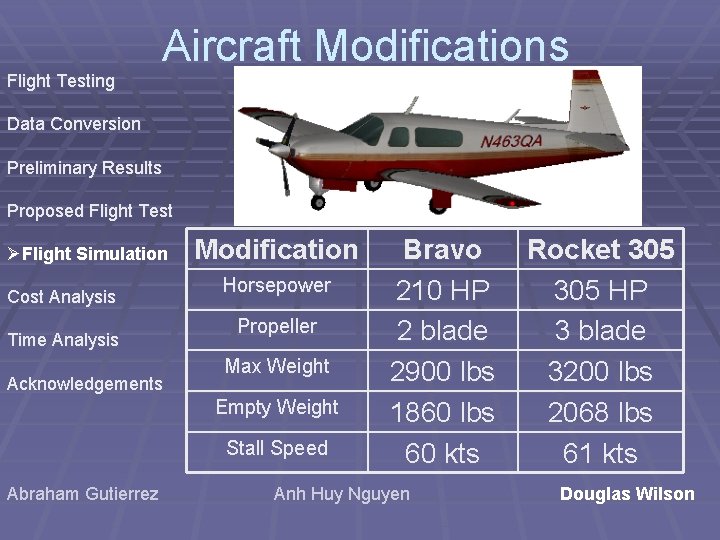
Flight Testing Aircraft Modifications Data Conversion Preliminary Results Proposed Flight Test ØFlight Simulation Cost Analysis Time Analysis Acknowledgements Modification Horsepower Propeller Max Weight Empty Weight Stall Speed Abraham Gutierrez Bravo 210 HP 2 blade 2900 lbs 1860 lbs 60 kts Anh Huy Nguyen Rocket 305 HP 3 blade 3200 lbs 2068 lbs 61 kts Douglas Wilson
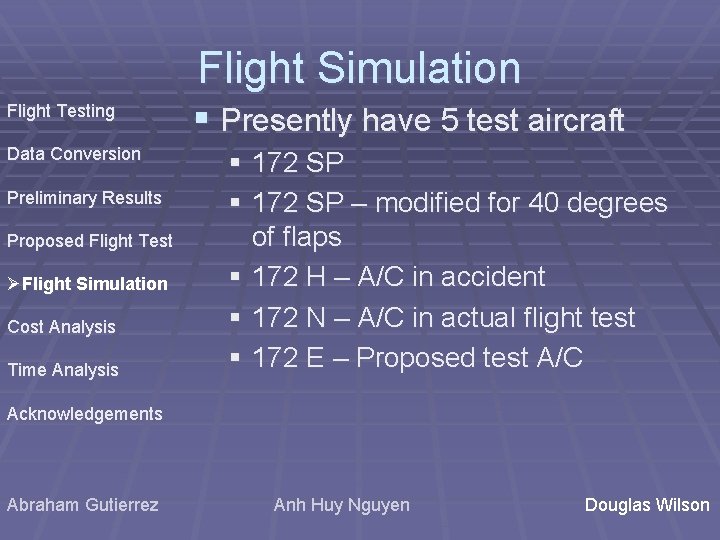
Flight Simulation Flight Testing Data Conversion Preliminary Results Proposed Flight Test ØFlight Simulation Cost Analysis Time Analysis § Presently have 5 test aircraft § 172 SP – modified for 40 degrees of flaps § 172 H – A/C in accident § 172 N – A/C in actual flight test § 172 E – Proposed test A/C Acknowledgements Abraham Gutierrez Anh Huy Nguyen Douglas Wilson
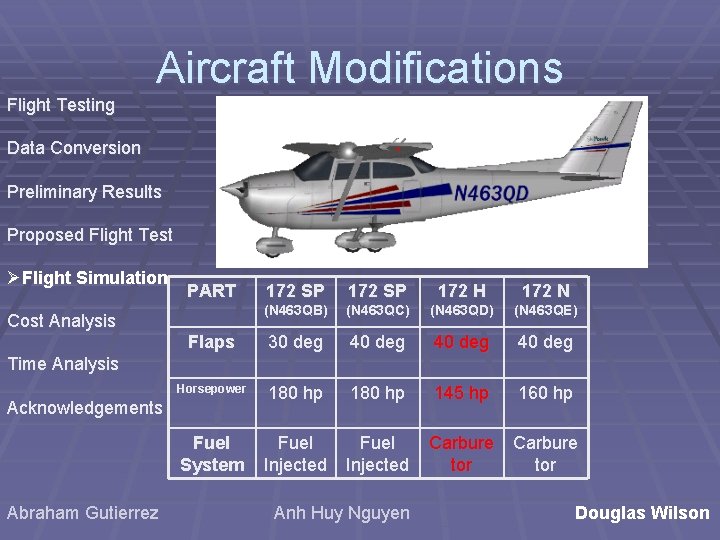
Aircraft Modifications Flight Testing Data Conversion Preliminary Results Proposed Flight Test ØFlight Simulation Cost Analysis PART 172 SP 172 H 172 N (N 463 QB) (N 463 QC) (N 463 QD) (N 463 QE) Flaps 30 deg 40 deg Horsepower 180 hp 145 hp 160 hp Fuel System Fuel Injected Carbure tor Time Analysis Acknowledgements Abraham Gutierrez Anh Huy Nguyen Douglas Wilson
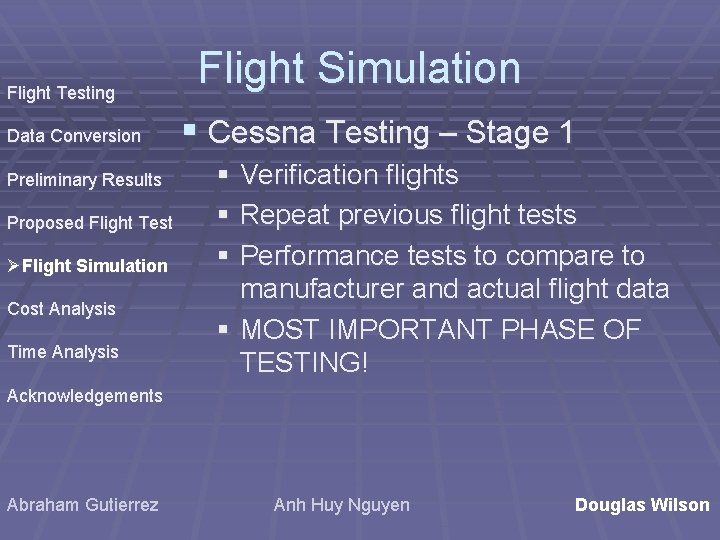
Flight Testing Data Conversion Preliminary Results Proposed Flight Test ØFlight Simulation Cost Analysis Time Analysis Flight Simulation § Cessna Testing – Stage 1 § Verification flights § Repeat previous flight tests § Performance tests to compare to manufacturer and actual flight data § MOST IMPORTANT PHASE OF TESTING! Acknowledgements Abraham Gutierrez Anh Huy Nguyen Douglas Wilson
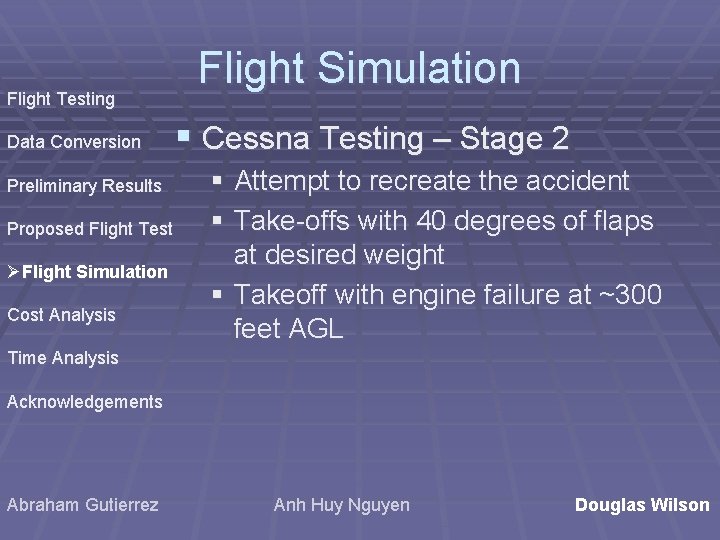
Flight Testing Data Conversion Preliminary Results Proposed Flight Test ØFlight Simulation Cost Analysis Flight Simulation § Cessna Testing – Stage 2 § Attempt to recreate the accident § Take-offs with 40 degrees of flaps at desired weight § Takeoff with engine failure at ~300 feet AGL Time Analysis Acknowledgements Abraham Gutierrez Anh Huy Nguyen Douglas Wilson
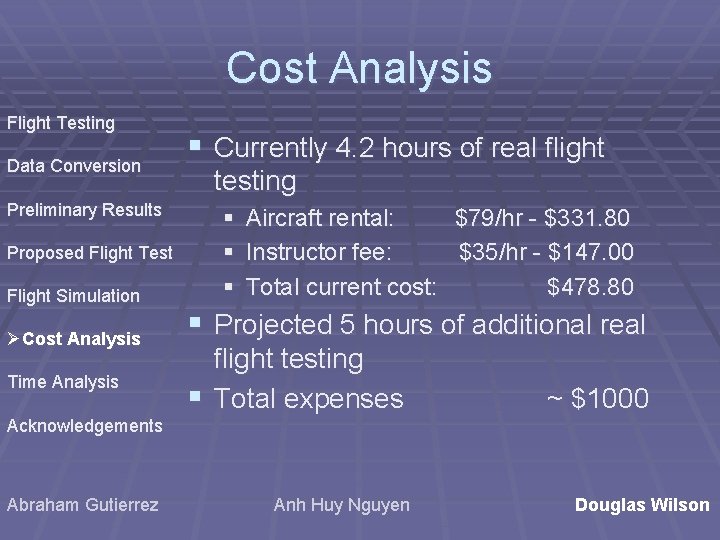
Cost Analysis Flight Testing Data Conversion Preliminary Results Proposed Flight Test Flight Simulation ØCost Analysis Time Analysis Acknowledgements Abraham Gutierrez § Currently 4. 2 hours of real flight testing § Aircraft rental: $79/hr - $331. 80 § Instructor fee: $35/hr - $147. 00 § Total current cost: $478. 80 § Projected 5 hours of additional real flight testing § Total expenses Anh Huy Nguyen ~ $1000 Douglas Wilson
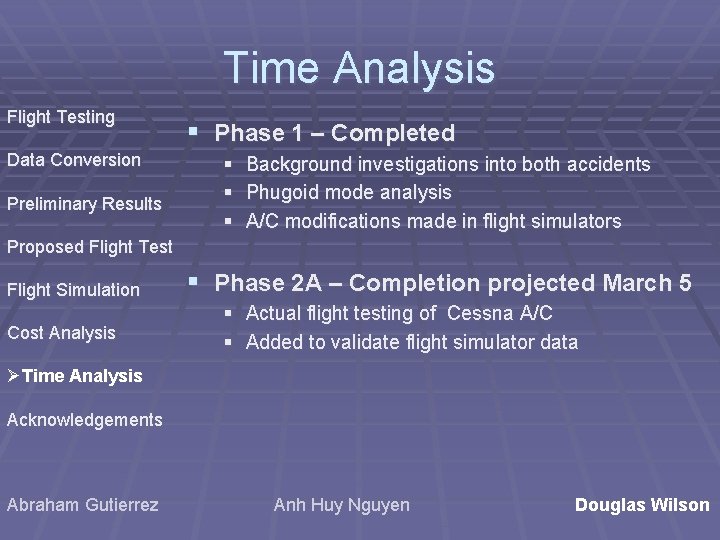
Time Analysis Flight Testing Data Conversion Preliminary Results § Phase 1 – Completed § § § Background investigations into both accidents Phugoid mode analysis A/C modifications made in flight simulators Proposed Flight Test Flight Simulation Cost Analysis § Phase 2 A – Completion projected March 5 § Actual flight testing of Cessna A/C § Added to validate flight simulator data ØTime Analysis Acknowledgements Abraham Gutierrez Anh Huy Nguyen Douglas Wilson
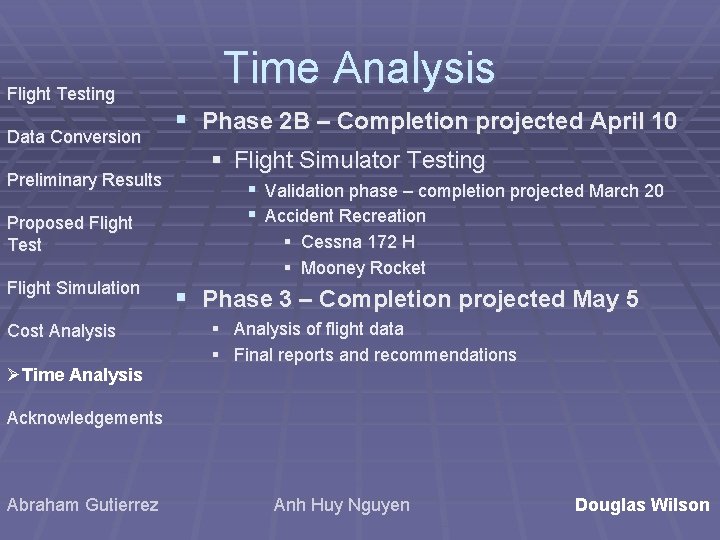
Flight Testing Data Conversion Preliminary Results Proposed Flight Test Flight Simulation Cost Analysis ØTime Analysis § Phase 2 B – Completion projected April 10 § Flight Simulator Testing § Validation phase – completion projected March 20 § Accident Recreation § Cessna 172 H § Mooney Rocket § Phase 3 – Completion projected May 5 § Analysis of flight data § Final reports and recommendations Acknowledgements Abraham Gutierrez Anh Huy Nguyen Douglas Wilson
Acknowledgments Flight Testing Data Conversion Preliminary Results Proposed Flight Test Flight Simulation Cost Analysis Time Analysis ØAcknowledgements Abraham Gutierrez § Wright Aviation in Georgetown, TX § Bill Eldredge and staff § Alan Weaver – Flight Instructor § Dr. Ron O. Stearman § Basil Philip § Marcus Kruger § Joshua Foxworth Anh Huy Nguyen Douglas Wilson
Summary § Mooney 305 § Bakersfield, CA accident § Phugoid Mode § Cessna 172 H § Falcon Field Accident § Flap settings and Engine Concerns § Flight Testing § Real Flight tests § X-Plane Simulator testing Abraham Gutierrez Anh Huy Nguyen Douglas Wilson