
The Use of Evaporative Light Scattering Detection in

- Slides: 30
The Use of Evaporative Light Scattering Detection in Pharmaceutical Analysis 1
Introduction Traditional HPLC detectors such as UV and RI have limited capabilities • RI detection is not gradient compatible • RI detection is susceptible to thermal instability and long equilibration times • Different analytes produce different UV responses depending on their extinction coefficient • UV and RI are not compatible with all solvents • Important information can be missed with an RI and a UV detector • ELSD better alternative than UV detection at low wavelengths
Advantages of Evaporative Light Scattering Detection Universal detection : responds to all compounds in the mobile phase • Detects compounds that do not possess a UV chromophore e. g. polymers, sugars Not dependent on the spectroscopic properties of an analyte Produces more uniform detection sensitivity for analytes Not susceptible to baseline drift during gradient elution, temperature or solvent pump fluctuations ELSD compatible with a much wider range of solvents compared to refractive index
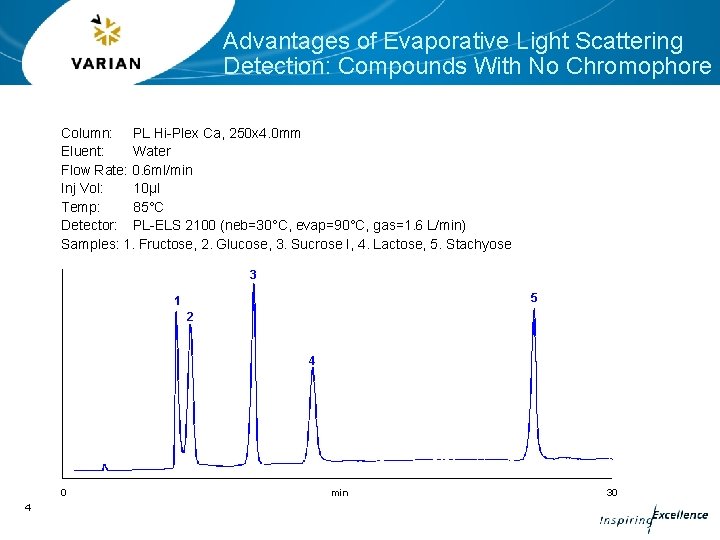
Advantages of Evaporative Light Scattering Detection: Compounds With No Chromophore Column: PL Hi-Plex Ca, 250 x 4. 0 mm Eluent: Water Flow Rate: 0. 6 ml/min Inj Vol: 10µl Temp: 85°C Detector: PL-ELS 2100 (neb=30°C, evap=90°C, gas=1. 6 L/min) Samples: 1. Fructose, 2. Glucose, 3. Sucrose I, 4. Lactose, 5. Stachyose 3 5 1 2 4 0 4 min 30
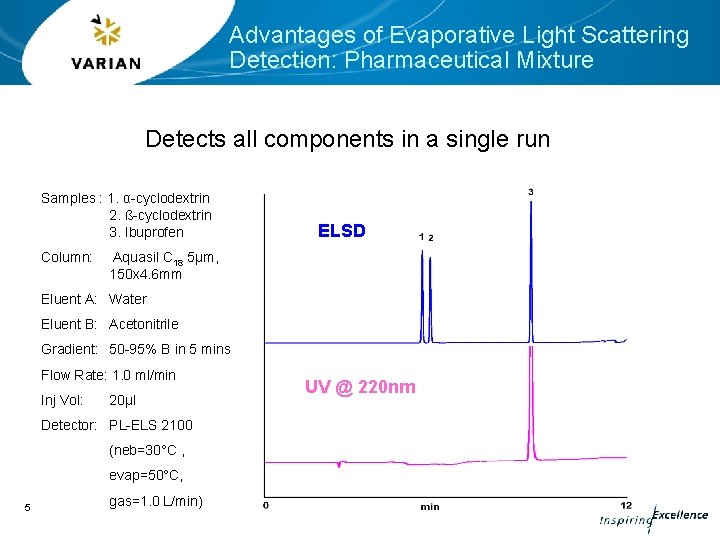
Advantages of Evaporative Light Scattering Detection: Pharmaceutical Mixture Detects all components in a single run Samples : 1. α-cyclodextrin 2. ß-cyclodextrin 3. Ibuprofen Column: ELSD Aquasil C 18 5µm, 150 x 4. 6 mm Eluent A: Water Eluent B: Acetonitrile Gradient: 50 -95% B in 5 mins Flow Rate: 1. 0 ml/min Inj Vol: 20µl Detector: PL-ELS 2100 (neb=30°C , evap=50°C, 5 gas=1. 0 L/min) UV @ 220 nm
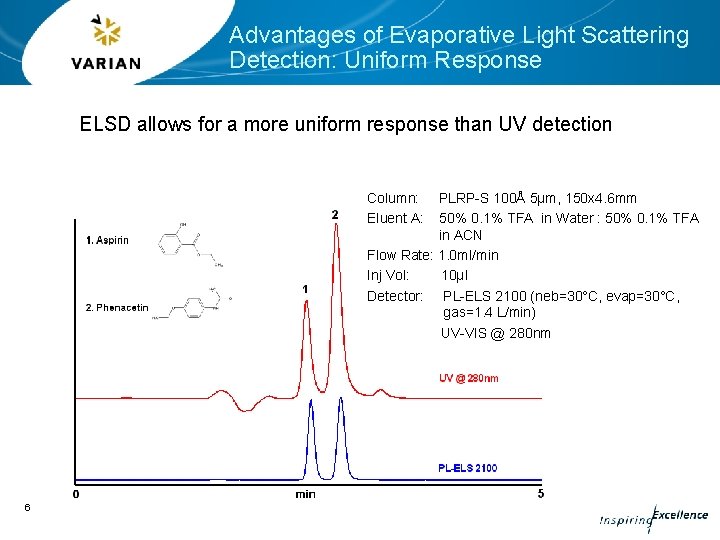
Advantages of Evaporative Light Scattering Detection: Uniform Response ELSD allows for a more uniform response than UV detection Column: Eluent A: PLRP-S 100Å 5µm, 150 x 4. 6 mm 50% 0. 1% TFA in Water : 50% 0. 1% TFA in ACN Flow Rate: 1. 0 ml/min Inj Vol: 10µl Detector: PL-ELS 2100 (neb=30°C, evap=30°C, gas=1. 4 L/min) UV-VIS @ 280 nm 6
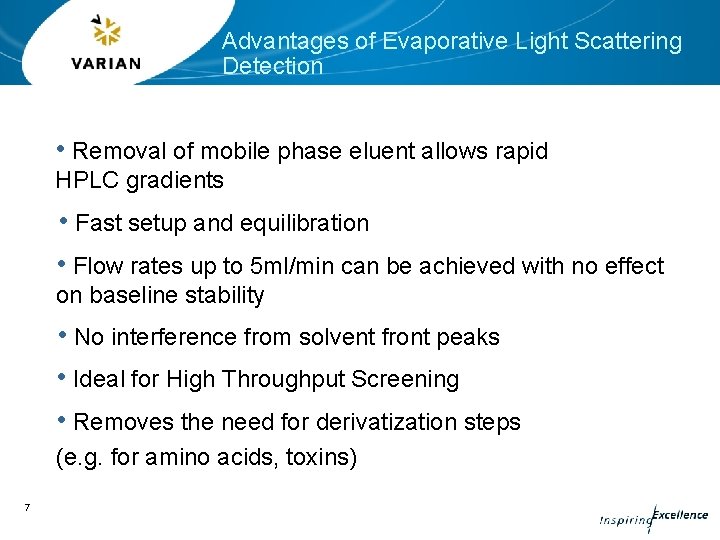
Advantages of Evaporative Light Scattering Detection • Removal of mobile phase eluent allows rapid HPLC gradients • Fast setup and equilibration • Flow rates up to 5 ml/min can be achieved with no effect on baseline stability • No interference from solvent front peaks • Ideal for High Throughput Screening • Removes the need for derivatization steps (e. g. for amino acids, toxins) 7
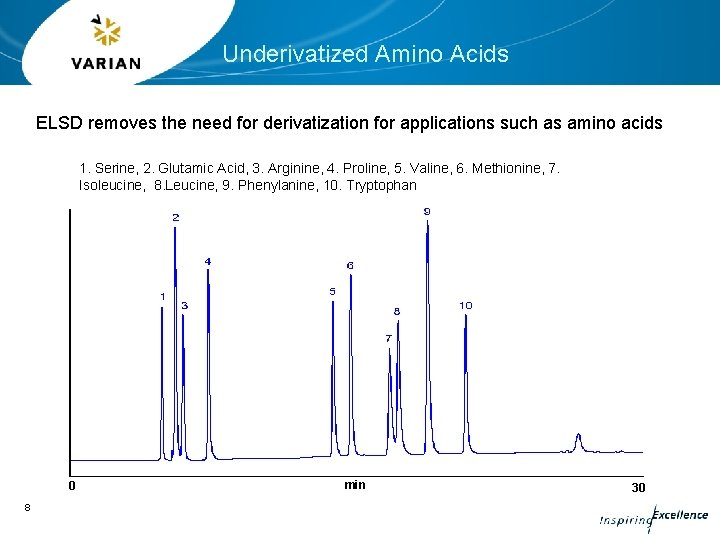
Underivatized Amino Acids ELSD removes the need for derivatization for applications such as amino acids 1. Serine, 2. Glutamic Acid, 3. Arginine, 4. Proline, 5. Valine, 6. Methionine, 7. Isoleucine, 8. Leucine, 9. Phenylanine, 10. Tryptophan 0 8 min 30
Advantages of Evaporative Light Scattering Detection: Ideal Complement to LC-MS Similar operating principles to LC-MS • Volatile buffers • Favors lower flow rates (i. e. 0. 2 -0. 5 ml/min) Can develop LC methods on ELSD then transfer to LC-MS ELSD can provide supporting information when used in tandem with LC-MS 9
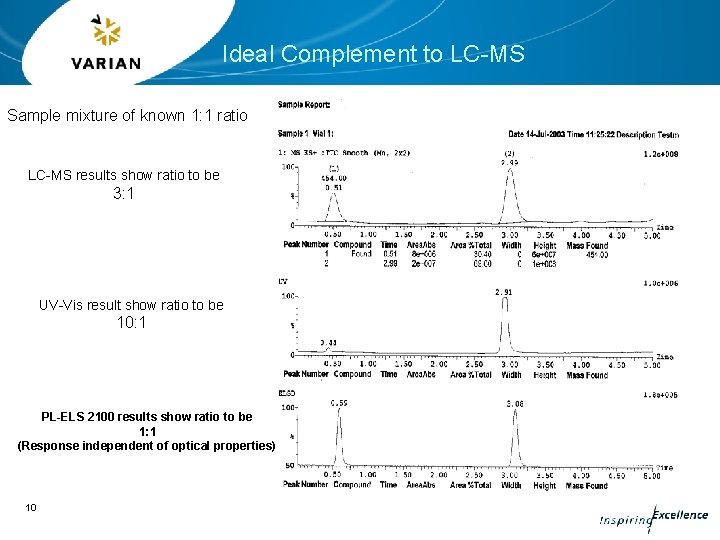
Ideal Complement to LC-MS Sample mixture of known 1: 1 ratio LC-MS results show ratio to be 3: 1 UV-Vis result show ratio to be 10: 1 PL-ELS 2100 results show ratio to be 1: 1 (Response independent of optical properties) 10
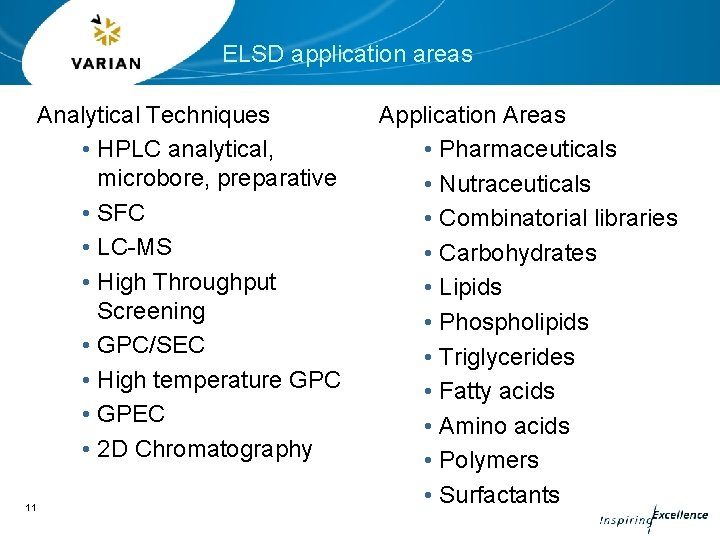
ELSD application areas Analytical Techniques • HPLC analytical, microbore, preparative • SFC • LC-MS • High Throughput Screening • GPC/SEC • High temperature GPC • GPEC • 2 D Chromatography 11 Application Areas • Pharmaceuticals • Nutraceuticals • Combinatorial libraries • Carbohydrates • Lipids • Phospholipids • Triglycerides • Fatty acids • Amino acids • Polymers • Surfactants
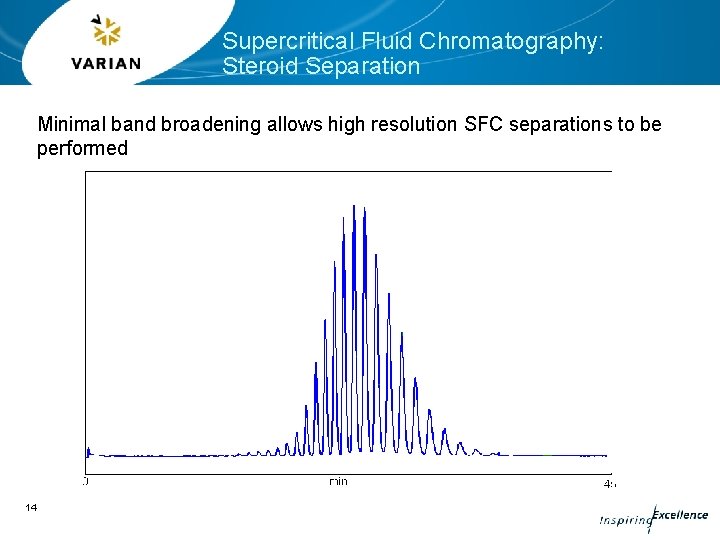
Supercritical Fluid Chromatography: Steroid Separation ELSD capable of handling supercritical CO 2 Properties of supercritical CO 2 are complementary to the nebulization step in ELSD Low baseline noise & improved S/N with SFC–ELSD Nebulizer must be heated to counter the Joule. Thompson cooling effect; prevents blockage of the nebulizer ELSD provides an alternative detection method to FID and UV for SFC separations 12
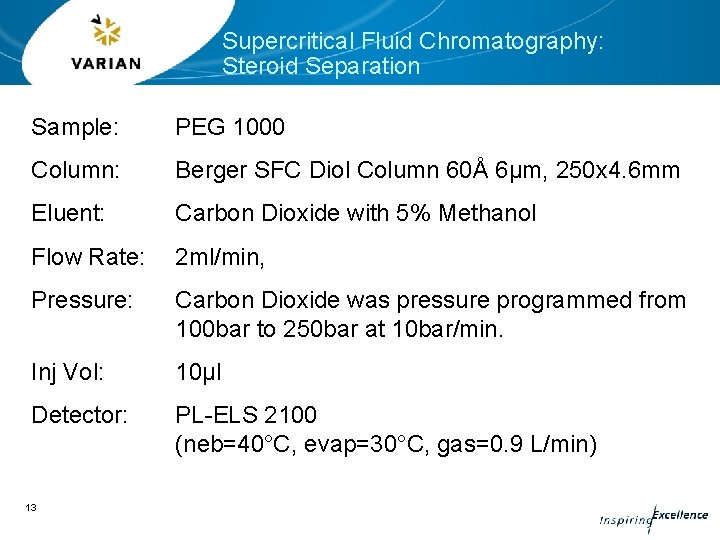
Supercritical Fluid Chromatography: Steroid Separation Sample: PEG 1000 Column: Berger SFC Diol Column 60Å 6µm, 250 x 4. 6 mm Eluent: Carbon Dioxide with 5% Methanol Flow Rate: 2 ml/min, Pressure: Carbon Dioxide was pressure programmed from 100 bar to 250 bar at 10 bar/min. Inj Vol: 10µl Detector: PL-ELS 2100 (neb=40°C, evap=30°C, gas=0. 9 L/min) 13
Supercritical Fluid Chromatography: Steroid Separation Minimal band broadening allows high resolution SFC separations to be performed PEG 1000 14
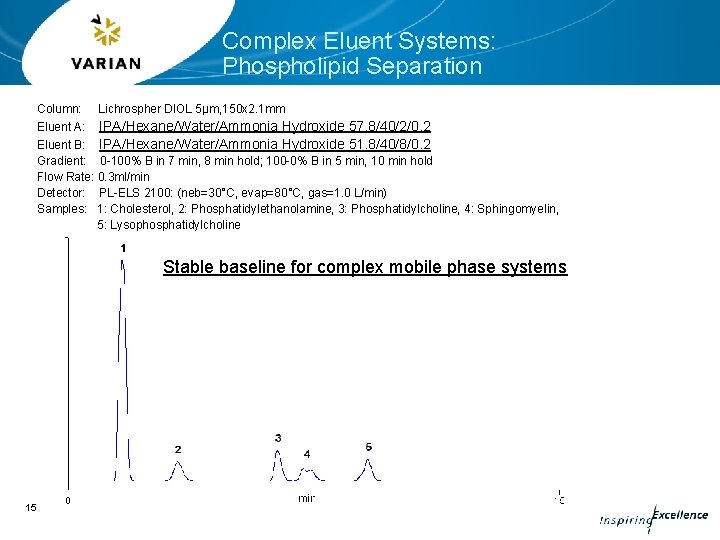
Complex Eluent Systems: Phospholipid Separation Column: Lichrospher DIOL 5µm, 150 x 2. 1 mm IPA/Hexane/Water/Ammonia Hydroxide 57. 8/40/2/0. 2 Eluent B: IPA/Hexane/Water/Ammonia Hydroxide 51. 8/40/8/0. 2 Eluent A: Gradient: 0 -100% B in 7 min, 8 min hold; 100 -0% B in 5 min, 10 min hold Flow Rate: 0. 3 ml/min Detector: PL-ELS 2100: (neb=30°C, evap=80°C, gas=1. 0 L/min) Samples: 1: Cholesterol, 2: Phosphatidylethanolamine, 3: Phosphatidylcholine, 4: Sphingomyelin, 5: Lysophosphatidylcholine Stable baseline for complex mobile phase systems 15
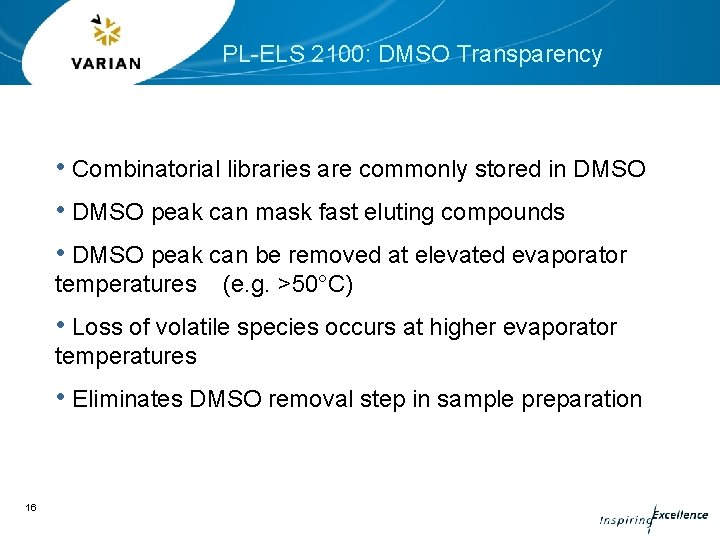
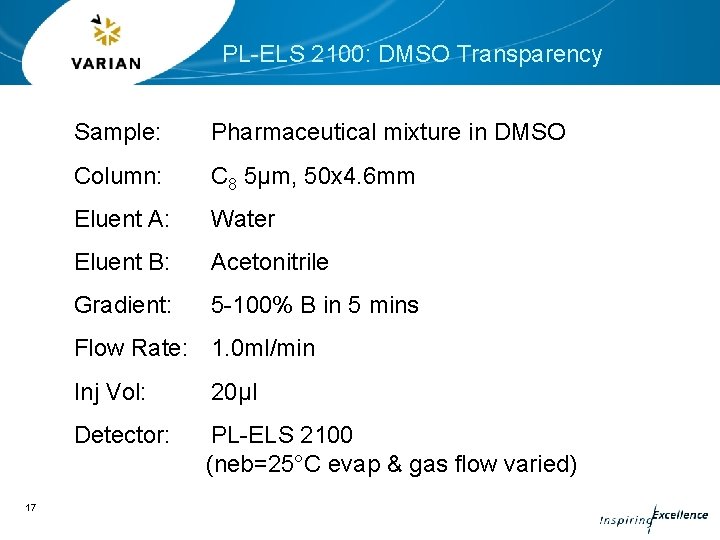
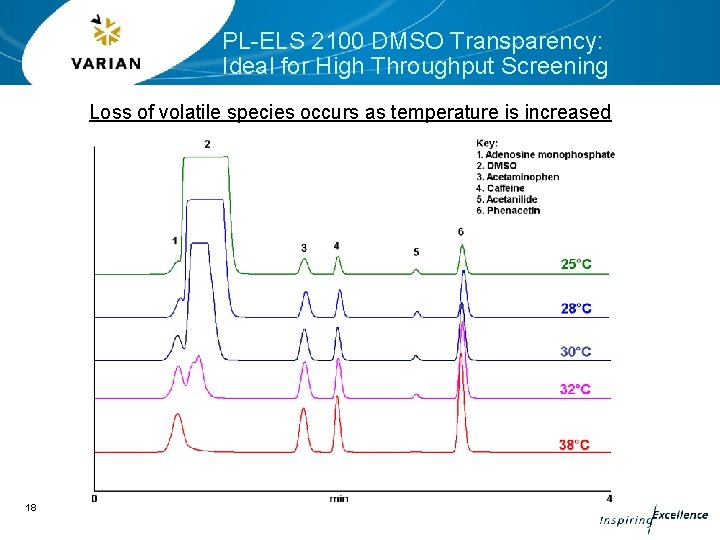
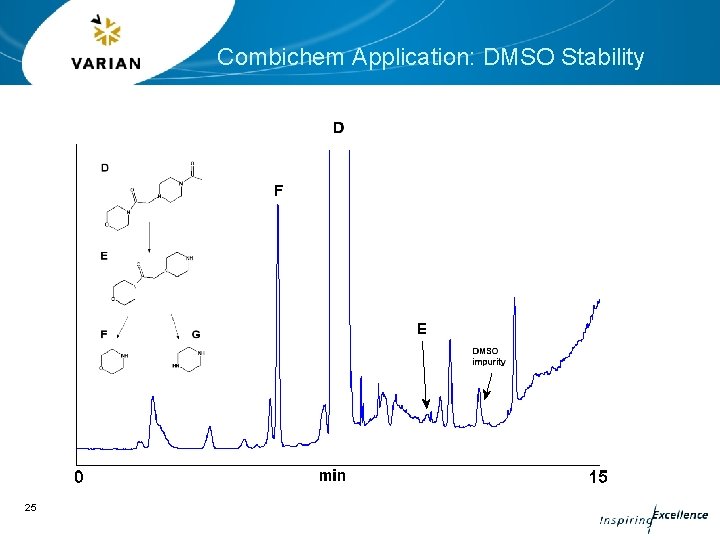
PL-ELS 2100: DMSO Transparency • Combinatorial libraries are commonly stored in DMSO • DMSO peak can mask fast eluting compounds • DMSO peak can be removed at elevated evaporator temperatures (e. g. >50°C) • Loss of volatile species occurs at higher evaporator temperatures • Eliminates DMSO removal step in sample preparation 16
PL-ELS 2100: DMSO Transparency Sample: Pharmaceutical mixture in DMSO Column: C 8 5µm, 50 x 4. 6 mm Eluent A: Water Eluent B: Acetonitrile Gradient: 5 -100% B in 5 mins Flow Rate: 1. 0 ml/min 17 Inj Vol: 20µl Detector: PL-ELS 2100 (neb=25°C evap & gas flow varied)
PL-ELS 2100 DMSO Transparency: Ideal for High Throughput Screening Loss of volatile species occurs as temperature is increased 18
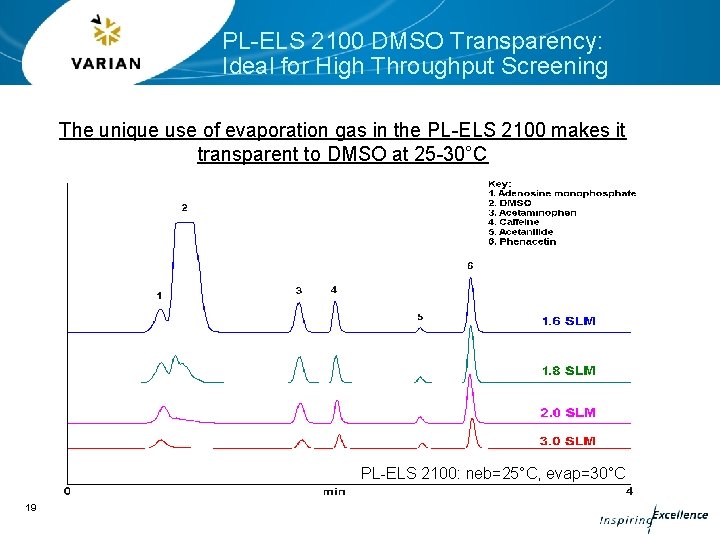
PL-ELS 2100 DMSO Transparency: Ideal for High Throughput Screening The unique use of evaporation gas in the PL-ELS 2100 makes it transparent to DMSO at 25 -30°C PL-ELS 2100: neb=25°C, evap=30°C 19
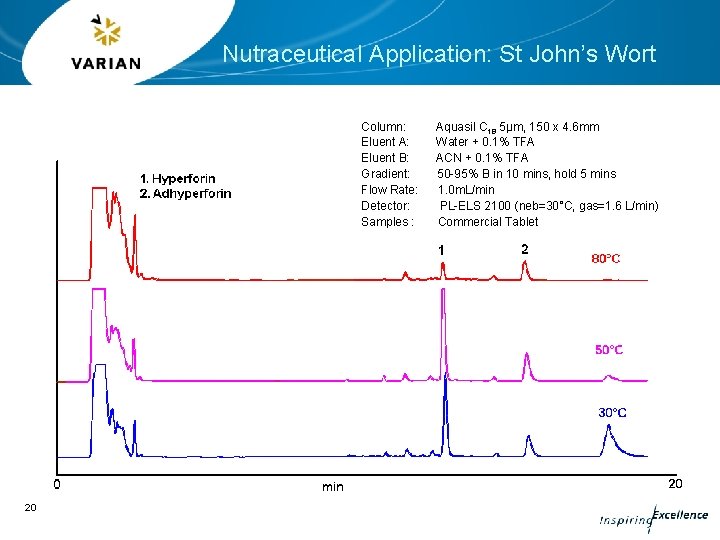
Nutraceutical Application: St John’s Wort Column: Eluent A: Eluent B: Gradient: Flow Rate: Detector: Samples : 20 Aquasil C 18 5µm, 150 x 4. 6 mm Water + 0. 1% TFA ACN + 0. 1% TFA 50 -95% B in 10 mins, hold 5 mins 1. 0 m. L/min PL-ELS 2100 (neb=30°C, gas=1. 6 L/min) Commercial Tablet
Fast Centrifugal Partition Chromatography: St John’s Wort PL-ELS 2100 is compatible with Centrifugal Partition Chromatography, for prep scale fractionation of compounds • The LED intensity can be reduced for the high loading levels • The evaporator gas can be used to control baseline noise, which can be a problem with this technique • UV detection is noisy with this technique, because the mobile phase can form cloudy emulsions 21
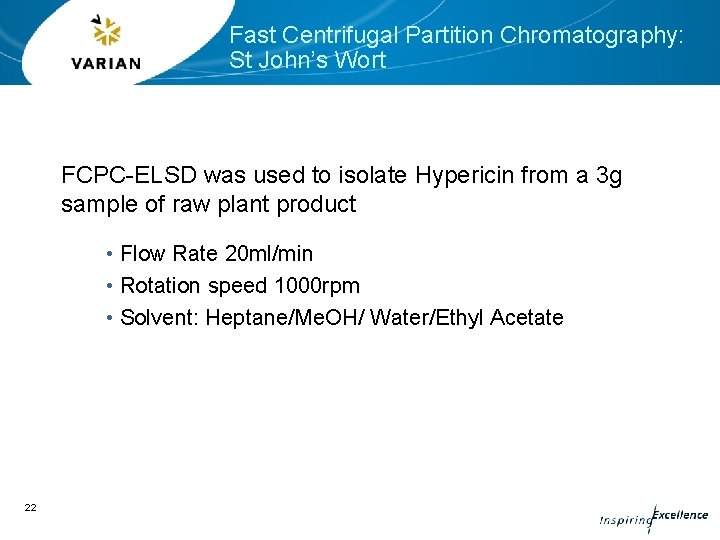
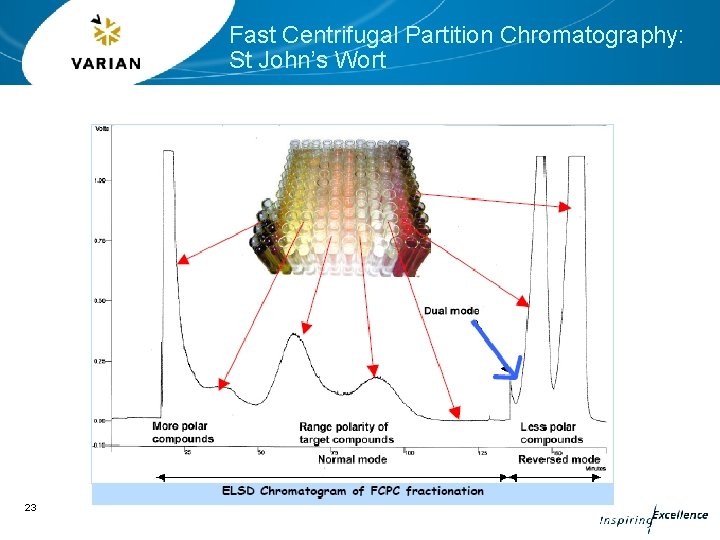
Fast Centrifugal Partition Chromatography: St John’s Wort FCPC-ELSD was used to isolate Hypericin from a 3 g sample of raw plant product • Flow Rate 20 ml/min • Rotation speed 1000 rpm • Solvent: Heptane/Me. OH/ Water/Ethyl Acetate 22
Fast Centrifugal Partition Chromatography: St John’s Wort 23
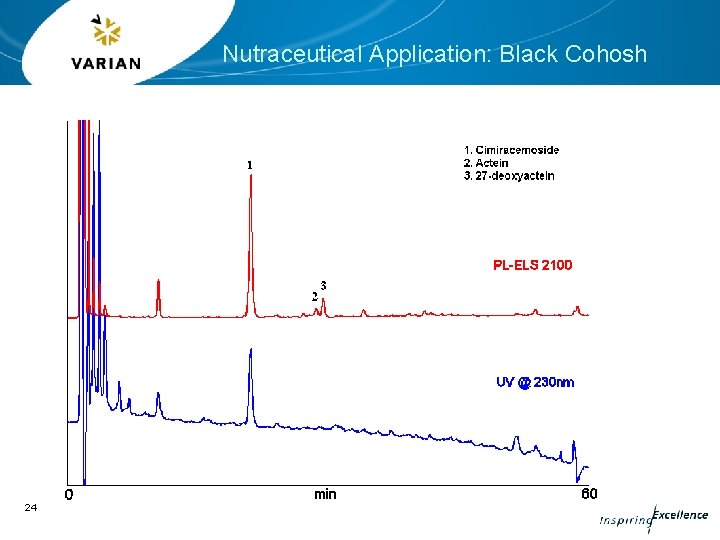
Nutraceutical Application: Black Cohosh 24
Combichem Application: DMSO Stability 25
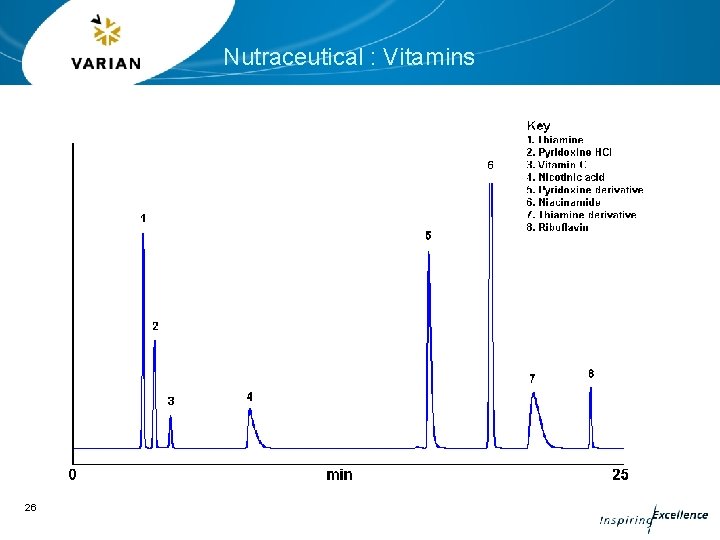
Nutraceutical : Vitamins 26
Features of the PL-ELS 2100 The PL-ELS 2100 offers the general benefits of evaporative light scattering detection which are well documented: • Universal detector, does not rely on the optical properties of the solute • Excellent baseline stability, compatible with gradient elution • High sensitivity • Removes the need for derivatization 27
Additional Benefits of the PL-ELS 2100 • Low temperature operation, even for 100% water • Improved detection of volatile compounds • Extremely low dispersion for high resolution separations • High eluent flow rates, up to 5 ml/min • Wide application range • Extremely small footprint, stackable • Ergonomic design • Easy to use 28
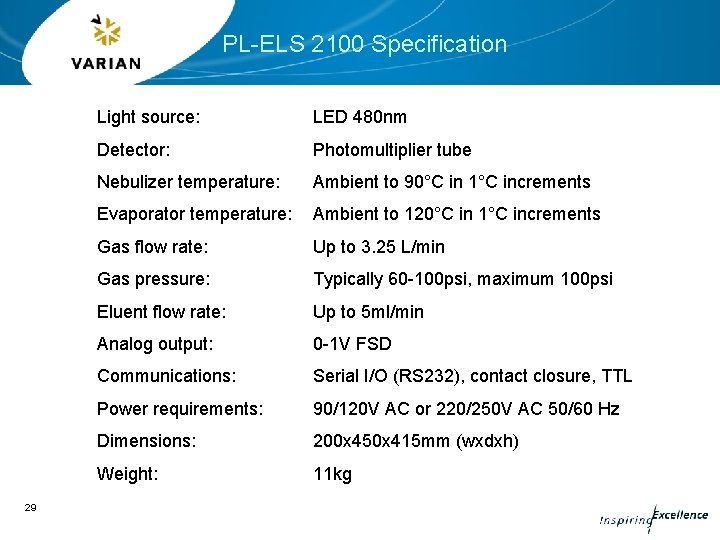
PL-ELS 2100 Specification 29 Light source: LED 480 nm Detector: Photomultiplier tube Nebulizer temperature: Ambient to 90°C in 1°C increments Evaporator temperature: Ambient to 120°C in 1°C increments Gas flow rate: Up to 3. 25 L/min Gas pressure: Typically 60 -100 psi, maximum 100 psi Eluent flow rate: Up to 5 ml/min Analog output: 0 -1 V FSD Communications: Serial I/O (RS 232), contact closure, TTL Power requirements: 90/120 V AC or 220/250 V AC 50/60 Hz Dimensions: 200 x 450 x 415 mm (wxdxh) Weight: 11 kg