
The use of Environmental Science for decision making

- Slides: 18
The use of Environmental Science for decision making in Insurance Krescencja Glapiak, John Hillier, Andreas Tsanakas, Melanie King, Boyka Simeonova, Alistair Milne 2 -PAGE SUMMARY (followed by full presentation) Presenter : K. Glapiak, k. glapiak@lboro. ac. uk
Results • Key decisions are seen as being taken in the ‘Underwriting & Pricing’ function or by senior management • Indirect science is perceived as the dominant input into decision-making in organizations holding (re)insurance risk • Direct scientific input is most dominant in larger and more exposed (re)insurance companies (Fig. 2, multivariate linear models, p < 0. 05), however, it is still used as a support to two main inputs (i. e. claims data, in-house catastrophe model use – Fig. 3). • Larger organisations are more likely to have in-house teams including people with Ph. D experience to engage with science (e. g. academics) , whilst smaller companies tend to look to modelling companies to provide accessible science. • In-house scientific research is used at least twice as often as engagement with external scientists
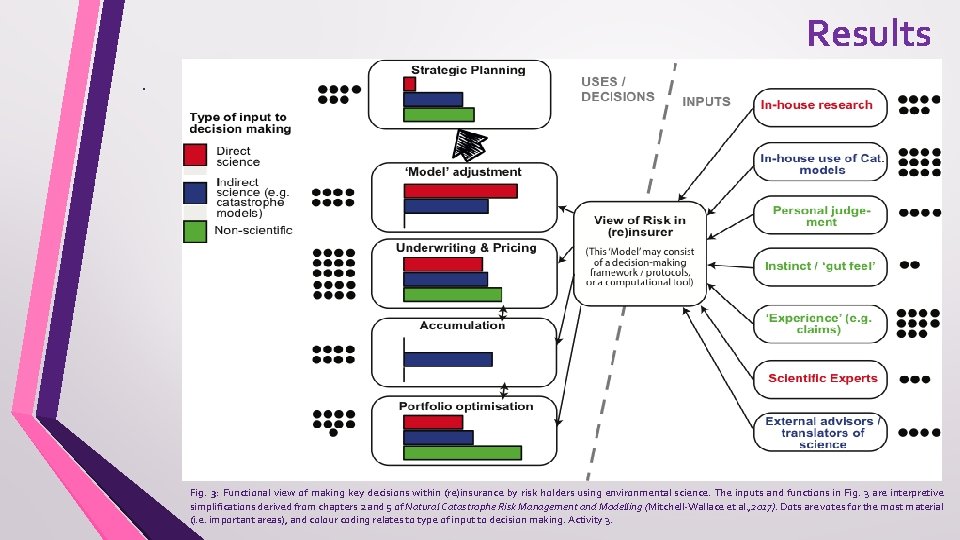
Results. Fig. 3: Functional view of making key decisions within (re)insurance by risk holders using environmental science. The inputs and functions in Fig. 3 are interpretive simplifications derived from chapters 2 and 5 of Natural Catastrophe Risk Management and Modelling (Mitchell-Wallace et al. , 2017). Dots are votes for the most material (i. e. important areas), and colour coding relates to type of input to decision making. Activity 3.
The use of Environmental Science for decision making in Insurance Ph. D Cand. Krescencja Glapiak, Dr John K. Hillier, Dr Andreas Tsanakas, Dr Melanie King, Dr Boyka Simeonova, Prof. Alistair Milne Presenter : K. Glapiak, Doctoral Researcher, Geography and Environment, School of Social Sciences, Loughborough University
Authors MSc Krescencja Podgorska (Glapiak) - Doctoral Researcher, Geography and Environment, School of Social Sciences, Loughborough University Dr John K. Hillier - Senior Lecturer in Physical Geography, Geography and Environment, School of Social Sciences, Loughborough University Dr Andreas Tsanakas - Reader in Actuarial Science, Cass Business School, Faculty of Actuarial Science and Insurance, CASS Business School, City, University of London Dr Melanie King - Lecturer in Systems Engineering, School of Mechanical, Electrical and Manufacturing Engineering, Loughborough University Dr Boyka Simeonova - Lecturer in Information Management, Deputy Director, Centre for Information Management Leader, KDE-RIG, Information Management at the School of Business and Economics, Loughborough University Prof Alistair Milne - Professor of Financial Economics, School of Business and Economics, Loughborough University
Abstract There is considerable global interest in evidence-based decision making. An example of this is the use of geoscience within (re)insurance for natural hazards (e. g. geophysical, meteorological). These cause economic losses averaging 120 billion USD per year. Modelling the risk of natural perils plays a vital part in the global (re)insurance sector decision-making. Thus, a 'model' comprising of a decision-making agenda/practices or software tools to form a 'view of risk' is a vital part of the (re)insurance sector’s decisionmaking strategy. Hence, the (re)insurance sector is of particular interest to environmental scientists seeking to engage with business, and it is relevant to ‘Operational Research’ studies as an example of a sophisticated user of complex models. Much is not understood about how such models shape organisational decision-making behaviour and their performance. Furthermore, the drivers for knowledge flow are distinct for each organization’s business model. Therefore, it is crucial to understand how environmental science propagates into key decision-making in the (re)insurance sector. Specifically, the relative strength of the various routes by which science flows into decision-making processes are not yet explicitly recorded. This study determines how geoscience is used in decision-making in (re)insurance (i. e. to form a ‘view of risk’), with the practical aim of providing evidence that academic geoscientists can use when commencing or developing their collaboration with this sector. Data include the views from 28 insurance practitioners collected at a dedicated session in the Oasis LMF conference 2018, a desk-based study of the scientific background of ‘C’-level decision makers, and insights gained through co-writing a briefing note of the observations with industry co -authors and a representative of the UK funding body UKRI. We show that catastrophe models are a significant and dominant means of scientific input into decision-making in organizations holding (re)insurance risk but that larger organisations often augment this with in-house teams that include Ph. D-level scientists. Also, the strongest route that exists for academic scientists to directly input is via the ‘Model Adjustment’ function and technical specialists there (e. g. Catastrophe Risk Manager’), but a disconnect is observed in that key decisions are seen as being taken in the ‘Underwriting & Pricing’ function or by senior management which require a further step to propagate the environmental science internally.
Case Study In this study, the (re)insurance sector is used as a case study to examine the use of environmental science within institutional decision making. This study used a session at the Oasis Loss Modelling Framework (LMF) 12 conference on 14 th Sept 2018 to collect data objectively documenting how views of natural hazard risk are formed and used in the (re)insurance community. To provide both breadth of data and depth of understanding, a mixture of methods were employed. For effective engagement, these were tailored to the drivers and behaviours of (re)insurance practitioners. Specifically, these practitioners have little time to spare, so approaches were selected either (i) focussed (i. e. time-limited) and aligned to practitioners' existing plans or (ii) had a reportable output to justify time spent.
Research questions • Why is science used in the insurance industry? And, what is its relationship to other factors when making key decisions? • How does science propagate into decision-making? • What are the potential barriers to better engagement? • Where lies the greatest opportunity for UKRI funding to facilitate impact, real world change? i. e.
Methods Workshop in a session at the Oasis Loss Modelling Framework conference held on the 14 th of September 2018 - time-block in a (re)insurance conference. • Questionnaire - Participants' experience • Activity 1 - Participants' decision making Q 1: Why is science used? Q 2: What are everyday/ operational decisions typically based upon? Q 3: What are major/strategic decisions typically based upon? • Activity 2 - Organisational Landscape • Activity 3 - Functional View • Briefing note
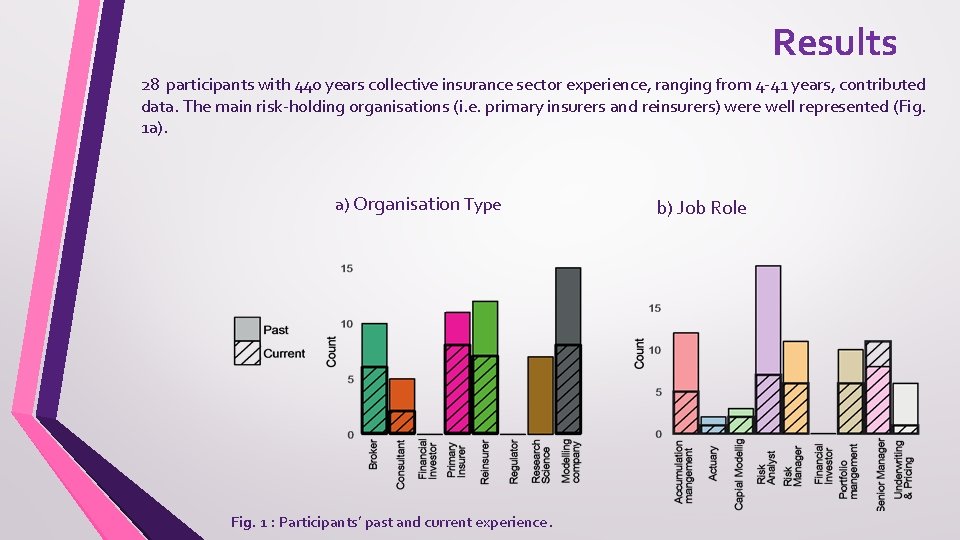
Results 28 participants with 440 years collective insurance sector experience, ranging from 4 -41 years, contributed data. The main risk-holding organisations (i. e. primary insurers and reinsurers) were well represented (Fig. 1 a). a) Organisation Type Fig. 1 : Participants’ past and current experience. b) Job Role
Results. Participants’ past and current experience: • Past experience of research science and working at companies who specialise in making catastrophe models was common. • The main functional areas within a (re)insurer (see Figs. 1 b and 3) are well represented, although Underwriting & Pricing is the least so in current roles. • Participants’ seniorities span from new risk analysts to board level, excepting boardlevel representation for (re)insurers, with scientists being statistically indistinguishable from other participants in seniority. • Participants were scientifically literate technical specialists, including scientists, broadly spanning the range of seniorities in the organisations they represent.
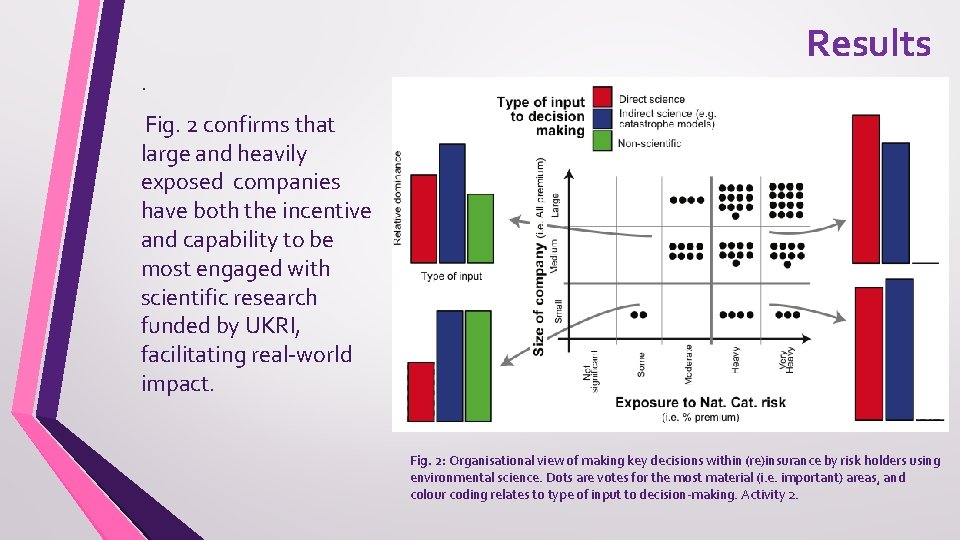
Results. Fig. 2 confirms that large and heavily exposed companies have both the incentive and capability to be most engaged with scientific research funded by UKRI, facilitating real-world impact. Fig. 2: Organisational view of making key decisions within (re)insurance by risk holders using environmental science. Dots are votes for the most material (i. e. important) areas, and colour coding relates to type of input to decision-making. Activity 2.
Results. • Within participants’ teams, despite the variety of individual circumstances, environmental science is used positively in decision-making; namely, use as a ‘driver’/’reassurance’ was ranked above ‘shield’/’regulation’ (p = 0. 02, Wilcoxon, unpaired, 1 -tailed). However, it was ranked as less important (p < 0. 01) than ‘Business Factors’ for both operational (i. e. day-to-day) and strategic decisionmaking. • Indirect science is perceived as the dominant input into decision-making in organizations holding (re)insurance risk (Figs. 2 & 3).
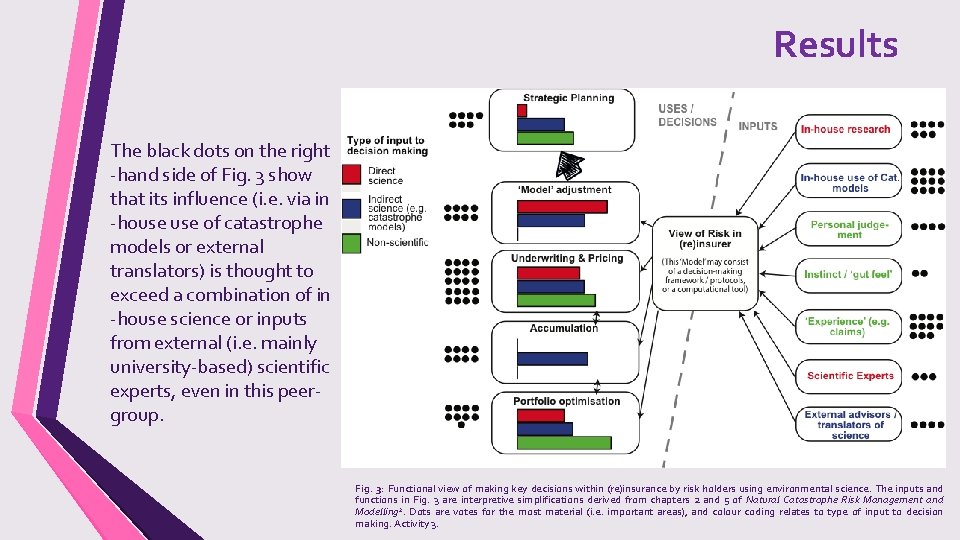
Results The black dots on the right -hand side of Fig. 3 show that its influence (i. e. via in -house of catastrophe models or external translators) is thought to exceed a combination of in -house science or inputs from external (i. e. mainly university-based) scientific experts, even in this peergroup. Fig. 3: Functional view of making key decisions within (re)insurance by risk holders using environmental science. The inputs and functions in Fig. 3 are interpretive simplifications derived from chapters 2 and 5 of Natural Catastrophe Risk Management and Modelling 2. Dots are votes for the most material (i. e. important areas), and colour coding relates to type of input to decision making. Activity 3.
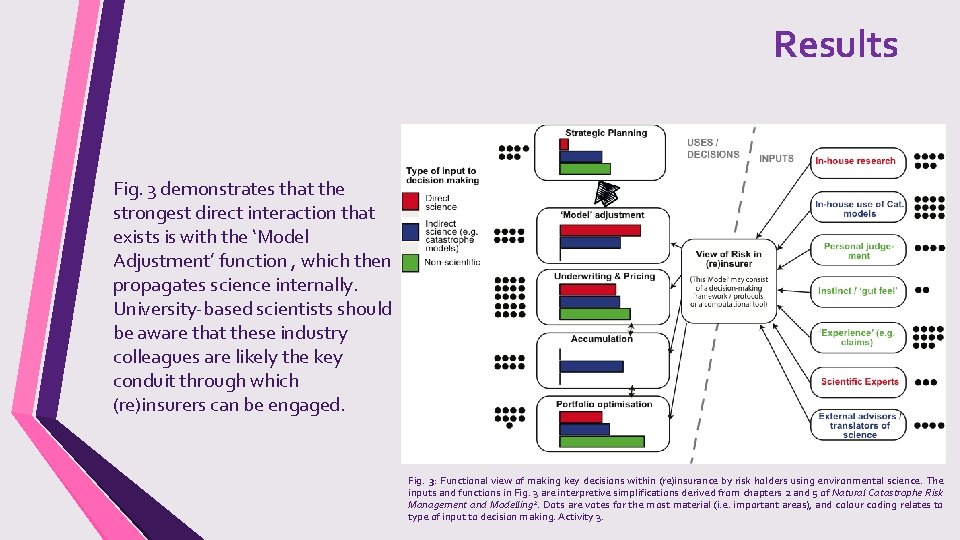
Results Fig. 3 demonstrates that the strongest direct interaction that exists is with the ‘Model Adjustment’ function , which then propagates science internally. University-based scientists should be aware that these industry colleagues are likely the key conduit through which (re)insurers can be engaged. Fig. 3: Functional view of making key decisions within (re)insurance by risk holders using environmental science. The inputs and functions in Fig. 3 are interpretive simplifications derived from chapters 2 and 5 of Natural Catastrophe Risk Management and Modelling 2. Dots are votes for the most material (i. e. important areas), and colour coding relates to type of input to decision making. Activity 3.
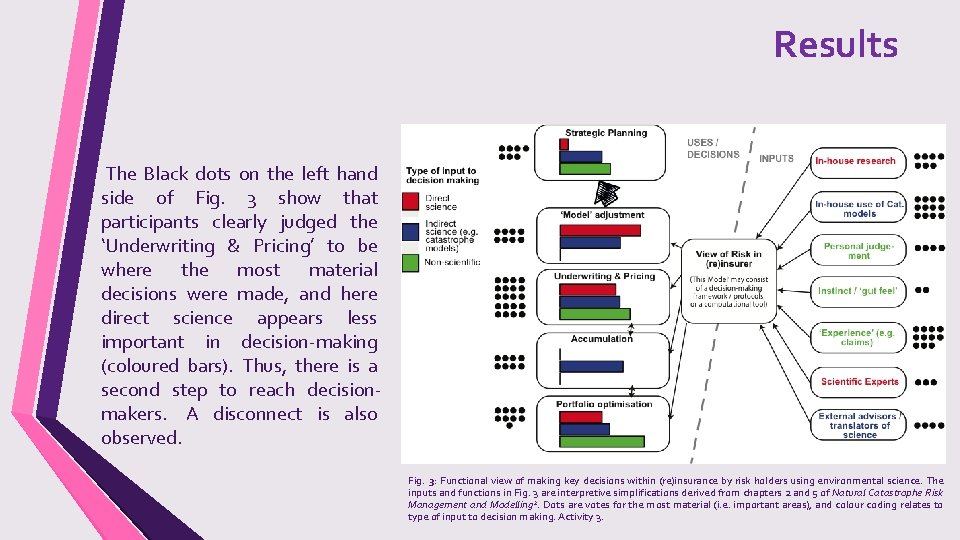
Results The Black dots on the left hand side of Fig. 3 show that participants clearly judged the ‘Underwriting & Pricing’ to be where the most material decisions were made, and here direct science appears less important in decision-making (coloured bars). Thus, there is a second step to reach decisionmakers. A disconnect is also observed. Fig. 3: Functional view of making key decisions within (re)insurance by risk holders using environmental science. The inputs and functions in Fig. 3 are interpretive simplifications derived from chapters 2 and 5 of Natural Catastrophe Risk Management and Modelling 2. Dots are votes for the most material (i. e. important areas), and colour coding relates to type of input to decision making. Activity 3.
Results. • • • Although direct input from university-based science is evidently desirable if resources allow (Fig. 2), in-house scientific research is used at least twice as often as engagement with external scientists (Fig. 3 right-hand side, black dots). Notably, direct scientific input into ‘Strategic Planning’, which participants associated with ‘senior management’ or ‘board-level’, is limited. Likely this is because direct science is just one of many considerations in decision-making at this senior level and may need translation before it can be considered since a limited number of the individuals at this level have scientific experience. Direct scientific input is most dominant in larger and more exposed (re)insurance companies (Fig. 2, multivariate linear models, p < 0. 05), however, it is still used as a support to two main inputs (i. e. claims data, inhouse catastrophe model use – Fig. 3). Larger organisations are more likely to have in-house teams including people with Ph. D experience to engage with science (e. g. academics), whilst smaller companies tend to look to modelling companies to provide accessible science.
Questions