
The use of context mental reinstatement and sketch

- Slides: 17
The use of context (mental reinstatement and sketch plan) to elicit recall from witnesses with autism spectrum disorder Dr Joanne Richards, Professor Becky Milne and Professor Coral Dando Joanne. Richards@port. ac. uk
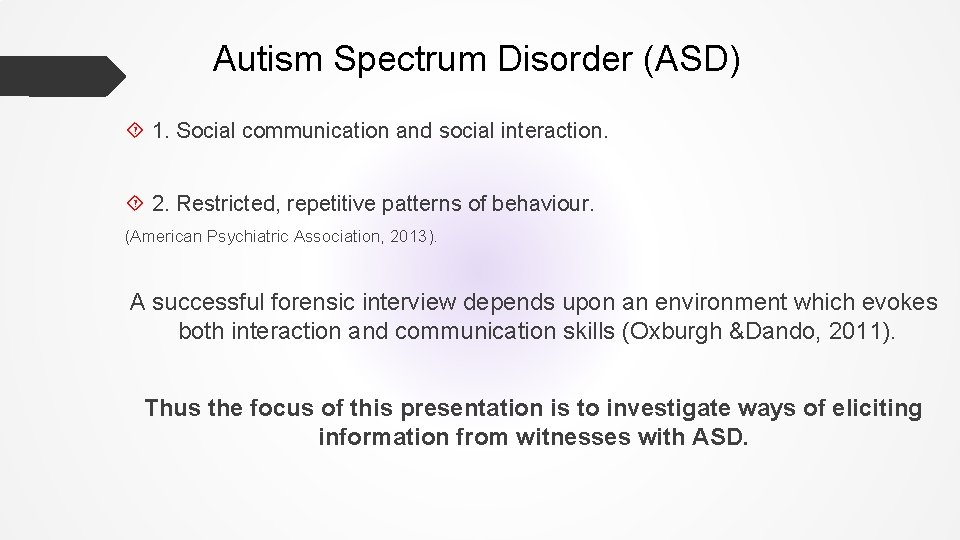
Autism Spectrum Disorder (ASD) 1. Social communication and social interaction. 2. Restricted, repetitive patterns of behaviour. (American Psychiatric Association, 2013). A successful forensic interview depends upon an environment which evokes both interaction and communication skills (Oxburgh &Dando, 2011). Thus the focus of this presentation is to investigate ways of eliciting information from witnesses with ASD.
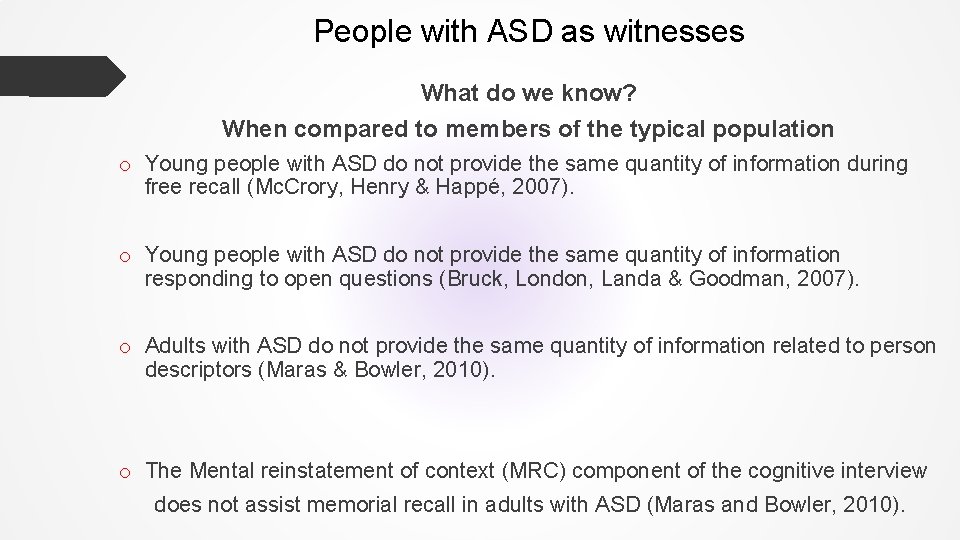
People with ASD as witnesses What do we know? When compared to members of the typical population o Young people with ASD do not provide the same quantity of information during free recall (Mc. Crory, Henry & Happé, 2007). o Young people with ASD do not provide the same quantity of information responding to open questions (Bruck, London, Landa & Goodman, 2007). o Adults with ASD do not provide the same quantity of information related to person descriptors (Maras & Bowler, 2010). o The Mental reinstatement of context (MRC) component of the cognitive interview does not assist memorial recall in adults with ASD (Maras and Bowler, 2010).
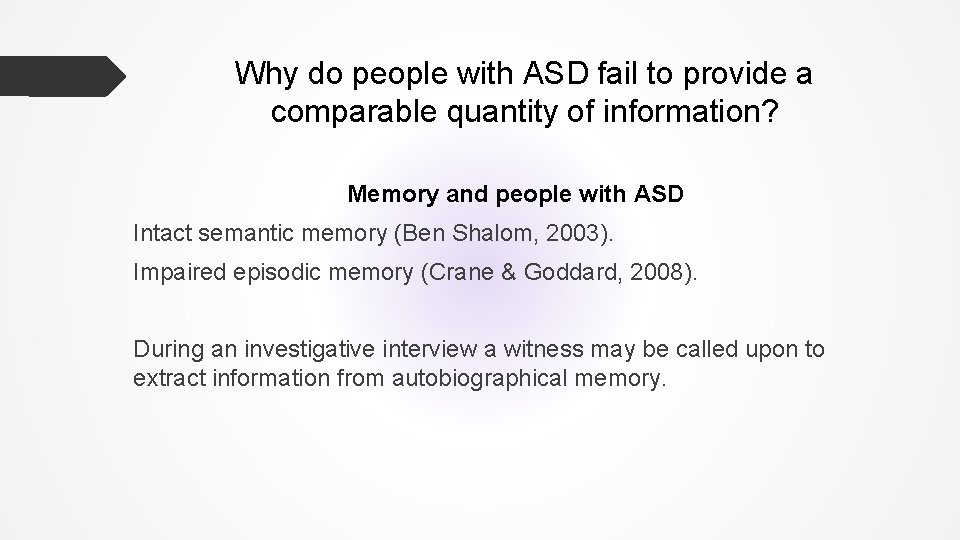
Why do people with ASD fail to provide a comparable quantity of information? Memory and people with ASD Intact semantic memory (Ben Shalom, 2003). Impaired episodic memory (Crane & Goddard, 2008). During an investigative interview a witness may be called upon to extract information from autobiographical memory.
Why might the MRC component hamper recall in people with ASD? Impaired episodic memory impacts upon the effectiveness of the CI (Bekerian & Dennett, 1993) People with ASD may fail to bind features of an event in memory (Brock et al 2002).
Processing information Problems associated with processing complex and intricate information (Williams, Minshew & Goldstein, 2008). Difficulties occur when strategies are required to integrate and organise incoming information (Williams, Minshew & Goldstein, 2008). Associated with impaired brain connectivity (Minshew & Goldstein, 2001) Supported by functional MRI scans (Just, Cherkassky, Keller & Minshew, 2004).
The task support hypothesis. An important finding in memory research is that when appropriate cues are used the performance of people with ASD is comparable to members of the typical population (Bowler et al 2008) The task support hypothesis therefore suggests that problems with memory function arise during retrieval stages rather than encoding. To this effect it is useful to continue to explore the use of cues to help people with ASD elicit memorial recall. This study focused upon the use of MRC and sketch plan (SKP) retrieval strategies.
Adapting MRC instructions for people with ASD. Develop a concise format in which to deliver the MRC instructions. Dando and Milne (2012) demonstrated how members of the typical population can be mentally reinstated using only 165 words. People with ASD may not respond in a typical way to sensory stimuli (Hilton et al, 2010). Therefore abridge the instructions aimed at activating sensory perceptions. No restrictions placed upon temporal ordering of recall. It was hypothesised that an ‘ASD friendly’ instruction to mentally reinstate would assist memorial recall in people with ASD.
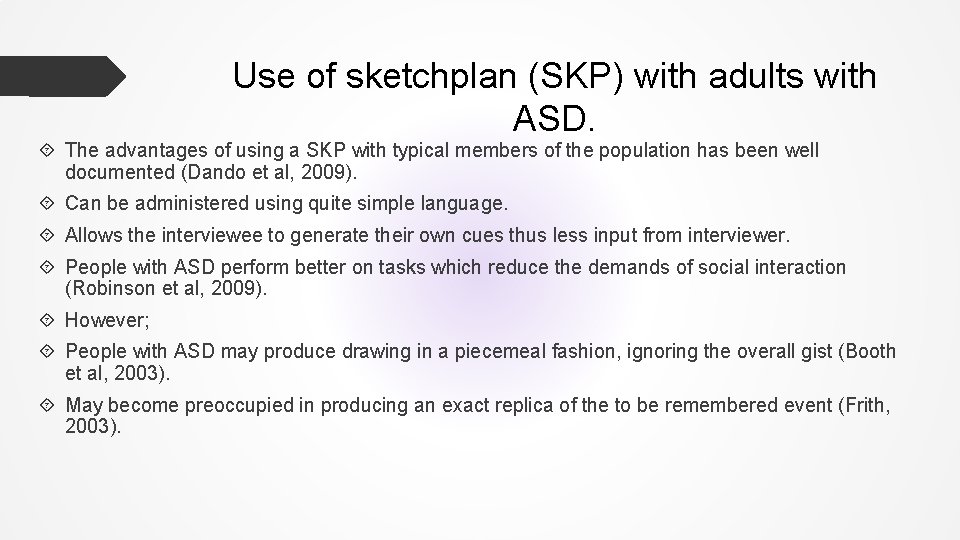
Use of sketchplan (SKP) with adults with ASD. The advantages of using a SKP with typical members of the population has been well documented (Dando et al, 2009). Can be administered using quite simple language. Allows the interviewee to generate their own cues thus less input from interviewer. People with ASD perform better on tasks which reduce the demands of social interaction (Robinson et al, 2009). However; People with ASD may produce drawing in a piecemeal fashion, ignoring the overall gist (Booth et al, 2003). May become preoccupied in producing an exact replica of the to be remembered event (Frith, 2003).
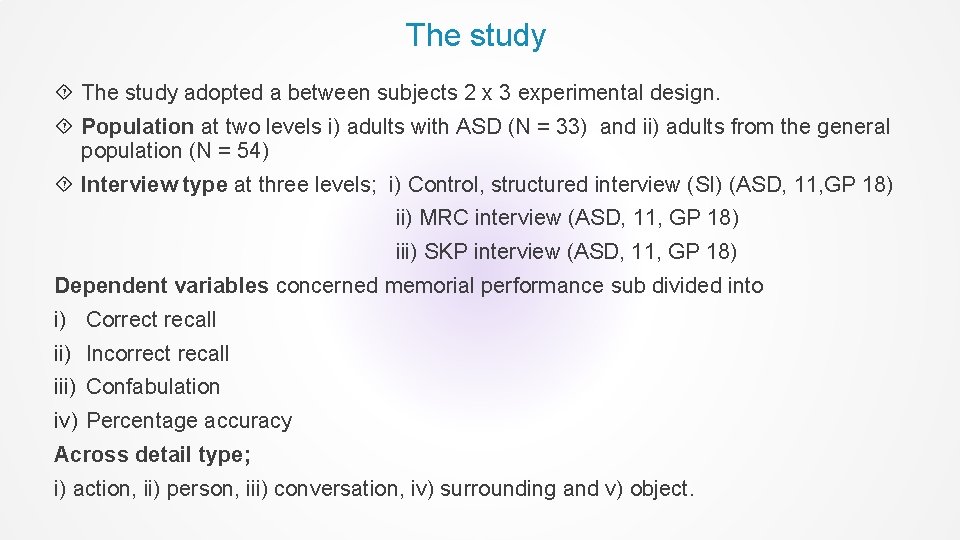
The study adopted a between subjects 2 x 3 experimental design. Population at two levels i) adults with ASD (N = 33) and ii) adults from the general population (N = 54) Interview type at three levels; i) Control, structured interview (SI) (ASD, 11, GP 18) ii) MRC interview (ASD, 11, GP 18) iii) SKP interview (ASD, 11, GP 18) Dependent variables concerned memorial performance sub divided into i) Correct recall ii) Incorrect recall iii) Confabulation iv) Percentage accuracy Across detail type; i) action, ii) person, iii) conversation, iv) surrounding and v) object.
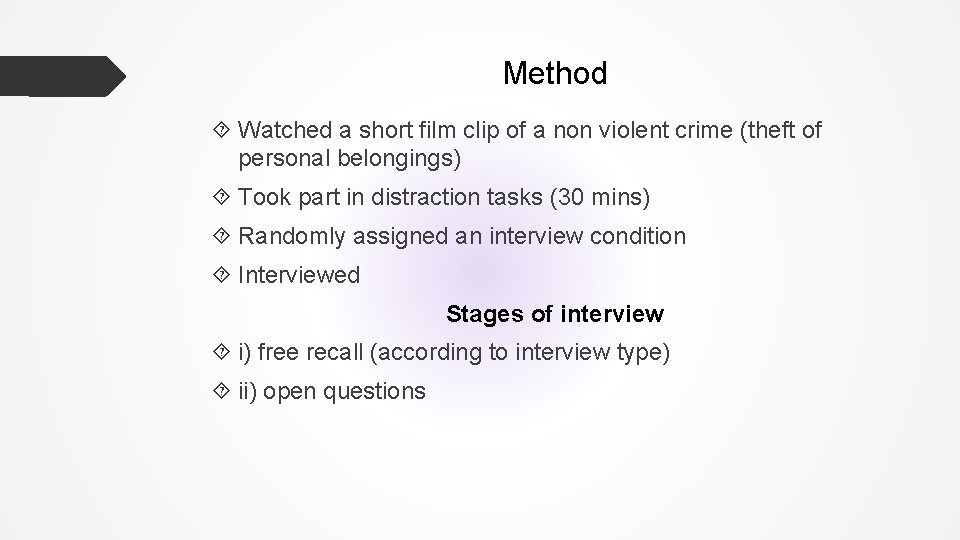
Method Watched a short film clip of a non violent crime (theft of personal belongings) Took part in distraction tasks (30 mins) Randomly assigned an interview condition Interviewed Stages of interview i) free recall (according to interview type) ii) open questions
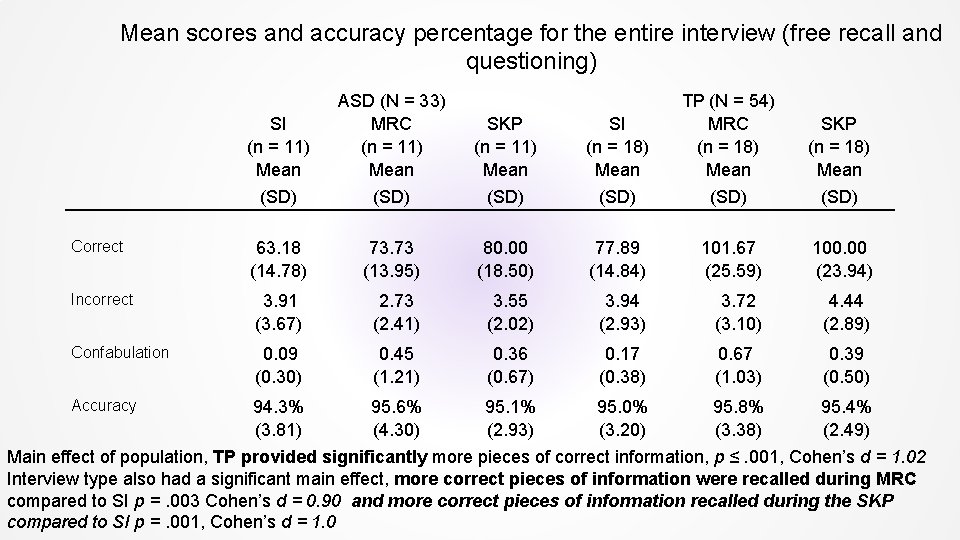
Mean scores and accuracy percentage for the entire interview (free recall and questioning) SI (n = 11) Mean (SD) ASD (N = 33) MRC (n = 11) Mean (SD) SKP (n = 11) Mean (SD) 63. 18 (14. 78) 73. 73 (13. 95) Incorrect 3. 91 (3. 67) Confabulation Accuracy Correct SI (n = 18) Mean (SD) TP (N = 54) MRC (n = 18) Mean (SD) SKP (n = 18) Mean (SD) 80. 00 (18. 50) 77. 89 (14. 84) 101. 67 (25. 59) 100. 00 (23. 94) 2. 73 (2. 41) 3. 55 (2. 02) 3. 94 (2. 93) 3. 72 (3. 10) 4. 44 (2. 89) 0. 09 (0. 30) 0. 45 (1. 21) 0. 36 (0. 67) 0. 17 (0. 38) 0. 67 (1. 03) 0. 39 (0. 50) 94. 3% (3. 81) 95. 6% (4. 30) 95. 1% (2. 93) 95. 0% (3. 20) 95. 8% (3. 38) 95. 4% (2. 49) Main effect of population, TP provided significantly more pieces of correct information, p ≤. 001, Cohen’s d = 1. 02 Interview type also had a significant main effect, more correct pieces of information were recalled during MRC compared to SI p =. 003 Cohen’s d = 0. 90 and more correct pieces of information recalled during the SKP compared to SI p =. 001, Cohen’s d = 1. 0
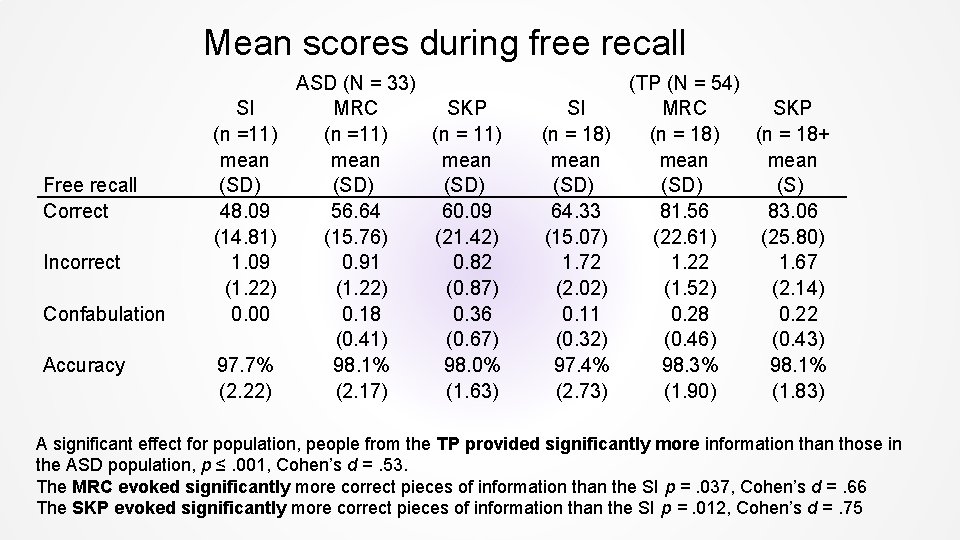
Mean scores during free recall Free recall Correct Incorrect Confabulation Accuracy ASD (N = 33) SI MRC SKP (n =11) (n = 11) mean (SD) 48. 09 56. 64 60. 09 (14. 81) (15. 76) (21. 42) 1. 09 0. 91 0. 82 (1. 22) (0. 87) 0. 00 0. 18 0. 36 (0. 41) (0. 67) 97. 7% 98. 1% 98. 0% (2. 22) (2. 17) (1. 63) (TP (N = 54) SI MRC SKP (n = 18) (n = 18+ mean (SD) (S) 64. 33 81. 56 83. 06 (15. 07) (22. 61) (25. 80) 1. 72 1. 22 1. 67 (2. 02) (1. 52) (2. 14) 0. 11 0. 28 0. 22 (0. 32) (0. 46) (0. 43) 97. 4% 98. 3% 98. 1% (2. 73) (1. 90) (1. 83) A significant effect for population, people from the TP provided significantly more information than those in the ASD population, p ≤. 001, Cohen’s d =. 53. The MRC evoked significantly more correct pieces of information than the SI p =. 037, Cohen’s d =. 66 The SKP evoked significantly more correct pieces of information than the SI p =. 012, Cohen’s d =. 75
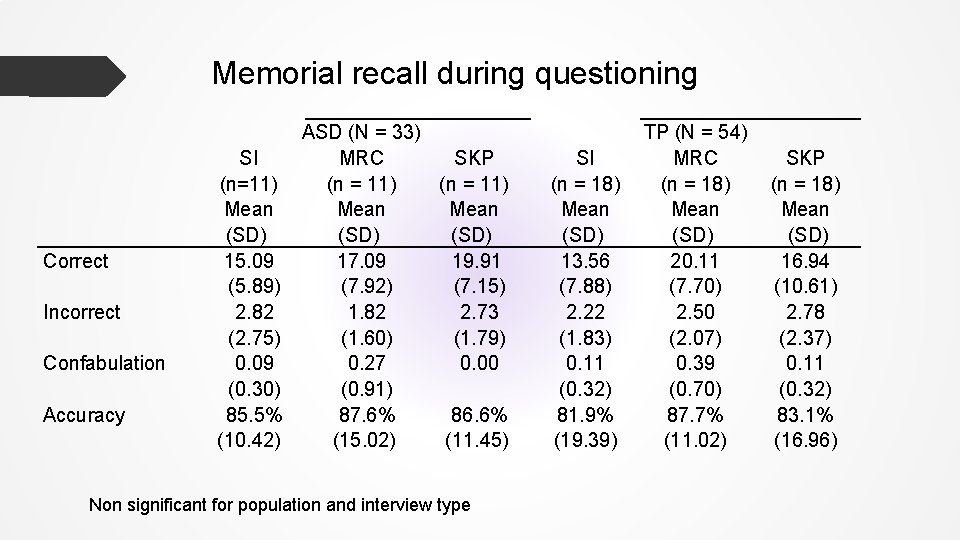
Memorial recall during questioning Correct Incorrect Confabulation Accuracy ASD (N = 33) SI MRC SKP (n=11) (n = 11) Mean (SD) 15. 09 17. 09 19. 91 (5. 89) (7. 92) (7. 15) 2. 82 1. 82 2. 73 (2. 75) (1. 60) (1. 79) 0. 09 0. 27 0. 00 (0. 30) (0. 91) 85. 5% 87. 6% 86. 6% (10. 42) (15. 02) (11. 45) Non significant for population and interview type SI (n = 18) Mean (SD) 13. 56 (7. 88) 2. 22 (1. 83) 0. 11 (0. 32) 81. 9% (19. 39) TP (N = 54) MRC (n = 18) Mean (SD) 20. 11 (7. 70) 2. 50 (2. 07) 0. 39 (0. 70) 87. 7% (11. 02) SKP (n = 18) Mean (SD) 16. 94 (10. 61) 2. 78 (2. 37) 0. 11 (0. 32) 83. 1% (16. 96)
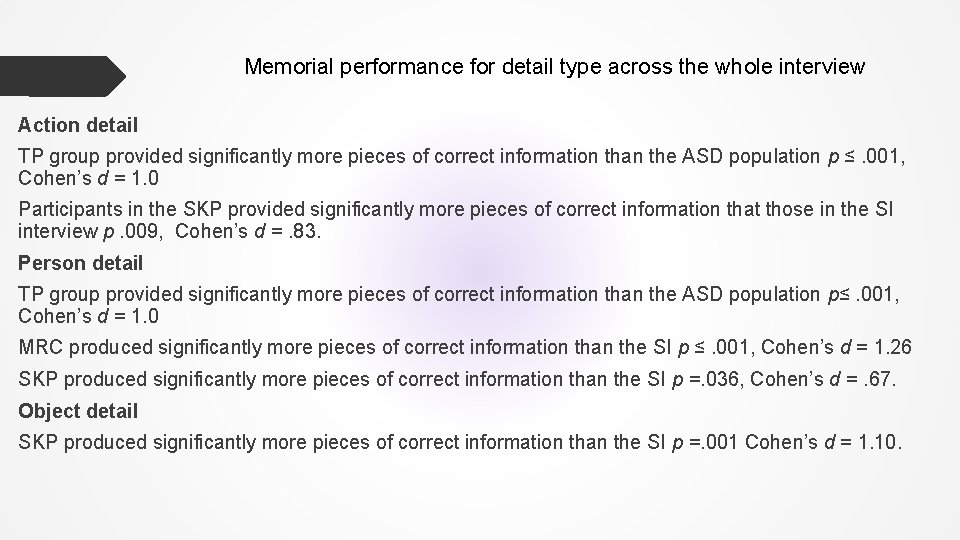
Memorial performance for detail type across the whole interview Action detail TP group provided significantly more pieces of correct information than the ASD population p ≤. 001, Cohen’s d = 1. 0 Participants in the SKP provided significantly more pieces of correct information that those in the SI interview p. 009, Cohen’s d =. 83. Person detail TP group provided significantly more pieces of correct information than the ASD population p≤. 001, Cohen’s d = 1. 0 MRC produced significantly more pieces of correct information than the SI p ≤. 001, Cohen’s d = 1. 26 SKP produced significantly more pieces of correct information than the SI p =. 036, Cohen’s d =. 67. Object detail SKP produced significantly more pieces of correct information than the SI p =. 001 Cohen’s d = 1. 10.
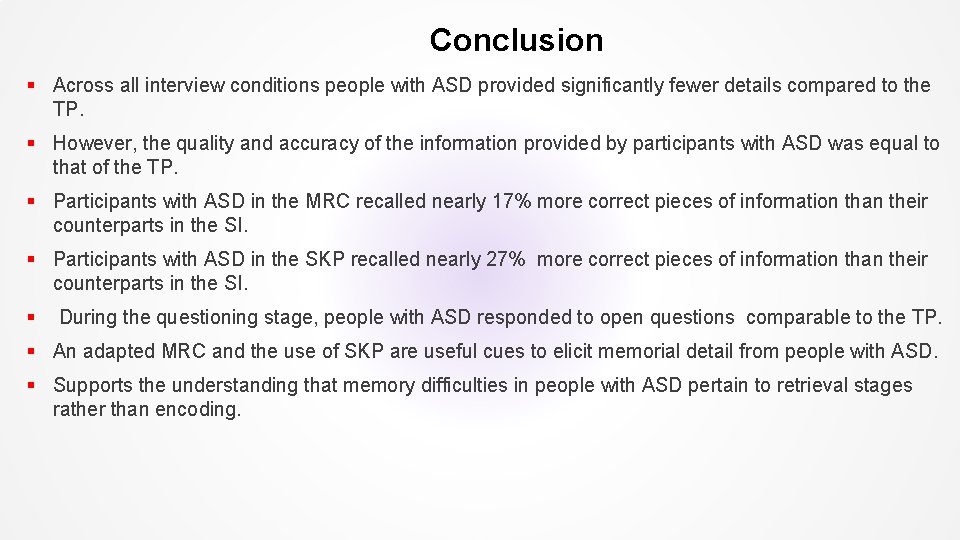
Conclusion § Across all interview conditions people with ASD provided significantly fewer details compared to the TP. § However, the quality and accuracy of the information provided by participants with ASD was equal to that of the TP. § Participants with ASD in the MRC recalled nearly 17% more correct pieces of information than their counterparts in the SI. § Participants with ASD in the SKP recalled nearly 27% more correct pieces of information than their counterparts in the SI. § During the questioning stage, people with ASD responded to open questions comparable to the TP. § An adapted MRC and the use of SKP are useful cues to elicit memorial detail from people with ASD. § Supports the understanding that memory difficulties in people with ASD pertain to retrieval stages rather than encoding.
Thank you for listening. Any Questions?