
The use of child and youth wellbeing indicators
The use of child and youth well-being indicators in child and youth policy First Benelux-Nordic expert meeting on child and youth policy Amsterdam, 13 -15 December 2009 – The Netherlands Youth Institute Indicators of child poverty and child well-being in the EU to assist evidence-based policies in the Member States István György Tóth – András Gábos TARKI Social Research Institute
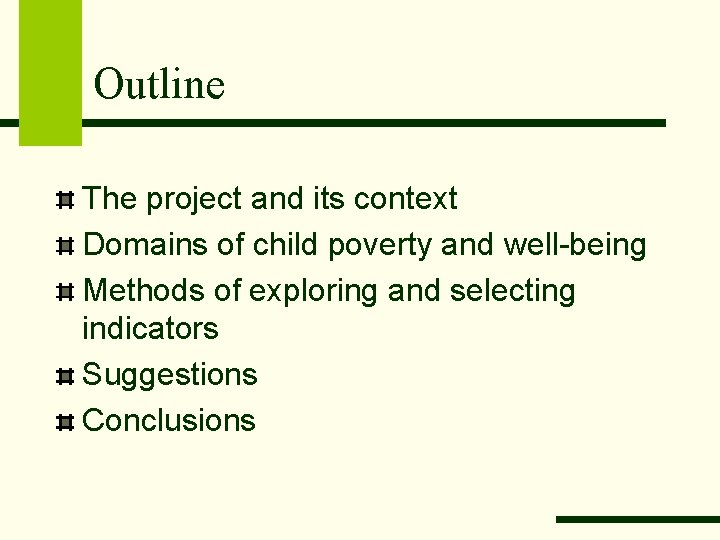
Outline The project and its context Domains of child poverty and well-being Methods of exploring and selecting indicators Suggestions Conclusions
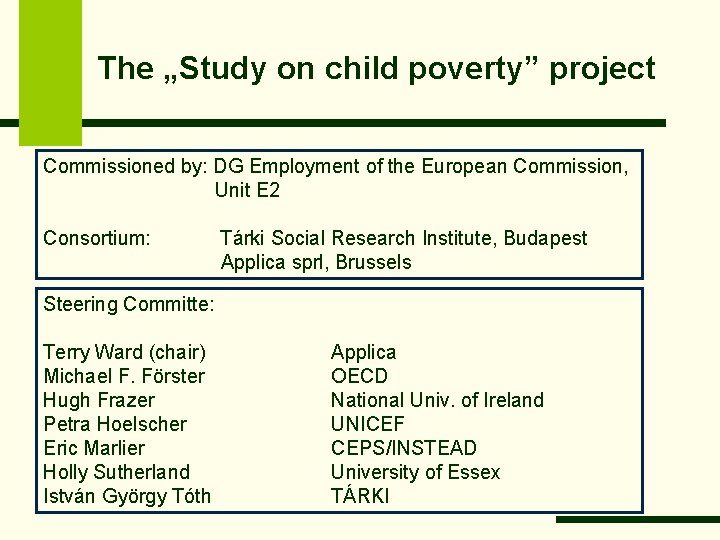
The „Study on child poverty” project Commissioned by: DG Employment of the European Commission, Unit E 2 Consortium: Tárki Social Research Institute, Budapest Applica sprl, Brussels Steering Committe: Terry Ward (chair) Michael F. Förster Hugh Frazer Petra Hoelscher Eric Marlier Holly Sutherland István György Tóth Applica OECD National Univ. of Ireland UNICEF CEPS/INSTEAD University of Essex TÁRKI
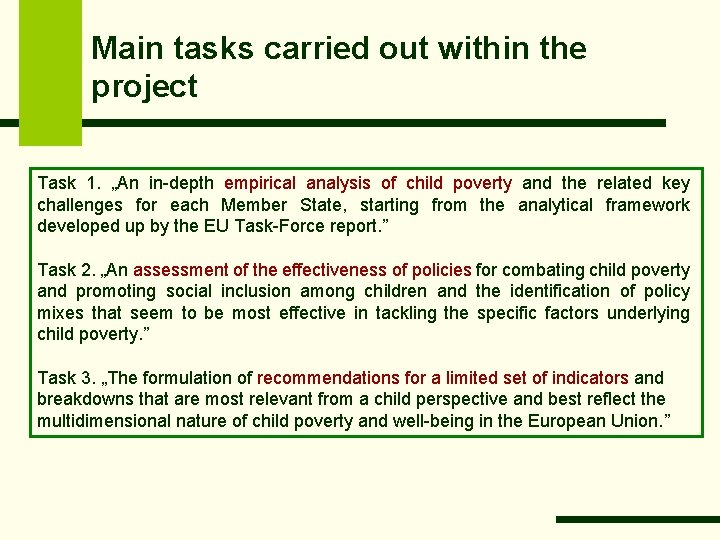
Main tasks carried out within the project Task 1. „An in-depth empirical analysis of child poverty and the related key challenges for each Member State, starting from the analytical framework developed up by the EU Task-Force report. ” Task 2. „An assessment of the effectiveness of policies for combating child poverty and promoting social inclusion among children and the identification of policy mixes that seem to be most effective in tackling the specific factors underlying child poverty. ” Task 3. „The formulation of recommendations for a limited set of indicators and breakdowns that are most relevant from a child perspective and best reflect the multidimensional nature of child poverty and well-being in the European Union. ”
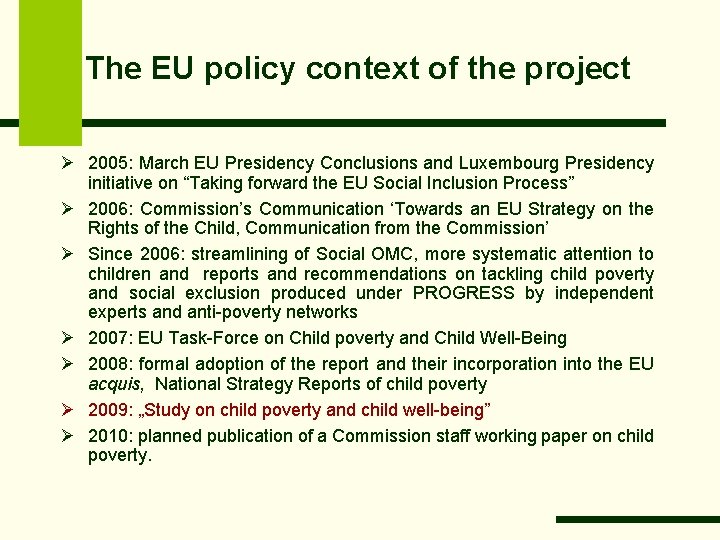
The EU policy context of the project Ø 2005: March EU Presidency Conclusions and Luxembourg Presidency initiative on “Taking forward the EU Social Inclusion Process” Ø 2006: Commission’s Communication ‘Towards an EU Strategy on the Rights of the Child, Communication from the Commission’ Ø Since 2006: streamlining of Social OMC, more systematic attention to children and reports and recommendations on tackling child poverty and social exclusion produced under PROGRESS by independent experts and anti-poverty networks Ø 2007: EU Task-Force on Child poverty and Child Well-Being Ø 2008: formal adoption of the report and their incorporation into the EU acquis, National Strategy Reports of child poverty Ø 2009: „Study on child poverty and child well-being” Ø 2010: planned publication of a Commission staff working paper on child poverty.
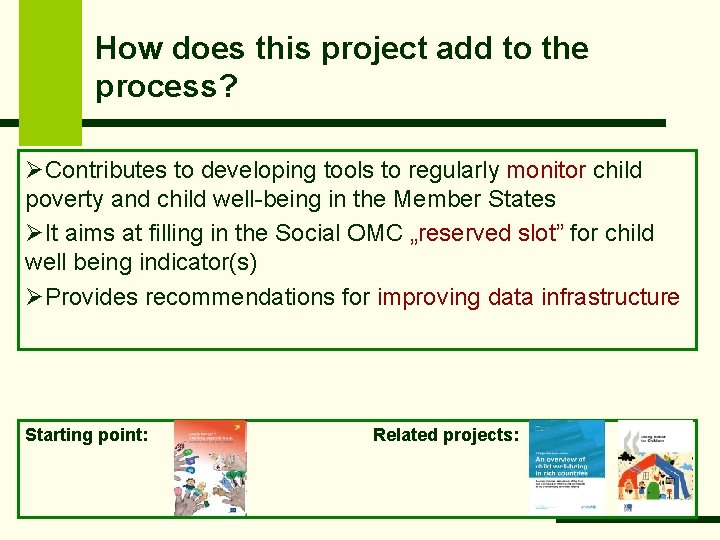
How does this project add to the process? ØContributes to developing tools to regularly monitor child poverty and child well-being in the Member States ØIt aims at filling in the Social OMC „reserved slot” for child well being indicator(s) ØProvides recommendations for improving data infrastructure Starting point: Related projects:
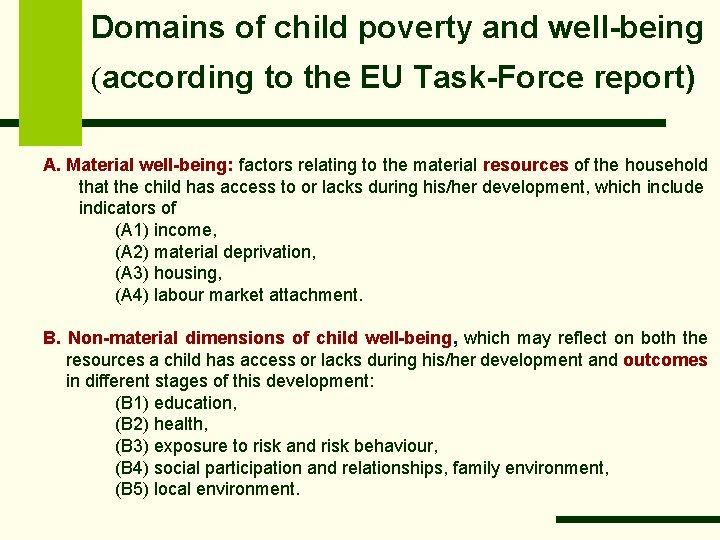
Domains of child poverty and well-being (according to the EU Task-Force report) A. Material well-being: factors relating to the material resources of the household that the child has access to or lacks during his/her development, which include indicators of (A 1) income, (A 2) material deprivation, (A 3) housing, (A 4) labour market attachment. B. Non-material dimensions of child well-being, which may reflect on both the resources a child has access or lacks during his/her development and outcomes in different stages of this development: (B 1) education, (B 2) health, (B 3) exposure to risk and risk behaviour, (B 4) social participation and relationships, family environment, (B 5) local environment.
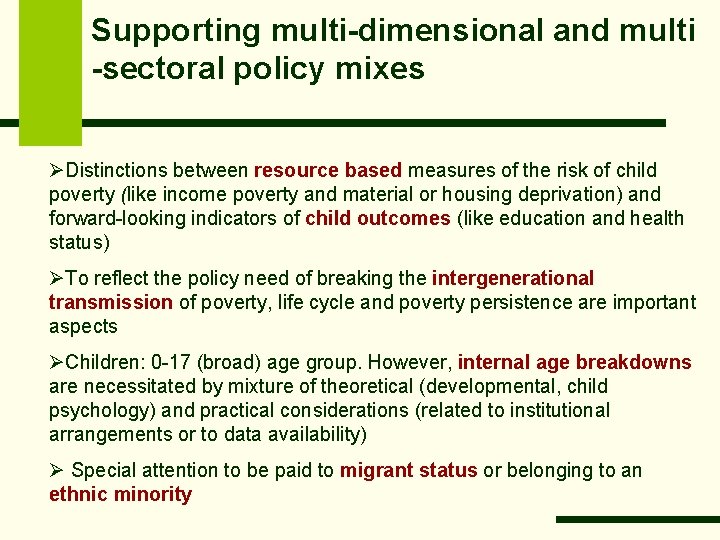
Supporting multi-dimensional and multi -sectoral policy mixes ØDistinctions between resource based measures of the risk of child poverty (like income poverty and material or housing deprivation) and forward-looking indicators of child outcomes (like education and health status) ØTo reflect the policy need of breaking the intergenerational transmission of poverty, life cycle and poverty persistence are important aspects ØChildren: 0 -17 (broad) age group. However, internal age breakdowns are necessitated by mixture of theoretical (developmental, child psychology) and practical considerations (related to institutional arrangements or to data availability) Ø Special attention to be paid to migrant status or belonging to an ethnic minority
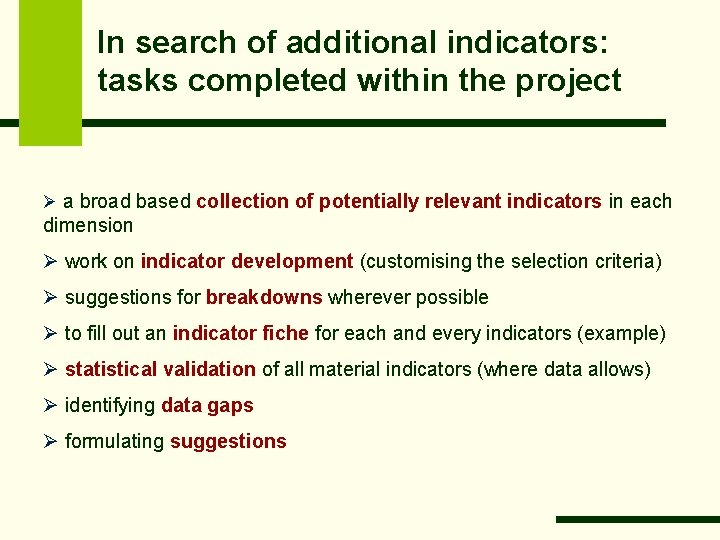
In search of additional indicators: tasks completed within the project Ø a broad based collection of potentially relevant indicators in each dimension Ø work on indicator development (customising the selection criteria) Ø suggestions for breakdowns wherever possible Ø to fill out an indicator fiche for each and every indicators (example) Ø statistical validation of all material indicators (where data allows) Ø identifying data gaps Ø formulating suggestions
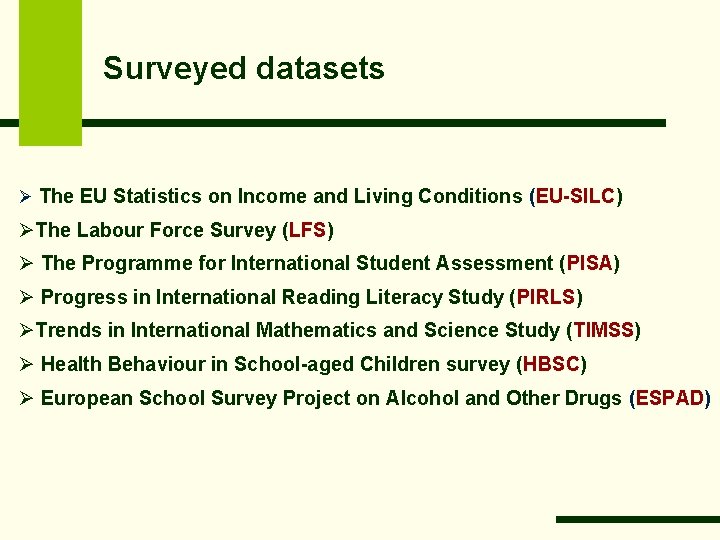
Surveyed datasets Ø The EU Statistics on Income and Living Conditions (EU-SILC) ØThe Labour Force Survey (LFS) Ø The Programme for International Student Assessment (PISA) Ø Progress in International Reading Literacy Study (PIRLS) ØTrends in International Mathematics and Science Study (TIMSS) Ø Health Behaviour in School-aged Children survey (HBSC) Ø European School Survey Project on Alcohol and Other Drugs (ESPAD)
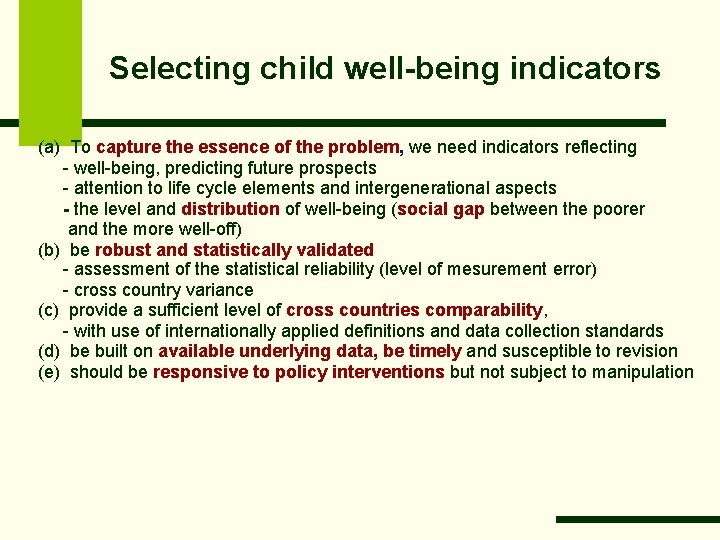
Selecting child well-being indicators (a) To capture the essence of the problem, we need indicators reflecting - well-being, predicting future prospects - attention to life cycle elements and intergenerational aspects - the level and distribution of well-being (social gap between the poorer and the more well-off) (b) be robust and statistically validated - assessment of the statistical reliability (level of mesurement error) - cross country variance (c) provide a sufficient level of cross countries comparability, - with use of internationally applied definitions and data collection standards (d) be built on available underlying data, be timely and susceptible to revision (e) should be responsive to policy interventions but not subject to manipulation
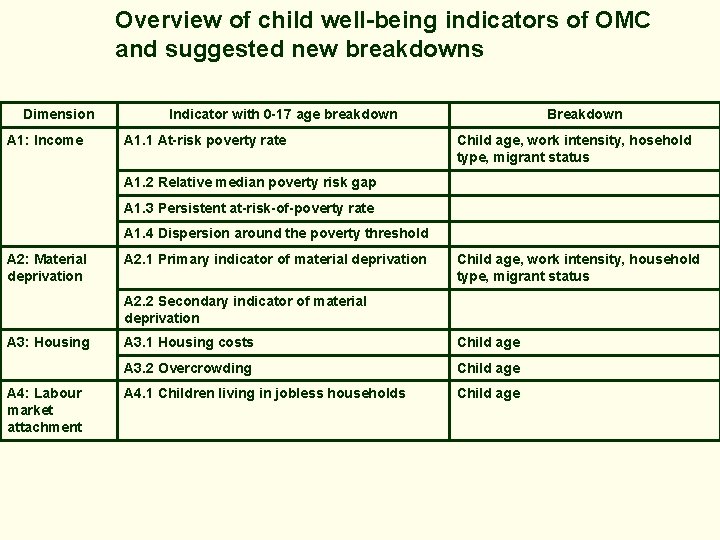
Overview of child well-being indicators of OMC and suggested new breakdowns Dimension A 1: Income Indicator with 0 -17 age breakdown A 1. 1 At-risk poverty rate Breakdown Child age, work intensity, hosehold type, migrant status A 1. 2 Relative median poverty risk gap A 1. 3 Persistent at-risk-of-poverty rate A 1. 4 Dispersion around the poverty threshold A 2: Material deprivation A 2. 1 Primary indicator of material deprivation Child age, work intensity, household type, migrant status A 2. 2 Secondary indicator of material deprivation A 3: Housing A 4: Labour market attachment A 3. 1 Housing costs Child age A 3. 2 Overcrowding Child age A 4. 1 Children living in jobless households Child age
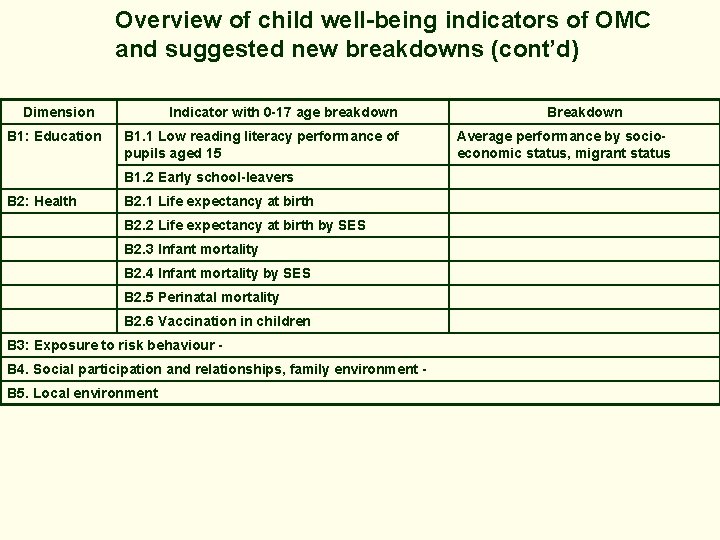
Overview of child well-being indicators of OMC and suggested new breakdowns (cont’d) Dimension B 1: Education Indicator with 0 -17 age breakdown B 1. 1 Low reading literacy performance of pupils aged 15 B 1. 2 Early school-leavers B 2: Health B 2. 1 Life expectancy at birth B 2. 2 Life expectancy at birth by SES B 2. 3 Infant mortality B 2. 4 Infant mortality by SES B 2. 5 Perinatal mortality B 2. 6 Vaccination in children B 3: Exposure to risk behaviour B 4. Social participation and relationships, family environment B 5. Local environment Breakdown Average performance by socioeconomic status, migrant status
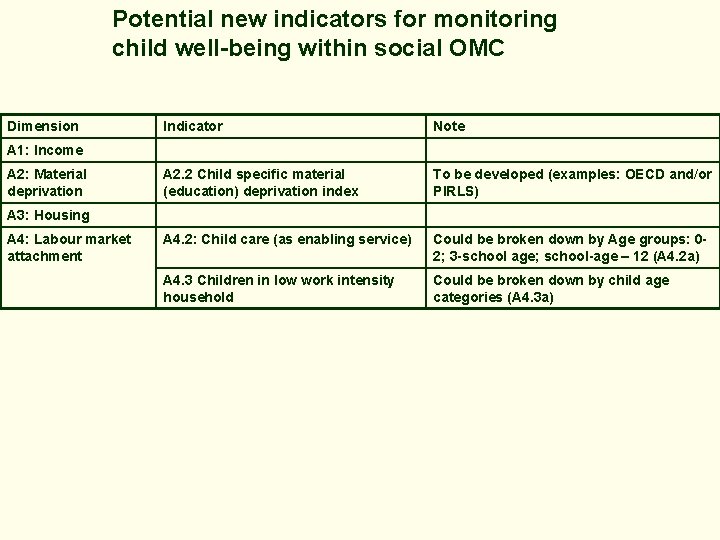
Potential new indicators for monitoring child well-being within social OMC Dimension Indicator Note A 2. 2 Child specific material (education) deprivation index To be developed (examples: OECD and/or PIRLS) A 4. 2: Child care (as enabling service) Could be broken down by Age groups: 02; 3 -school age; school-age – 12 (A 4. 2 a) A 4. 3 Children in low work intensity household Could be broken down by child age categories (A 4. 3 a) A 1: Income A 2: Material deprivation A 3: Housing A 4: Labour market attachment
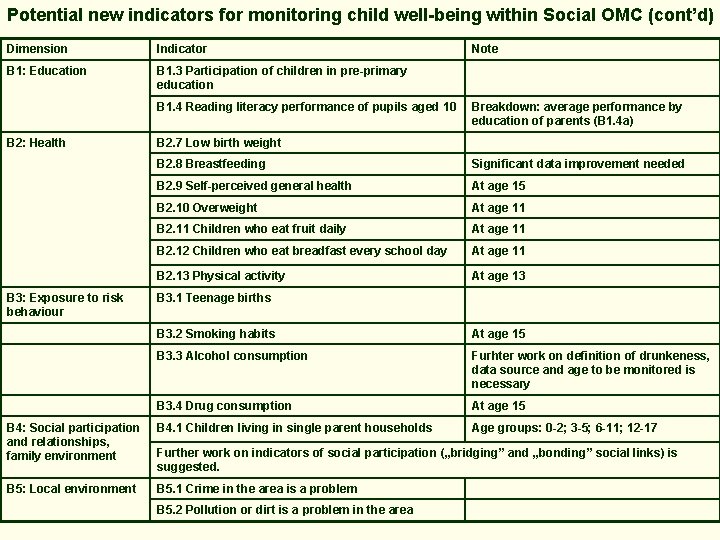
Potential new indicators for monitoring child well-being within Social OMC (cont’d) Dimension Indicator B 1: Education B 1. 3 Participation of children in pre-primary education B 1. 4 Reading literacy performance of pupils aged 10 B 2: Health B 3: Exposure to risk behaviour Note Breakdown: average performance by education of parents (B 1. 4 a) B 2. 7 Low birth weight B 2. 8 Breastfeeding Significant data improvement needed B 2. 9 Self-perceived general health At age 15 B 2. 10 Overweight At age 11 B 2. 11 Children who eat fruit daily At age 11 B 2. 12 Children who eat breadfast every school day At age 11 B 2. 13 Physical activity At age 13 B 3. 1 Teenage births B 3. 2 Smoking habits At age 15 B 3. 3 Alcohol consumption Furhter work on definition of drunkeness, data source and age to be monitored is necessary B 3. 4 Drug consumption At age 15 B 4: Social participation and relationships, family environment B 4. 1 Children living in single parent households Age groups: 0 -2; 3 -5; 6 -11; 12 -17 B 5: Local environment B 5. 1 Crime in the area is a problem Further work on indicators of social participation („bridging” and „bonding” social links) is suggested. B 5. 2 Pollution or dirt is a problem in the area
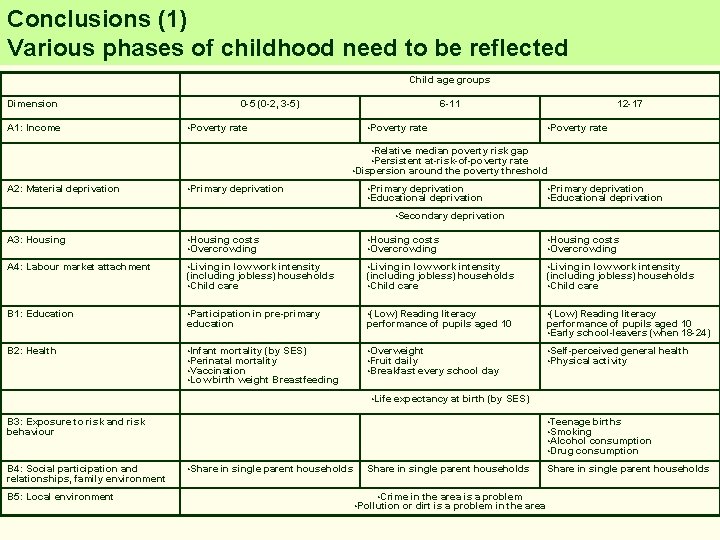
Conclusions (1) Various phases of childhood need to be reflected Child age groups Dimension A 1: Income 0 -5 (0 -2, 3 -5) 6 -11 • Poverty rate 12 -17 • Poverty rate • Relative median poverty risk gap • Persistent at-risk-of-poverty rate • Dispersion around the poverty threshold A 2: Material deprivation • Primary deprivation • Educational deprivation • Secondary deprivation A 3: Housing • Housing costs • Overcrowding A 4: Labour market attachment • Living in low work intensity B 1: Education • Participation in pre-primary • (Low) Reading literacy B 2: Health • Infant mortality (by SES) • Perinatal mortality • Vaccination • Low birth weight Breastfeeding • Overweight • Fruit daily • Breakfast every school day • Self-perceived general health • Physical activity (including jobless) households • Child care education (including jobless) households • Child care performance of pupils aged 10 • Early school-leavers (when 18 -24) • Life expectancy at birth (by SES) B 3: Exposure to risk and risk behaviour B 4: Social participation and relationships, family environment B 5: Local environment • Teenage births • Smoking • Alcohol consumption • Drug consumption • Share in single parent households • Crime in the area is a problem • Pollution or dirt is a problem in the area Share in single parent households
… therefore … filling in the “reserved slot” for child well-being is neither feasible nor desirable with only one or two well-being indicators …
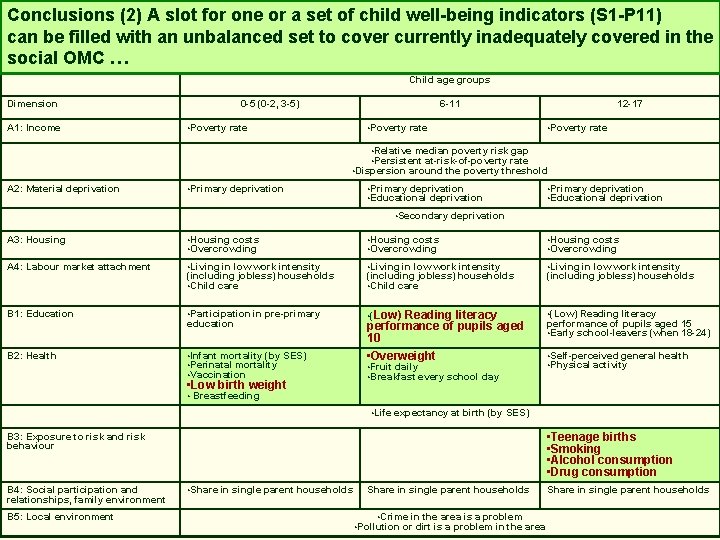
Conclusions (2) A slot for one or a set of child well-being indicators (S 1 -P 11) can be filled with an unbalanced set to cover currently inadequately covered in the social OMC … Child age groups Dimension A 1: Income 0 -5 (0 -2, 3 -5) 6 -11 • Poverty rate 12 -17 • Poverty rate • Relative median poverty risk gap • Persistent at-risk-of-poverty rate • Dispersion around the poverty threshold A 2: Material deprivation • Primary deprivation • Educational deprivation • Secondary deprivation A 3: Housing • Housing costs • Overcrowding A 4: Labour market attachment • Living in low work intensity B 1: Education • Participation in pre-primary • (Low) Reading literacy performance of pupils aged 10 • (Low) Reading literacy B 2: Health • Infant mortality (by SES) • Perinatal mortality • Vaccination • Overweight • Self-perceived general health • Physical activity (including jobless) households • Child care education • Low birth weight (including jobless) households • Child care • Fruit daily • Breakfast every school day (including jobless) households performance of pupils aged 15 • Early school-leavers (when 18 -24) • Breastfeeding • Life expectancy at birth (by SES) • Teenage births • Smoking • Alcohol consumption • Drug consumption B 3: Exposure to risk and risk behaviour B 4: Social participation and relationships, family environment B 5: Local environment • Share in single parent households • Crime in the area is a problem • Pollution or dirt is a problem in the area Share in single parent households
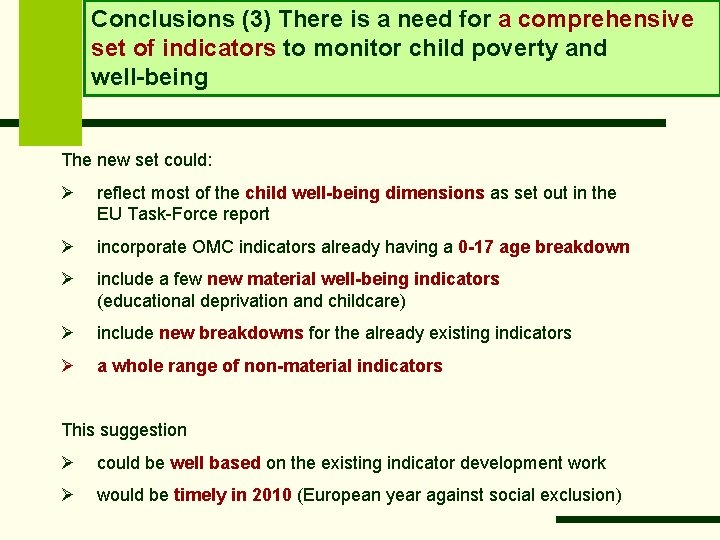
Conclusions (3) There is a need for a comprehensive set of indicators to monitor child poverty and well-being The new set could: Ø reflect most of the child well-being dimensions as set out in the EU Task-Force report Ø incorporate OMC indicators already having a 0 -17 age breakdown Ø include a few new material well-being indicators (educational deprivation and childcare) Ø include new breakdowns for the already existing indicators Ø a whole range of non-material indicators This suggestion Ø could be well based on the existing indicator development work Ø would be timely in 2010 (European year against social exclusion)
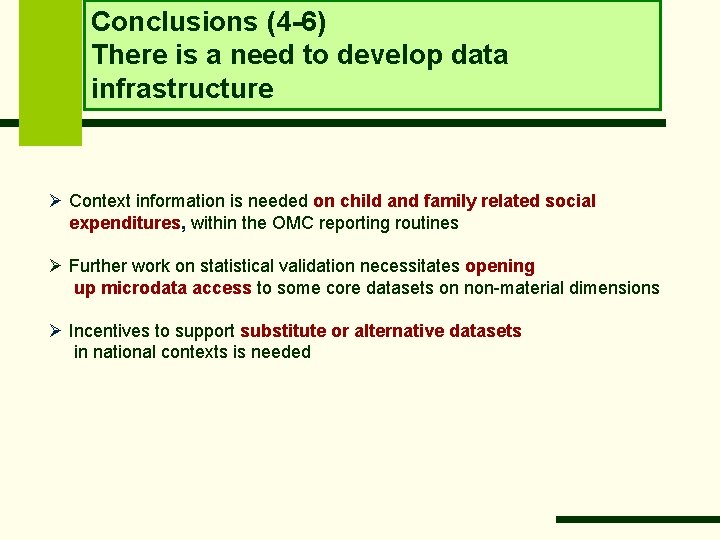
Conclusions (4 -6) There is a need to develop data infrastructure Ø Context information is needed on child and family related social expenditures, within the OMC reporting routines Ø Further work on statistical validation necessitates opening up microdata access to some core datasets on non-material dimensions Ø Incentives to support substitute or alternative datasets in national contexts is needed
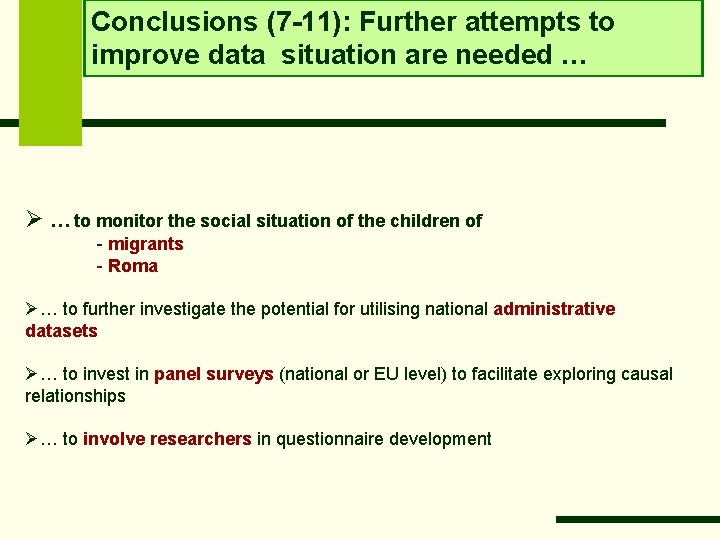
Conclusions (7 -11): Further attempts to improve data situation are needed … Ø … to monitor the social situation of the children of - migrants - Roma Ø… to further investigate the potential for utilising national administrative datasets Ø… to invest in panel surveys (national or EU level) to facilitate exploring causal relationships Ø… to involve researchers in questionnaire development
Final report will be available at: www. tarki. hu
- Slides: 22