
The Use of AI in swine Reproduction Dr
- Slides: 37
The Use of AI in swine Reproduction Dr. Jeff Clapper South Dakota State University
Advantages of AI ·Allows more extensive use of older boars on lighter weight females. ·Decreases the number of boars and time required for breeding when estrus is synchronized. ·Promotes development of a closed herd. ·Allows introduction of new genetic material into a herd with minimum risk of disease. ·You know that semen is alive because you can examine it.
Disadvantages of AI üAI requires a higher level of management in order for it to be effective. üRisk of disease is of greater importance because a diseased boar could spread this to 15 - 20 females. üThere is an increased margin of error brought about by the human factor that may lead to reduced reproductive performance. üIt is easy to become complacent when things are working well. This can lead to cutting corners and a decrease in reproductive performance.
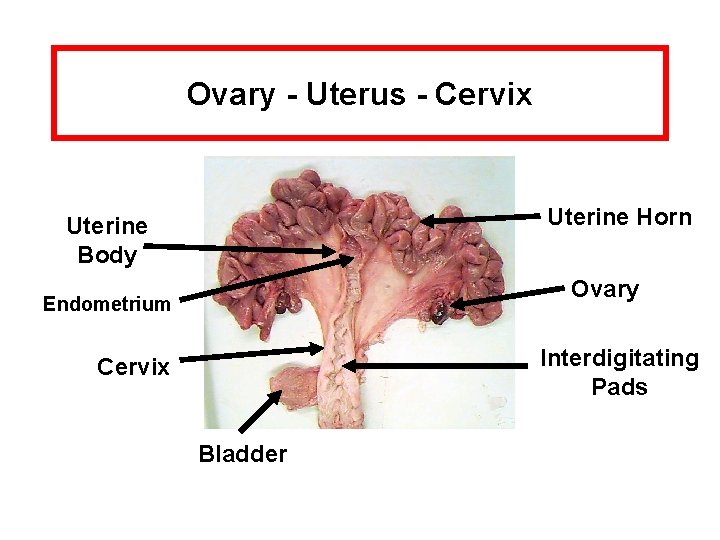
Ovary - Uterus - Cervix Uterine Horn Uterine Body Ovary Endometrium Interdigitating Pads Cervix Bladder
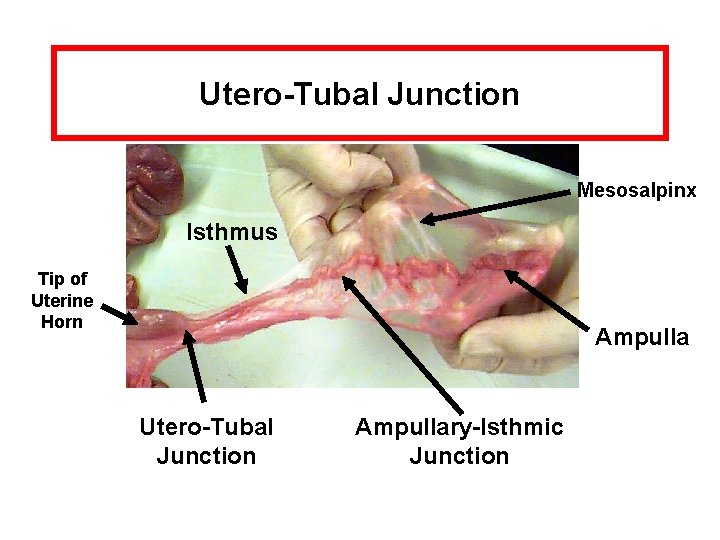
Utero-Tubal Junction Mesosalpinx Isthmus Tip of Uterine Horn Ampulla Utero-Tubal Junction Ampullary-Isthmic Junction
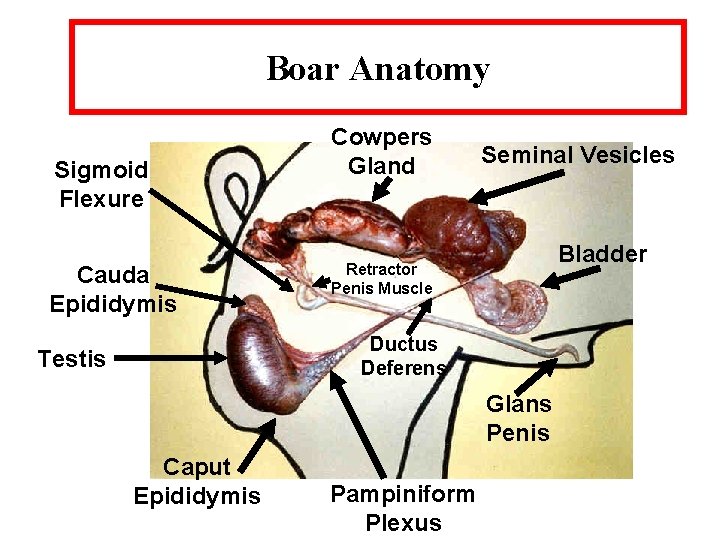
Boar Anatomy Sigmoid Flexure Cauda Epididymis Cowpers Gland Seminal Vesicles Bladder Retractor Penis Muscle Ductus Deferens Testis Glans Penis Caput Epididymis Pampiniform Plexus
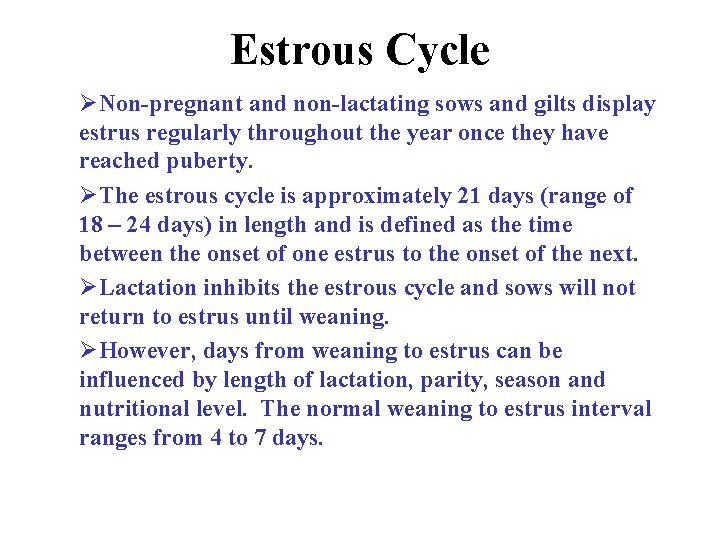
Estrous Cycle ØNon-pregnant and non-lactating sows and gilts display estrus regularly throughout the year once they have reached puberty. ØThe estrous cycle is approximately 21 days (range of 18 – 24 days) in length and is defined as the time between the onset of one estrus to the onset of the next. ØLactation inhibits the estrous cycle and sows will not return to estrus until weaning. ØHowever, days from weaning to estrus can be influenced by length of lactation, parity, season and nutritional level. The normal weaning to estrus interval ranges from 4 to 7 days.
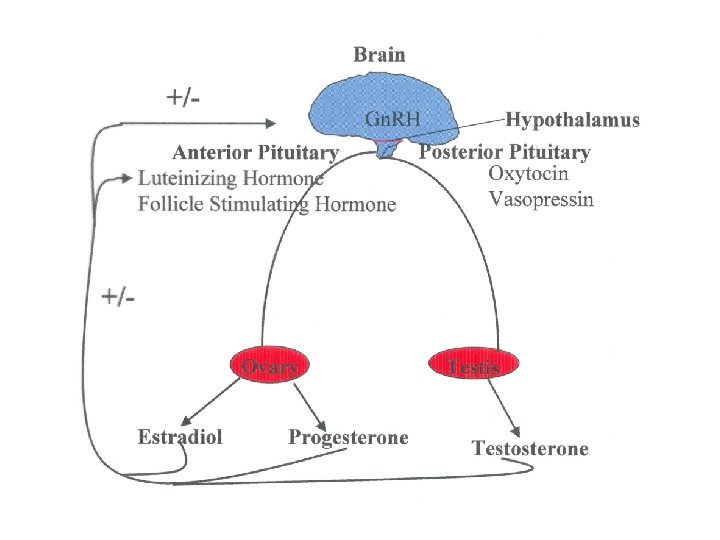
Estrous Cycle ØAs estrus approaches, 6 – 10 follicles form on each ovary. Follicle stimulating hormone (FSH) stimulates the growth of these follicles at a rapid pace for about 3 days prior to estrus. ØCells within each follicle secrete estrogen which causes the typical signs of estrus in the female. ØOvulation, or release of the ova from the follicle, is stimulated by luteinizing hormone (LH). ØOvulation occurs about 40 hours after the onset of estrus but this interval is variable. ØSeveral factors can influence the number of ova shed or ovulation rate.
Generally sows will ovulate 18 – 20 ova while gilts may ovulate 12 – 14 ova. Flushing (feeding increased energy levels prior to estrus) may increase ovulation rate but usually has little effect on litter size. The white or maternal breeds usually have a higher ovulation rate than the colored or terminal breeds. Crossbred females generally ovulate more than either of the parent breeds.
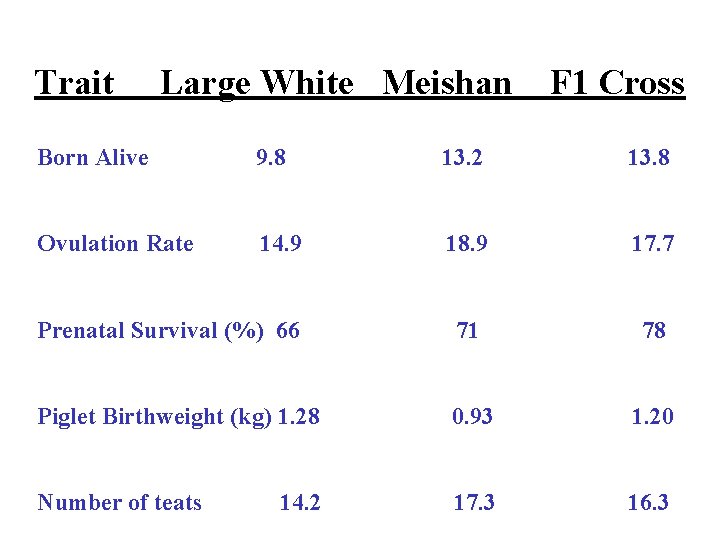
Trait Large White Meishan F 1 Cross Born Alive 9. 8 13. 2 13. 8 Ovulation Rate 14. 9 18. 9 17. 7 Prenatal Survival (%) 66 71 78 Piglet Birthweight (kg) 1. 28 0. 93 1. 20 Number of teats 17. 3 16. 3 14. 2
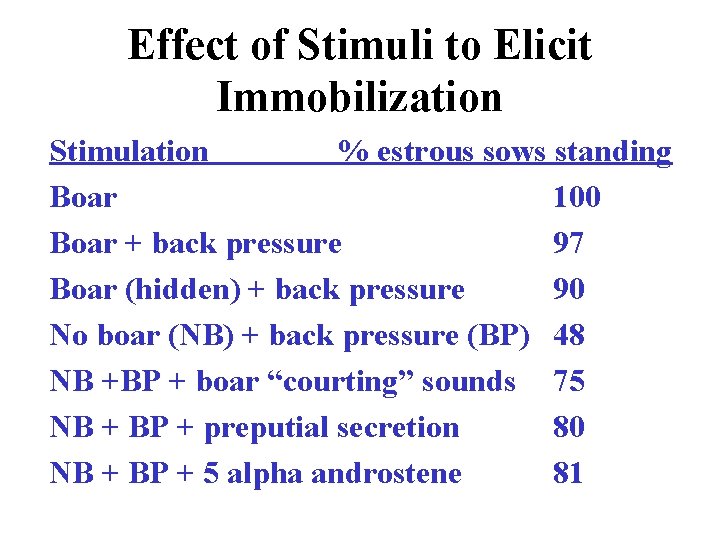
Estrus ØThe onset of estrus and estrus behavior occurs gradually and individual females may respond differently. ØThe classic or primary sign of estrus in the gilt or sow is standing to be mounted by the boar or another sow or gilt. ØMany sows and gilts will also stand for the “back pressure test” when applied by a stockman. However, a higher percentage of females will stand immobile for the stockman if a boar is present.
Effect of Stimuli to Elicit Immobilization Stimulation % estrous sows standing Boar 100 Boar + back pressure 97 Boar (hidden) + back pressure 90 No boar (NB) + back pressure (BP) 48 NB +BP + boar “courting” sounds 75 NB + BP + preputial secretion 80 NB + BP + 5 alpha androstene 81
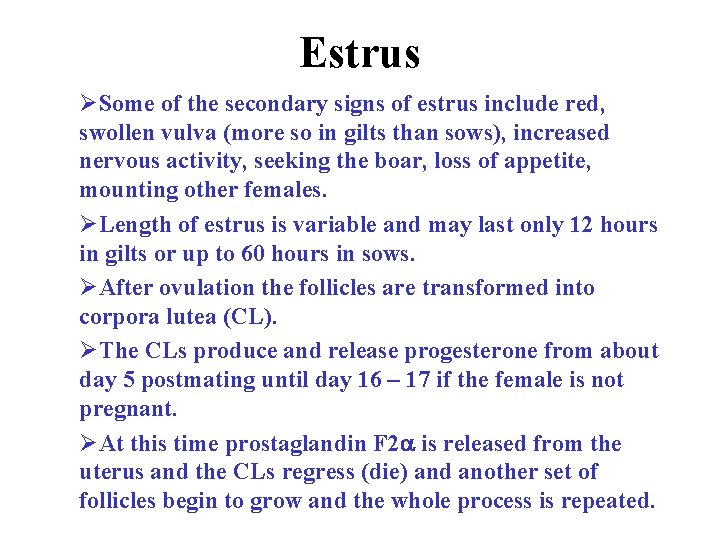
Estrus ØSome of the secondary signs of estrus include red, swollen vulva (more so in gilts than sows), increased nervous activity, seeking the boar, loss of appetite, mounting other females. ØLength of estrus is variable and may last only 12 hours in gilts or up to 60 hours in sows. ØAfter ovulation the follicles are transformed into corpora lutea (CL). ØThe CLs produce and release progesterone from about day 5 postmating until day 16 – 17 if the female is not pregnant. ØAt this time prostaglandin F 2 is released from the uterus and the CLs regress (die) and another set of follicles begin to grow and the whole process is repeated.
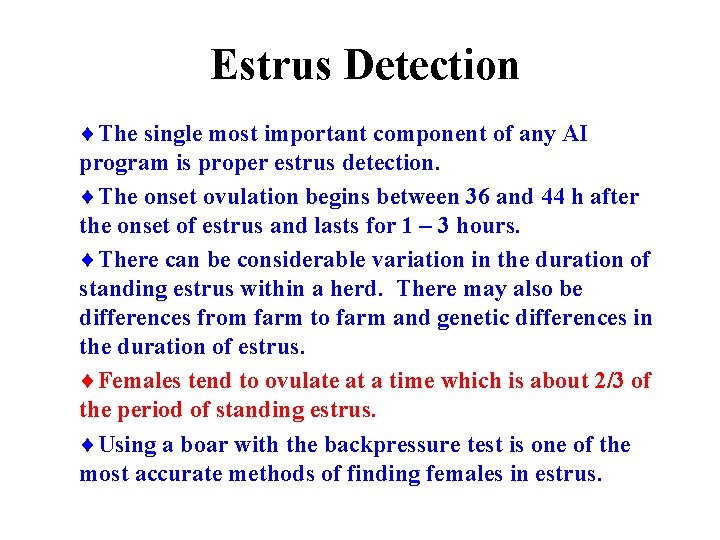
Estrus Detection ¨The single most important component of any AI program is proper estrus detection. ¨The onset ovulation begins between 36 and 44 h after the onset of estrus and lasts for 1 – 3 hours. ¨There can be considerable variation in the duration of standing estrus within a herd. There may also be differences from farm to farm and genetic differences in the duration of estrus. ¨Females tend to ovulate at a time which is about 2/3 of the period of standing estrus. ¨Using a boar with the backpressure test is one of the most accurate methods of finding females in estrus.
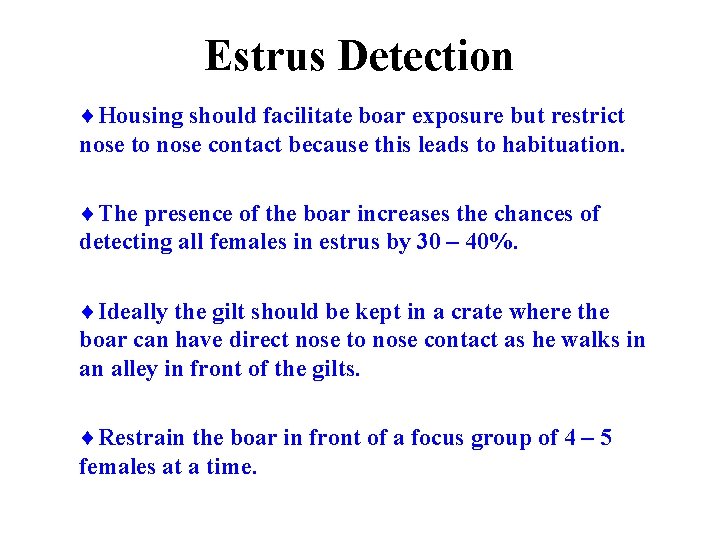
Estrus Detection ¨Housing should facilitate boar exposure but restrict nose to nose contact because this leads to habituation. ¨The presence of the boar increases the chances of detecting all females in estrus by 30 – 40%. ¨Ideally the gilt should be kept in a crate where the boar can have direct nose to nose contact as he walks in an alley in front of the gilts. ¨Restrain the boar in front of a focus group of 4 – 5 females at a time.
Estrus Detection ¨Estrus detection should ideally be performed ½ to 1 hour before or after feeding twice a day at 7: 00 AM and 5: 00 PM or as close to the end of the work day as possible. ¨The more frequently estrus detection is done the better the chances of inseminating at the correct time. ¨Use of an old smelly boar that produces lots of saliva is best. Nose to nose contact is essential because the boar produces a pheromone in the saliva that helps to initiate the standing reflex in the female. ¨The “standing reflex” involves prolonged contractions of the skeletal muscles much like isometric exercises.
Estrus Detection ¨After 5 – 10 minutes the female becomes fatigued and becomes refractory to the boar stimulus or back pressure stimulus for a duration of 1 to 2 hours even though she is in estrus. ¨Sperm can remain viable within the female reproductive tract for 24 hours, however, there is a gradual loss with time. Eggs are only viable for about 6 hours or less. ¨The goal of each manager is to devise an estrus detection and insemination program that will provide an adequate number of viable sperm near the site of ovulation 6 – 10 hours prior to ovulation.
When to Inseminate • Based upon 2 X/d estrus detection: – If sows are in estrus 3 -4 d PW, wait 24 h to inseminate, then inseminate 12 h later. – If sows are in estrus on d 5 PW, wait 12 h to inseminate, then inseminate 12 h later. – If sows are in estrus 6 -7 d PW, inseminate immediately, then inseminate 12 h later.
When to Inseminate • If 1 X/d estrus detections are performed then the sow should be inseminated immediately upon detecting her in estrus and then in 12 h. • Inseminations should continue for every day that she is in estrus but no more than 3 times.
When to Inseminate • Double matings are superior to single matings in terms of litter size and conception rate. • If gilts exhibited estrus for 2 d then double matings increase farrowing rate and litter size. • The number born alive is more related to multiple matings than is farrowing rate. • Semen to be used should be between 36 48 h old.
Sources of Semen • Over 50 different suppliers of boar semen are now available to the producer. Semen is collected and shipped fresh and extended to the customers door via UPS or Fed Ex at a cost of $20 - $40. • Contract Semen Customer signs a contract with semen supplier to use a specified amount of semen each week. This is very cost effective for very large producers that breed a large number of females each week.
Sources of Semen • Semen from a Particular boar - Generally this is the most costly and ranges from $20 $60/dose. Delays can occur if semen is sought from a popular boar. • Special mixed Semen - This is a mixture of semen from many different boars of the same breed. Not as expensive as from a particular boar.
Sources of Semen • Mixed Semen - This is a mixture of semen from many different boars of different breeds. This tends to be the least expesnive and could be used in generating terminal line of commercial pigs. • Left Over Semen - This is semen that is left over from a collection and has not been sold. This is then sold at a discounted price.
Sources of Semen • All semen should be stored in the dark at 62 -65 F (17 C). Semen in extender can last as long as 7 d, but it is best to use it as soon as possible. • Semen in extender should be gently rotated twice a day to ensure mixing of semen with extender.
Training Boars for Semen Collection • Select a person who is patient and enjoys working with animals. • Begin training during the isolation process by building a trust between you and the boar. Spend a few minutes each day scratching, rubbing and talking with the boar. • Boars vary in their rate of sexual development. Some 7 mo old boars are ready to be trained and others require 4 - 6 wks longer.
Training Boars (con’t) • Provide a clean, dry, well lighted area free of distractions. A breeding mat helps provide footing. A boar that slips during mounting may be shy about attempting it again. • Keep the area about 8 x 10 ft, so that the boar is focused. • If possible, collect a previously trained boar first. The odor and sound may stimulate the “rookie” if he is located next to the collection area.
Training Boars (con’t) • Adjust the dummy so that it is equal to or slightly lower than the boar being trained. • Plan for short training sessions (15 -20 min). Some boars may mount the dummy immediately but others may want to explore the pen and dummy for several session.
Training Boars (con’t) • Some boars require coaxing. Crouch down near the dummy, allow the boar to smell your hand clothes and talk in a reassuring tone. Try pouring semen from a previous collection on the dummy. • Keep the boar focused on the dummy. If needed, use winged gates to keep him in front of the dummy.
Insemination Process • Move the boar in front of 2 -3 estrus females to be inseminated. Make sure the female is exposed to the boar before beginning the insemination. • Clean the vulva with a clean dry paper towel. • Part the lips of the vuvla with one hand gently insert the catheter into the vagina pushing forwards and upwards for the first 6 -8 inches. Advance until resistance is felt.
Insemination Process • If using the golden pig catheter, push the catheter into the cervix and you will feel it pop in. • If using a spirette or tother threaded catheter, turn it counterclockwise to enter the cervix. It will flip back when twisted counterclockwise when it is locked in.
Insemination Process • Get the semen from the storage container and resuspend by gently rotating the bottle or cochette. • Cut off the tip of the bottle or open the cochette and place on the catheter. Lift the catheter and apply gentle pressure to fill the catheter and begin the insemination.
Insemination Process • Begin rubbing the underline to stimulate uterine contractions. • Normal services take 5 - 10 min; gilts may take longer. You may have to tip the bottle down to slow the insemination. • Once the container is empty it can be removed. Don’t force air down the catheter.
Insemination Process • The catheter can be removed by clockwise rotation of the spirette or by gently pulling on the foam tip type. • Check the tip of the catheter for blood and record if found.
AI Tips • If the female lays down during insemination, continue with procedure as she lays down. Slapping her to get her up inhibits the release of oxytocin and uterine contractions. • Sows may pull the semen from the bottle faster than needed, lower the bag or bottle to slow deposition of the semen.
AI Tips • If the bottle of semen is collapsed and still has some semen left in it, remove the bottle and allow it to re-expand with air and then reconnect to the catheter and finish. • Bend the catheter to prevent the backflow of semen after insemination and continue to rub the underline.