
The Use of Accelerator Beams for Calibration and
The Use of Accelerator Beams for Calibration and Characterization of Solid State Nuclear Track Detectors Eric Benton Department of Physics Oklahoma State University, Stillwater, OK 74078 USA
Uses of Accelerators for SSNTD Research • Calibration/Determination of NTD sensitivity • Space Radiation Photoreaction and Dosimetry (calibration, intercomparison of detectors from different labs, assessment of shielding materials) • Cosmic Ray (Astrophysics) Research • Nuclear and Particle Physics • Neutron Dosimetry • Air Crew Dosimetry • etc.
Accelerators useful for SSNTD Research Accelerator must produce particles that will result in tracks in CR-39 PNTD • Tracks formed by primary particles (LET H 2 O 5 ke. V/ m) – £ 12 Me. V Protons – £ 200 Me. V a-particles – ions of Z 6 of all energies • Tracks formed by secondaries produced in nuclear interactions between primaries and heavy target nuclei – high energy protons – neutrons • Range of particle in NTD must be sufficient to leave visible track after etching. . . low energy limitation.
Useful to (arbitrarily) group Accelerators by Beam Energy • • Primary Particles form Tracks Very High Energy Heavy Ion Accelerators Medium Energy Heavy Ion Accelerators Low Energy Heavy Ion/Proton Accelerators • • Secondary Particles Produce Tracks Medium to High Energy Proton Accelerators Spallation Neutron Sources

Very High Energy Heavy Ion Accelerator Facilities • These facilities can accelerate heavy ions (Z>1) for use in SSNTD studies, but rarely do. • Difficult to get beam time for SSNTD experiments on these accelerators.
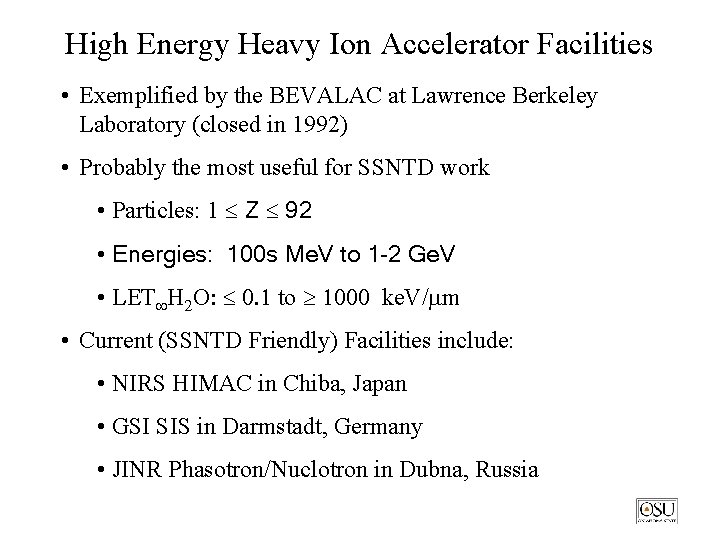
High Energy Heavy Ion Accelerator Facilities • Exemplified by the BEVALAC at Lawrence Berkeley Laboratory (closed in 1992) • Probably the most useful for SSNTD work • Particles: 1 £ Z £ 92 • Energies: 100 s Me. V to 1 -2 Ge. V • LET H 2 O: £ 0. 1 to 1000 ke. V/ m • Current (SSNTD Friendly) Facilities include: • NIRS HIMAC in Chiba, Japan • GSI SIS in Darmstadt, Germany • JINR Phasotron/Nuclotron in Dubna, Russia
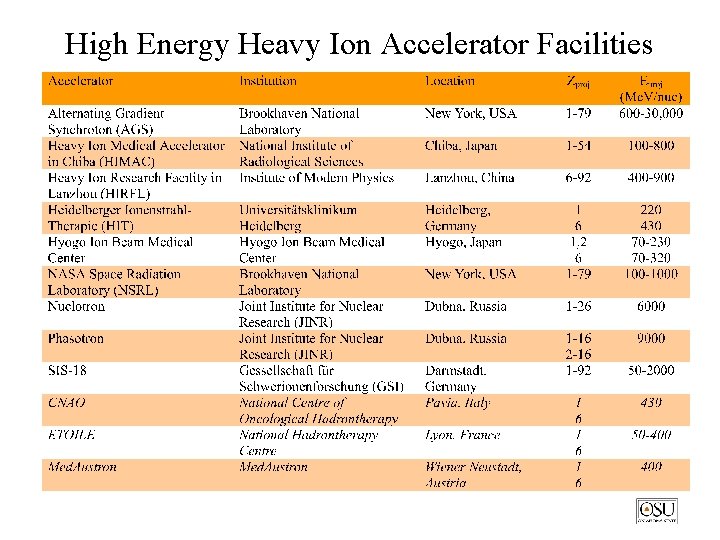
High Energy Heavy Ion Accelerator Facilities
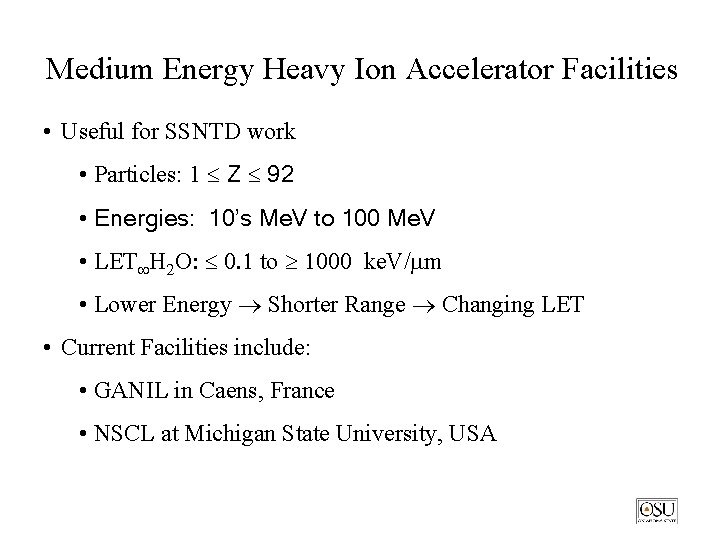
Medium Energy Heavy Ion Accelerator Facilities • Useful for SSNTD work • Particles: 1 £ Z £ 92 • Energies: 10’s Me. V to 100 Me. V • LET H 2 O: £ 0. 1 to 1000 ke. V/ m • Lower Energy ® Shorter Range ® Changing LET • Current Facilities include: • GANIL in Caens, France • NSCL at Michigan State University, USA
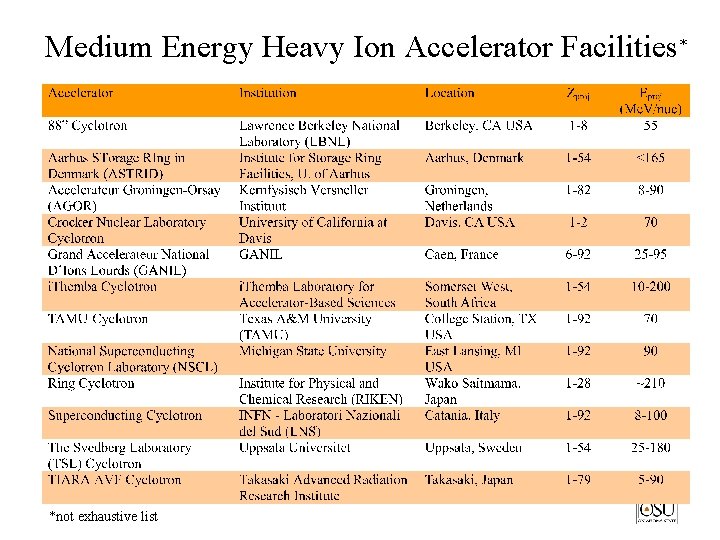
Medium Energy Heavy Ion Accelerator Facilities* *not exhaustive list
Low Energy Heavy Ion Accelerator Facilities • Limited usefulness in SSNTD work • Particles: 1 £ Z £ 92 • Energies: 1 to 10 Me. V • LET H 2 O: 500 ke. V/ m • Low Energy ® Very Short Range ® Changing LET • Low Energy ® Very Short Range ® over etch tracks • Current Facilities include: • GSI Unilac in Darmstadt, Germany • BNL Tandem Van de Graaff in New York, USA
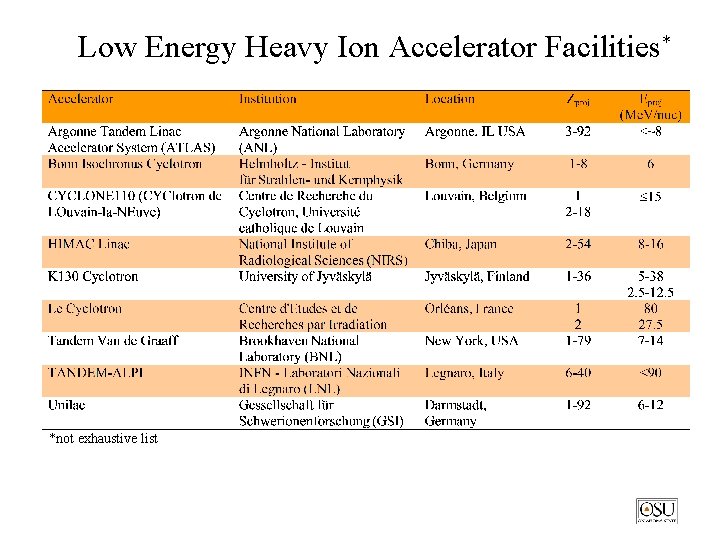
Low Energy Heavy Ion Accelerator Facilities* *not exhaustive list
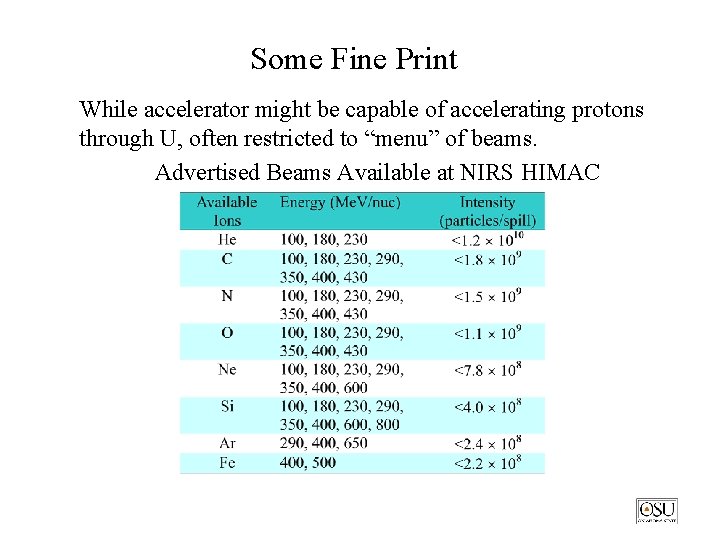
Some Fine Print While accelerator might be capable of accelerating protons through U, often restricted to “menu” of beams. Advertised Beams Available at NIRS HIMAC
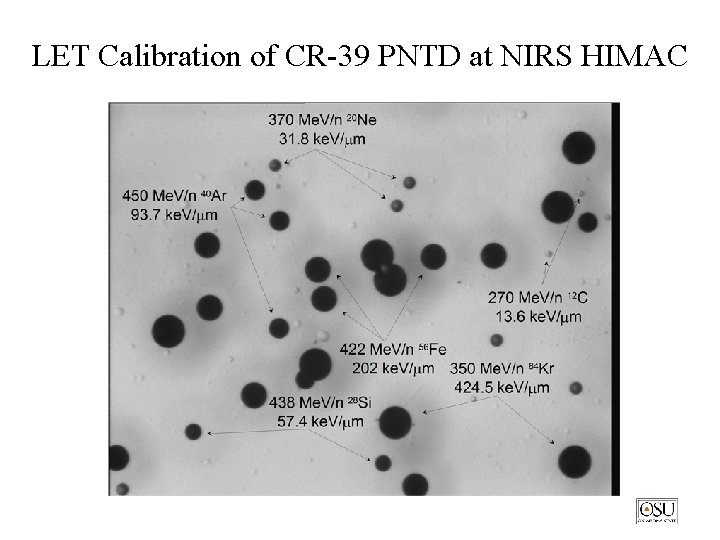
LET Calibration of CR-39 PNTD at NIRS HIMAC
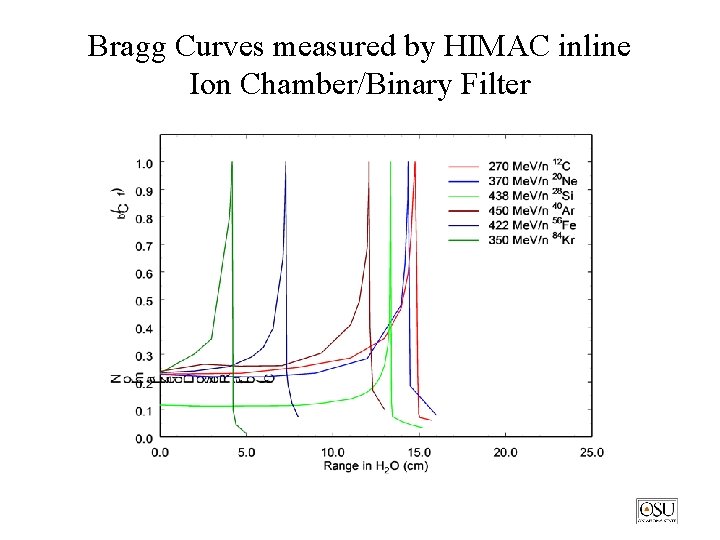
Bragg Curves measured by HIMAC inline Ion Chamber/Binary Filter
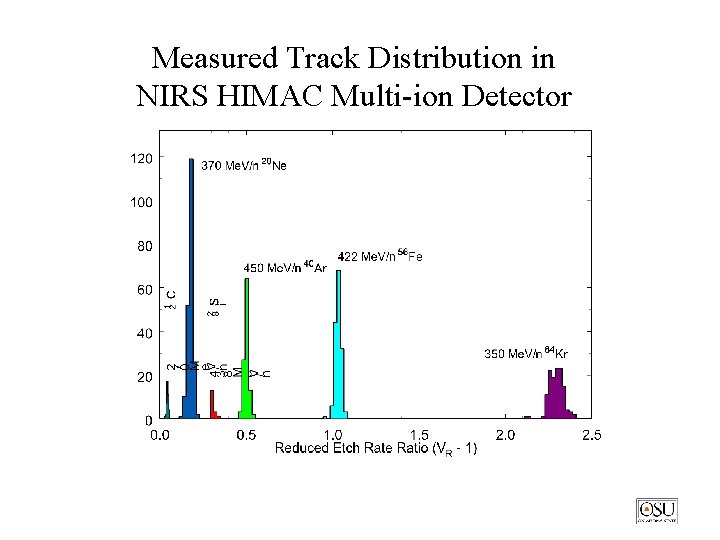
Measured Track Distribution in NIRS HIMAC Multi-ion Detector
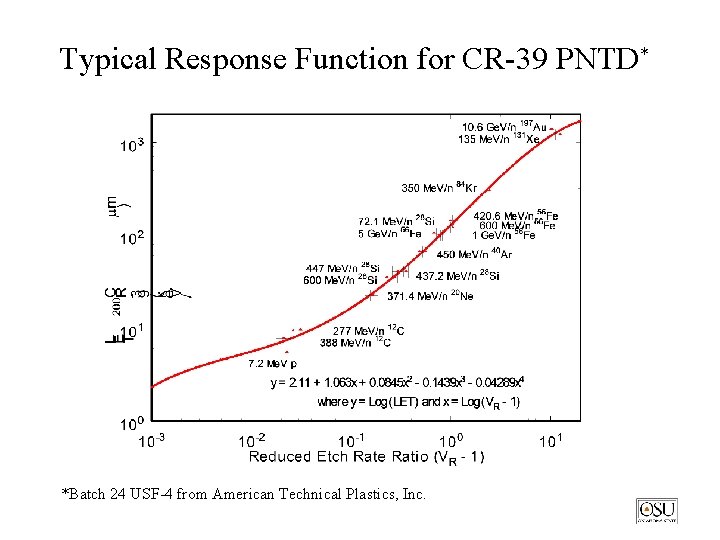
Typical Response Function for CR-39 PNTD* *Batch 24 USF-4 from American Technical Plastics, Inc.
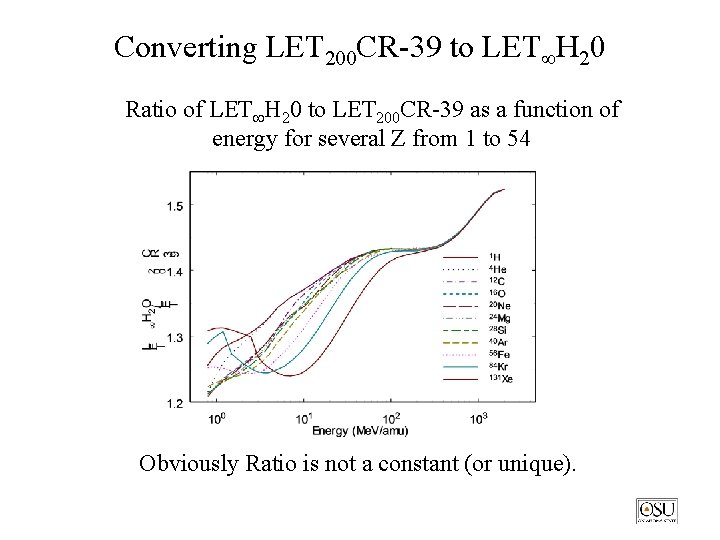
Converting LET 200 CR-39 to LET H 20 Ratio of LET H 20 to LET 200 CR-39 as a function of energy for several Z from 1 to 54 Obviously Ratio is not a constant (or unique).
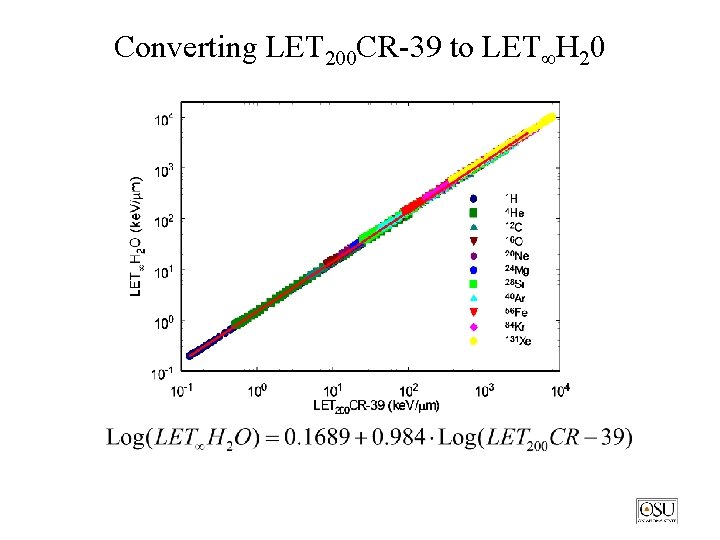
Converting LET 200 CR-39 to LET H 20
ICCHIBAN Project (Inter. Comparison of Cosmic-rays with Heavy Ion Beams At NIRS) Objectives of the ICCHIBAN Project • • • Determine the response of space radiation dosimeters to heavy ions of charge and energy similar to that found in the galactic cosmic radiation (GCR) spectrum. Compare response and sensitivity of various space radiation monitoring instruments. Aid in reconciling differences in measurements made by various radiation instruments during space flight. Establish and characterize a heavy ion “reference standard” against which space radiation instruments can be calibrated.
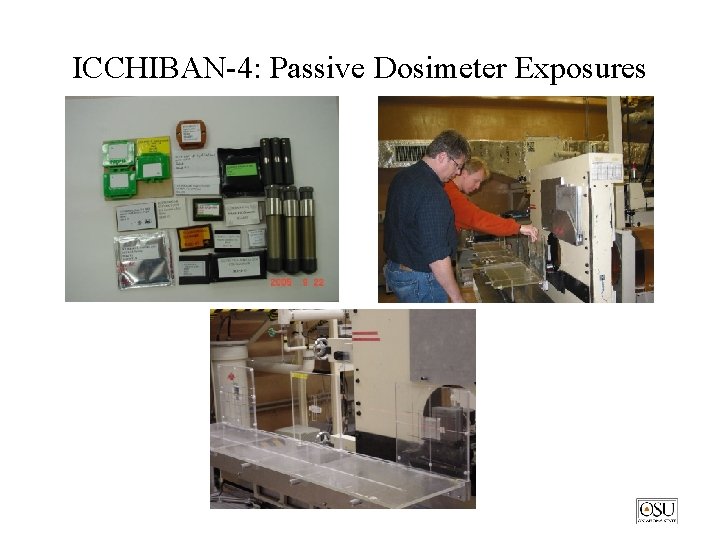
ICCHIBAN-4: Passive Dosimeter Exposures
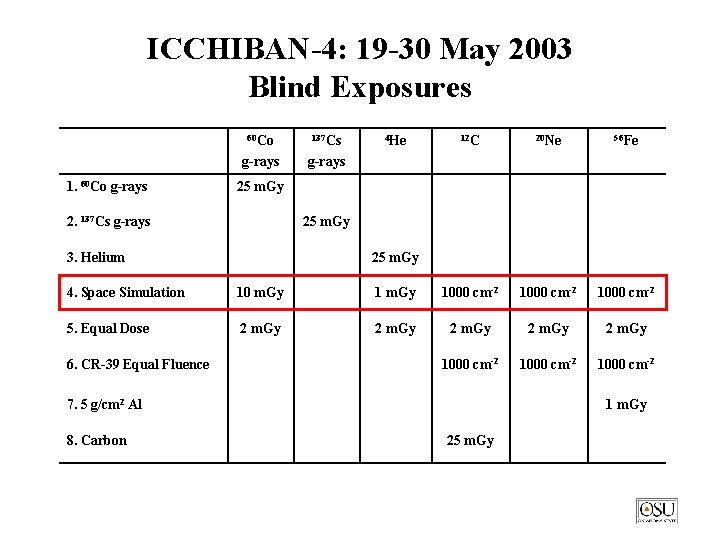
ICCHIBAN-4: 19 -30 May 2003 Blind Exposures 1. 60 Co g-rays 60 Co 137 Cs g-rays 4 He 12 C 20 Ne 56 Fe 25 m. Gy 2. 137 Cs g-rays 25 m. Gy 3. Helium 25 m. Gy 4. Space Simulation 10 m. Gy 1000 cm-2 5. Equal Dose 2 m. Gy 1000 cm-2 6. CR-39 Equal Fluence 7. 5 g/cm 2 Al 8. Carbon 1 m. Gy 25 m. Gy
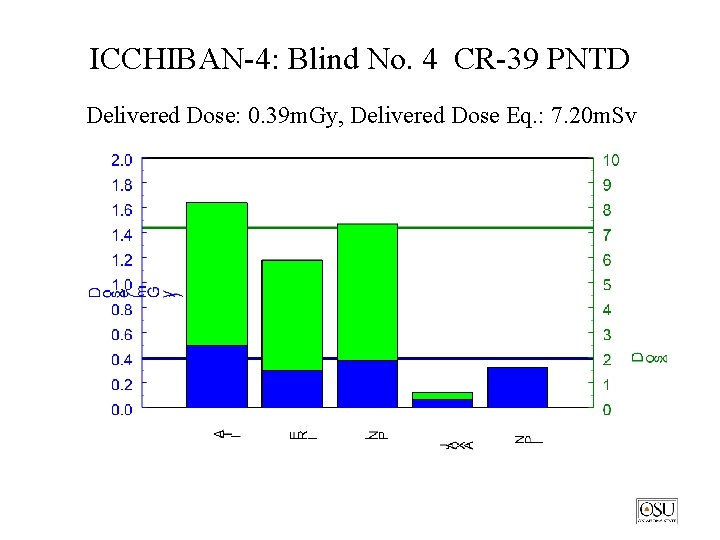
ICCHIBAN-4: Blind No. 4 CR-39 PNTD Delivered Dose: 0. 39 m. Gy, Delivered Dose Eq. : 7. 20 m. Sv
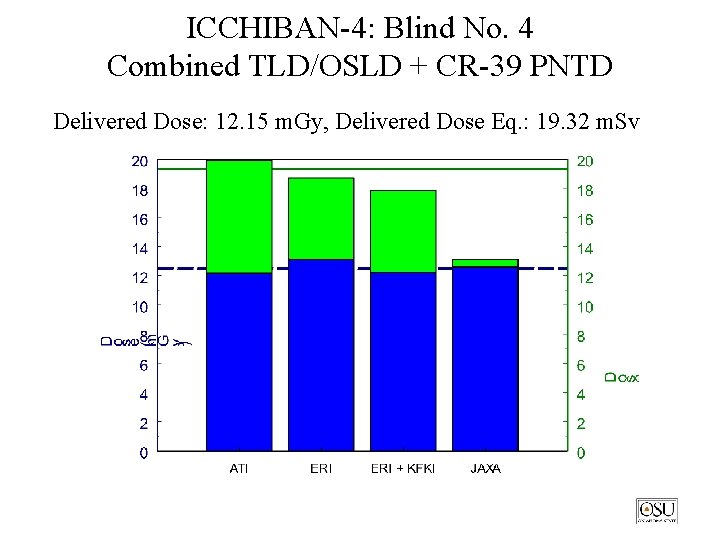
ICCHIBAN-4: Blind No. 4 Combined TLD/OSLD + CR-39 PNTD Delivered Dose: 12. 15 m. Gy, Delivered Dose Eq. : 19. 32 m. Sv
Proton and Carbon Beam Radiotherapy Accelerators • ~30 Proton Cancer Treatment Centers operating worldwide • ~10 more Proton Centers to become operation over next five years • 4 -5 Carbon Cancer Treatment Accelerators operating worldwide • 2 -3 Carbon Cancer Treatment Accelerators over next five years
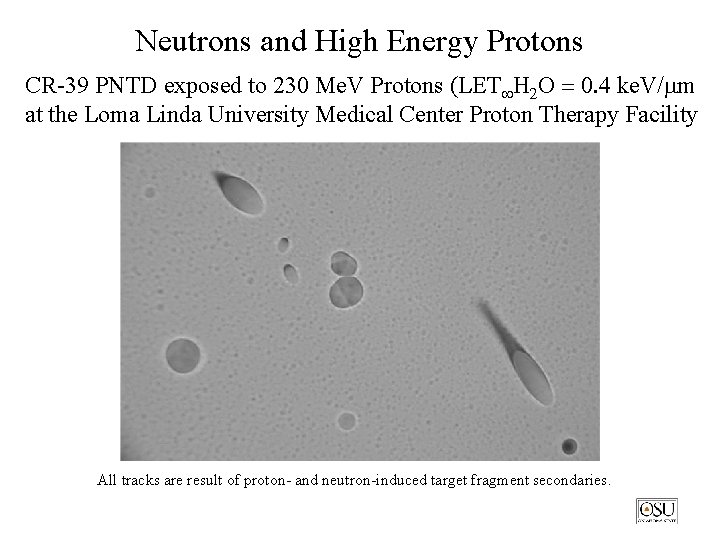
Neutrons and High Energy Protons CR-39 PNTD exposed to 230 Me. V Protons (LET H 2 O = 0. 4 ke. V/ m at the Loma Linda University Medical Center Proton Therapy Facility All tracks are result of proton- and neutron-induced target fragment secondaries.
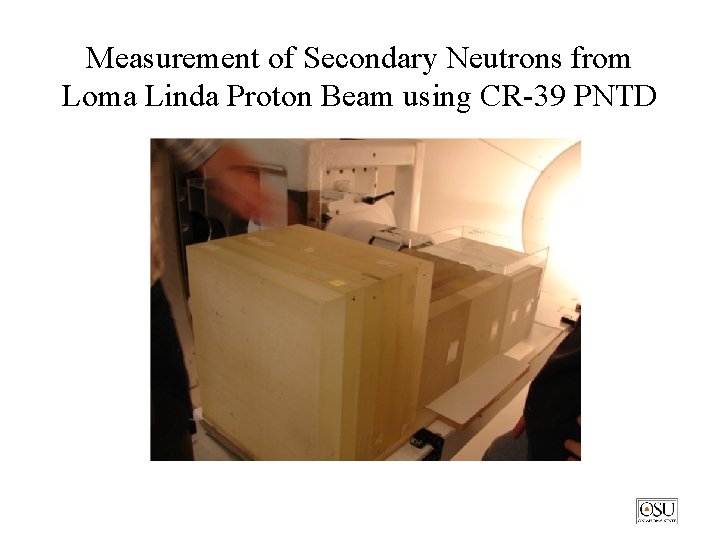
Measurement of Secondary Neutrons from Loma Linda Proton Beam using CR-39 PNTD
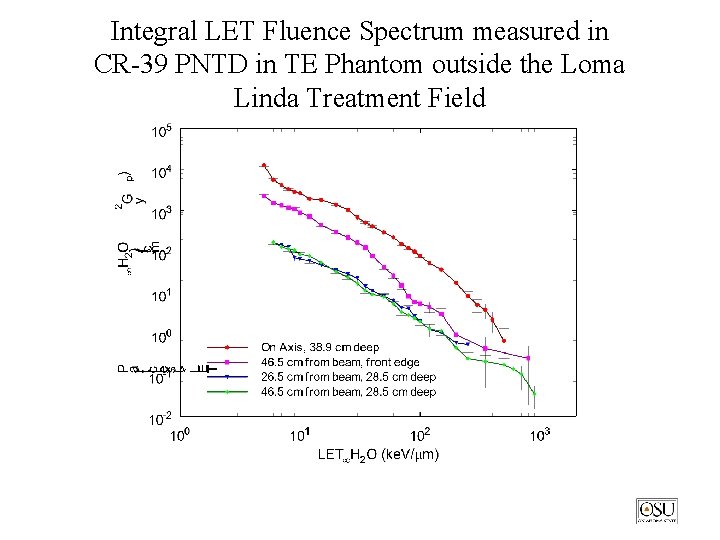
Integral LET Fluence Spectrum measured in CR-39 PNTD in TE Phantom outside the Loma Linda Treatment Field
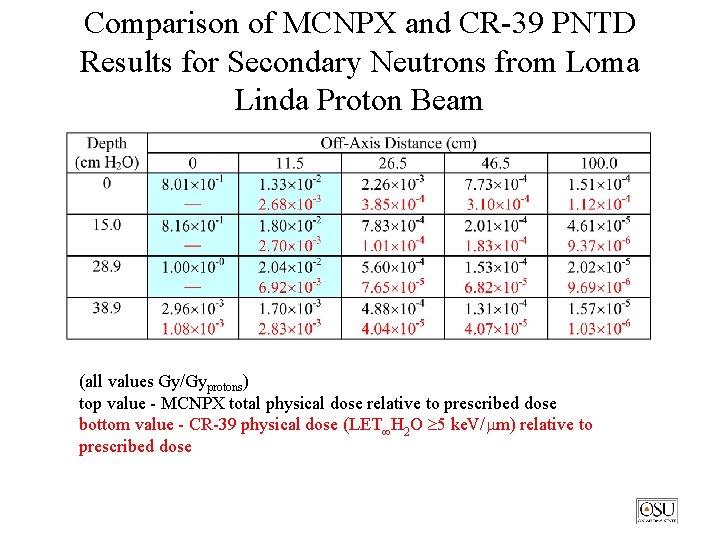
Comparison of MCNPX and CR-39 PNTD Results for Secondary Neutrons from Loma Linda Proton Beam (all values Gy/Gyprotons) top value - MCNPX total physical dose relative to prescribed dose bottom value - CR-39 physical dose (LET H 2 O 5 ke. V/ m) relative to prescribed dose
Concluding Remarks • SSNTDs and Accelerators make up a “two-way street” • Accelerators are useful in calibrating and investigating SSNTDs • SSNTDs useful in characterizing Accelerator beams • Together, both can be used for other science (e. g. nuclear physics measurements, ICCHIBAN) • High Energy Heavy Ion Accelerators are often the most useful: • Limited number of facilities • New opportunities due to growth of Carbon Radiotherapy • Beam time (often at no cost) is available through a proposal submission/review process.

Acknowledgements • Nakahiro Yasuda, Yukio Uchihori, and Hisashi Kitamura of the National Institute for Radiological Sciences, Chiba, Japan • Jack Miller of Lawrence Berkeley National Laboratory • Dieter Schardt of Gessellschaft für Schwerionenforschung (GSI) • Michael Moyers of Loma Linda University Medical Center
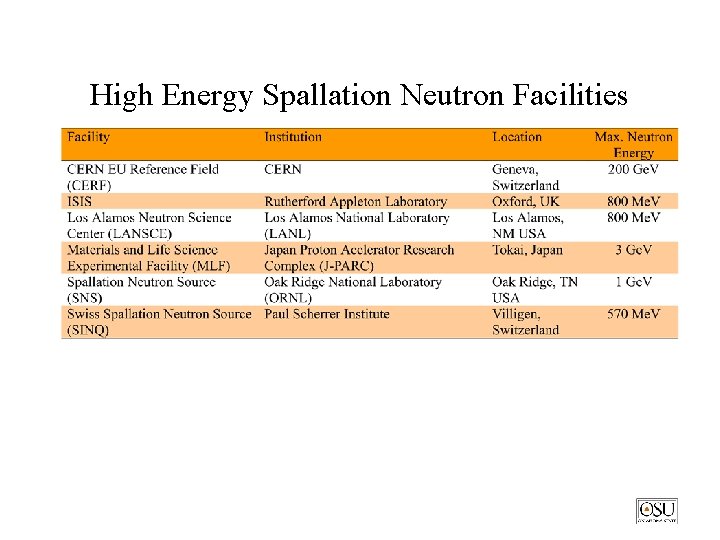
High Energy Spallation Neutron Facilities
- Slides: 31