
THE US NATIONAL VIRTUAL OBSERVATORY The Virtual Observatory
THE US NATIONAL VIRTUAL OBSERVATORY The Virtual Observatory: Core Capabilities and Support for Statistical Analyses in Astronomy Robert Hanisch US National Virtual Observatory Space Telescope Science Institute 25 Jan 2006 1
Overview The objective of the Virtual Observatory is to enable new science by greatly enhancing access to data and computing resources. The VO is intended to make it easy to locate, retrieve, and analyze data from archives and catalogs worldwide. • Motivation; who’s involved; technical challenges and approach; capabilities • Statistics in the VO • Future 25 Jan 2006 2
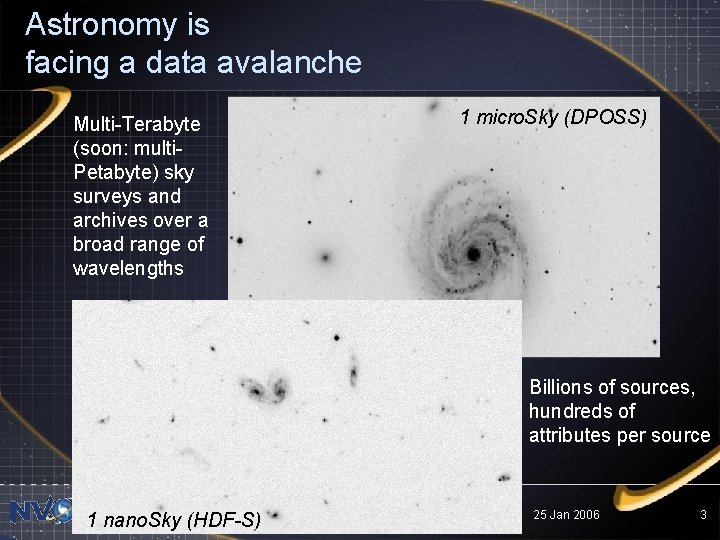
Astronomy is facing a data avalanche Multi-Terabyte (soon: multi. Petabyte) sky surveys and archives over a broad range of wavelengths 1 micro. Sky (DPOSS) Billions of sources, hundreds of attributes per source 1 nano. Sky (HDF-S) 25 Jan 2006 3
The changing face of observational astronomy • Large digital sky surveys are becoming dominant source of data in astronomy: > 100 TB, growing rapidly – SDSS, 2 MASS, DPOSS, GSC, FIRST, NVSS, RASS, IRAS, QUEST, GALEX, SST; CMBR experiments; Microlensing experiments; NEAT, LONEOS, and other searches for Solar system objects – Digital libraries: ADS, astro-ph, NED, CDS, NSSDC – Observatory archives: HST, CXO, space and ground-based – Future: Pan. STARRS, LSST, and other synoptic surveys; astrometric missions, GW detectors • Data sets orders of magnitude larger, more complex, more homogeneous than in the past • Roughly 1 TB/Sky/band/epoch – Human Genome is < 1 GB, Library of Congress ~ 20 TB 25 Jan 2006 4
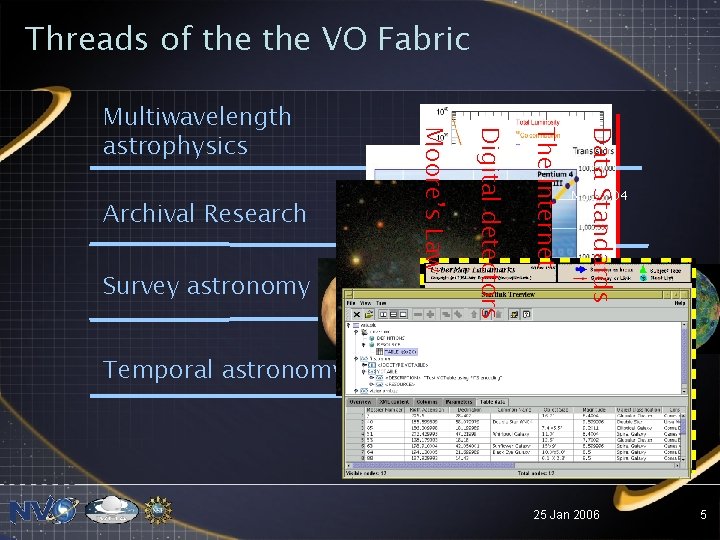
Threads of the VO Fabric Data Standards The Internet Survey astronomy Digital detectors Archival Research Moore’s Law Multiwavelength astrophysics NGC 3104 Temporal astronomy 25 Jan 2006 5
Who is the National Virtual Observatory? • US NVO development project, funded by NSF Information Technology Program and managed by NSF Astronomy Division, is in final year of 5 -year project • Funding is $10 M+ over the 5 years • 17 organizations (astro, CS, IT) involved – JHU (PI Alex Szalay), STSc. I, Caltech (Astronomy, IPAC, CACR), HEASARC, SAO, NRAO, NOAO, NCSA, SDSC, FNAL, USNO, et al. • Collaboration with Gemini, LSST, et al. 25 Jan 2006 6
International collaboration • NVO is co-founder of the International Virtual Observatory Alliance • IVOA now has 16 member projects • Adopted a standards process based on W 3 C • Forum for discussion and sharing of experience http: //ivoa. net 25 Jan 2006 7
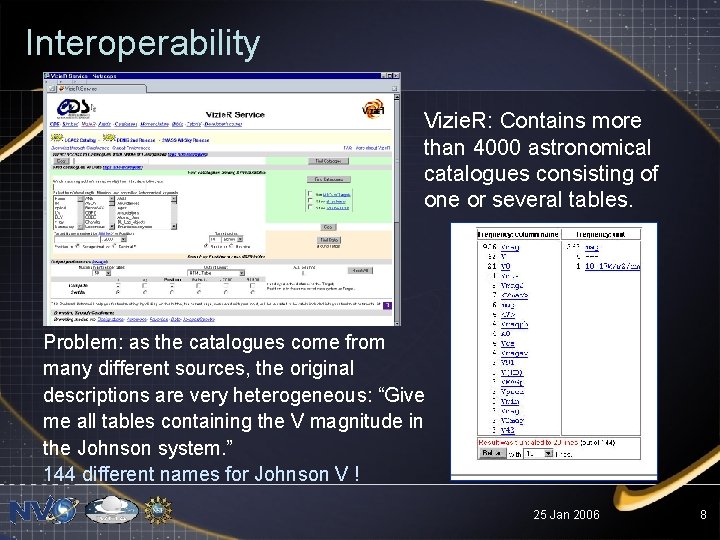
Interoperability Vizie. R: Contains more than 4000 astronomical catalogues consisting of one or several tables. Problem: as the catalogues come from many different sources, the original descriptions are very heterogeneous: “Give me all tables containing the V magnitude in the Johnson system. ” 144 different names for Johnson V ! 25 Jan 2006 8
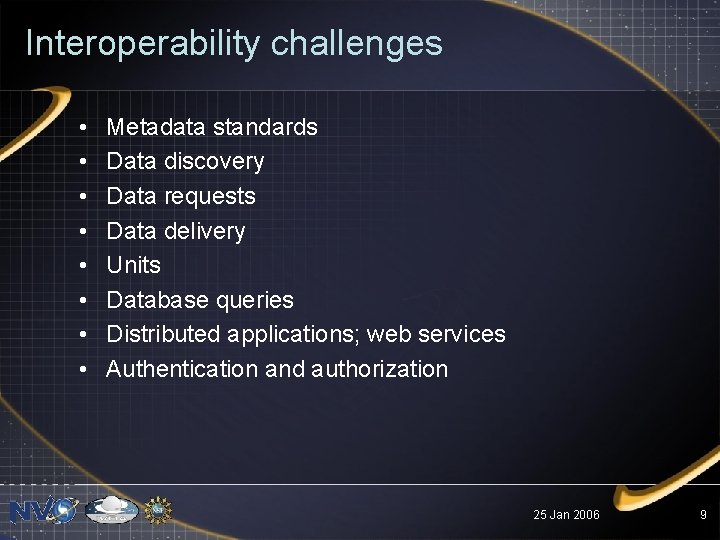
Interoperability challenges • • Metadata standards Data discovery Data requests Data delivery Units Database queries Distributed applications; web services Authentication and authorization 25 Jan 2006 9
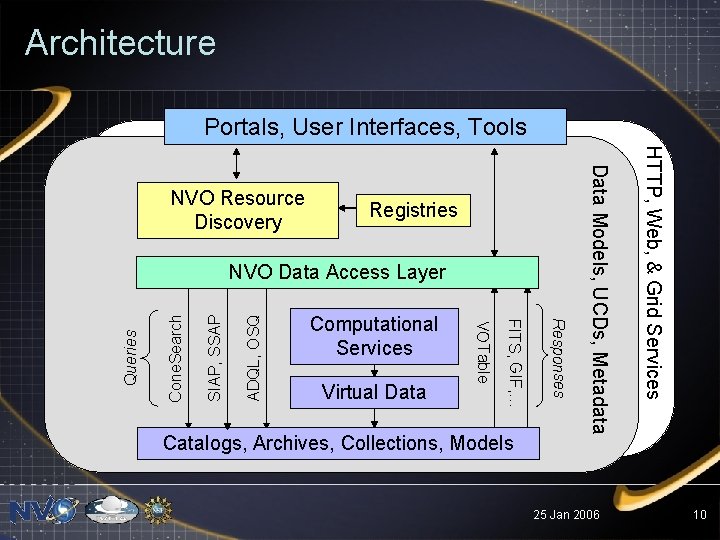
Architecture Portals, User Interfaces, Tools ADQL, OSQ SIAP, SSAP Cone. Search Catalogs, Archives, Collections, Models Responses Virtual Data FITS, GIF, … Computational Services VOTable Queries NVO Data Access Layer 25 Jan 2006 HTTP, Web, & Grid Services Registries Data Models, UCDs, Metadata NVO Resource Discovery 10

NVO Components • Data discovery and location – Resource Registry: Organizations, archives, tables, databases, services – Footprint Services • Data access – Simple tables and observation logs: Cone Search – Images: Simple Image Access Protocol (SIAP) – Spectra: Simple Spectrum Access Protocol (SSAP) VOTables and FITS used to exchange data throughout the VO – Databases: Sky. Node, with Astronomical Data Query Language (ADQL) – Transient events: VOEvent protocol – Data models, Space-Time Coordinates (STC) 25 Jan 2006 11

NVO Components • Distributed data storage – VOStore, VOSpace – Authentication and authorization • Distributed computing – Web services – Grid services – Scalability 25 Jan 2006 12

NVO Applications • • • Registry Interface Data. Scope Coverage Maps Open Sky. Query WESIX (SExtractor) WCS Fixer Spectrum Services VOEvent Net Montage mosaics Integration with legacy software systems 25 Jan 2006 13
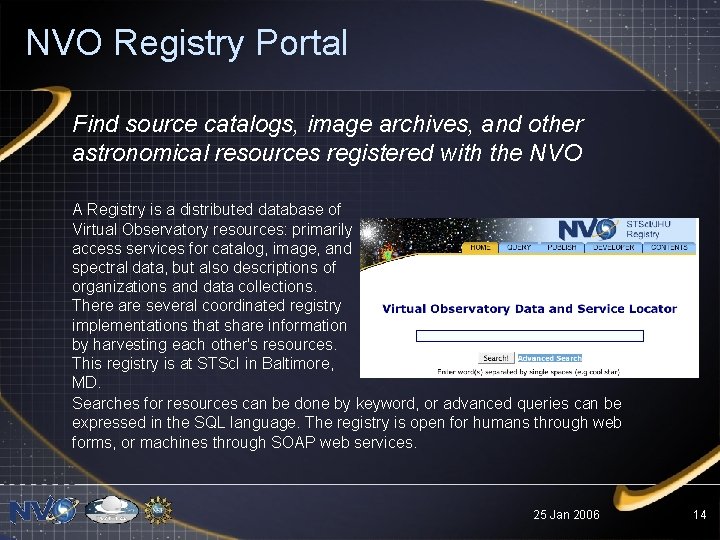
NVO Registry Portal Find source catalogs, image archives, and other astronomical resources registered with the NVO A Registry is a distributed database of Virtual Observatory resources: primarily access services for catalog, image, and spectral data, but also descriptions of organizations and data collections. There are several coordinated registry implementations that share information by harvesting each other's resources. This registry is at STSc. I in Baltimore, MD. Searches for resources can be done by keyword, or advanced queries can be expressed in the SQL language. The registry is open for humans through web forms, or machines through SOAP web services. 25 Jan 2006 14
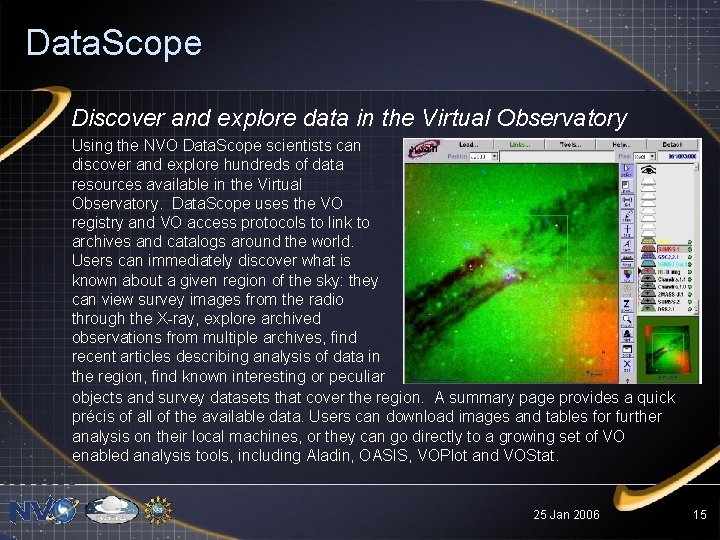
Data. Scope Discover and explore data in the Virtual Observatory Using the NVO Data. Scope scientists can discover and explore hundreds of data resources available in the Virtual Observatory. Data. Scope uses the VO registry and VO access protocols to link to archives and catalogs around the world. Users can immediately discover what is known about a given region of the sky: they can view survey images from the radio through the X-ray, explore archived observations from multiple archives, find recent articles describing analysis of data in the region, find known interesting or peculiar objects and survey datasets that cover the region. A summary page provides a quick précis of all of the available data. Users can download images and tables for further analysis on their local machines, or they can go directly to a growing set of VO enabled analysis tools, including Aladin, OASIS, VOPlot and VOStat. 25 Jan 2006 15
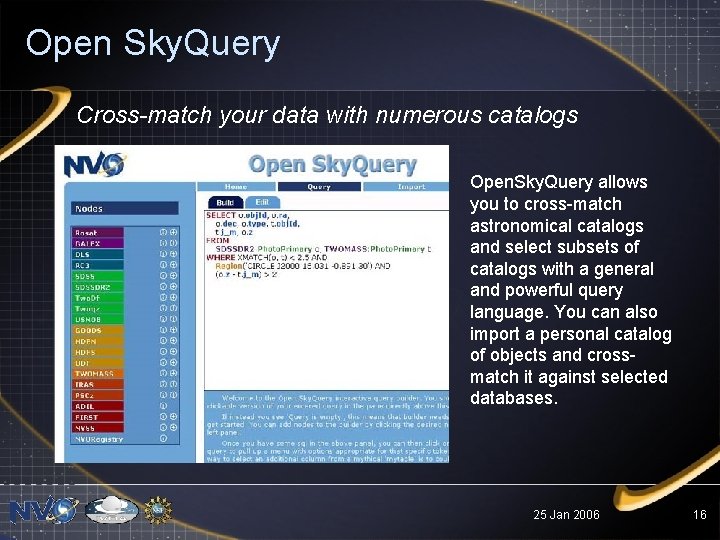
Open Sky. Query Cross-match your data with numerous catalogs Open. Sky. Query allows you to cross-match astronomical catalogs and select subsets of catalogs with a general and powerful query language. You can also import a personal catalog of objects and crossmatch it against selected databases. 25 Jan 2006 16
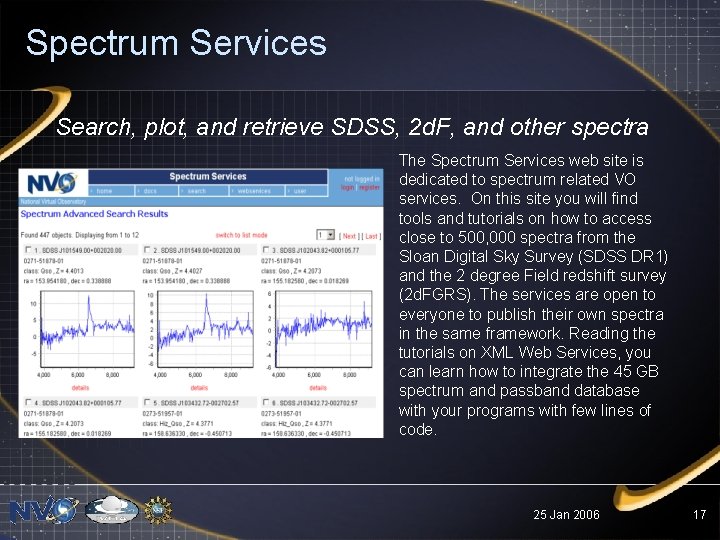
Spectrum Services Search, plot, and retrieve SDSS, 2 d. F, and other spectra The Spectrum Services web site is dedicated to spectrum related VO services. On this site you will find tools and tutorials on how to access close to 500, 000 spectra from the Sloan Digital Sky Survey (SDSS DR 1) and the 2 degree Field redshift survey (2 d. FGRS). The services are open to everyone to publish their own spectra in the same framework. Reading the tutorials on XML Web Services, you can learn how to integrate the 45 GB spectrum and passband database with your programs with few lines of code. 25 Jan 2006 17
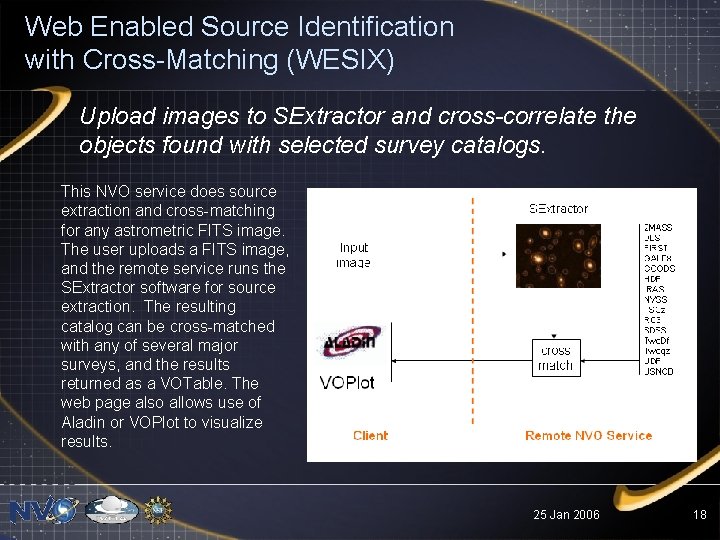
Web Enabled Source Identification with Cross-Matching (WESIX) Upload images to SExtractor and cross-correlate the objects found with selected survey catalogs. This NVO service does source extraction and cross-matching for any astrometric FITS image. The user uploads a FITS image, and the remote service runs the SExtractor software for source extraction. The resulting catalog can be cross-matched with any of several major surveys, and the results returned as a VOTable. The web page also allows use of Aladin or VOPlot to visualize results. 25 Jan 2006 18
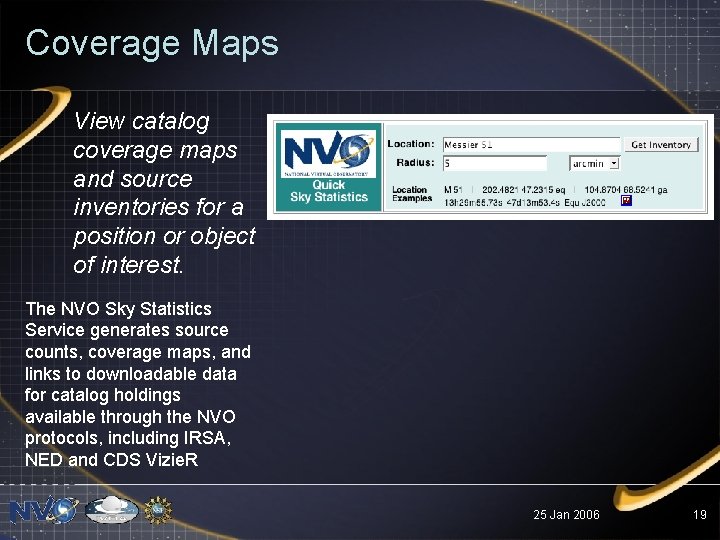
Coverage Maps View catalog coverage maps and source inventories for a position or object of interest. The NVO Sky Statistics Service generates source counts, coverage maps, and links to downloadable data for catalog holdings available through the NVO protocols, including IRSA, NED and CDS Vizie. R 25 Jan 2006 19
WCS Fixer Repair image coordinates in images with inaccurate or misaligned coordinate systems. 25 Jan 2006 20
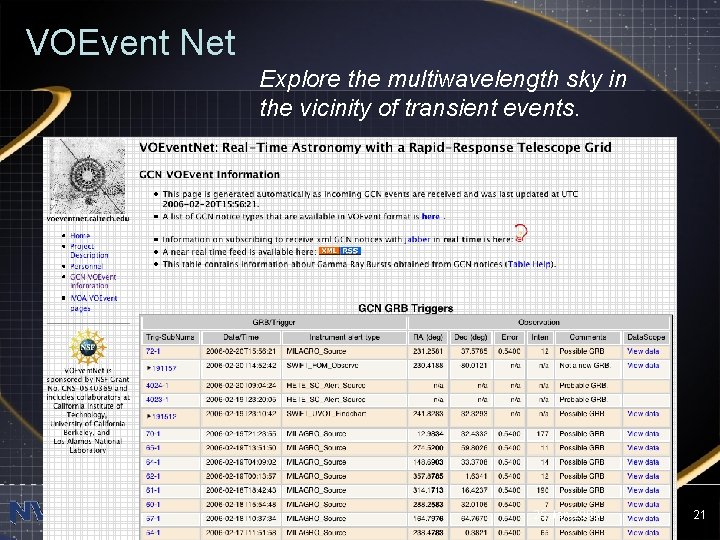
VOEvent Net Explore the multiwavelength sky in the vicinity of transient events. 25 Jan 2006 21
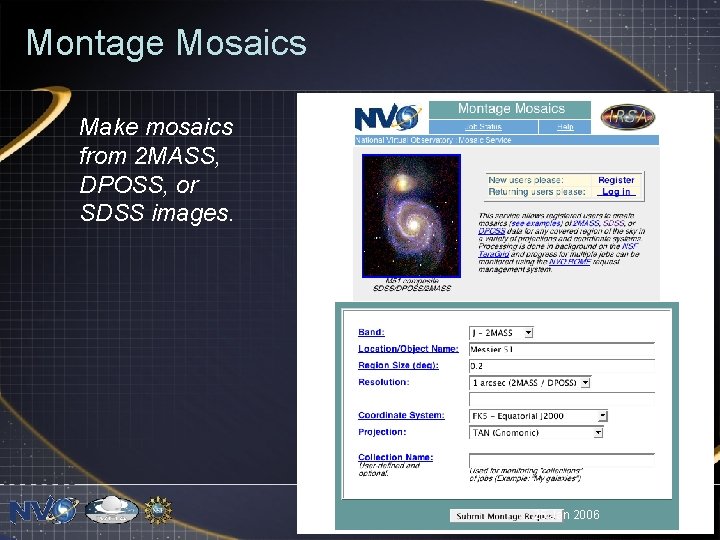
Montage Mosaics Make mosaics from 2 MASS, DPOSS, or SDSS images. 25 Jan 2006 22
VO Tools • VOTable display and analysis – VOPlot, TOPCAT, Mirage • Image display and analysis – Aladin, OASIS – Other standard display tools for downloaded data • Spectrum display and analysis – VOSpec, Spec. View 25 Jan 2006 23
Statistics and the VO… 25 Jan 2006 24
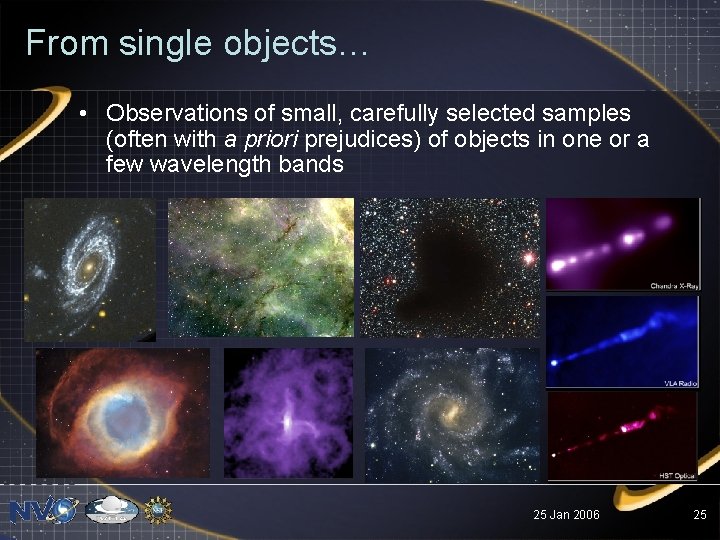
From single objects… • Observations of small, carefully selected samples (often with a priori prejudices) of objects in one or a few wavelength bands 25 Jan 2006 25
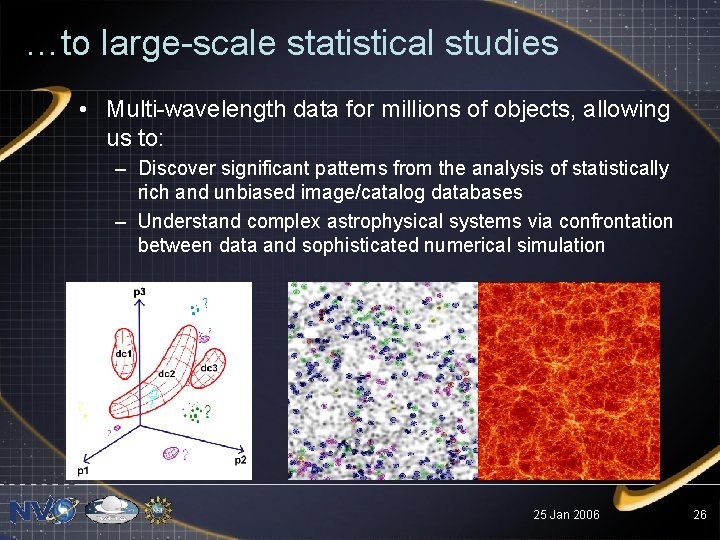
…to large-scale statistical studies • Multi-wavelength data for millions of objects, allowing us to: – Discover significant patterns from the analysis of statistically rich and unbiased image/catalog databases – Understand complex astrophysical systems via confrontation between data and sophisticated numerical simulation 25 Jan 2006 26
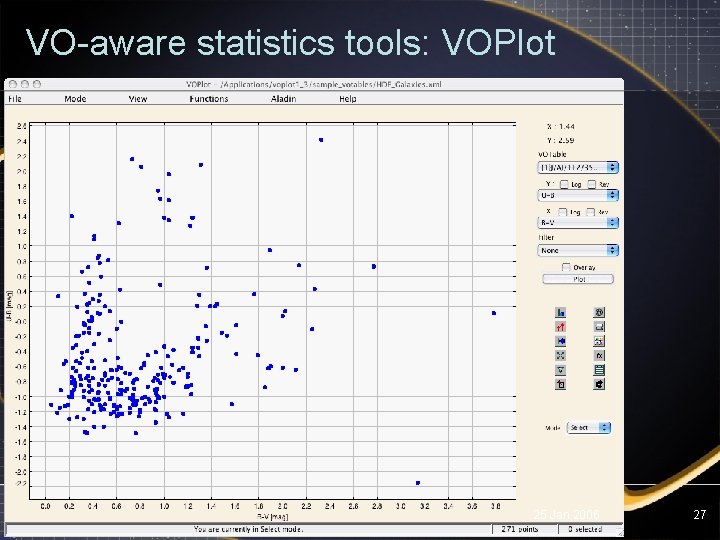
VO-aware statistics tools: VOPlot 25 Jan 2006 27
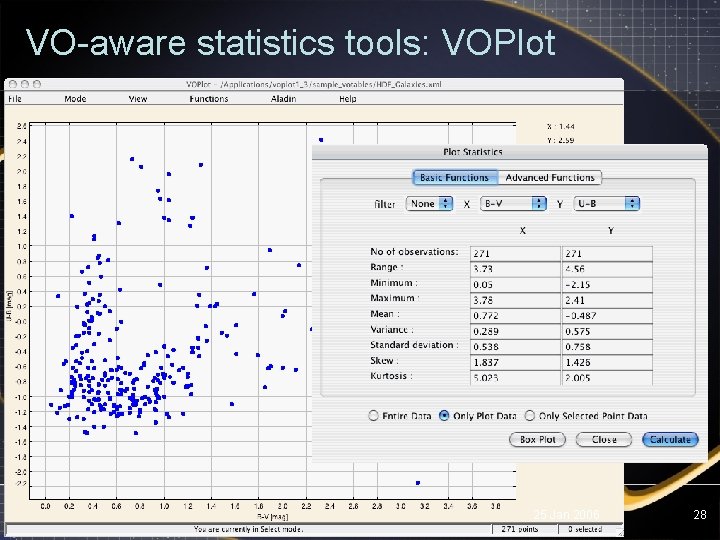
VO-aware statistics tools: VOPlot 25 Jan 2006 28
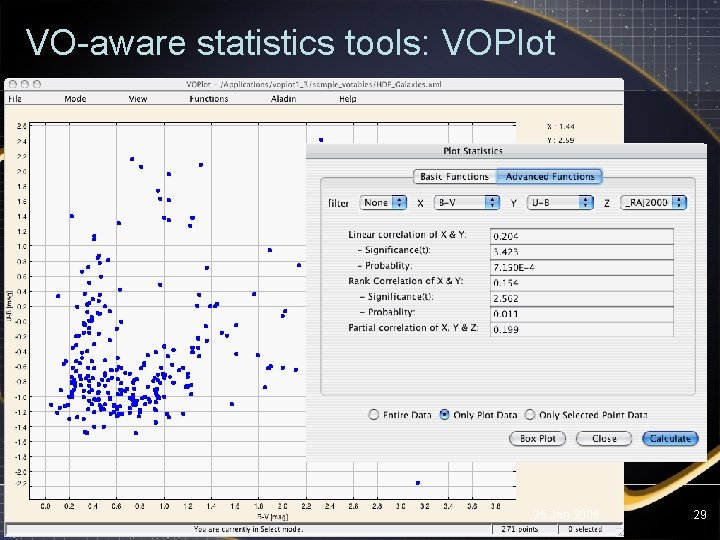
VO-aware statistics tools: VOPlot 25 Jan 2006 29
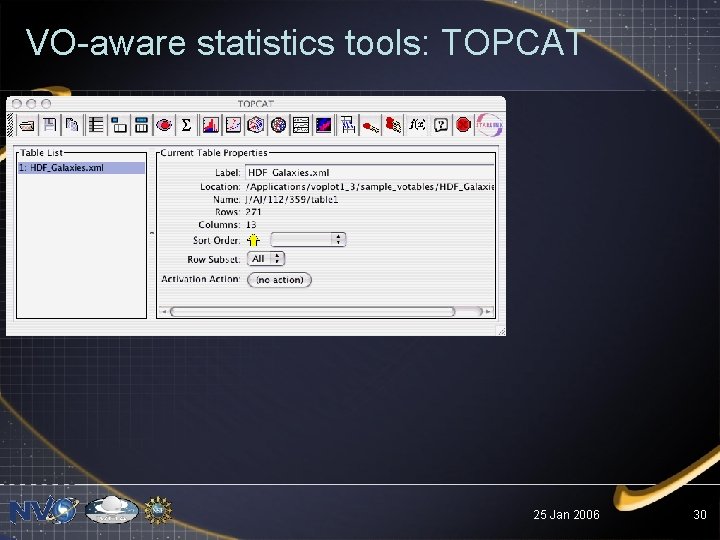
VO-aware statistics tools: TOPCAT 25 Jan 2006 30
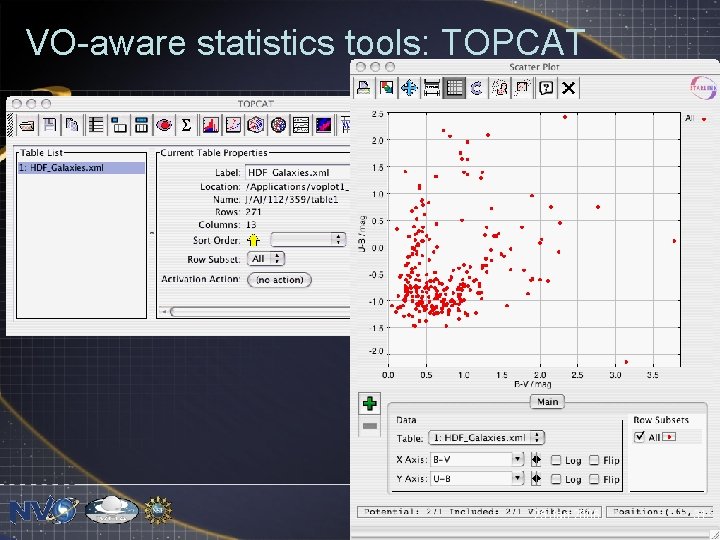
VO-aware statistics tools: TOPCAT 25 Jan 2006 31
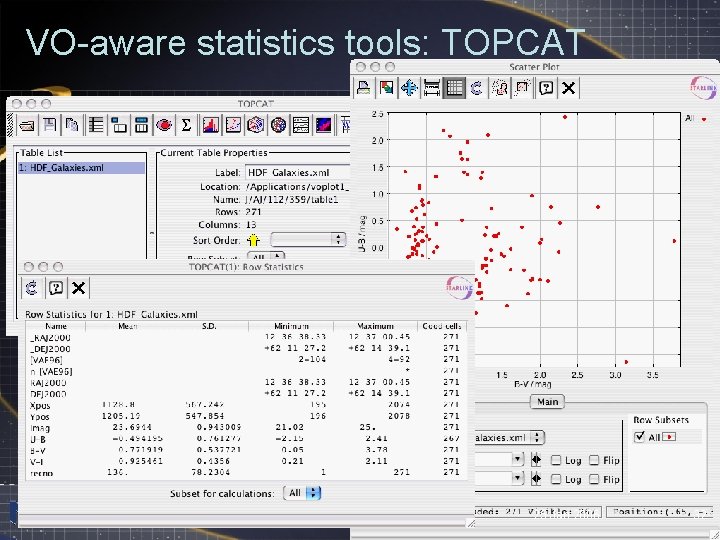
VO-aware statistics tools: TOPCAT 25 Jan 2006 32
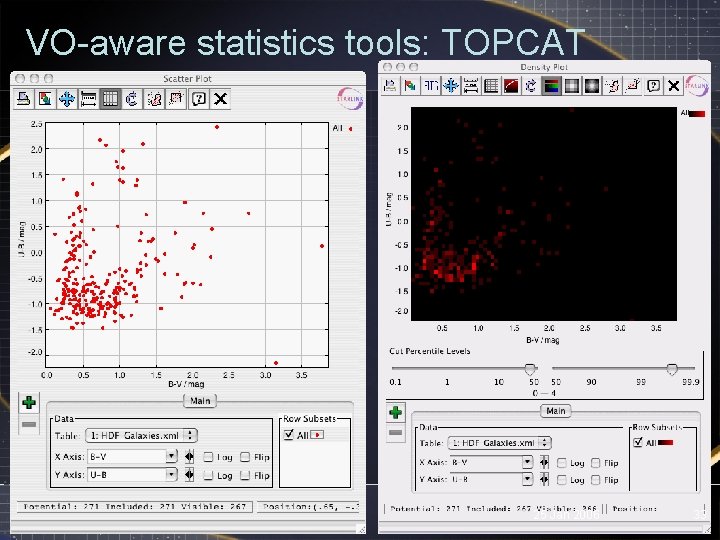
VO-aware statistics tools: TOPCAT 25 Jan 2006 33
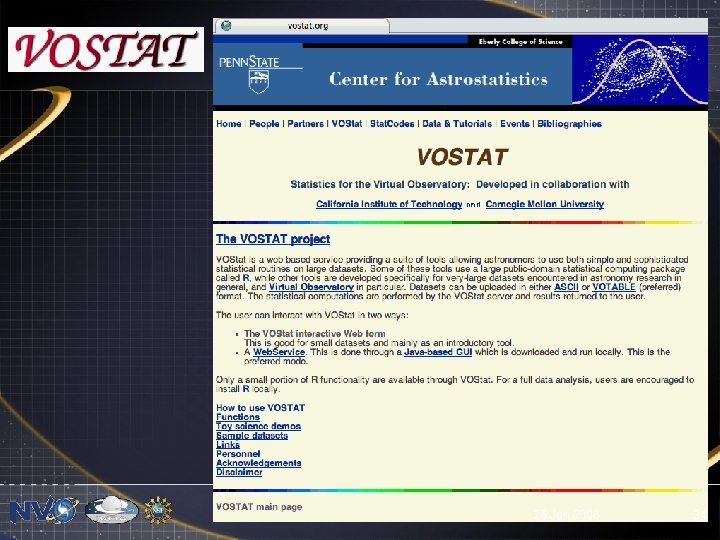
25 Jan 2006 34
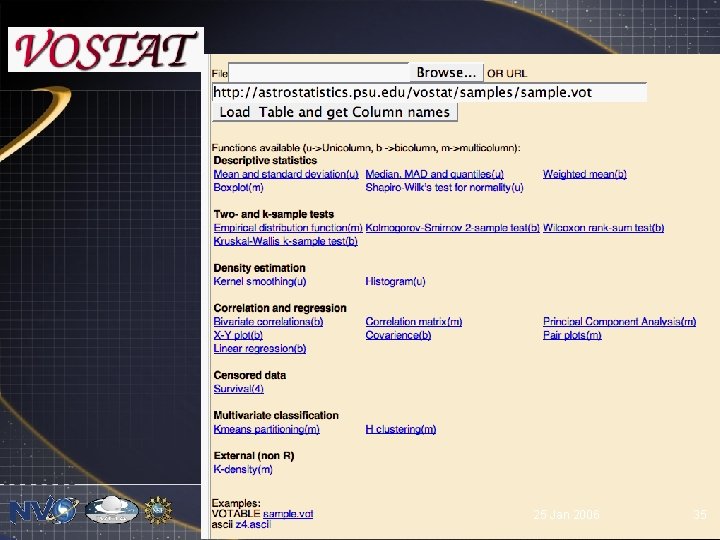
25 Jan 2006 35
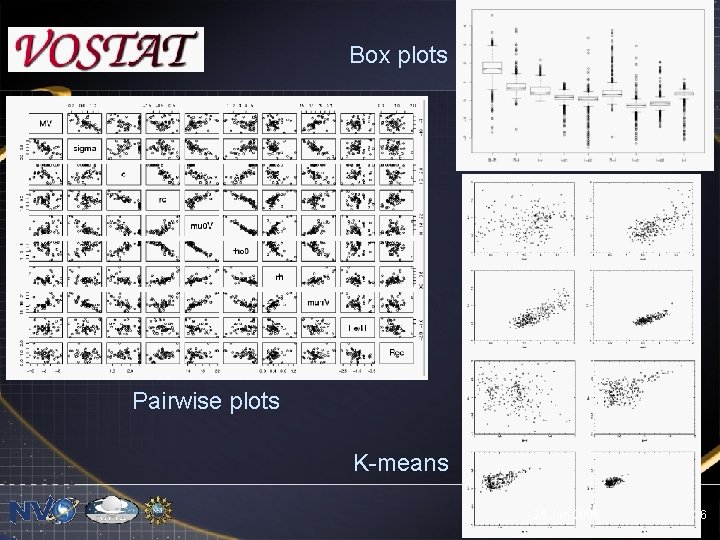
Box plots Pairwise plots K-means 25 Jan 2006 36
Statistics in the VO • What more is needed? – Scalability: Extend analysis to 10^9 measurements or more – Operate on data where it resides – VOSpace • Probabilistic cross-matching 25 Jan 2006 37
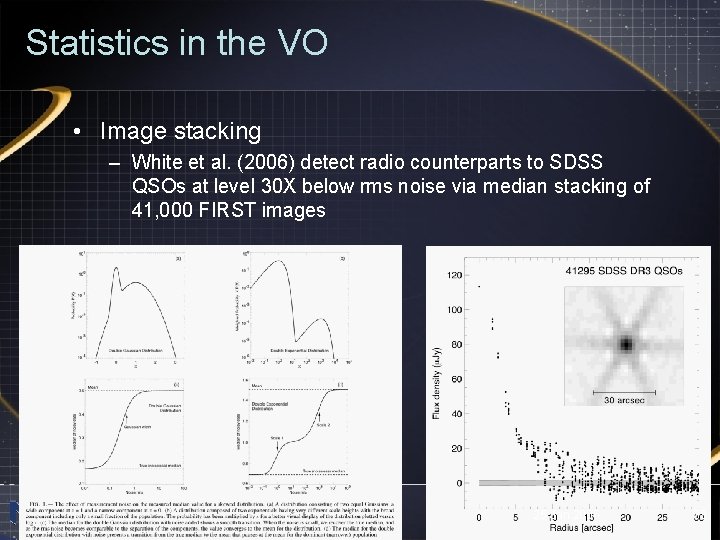
Statistics in the VO • Image stacking – White et al. (2006) detect radio counterparts to SDSS QSOs at level 30 X below rms noise via median stacking of 41, 000 FIRST images 25 Jan 2006 38
Next steps • NVO Facility – Joint NASA/NSF program, operations to begin in 2007 – Partnership between NASA data centers, major groundbased observatories, university research groups. Need to define the requirements for VO-enabled statistical analysis. • VO concept is being adopted broadly – AGU special session on VOs – NASA solicitation for Virtual Observatories for Solar and Space Physics Data (Vx. Os); AISRP support for VO technology 25 Jan 2006 39
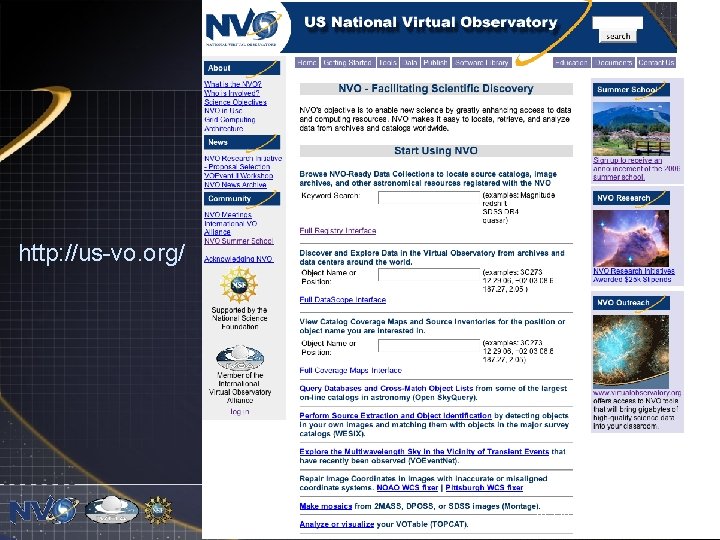
http: //us-vo. org/ 25 Jan 2006 40
- Slides: 40