
The US Judicial Branch A Level Government Politics
The US Judicial Branch A Level Government & Politics Students should be able to: • • • Identify the Key Components of the US Judicial Branch Explore the political significance of the Supreme Court Compare and contrast the Judicial Branch with that in the UK
The Judicial Branch includes: All the US Courts in the Federal Court system from State Courts up to the Supreme Court. The Judicial Branch is a key part of the Separation of Powers

The Judicial Branch and the Constitution The Judicial Branch is set out in the US Constitution in Article III Section 1 sets out the Supreme Court as the only judicial power in the US Congress can ‘ordain and establish’ new courts Judges shall hold their office for life in ‘good behavior’ No provision for number of Supreme Court justices No Mention of Judicial Activism
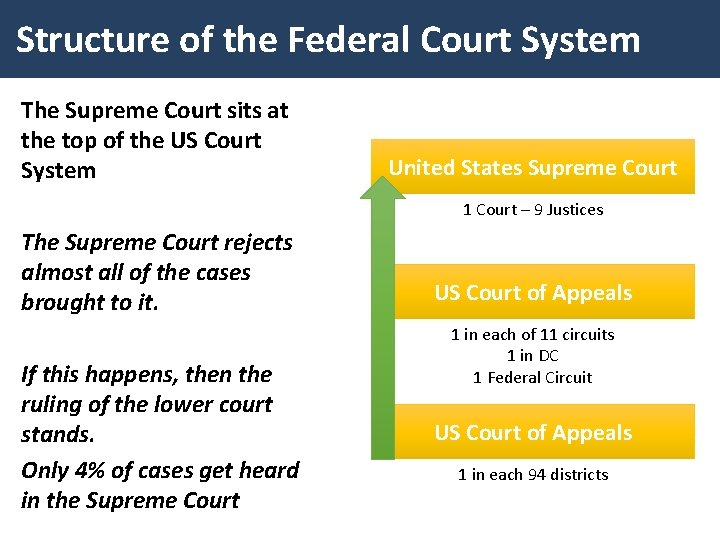
Structure of the Federal Court System The Supreme Court sits at the top of the US Court System United States Supreme Court 1 Court – 9 Justices The Supreme Court rejects almost all of the cases brought to it. If this happens, then the ruling of the lower court stands. Only 4% of cases get heard in the Supreme Court US Court of Appeals 1 in each of 11 circuits 1 in DC 1 Federal Circuit US Court of Appeals 1 in each 94 districts
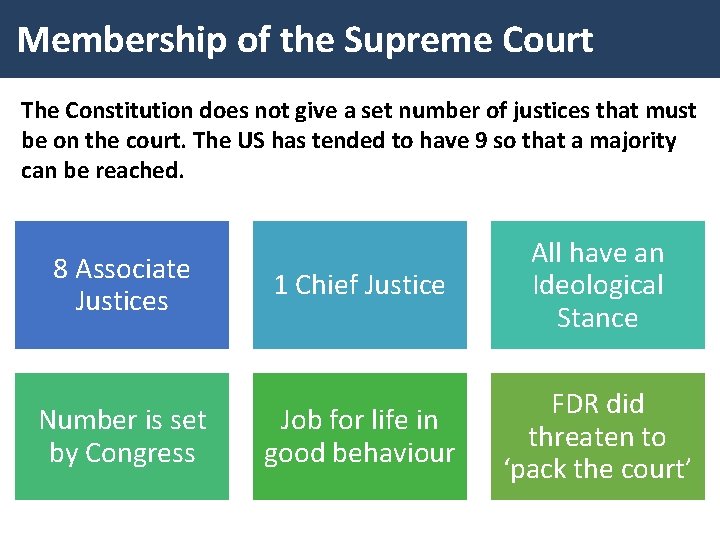
Membership of the Supreme Court The Constitution does not give a set number of justices that must be on the court. The US has tended to have 9 so that a majority can be reached. 8 Associate Justices Number is set by Congress 1 Chief Justice All have an Ideological Stance Job for life in good behaviour FDR did threaten to ‘pack the court’
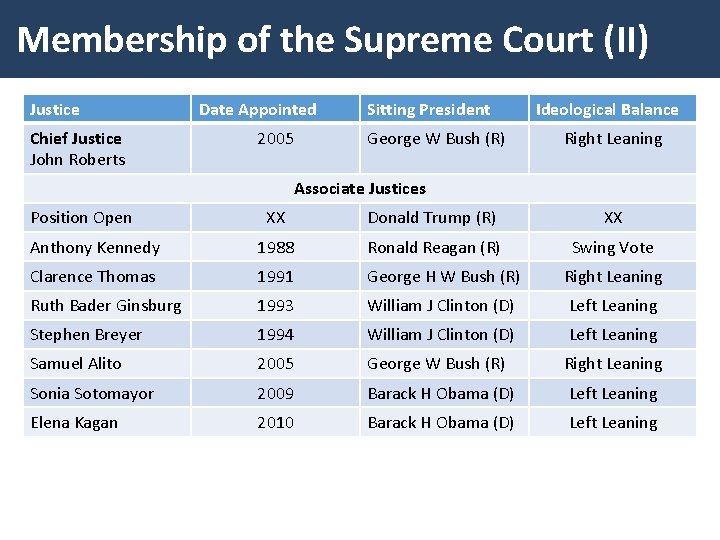
Membership of the Supreme Court (II) Justice Chief Justice John Roberts Date Appointed 2005 Sitting President George W Bush (R) Ideological Balance Right Leaning Associate Justices Position Open XX Donald Trump (R) XX Anthony Kennedy 1988 Ronald Reagan (R) Swing Vote Clarence Thomas 1991 George H W Bush (R) Right Leaning Ruth Bader Ginsburg 1993 William J Clinton (D) Left Leaning Stephen Breyer 1994 William J Clinton (D) Left Leaning Samuel Alito 2005 George W Bush (R) Right Leaning Sonia Sotomayor 2009 Barack H Obama (D) Left Leaning Elena Kagan 2010 Barack H Obama (D) Left Leaning
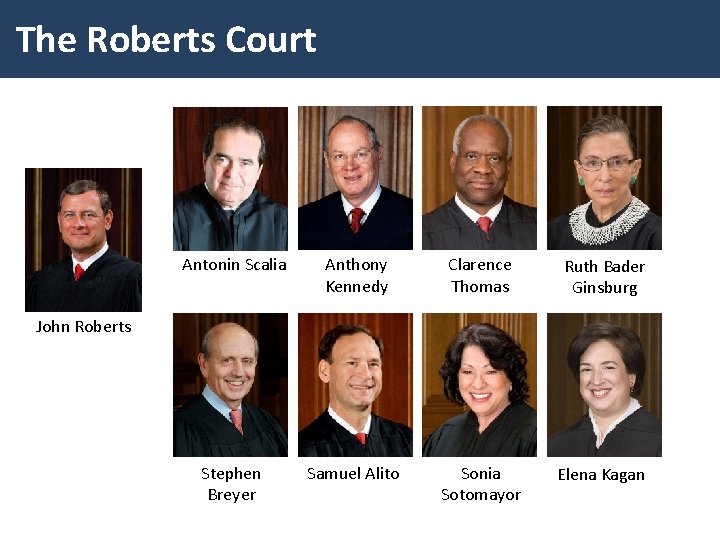
The Roberts Court Antonin Scalia Anthony Kennedy Clarence Thomas Ruth Bader Ginsburg Stephen Breyer Samuel Alito Sonia Sotomayor Elena Kagan John Roberts
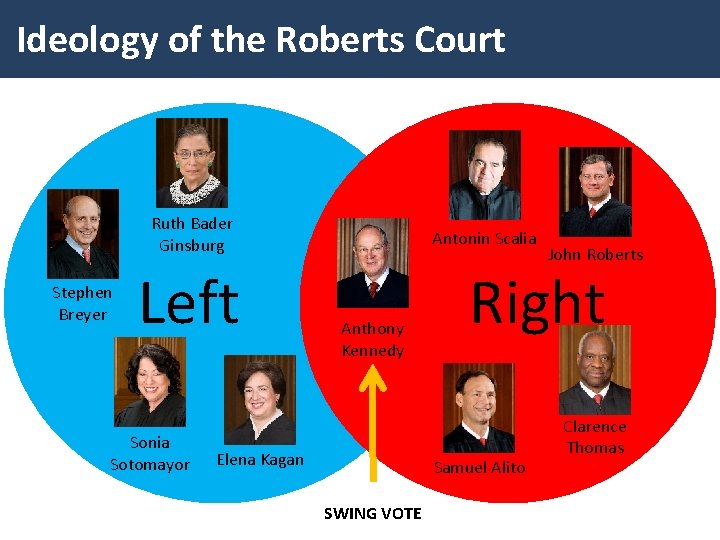
Ideology of the Roberts Court Ruth Bader Ginsburg Stephen Breyer Left Sonia Sotomayor Antonin Scalia Anthony Kennedy Elena Kagan Right Samuel Alito SWING VOTE John Roberts Clarence Thomas
Judicial Philosophy President’s often want to appoint Justices that fit their own ideological image Reagan: Obama: Bork, Scalia Sotomayor, Kagan Justices are often seen as ‘conservatives’ or ‘liberals’ There are more classifications such as activist.
Judicial Review No constitutional basis for this power Found in Marbury v Madison 1803 Allowed the Court to rule: • Acts of Congress • Executive Actions • State Law UNCONSTITUTIONAL
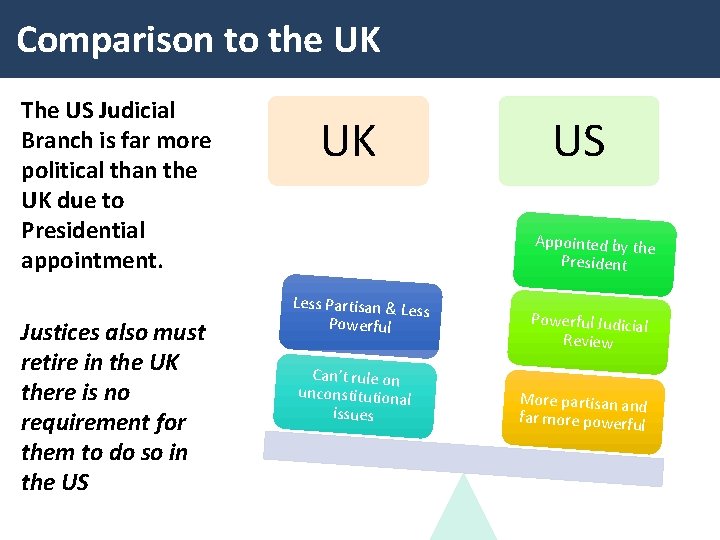
Comparison to the UK The US Judicial Branch is far more political than the UK due to Presidential appointment. Justices also must retire in the UK there is no requirement for them to do so in the US UK US Appointed by the President Less Partisan & Le ss Powerful Can’t rule on unconstitutional issues Powerful Judicial Review More partisan and far more powerfu l
The US Judicial Branch A Level Government & Politics Students should be able to: • • • Identify the Key Components of the US Judicial Branch Explore the political significance of the Supreme Court Compare and contrast the Judicial Branch with that in the UK
- Slides: 12