
The US Constitution A Level Government Politics Students






- Slides: 27
The US Constitution A Level Government & Politics Students should be able to: • • • Understand the aims of a Constitution Identify and recall which provisions are outlined in each Article of the Constitution Identify significant key provisions within the Articles
What is a Constitution • A Constitution is a system of rules which describes the structure and powers of Government • It also outlines the relationship between the three branches of government • As well as the relationship between the government and the citizens • Constitutions can be codified or uncodified • Codified Constitutions are in one single place where as Uncodified Constitutions are found in many different places such as Legislation, Common Law and even Conventions
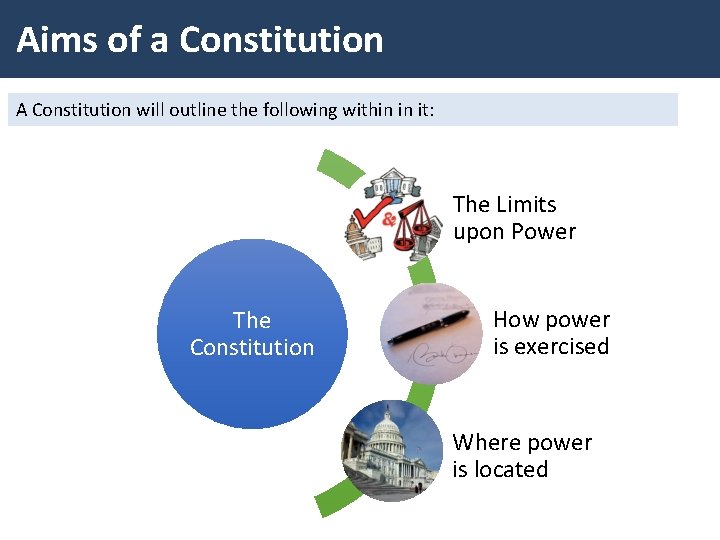
Aims of a Constitution A Constitution will outline the following within in it: The Limits upon Power The Constitution How power is exercised Where power is located
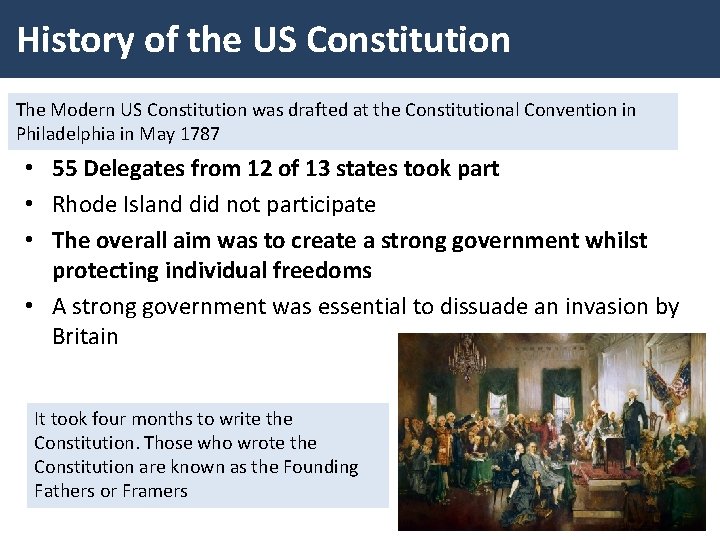
History of the US Constitution The Modern US Constitution was drafted at the Constitutional Convention in Philadelphia in May 1787 • 55 Delegates from 12 of 13 states took part • Rhode Island did not participate • The overall aim was to create a strong government whilst protecting individual freedoms • A strong government was essential to dissuade an invasion by Britain It took four months to write the Constitution. Those who wrote the Constitution are known as the Founding Fathers or Framers
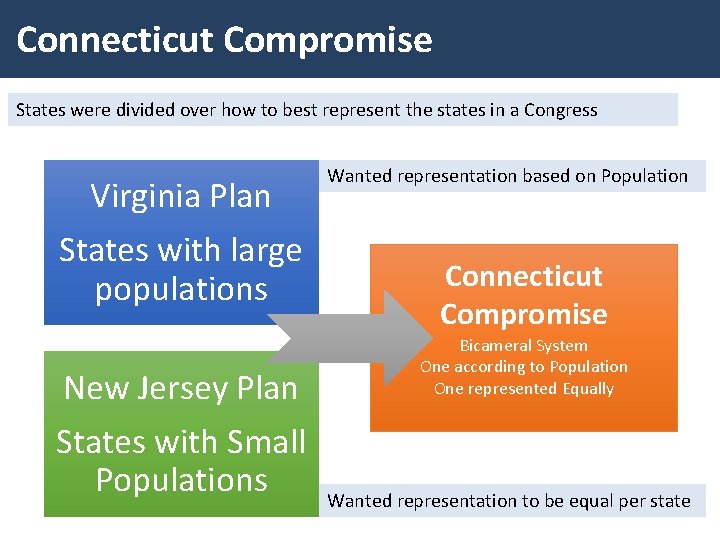
Connecticut Compromise States were divided over how to best represent the states in a Congress Virginia Plan States with large populations New Jersey Plan States with Small Populations Wanted representation based on Population Connecticut Compromise Bicameral System One according to Population One represented Equally Wanted representation to be equal per state
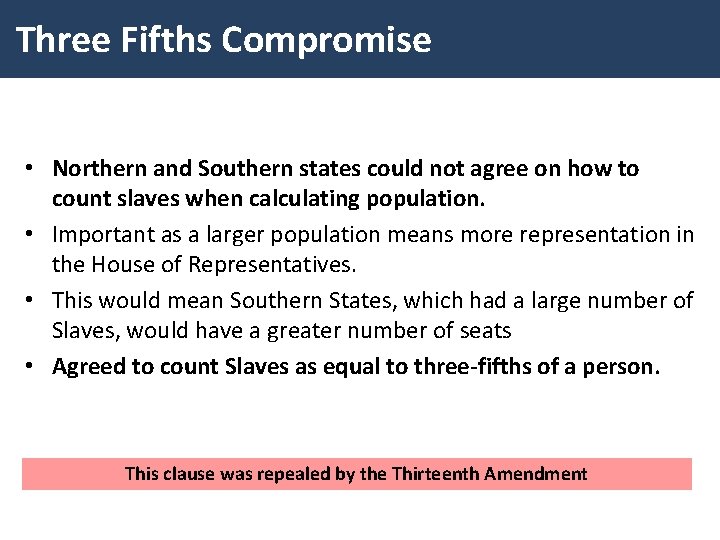
Three Fifths Compromise • Northern and Southern states could not agree on how to count slaves when calculating population. • Important as a larger population means more representation in the House of Representatives. • This would mean Southern States, which had a large number of Slaves, would have a greater number of seats • Agreed to count Slaves as equal to three-fifths of a person. This clause was repealed by the Thirteenth Amendment
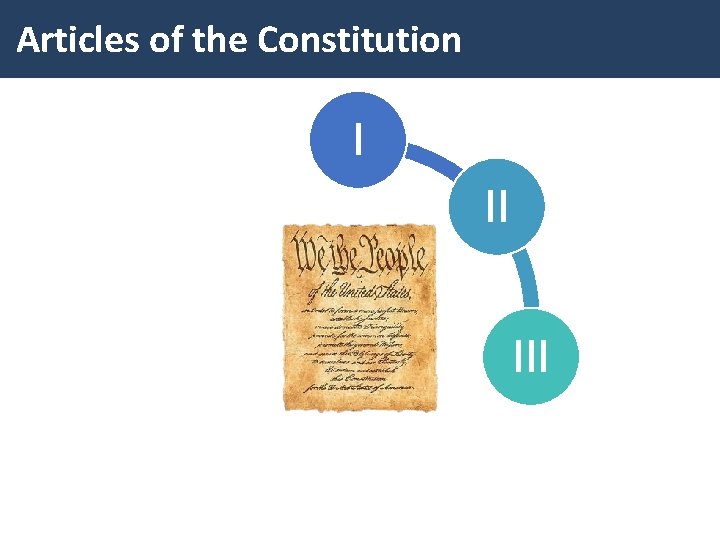
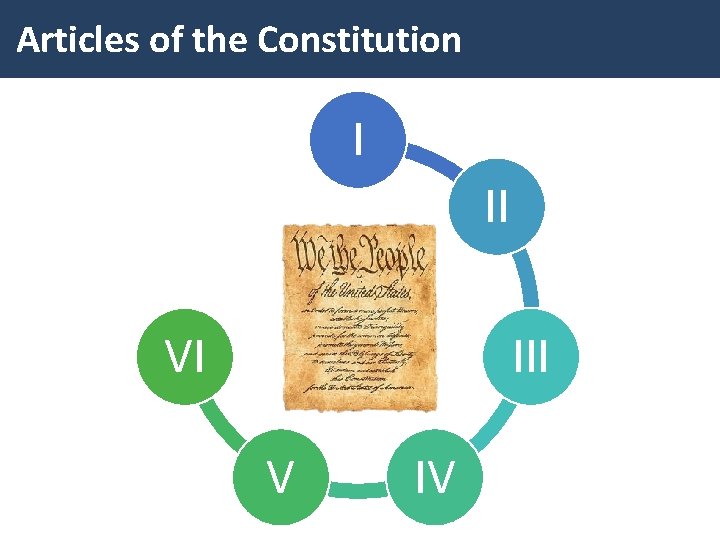
Articles of the Constitution I
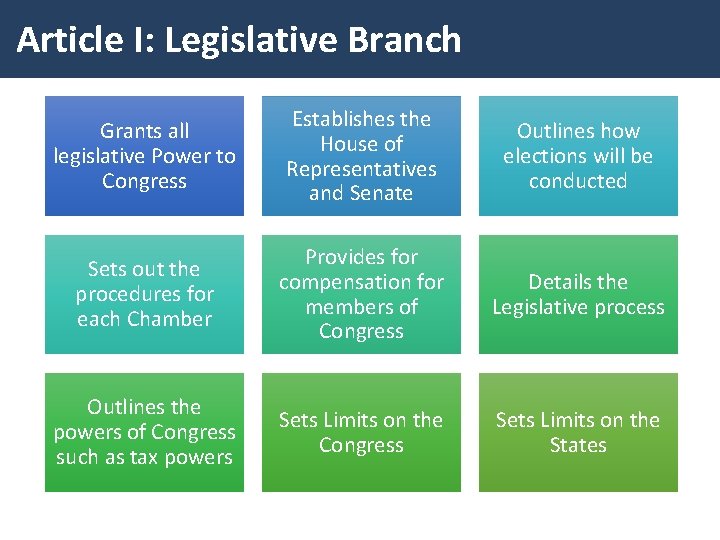
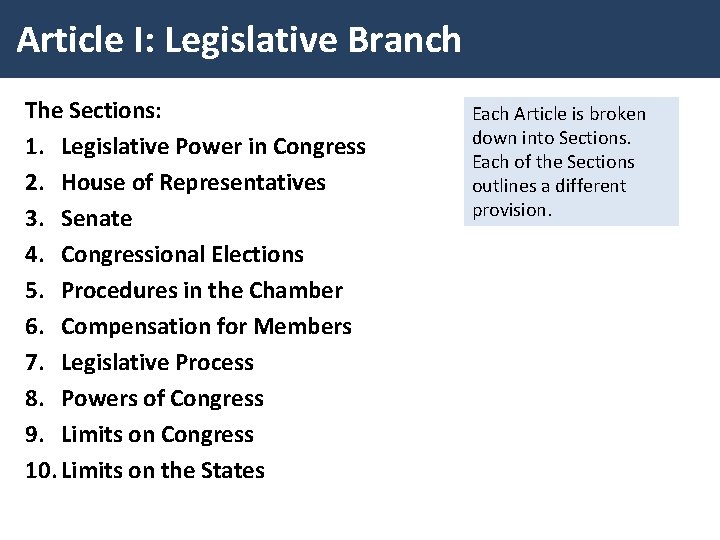
Article I: Legislative Branch Grants all legislative Power to Congress Establishes the House of Representatives and Senate Outlines how elections will be conducted Sets out the procedures for each Chamber Provides for compensation for members of Congress Details the Legislative process Outlines the powers of Congress such as tax powers Sets Limits on the Congress Sets Limits on the States
Article I: Legislative Branch The Sections: 1. Legislative Power in Congress 2. House of Representatives 3. Senate 4. Congressional Elections 5. Procedures in the Chamber 6. Compensation for Members 7. Legislative Process 8. Powers of Congress 9. Limits on Congress 10. Limits on the States Each Article is broken down into Sections. Each of the Sections outlines a different provision.
Article I: Legislative Branch Key Clauses Within each Section are clauses. These are some of the most important ones Vesting Clause • All legislative Powers herein granted shall be vested in a Congress of the United States, which shall consist of a Senate and House of Representatives. Origination Clause • All Bills for raising Revenue shall originate in the House of Representatives; but the Senate may propose or concur with Amendments as on other Bills. Necessary and Proper Clause • The Congress shall have Power. . . To make all Laws which shall be necessary and proper for carrying into Execution the foregoing Powers, and all other Powers vested by this Constitution in the Government of the United States, or in any Department or Officer thereof. Tax and Spending Clause • The Congress shall have Power To lay and collect Taxes, Duties, Imposts and Excises, to pay the Debts and provide for the common Defence and general Welfare of the United States War Clause • To declare War, grant Letters of Marque and Reprisal, and make Rules concerning Captures on Land Water;
Articles of the Constitution I II
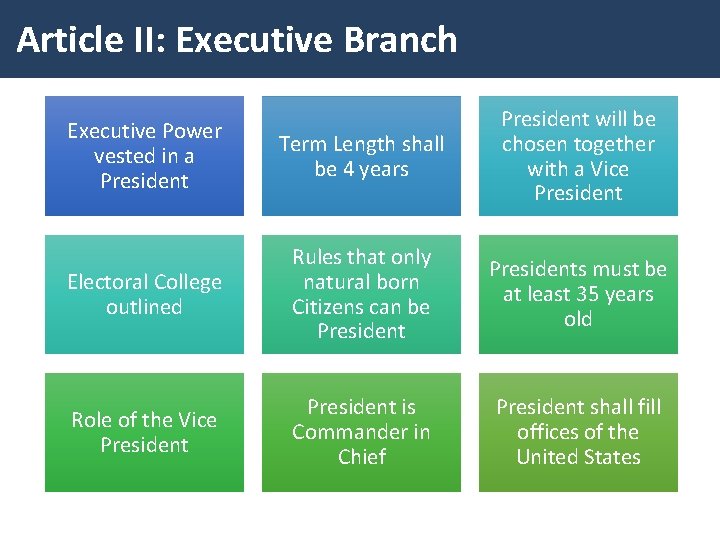
Article II: Executive Branch Executive Power vested in a President Term Length shall be 4 years President will be chosen together with a Vice President Electoral College outlined Rules that only natural born Citizens can be Presidents must be at least 35 years old Role of the Vice President is Commander in Chief President shall fill offices of the United States
Article II: Executive Branch The Sections: 1. Presidents and Vice Presidents 2. Powers of the President 3. Presidential Responsibilities 4. Impeachment The Electoral College is outlined in Section 1 The Oath of Office is outlined in Section 1 Eligibility for Office is outlined in Section 1 The President is stated as Commander in Chief in Section 2 The State of the Union address is outlined in Section 3
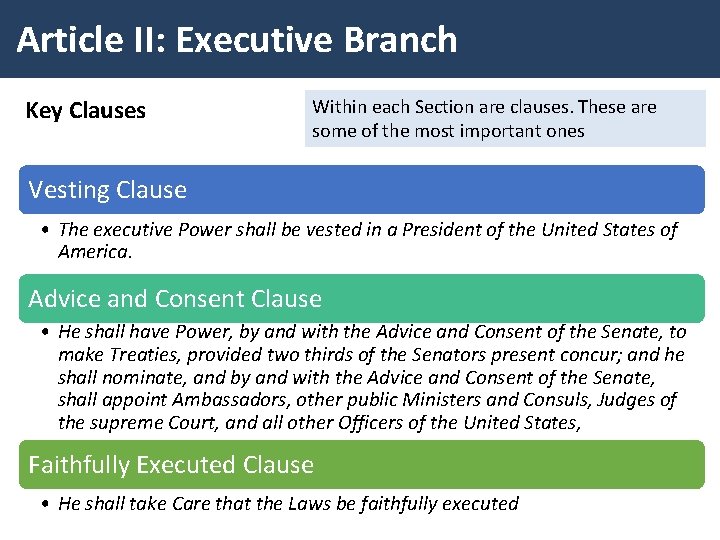
Article II: Executive Branch Key Clauses Within each Section are clauses. These are some of the most important ones Vesting Clause • The executive Power shall be vested in a President of the United States of America. Advice and Consent Clause • He shall have Power, by and with the Advice and Consent of the Senate, to make Treaties, provided two thirds of the Senators present concur; and he shall nominate, and by and with the Advice and Consent of the Senate, shall appoint Ambassadors, other public Ministers and Consuls, Judges of the supreme Court, and all other Officers of the United States, Faithfully Executed Clause • He shall take Care that the Laws be faithfully executed
Articles of the Constitution I II III
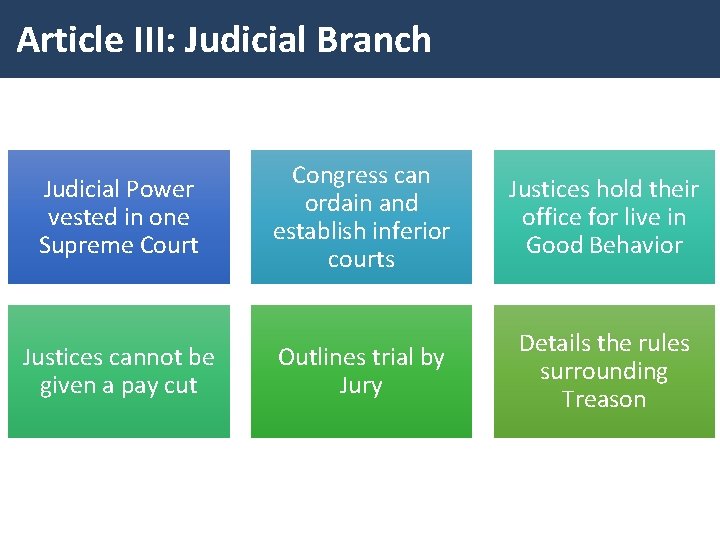
Article III: Judicial Branch Judicial Power vested in one Supreme Court Justices cannot be given a pay cut Congress can ordain and establish inferior courts Justices hold their office for live in Good Behavior Outlines trial by Jury Details the rules surrounding Treason
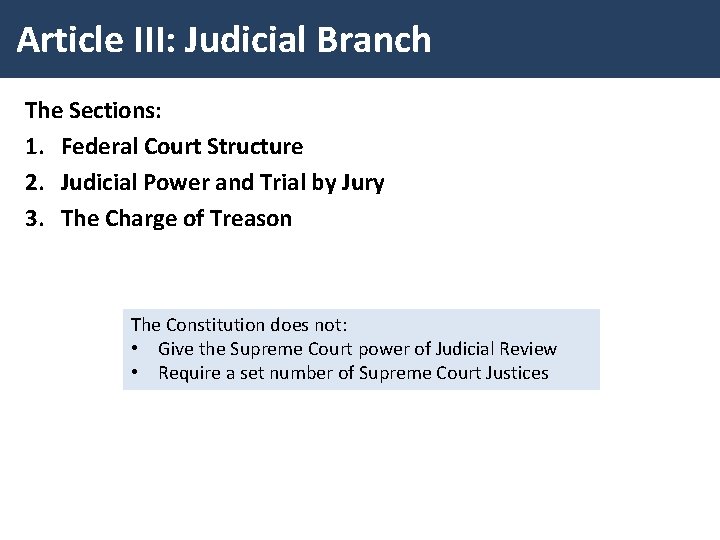
Article III: Judicial Branch The Sections: 1. Federal Court Structure 2. Judicial Power and Trial by Jury 3. The Charge of Treason The Constitution does not: • Give the Supreme Court power of Judicial Review • Require a set number of Supreme Court Justices
Articles of the Constitution I II IV
Article IV: Relationship between States Full Faith & Credit Clause New States can be admitted to the Union No New States can be formed from current states without legislation Guarantee of a republican form of government Guarantees protection from invasion Protection from Civil War
Articles of the Constitution I II III V IV
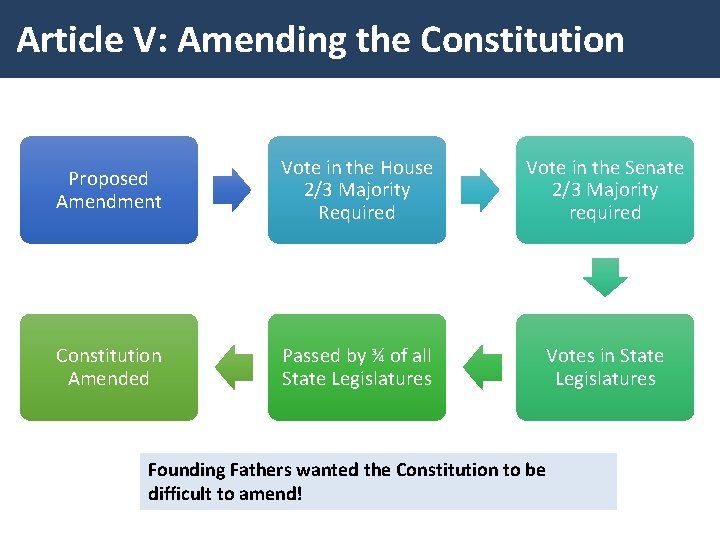
Article V: Amending the Constitution Proposed Amendment Vote in the House 2/3 Majority Required Vote in the Senate 2/3 Majority required Constitution Amended Passed by ¾ of all State Legislatures Votes in State Legislatures Founding Fathers wanted the Constitution to be difficult to amend!
Articles of the Constitution I II VI III V IV
Article VI: Federal Supremacy All debts from States are now responsibility of the US Federal Law shall be the Supreme Law of the Land All Senators and Representatives at any level are bound by Constitutional Oath No religious test can be a requirement of Office
Articles of the Constitution I VII II VI III V IV
Article VII: Ratification Procedure 9 out of 13 states must ratify the Constitution before it can be established. # State Date 1 Delaware 7 December 1787 2 Pennsylvania 12 December 1787 3 New Jersey 18 December 1787 4 Georgia 2 January 1788 5 Connecticut 9 January 1788 6 Massachusetts 6 February 1788 7 Maryland 28 April 1788 8 South Carolina 23 May 1788 9 New Hampshire 21 June 1788
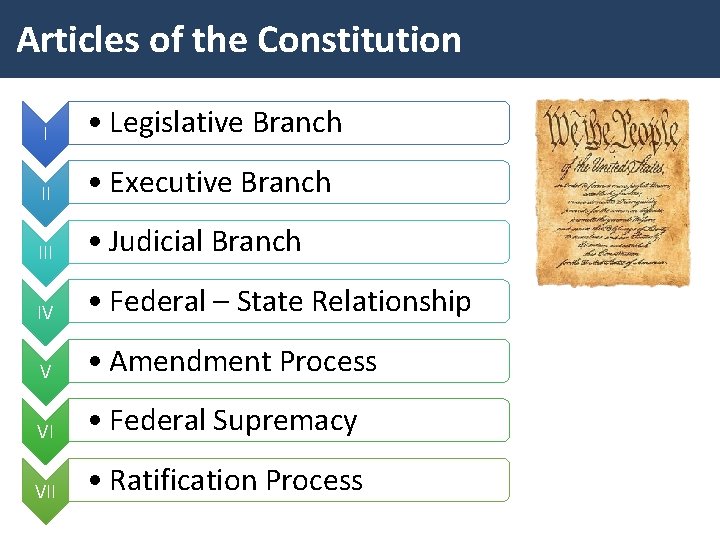
Articles of the Constitution I • Legislative Branch II • Executive Branch III • Judicial Branch IV • Federal – State Relationship V • Amendment Process VI • Federal Supremacy VII • Ratification Process
The US Constitution A Level Government & Politics Students should be able to: • • • Understand the aims of a Constitution Identify and recall which provisions are outlined in each Article of the Constitution Identify significant key provisions within the Articles