
The Urbanisation Pathway L O To outline the
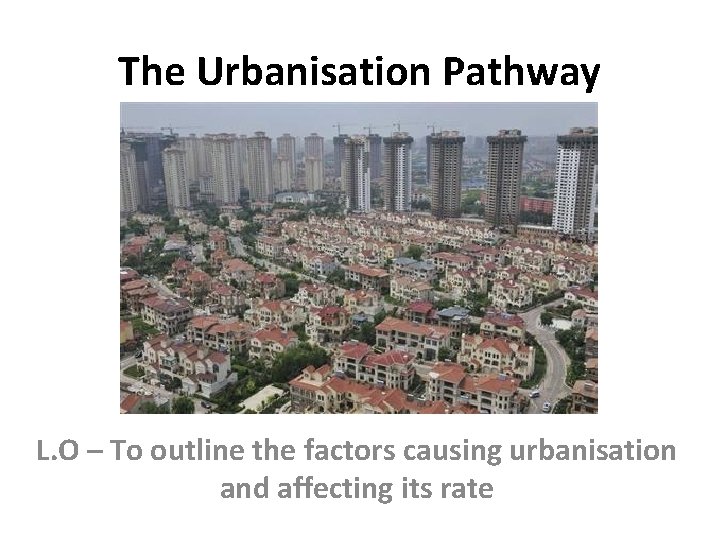
The Urbanisation Pathway L. O – To outline the factors causing urbanisation and affecting its rate
To Start • Imagine you are a poor young farmer in a rural part of Brazil (you have a family) • What factors would force you to leave where you live? • What factors would Sao Paulo have that could attract you here? Discuss in pairs for 2 minutes.
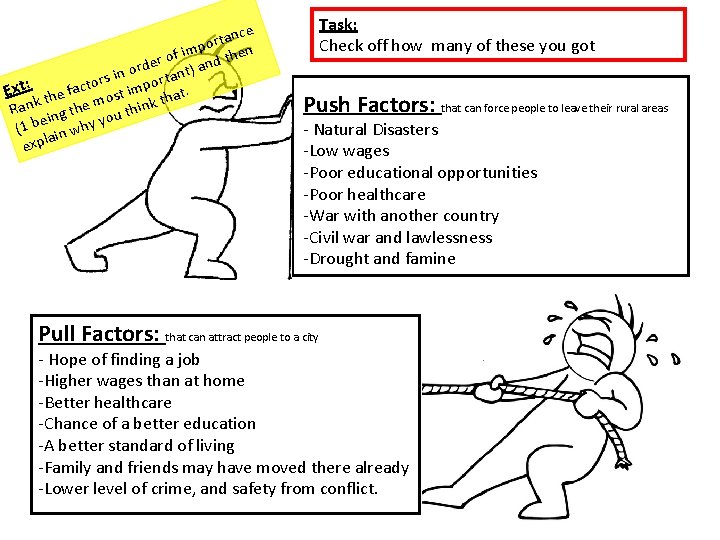
nce a t r impo then f o der t) and r o n rtan rs i o o : t p t c Ex the fa ost im that. Rank ing the m u think o e (1 b in why y a expl Task: Check off how many of these you got Push Factors: that can force people to leave their rural areas - Natural Disasters -Low wages -Poor educational opportunities -Poor healthcare -War with another country -Civil war and lawlessness -Drought and famine Pull Factors: that can attract people to a city - Hope of finding a job -Higher wages than at home -Better healthcare -Chance of a better education -A better standard of living -Family and friends may have moved there already -Lower level of crime, and safety from conflict.
Causes of Urbanisation PUSH-PULL factors • Rural-urban migration is caused by environmental and economic problems in the countryside (PUSH) E. g. • Pressure on the land • Unemployment from mechanisation • Poor medical and education services • Lack of amenities • Natural Hazards
Causes of Urbanisation PUSH-PULL factors Rural-urban migration is also caused by greater perceived opportunities in the city (PULL) E. g. Better standard of living Higher wages Better education and healthcare Proper housing Less impact from natural hazards
Causes of Urbanisation OTHER CAUSES Natural Increase This is especially high in LIC’s due to young migrants of working age having children. Death rates are also lower in the cities so the urban population increases Economic growth Foreign companies (often from HIC’s) and governments are investing in LIC cities to develop manufacturing
What About HICs? • The rates of urbanisation are much slower in HICs. (Why do you think this is? ) 1. A large proportion of people already live in urban areas 2. Modern transport and amenities means people can live on the edge of cities (or in rural areas) and commute into urban areas to work 3. Rural areas are often quieter and have much more space which appeals to families and elderly people
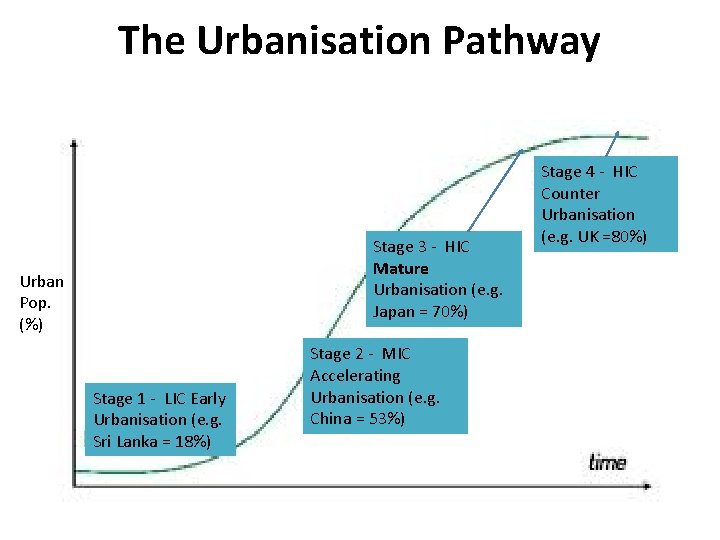
The Urbanisation Pathway Stage 3 - HIC Mature Urbanisation (e. g. Japan = 70%) Urban Pop. (%) Stage 1 - LIC Early Urbanisation (e. g. Sri Lanka = 18%) Stage 2 - MIC Accelerating Urbanisation (e. g. China = 53%) Stage 4 - HIC Counter Urbanisation (e. g. UK =80%)
- Slides: 8