
The Urban Game An exercise in urbanization and

The Urban Game An exercise in urbanization and industrialization
Let’s Begin �The year is 1700 and the nation is the United States of America. The scene is a rural village. n Your village should contain the following items at this point: ¨ ¨ ¨ ¨ ¨ n A river that runs from one end of the map to the opposite end (your river should not be more than 3 squares wide) Two roads (1 square wide) that intersect near the middle of your map and extend off the map in each cardinal direction. Two wooden bridges (1 square wide) 10 houses 1 church 1 cemetery 1 store 1 restaurant 1 coalmine 1 park And of course, you need to give your village a name!

Preparing for the Game n Draw: 1. 2. 3. 4. 5. 6. A river across your paper connecting east to west, the river should be about 1 inch wide Draw a simple wooden bridge across the river Draw two roads (one north/south which goes across the bridge, one east/west) Mark off a portion of your lands for the commons (land that can be used by all in the village) Draw 10 houses. Draw 1 church, 1 cemetery, 1 store, 1 restaurant, 1 coal mine, and at least 50 trees!!!
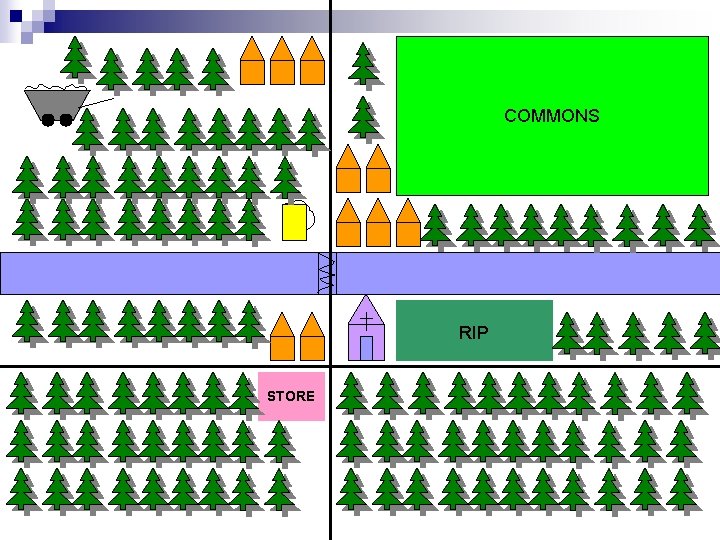
COMMONS RIP STORE
It’s 1700 and we are in the USA… Listen carefully as we read background to our game. n Think about: n ¨ What people do for a living ¨ How people live ¨ The different classes in our village n Over the next 100 years, we are going to experience a major revolution!!!
Round One– 1745 Since you invested your money, thereby making a tidy profit, build yourself 1 nice home anywhere on the map n Build the canal (it must run parallel to the water) n
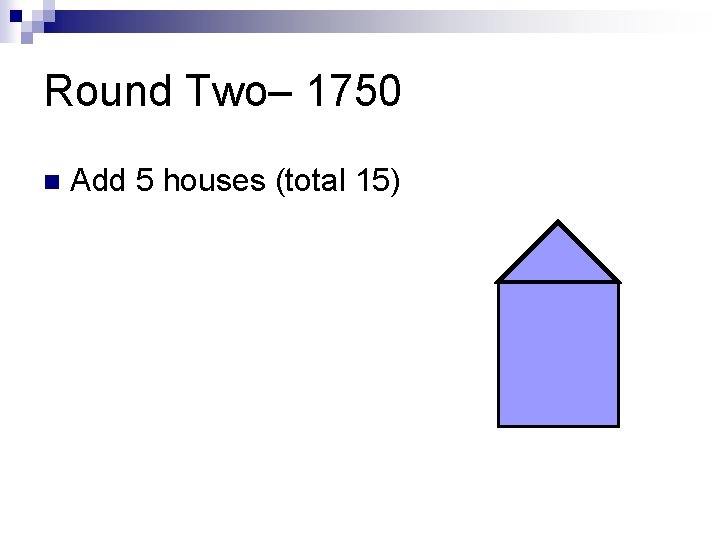
Round Two– 1750 n Add 5 houses (total 15)
Round Three– 1760 Take away ½ your commons n Add 1 more nice house n
Round Four– 1773 n Add 1 factory ¨ Factory must be on the river bank ¨ Canal water does NOT move fast enough to power the factory machines ¨ Do NOT add smoke to this factory!
Round Five– 1774 Add 5 houses (total 20) n 1 church n 1 restaurant n 1 store n You may draw additional roads and 1 more bridge n
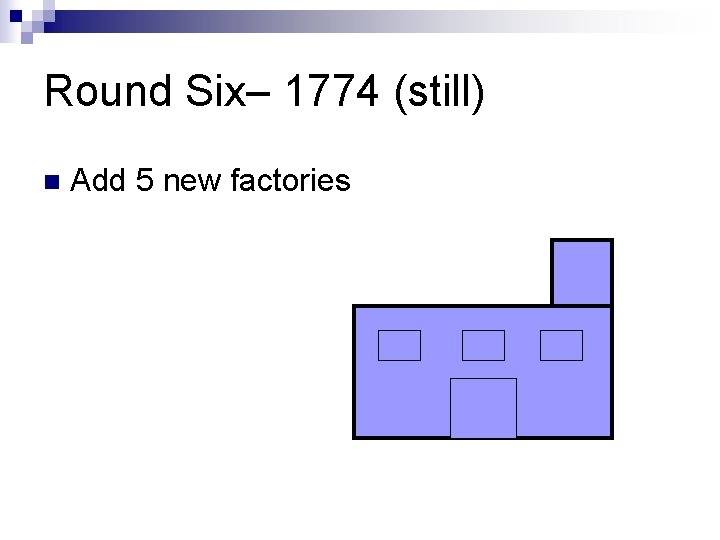
Round Six– 1774 (still) n Add 5 new factories
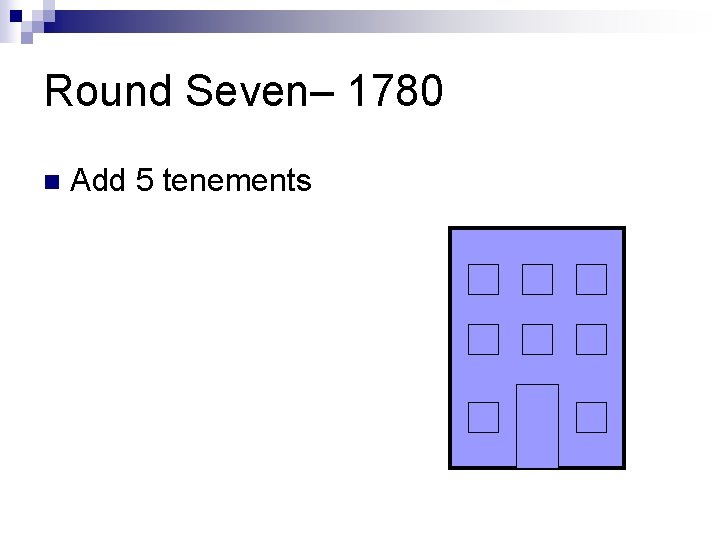
Round Seven– 1780 n Add 5 tenements
Round 8– 1781 n n n Add 1 store 1 restaurant 1 church 1 school (for boys of families wealthy enough to send kids to school) Workers work 6 days a week and Sundays are the only day of rest. People flock to churches– make them convenient for the tired feet of the workers
Round 9– 1782 n Add 2 more restaurants
Round 10– 1783 Add 2 special homes n Add 1 more factory n Add 15 houses for management personnel (35 total) n
Round 11– 1785 Add 10 factories with smoke n Add smoke to all pre-existing factories n Add 5 houses (40 total) n Add 1 tenement n Also, add 1 more nice house n
Round 12– 1800 Add 1 new coal mine n Add 1 new iron bridge to replace the old wooden one n Add 5 more house (45 total) n
Round 13– 1815 n Draw 1 cemetery
Round 14– 1820 n n n Add 1 major railroad connecting your factories to your coal mines The railroad should be one continuous line Draw one railroad station on the railroad line You may draw additional bridges if necessary (no more than 2) Add 5 more houses for railroad workers (50 total)
Round 15– 1827 Add 1 jail n Add 2 restaurants n Add 2 tenements n
Round 16– 1835 n Add 20 street lamps
Round 17– 1838 Add 2 hospitals n 1 more cemetery n
Round 18– 1840 Add 1 more railroad line passing east to west through your town n Add 1 more railroad station n
Round 19– 1842 Add 2 theaters/museums n Add 2 private schools (put a “P” on the school) n Add 1 restaurant n
Round 20– 1845 Add 1 cemetery n Add 1 jail n 1 hospital to accommodate the victims of urban life n
Round 21– 1850 Add 20 houses (70 total) n 5 tenements n 2 stores n 1 church n 5 factories n 1 restaurant n 1 more nice house n
- Slides: 26