
The Urban Food System The Hungry Cities Workshop
The Urban Food System The Hungry Cities Workshop University of Cape Town, 09 February 2015 Gareth Haysom | ACC and The Hungry Cities Partnership
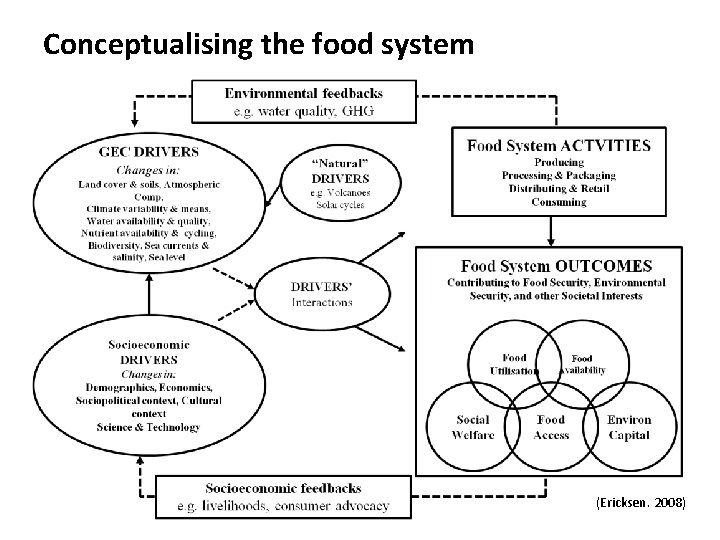
Conceptualising the food system (Ericksen. 2008)
The urban food system “a city is what it eats. ” (Roberts, 2001) “Feeding cities takes a gargantuan effort: one that arguably has a greater social and physical impact on our lives and the planet than anything else we do” (Steel, 2008: ) “With cities already consuming an estimated 75% of the world’s food and energy resources, it doesn’t take a mathematical genius to see that prety soon the sums wont add up” (Steel, 2008: )
“About two years after the breakup of the Soviet Union I was in discussion with a senior Russian official whose job it was to direct the production of bread in St. Petersburg. "Please understand that we are keen to move towards a market system", he told me. "But we need to understand the fundamental details of how such a system works. . . Tell me, for example: who is in charge of the supply of bread to the population of London? " There was nothing naive about his question, because the answer ("nobody is in charge"), when one thinks carefully about it, is astonishingly hard to believe. Only in the industrialised West have we forgotten just how strange it is. ” (Seabright 2010, 10)
The city and food • In an environment where residents purchase the bulk of food they consume, access has both economic and spatial dimensions. • In complex systems such as urban food systems, there are multiple role players and distributed authority. This means that no single entity assumes responsibility for the food system, let alone, addressing food insecurity.
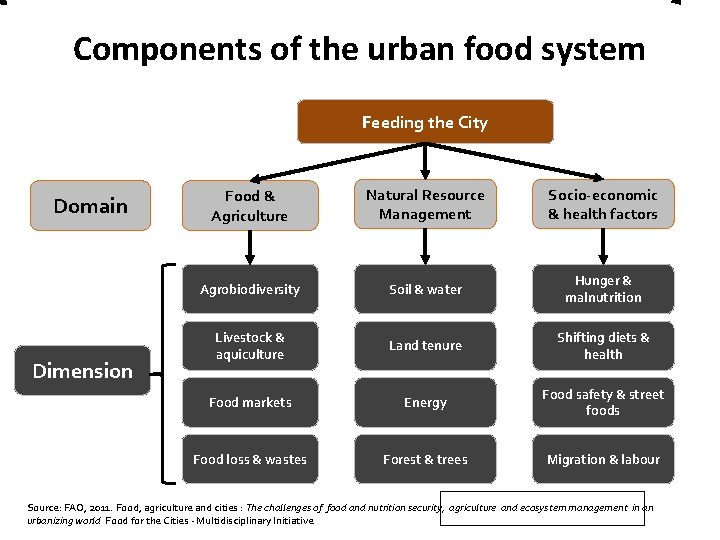
Components of the urban food system Feeding the City Domain Dimension Food & Agriculture Natural Resource Management Socio-economic & health factors Agrobiodiversity Soil & water Hunger & malnutrition Livestock & aquiculture Land tenure Shifting diets & health Food markets Energy Food safety & street foods Food loss & wastes Forest & trees Migration & labour Source: FAO, 2011. Food, agriculture and cities : The challenges of food and nutrition security, agriculture and ecosystem management in an urbanizing world Food for the Cities - Multidisciplinary Initiative
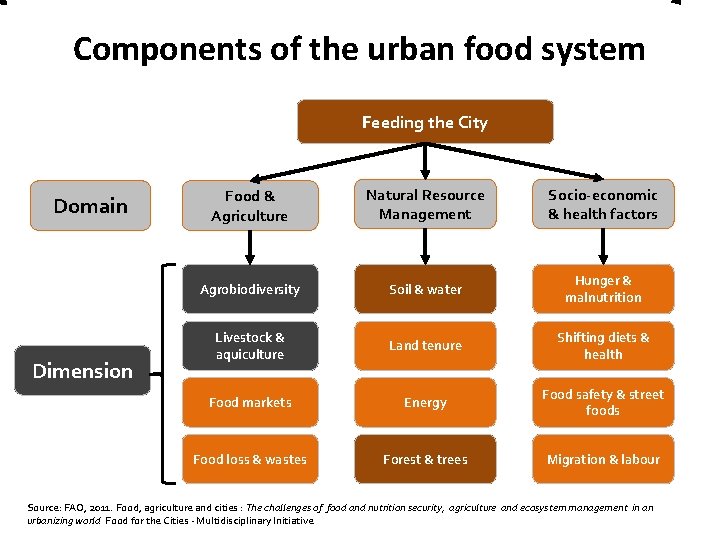
Components of the urban food system Feeding the City Domain Dimension Food & Agriculture Natural Resource Management Socio-economic & health factors Agrobiodiversity Soil & water Hunger & malnutrition Livestock & aquiculture Land tenure Shifting diets & health Food markets Energy Food safety & street foods Food loss & wastes Forest & trees Migration & labour Source: FAO, 2011. Food, agriculture and cities : The challenges of food and nutrition security, agriculture and ecosystem management in an urbanizing world Food for the Cities - Multidisciplinary Initiative
![“If planners are not conscious [of food issues], then their impact is negative, not](http://slidetodoc.com/presentation_image_h/f1bbb70f6d2b5595dc75421792404ad6/image-8.jpg "“If planners are not conscious [of food issues], then their impact is negative, not")
“If planners are not conscious [of food issues], then their impact is negative, not just neutral” (Pothukuchi, 2000)
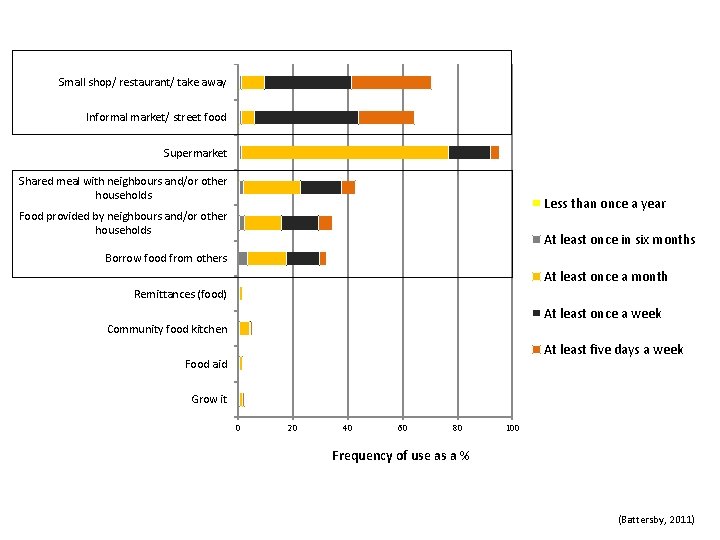
Small shop/ restaurant/ take away Informal market/ street food Supermarket Shared meal with neighbours and/or other households Less than once a year Food provided by neighbours and/or other households At least once in six months Borrow food from others At least once a month Remittances (food) At least once a week Community food kitchen At least five days a week Food aid Grow it 0 20 40 60 80 100 Frequency of use as a % (Battersby, 2011)
http: //aixlab. wordpress. com/page/2/
Nutrition Transition 2 nd Urban Transition Davis, 2006; Satterthwaite, 2007; Pieterse, 2008; Beall & Fox, 2009; Swilling and Annecke, 2011; Turok, 2012. Drewnowski & Popkin, 1997; . Popkin, 1998; Popkin, 2002; Kennedy et al, 2004; Hawkes, 2006; Nellemann et al, 2009. Global mutually reinforcing transitions Big Food Transition Reardon et al, 2003; Reardon et al, 2007; Patel, 2007; Thu, 2009; Igumbor et al, 2012; Monteiro & Cannon, 2012. Economic & Ecological Transitions Harvey, 1989; Perez, 2002; Perez, 2007; MEA, 2006, IAASTD, 2009; IPCC, 2014.
Community Food Security Coalition (US n= 176)
Individual Household Current area of focus – Capabilities frame Community/ Neighbourhood City -Seeing endowments as foundation on which capacity and capability is built: Focus on individual or family unit. -Attention paid to enabling food access, health, etc. – project driven. -No consideration given to systemic challenges within food system. Current area of intervention – Capabilities frame General area of action – Rescue/philanthropic frame -Seeing endowments as foundation but community endowments focus. Eg: land for food production, etc. -Attention paid to enabling food access through mix of economic and/or community initiatives. – project driven. -Little consideration given to systemic challenges system. -Governance focus considering multiple food Emerging area of action – Urban system actors and voices – agency. . -Adopts a strategic view of food system. food governance frame -Pluralistic politics with strategic governance.
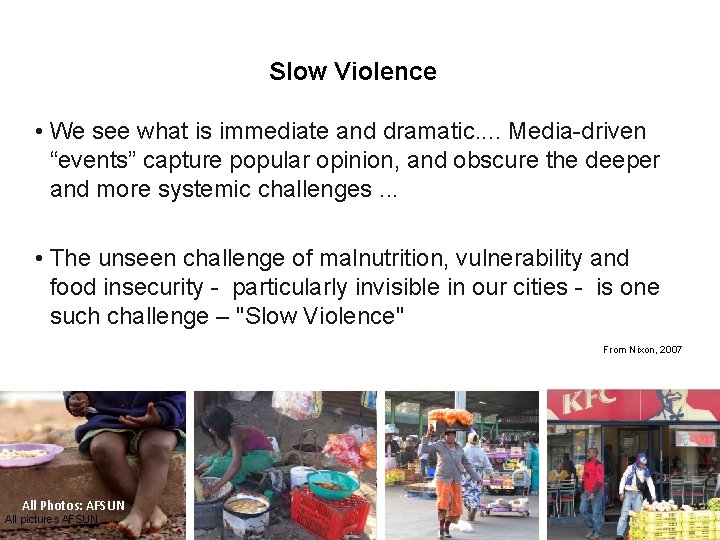
Slow Violence • We see what is immediate and dramatic. . Media-driven “events” capture popular opinion, and obscure the deeper and more systemic challenges. . . • The unseen challenge of malnutrition, vulnerability and food insecurity - particularly invisible in our cities - is one such challenge – "Slow Violence" From Nixon, 2007 All Photos: AFSUN All pictures AFSUN
Thank you Gareth Haysom gareth. haysom@uct. ac. za www. africancentreforcities. net www. afsun. org
- Slides: 15