
The upgrade of the LHCb Vertex Locator VELO
The upgrade of the LHCb Vertex Locator (VELO) Vertex 2013 17 September 2013 Martin van Beuzekom on behalf of the LHCb VELO upgrade group u u u Introduction to the upgrade of LHCb Upgrade of the Vertex Locator Radiation environment and silicon Readout challenge Cooling RF-box
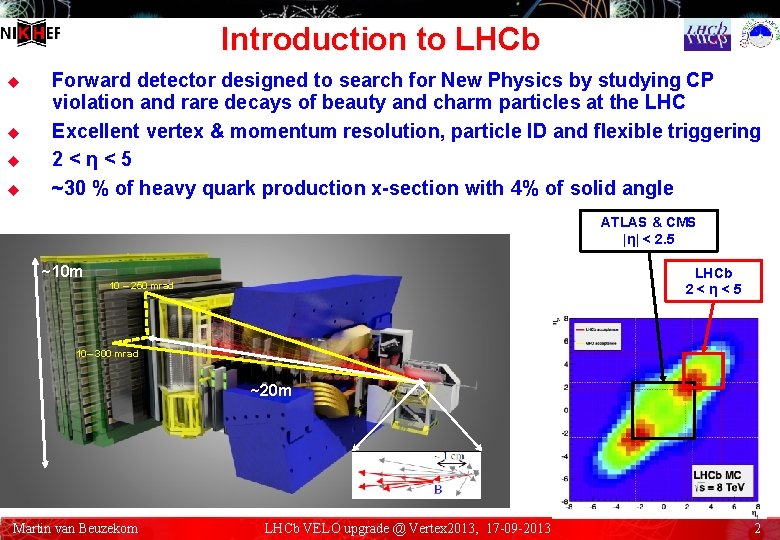
Introduction to LHCb u u Forward detector designed to search for New Physics by studying CP violation and rare decays of beauty and charm particles at the LHC Excellent vertex & momentum resolution, particle ID and flexible triggering 2<η<5 ~30 % of heavy quark production x-section with 4% of solid angle ATLAS & CMS |η| < 2. 5 ~10 m LHCb 2<η<5 10 – 250 mrad 10– 300 mrad ~20 m Martin van Beuzekom LHCb VELO upgrade @ Vertex 2013, 17 -09 -2013 2
Why upgrade u No deviation observed from The Standard Model (not yet) -> Need more statistics! u Currently LHCb runs at twice its design luminosity u n u u At long shutdown 2 (2018) we hope to have ~3 x the current statistics Another factor 2 in statistics will take another 5 years n u u u further increase is not possible (next slides) not very rewarding The amount of data and the physics yield from data recorded by the current LHCb experiment is limited by the detector LHCb luminosity is lower than LHC can deliver, no LHC upgrade required -> Upgrade the detector to cope with higher luminosity Martin van Beuzekom LHCb VELO upgrade @ Vertex 2013, 17 -09 -2013 3
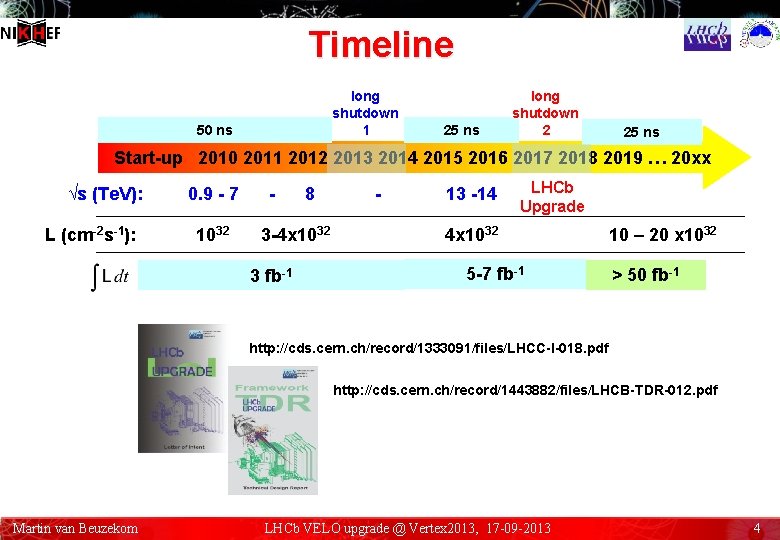
Timeline long shutdown 1 50 ns 25 ns long shutdown 2 25 ns Start-up 2010 2011 2012 2013 2014 2015 2016 2017 2018 2019 … 20 xx √s (Te. V): L (cm-2 s-1): 0. 9 - 7 1032 - 8 3 -4 x 1032 3 fb-1 - 13 -14 LHCb Upgrade 4 x 1032 5 -7 fb-1 10 – 20 x 1032 > 50 fb-1 http: //cds. cern. ch/record/1333091/files/LHCC-I-018. pdf http: //cds. cern. ch/record/1443882/files/LHCB-TDR-012. pdf Martin van Beuzekom LHCb VELO upgrade @ Vertex 2013, 17 -09 -2013 4
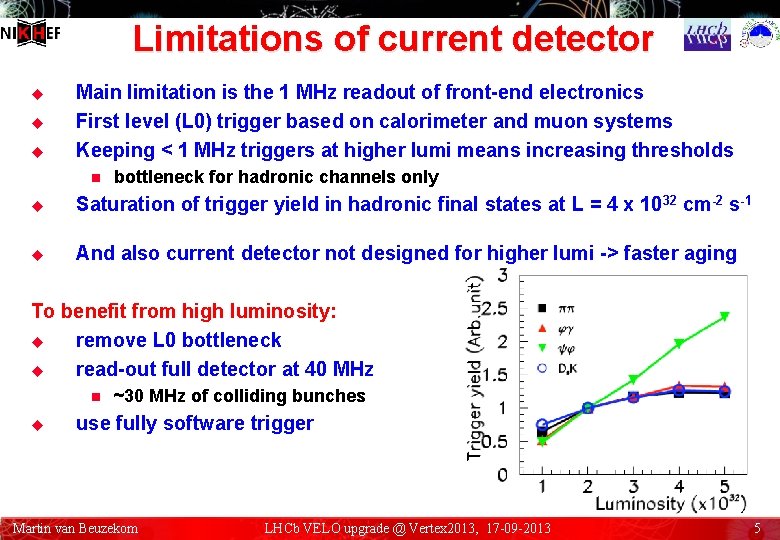
Limitations of current detector u u u Main limitation is the 1 MHz readout of front-end electronics First level (L 0) trigger based on calorimeter and muon systems Keeping < 1 MHz triggers at higher lumi means increasing thresholds n bottleneck for hadronic channels only u Saturation of trigger yield in hadronic final states at L = 4 x 1032 cm-2 s-1 u And also current detector not designed for higher lumi -> faster aging To benefit from high luminosity: u remove L 0 bottleneck u read-out full detector at 40 MHz n u ~30 MHz of colliding bunches use fully software trigger Martin van Beuzekom LHCb VELO upgrade @ Vertex 2013, 17 -09 -2013 5
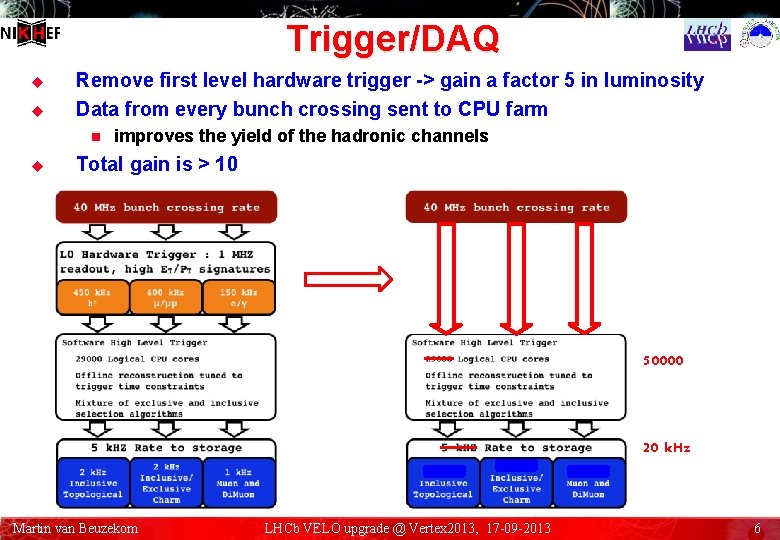
Trigger/DAQ u u Remove first level hardware trigger -> gain a factor 5 in luminosity Data from every bunch crossing sent to CPU farm n u improves the yield of the hadronic channels Total gain is > 10 50000 20 k. Hz Martin van Beuzekom LHCb VELO upgrade @ Vertex 2013, 17 -09 -2013 6
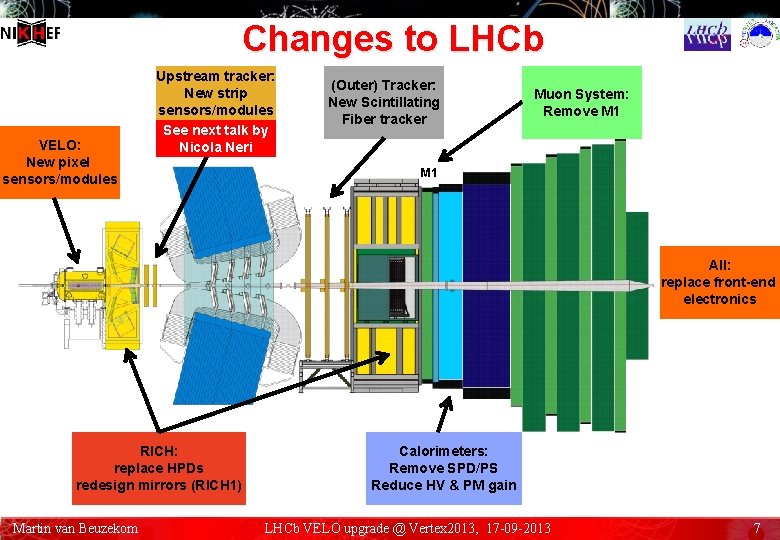
Changes to LHCb VELO: New pixel sensors/modules Upstream tracker: New strip sensors/modules See next talk by Nicola Neri (Outer) Tracker: New Scintillating Fiber tracker Muon System: Remove M 1 All: replace front-end electronics RICH: replace HPDs redesign mirrors (RICH 1) Martin van Beuzekom Calorimeters: Remove SPD/PS Reduce HV & PM gain LHCb VELO upgrade @ Vertex 2013, 17 -09 -2013 7
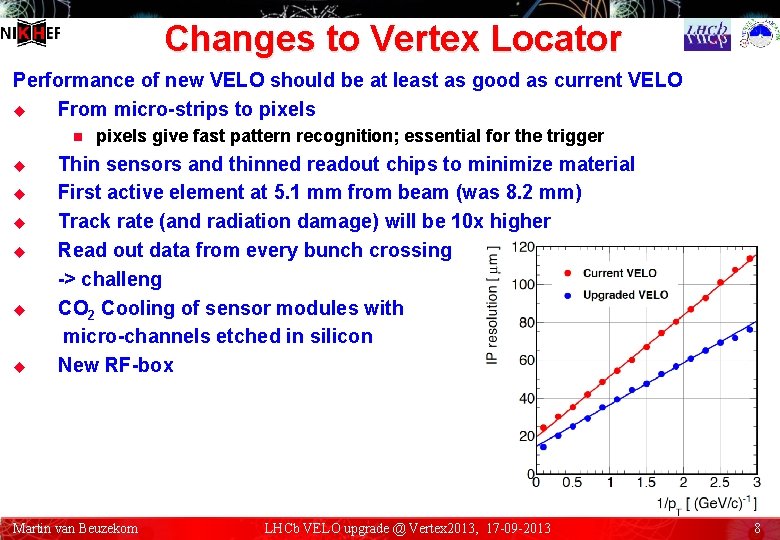
Changes to Vertex Locator Performance of new VELO should be at least as good as current VELO u From micro-strips to pixels n u u u pixels give fast pattern recognition; essential for the trigger Thin sensors and thinned readout chips to minimize material First active element at 5. 1 mm from beam (was 8. 2 mm) Track rate (and radiation damage) will be 10 x higher Read out data from every bunch crossing -> challeng CO 2 Cooling of sensor modules with micro-channels etched in silicon New RF-box Martin van Beuzekom LHCb VELO upgrade @ Vertex 2013, 17 -09 -2013 8
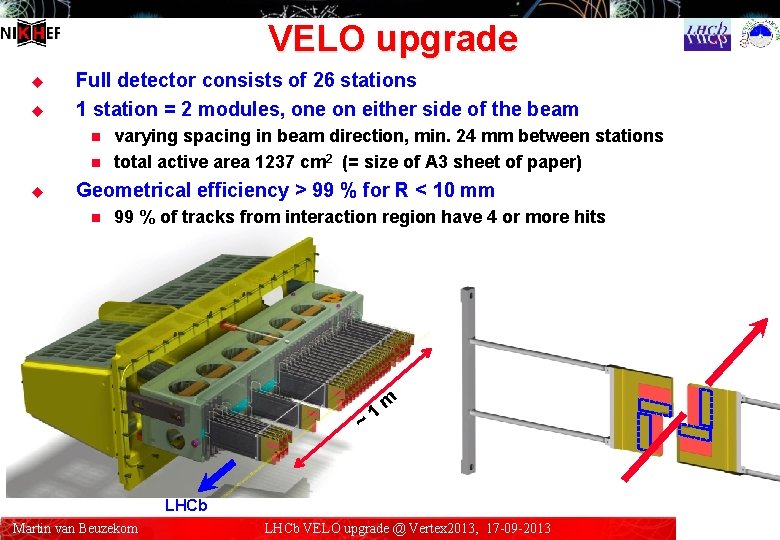
VELO upgrade u u Full detector consists of 26 stations 1 station = 2 modules, one on either side of the beam n n u varying spacing in beam direction, min. 24 mm between stations total active area 1237 cm 2 (= size of A 3 sheet of paper) Geometrical efficiency > 99 % for R < 10 mm n 99 % of tracks from interaction region have 4 or more hits ~ 1 m LHCb Martin van Beuzekom LHCb VELO upgrade @ Vertex 2013, 17 -09 -2013 9
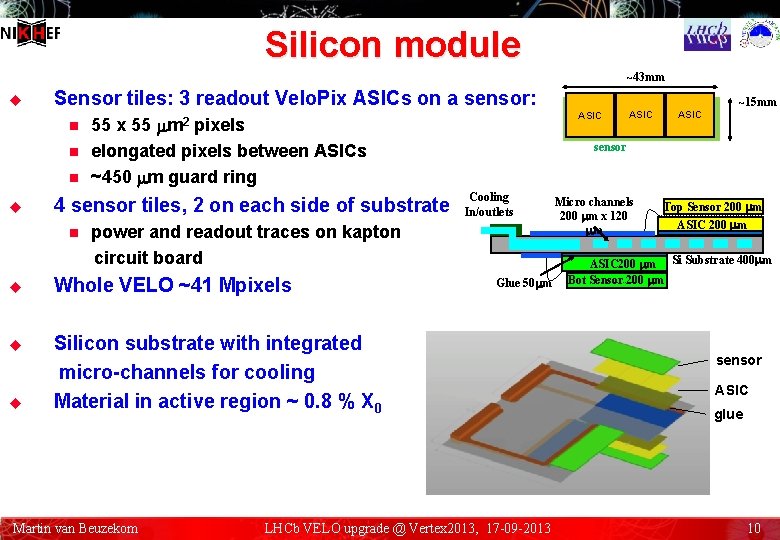
Silicon module ~43 mm u Sensor tiles: 3 readout Velo. Pix ASICs on a sensor: n n n u 55 x 55 mm 2 pixels elongated pixels between ASICs ~450 mm guard ring 4 sensor tiles, 2 on each side of substrate n Whole VELO ~41 Mpixels u Silicon substrate with integrated micro-channels for cooling Material in active region ~ 0. 8 % X 0 u Martin van Beuzekom ASIC sensor Cooling In/outlets power and readout traces on kapton circuit board u ~15 mm ASIC Glue 50 mm LHCb VELO upgrade @ Vertex 2013, 17 -09 -2013 Micro channels 200 mm x 120 mm Top Sensor 200 mm. . . . . ASIC 200 mm. . . . . Bot Sensor 200 mm ASIC 200 mm Si Substrate 400 mm sensor ASIC glue 10
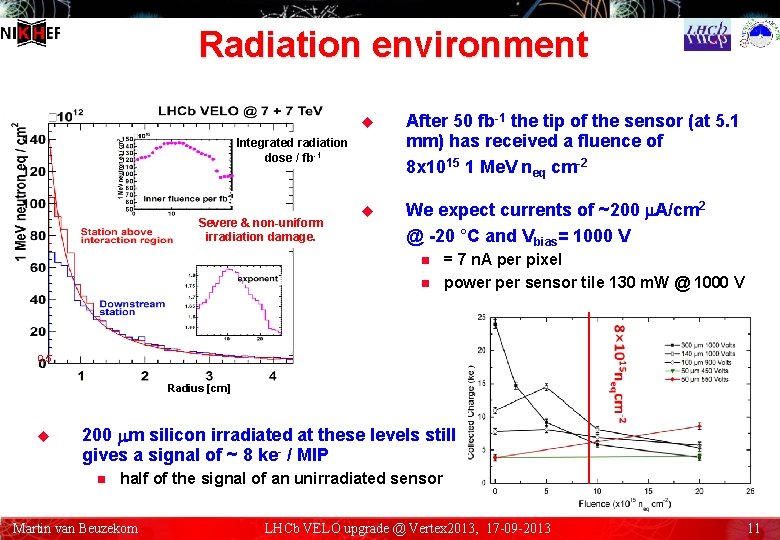
Radiation environment u After 50 fb-1 the tip of the sensor (at 5. 1 mm) has received a fluence of 8 x 10¹⁵ 1 Me. V neq cm-2 u We expect currents of ~200 m. A/cm 2 @ -20 °C and Vbias= 1000 V Integrated radiation dose / fb-1 Severe & non-uniform irradiation damage. n n = 7 n. A per pixel power per sensor tile 130 m. W @ 1000 V 0. 5 Radius [cm] u 200 mm silicon irradiated at these levels still gives a signal of ~ 8 ke- / MIP n half of the signal of an unirradiated sensor Martin van Beuzekom LHCb VELO upgrade @ Vertex 2013, 17 -09 -2013 11
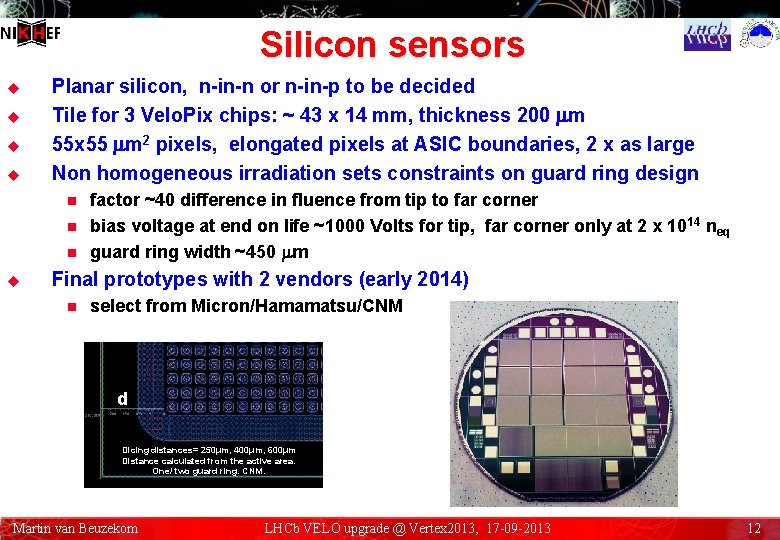
Silicon sensors u u Planar silicon, n-in-n or n-in-p to be decided Tile for 3 Velo. Pix chips: ~ 43 x 14 mm, thickness 200 mm 55 x 55 mm 2 pixels, elongated pixels at ASIC boundaries, 2 x as large Non homogeneous irradiation sets constraints on guard ring design n u factor ~40 difference in fluence from tip to far corner bias voltage at end on life ~1000 Volts for tip, far corner only at 2 x 10 14 neq guard ring width ~450 mm Final prototypes with 2 vendors (early 2014) n select from Micron/Hamamatsu/CNM d Dicing distances= 250μm, 400μm, 600μm Distance calculated from the active area. One/ two guard ring. CNM. Martin van Beuzekom LHCb VELO upgrade @ Vertex 2013, 17 -09 -2013 12
Velopix ASIC u u Matrix of 256 x 256 pixels -> 14. 08 x 14. 08 mm 2 active area Velo. Pix is based on Timepix-3 (from Medipix-3 collaboration) n u TPX 3 is a general purpose chip n n n u u Many aspects of the design driven by VELO upgrade requirements Re-use of MPX 3 IP blocks, and use of CERN high density cell library Chip testing started 2 weeks ago 130 nm CMOS technology Many specifications of TPX 3 are the same/similar for Velo. Pix n n u Velo. Pix designed by CERN medipix group and Nikhef Fast front-end: Timewalk < 25 ns Simultaneous Time-of-Arrival and Time-over-Threshold measurements Zero suppressed data Trigger-less / data driven readout: Each hit is time-stamped, labeled and sent off chip immediately Velopix hit-rate = ~8 x Timepix 3 rate Martin van Beuzekom LHCb VELO upgrade @ Vertex 2013, 17 -09 -2013 13
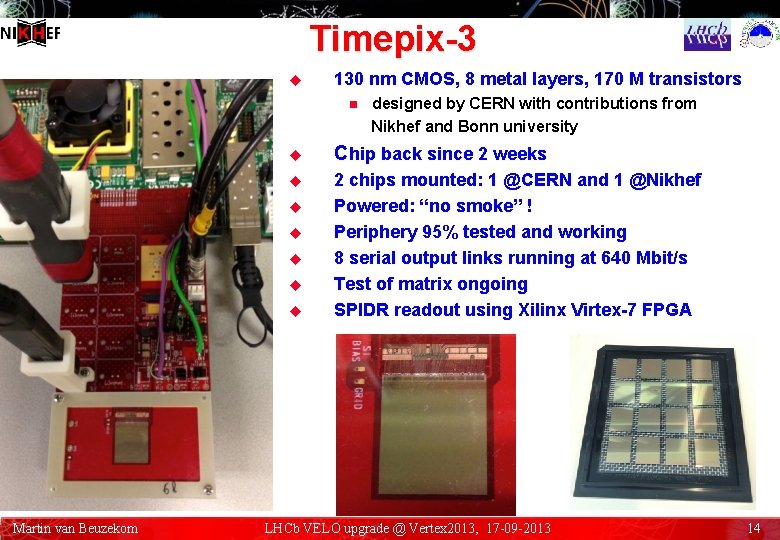
Timepix-3 u 130 nm CMOS, 8 metal layers, 170 M transistors n u Chip back since 2 weeks u 2 chips mounted: 1 @CERN and 1 @Nikhef Powered: “no smoke” ! Periphery 95% tested and working 8 serial output links running at 640 Mbit/s Test of matrix ongoing SPIDR readout using Xilinx Virtex-7 FPGA u u u Martin van Beuzekom designed by CERN with contributions from Nikhef and Bonn university LHCb VELO upgrade @ Vertex 2013, 17 -09 -2013 14
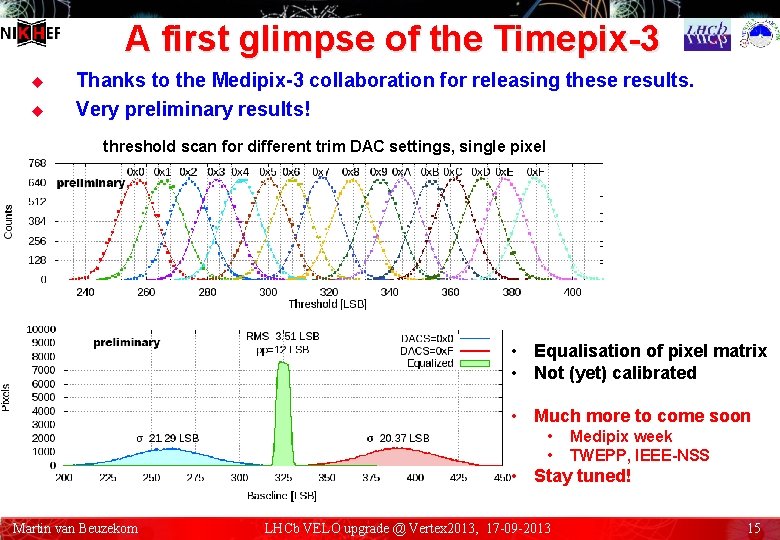
A first glimpse of the Timepix-3 u u Thanks to the Medipix-3 collaboration for releasing these results. Very preliminary results! threshold scan for different trim DAC settings, single pixel • Equalisation of pixel matrix • Not (yet) calibrated • Much more to come soon • • Medipix week TWEPP, IEEE-NSS • Stay tuned! Martin van Beuzekom LHCb VELO upgrade @ Vertex 2013, 17 -09 -2013 15
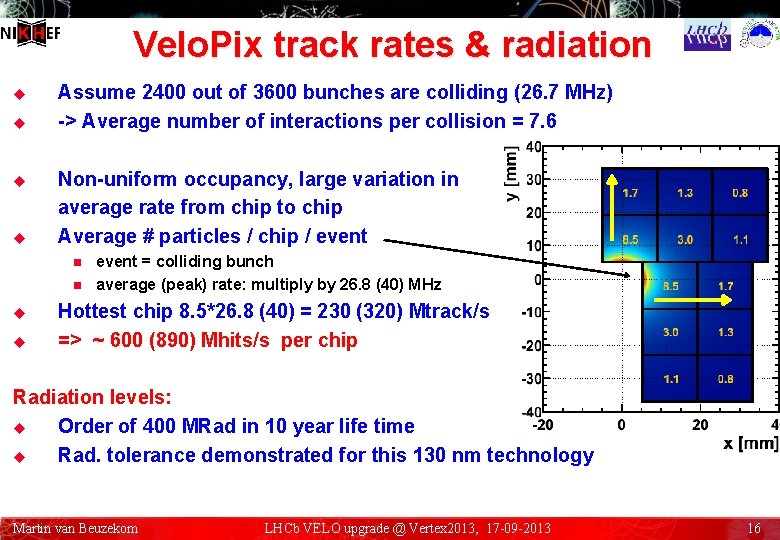
Velo. Pix track rates & radiation u u Assume 2400 out of 3600 bunches are colliding (26. 7 MHz) -> Average number of interactions per collision = 7. 6 Non-uniform occupancy, large variation in average rate from chip to chip Average # particles / chip / event n n u u event = colliding bunch average (peak) rate: multiply by 26. 8 (40) MHz Hottest chip 8. 5*26. 8 (40) = 230 (320) Mtrack/s => ~ 600 (890) Mhits/s per chip Radiation levels: u Order of 400 MRad in 10 year life time u Rad. tolerance demonstrated for this 130 nm technology Martin van Beuzekom LHCb VELO upgrade @ Vertex 2013, 17 -09 -2013 16
Timepix-3 -> Velo. Pix u Increase hit rate capabilities by factor 8 n n n u Output bandwidth of Velo. Pix > 13 Gbit/s (average, 20 Gbit/s peak) n u u u 4 links at ~ 5 Gbit/s Single event upset robustness n u grouping of pixel hits (2 x 4 super pixels) -> 30 % data reduction increase output bandwidth optimize buffering DICE cells, 3 -redundant Comply to LHCb slow and fast control requirements < 3 Watts per chip @ 1. 5 V (1. 5 W/cm 2) Expected threshold ~1 ke. Design is ongoing, same design team as Timepix-3 Aim for first submission early summer 2014 Production of chips end 2015 Martin van Beuzekom LHCb VELO upgrade @ Vertex 2013, 17 -09 -2013 17
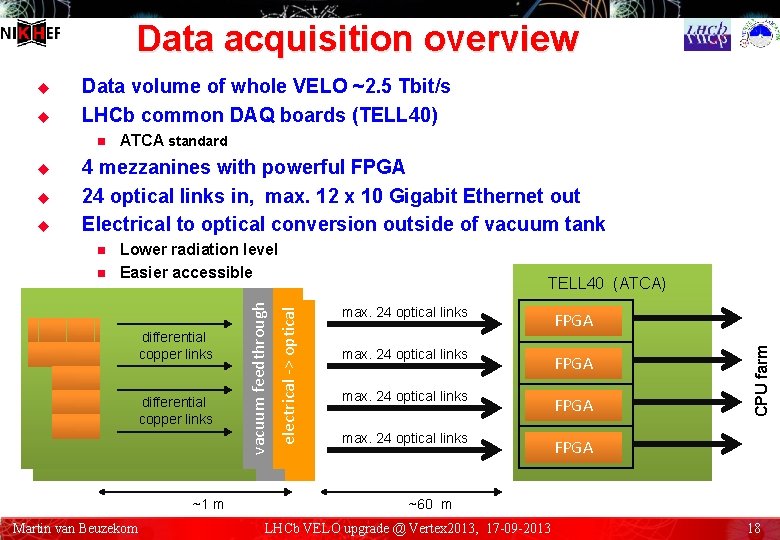
Data acquisition overview n u u u ATCA standard 4 mezzanines with powerful FPGA 24 optical links in, max. 12 x 10 Gigabit Ethernet out Electrical to optical conversion outside of vacuum tank n n Lower radiation level Easier accessible differential copper links ~1 m Martin van Beuzekom TELL 40 (ATCA) max. 24 optical links FPGA CPU farm u Data volume of whole VELO ~2. 5 Tbit/s LHCb common DAQ boards (TELL 40) vacuum feedthrough vacuum feedtrhough electrical -> optical u ~60 m LHCb VELO upgrade @ Vertex 2013, 17 -09 -2013 18
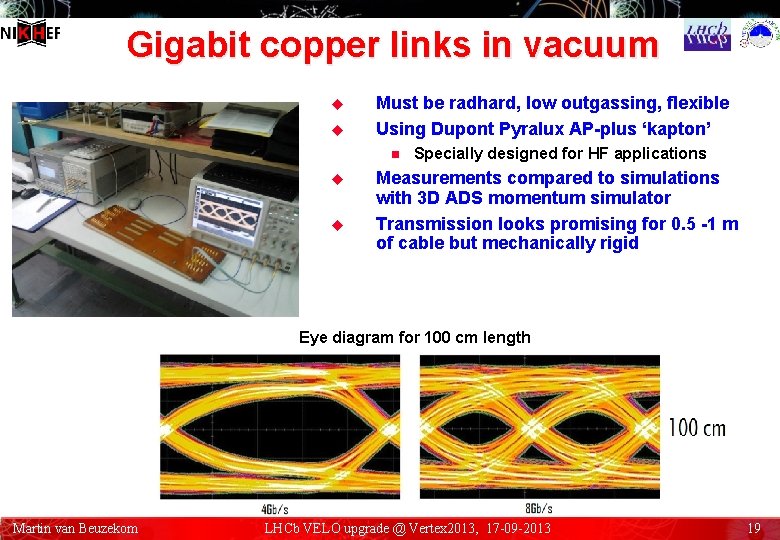
Gigabit copper links in vacuum u u Must be radhard, low outgassing, flexible Using Dupont Pyralux AP-plus ‘kapton’ n u u Specially designed for HF applications Measurements compared to simulations with 3 D ADS momentum simulator Transmission looks promising for 0. 5 -1 m of cable but mechanically rigid Eye diagram for 100 cm length Martin van Beuzekom LHCb VELO upgrade @ Vertex 2013, 17 -09 -2013 19
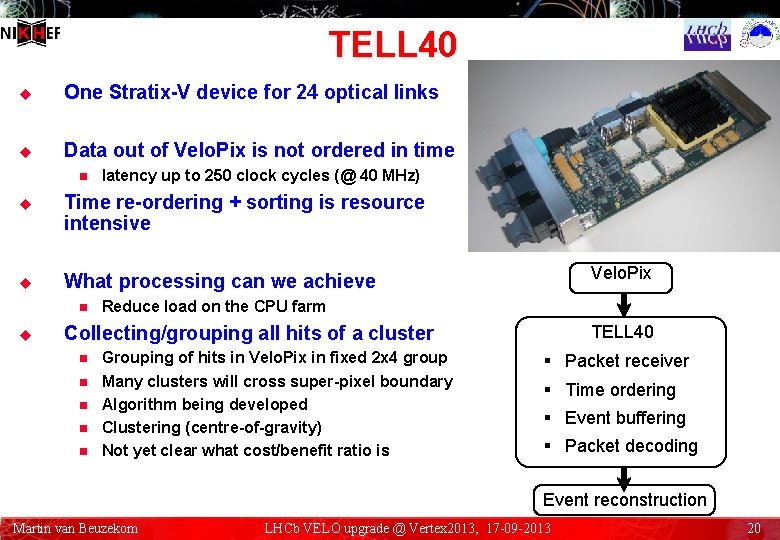
TELL 40 u One Stratix-V device for 24 optical links u Data out of Velo. Pix is not ordered in time n latency up to 250 clock cycles (@ 40 MHz) u Time re-ordering + sorting is resource intensive u What processing can we achieve n u Velo. Pix Reduce load on the CPU farm Collecting/grouping all hits of a cluster n n n Grouping of hits in Velo. Pix in fixed 2 x 4 group Many clusters will cross super-pixel boundary Algorithm being developed Clustering (centre-of-gravity) Not yet clear what cost/benefit ratio is TELL 40 § Packet receiver § Time ordering § Event buffering § Packet decoding Event reconstruction Martin van Beuzekom LHCb VELO upgrade @ Vertex 2013, 17 -09 -2013 20
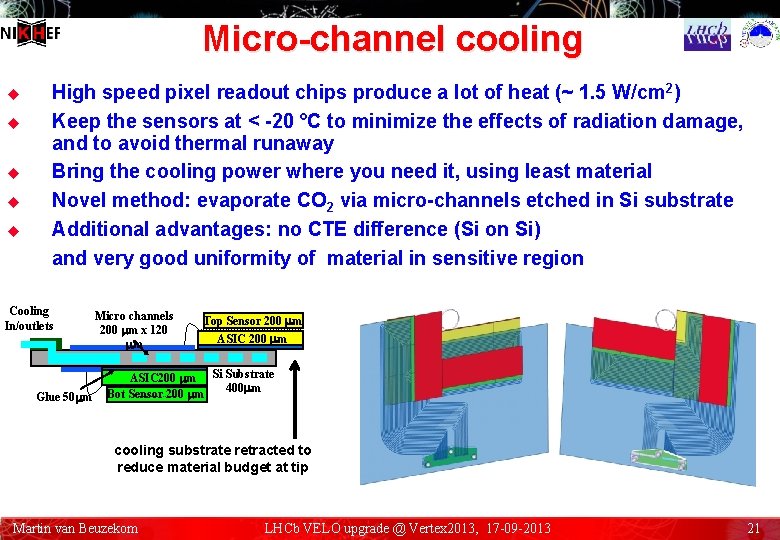
Micro-channel cooling u u u High speed pixel readout chips produce a lot of heat (~ 1. 5 W/cm 2) Keep the sensors at < -20 °C to minimize the effects of radiation damage, and to avoid thermal runaway Bring the cooling power where you need it, using least material Novel method: evaporate CO 2 via micro-channels etched in Si substrate Additional advantages: no CTE difference (Si on Si) and very good uniformity of material in sensitive region Cooling In/outlets Glue 50 mm Micro channels 200 mm x 120 mm Top Sensor 200 mm. . . . . ASIC 200 mm. . . . . Bot Sensor 200 mm ASIC 200 mm Si Substrate 400 mm cooling substrate retracted to reduce material budget at tip Martin van Beuzekom LHCb VELO upgrade @ Vertex 2013, 17 -09 -2013 21
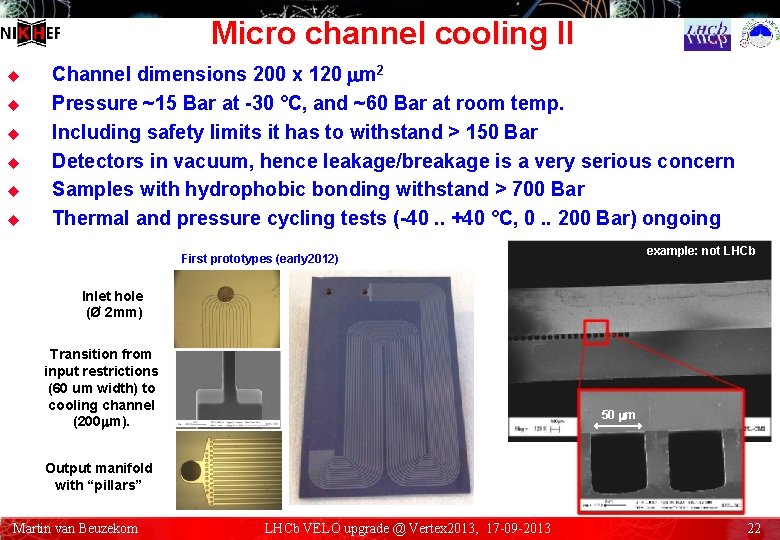
Micro channel cooling II u u u Channel dimensions 200 x 120 mm 2 Pressure ~15 Bar at -30 °C, and ~60 Bar at room temp. Including safety limits it has to withstand > 150 Bar Detectors in vacuum, hence leakage/breakage is a very serious concern Samples with hydrophobic bonding withstand > 700 Bar Thermal and pressure cycling tests (-40. . +40 °C, 0. . 200 Bar) ongoing example: not LHCb First prototypes (early 2012) Inlet hole (Ø 2 mm) Transition from input restrictions (60 um width) to cooling channel (200 mm). 50 mm Output manifold with “pillars” Martin van Beuzekom LHCb VELO upgrade @ Vertex 2013, 17 -09 -2013 22
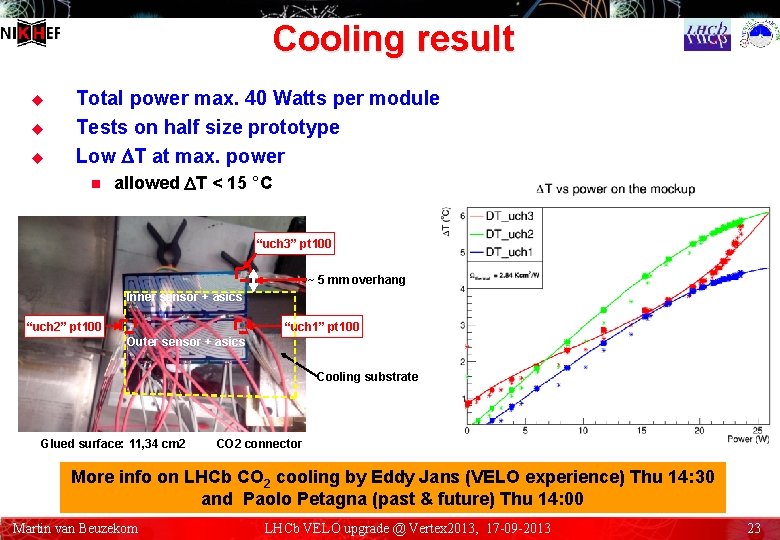
Cooling result u u u Total power max. 40 Watts per module Tests on half size prototype Low DT at max. power n allowed DT < 15 °C “uch 3” pt 100 ~ 5 mm overhang Inner sensor + asics “uch 2” pt 100 “uch 1” pt 100 Outer sensor + asics Cooling substrate Glued surface: 11, 34 cm 2 CO 2 connector More info on LHCb CO 2 cooling by Eddy Jans (VELO experience) Thu 14: 30 and Paolo Petagna (past & future) Thu 14: 00 Martin van Beuzekom LHCb VELO upgrade @ Vertex 2013, 17 -09 -2013 23
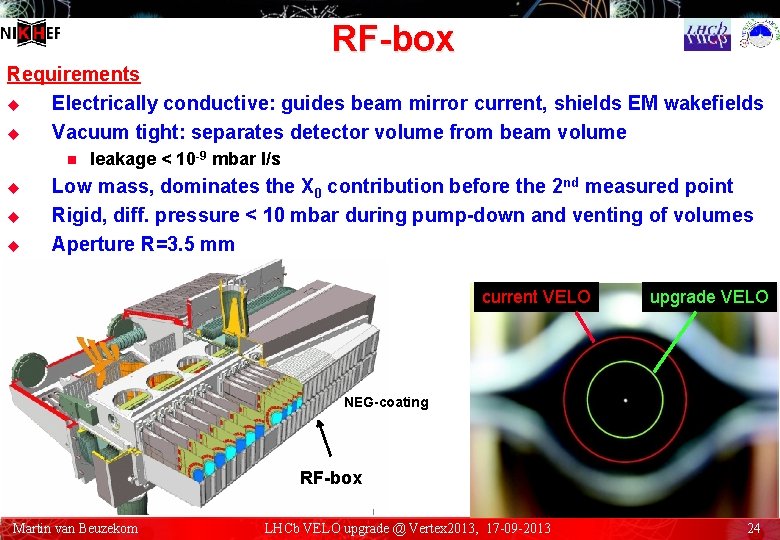
RF-box Requirements u Electrically conductive: guides beam mirror current, shields EM wakefields u Vacuum tight: separates detector volume from beam volume n u u u leakage < 10 -9 mbar l/s Low mass, dominates the X 0 contribution before the 2 nd measured point Rigid, diff. pressure < 10 mbar during pump-down and venting of volumes Aperture R=3. 5 mm current VELO upgrade VELO NEG-coating RF-box Martin van Beuzekom LHCb VELO upgrade @ Vertex 2013, 17 -09 -2013 24
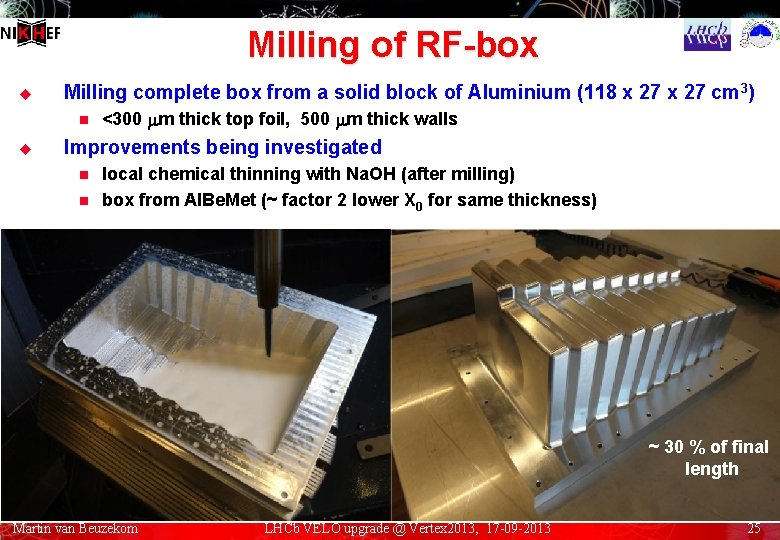
Milling of RF-box u Milling complete box from a solid block of Aluminium (118 x 27 cm 3) n u <300 mm thick top foil, 500 mm thick walls Improvements being investigated n n local chemical thinning with Na. OH (after milling) box from Al. Be. Met (~ factor 2 lower X 0 for same thickness) ~ 30 % of final length Martin van Beuzekom LHCb VELO upgrade @ Vertex 2013, 17 -09 -2013 25
Conclusion / outlook u u LHCb is actively working on a detector upgrade, to be installed in 2018 Will run at L = 2 x 1033 (factor 5 increase w. r. t. current detector) No more hardware trigger, all data to CPU farm Vertex Locator will consist of planar silicon pixels, 55 x 55 mm 2 n n u Velo. Pix ASIC based on Timepix-3 n u 130 nm CMOS, 20 Gbit/s output bandwidth per ASIC Evaporative CO 2 cooling in Silicon micro-channel substrate n u nearest pixel only 5. 1 mm from the beams fluence at tip of sensor 8 x 10¹⁵ 1 Me. V neq / cm 2 low mass, small DT < 300 mm thick RF-box milled from solid block of Aluminium The LHCb VELO upgrade is a very challenging project which uses many novel techniques Martin van Beuzekom LHCb VELO upgrade @ Vertex 2013, 17 -09 -2013 26
- Slides: 26