
The Update of the European Strategy for Particle
- Slides: 32
The Update of the European Strategy for Particle Physics and first Steps for its Implementation M. Krammer (chairman of ECFA) HEPHY, Vienna, Austria INSTR 14, Novosibirsk, Russia March 2014
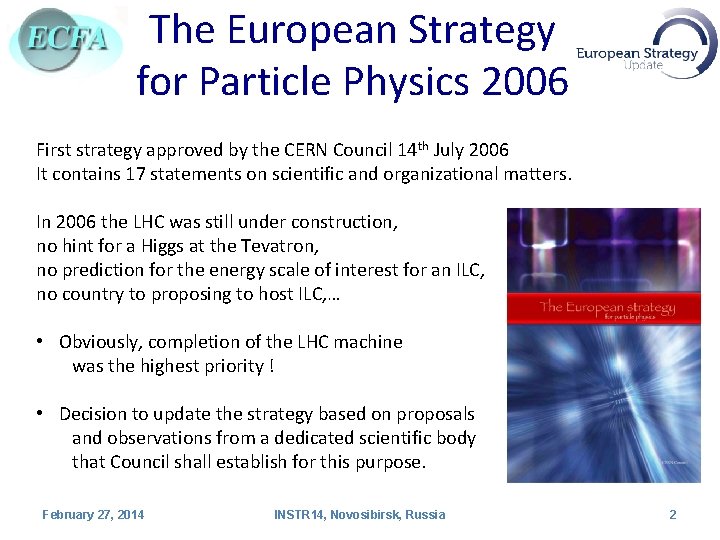
The European Strategy for Particle Physics 2006 First strategy approved by the CERN Council 14 th July 2006 It contains 17 statements on scientific and organizational matters. In 2006 the LHC was still under construction, no hint for a Higgs at the Tevatron, no prediction for the energy scale of interest for an ILC, no country to proposing to host ILC, … • Obviously, completion of the LHC machine was the highest priority ! • Decision to update the strategy based on proposals and observations from a dedicated scientific body that Council shall establish for this purpose. February 27, 2014 INSTR 14, Novosibirsk, Russia 2
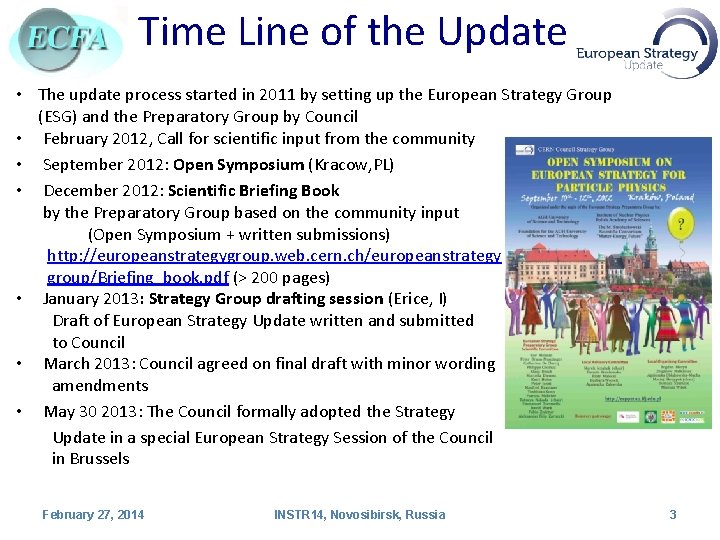
Time Line of the Update • The update process started in 2011 by setting up the European Strategy Group (ESG) and the Preparatory Group by Council • February 2012, Call for scientific input from the community • September 2012: Open Symposium (Kracow, PL) • December 2012: Scientific Briefing Book by the Preparatory Group based on the community input (Open Symposium + written submissions) http: //europeanstrategygroup. web. cern. ch/europeanstrategy group/Briefing_book. pdf (> 200 pages) • January 2013: Strategy Group drafting session (Erice, I) Draft of European Strategy Update written and submitted to Council • March 2013: Council agreed on final draft with minor wording amendments • May 30 2013: The Council formally adopted the Strategy Update in a special European Strategy Session of the Council in Brussels February 27, 2014 INSTR 14, Novosibirsk, Russia 3
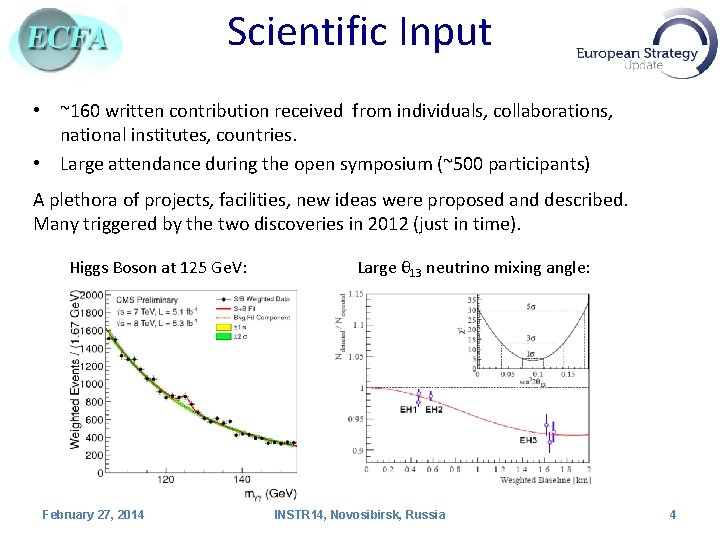
Scientific Input • ~160 written contribution received from individuals, collaborations, national institutes, countries. • Large attendance during the open symposium (~500 participants) A plethora of projects, facilities, new ideas were proposed and described. Many triggered by the two discoveries in 2012 (just in time). Higgs Boson at 125 Ge. V: February 27, 2014 Large θ 13 neutrino mixing angle: INSTR 14, Novosibirsk, Russia 4
A quick tour through the most discussed (fascinating) projects: February 27, 2014 INSTR 14, Novosibirsk, Russia 5
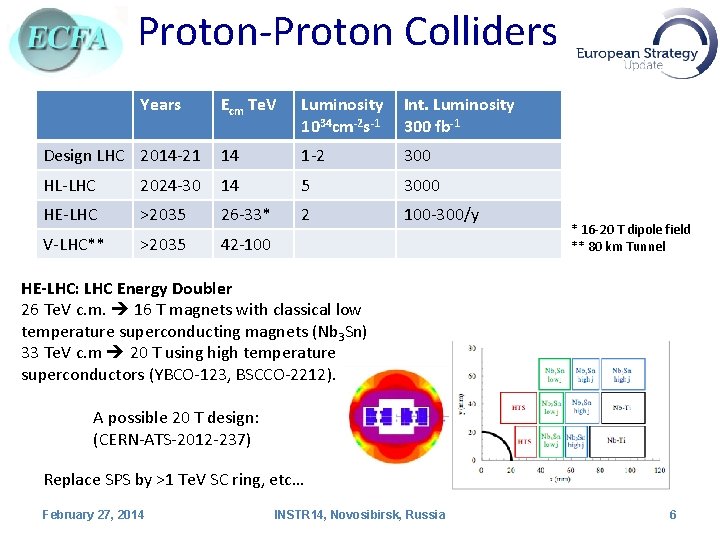
Proton-Proton Colliders Years Ecm Te. V Luminosity 1034 cm-2 s-1 Int. Luminosity 300 fb-1 Design LHC 2014 -21 14 1 -2 300 HL-LHC 2024 -30 14 5 3000 HE-LHC >2035 26 -33* 2 100 -300/y V-LHC** >2035 42 -100 * 16 -20 T dipole field ** 80 km Tunnel HE-LHC: LHC Energy Doubler 26 Te. V c. m. 16 T magnets with classical low temperature superconducting magnets (Nb 3 Sn) 33 Te. V c. m 20 T using high temperature superconductors (YBCO-123, BSCCO-2212). A possible 20 T design: (CERN-ATS-2012 -237) Replace SPS by >1 Te. V SC ring, etc… February 27, 2014 INSTR 14, Novosibirsk, Russia 6
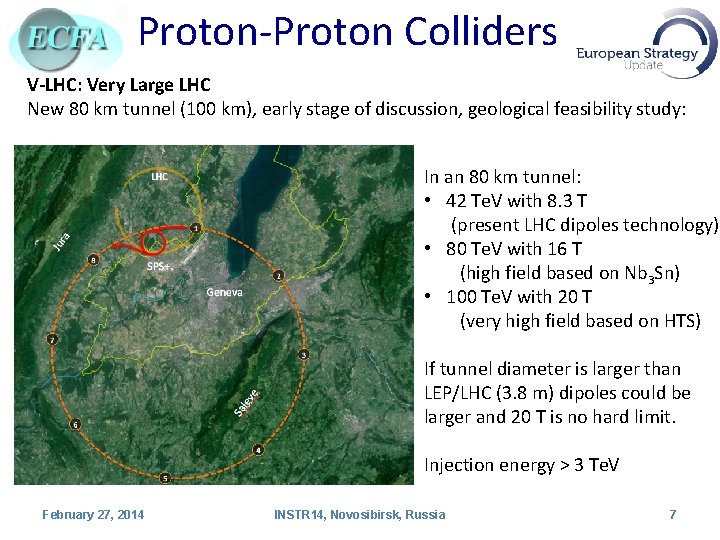
Proton-Proton Colliders V-LHC: Very Large LHC New 80 km tunnel (100 km), early stage of discussion, geological feasibility study: In an 80 km tunnel: • 42 Te. V with 8. 3 T (present LHC dipoles technology) • 80 Te. V with 16 T (high field based on Nb 3 Sn) • 100 Te. V with 20 T (very high field based on HTS) If tunnel diameter is larger than LEP/LHC (3. 8 m) dipoles could be larger and 20 T is no hard limit. Injection energy > 3 Te. V February 27, 2014 INSTR 14, Novosibirsk, Russia 7
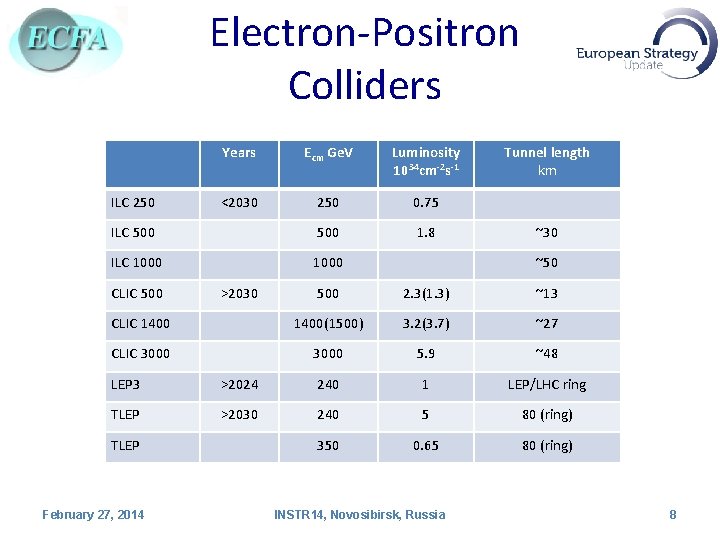
Electron-Positron Colliders Years Ecm Ge. V Luminosity 1034 cm-2 s-1 <2030 250 0. 75 ILC 500 1. 8 ILC 1000 ILC 250 CLIC 500 >2030 Tunnel length km ~30 ~50 500 2. 3(1. 3) ~13 CLIC 1400(1500) 3. 2(3. 7) ~27 CLIC 3000 5. 9 ~48 LEP 3 >2024 240 1 LEP/LHC ring TLEP >2030 240 5 80 (ring) 350 0. 65 80 (ring) TLEP February 27, 2014 INSTR 14, Novosibirsk, Russia 8
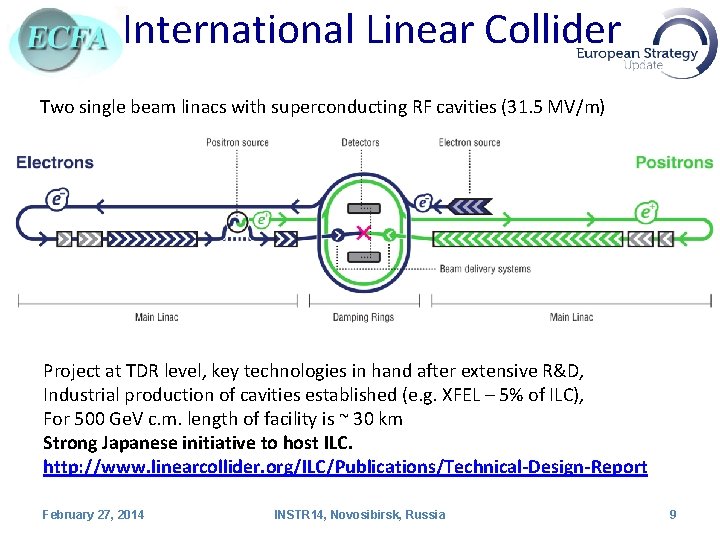
International Linear Collider Two single beam linacs with superconducting RF cavities (31. 5 MV/m) Project at TDR level, key technologies in hand after extensive R&D, Industrial production of cavities established (e. g. XFEL – 5% of ILC), For 500 Ge. V c. m. length of facility is ~ 30 km Strong Japanese initiative to host ILC. http: //www. linearcollider. org/ILC/Publications/Technical-Design-Report February 27, 2014 INSTR 14, Novosibirsk, Russia 9
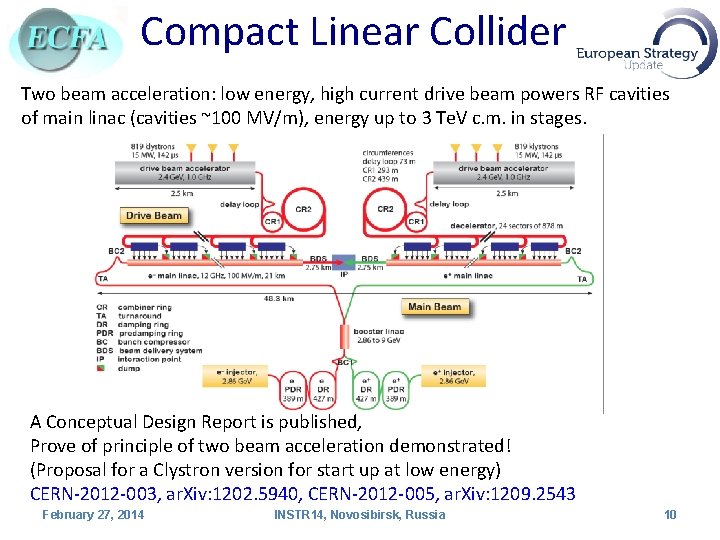
Compact Linear Collider Two beam acceleration: low energy, high current drive beam powers RF cavities of main linac (cavities ~100 MV/m), energy up to 3 Te. V c. m. in stages. A Conceptual Design Report is published, Prove of principle of two beam acceleration demonstrated! (Proposal for a Clystron version for start up at low energy) CERN-2012 -003, ar. Xiv: 1202. 5940, CERN-2012 -005, ar. Xiv: 1209. 2543 February 27, 2014 INSTR 14, Novosibirsk, Russia 10
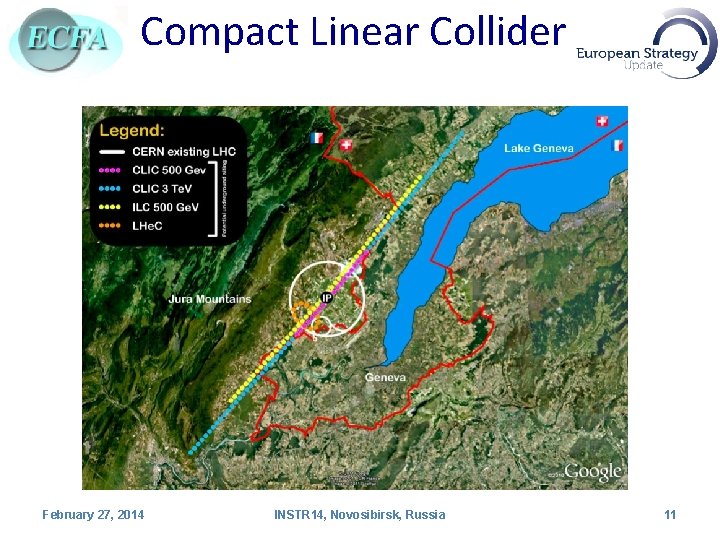
Compact Linear Collider February 27, 2014 INSTR 14, Novosibirsk, Russia 11
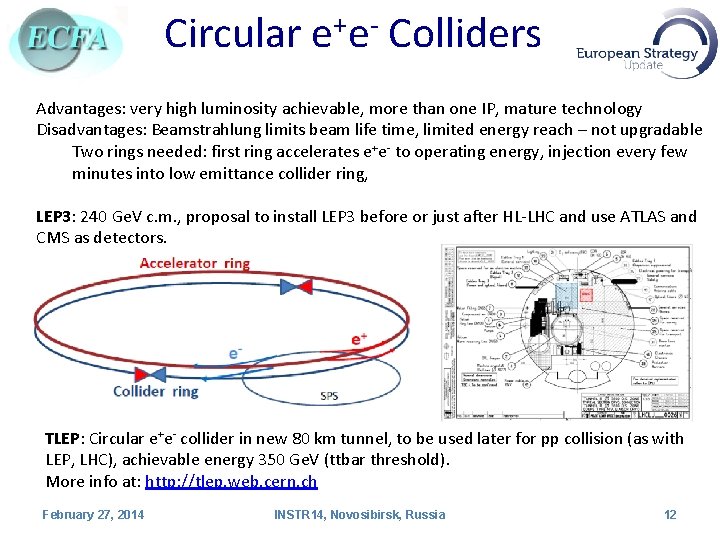
Circular e+e- Colliders Advantages: very high luminosity achievable, more than one IP, mature technology Disadvantages: Beamstrahlung limits beam life time, limited energy reach – not upgradable Two rings needed: first ring accelerates e+e- to operating energy, injection every few minutes into low emittance collider ring, LEP 3: 240 Ge. V c. m. , proposal to install LEP 3 before or just after HL-LHC and use ATLAS and CMS as detectors. TLEP: Circular e+e- collider in new 80 km tunnel, to be used later for pp collision (as with LEP, LHC), achievable energy 350 Ge. V (ttbar threshold). More info at: http: //tlep. web. cern. ch February 27, 2014 INSTR 14, Novosibirsk, Russia 12
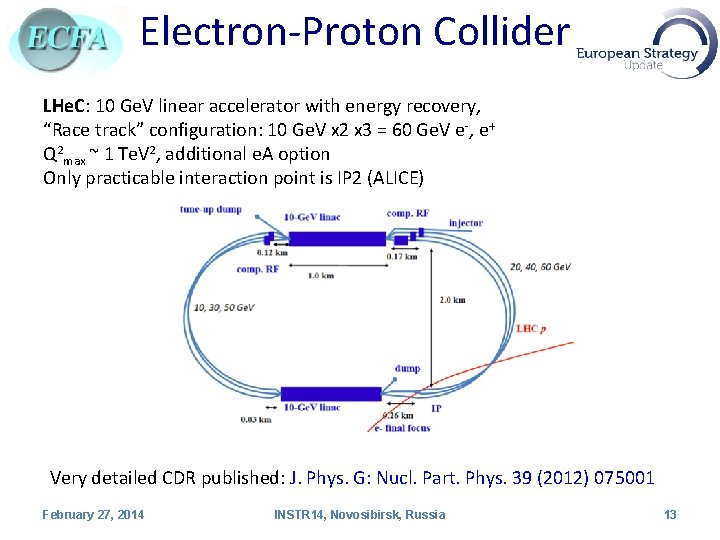
Electron-Proton Collider LHe. C: 10 Ge. V linear accelerator with energy recovery, “Race track” configuration: 10 Ge. V x 2 x 3 = 60 Ge. V e-, e+ Q 2 max ~ 1 Te. V 2, additional e. A option Only practicable interaction point is IP 2 (ALICE) Very detailed CDR published: J. Phys. G: Nucl. Part. Phys. 39 (2012) 075001 February 27, 2014 INSTR 14, Novosibirsk, Russia 13
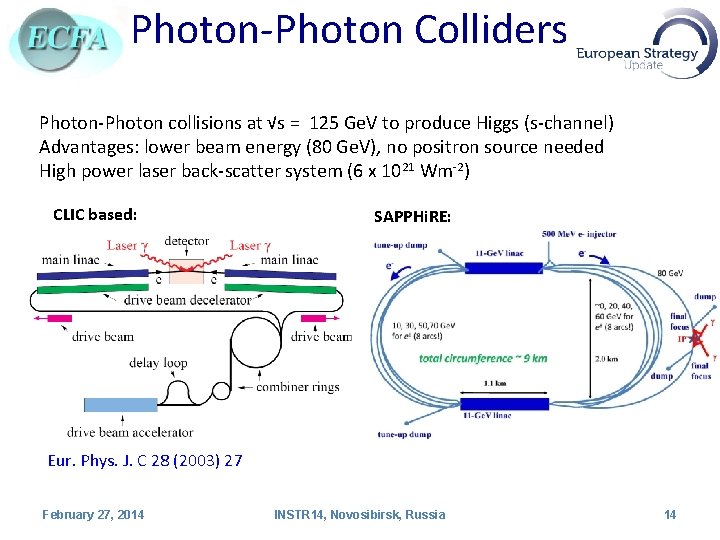
Photon-Photon Colliders Photon-Photon collisions at √s = 125 Ge. V to produce Higgs (s-channel) Advantages: lower beam energy (80 Ge. V), no positron source needed High power laser back-scatter system (6 x 10²¹ Wm-2) CLIC based: SAPPHi. RE: Eur. Phys. J. C 28 (2003) 27 February 27, 2014 INSTR 14, Novosibirsk, Russia 14
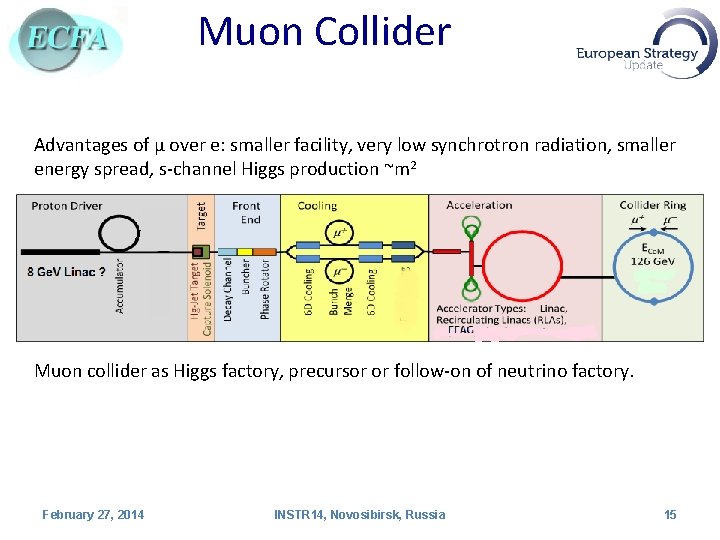
Muon Collider Advantages of µ over e: smaller facility, very low synchrotron radiation, smaller energy spread, s-channel Higgs production ~m 2 Muon collider as Higgs factory, precursor or follow-on of neutrino factory. February 27, 2014 INSTR 14, Novosibirsk, Russia 15
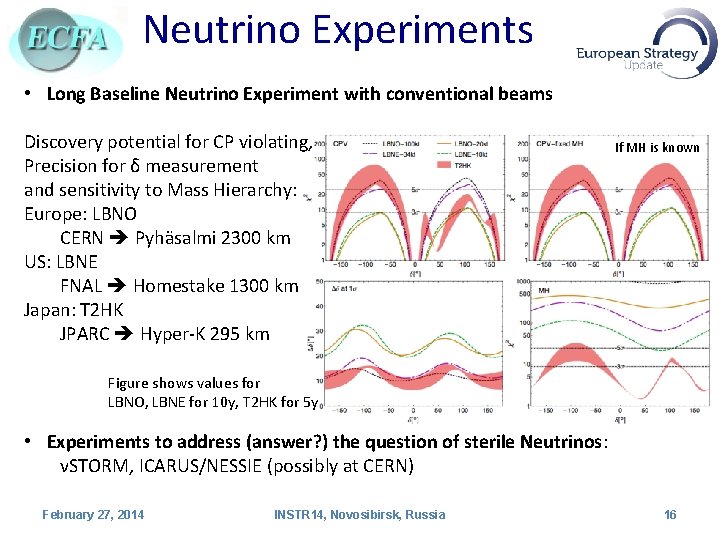
Neutrino Experiments • Long Baseline Neutrino Experiment with conventional beams Discovery potential for CP violating, Precision for δ measurement and sensitivity to Mass Hierarchy: Europe: LBNO CERN Pyhäsalmi 2300 km US: LBNE FNAL Homestake 1300 km Japan: T 2 HK JPARC Hyper-K 295 km If MH is known Figure shows values for LBNO, LBNE for 10 y, T 2 HK for 5 y • Experiments to address (answer? ) the question of sterile Neutrinos: νSTORM, ICARUS/NESSIE (possibly at CERN) February 27, 2014 INSTR 14, Novosibirsk, Russia 16
The Update of the European Strategy 2013 Excerpt from the Strategy Update Official text highlighted, interpretations are my own, however trying to reflect the consensus. February 27, 2014 INSTR 14, Novosibirsk, Russia 17
Scientific Activities After careful analysis of many possible large-scale scientific activities requiring significant resources, sizeable collaborations and sustained commitment, the following four activities have been identified as carrying the highest priority. The strategy update must strike a balance between maintaining the diversity of the scientific program and setting priorities since the available resources are limited. • Only large scale projects are prioritized • Competitive small and medium size projects (national, regional) are important to keep the diversity of our field, since a breakthrough often emerges in unexpected areas A priori these 4 activities are not prioritized, it is meant that all 4 should be pursued – there is a logical time line! February 27, 2014 INSTR 14, Novosibirsk, Russia 18
High-Priority Large-Scale Scientific Activities LHC and HL-LHC: c). . . Europe’s top priority should be the exploitation of the full potential of the LHC, including the high-luminosity upgrade of the machine and detectors with a view to collecting ten times more data than in the initial design, by around 2030. … The strategy recommends to go for the full upgrade, i. e. 3 ab-1, without compromises! The work and input from the experiments have made the case for HL-LHC and a target integrated luminosity of 3 ab-1. This is a big “new” project. Huge work ahead, upgrade of LHC and upgrade of the detectors, funding to be secured, etc. It is the next big challenge for particle physics world-wide contributions from other regions than Europe are crucial. February 27, 2014 INSTR 14, Novosibirsk, Russia 19
High-Priority Large-Scale Scientific Activities ! e c). . . Europe’s top priority should be the exploitation of the full potential of the r u LHC, including the high-luminosity upgrade of the machine and detectors with a t u f view to collecting ten times more data than in the initial design, by around 2030. r a … e n e The strategy recommends to go for thehfull upgrade, i. e. 3 ab , without t compromises! r o f The work and input from the experiments have made the case for HL-LHC and a m target integrated luminosity of 3 ab. a r g o This is a big “new” project. Huge work ahead, upgrade of LHC and upgrade of the r P detectors, funding to be secured, etc. LHC and HL-LHC: -1 -1 It is the next big challenge for particle physics world-wide contributions from other regions than Europe are crucial. February 27, 2014 INSTR 14, Novosibirsk, Russia 20
High-Priority Large-Scale Scientific Activities Design studies and R&D for post-LHC projects: d) … CERN should undertake design studies for accelerator projects in a global context, with emphasis on proton-proton and electron-positron high-energy frontier machines … Europe has a vision for CERNs future as the laboratory at the forefront of particle physics. This statement sees the future in the energy frontier. Possible machines are CLIC, HE-LHC, V-LHC, T-LEP (in connection with V-LHC) More scientific input is needed before one can decide on a next large machine at CERN. The strategy encourages accelerator R&D for proton-proton and electronpositron colliders, and consequently mentions explicitly high-field magnets and high-gradient accelerating structures. February 27, 2014 INSTR 14, Novosibirsk, Russia 21
High-Priority Large-Scale Scientific Activities Design studies and R&D for post-LHC projects: ! m 5 a 3 r 0 g 2 o r > at the forefront of Europe has a vision for CERNs future as the laboratory p r o e particle physics. This statement sees the future in the energy frontier. f it m. HE-LHC, o. V-LHC, Possible machines are CLIC, T-LEP (in connection with V-LHC) w gis neededebefore n n More scientific input one can decide on a next large machine o r at CERN. L a p e The strategy encourages accelerator R&D for proton-proton and electronr P positron colliders, and consequently mentions explicitly high-field magnets and d) … CERN should undertake design studies for accelerator projects in a global context, with emphasis on proton-proton and electron-positron high-energy frontier machines … high-gradient accelerating structures. February 27, 2014 INSTR 14, Novosibirsk, Russia 22
High-Priority Large-Scale Scientific Activities International Linear Collider: e) There is a strong scientific case for an electron-positron collider … European groups are eager to participate. Europe looks forward to a proposal from Japan to discuss a possible participation. This is a strong statement in favor of the ILC and in particular of the Japanese initiative. The strategy supports a machine with an initial energy of 250 Ge. V to perform Higgs studies and sees the energy upgradability of the ILC as major asset! Many European groups are very interested in participating in the ILC project. Expect Japanese government to comes forward with a clear plan for hosting the ILC in Japan and an invitation for Europe to participate. February 27, 2014 INSTR 14, Novosibirsk, Russia 23
High-Priority Large-Scale Scientific Activities International Linear Collider: ! e) There is a strong scientific case for an electron-positron collider … European groups are eager to participate. Europe looks forward to a proposal from Japan to discuss a possible participation. m a r g This is a strong statement in favor of the ILC and o in particular of the Japanese r initiative. P e t The strategy supports a machine with an initial energy of 250 Ge. V to perform a i dupgradability of the ILC as major asset! Higgs studies and sees the Energy e m Many European groups are very interested in participating in the ILC project. r e t Expect Japanese government to comes forward with a clear plan for hosting the n ILC in Japan and. Ian invitation for Europe to participate. February 27, 2014 INSTR 14, Novosibirsk, Russia 24
High-Priority Large-Scale Scientific Activities Neutrino Programme: f) … CERN should develop a neutrino programme to pave the way for a substantial European role in future long-baseline experiments. Europe should explore the possibility of major participation in leading long-baseline neutrino projects in the US and Japan. It is important to reconstitute a neutrino physics activity at CERN, in order to provide technical expertise, support and focus for Europe to play a leading role in the forthcoming experiments – not necessarily hosted in Europe. Note the emphasis on “long baseline”! February 27, 2014 INSTR 14, Novosibirsk, Russia 25
Other Scientific Activities Statements g) to k) define other scientific activities which are essential for HEP, but do not need a prioritization. These are: • Theory • Small and mid-size experiments studying quark flavour physics, dipole moments, precision measurements at lower energies with neutrons, muons and antiprotons, etc. • Instrumentation, state-of-the-art infrastructure at CERN, large scale data-intensive computing • Non-accelerator experiments at the overlap with astroparticle physics. • Research at the boundary between particle and nuclear physics. February 27, 2014 INSTR 14, Novosibirsk, Russia 26
The implementation of the strategy update has already started: February 27, 2014 INSTR 14, Novosibirsk, Russia 27
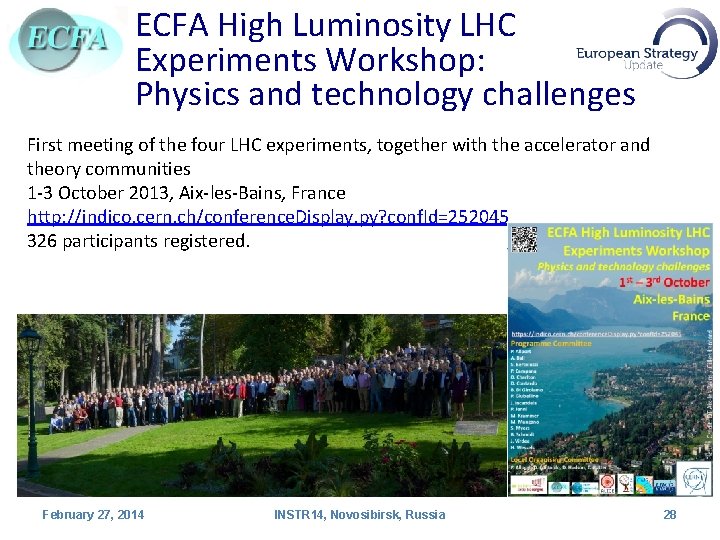
ECFA High Luminosity LHC Experiments Workshop: Physics and technology challenges First meeting of the four LHC experiments, together with the accelerator and theory communities 1 -3 October 2013, Aix-les-Bains, France http: //indico. cern. ch/conference. Display. py? conf. Id=252045 326 participants registered. February 27, 2014 INSTR 14, Novosibirsk, Russia 28
ECFA High Luminosity LHC Experiments Workshop: Physics and technology challenges Work of Preparatory Groups in several areas before the workshop Very positive interaction between the experiments Several issues for common R&D identified Interest to follow up this workshop with more dedicated meetings between the experiments and theorists • A 2 nd “Aix-Les-Bain” workshop in preparation for October 2014 • • Workshop Summary Document: ECFA/13/284 Available at: http: //cds. cern. ch/record/1631032/ February 27, 2014 INSTR 14, Novosibirsk, Russia 29
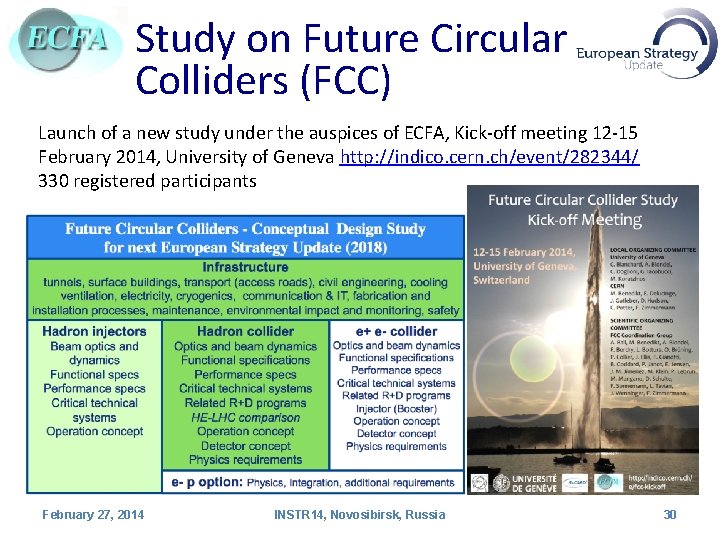
Study on Future Circular Colliders (FCC) Launch of a new study under the auspices of ECFA, Kick-off meeting 12 -15 February 2014, University of Geneva http: //indico. cern. ch/event/282344/ 330 registered participants February 27, 2014 INSTR 14, Novosibirsk, Russia 30
Summary The Strategy Update is the result of a systematic and exhaustive discussion involving the whole particle physics community in Europe and elsewhere. In all the discussions science was placed first! Four high-priority large-scale activities identified. • High-Luminosity LHC • R&D for a future machine at CERN • Participation in the ILC in Japan • Support for European neutrino community Europe has a clear vision and strategy for the future! The program is challenging, but not unrealistic. Europe supports the global effort in our field. The implementation of the strategy has started! The next update of the European strategy is foreseen in about 5 years. February 27, 2014 INSTR 14, Novosibirsk, Russia 31
Thank you for your attention! February 27, 2014 INSTR 14, Novosibirsk, Russia 32