
The upcoming Regional Spatial and Economic Strategy Malachy

- Slides: 28
The upcoming Regional Spatial and Economic Strategy Malachy Bradley Assistant Director
Content ØRegional Assemblies ØRegional Role ØRSES Process ØRSES Approach ØImplementation and Monitoring ØChallenges / Opportunities
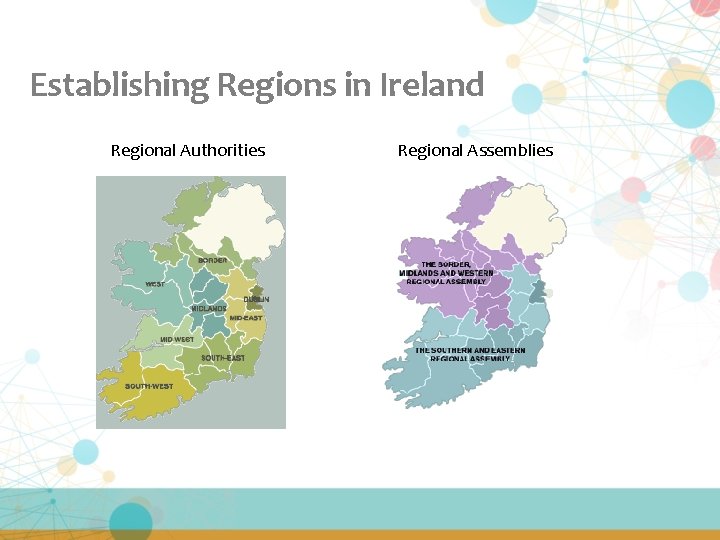
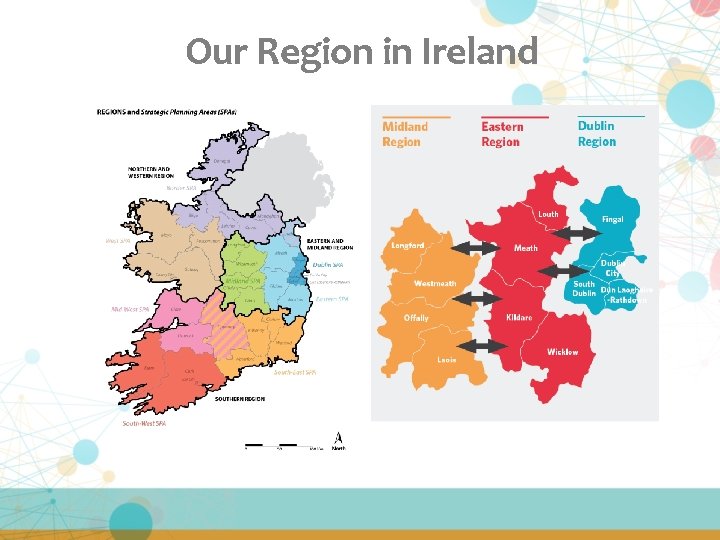
Establishing Regions in Ireland Regional Authorities Regional Assemblies
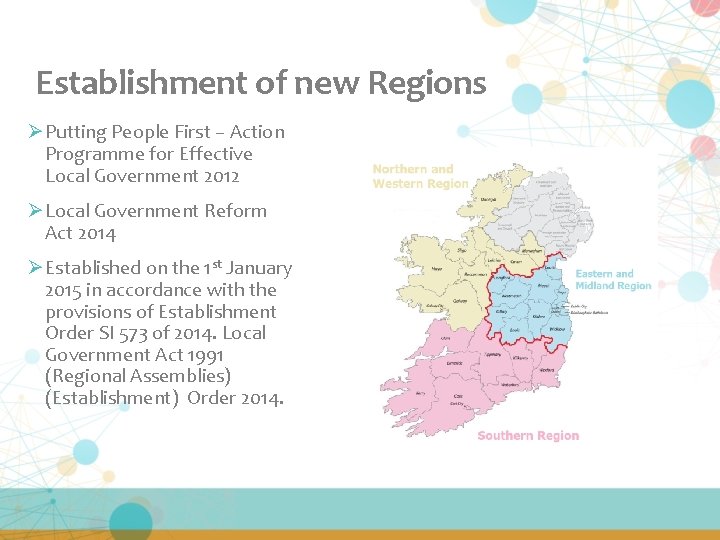
Establishment of new Regions ØPutting People First – Action Programme for Effective Local Government 2012 ØLocal Government Reform Act 2014 ØEstablished on the 1 st January 2015 in accordance with the provisions of Establishment Order SI 573 of 2014. Local Government Act 1991 (Regional Assemblies) (Establishment) Order 2014.
Our Region in Ireland
Functions of Regional Assemblies ØTo manage Regional Operational Programmes monitoring and making proposals in all EU programmes of assistance from the EU. ØTo co-ordinate, promote or support strategic planning and sustainable development of the regions ØTo prepare and oversee the implementation of the Regional Planning Guidelines, to be replaced by new Regional Spatial and Economic Strategies, and providing statutory observations on local authority development plans and variations. ØTo promote effectiveness in local government and public services in the region, in conjunction with the National Oversight & Audit Commission.
RPG Implementation Section 27 of the P & D Act (as Amended) - key section ØSection 27 A – Role of RA in the Preparation of a Draft Development Plan ØSection 27 B – Role of the RA in the making of a Draft Development Plan ØSection 27 C – Role of the RA in the making of a variation (under S 13 of the Act) to a Development We may also indirectly make observations, comments and recommendations on the following: ØMaterial Alterations to a Development Plan (S 12 (7) of the Act ) and; ØPreparation and making of Local Area Plans (S 18, 19, 20 of the Act) ØOther plans or polices of a regional / national perspective
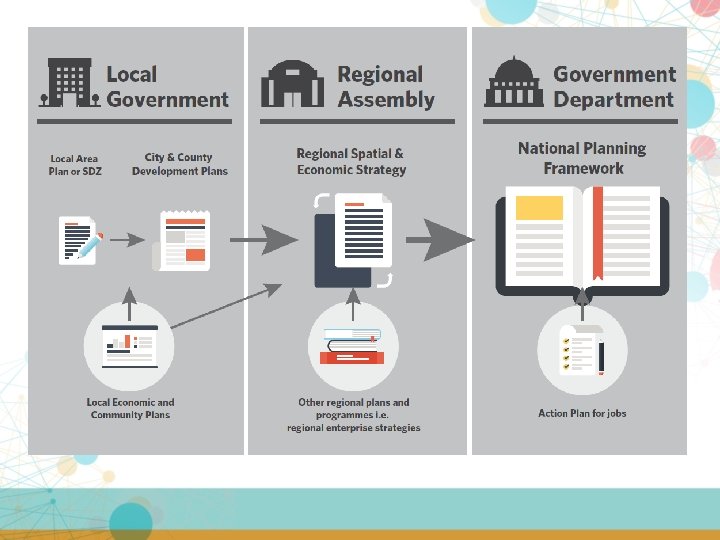
RSES in Legislation ØRegional Planning Guidelines (RPGs) prepared by the dissolved regional authorities for the period 2010 to 2022 continue to have effect until a Regional Spatial and Economic Strategy is prepared and adopted by the regional assembly ØEach Regional Assembly will prepare a long-term (12 -20 years) Regional Spatial and Economic Strategy (RSES) for all of region ØThe RSES shall support the implementation of the National Planning Framework (NPF) and economic policies and objectives of the Government ØAdoption of the RSES is a Reserved Function which requires the consent of the members of the Assembly
Scope and Content of RSES The spatial strategy will address the location and provision of — ØEmployment, industrial and commercial development ØRetail development ØHousing ØTransportation, including public transportation ØWater services ØEnergy and communications networks ØWaste management facilities ØEducational, healthcare, sports and community facilities ØThe preservation and protection of the environment and its amenities ØLandscape ØThe promotion of sustainable settlement and transportation strategies, including greenhouse gas emissions and climate change
Scope and Content of RSES – Economic Elements The economic elements of the RSES will focus on: ØCreating and sustaining jobs ØIdentifying regional strengths and opportunities ØIdentifying the regional attributes that are essential to enhancing regional economic performance including; • the quality of the environment • the qualities of cities, towns and rural areas • physical infrastructure, and • social, community and cultural facilities ØProposals for augmenting the economic performance of the region
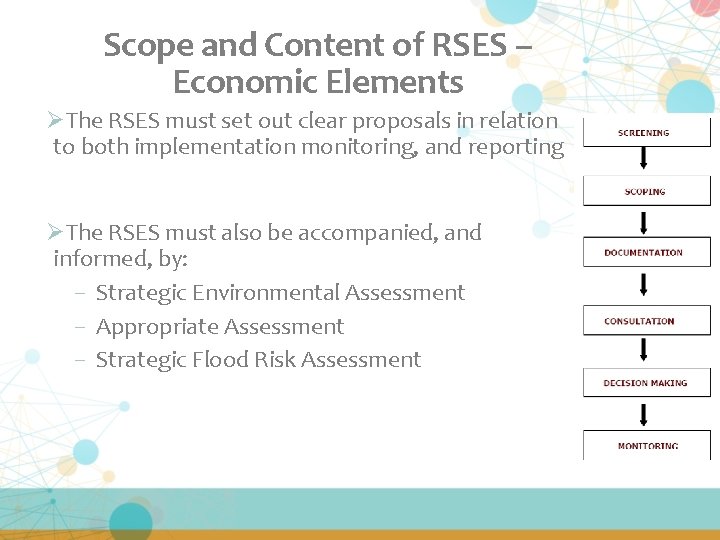
Scope and Content of RSES – Economic Elements ØThe RSES must set out clear proposals in relation to both implementation monitoring, and reporting ØThe RSES must also be accompanied, and informed, by: Strategic Environmental Assessment Appropriate Assessment Strategic Flood Risk Assessment
RSES Approach ØConsolidation of regional structures, greater coherence between national policy making and local action ØStronger role in economic development through RSESs (LECP role) ØPrepare RSES in tandem with NPF Ø 12 year lifespan 2017 to 2029 ØRSES will be aligned with the Regional APJs ØPolicy formulation based on evidence ØEach RSES will take account of sub-regional Strategic Planning Areas ØBuilding block / co-production approach
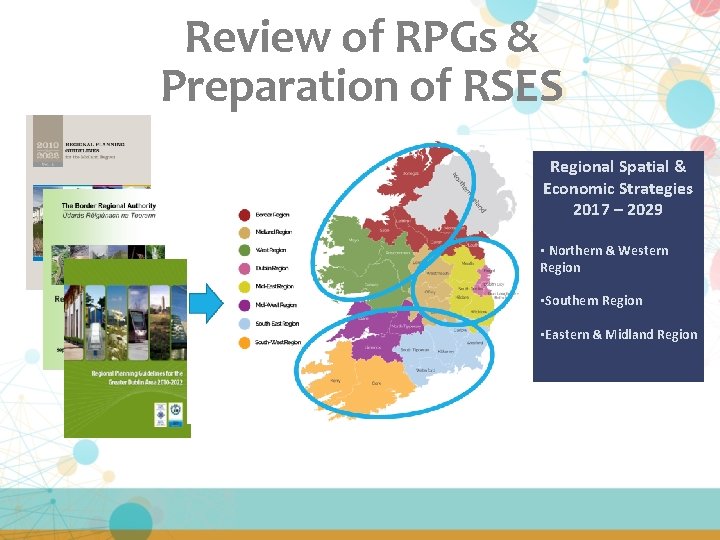
Review of RPGs & Preparation of RSES Regional Spatial & Economic Strategies 2017 – 2029 • Northern & Western Region • Southern Region • Eastern & Midland Region
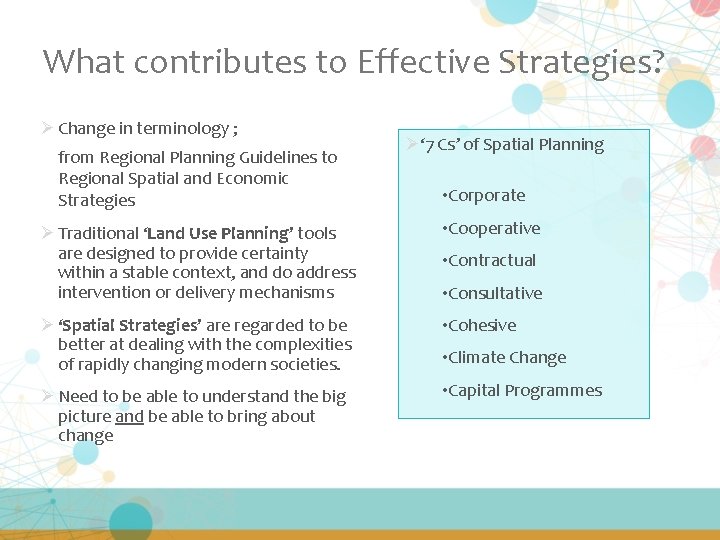
What contributes to Effective Strategies? Ø Change in terminology ; from Regional Planning Guidelines to Regional Spatial and Economic Strategies Ø‘ 7 Cs’ of Spatial Planning • Corporate Ø Traditional ‘Land Use Planning’ tools are designed to provide certainty within a stable context, and do address intervention or delivery mechanisms • Cooperative Ø ‘Spatial Strategies’ are regarded to be better at dealing with the complexities of rapidly changing modern societies. • Cohesive Ø Need to be able to understand the big picture and be able to bring about change • Capital Programmes • Contractual • Consultative • Climate Change
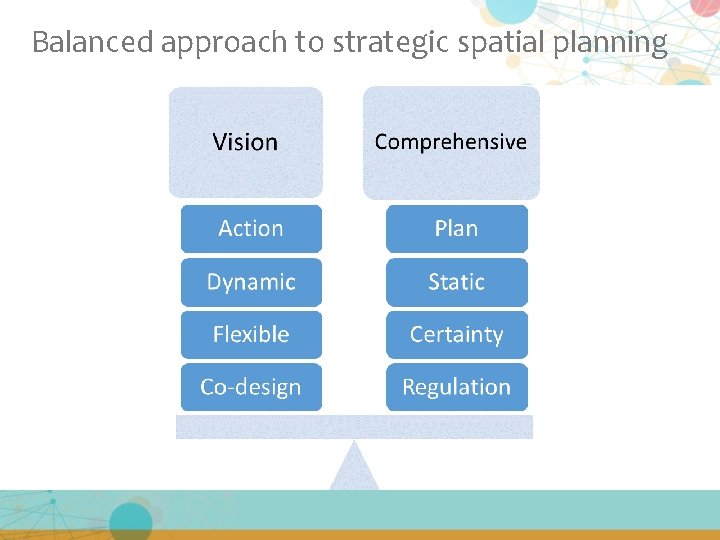
Balanced approach to strategic spatial planning
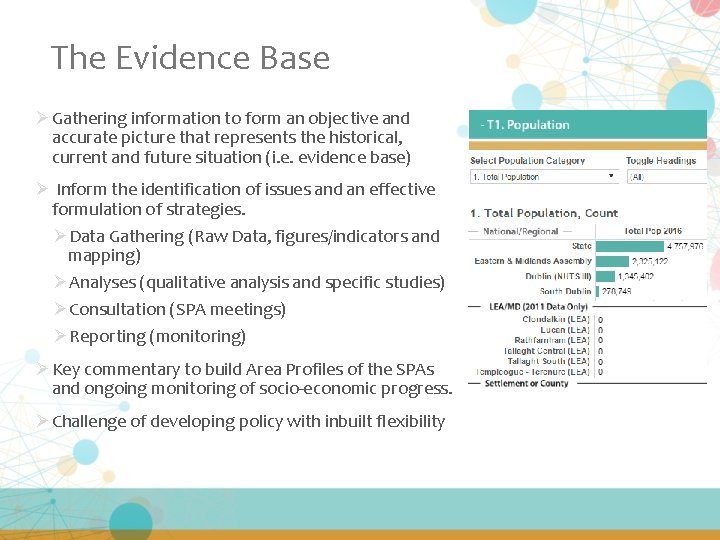
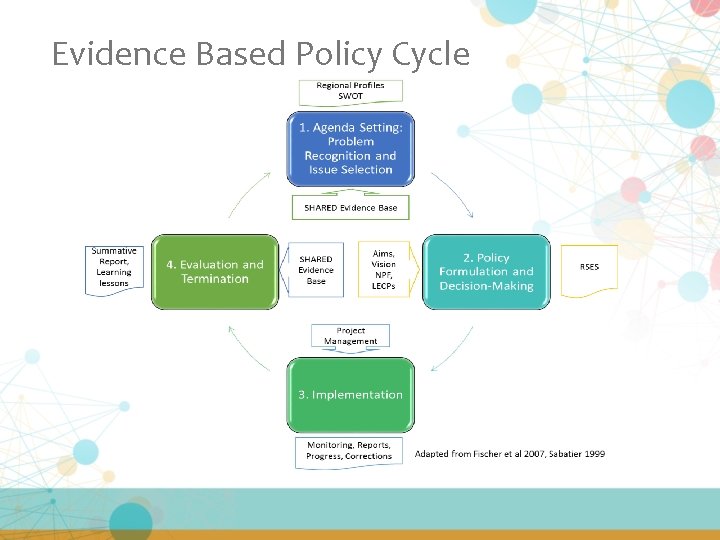
The Evidence Base Ø Gathering information to form an objective and accurate picture that represents the historical, current and future situation (i. e. evidence base) Ø Inform the identification of issues and an effective formulation of strategies. ØData Gathering (Raw Data, figures/indicators and mapping) ØAnalyses (qualitative analysis and specific studies) ØConsultation (SPA meetings) ØReporting (monitoring) Ø Key commentary to build Area Profiles of the SPAs and ongoing monitoring of socio-economic progress. Ø Challenge of developing policy with inbuilt flexibility
Evidence Based Policy Cycle
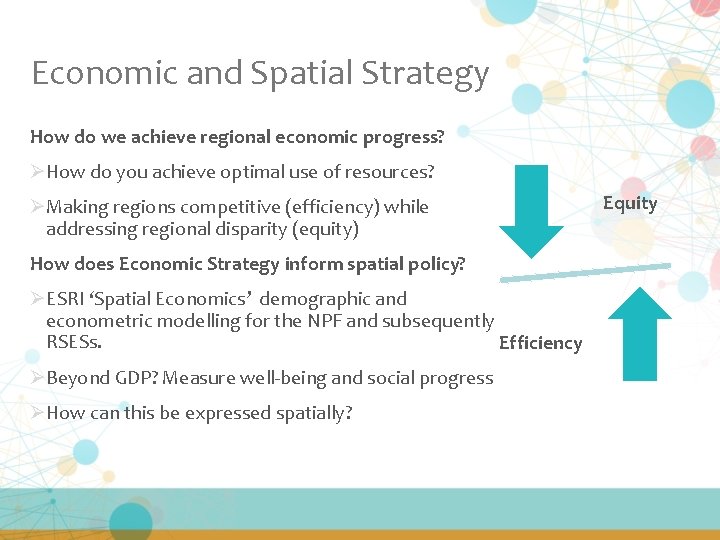
Economic and Spatial Strategy How do we achieve regional economic progress? ØHow do you achieve optimal use of resources? ØMaking regions competitive (efficiency) while addressing regional disparity (equity) How does Economic Strategy inform spatial policy? ØESRI ‘Spatial Economics’ demographic and econometric modelling for the NPF and subsequently RSESs. Efficiency ØBeyond GDP? Measure well-being and social progress ØHow can this be expressed spatially? Equity
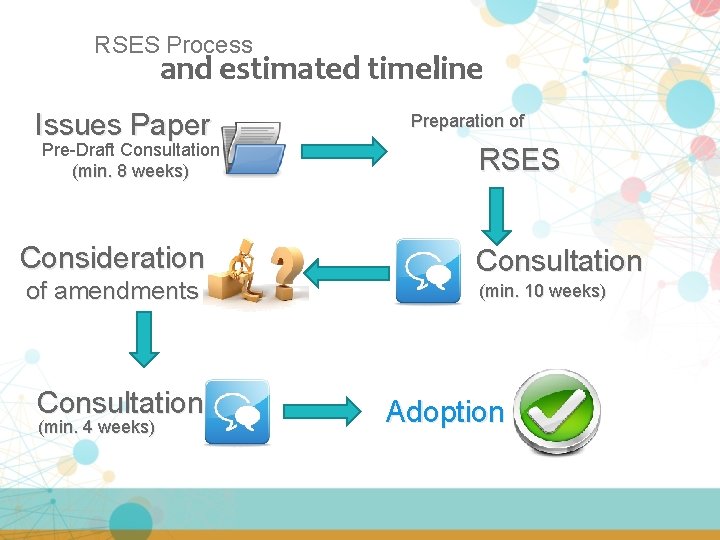
RSES Process and estimated timeline Issues Paper Pre-Draft Consultation (min. 8 weeks) Consideration of amendments Consultation (min. 4 weeks) Preparation of RSES Consultation (min. 10 weeks) Adoption
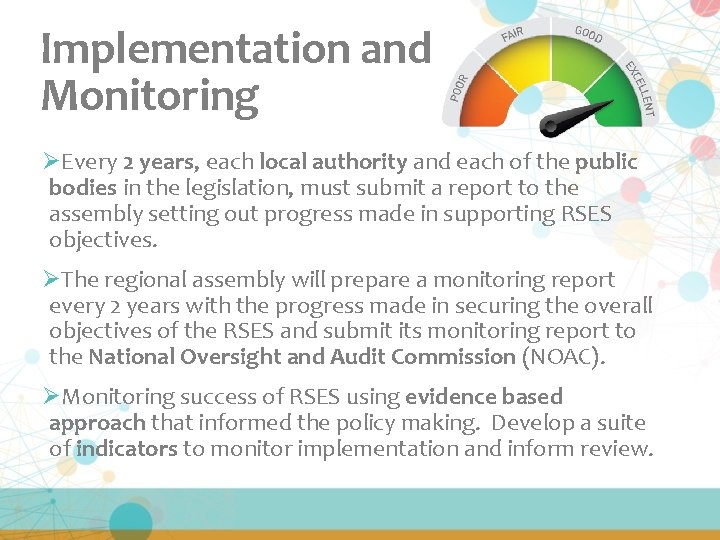
Implementation and Monitoring ØEvery 2 years, each local authority and each of the public bodies in the legislation, must submit a report to the assembly setting out progress made in supporting RSES objectives. ØThe regional assembly will prepare a monitoring report every 2 years with the progress made in securing the overall objectives of the RSES and submit its monitoring report to the National Oversight and Audit Commission (NOAC). ØMonitoring success of RSES using evidence based approach that informed the policy making. Develop a suite of indicators to monitor implementation and inform review.
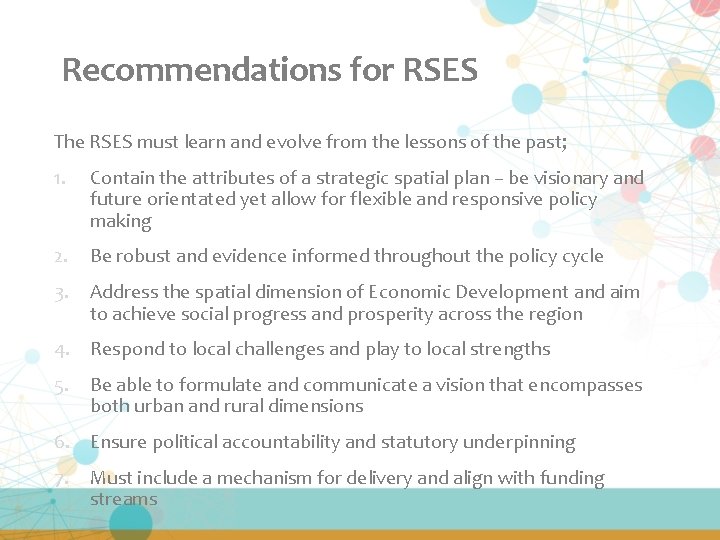
Recommendations for RSES The RSES must learn and evolve from the lessons of the past; 1. Contain the attributes of a strategic spatial plan – be visionary and future orientated yet allow for flexible and responsive policy making 2. Be robust and evidence informed throughout the policy cycle 3. Address the spatial dimension of Economic Development and aim to achieve social progress and prosperity across the region 4. Respond to local challenges and play to local strengths 5. Be able to formulate and communicate a vision that encompasses both urban and rural dimensions 6. Ensure political accountability and statutory underpinning 7. Must include a mechanism for delivery and align with funding streams
Challenges /Opportunities ØIntegrated approach to spatial and economic planning at a Strategic Level – potential for Assemblies to lead and influence ØStrategic Focus ØCreating Regional Identity / Vision ØManaging Expectation – hard decisions will have to be made ØAddressing climate change and transition to low carbon ØInvestment Priorities ØConsideration of Urban & Rural and Dublin v. Rest of region/country
Challenges / Opportunities ØFailure of last polices to prevent market led forces ØManaging the two Speed Economy and Dublin's role ØHousing delivery issues long term planning v short term need ØRelieve Dublin led development pressures – recent growth trends ØReverse the decline of rural settlements ØAll Ireland cross border context incl. Brexit ØMarine – Dublin Bay and other ports
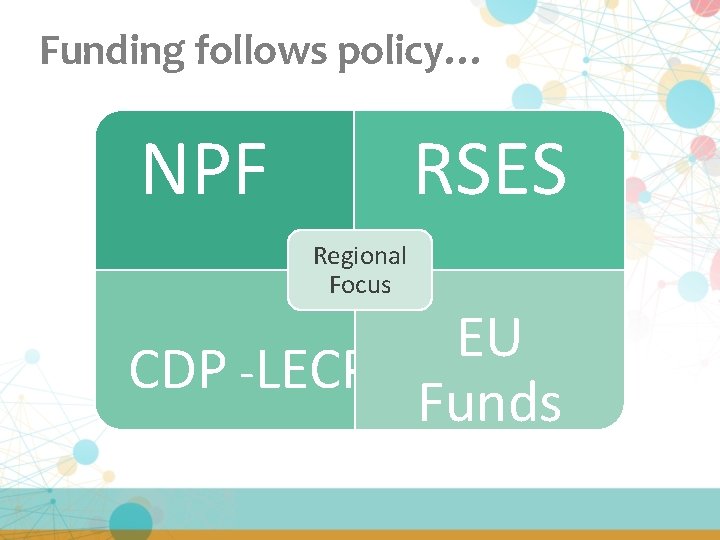
Funding follows policy… NPF RSES Regional Focus EU CDP -LECP Funds
Malachy Bradley Assistant Director Email: mbradley@emra. ie Phone: 00 353 (0) 1 8074482 www. emra. ie