
THE UNUSUAL STRUCTURE DETECTION IN EXTENSIVE AIR SHOWER
![HORIZON-8 T (HT) DETECTOR SYSTEM [1, 2, 3] An innovative detector system • EAS](https://slidetodoc.com/presentation_image_h/0547597bc2aaa3d55cf51ad7ee53646f/image-3.jpg "HORIZON-8 T (HT) DETECTOR SYSTEM [1, 2, 3] An innovative detector system • EAS")
![HORIZON-T (HT) DETECTOR SYSTEM • Z plane detectors • R 7723 Hamamtsu [6] PMT](https://slidetodoc.com/presentation_image_h/0547597bc2aaa3d55cf51ad7ee53646f/image-4.jpg "HORIZON-T (HT) DETECTOR SYSTEM • Z plane detectors • R 7723 Hamamtsu [6] PMT")
![UNUSUAL EAS AT Event of Jan 26 ’ 16. HT EXAMPLE [4] 9 Close](https://slidetodoc.com/presentation_image_h/0547597bc2aaa3d55cf51ad7ee53646f/image-9.jpg "UNUSUAL EAS AT Event of Jan 26 ’ 16. HT EXAMPLE [4] 9 Close")
![UNUSUAL EAS AT HT EXAMPLE [4] Far from the axis: • Widely separated and](https://slidetodoc.com/presentation_image_h/0547597bc2aaa3d55cf51ad7ee53646f/image-10.jpg "UNUSUAL EAS AT HT EXAMPLE [4] Far from the axis: • Widely separated and")
![REFERENCES • [1] RU Beisembaev, EA Beisembaeva, OD Dalkarov, VA Ryabov, AV Stepanov, NG](https://slidetodoc.com/presentation_image_h/0547597bc2aaa3d55cf51ad7ee53646f/image-18.jpg "REFERENCES • [1] RU Beisembaev, EA Beisembaeva, OD Dalkarov, VA Ryabov, AV Stepanov, NG")
- Slides: 18
THE UNUSUAL STRUCTURE DETECTION IN EXTENSIVE AIR SHOWER EVENTS AT HORIZON-8 T COSMIC RAYS DETECTOR SYSTEM 1 By: Ayan Batyrkhanov For Horizon-t group
HORIZON-T GROUP • R. U. Beisembaev, E. A. Beisembaeva, O. D. Dalkarov, V. A. Ryabov, S. B. Shaulov, M. I. Vildanova, V. V. Zhukov • P. N. Lebedev Physical Institute of the Russian Academy of Sciences, Moscow, Russia • K. A. Baigarin, A. Batyrkhanov, A. Iakovlev, T. Uakhitov, A. Yeltokov • Nazarbayev University, Astana, Kazakhstan • T. X. Sadykov • LLP “Institute of Physics and Technology”, Almaty, Kazakhstan • D. Beznosko • Bard College, New Orleans, LA, USA
HORIZON-8 T (HT) DETECTOR SYSTEM [1, 2, 3] An innovative detector system • EAS E> 1016 e. V ; Zenith angles • pulse shape -> disk width information (0 o - 85 o). • 2 ns resolution • At Tien Shan high-altitude Science Station ~3340 meters above the sea level • 8 (points 9 and 10 are recent upgrade) charged particle detection points [8] • separated by the distance up to 1. 3 kilometer • Hardware trigger points: 5 & 6 Station Yastreb Stone Center name ov Flower Station # 1 2 3 Left 4 Kurashki Right Bottom Upper n 5 6 7 8 Cher 600 m VCD 9 • Optical detector subsystem • to view the Vavilov. Bunker Cherenkov light from the EAS 10 3
HORIZON-T (HT) DETECTOR SYSTEM • Z plane detectors • R 7723 Hamamtsu [6] PMT (1. 2 ns resolution) at points 1 -8 • H 6527 Hamamatsu PMT at points 910 • 5 -12 m 2 at far points planned [8] • 500 MHz digitization CAEN [9] DT 5730 ADC • Cherenkov-Vavilov light detector • with Hamamtsu H 6527 PMTs • All channels MIP/cable/linear range calibrated • Two physics runs: 2016 -2017 and 20172018 R 7723 PMT with glass gives pulse front resolution of ~2. 2 ns Scintillator additional contribution ~5 ns Total contribution: ~7 ns 4
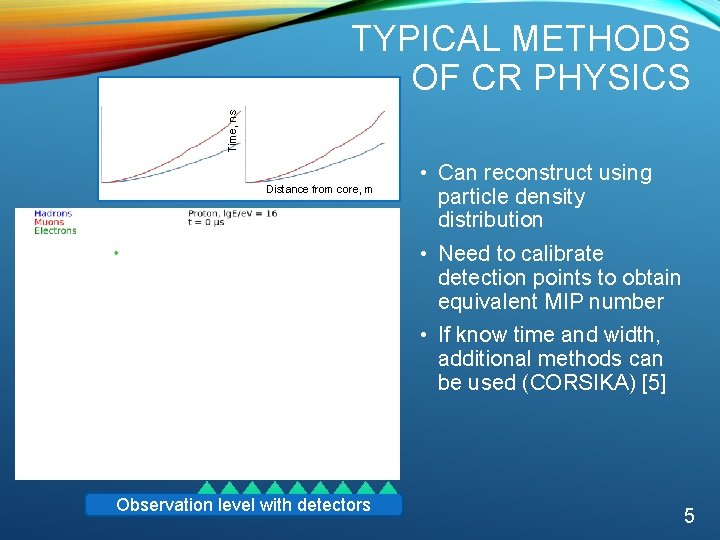
Time, ns TYPICAL METHODS OF CR PHYSICS Distance from core, m • Can reconstruct using particle density distribution • Need to calibrate detection points to obtain equivalent MIP number • If know time and width, additional methods can be used (CORSIKA) [5] Observation level with detectors 5
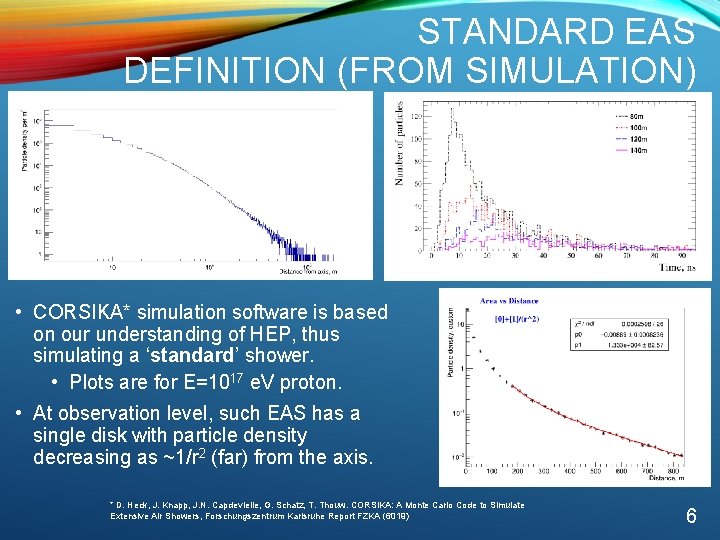
STANDARD EAS DEFINITION (FROM SIMULATION) Particle density vs. distance from EAS axis Number of particles arrival in time at different distances from EAS axis. • CORSIKA* simulation software is based on our understanding of HEP, thus simulating a ‘standard’ shower. • Plots are for E=1017 e. V proton. • At observation level, such EAS has a single disk with particle density decreasing as ~1/r 2 (far) from the axis. * D. Heck, J. Knapp, J. N. Capdevielle, G. Schatz, T. Thouw. CORSIKA: A Monte Carlo Code to Simulate Extensive Air Showers, Forschungszentrum Karlsruhe Report FZKA (6019) 6
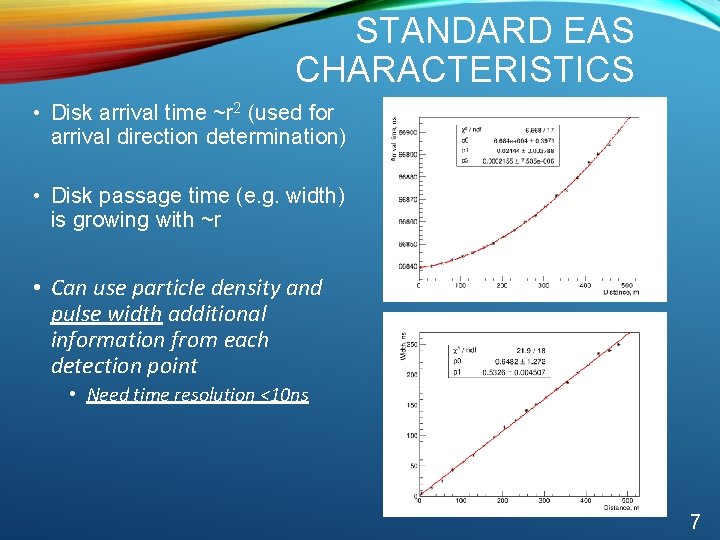
STANDARD EAS CHARACTERISTICS • Disk arrival time ~r 2 (used for arrival direction determination) • Disk passage time (e. g. width) is growing with ~r • Can use particle density and pulse width additional information from each detection point • Need time resolution <10 ns 7
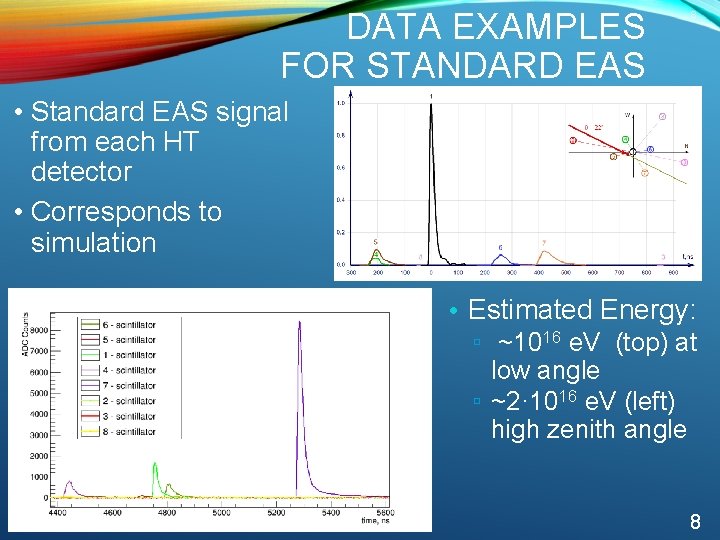
DATA EXAMPLES FOR STANDARD EAS 8 • Standard EAS signal from each HT detector • Corresponds to simulation • Estimated Energy: ▫ ~1016 e. V (top) at low angle ▫ ~2· 1016 e. V (left) high zenith angle 8
UNUSUAL EAS AT Event of Jan 26 ’ 16. HT EXAMPLE [4] 9 Close to the axis: • Narrow peak • Smaller peak with steps Farther from the axis: • Peaks composed of many smaller peaks • Separated a bit 9
UNUSUAL EAS AT HT EXAMPLE [4] Far from the axis: • Widely separated and easily distinguishable peaks 10
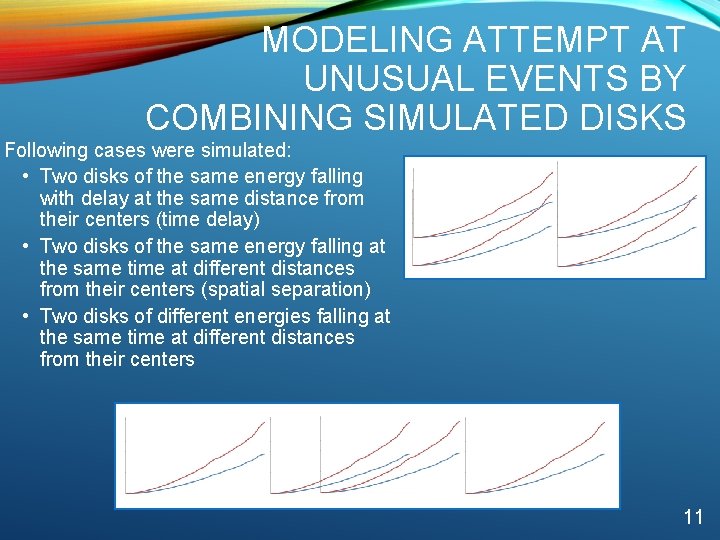
MODELING ATTEMPT AT UNUSUAL EVENTS BY COMBINING SIMULATED DISKS Following cases were simulated: • Two disks of the same energy falling with delay at the same distance from their centers (time delay) • Two disks of the same energy falling at the same time at different distances from their centers (spatial separation) • Two disks of different energies falling at the same time at different distances from their centers 11
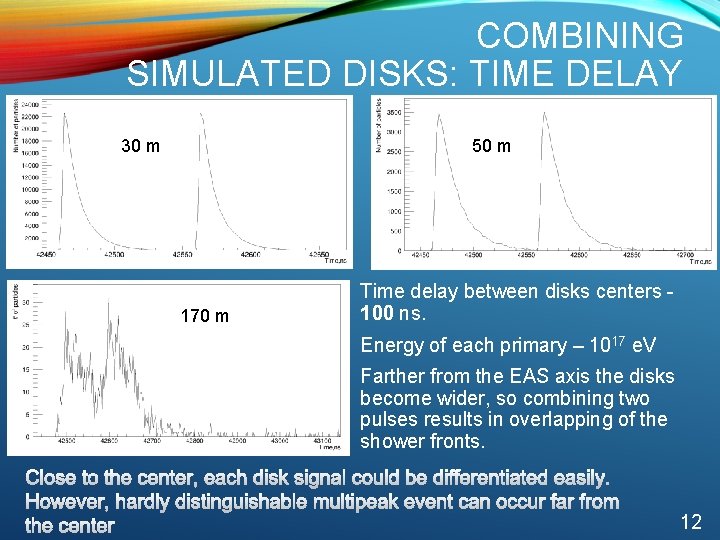
COMBINING SIMULATED DISKS: TIME DELAY 50 m 30 m 170 m Time delay between disks centers - 100 ns. Energy of each primary – 1017 e. V Farther from the EAS axis the disks become wider, so combining two pulses results in overlapping of the shower fronts. 12
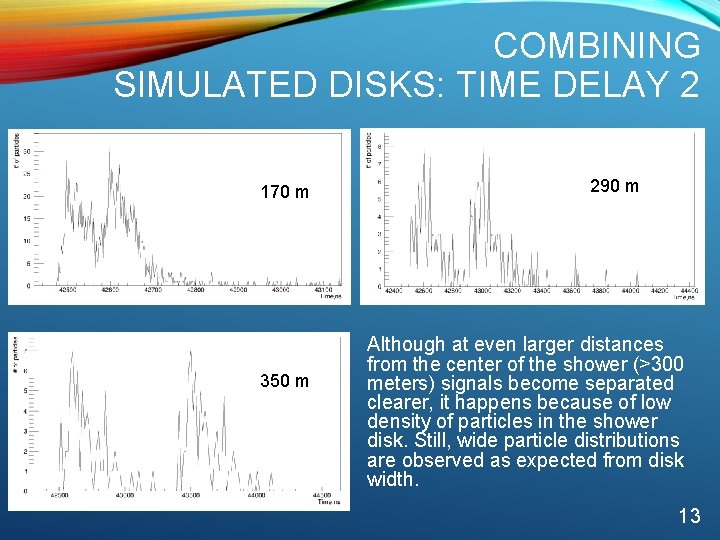
COMBINING SIMULATED DISKS: TIME DELAY 2 170 m 350 m 290 m Although at even larger distances from the center of the shower (>300 meters) signals become separated clearer, it happens because of low density of particles in the shower disk. Still, wide particle distributions are observed as expected from disk width. 13
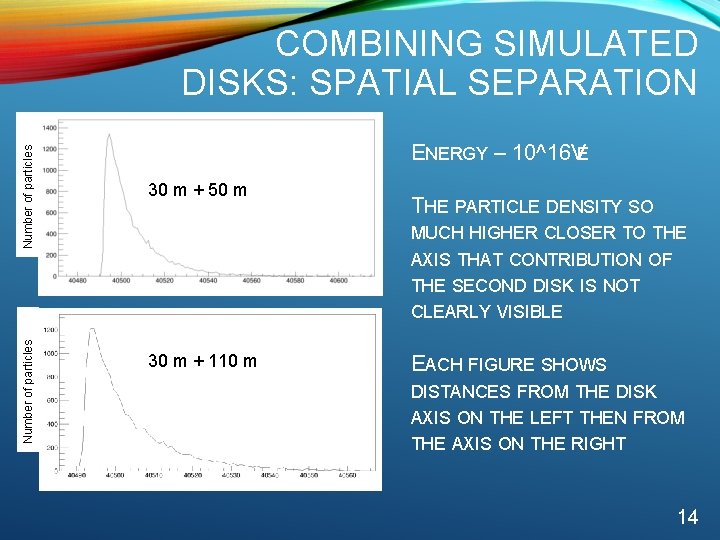
Number of particles COMBINING SIMULATED DISKS: SPATIAL SEPARATION ENERGY – 10^16 VE 30 m + 50 m 30 m + 110 m THE PARTICLE DENSITY SO MUCH HIGHER CLOSER TO THE AXIS THAT CONTRIBUTION OF THE SECOND DISK IS NOT CLEARLY VISIBLE EACH FIGURE SHOWS DISTANCES FROM THE DISK AXIS ON THE LEFT THEN FROM THE AXIS ON THE RIGHT 14
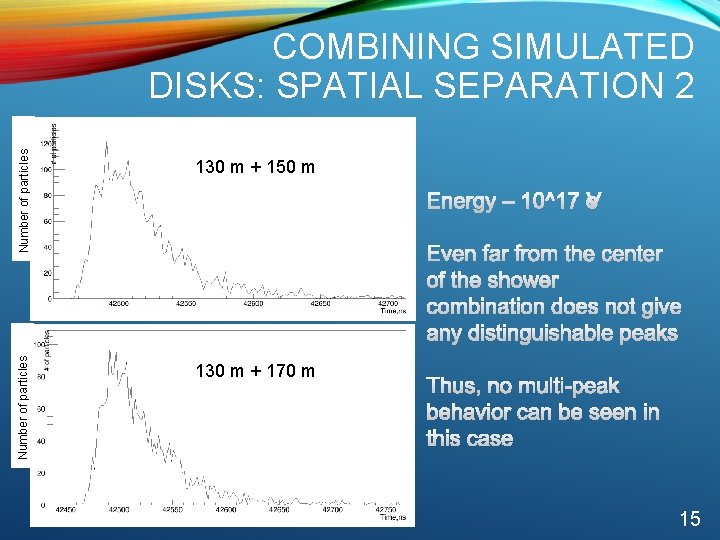
Number of particles COMBINING SIMULATED DISKS: SPATIAL SEPARATION 2 130 m + 150 m 130 m + 170 m 15
CONCLUSION • In HT data, ‘unusual’ events have been identified • Simple combination of simulated disks doesn’t give similar picture • The data analysis continues and more physics runs are planned • Far periphery detectors upgrade to larger areas is planned 16
FUTURE PLANS • Two additional far periphery detector points will be installed and collecting data • Area of the scintillators will be increased to 5 -12 m^2. • Analysis of multipeak behavior of unusual EAS events is in progress. • Peak to peak distance dependence in multipeak • Areas of multipeak signals in such events 17
REFERENCES • [1] RU Beisembaev, EA Beisembaeva, OD Dalkarov, VA Ryabov, AV Stepanov, NG Vildanov, MI Vildanova, VV Zhukov, KA Baigarin, D Beznosko, TX Sadykov, NS Suleymenov, "The 'Horizon-T' Experiment: Extensive Air Showers Detection, " ar. Xiv: 1605. 05179 [physics. ins-det], May 17 2016. • [2] Rashid Beisembaev, Dmitriy Beznosko, Kanat Baigarin, Elena Beisembaeva, Oleg Dalkarov, Vladimi Ryabov, Turlan Sadykov, Sergei Shaulov, Aleksei Stepanov, Marina Vildanova, Nikolay Vildanov, Valeriy Zhukov. "Horizon-T experiment status. " EPJ Web Conf. 145 11004 (2017). DOI: 10. 1051/epjconf/201614511004 • [3] Rashid Beisembaev, Dmitriy Beznosko, Kanat Baigarin, Elena Beisembaeva, Oleg Dalkarov, Vladimir Ryabov, Turlan Sadykov, Sergei Shaulov, Aleksei Stepanov, Marina Vildanova, Nikolay Vildanov, Valeriy Zhukov. " Extensive Air Showers with unusual structure. " EPJ Web Conf. 145 14001 (2017). DOI: 10. 1051/epjconf/201614514001 ISVHECRI • [4] R U Beisembaev, D Beznosko, K A Baigarin, A Batyrkhanov, E A Beisembaeva, T. Beremkulov, O D Dalkarov, A Iakovlev, V A Ryabov, N S Suleimenov, T Kh Sadykov, Z Tagay, T Uakhitov, M I Vildanova and V V Zhukov. "Horizon-T experiment and detection of Extensive air showers with unusual structure", accepted to Journal of Physics: Conference series, 2018 • [5]. D. Heck, J. Knapp, J. N. Capdevielle, G. Schatz, T. Thouw. CORSIKA: A Monte Carlo Code to Simulate Extensive Air Showers, Forschungszentrum Karlsruhe Report FZKA (6019). • [6]. HAMAMATSU PHOTONICS K. K. , Electron Tube Division, 314 -5, Shimokanzo, Iwata City, Shizuoka Pref. , 438 -0193, Japan, http: //www. hamamatsu. com • [7] R. U. Beisembaev, D. Beznosko, E. A. Beisembaeva, A. Duspayev, A. Iakovlev, T. X. Sadykov, T. Uakhitov, M. I. Vildanova, M. Yessenov and V. V. Zhukov, "Fast and simple glass-based charged particles detector with large linear detection range, " Journal of Instrumentation, vol. 12, no. T 07008, 2017. • [8] D. Beznosko, T. Beremkulov, A. Iakovlev, S. Jakupov, D. Turganov, A. Tussipzhan, T. Uakhitov, M. I. Vildanova, A. Yeltokov, V. V. Zhukov. "Horizon-T Experiment Upgrade and Calibration of New Detection Points", ar. Xiv: 1803. 08309 [physics. ins-det], Mar 22, 2018. • [9]. CAEN S. p. A. Via della Vetraia, 11, 55049 Viareggio Lucca, Italy. http: //caen. it. 18