
The Unruh Temperature For a Uniformly Accelerated Observer
The Unruh Temperature For a Uniformly Accelerated Observer Cory Thornsberry December 10, 2012
The Unruh Effect • Two inertial observers in the Minkowski vacuum will agree on the vacuum state • We add a non-inertial observer accelerating with constant acceleration, a. • The accelerating observer will “feel” a thermal bath of particles.

The Unruh Effect contd. • “…an accelerated detector, even in flat spacetime, will detect particles in the vacuum” Unruh, 1976 • There is a physical temperature associated with the particle bath, Tu. • For simplicity, we assume… o Uniformly accelerated observer o Acceleration is only in the z-direction
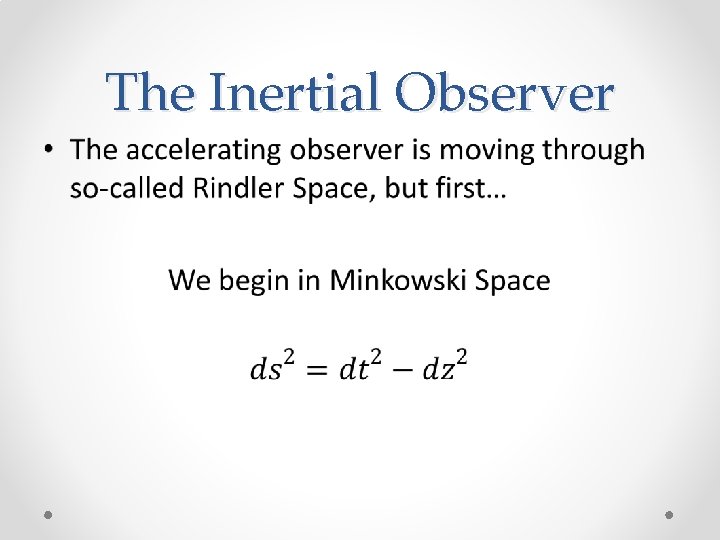
The Inertial Observer •
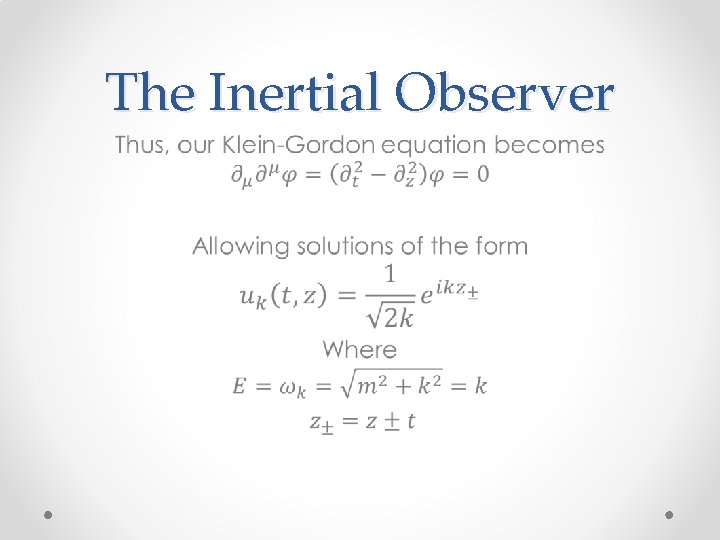
The Inertial Observer •
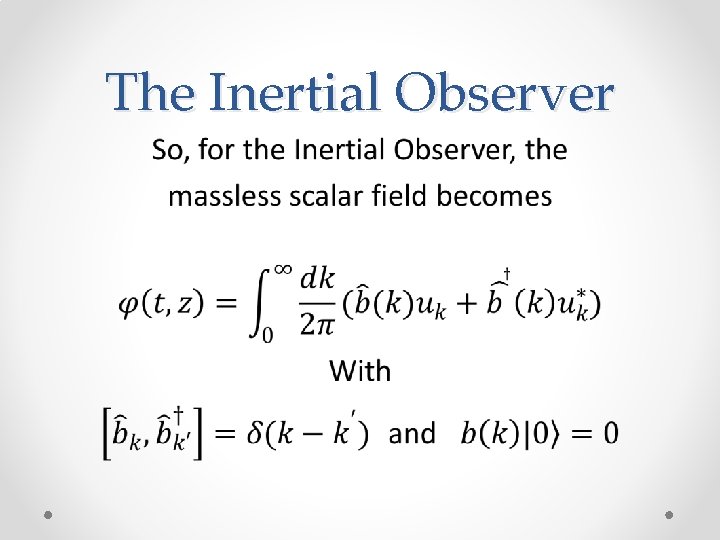
The Inertial Observer •
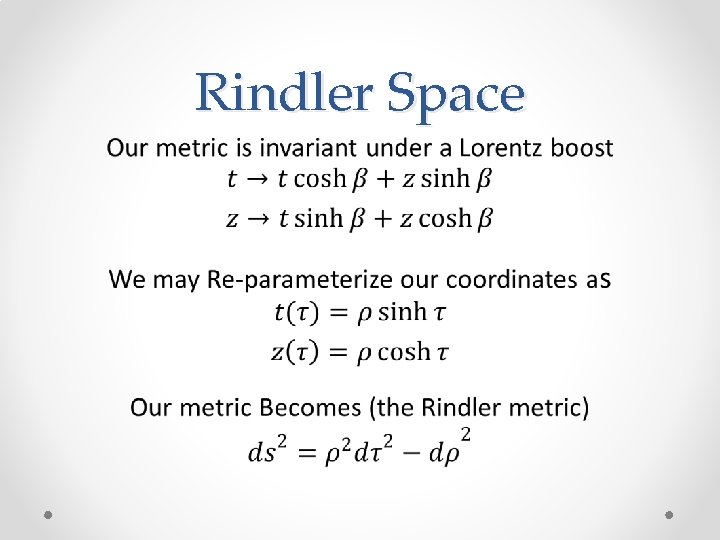
Rindler Space •
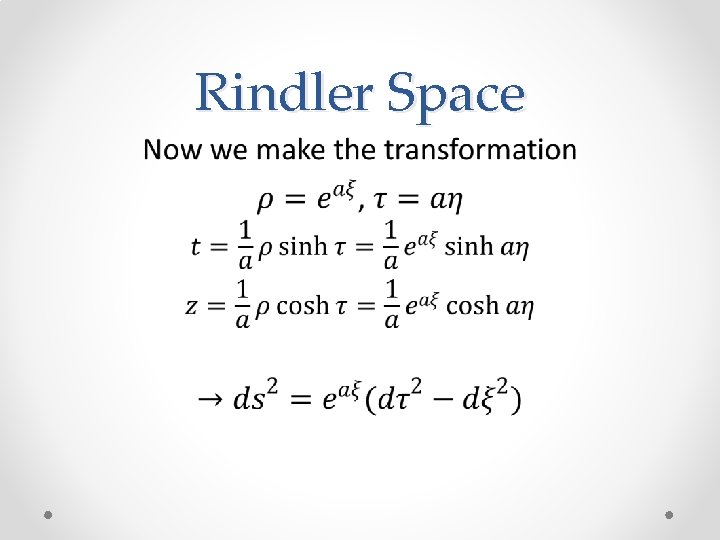
Rindler Space •
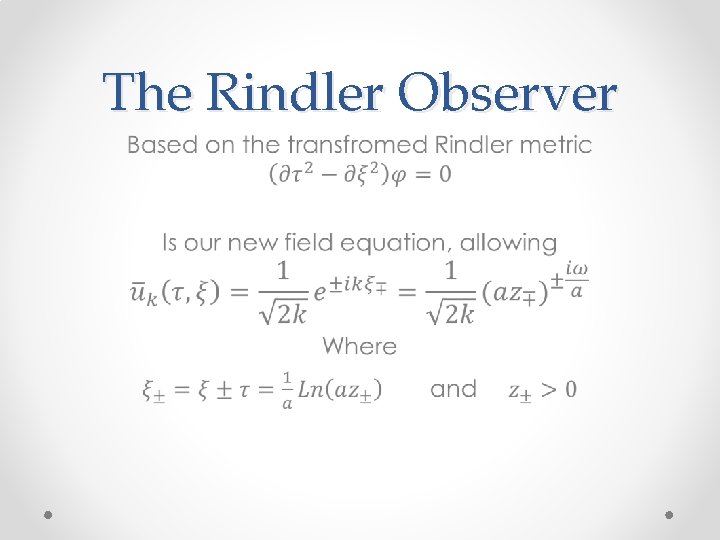
The Rindler Observer •
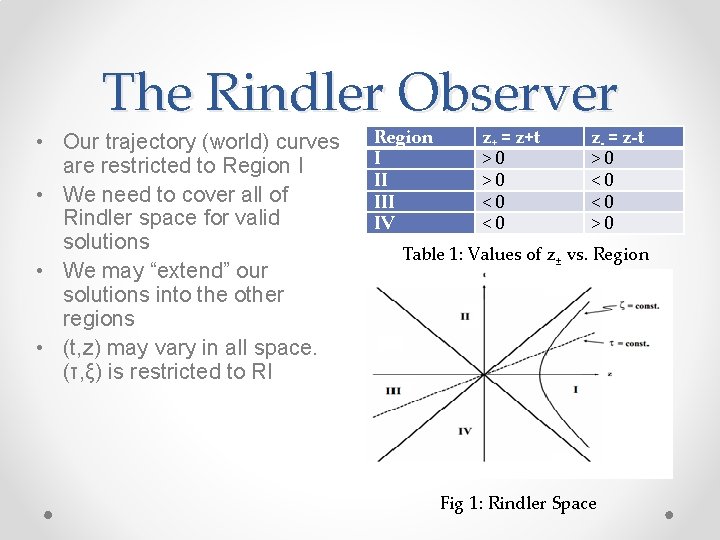
The Rindler Observer • Our trajectory (world) curves are restricted to Region I • We need to cover all of Rindler space for valid solutions • We may “extend” our solutions into the other regions • (t, z) may vary in all space. (τ, ξ) is restricted to RI Region I II IV z+ = z+t >0 >0 <0 <0 z- = z-t >0 <0 <0 >0 Table 1: Values of z± vs. Region Fig 1: Rindler Space
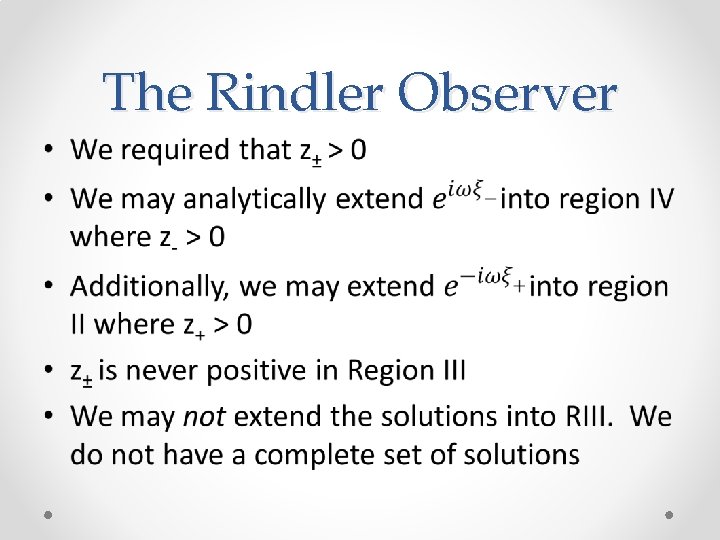
The Rindler Observer •
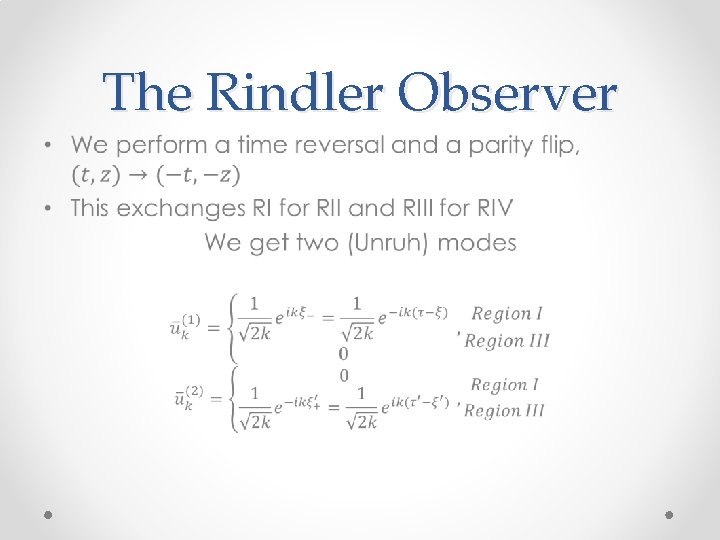
The Rindler Observer •
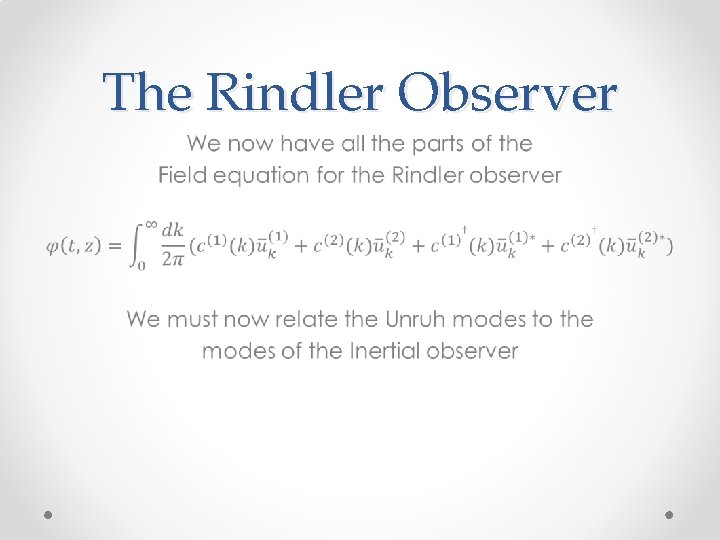
The Rindler Observer •
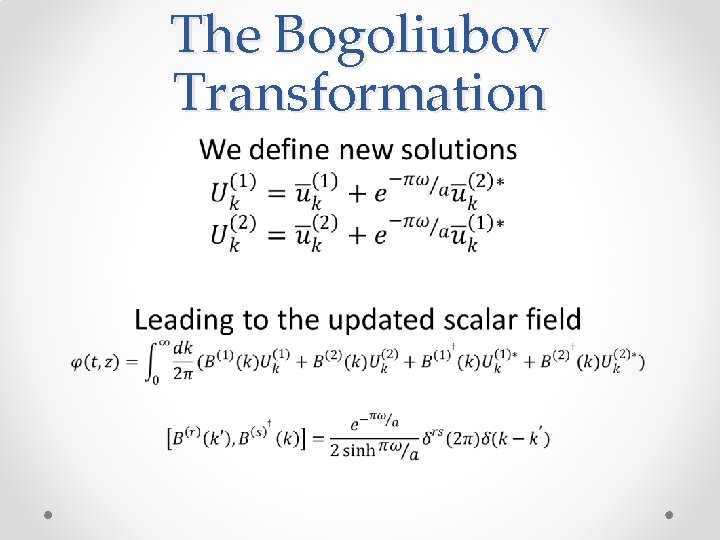
The Bogoliubov Transformation •
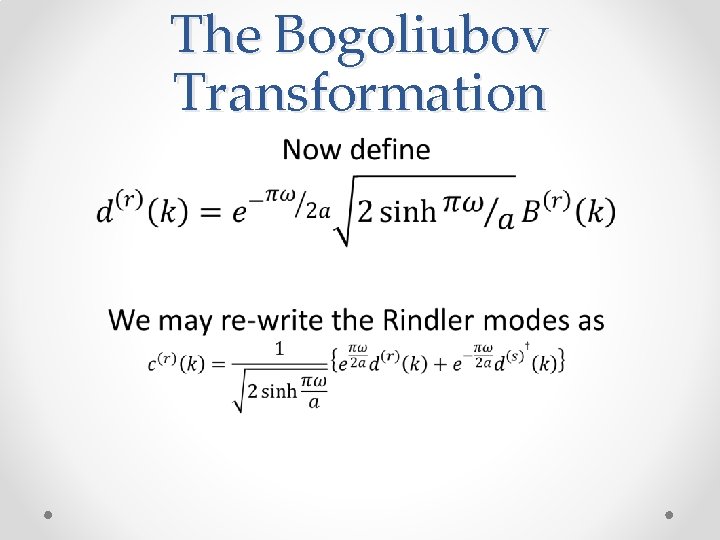
The Bogoliubov Transformation •
The Bogoliubov Transformation • Those two modes are known as a Bogoliubov Transformation. They relate the modes of the inertial and Rindler observers.
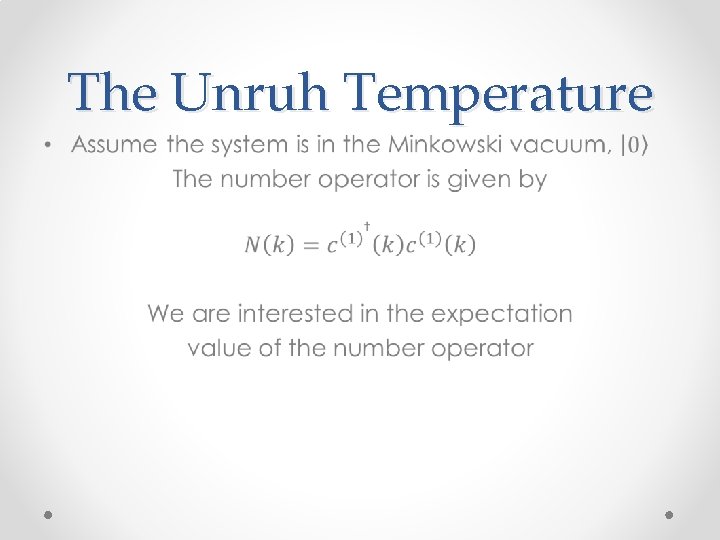
The Unruh Temperature •
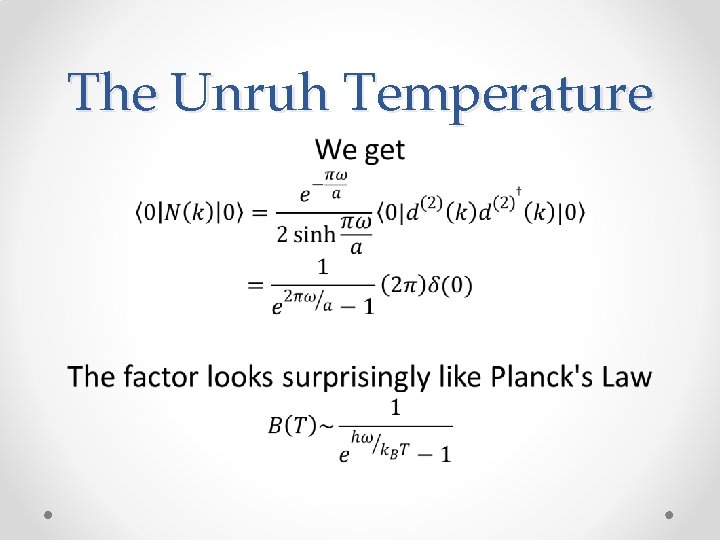
The Unruh Temperature •
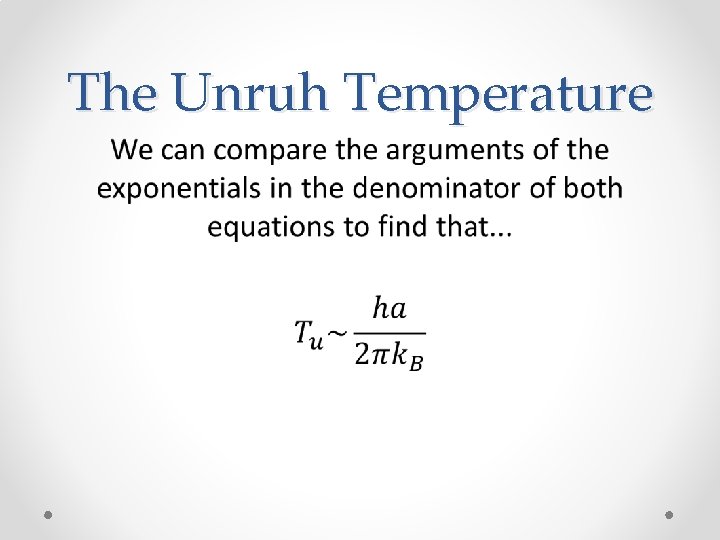
The Unruh Temperature •
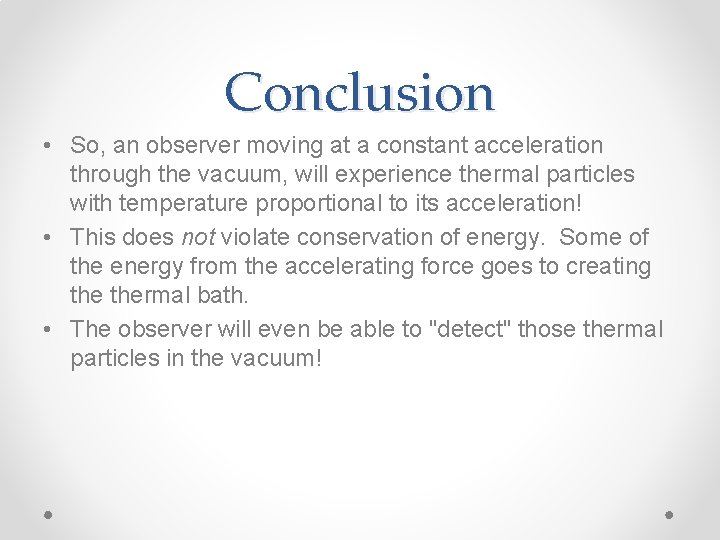
Conclusion • So, an observer moving at a constant acceleration through the vacuum, will experience thermal particles with temperature proportional to its acceleration! • This does not violate conservation of energy. Some of the energy from the accelerating force goes to creating thermal bath. • The observer will even be able to "detect" those thermal particles in the vacuum!
References • Bièvre, S. , Merkli, M. “The Unruh effect revisited”. Class. Quant. Grav. 23, 2006 pp. 6525 – 6542 • Crispino, L. , Higuchi, A. , Matsas, G. “The Unruh effect and its applications”, Rev. Mod. Phys. 80, 1 July 2008 pp. 787 – 838 • Pringle, L. N. “Rindler observers, correlated states, boundary conditions, and the meaning of thermal spectrum”. Phys. Rev. D. Volume 39, Number 8, 15 April 1989 pp. 2178 – 2186 • Siopsis, G. “Quantum Field Theory I: Unit 5. 3, The Unruh effect”. University of Tennessee Knoxville. 2012 pp. 134 – 140 • Rindler, W. “Kruskal Space and the Uniformly Accelerating Frame”. American Journal of Physics. Volume 34, Issue 12, December 1966, pp. 1174 • Unruh, W. G. “Notes on black-hole Evaporation”. Phys. Rev. D. Volume 14, Number 4, 15 August 1976 pp. 870 – 892
- Slides: 21