
THE UNIVERSITY OF THE STATE OF NEW YORK

- Slides: 51
THE UNIVERSITY OF THE STATE OF NEW YORK REGENTS HIGH SCHOOL EXAMINATION PHYSICAL SETTING CHEMISTRY JUNE 23, 2015
1 Compared to an electron, which particle has a charge that is equal in magnitude but opposite in sign? 1. 2. 3. 4. an alpha particle a beta particle a neutron a proton
2 The mass of a proton is approximately equal to 1. 1 atomic mass unit 2. 12 atomic mass units 3. the mass of 1 mole of carbon atoms 4. the mass of 12 moles of electrons
3 Which property decreases when the elements in Group 17 are considered in order of increasing atomic number? 1. 2. 3. 4. atomic mass atomic radius melting point electronegativity
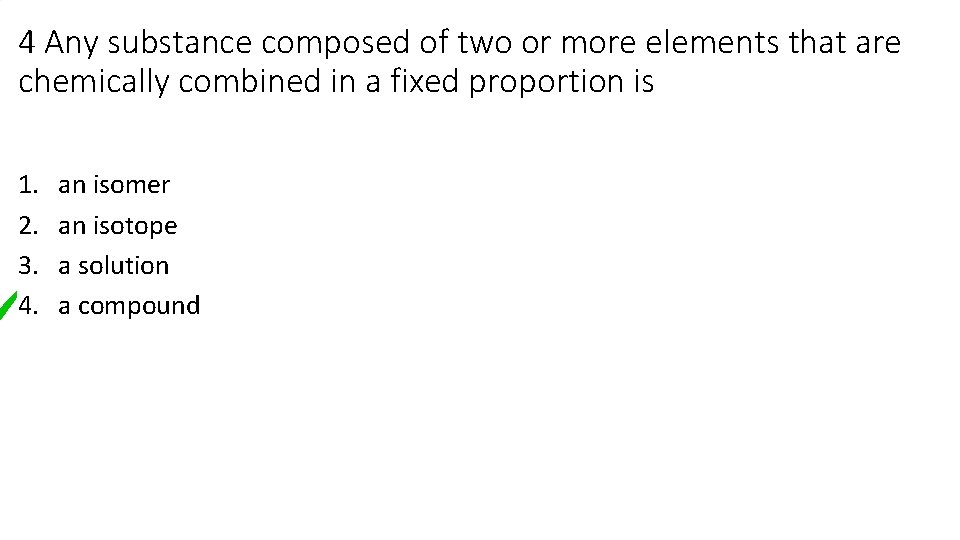
4 Any substance composed of two or more elements that are chemically combined in a fixed proportion is 1. 2. 3. 4. an isomer an isotope a solution a compound
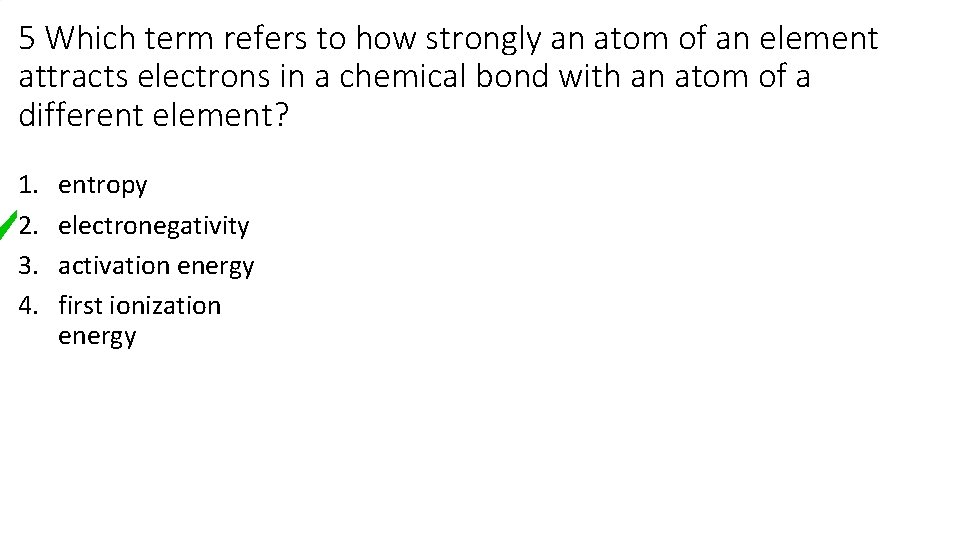
5 Which term refers to how strongly an atom of an element attracts electrons in a chemical bond with an atom of a different element? 1. 2. 3. 4. entropy electronegativity activation energy first ionization energy
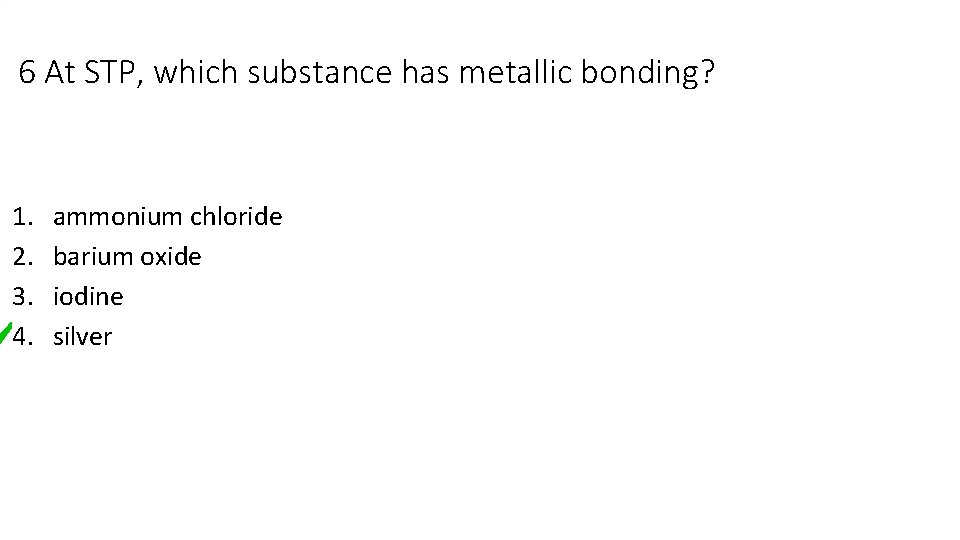
6 At STP, which substance has metallic bonding? 1. 2. 3. 4. ammonium chloride barium oxide iodine silver
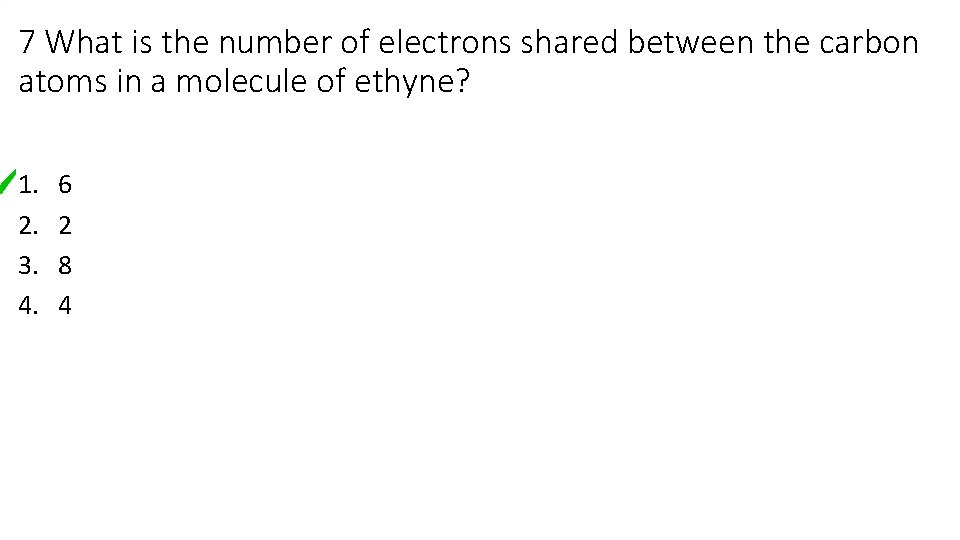
7 What is the number of electrons shared between the carbon atoms in a molecule of ethyne? 1. 2. 3. 4. 6 2 8 4
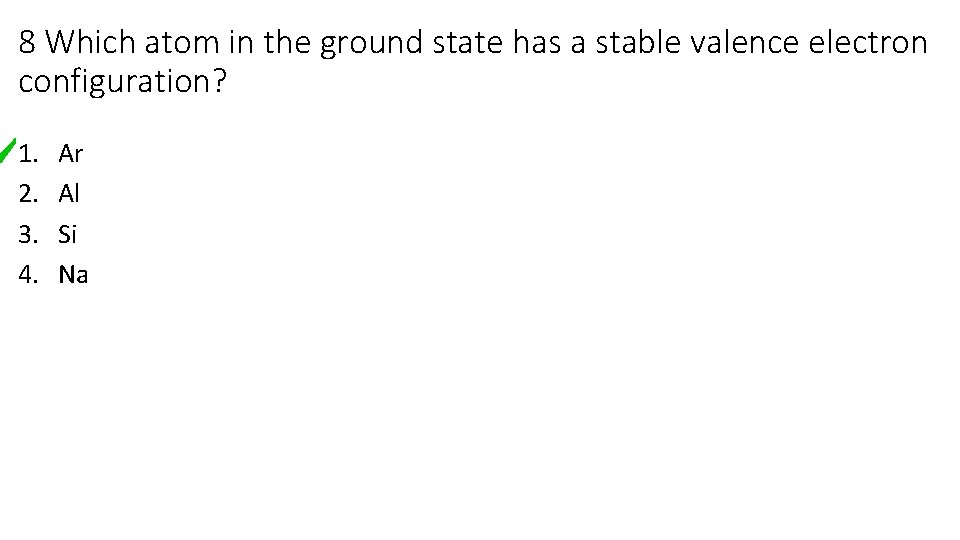
8 Which atom in the ground state has a stable valence electron configuration? 1. 2. 3. 4. Ar Al Si Na
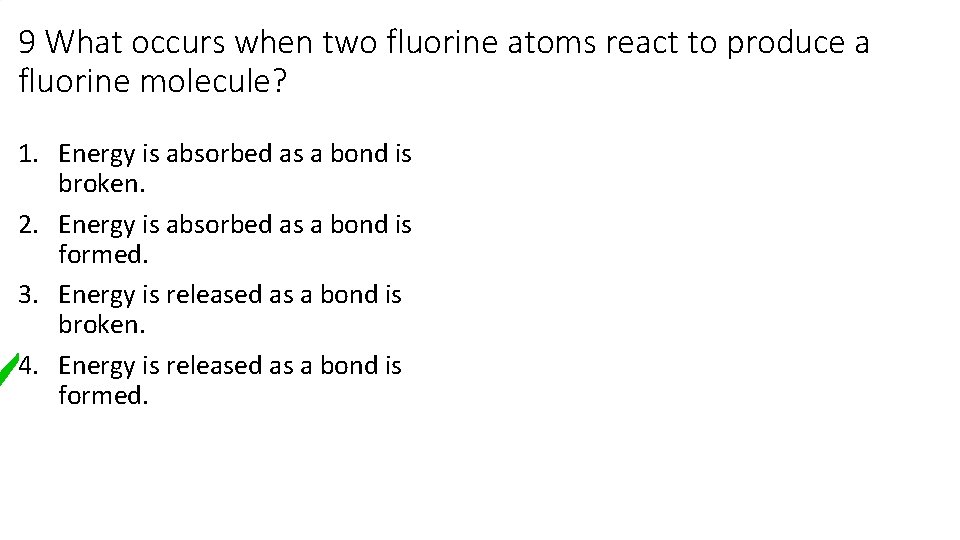
9 What occurs when two fluorine atoms react to produce a fluorine molecule? 1. Energy is absorbed as a bond is broken. 2. Energy is absorbed as a bond is formed. 3. Energy is released as a bond is broken. 4. Energy is released as a bond is formed.
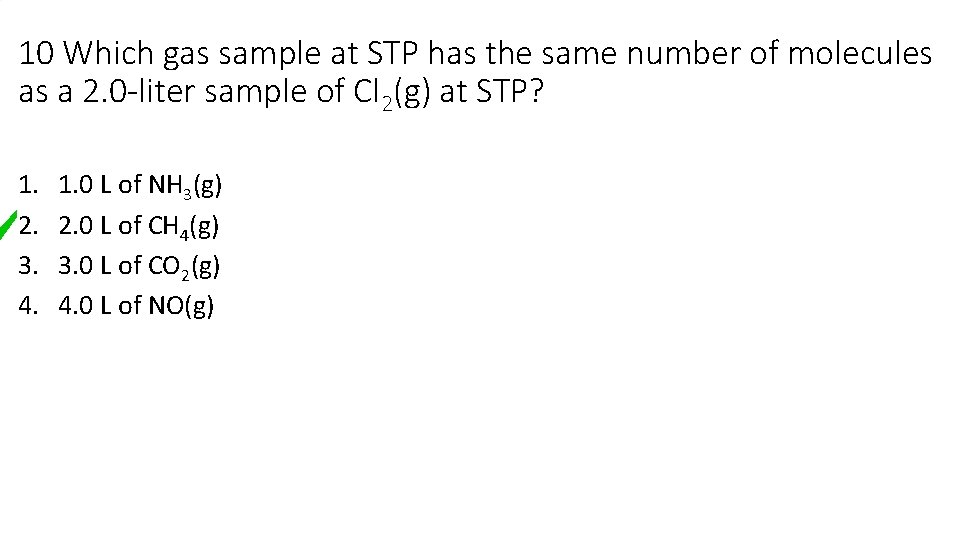
10 Which gas sample at STP has the same number of molecules as a 2. 0 -liter sample of Cl 2(g) at STP? 1. 2. 3. 4. 1. 0 L of NH 3(g) 2. 0 L of CH 4(g) 3. 0 L of CO 2(g) 4. 0 L of NO(g)
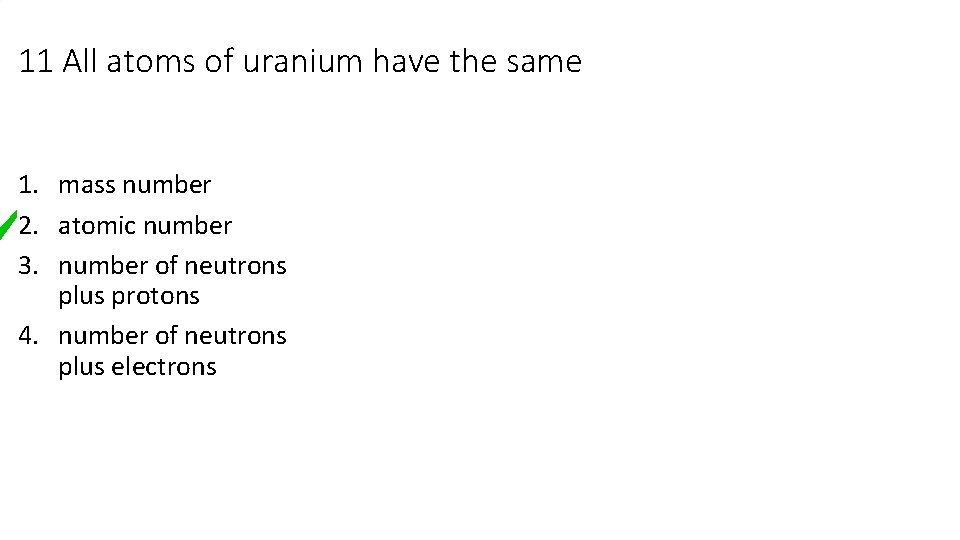
11 All atoms of uranium have the same 1. mass number 2. atomic number 3. number of neutrons plus protons 4. number of neutrons plus electrons
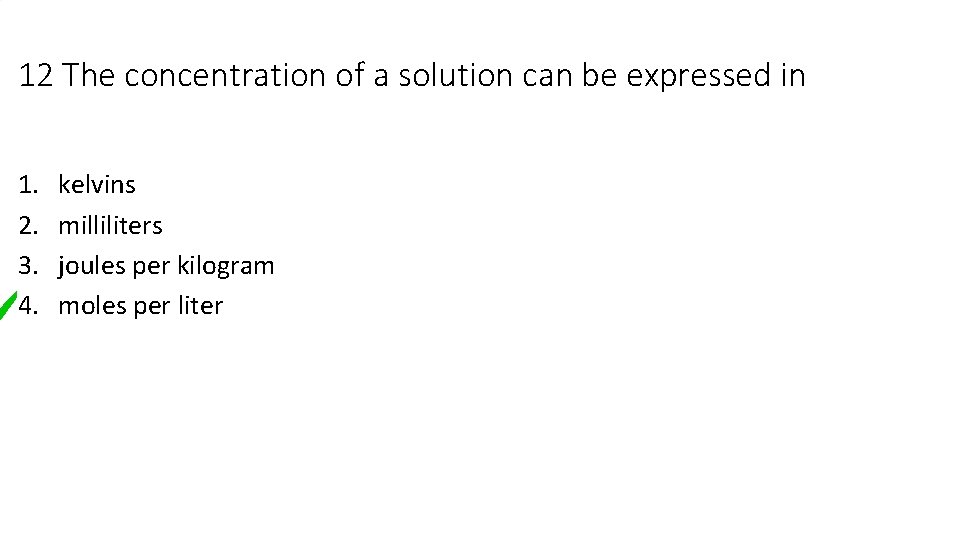
12 The concentration of a solution can be expressed in 1. 2. 3. 4. kelvins milliliters joules per kilogram moles per liter
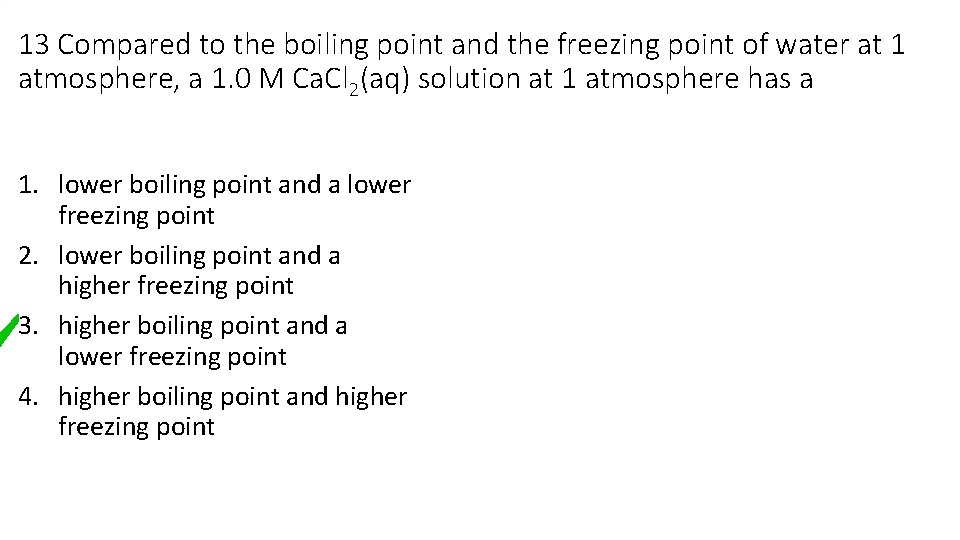
13 Compared to the boiling point and the freezing point of water at 1 atmosphere, a 1. 0 M Ca. Cl 2(aq) solution at 1 atmosphere has a 1. lower boiling point and a lower freezing point 2. lower boiling point and a higher freezing point 3. higher boiling point and a lower freezing point 4. higher boiling point and higher freezing point
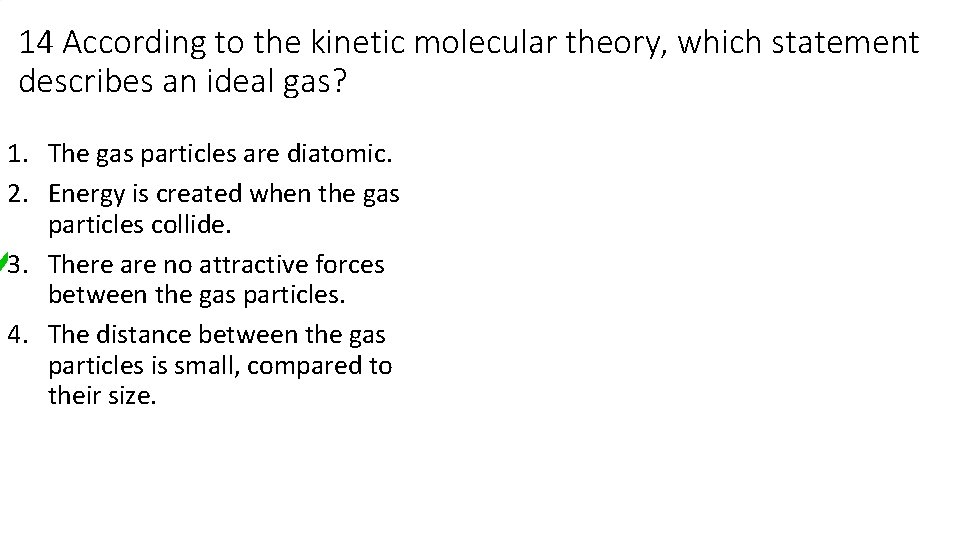
14 According to the kinetic molecular theory, which statement describes an ideal gas? 1. The gas particles are diatomic. 2. Energy is created when the gas particles collide. 3. There are no attractive forces between the gas particles. 4. The distance between the gas particles is small, compared to their size.
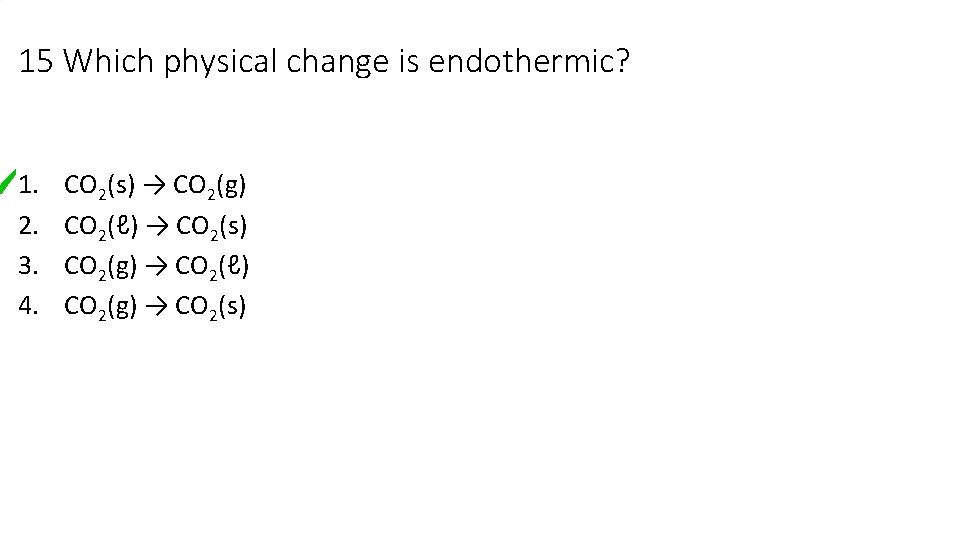
15 Which physical change is endothermic? 1. 2. 3. 4. CO 2(s) → CO 2(g) CO 2(ℓ) → CO 2(s) CO 2(g) → CO 2(ℓ) CO 2(g) → CO 2(s)
16 Which Group 16 element combines with hydrogen to form a compound that has the strongest hydrogen bonding between its molecules? 1. 2. 3. 4. oxygen selenium sulfur tellurium
17 Hydrocarbons are composed of the elements 1. 2. 3. 4. carbon and hydrogen, only carbon and oxygen, only carbon, hydrogen, and oxygen carbon, nitrogen, and oxygen
18 Which atom is bonded to the carbon atom in the functional group of a ketone? 1. 2. 3. 4. fluorine hydrogen nitrogen oxygen
19 Two types of organic reactions are 1. addition and sublimation 2. deposition and saponification 3. decomposition and evaporation 4. esterification and polymerization
20 The isomers butane and methylpropane have 1. the same molecular formula and the same properties 2. the same molecular formula and different properties 3. different molecular formulas and the same properties 4. different molecular formulas and different properties
21 In a redox reaction, which particles are lost and gained in equal numbers? 1. 2. 3. 4. electrons neutrons hydroxide ions hydronium ions
22 What is the oxidation state for a Mn atom? 1. 2. 3. 4. 0 +7 +3 +4
23 Which compounds are classified as electrolytes? 1. 2. 3. 4. KNO 3 and H 2 SO 4 KNO 3 and CH 3 OH CH 3 OCH 3 and H 2 SO 4 CH 3 OCH 3 and CH 3 OH
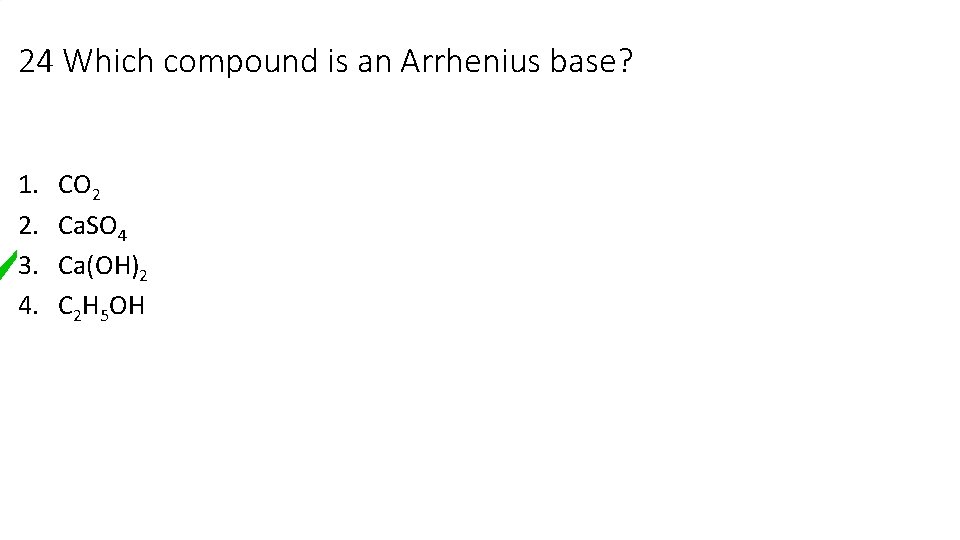
24 Which compound is an Arrhenius base? 1. 2. 3. 4. CO 2 Ca. SO 4 Ca(OH)2 C 2 H 5 OH
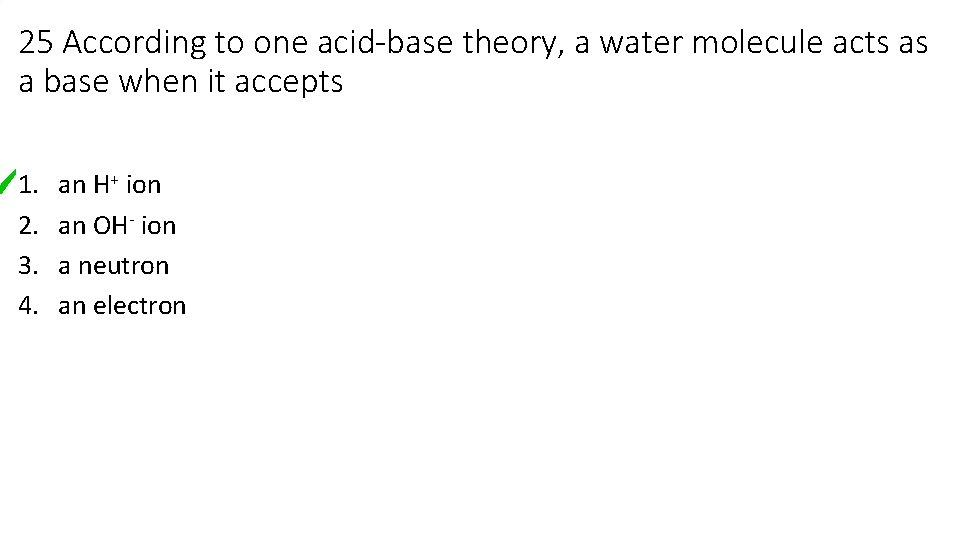
25 According to one acid-base theory, a water molecule acts as a base when it accepts 1. 2. 3. 4. an H+ ion an OH- ion a neutron an electron
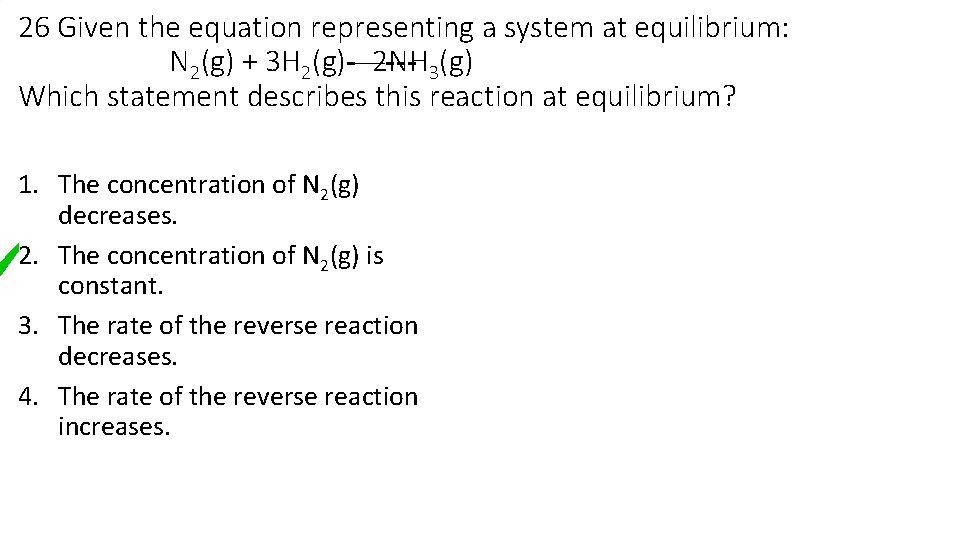
26 Given the equation representing a system at equilibrium: N 2(g) + 3 H 2(g) — 2 NH 3(g) Which statement describes this reaction at equilibrium? 1. The concentration of N 2(g) decreases. 2. The concentration of N 2(g) is constant. 3. The rate of the reverse reaction decreases. 4. The rate of the reverse reaction increases.
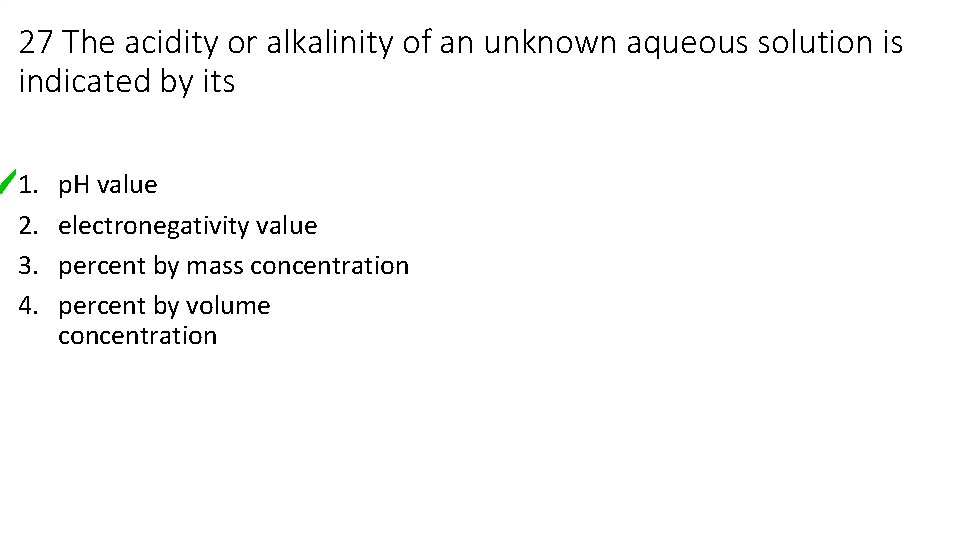
27 The acidity or alkalinity of an unknown aqueous solution is indicated by its 1. 2. 3. 4. p. H value electronegativity value percent by mass concentration percent by volume concentration
28 The laboratory process in which the volume of a solution of known concentration is used to determine the concentration of another solution is called 1. 2. 3. 4. distillation fermentation titration transmutation
29 Which list of nuclear emissions is arranged in order from the greatest penetrating power to the least penetrating power? 1. alpha particle, beta particle, gamma ray 2. alpha particle, gamma ray, beta particle 3. gamma ray, alpha particle, beta particle 4. gamma ray, beta particle, alpha particle
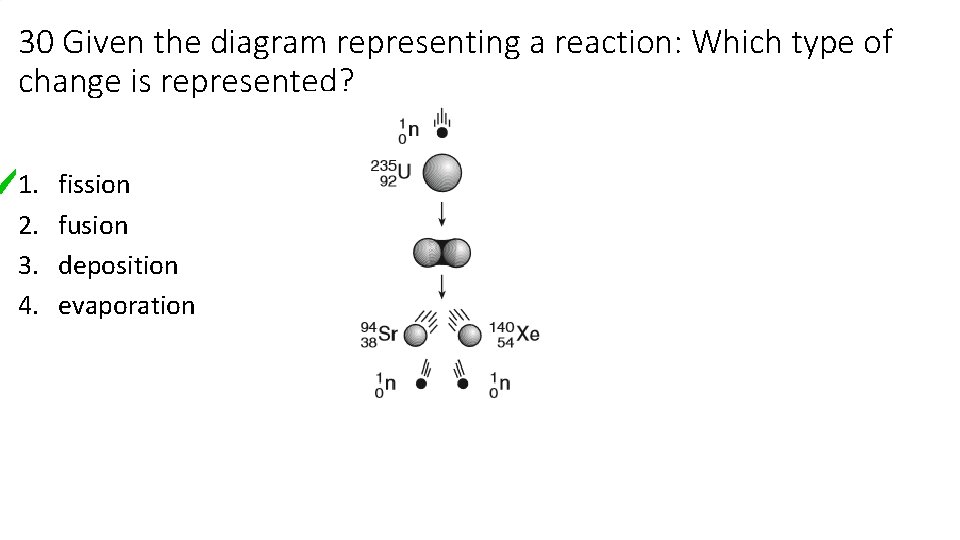
30 Given the diagram representing a reaction: Which type of change is represented? 1. 2. 3. 4. fission fusion deposition evaporation
31 Which electron shell contains the valence electrons of a radium atom in the ground state? 1. 2. 3. 4. the sixth shell the second shell the seventh shell the eighteenth shell
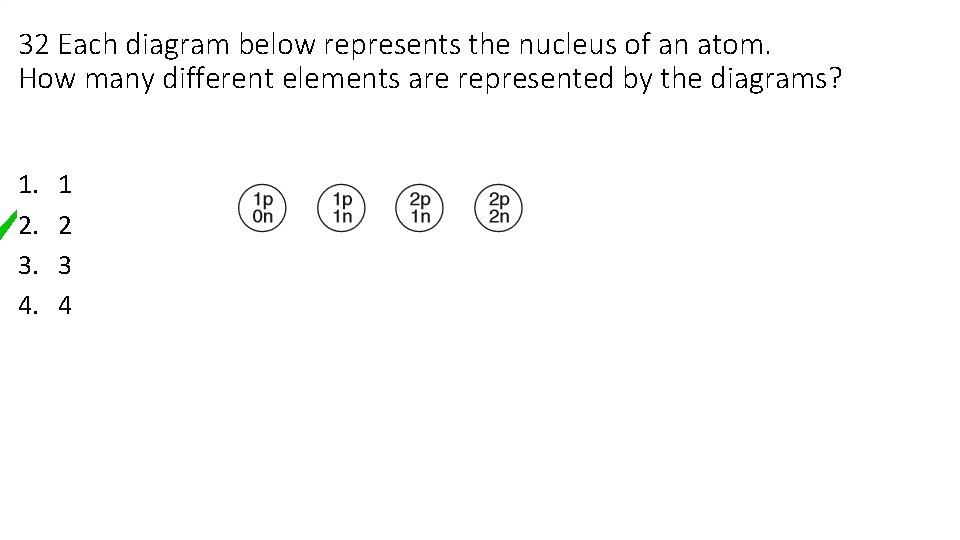
32 Each diagram below represents the nucleus of an atom. How many different elements are represented by the diagrams? 1. 2. 3. 4. 1 2 3 4
33 Chlorine and element X have similar chemical properties. An atom of element X could have an electron configuration of 1. 2. 3. 4. 2 -2 2 -8 -1 2 -8 -8 2 -8 -18 -7
34 Which group of elements contains a metalloid? 1. 2. 3. 4. Group 8 Group 2 Group 16 Group 18
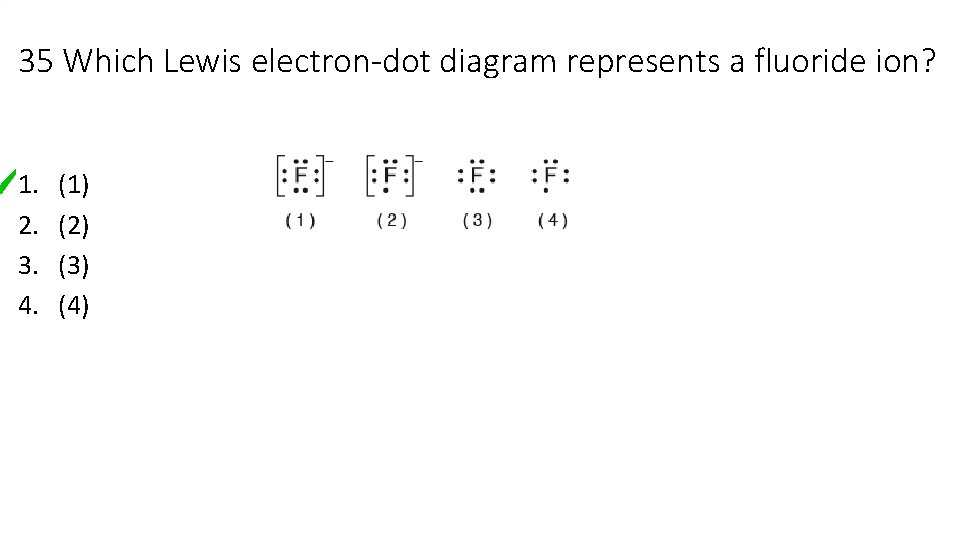
35 Which Lewis electron-dot diagram represents a fluoride ion? 1. 2. 3. 4. (1) (2) (3) (4)
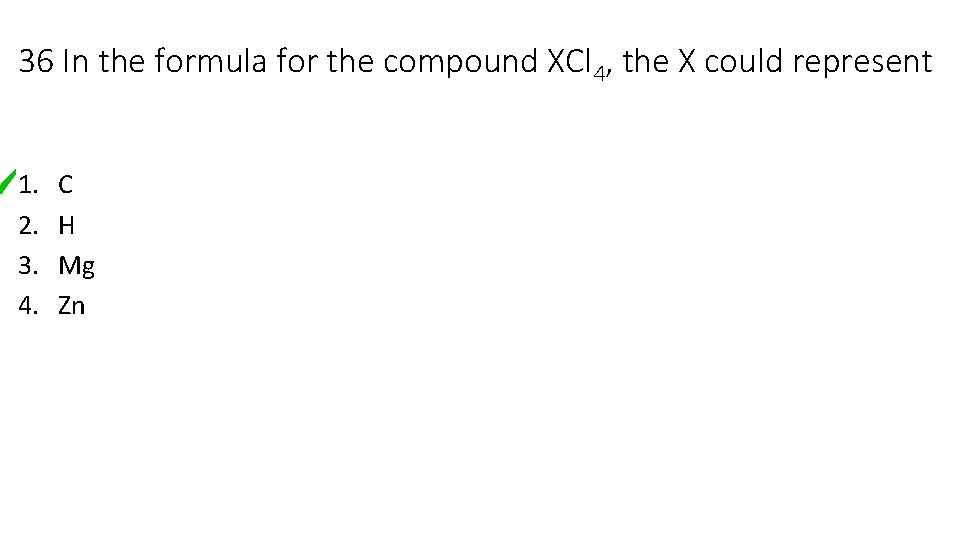
36 In the formula for the compound XCl 4, the X could represent 1. 2. 3. 4. C H Mg Zn
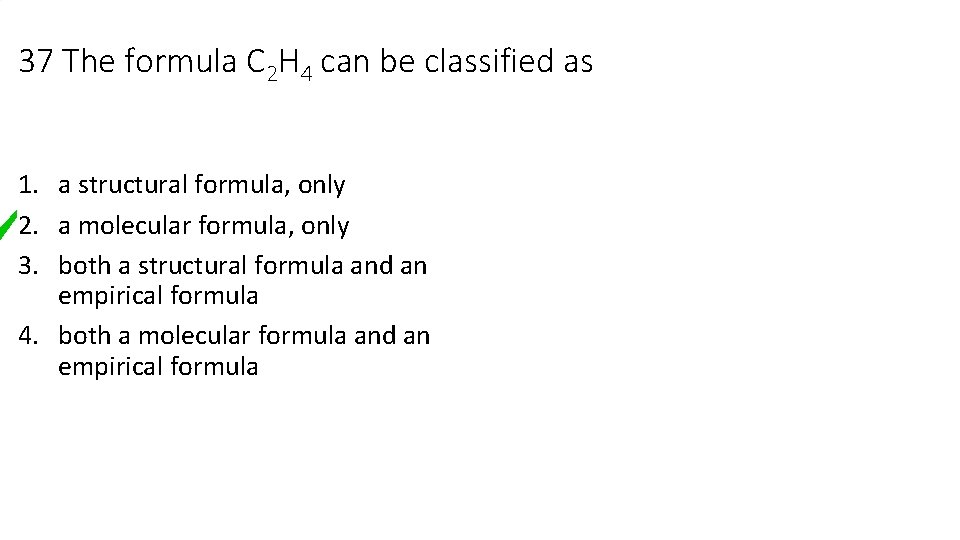
37 The formula C 2 H 4 can be classified as 1. a structural formula, only 2. a molecular formula, only 3. both a structural formula and an empirical formula 4. both a molecular formula and an empirical formula
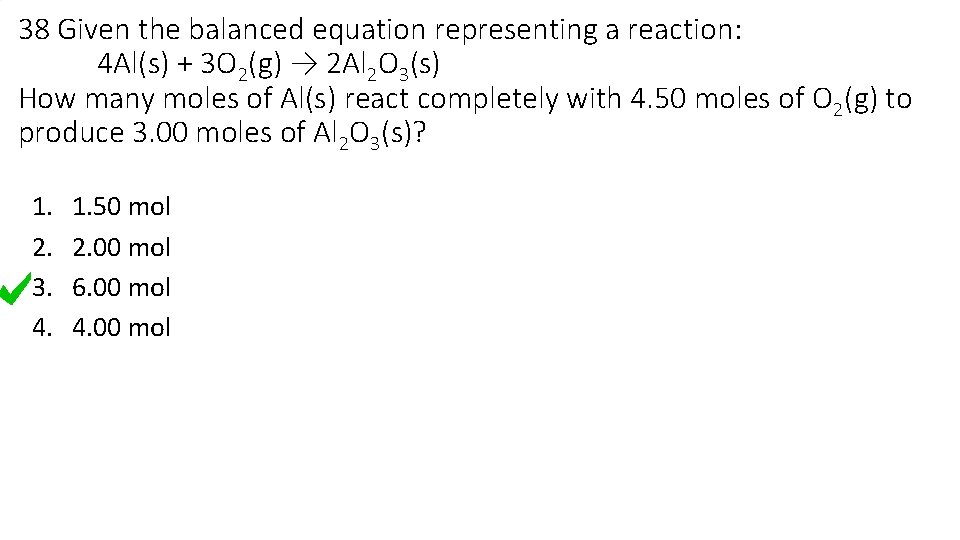
38 Given the balanced equation representing a reaction: 4 Al(s) + 3 O 2(g) → 2 Al 2 O 3(s) How many moles of Al(s) react completely with 4. 50 moles of O 2(g) to produce 3. 00 moles of Al 2 O 3(s)? 1. 2. 3. 4. 1. 50 mol 2. 00 mol 6. 00 mol 4. 00 mol
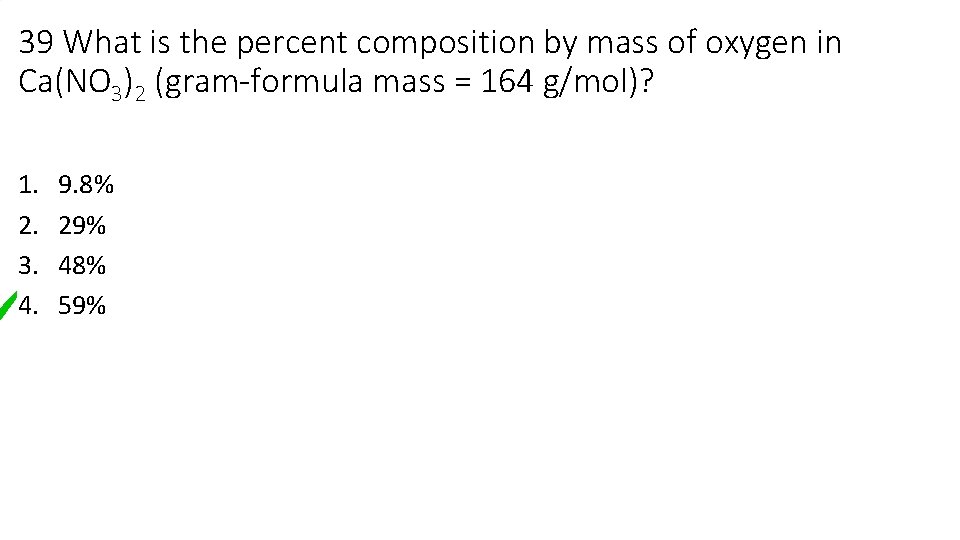
39 What is the percent composition by mass of oxygen in Ca(NO 3)2 (gram-formula mass = 164 g/mol)? 1. 2. 3. 4. 9. 8% 29% 48% 59%
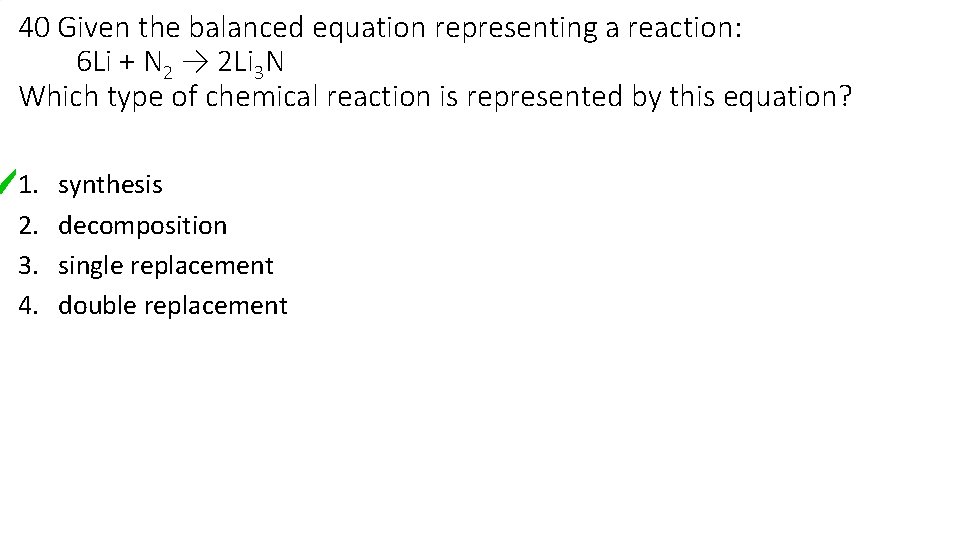
40 Given the balanced equation representing a reaction: 6 Li + N 2 → 2 Li 3 N Which type of chemical reaction is represented by this equation? 1. 2. 3. 4. synthesis decomposition single replacement double replacement
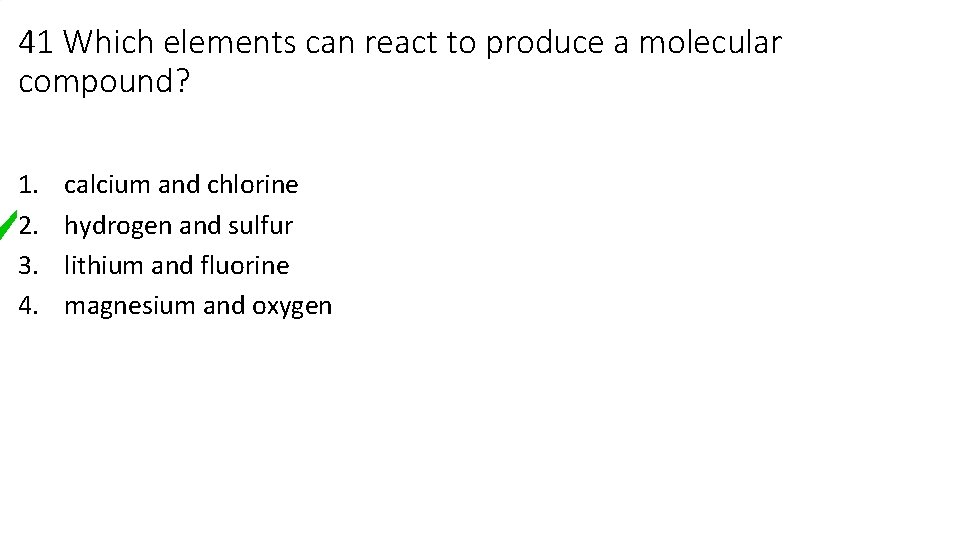
41 Which elements can react to produce a molecular compound? 1. 2. 3. 4. calcium and chlorine hydrogen and sulfur lithium and fluorine magnesium and oxygen
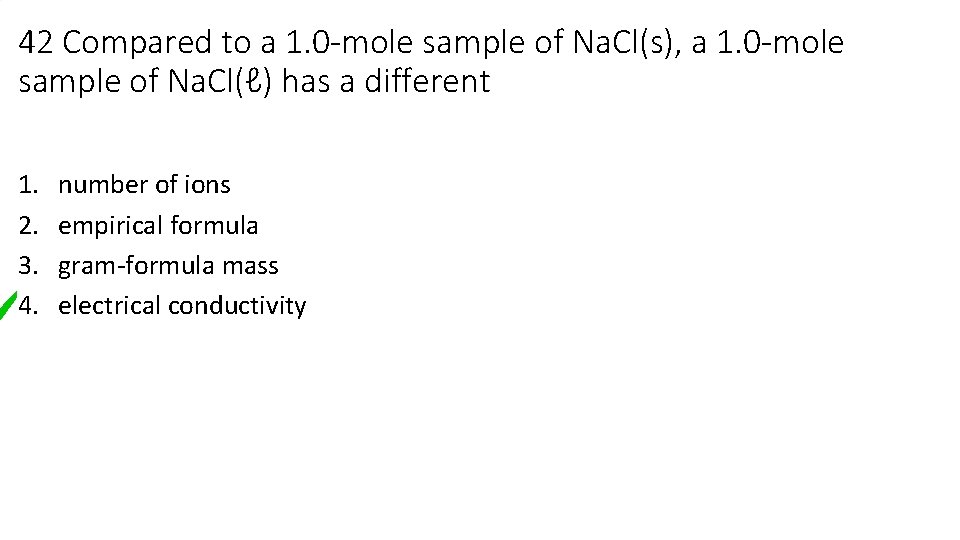
42 Compared to a 1. 0 -mole sample of Na. Cl(s), a 1. 0 -mole sample of Na. Cl(ℓ) has a different 1. 2. 3. 4. number of ions empirical formula gram-formula mass electrical conductivity
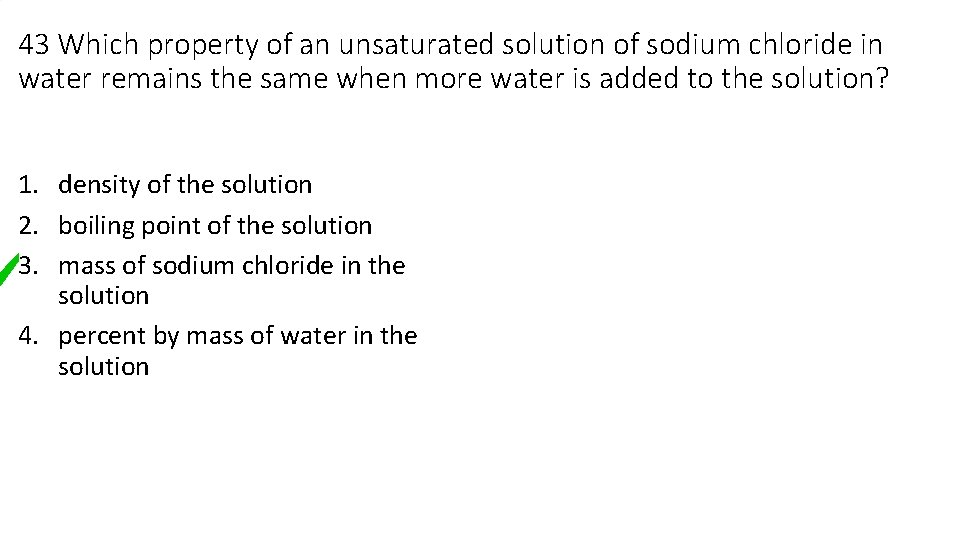
43 Which property of an unsaturated solution of sodium chloride in water remains the same when more water is added to the solution? 1. density of the solution 2. boiling point of the solution 3. mass of sodium chloride in the solution 4. percent by mass of water in the solution
44 Which ion combines with Ba 2+ to form a compound that is most soluble in water? 1. 2. 3. 4. S 2 OHCO 32 SO 42 -
45 When a sample of gas is cooled in a sealed, rigid container, the pressure the gas exerts on the walls of the container will decrease because the gas particles hit the walls of the container 1. 2. 3. 4. less often and with less force less often and with more force more often and with less force more often and with more force
46 A rigid cylinder with a movable piston contains 50. 0 liters of a gas at 30. 0°C with a pressure of 1. 00 atmosphere. What is the volume of the gas in the cylinder at STP? 1. 2. 3. 4. 5. 49 L 45. 0 L 55. 5 L 455 L
47 Given the potential energy diagram for a chemical reaction: Which numbered interval represents the heat of reaction? 1. 2. 3. 4. 1 2 3 4
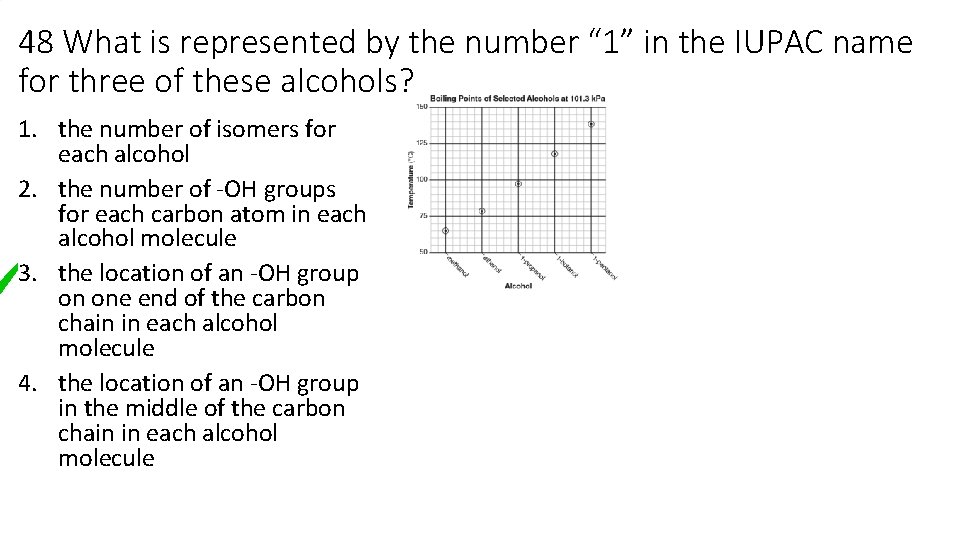
48 What is represented by the number “ 1” in the IUPAC name for three of these alcohols? 1. the number of isomers for each alcohol 2. the number of -OH groups for each carbon atom in each alcohol molecule 3. the location of an -OH group on one end of the carbon chain in each alcohol molecule 4. the location of an -OH group in the middle of the carbon chain in each alcohol molecule
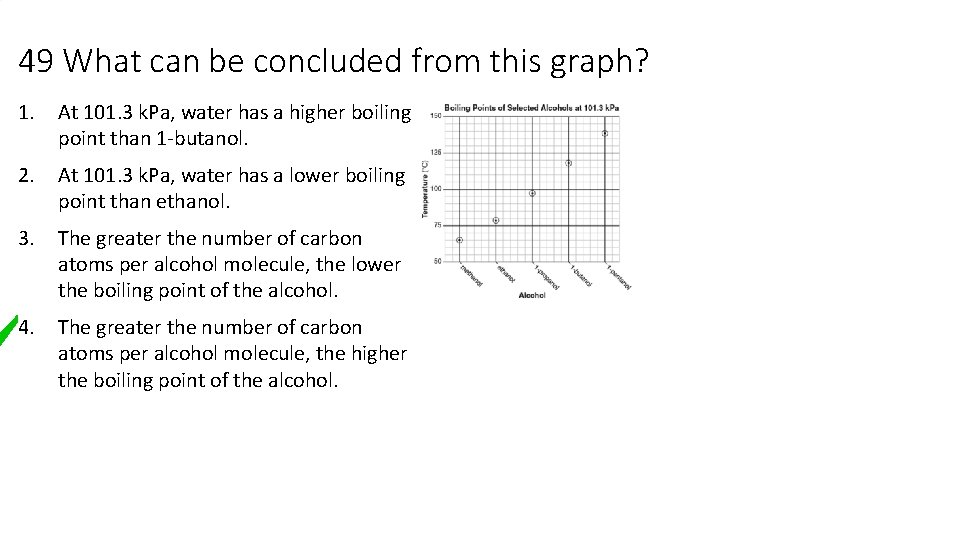
49 What can be concluded from this graph? 1. At 101. 3 k. Pa, water has a higher boiling point than 1 -butanol. 2. At 101. 3 k. Pa, water has a lower boiling point than ethanol. 3. The greater the number of carbon atoms per alcohol molecule, the lower the boiling point of the alcohol. 4. The greater the number of carbon atoms per alcohol molecule, the higher the boiling point of the alcohol.
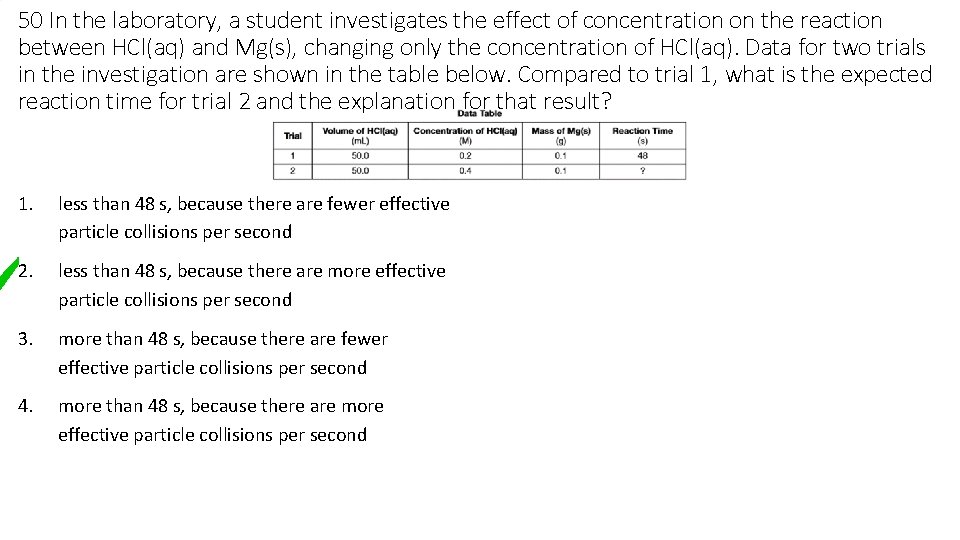
50 In the laboratory, a student investigates the effect of concentration on the reaction between HCl(aq) and Mg(s), changing only the concentration of HCl(aq). Data for two trials in the investigation are shown in the table below. Compared to trial 1, what is the expected reaction time for trial 2 and the explanation for that result? 1. less than 48 s, because there are fewer effective particle collisions per second 2. less than 48 s, because there are more effective particle collisions per second 3. more than 48 s, because there are fewer effective particle collisions per second 4. more than 48 s, because there are more effective particle collisions per second