
THE UNIVERSITY OF TEXAS AT EL PASO COMPUTER



- Slides: 24
THE UNIVERSITY OF TEXAS AT EL PASO COMPUTER SCIENCE Ann Q. Gates Professor and Chair Director - CREST Cyber. Share Center of Excellence Director - CAHSI INCLUDES Martine Ceberio Professor
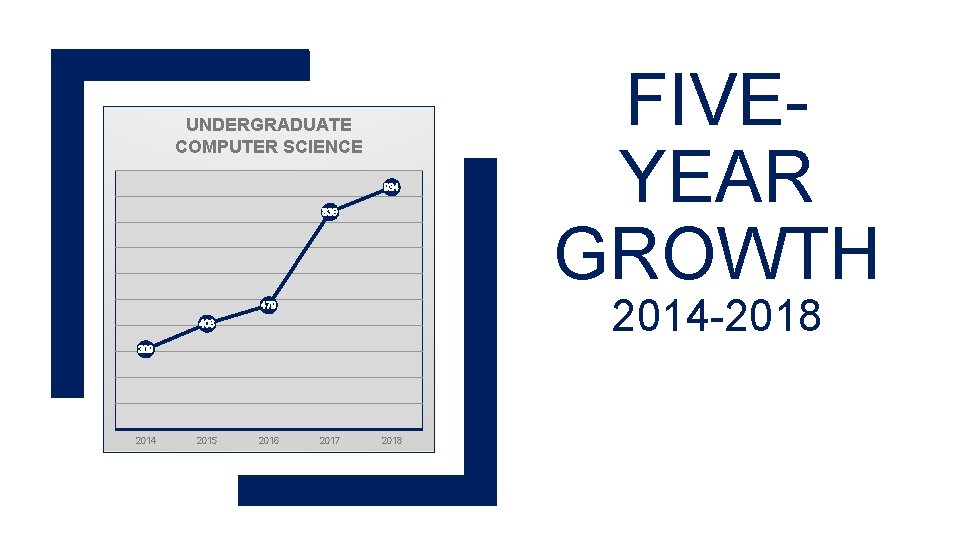
UNDERGRADUATE COMPUTER SCIENCE 934 839 2014 -2018 479 408 309 2014 2015 2016 FIVEYEAR GROWTH 2017 2018
Support for Change
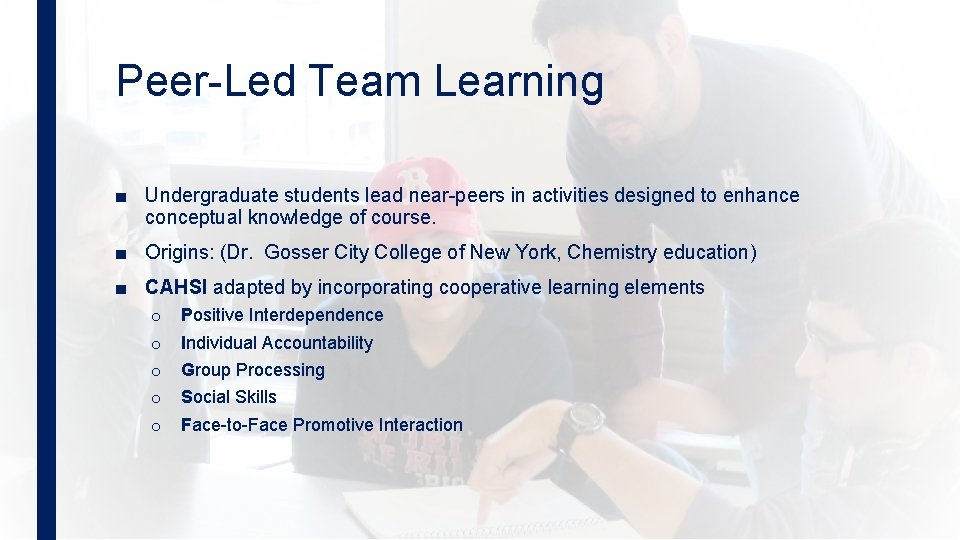
Peer-Led Team Learning ■ Undergraduate students lead near-peers in activities designed to enhance conceptual knowledge of course. ■ Origins: (Dr. Gosser City College of New York, Chemistry education) ■ CAHSI adapted by incorporating cooperative learning elements o o o Positive Interdependence Individual Accountability Group Processing Social Skills Face-to-Face Promotive Interaction
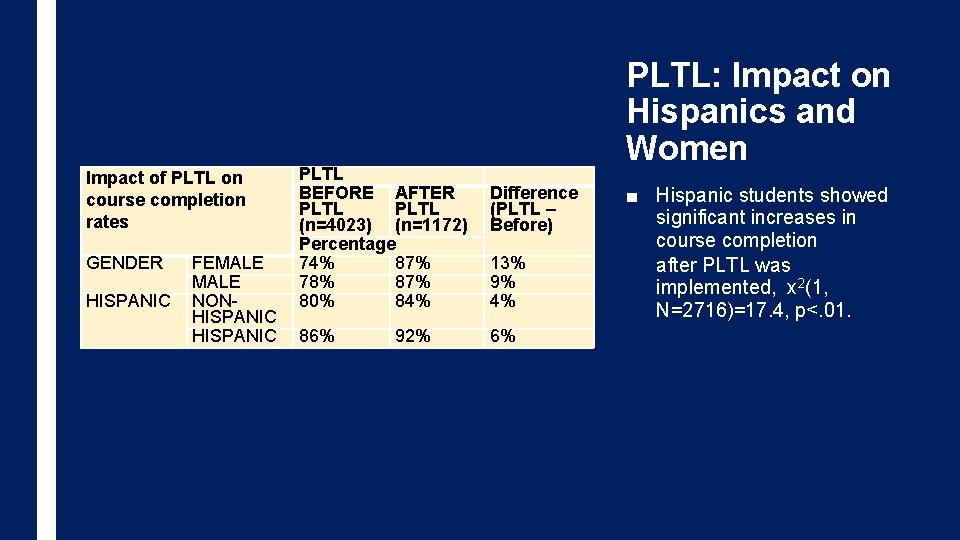
Impact of PLTL on course completion rates GENDER HISPANIC FEMALE NONHISPANIC PLTL BEFORE AFTER PLTL (n=4023) (n=1172) Percentage 74% 87% 78% 87% 80% 84% 86% 92% PLTL: Impact on Hispanics and Women Difference (PLTL – Before) 13% 9% 4% 6% ■ Hispanic students showed significant increases in course completion after PLTL was implemented, x 2(1, N=2716)=17. 4, p<. 01.
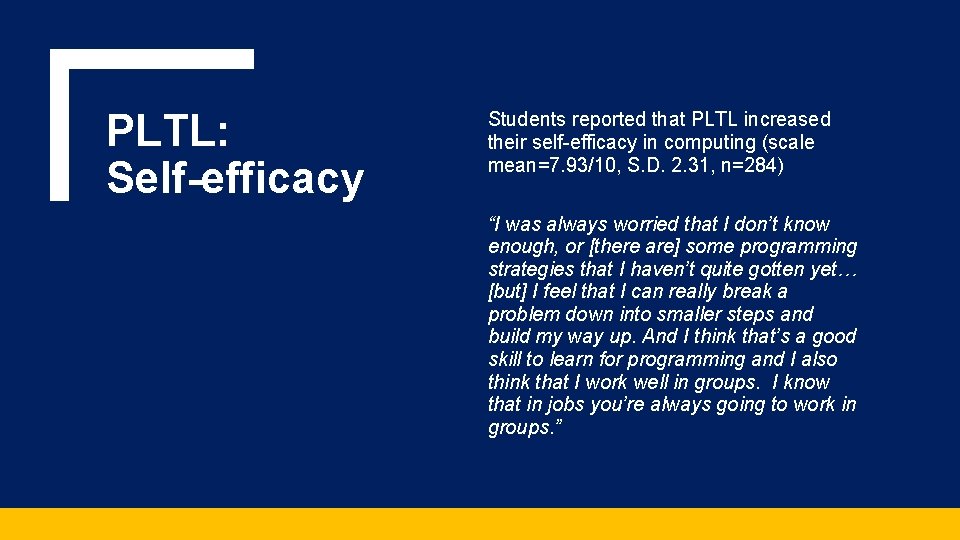
PLTL: Self-efficacy Students reported that PLTL increased their self-efficacy in computing (scale mean=7. 93/10, S. D. 2. 31, n=284) “I was always worried that I don’t know enough, or [there are] some programming strategies that I haven’t quite gotten yet… [but] I feel that I can really break a problem down into smaller steps and build my way up. And I think that’s a good skill to learn for programming and I also think that I work well in groups. I know that in jobs you’re always going to work in groups. ”
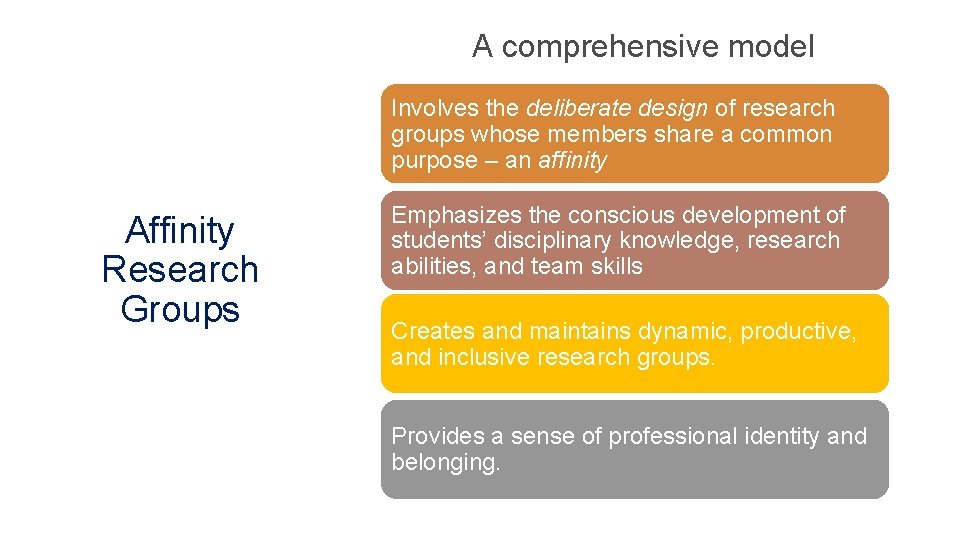
A comprehensive model Involves the deliberate design of research groups whose members share a common purpose – an affinity Affinity Research Groups Emphasizes the conscious development of students’ disciplinary knowledge, research abilities, and team skills Creates and maintains dynamic, productive, and inclusive research groups. Provides a sense of professional identity and belonging.
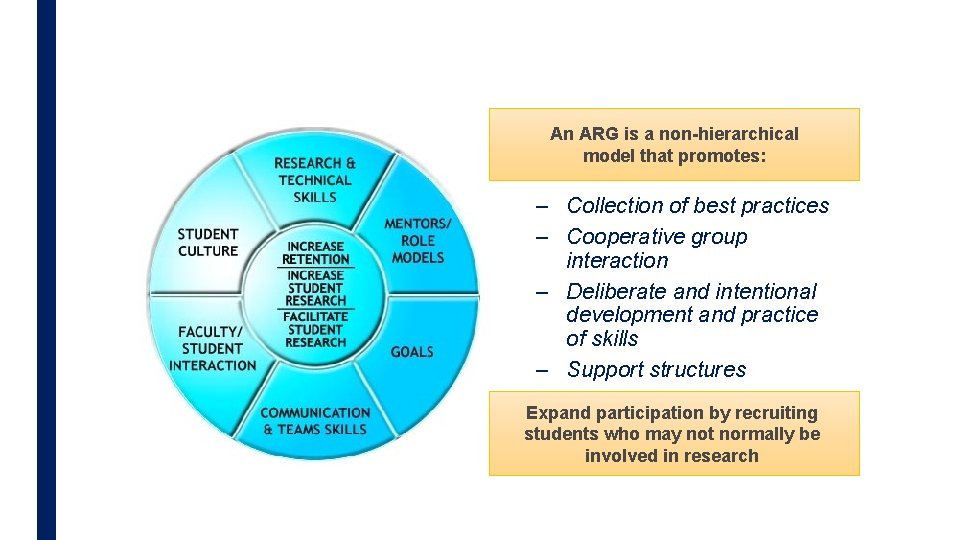
An ARG is a non-hierarchical model that promotes: – Collection of best practices – Cooperative group interaction – Deliberate and intentional development and practice of skills – Support structures Expand participation by recruiting students who may not normally be involved in research
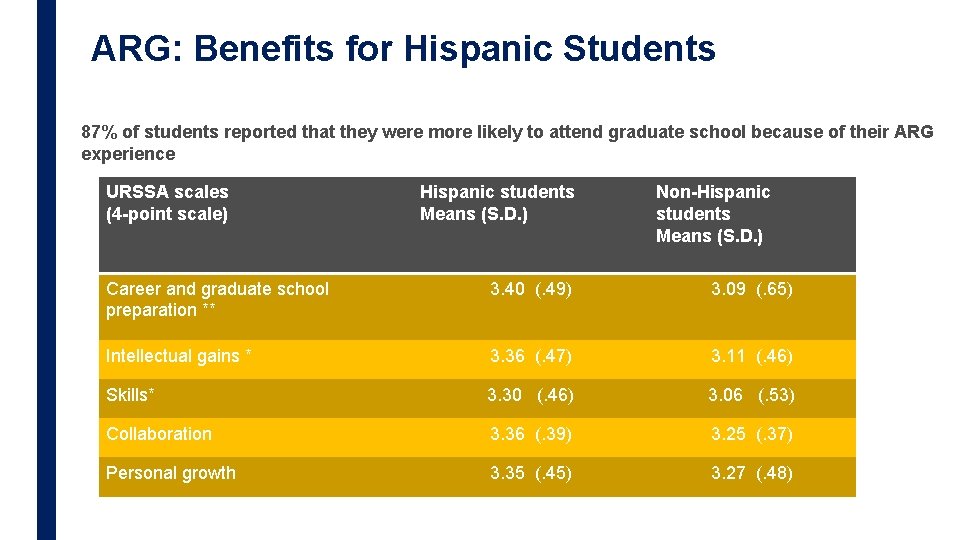
ARG: Benefits for Hispanic Students 87% of students reported that they were more likely to attend graduate school because of their ARG experience URSSA scales (4 -point scale) Hispanic students Means (S. D. ) Non-Hispanic students Means (S. D. ) Career and graduate school preparation ** 3. 40 (. 49) 3. 09 (. 65) Intellectual gains * 3. 36 (. 47) 3. 11 (. 46) Skills* **p<. 01, *p<. 05 ; independent samples t-tests 3. 30 (. 46) 3. 06 (. 53) Collaboration 3. 36 (. 39) 3. 25 (. 37) Personal growth 3. 35 (. 45) 3. 27 (. 48)
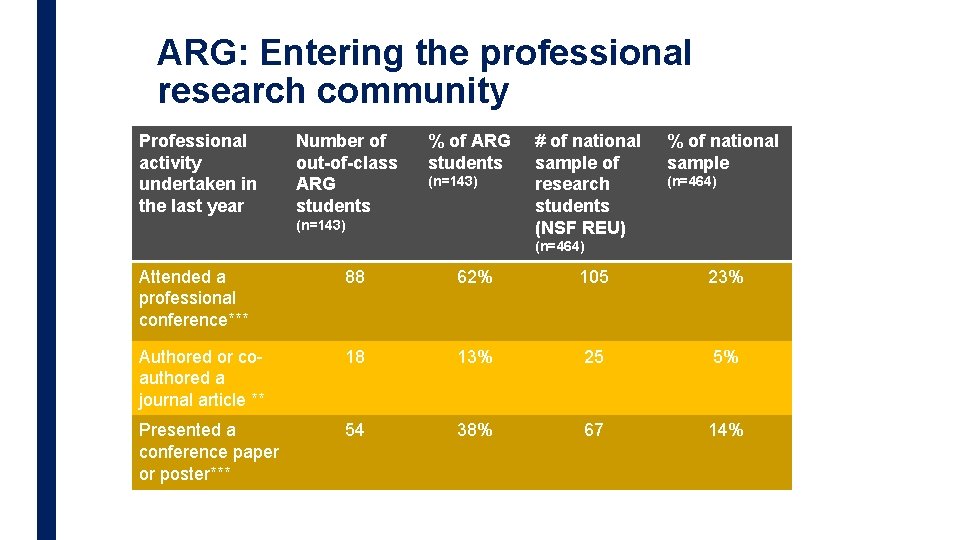
ARG: Entering the professional research community Professional activity undertaken in the last year Number of out-of-class ARG students % of ARG students (n=143) # of national sample of research students (NSF REU) % of national sample (n=464) Attended a professional conference*** 88 62% 105 23% Authored or coauthored a journal article ** 18 13% 25 5% *** p<. 001, Presented a **p<. 01; independent 54 samples t-tests 38% conference paper or poster*** 67 14%
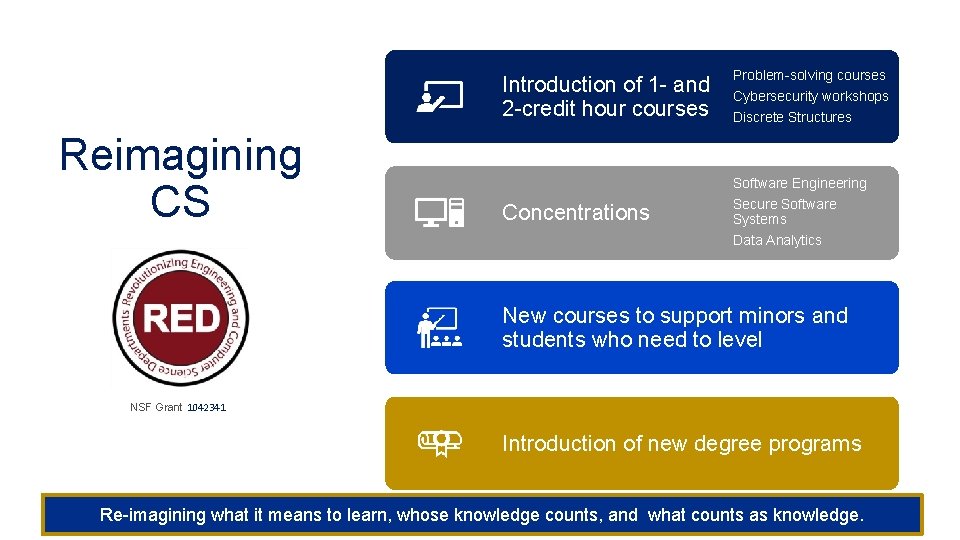
Introduction of 1 - and 2 -credit hour courses Reimagining CS Problem-solving courses Cybersecurity workshops Discrete Structures Software Engineering Concentrations Secure Software Systems Data Analytics New courses to support minors and students who need to level NSF Grant 1042341 Introduction of new degree programs Re-imagining what it means to learn, whose knowledge counts, and what counts as knowledge.
CAHSIGOOGLE PROBLEM SOLVING COURSES
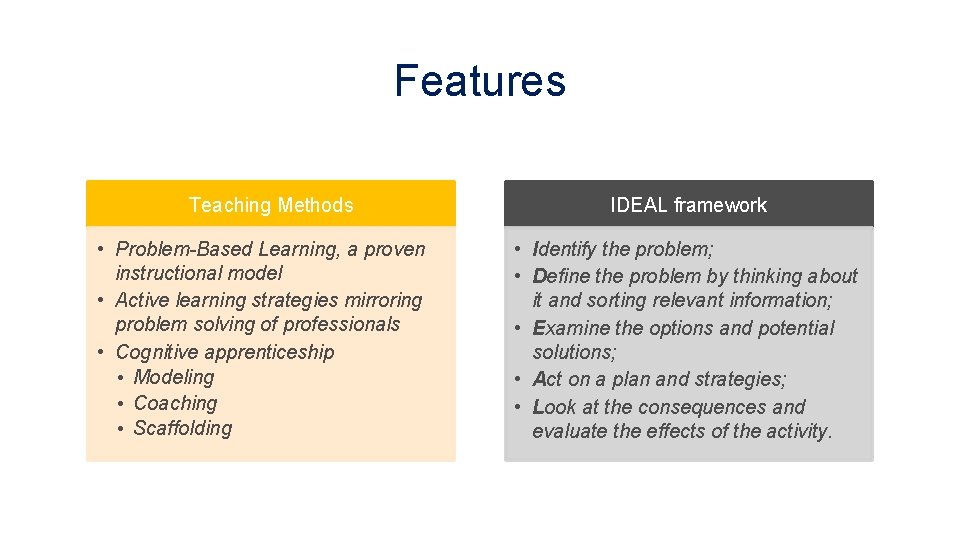
Features Teaching Methods • Problem-Based Learning, a proven instructional model • Active learning strategies mirroring problem solving of professionals • Cognitive apprenticeship • Modeling • Coaching • Scaffolding IDEAL framework • Identify the problem; • Define the problem by thinking about it and sorting relevant information; • Examine the options and potential solutions; • Act on a plan and strategies; • Look at the consequences and evaluate the effects of the activity.
■ We're problem solvers, as computer scientists. And yet, it feels like we have stopped, or forgotten, or been too busy to make it more explicit in our regular (core) classes. The problem-solving course is our remedy. ■ One of the biggest things that we have learned by running these classes is how. . . we're seeing big holes in our curriculum. This is forcing us to understand what students want to get out of our program… we need to be more proactive to actually train them to do the stuff they need to do on the job. CAHSIGoogle Problem Solving Courses Faculty Reflections
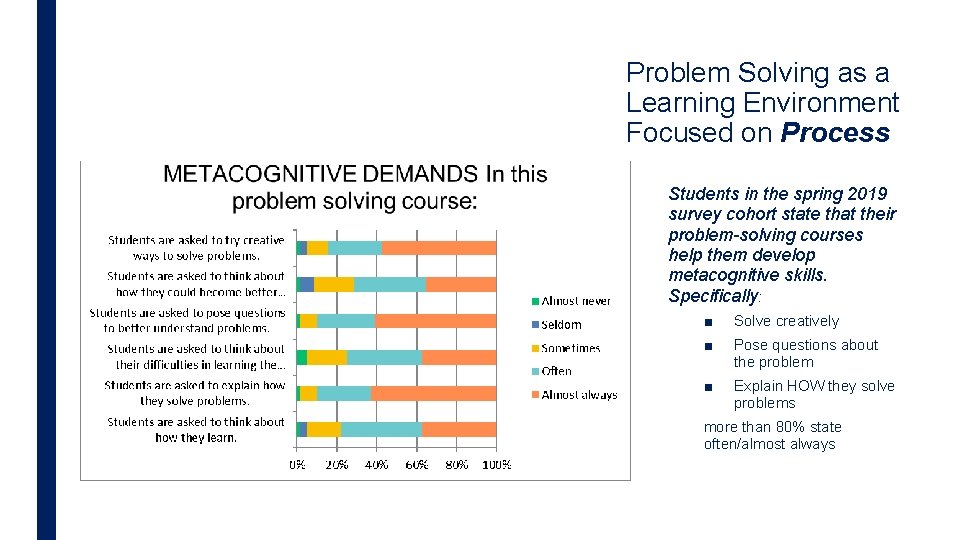
Problem Solving as a Learning Environment Focused on Process Students in the spring 2019 survey cohort state that their problem-solving courses help them develop metacognitive skills. Specifically: ■ Solve creatively ■ Pose questions about the problem ■ Explain HOW they solve problems more than 80% state often/almost always
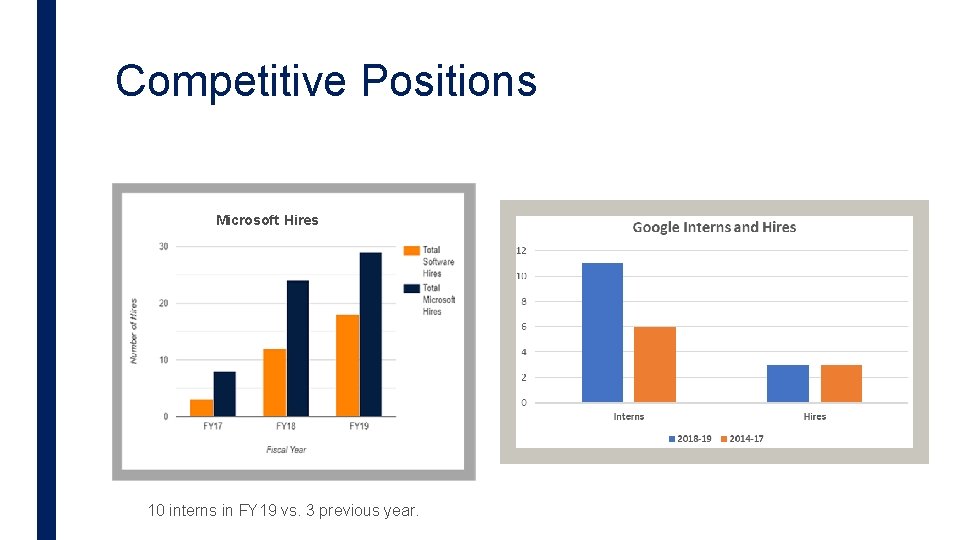
Competitive Positions Microsoft Hires 10 interns in FY 19 vs. 3 previous year.
OTHER COURSES
One-Credit Hour Course Cyber Security Salamah* Workshop-style course introducing students to: Current software vulnerabilities Cyber operation techniques Defense and mitigation techniques Cybersecurity analysis tools 10 workshops in total including: *Collaboration with ARL and industry Route hijacking Buffer overflow Android security Reverse engineering Digital forensics 18
Discrete Structures as a 1+2 Sequence ■ Discrete Math used was a bottleneck in our curriculum ■ Lack of genuine alignment and motivation for our CS students ■ Split into a 1 hr + 2 hrs sequence, offered along with CS 1 and CS 2
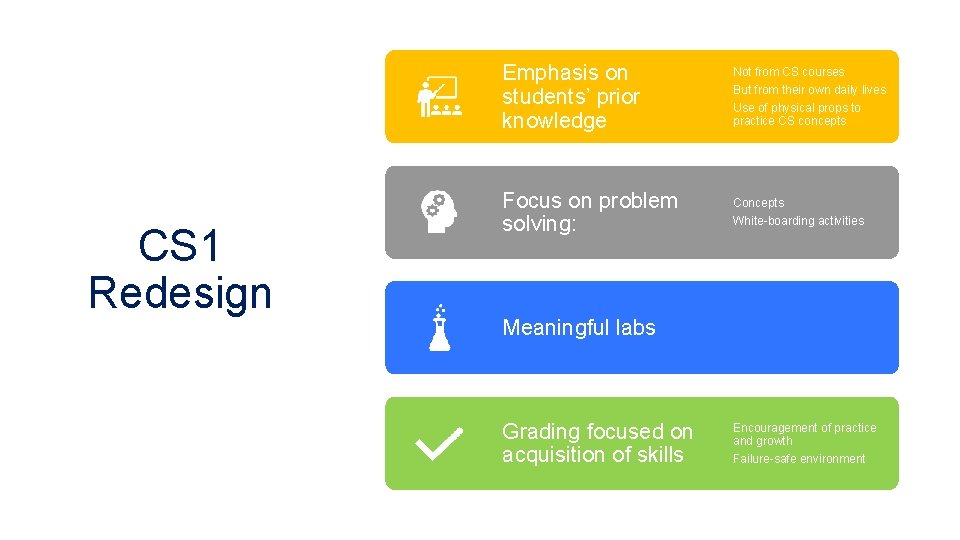
Emphasis on students’ prior knowledge CS 1 Redesign Focus on problem solving: Not from CS courses But from their own daily lives Use of physical props to practice CS concepts Concepts White-boarding activities Meaningful labs Grading focused on acquisition of skills Encouragement of practice and growth Failure-safe environment
On-going CS 2 redesign ■ Focus on growth and skills ■ Focus on problem solving ■ Emphasis on extracurricular opportunities (such as internships) ■ All while adjusting to growing enrollment
Faculty Brownbag Meetings ■ Increase communication between faculty ■ Increase collegiality ■ Center conversations on students’ success – Student success is always our concern – Exchanging ideas on student success makes our efforts more efficient
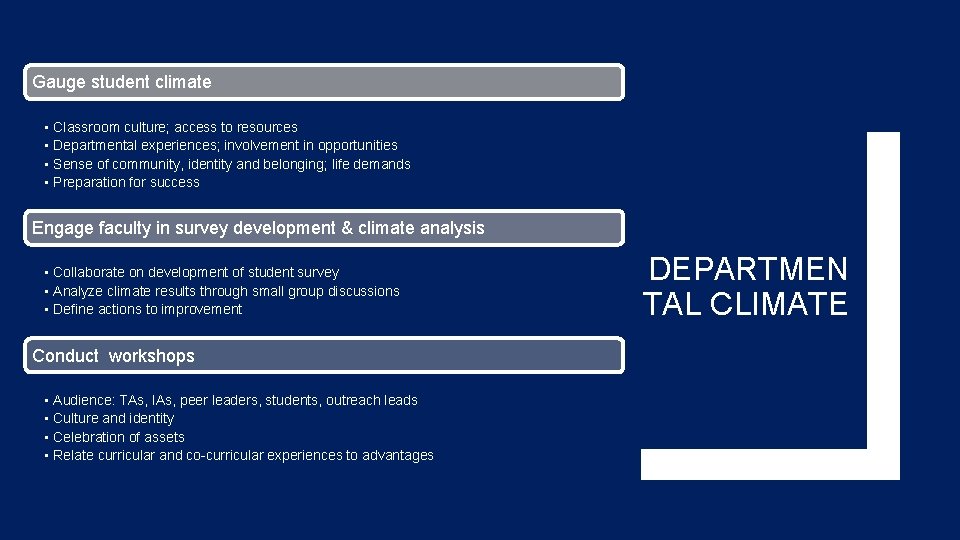
Gauge student climate • Classroom culture; access to resources • Departmental experiences; involvement in opportunities • Sense of community, identity and belonging; life demands • Preparation for success Engage faculty in survey development & climate analysis • Collaborate on development of student survey • Analyze climate results through small group discussions • Define actions to improvement Conduct workshops • Audience: TAs, IAs, peer leaders, students, outreach leads • Culture and identity • Celebration of assets • Relate curricular and co-curricular experiences to advantages DEPARTMEN TAL CLIMATE
QUESTIONS agates@utep. edu mceberio@utep. edu