
The University of California UAS Safety Management System


- Slides: 52
The University of California UAS Safety Management System Brandon Stark, Director Unmanned Aircraft System Safety Center of Excellence University of California
Topics • UAS Safety • Safety Management System • • Policies Risk Management Safety Assurance Safety Promotion • Moving forward 2
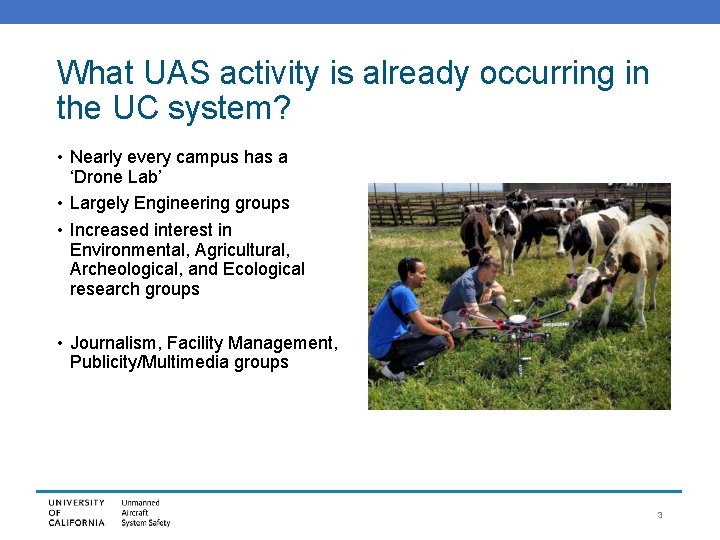
What UAS activity is already occurring in the UC system? • Nearly every campus has a ‘Drone Lab’ • Largely Engineering groups • Increased interest in Environmental, Agricultural, Archeological, and Ecological research groups • Journalism, Facility Management, Publicity/Multimedia groups 3
UAS Vocab • UAS – Unmanned Aircraft System • COA – Certificate of Authorization, applies for both Public Agencies or Commercial UAS flights • Part 107 – New SUAS Regulations (Aug 29 th, 2016) • Pilot Certificate – Pilot’s license • Remote Pilot Certificate – New SUAS RPIC license • RPIC – Remote Pilot in command • UAS Registration – Each aircraft must have an FAA number (starts with N or FA) • SUAS – Small UAS (under 55 lbs) • Section 333 Exemption – Congressional exemption from the prohibition of commercial UAS flights • VO – Visual observer 4
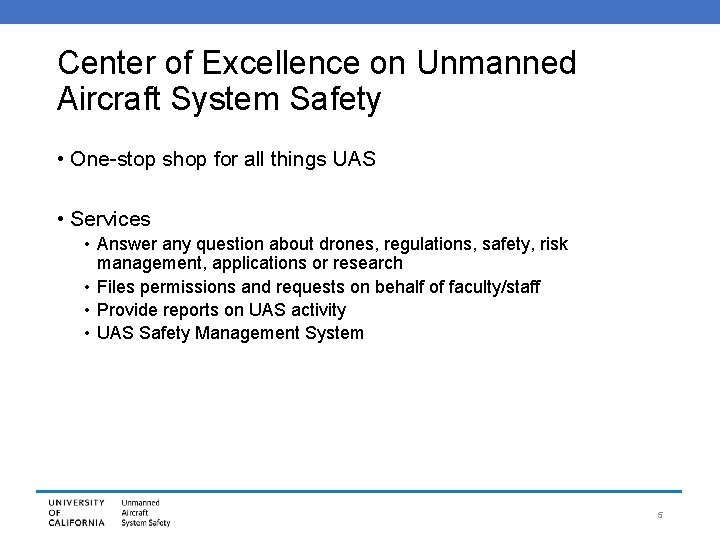
Center of Excellence on Unmanned Aircraft System Safety • One-stop shop for all things UAS • Services • Answer any question about drones, regulations, safety, risk management, applications or research • Files permissions and requests on behalf of faculty/staff • Provide reports on UAS activity • UAS Safety Management System 5
UAS or Model Aircraft are defined as a subset of Unmanned Aircraft. Model Aircraft are differentiated from Unmanned Aircraft only by the purpose in which they are flown Unmanned Aircraft Small Unmanned Aircraft Model Aircraft Sec 336 in H. R. 658 – “The FAA Modernization and Reform Act of 2012” 6
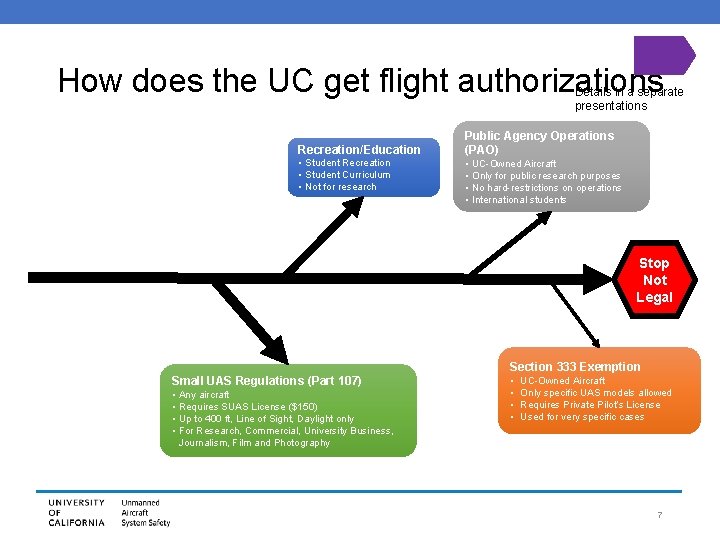
How does the UC get flight authorizations Details in a separate presentations Recreation/Education • Student Recreation • Student Curriculum • Not for research Public Agency Operations (PAO) • UC-Owned Aircraft • Only for public research purposes • No hard-restrictions on operations • International students Stop Not Legal Section 333 Exemption Small UAS Regulations (Part 107) • Any aircraft • Requires SUAS License ($150) • Up to 400 ft, Line of Sight, Daylight only • For Research, Commercial, University Business, Journalism, Film and Photography • • UC-Owned Aircraft Only specific UAS models allowed Requires Private Pilot’s License Used for very specific cases 7
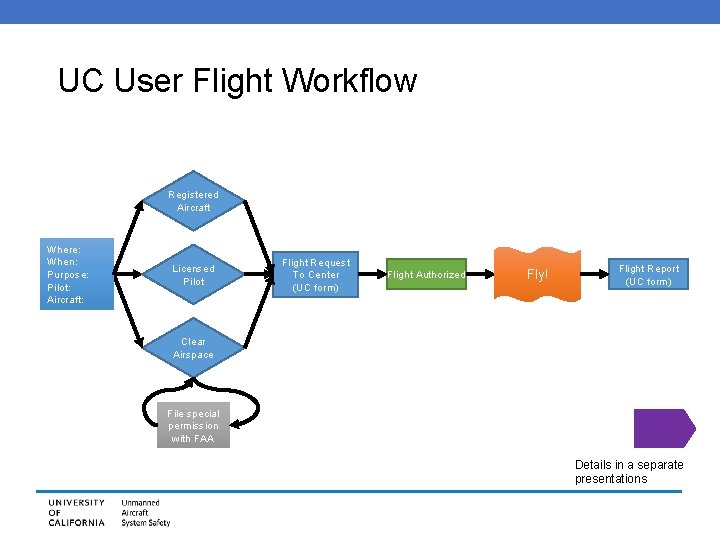
UC User Flight Workflow Registered Aircraft Where: When: Purpose: Pilot: Aircraft: Licensed Pilot Flight Request To Center (UC form) Flight Authorized Fly! Flight Report (UC form) Clear Airspace File special permission with FAA Details in a separate presentations
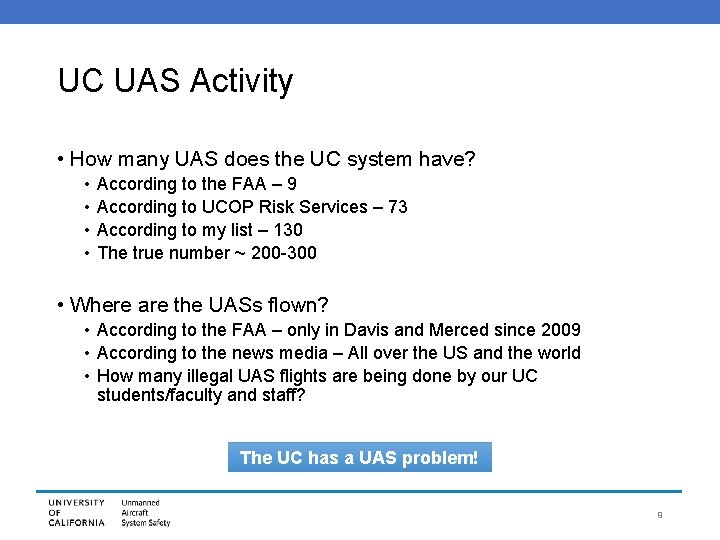
UC UAS Activity • How many UAS does the UC system have? • • According to the FAA – 9 According to UCOP Risk Services – 73 According to my list – 130 The true number ~ 200 -300 • Where are the UASs flown? • According to the FAA – only in Davis and Merced since 2009 • According to the news media – All over the US and the world • How many illegal UAS flights are being done by our UC students/faculty and staff? The UC has a UAS problem! 9
What’s going wrong? • Lack of knowledge of UAS regulations • Don’t blame recent changes! – UAS have been heavily regulated since 2005 • Recent changes have only decreased the number restrictions (by adding more alternative process with new rules) • Affects both for end-users and the campus administrators • Lack of value-added oversight • Current reporting mechanisms offer no improvement to regular use • Hard to encourage buy-in 10
“Legal” ≠ “Safe” Just because you follow the letter of the law does not mean that you are guaranteed to be safe
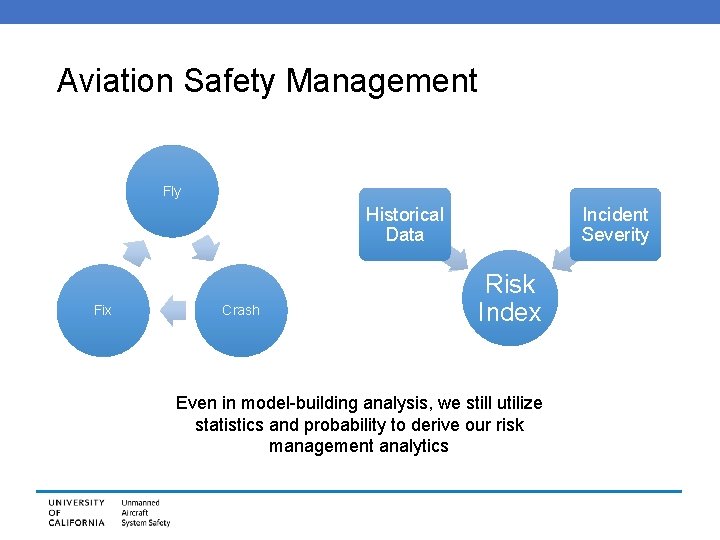
Aviation Safety Management Fly Historical Data Fix Crash Incident Severity Risk Index Even in model-building analysis, we still utilize statistics and probability to derive our risk management analytics
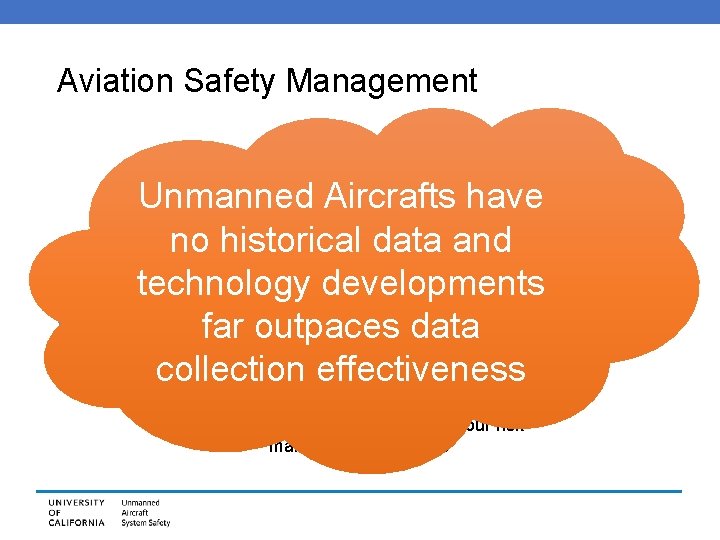
Aviation Safety Management Unmanned Aircrafts have Historical Data no historical data and Risk technology developments Index far outpaces data collection effectiveness Fly Fix Crash Even in model-building analysis, we still utilize statistics and probability to derive our risk management analytics Incident Severity
Introduction to Safety Management Systems Ensuring safety with Unmanned Aircrafts requires a different approach that 1. Incorporates a dynamic risk management systems 2. Has built in mechanisms for improvement and 3. Scales appropriately to risk This is exactly why the FAA has spent the past decade developing what is now known as Safety Management Systems (2006)
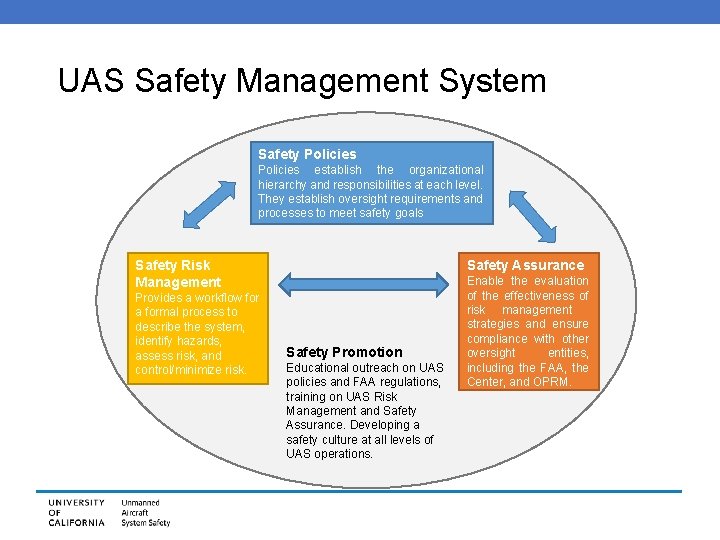
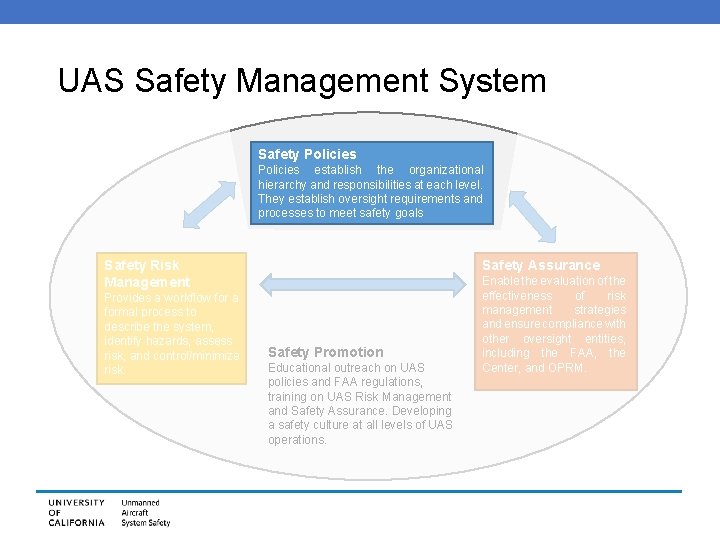
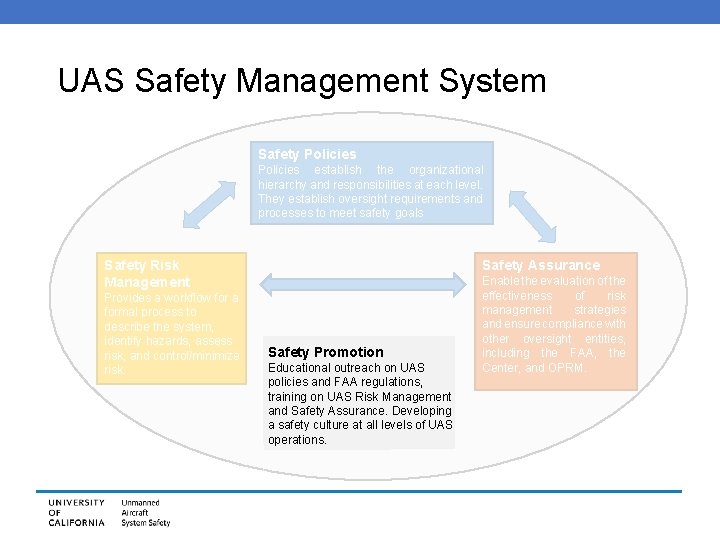
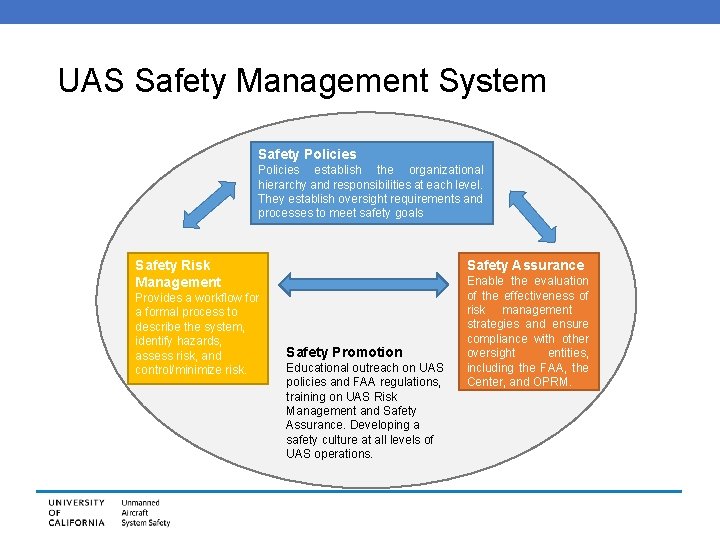
UAS Safety Management System Safety Policies establish the organizational hierarchy and responsibilities at each level. They establish oversight requirements and processes to meet safety goals Safety Assurance Safety Risk Management Provides a workflow for a formal process to describe the system, identify hazards, assess risk, and control/minimize risk. Safety Promotion Educational outreach on UAS policies and FAA regulations, training on UAS Risk Management and Safety Assurance. Developing a safety culture at all levels of UAS operations. Enable the evaluation of the effectiveness of risk management strategies and ensure compliance with other oversight entities, including the FAA, the Center, and OPRM.
Safety Risk Management & Safety Assurance • Safety Risk Management and Safety Assurance are two separate processes • But its useful to think about how they interact
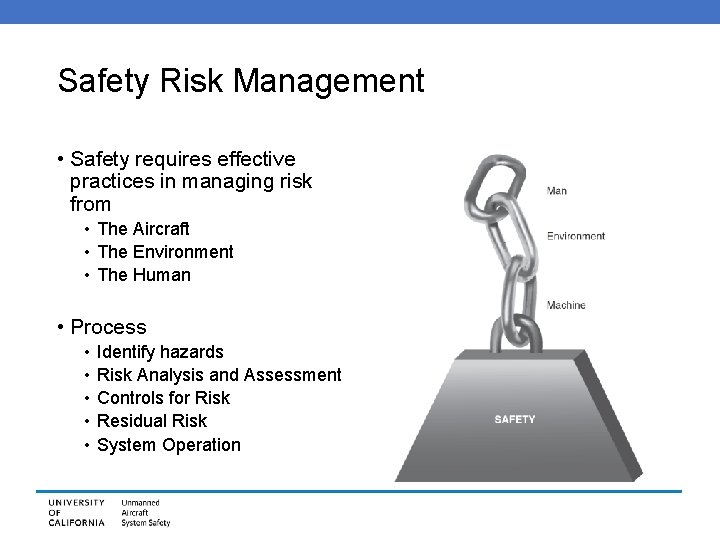
Safety Risk Management • Safety requires effective practices in managing risk from • The Aircraft • The Environment • The Human • Process • • • Identify hazards Risk Analysis and Assessment Controls for Risk Residual Risk System Operation
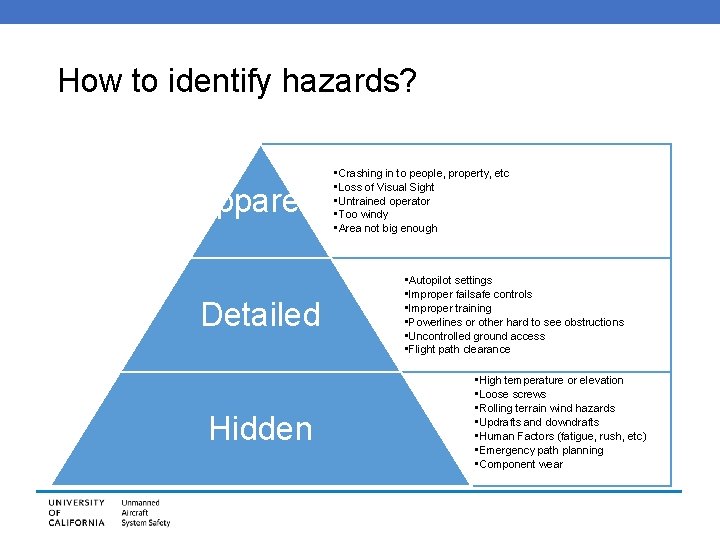
How to identify hazards? Apparent Detailed Hidden • Crashing in to people, property, etc • Loss of Visual Sight • Untrained operator • Too windy • Area not big enough • Autopilot settings • Improper failsafe controls • Improper training • Powerlines or other hard to see obstructions • Uncontrolled ground access • Flight path clearance • High temperature or elevation • Loose screws • Rolling terrain wind hazards • Updrafts and downdrafts • Human Factors (fatigue, rush, etc) • Emergency path planning • Component wear
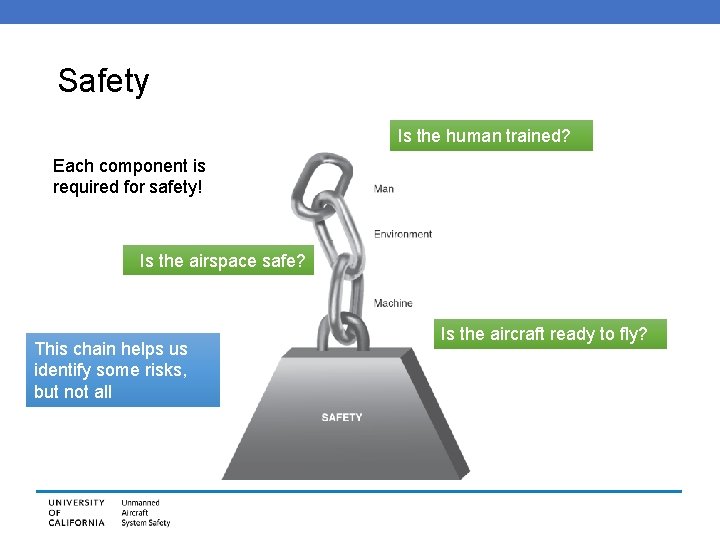
Safety Is the human trained? Each component is required for safety! Is the airspace safe? This chain helps us identify some risks, but not all Is the aircraft ready to fly?
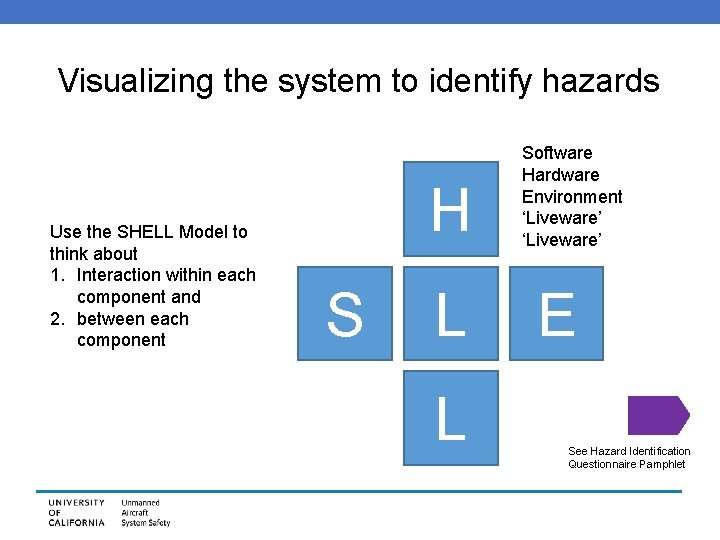
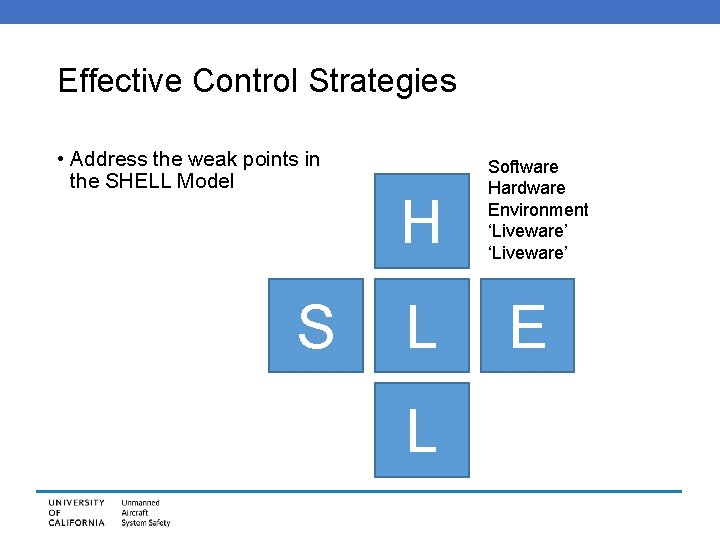
Visualizing the system to identify hazards Use the SHELL Model to think about 1. Interaction within each component and 2. between each component H S L L Software Hardware Environment ‘Liveware’ E See Hazard Identification Questionnaire Pamphlet
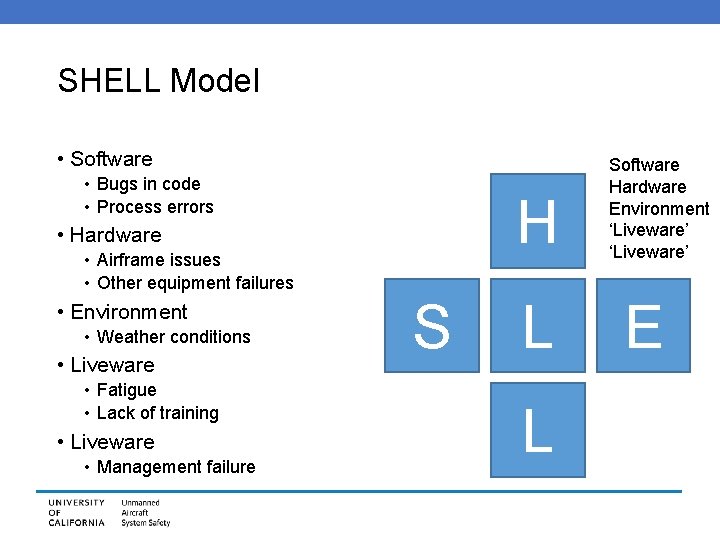
SHELL Model • Software • Bugs in code • Process errors H • Hardware • Airframe issues • Other equipment failures • Environment • Weather conditions • Liveware • Fatigue • Lack of training • Liveware • Management failure S L L Software Hardware Environment ‘Liveware’ E
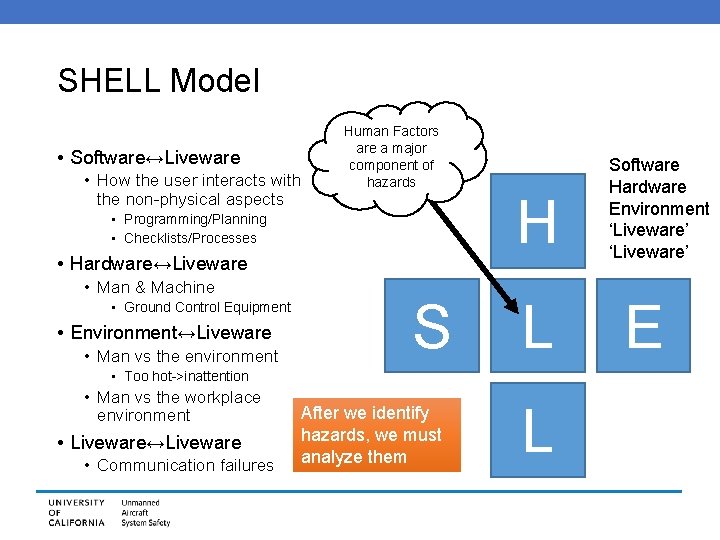
SHELL Model • Software↔Liveware • How the user interacts with the non-physical aspects Human Factors are a major component of hazards • Programming/Planning • Checklists/Processes • Hardware↔Liveware • Man & Machine • Ground Control Equipment • Environment↔Liveware • Man vs the environment S H L • Too hot->inattention • Man vs the workplace environment • Liveware↔Liveware • Communication failures After we identify hazards, we must analyze them L Software Hardware Environment ‘Liveware’ E
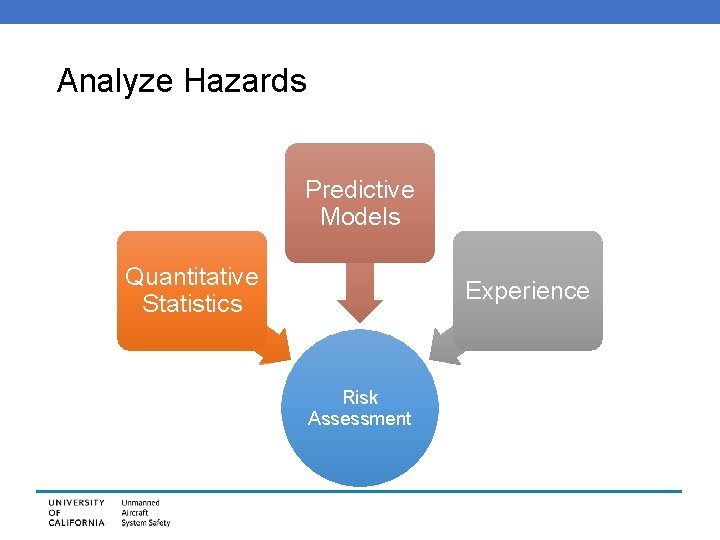
Analyze Hazards Predictive Models Quantitative Statistics Experience Risk Assessment
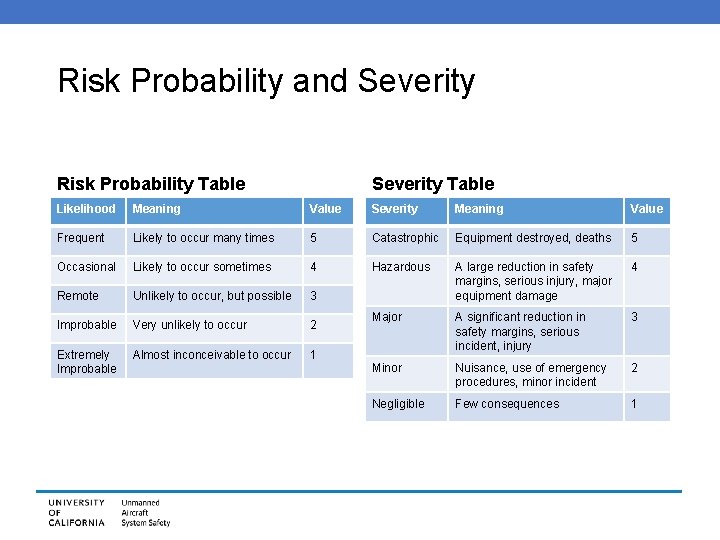
Risk Probability and Severity Risk Probability Table Severity Table Likelihood Meaning Value Severity Meaning Value Frequent Likely to occur many times 5 Catastrophic Equipment destroyed, deaths 5 Occasional Likely to occur sometimes 4 Hazardous 4 Remote Unlikely to occur, but possible 3 A large reduction in safety margins, serious injury, major equipment damage Improbable Very unlikely to occur 2 Major 3 Extremely Improbable Almost inconceivable to occur 1 A significant reduction in safety margins, serious incident, injury Minor Nuisance, use of emergency procedures, minor incident 2 Negligible Few consequences 1
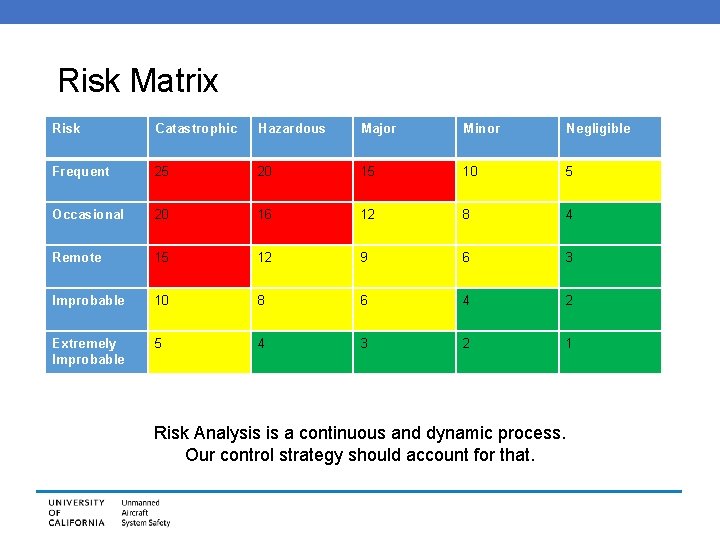
Risk Matrix Risk Catastrophic Hazardous Major Minor Negligible Frequent 25 20 15 10 5 Occasional 20 16 12 8 4 Remote 15 12 9 6 3 Improbable 10 8 6 4 2 Extremely Improbable 5 4 3 2 1 Risk Analysis is a continuous and dynamic process. Our control strategy should account for that.
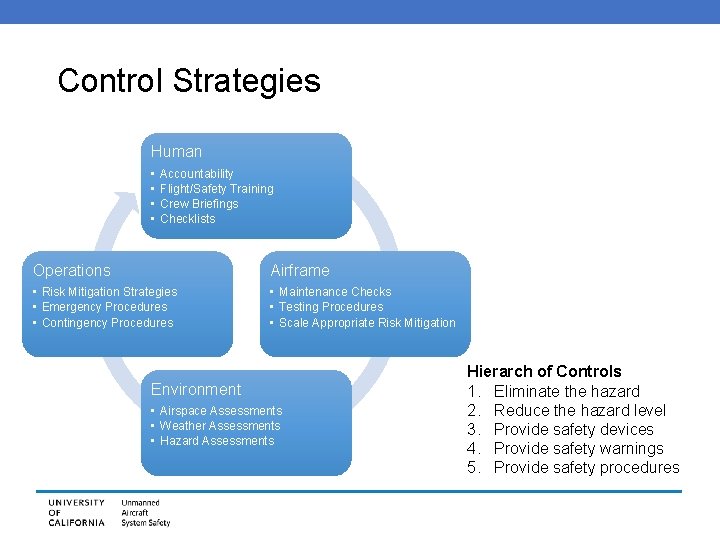
Control Strategies Human • • Accountability Flight/Safety Training Crew Briefings Checklists Operations Airframe • Risk Mitigation Strategies • Emergency Procedures • Contingency Procedures • Maintenance Checks • Testing Procedures • Scale Appropriate Risk Mitigation Environment • Airspace Assessments • Weather Assessments • Hazard Assessments Hierarch of Controls 1. Eliminate the hazard 2. Reduce the hazard level 3. Provide safety devices 4. Provide safety warnings 5. Provide safety procedures
Effective Control Strategies • Address the weak points in the SHELL Model S H L L Software Hardware Environment ‘Liveware’ E
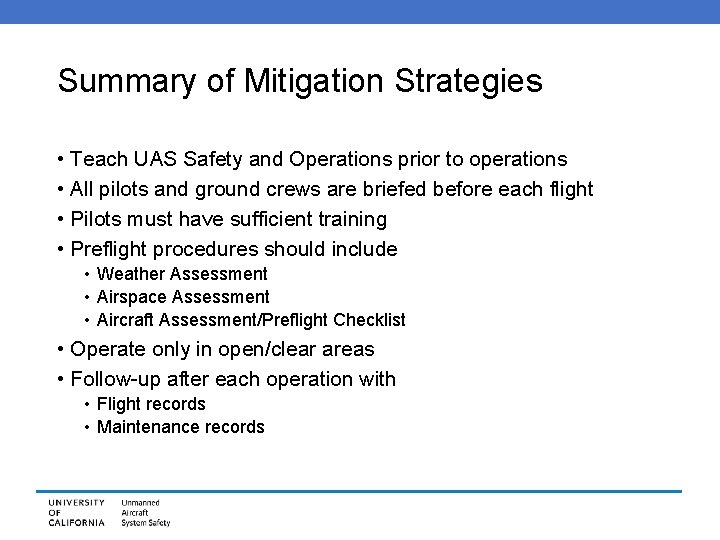
Summary of Mitigation Strategies • Teach UAS Safety and Operations prior to operations • All pilots and ground crews are briefed before each flight • Pilots must have sufficient training • Preflight procedures should include • Weather Assessment • Airspace Assessment • Aircraft Assessment/Preflight Checklist • Operate only in open/clear areas • Follow-up after each operation with • Flight records • Maintenance records
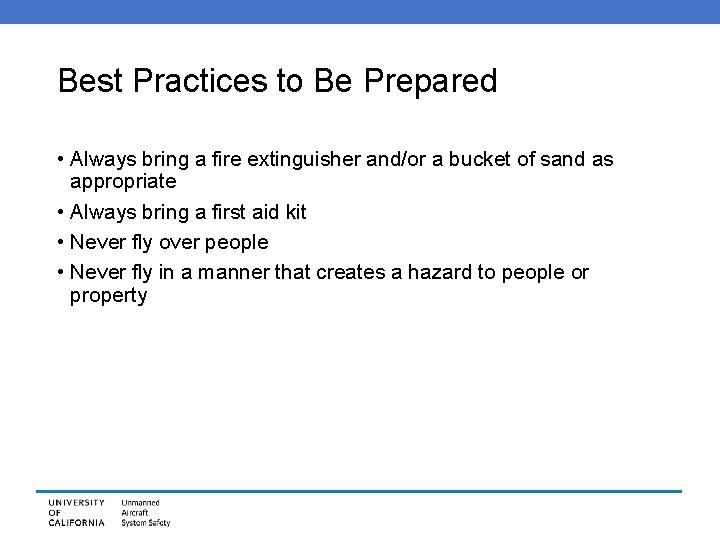
Best Practices to Be Prepared • Always bring a fire extinguisher and/or a bucket of sand as appropriate • Always bring a first aid kit • Never fly over people • Never fly in a manner that creates a hazard to people or property
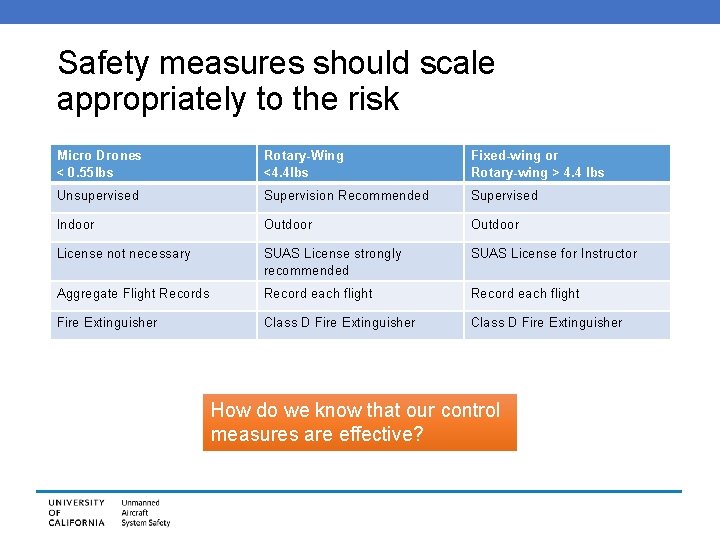
Safety measures should scale appropriately to the risk Micro Drones < 0. 55 lbs Rotary-Wing <4. 4 lbs Fixed-wing or Rotary-wing > 4. 4 lbs Unsupervised Supervision Recommended Supervised Indoor Outdoor License not necessary SUAS License strongly recommended SUAS License for Instructor Aggregate Flight Records Record each flight Fire Extinguisher Class D Fire Extinguisher How do we know that our control measures are effective?
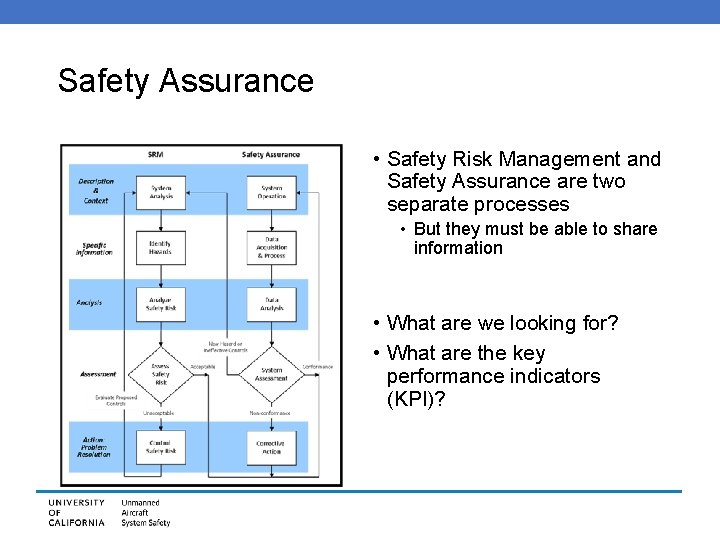
Safety Assurance • Safety Risk Management and Safety Assurance are two separate processes • But they must be able to share information • What are we looking for? • What are the key performance indicators (KPI)?
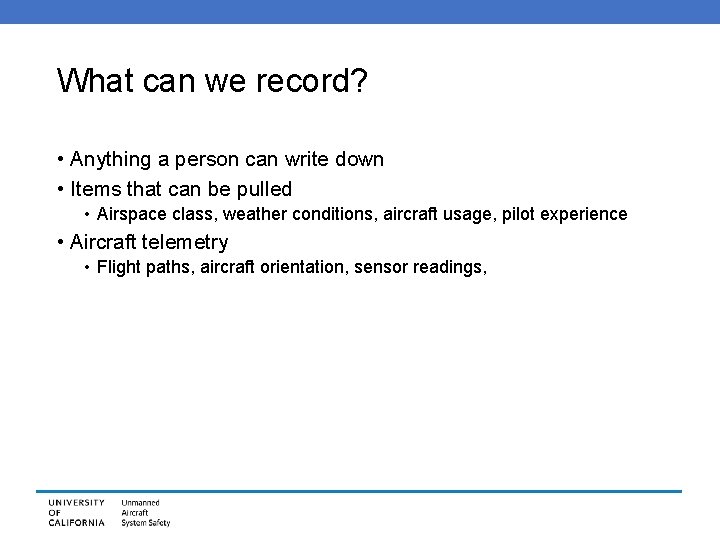
What can we record? • Anything a person can write down • Items that can be pulled • Airspace class, weather conditions, aircraft usage, pilot experience • Aircraft telemetry • Flight paths, aircraft orientation, sensor readings,
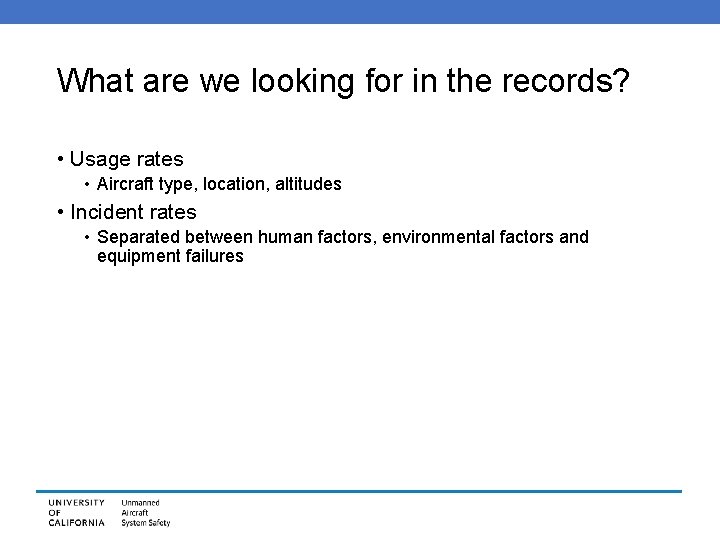
What are we looking for in the records? • Usage rates • Aircraft type, location, altitudes • Incident rates • Separated between human factors, environmental factors and equipment failures
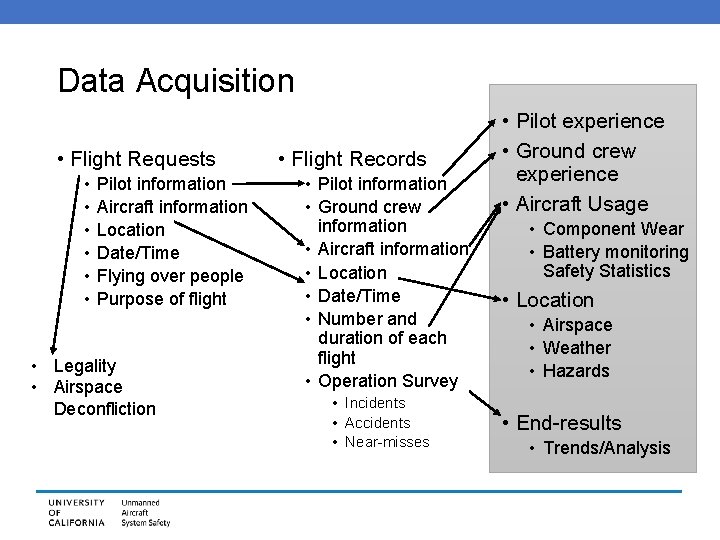
Data Acquisition • Flight Requests • • • Pilot information Aircraft information Location Date/Time Flying over people Purpose of flight • Legality • Airspace Deconfliction • Flight Records • Pilot information • Ground crew information • Aircraft information • Location • Date/Time • Number and duration of each flight • Operation Survey • Incidents • Accidents • Near-misses • Pilot experience • Ground crew experience • Aircraft Usage • Component Wear • Battery monitoring Safety Statistics • Location • Airspace • Weather • Hazards • End-results • Trends/Analysis
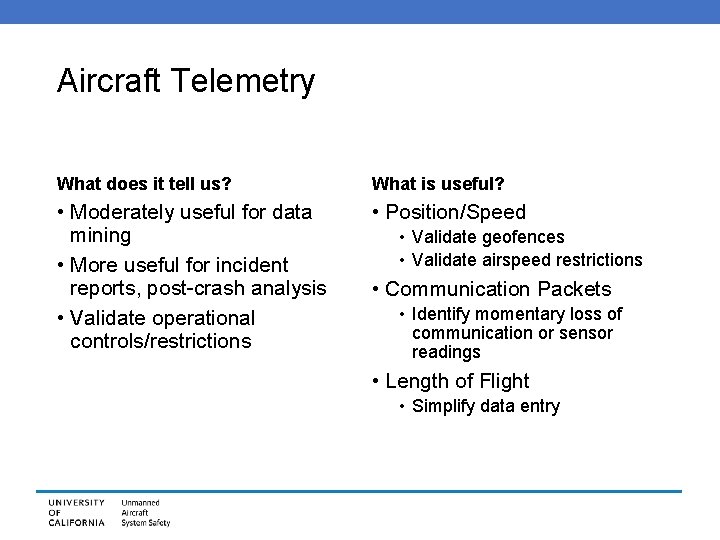
Aircraft Telemetry What does it tell us? What is useful? • Moderately useful for data mining • More useful for incident reports, post-crash analysis • Validate operational controls/restrictions • Position/Speed • Validate geofences • Validate airspeed restrictions • Communication Packets • Identify momentary loss of communication or sensor readings • Length of Flight • Simplify data entry
UAS Safety Management System Safety Policies establish the organizational hierarchy and responsibilities at each level. They establish oversight requirements and processes to meet safety goals Safety Assurance Safety Risk Management Provides a workflow for a formal process to describe the system, identify hazards, assess risk, and control/minimize risk. Safety Promotion Educational outreach on UAS policies and FAA regulations, training on UAS Risk Management and Safety Assurance. Developing a safety culture at all levels of UAS operations. Enable the evaluation of the effectiveness of risk management strategies and ensure compliance with other oversight entities, including the FAA, the Center, and OPRM.
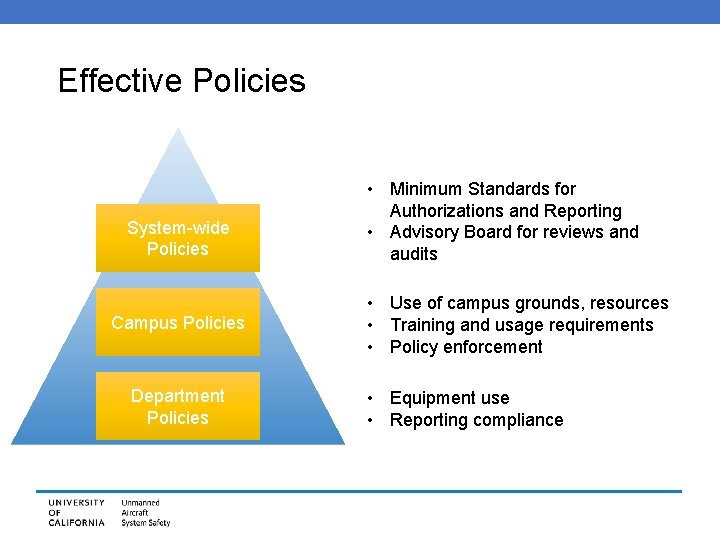
Effective Policies System-wide Policies Campus Policies Department Policies • Minimum Standards for Authorizations and Reporting • Advisory Board for reviews and audits • Use of campus grounds, resources • Training and usage requirements • Policy enforcement • Equipment use • Reporting compliance
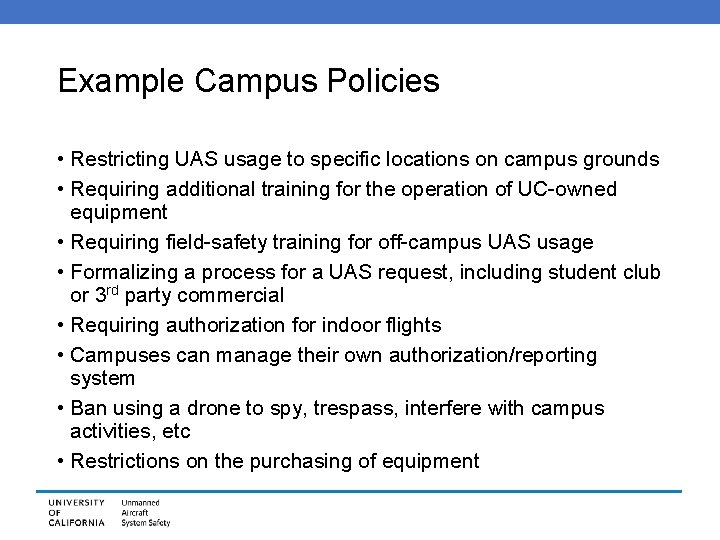
Example Campus Policies • Restricting UAS usage to specific locations on campus grounds • Requiring additional training for the operation of UC-owned equipment • Requiring field-safety training for off-campus UAS usage • Formalizing a process for a UAS request, including student club or 3 rd party commercial • Requiring authorization for indoor flights • Campuses can manage their own authorization/reporting system • Ban using a drone to spy, trespass, interfere with campus activities, etc • Restrictions on the purchasing of equipment
What isn’t allowed • Policies cannot waive federal regulations • All non-recreational UAS activity requires a license • Campus policy cannot ban all drones from flying over campus • Only the FAA can regulate airspace. Campus can ban the operation of drones on campus grounds, or ban drones from taking off/landing on campus grounds • Requiring additional equipment for any aircraft in the airspace above campus • Campus can require equipment for drones that are operated on campus grounds
Compliance The FAA requires that the (1) remote pilot in command, (2) owner, or (3) person manipulating the flight controls make available to the FAA, upon request, (1) Remote Pilot Certificate with small UAS Rating (2) Any document, record, or report on (a) Aircraft registration (b) Flight records (c) Incident reports (d) Deviation from regulations (e) Authorization from ATC (as appropriate) (f) Waiver from specific provisions (as appropriate)
Compliance The FAA requires that the (1) remote pilot in command, (2) owner, (3) person manipulating the flight controls , or (4) visual observer To allow the FAA, upon request, to test or inspect (1) The SUAS (2) The remote pilot in command (3) The person manipulating the flight controls (4) The visual observer
Compliance The FAA requires that the remote pilot in command to file a report to the FAA within 10 days of any incident that causes (1) Serious injury to any person or any loss of consciousness (2) Damage to any property, other than the SUAS, greater than $500
UC Policy Compliance • Requires compliance with FAA regulations • Requires compliance with UC Insurance Policy • Includes • Prior authorization • Campuses may manage their own authorization/reporting system • Operate in a manner that ensures public safety, right to privacy, civil rights and civil liberties
UC Insurance Compliance • Automatic coverage for UC-owned aircraft • • Under 55 lbs Flight operations are within line of sight Flight operations are below 400 ft For official UC-business (including research) • Any UAS’s that do not meet these criteria must be approved by the underwriter before they can be covered.
Means for Reporting Compliance • UC Risk Services is developing a systemwide resource for authorizations and reporting • Until its active, there are temporary forms available at uassafety. ucmerced. edu
UAS Safety Management System Safety Policies establish the organizational hierarchy and responsibilities at each level. They establish oversight requirements and processes to meet safety goals Safety Assurance Safety Risk Management Provides a workflow for a formal process to describe the system, identify hazards, assess risk, and control/minimize risk. Safety Promotion Educational outreach on UAS policies and FAA regulations, training on UAS Risk Management and Safety Assurance. Developing a safety culture at all levels of UAS operations. Enable the evaluation of the effectiveness of risk management strategies and ensure compliance with other oversight entities, including the FAA, the Center, and OPRM.
Safety Promotion • UC Center of Excellence on UAS Safety • Production of UC UAS Fleet Management System • Yearly visits to campuses • Two UAS listservs – • UC-UAS-EHS-L for EH&S, Risk and Campus Safety • UC-UAS-RESEARCH-L for researchers and other end-users • Develop presentations and other resources • Training material and videos
Safety Promotion • Safety must be communicated at all levels • Resources are available for campuses to use, modify and distribute • Recommended Targets • • New Student Orientations Student Club Training Laboratory Safety Training Field Safety Training
UAS Safety Management System Safety Policies establish the organizational hierarchy and responsibilities at each level. They establish oversight requirements and processes to meet safety goals Safety Assurance Safety Risk Management Provides a workflow for a formal process to describe the system, identify hazards, assess risk, and control/minimize risk. Safety Promotion Educational outreach on UAS policies and FAA regulations, training on UAS Risk Management and Safety Assurance. Developing a safety culture at all levels of UAS operations. Enable the evaluation of the effectiveness of risk management strategies and ensure compliance with other oversight entities, including the FAA, the Center, and OPRM.
Expect a flood of UAS activity! It will come from all sides • Researchers • Student Clubs • Campus Staff • Facility Management • Visitors
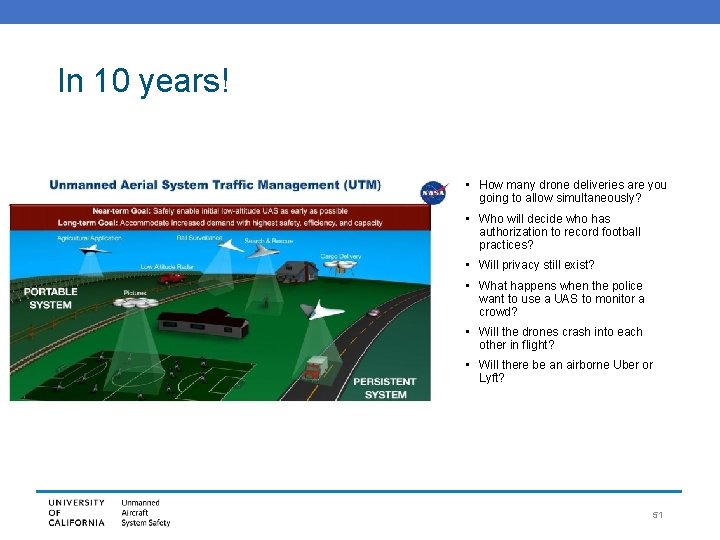
In 10 years! • How many drone deliveries are you going to allow simultaneously? • Who will decide who has authorization to record football practices? • Will privacy still exist? • What happens when the police want to use a UAS to monitor a crowd? • Will the drones crash into each other in flight? • Will there be an airborne Uber or Lyft? 51
Questions? Email: bstark 2@ucmerced. edu UASSafety@ucmerced. edu http: //tinyurl. com/UC-UAS-COE http: //uassafety. ucmerced. edu/ Facebook page: https: //www. facebook. com/UC. UAS. Safety/ Phone: (209) 201 - 2051 Please sign up for the UC UAS Listserves if you’d like to be kept in the loop of the latest developments Other Presentations: Drones in the UC System SUAS Remote Pilot Certificate Exam Drones for Student Clubs Drones for Researchers Drones for Staff 52