
The University Of Birmingham HOW CAN CULTURAL COMPETENCE
The University Of Birmingham HOW CAN CULTURAL COMPETENCE BE ASSESSED? BY MEL STEWART The School of HEALTH SCIENCES
Objectives To • Investigate the notion of cultural competence • Examine ways which attempt to measure cultural competence • Share the experiences of undergraduates engaged in the self-assessment of cultural competence • Discuss institutional approaches in managing cultural competence The School of HEALTH SCIENCES
What is Cultural Competence? • Cultural Sensitivity • Cultural diversity • Political correctness The School of HEALTH SCIENCES
Common Definitions • 'a set of congruent behaviours, attitudes and policies that come together in a system agency or among professionals that enables effective work in cross-cultural situations. ' (HHSOMH 2000). Chandra (1996) in 'Facing up to Difference - A toolkit for creating culturally competent health services for black and minority communities' • ‘denote services perceived by black and minority ethnic users as being in harmony with their cultural and religious beliefs and not just provided by people who are, or assumed to be ‘culturally sensitive. ’ The School of HEALTH SCIENCES
Elements of Cultural Competence The School of HEALTH SCIENCES
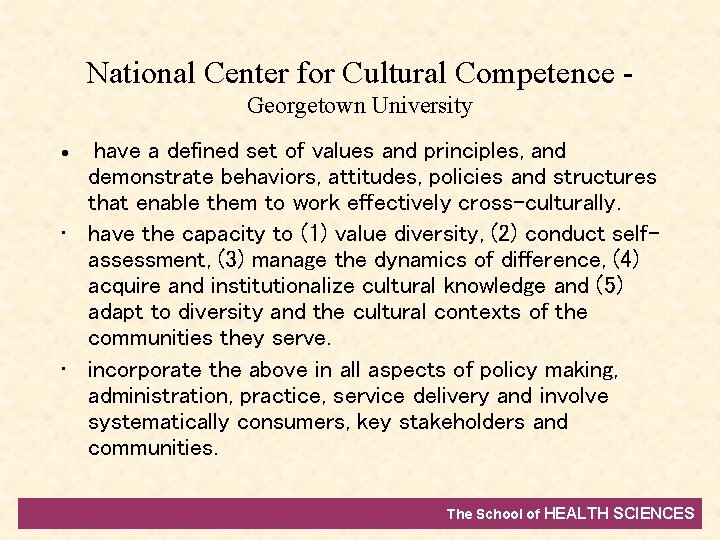
National Center for Cultural Competence Georgetown University have a defined set of values and principles, and demonstrate behaviors, attitudes, policies and structures that enable them to work effectively cross-culturally. • have the capacity to (1) value diversity, (2) conduct selfassessment, (3) manage the dynamics of difference, (4) acquire and institutionalize cultural knowledge and (5) adapt to diversity and the cultural contexts of the communities they serve. • incorporate the above in all aspects of policy making, administration, practice, service delivery and involve systematically consumers, key stakeholders and communities. • The School of HEALTH SCIENCES
Method • The study employed a repertory grid approach • The repertory grid is a formal way of demonstrating the mathematical relationship between specific constructs (these are normally given as adjectives), and elements – the people construing them. The School of HEALTH SCIENCES
Repertory Grid of Cultural Competence The School of HEALTH SCIENCES

Repertory Grid Clinical Competence The School of HEALTH SCIENCES
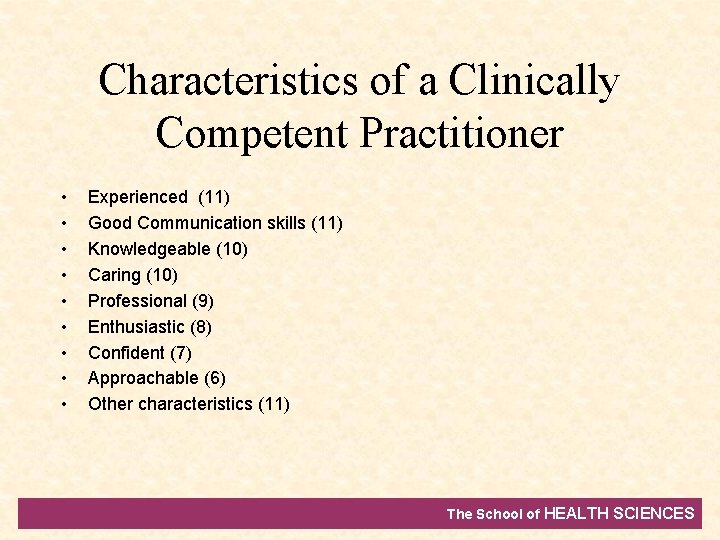
Characteristics of a Clinically Competent Practitioner • • • Experienced (11) Good Communication skills (11) Knowledgeable (10) Caring (10) Professional (9) Enthusiastic (8) Confident (7) Approachable (6) Other characteristics (11) The School of HEALTH SCIENCES
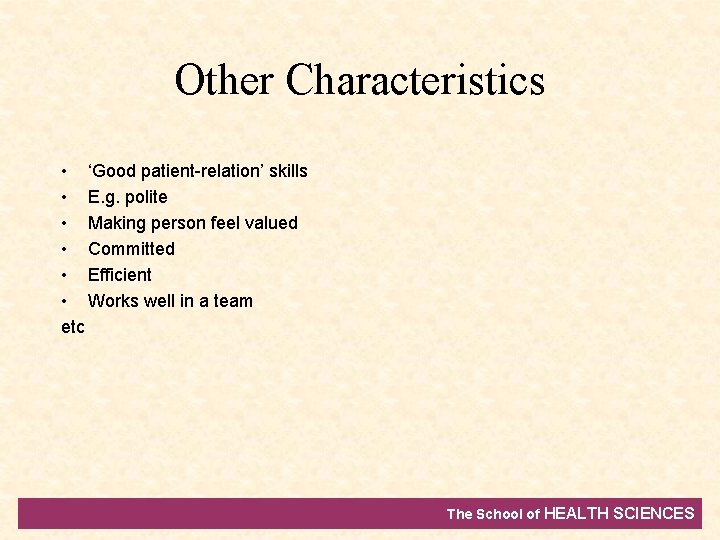
Other Characteristics • ‘Good patient-relation’ skills • E. g. polite • Making person feel valued • Committed • Efficient • Works well in a team etc The School of HEALTH SCIENCES
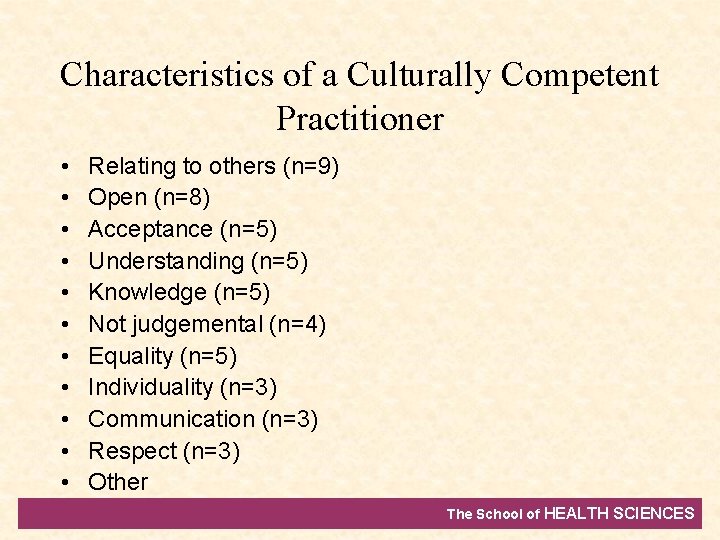
Characteristics of a Culturally Competent Practitioner • • • Relating to others (n=9) Open (n=8) Acceptance (n=5) Understanding (n=5) Knowledge (n=5) Not judgemental (n=4) Equality (n=5) Individuality (n=3) Communication (n=3) Respect (n=3) Other The School of HEALTH SCIENCES
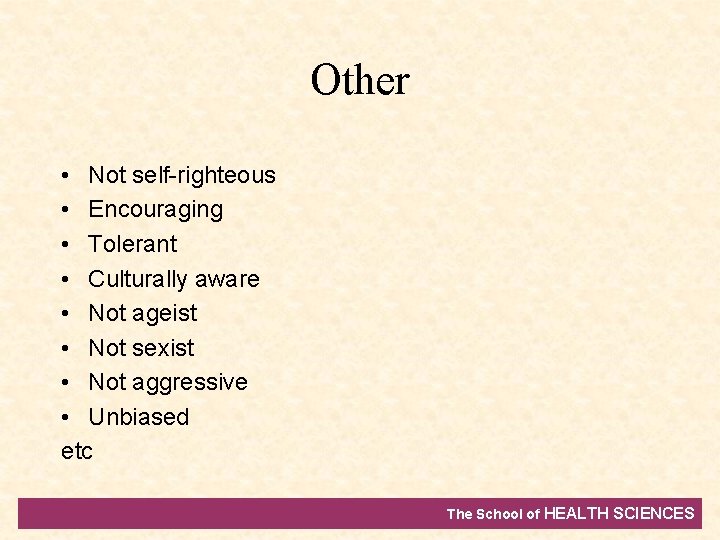
Other • Not self-righteous • Encouraging • Tolerant • Culturally aware • Not ageist • Not sexist • Not aggressive • Unbiased etc The School of HEALTH SCIENCES
Suggestions for increasing cultural competence • • • increasing the numbers of underrepresented minorities in the health professions and health care leadership understanding and managing socio-culturally based variations in health beliefs, values, and behaviours Enhance professional education in cultural diversity interaction Efforts should be made to know about, an avoid behaviours that might be offensive, impractical or irrelevant Updating education in cultural diversity The School of HEALTH SCIENCES
Factors contributing to the Development of Cultural Competence in Undergraduate Health Care Curricula • • • Awareness and acceptance of the wide range of cultural diversity (in developing systems of care) The acquisition of knowledge of cultural differences and similarities and knowledge of client’s culture Knowledge of one’s own cultural values and identity Ability to communicate effectively across cultural groups Utilisation of knowledge to adapt services and skills The development of a lifelong learning and reflection that includes the examination of attitudes and values of cultural groups (Stewart 2002) The School of HEALTH SCIENCES
Discussion Institutional approaches in developing and managing cultural competence The School of HEALTH SCIENCES
References • Chandra, J (1996). Facing up to Difference. A Toolkit for creating culturally competent health services for black and minority ethnic communities. King’s Fund, London. • U. S. Department of Health and Human Services, Office of Minority Health, Resources for Cross Cultural Health Care. (2000). Assuring Cultural Competence in Health Care: Recommendations for National Standards and an Outcomes-Focused Research Agenda. • Joseph R. Betancourt, Alexander R. Green, J. Emilio Carrillo and Owusu Ananeh. Firempong (2003) Defining cultural competence: a practical framework for addressing racial/ethnic disparities in health and health care Public Health Reports, Volume 118, Issue 4, Pages 293 -302 • Niemeir JP, Burnett DM, Whitaker DA (2003) Cultural Competence in a the Multidisciplinary rehabilitation Setting: Are we falling short in meeting needs? Archivives of Physical and Medical Rehabilitation Vol 84, Pages 1241 -1245 • Stewart M (2002) The Development of Cultural Competence in Health Care Undergraduates Physiotherapy Vol. 88, No. 10. p 620 -29 • http: //www 3. georgetown. edu/research/gucchd/nccc/framework. html#lc The School of HEALTH SCIENCES
- Slides: 17