
The Universe How was it formed How old
- Slides: 14
The Universe How was it formed? How old is it? What does the future hold?
What is the universe? The sum of all matter and energy that exists, that has ever existed, and that will ever exist
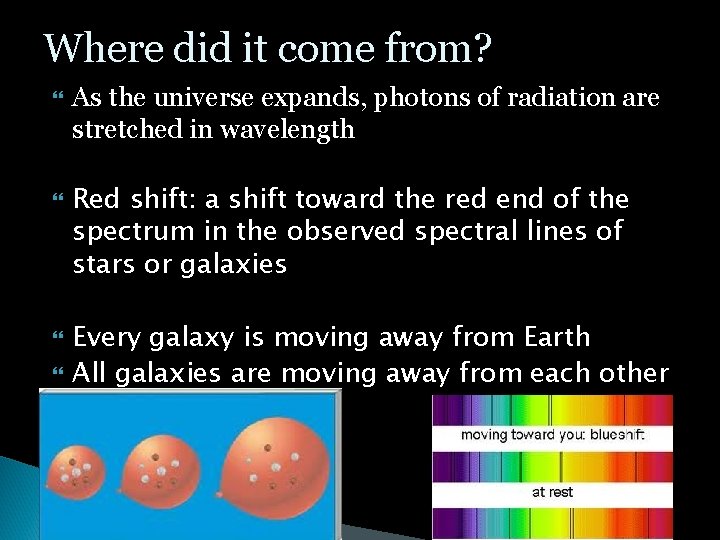
Where did it come from? As the universe expands, photons of radiation are stretched in wavelength Red shift: a shift toward the red end of the spectrum in the observed spectral lines of stars or galaxies Every galaxy is moving away from Earth All galaxies are moving away from each other
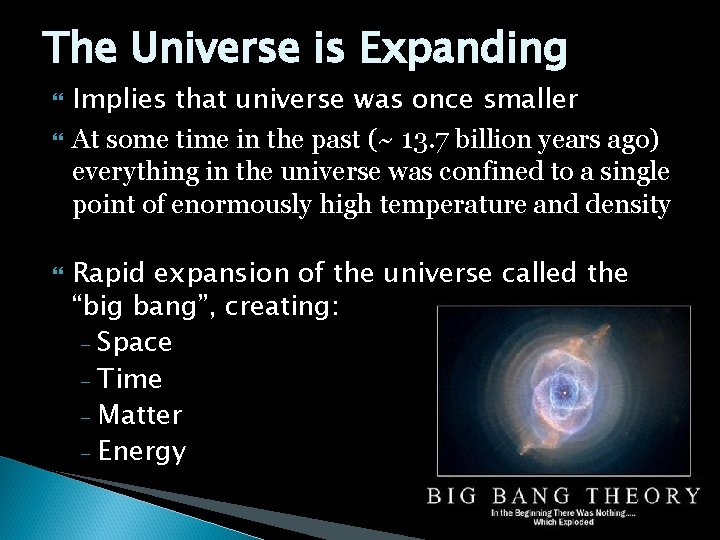
The Universe is Expanding Implies that universe was once smaller At some time in the past (~ 13. 7 billion years ago) everything in the universe was confined to a single point of enormously high temperature and density Rapid expansion of the universe called the “big bang”, creating: - Space - Time - Matter - Energy
A few notes on expansion There is no “center” or “edge” to the expansion The universe is not expanding into space, it is creating space Galaxies are not flying apart into the rest of the universe, they are just along for the ride
Cosmic Background Radiation Theory that the expansion of matter and energy should still be detectable today as microwave radiation. Radiation is any way in which energy is transmitted through space from one point to another without the need of a physical connection Overall temperature of universe about 2. 7 K Also, Gamma ray → X ray → ultraviolet → radio Using a large antenna, a background “hiss” is detectable at any time filling all space
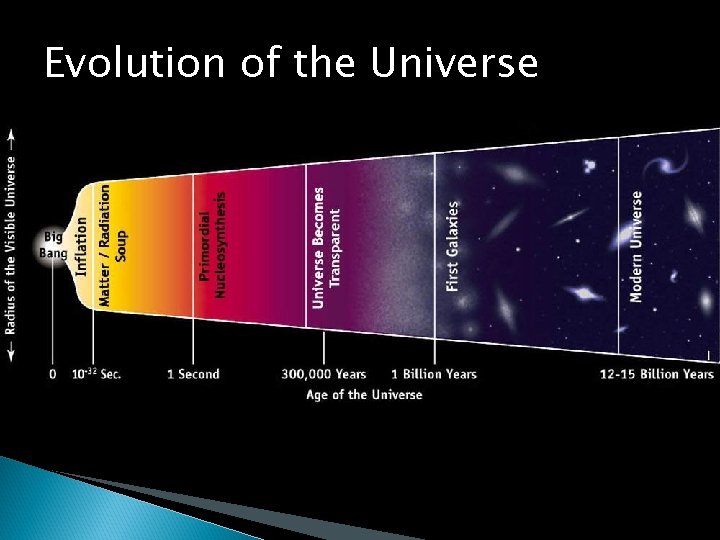
Evolution of the Universe After a few seconds: expansion cooled the universe enough for protons, neutrons and electrons to form After a million years: hydrogen atoms form Hydrogen fuels stars Galaxies and planets followed soon after
Evolution of the Universe
How old is the universe? Using the Hubble Constant (rate of universal expansion), best current estimate is: 13. 7 ± 0. 13 billion years
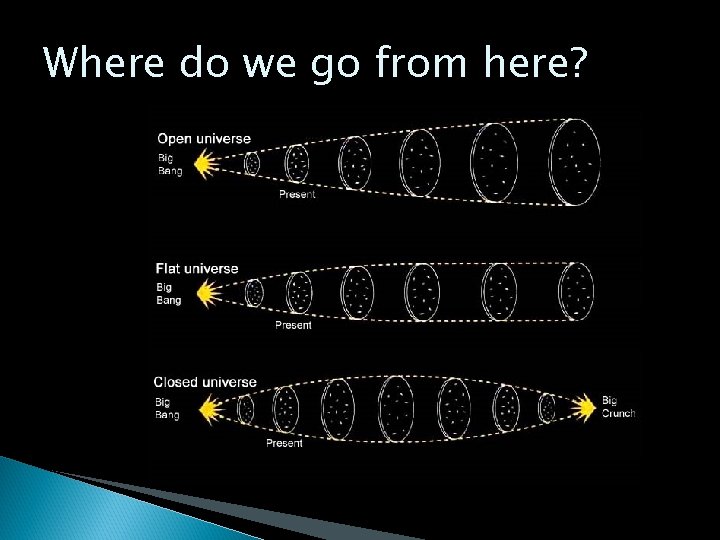
Where do we go from here? Still expanding, but maybe not forever Combined gravity of all the mass in universe also pulling it inward, in direction opposite of expansion
Where do we go from here?
Depends on mass Small amount of mass = universe expands forever Moderate amount of mass = expansion continues at a slower rate Large amount of mass = universe will contract, eventually collapsing back on itself
Measuring Distance in Space Astronomical Unit (A. U. ): average distance between Earth and the Sun o 1 A. U. = 1. 5 x 10⁸ km Speed of Light: the fastest possible speed o = 299, 792 km/s (670, 616, 629 mph) Light-year: the distance that light travels in one year o 1 ly = 9. 46 x 1012 km (6 trillion miles)
Viewing Objects in Space We see the universe now as it was in the past The further away a celestial body is, the older the light we get from that object Light that comes from the sun takes more than 8 minutes to get to Earth