
The United States Senate Above is the House

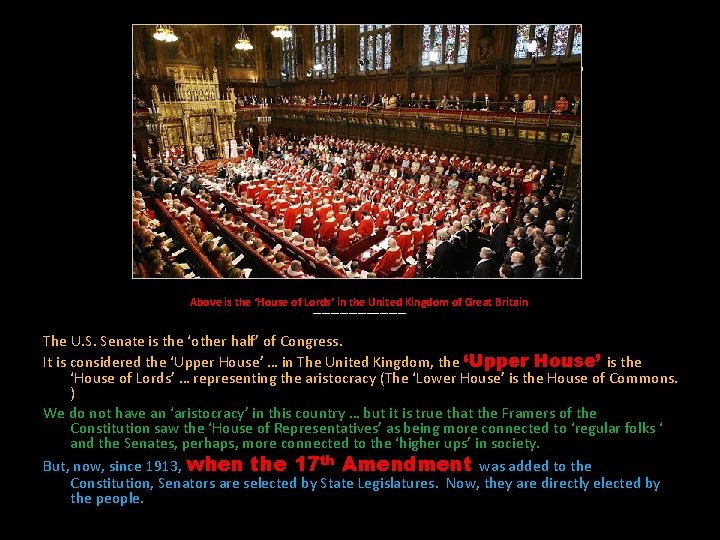
The United States Senate Above is the ‘House of Lords’ in the United Kingdom of Great Britain ~~~~~~~~~~~ The U. S. Senate is the ‘other half’ of Congress. It is considered the ‘Upper House’ … in The United Kingdom, the ‘Upper House’ is the ‘House of Lords’ … representing the aristocracy (The ‘Lower House’ is the House of Commons. ) We do not have an ‘aristocracy’ in this country … but it is true that the Framers of the Constitution saw the ‘House of Representatives’ as being more connected to ‘regular folks ‘ and the Senates, perhaps, more connected to the ‘higher ups’ in society. But, now, since 1913, when the 17 th Amendment was added to the Constitution, Senators are selected by State Legislatures. Now, they are directly elected by the people.
![The 110 th U. S. Senate [2009 -2011]](http://slidetodoc.com/presentation_image_h2/474adfce94912477a74a640d9870b46e/image-3.jpg "The 110 th U. S. Senate [2009 -2011]")
The 110 th U. S. Senate [2009 -2011]
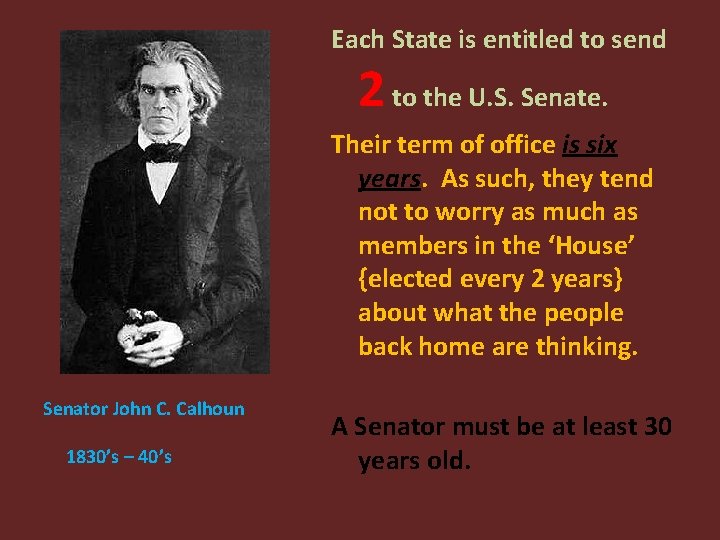
Each State is entitled to send 2 to the U. S. Senate. Their term of office is six years. As such, they tend not to worry as much as members in the ‘House’ {elected every 2 years} about what the people back home are thinking. Senator John C. Calhoun 1830’s – 40’s A Senator must be at least 30 years old.
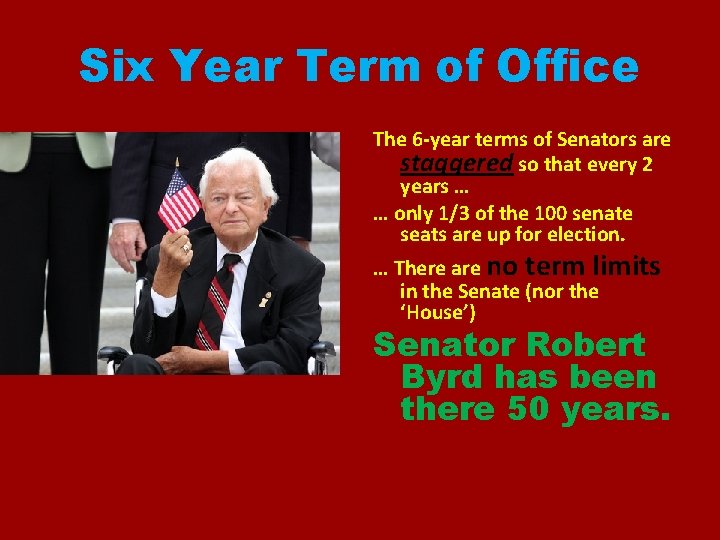
Six Year Term of Office The 6 -year terms of Senators are staggered so that every 2 years … … only 1/3 of the 100 senate seats are up for election. … There are no term limits in the Senate (nor the ‘House’) Senator Robert Byrd has been there 50 years.
![Oklahoma’s 2 Senators [All U. S. Senators have a website at senate. gov] James](http://slidetodoc.com/presentation_image_h2/474adfce94912477a74a640d9870b46e/image-6.jpg "Oklahoma’s 2 Senators [All U. S. Senators have a website at senate. gov] James")
Oklahoma’s 2 Senators [All U. S. Senators have a website at senate. gov] James Inhofe –Republican http: //inhofe. senate. gov/public/ Tom Coburn – Republican http: //coburn. senate. gov/pub lic/
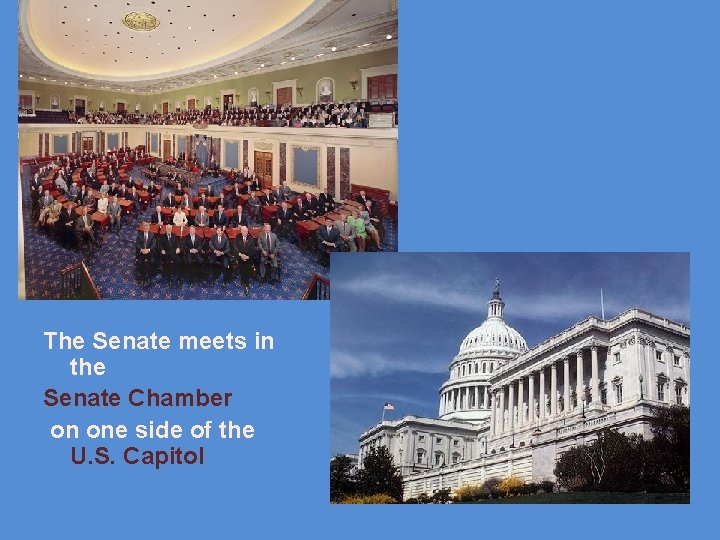
The Senate meets in the Senate Chamber on one side of the U. S. Capitol
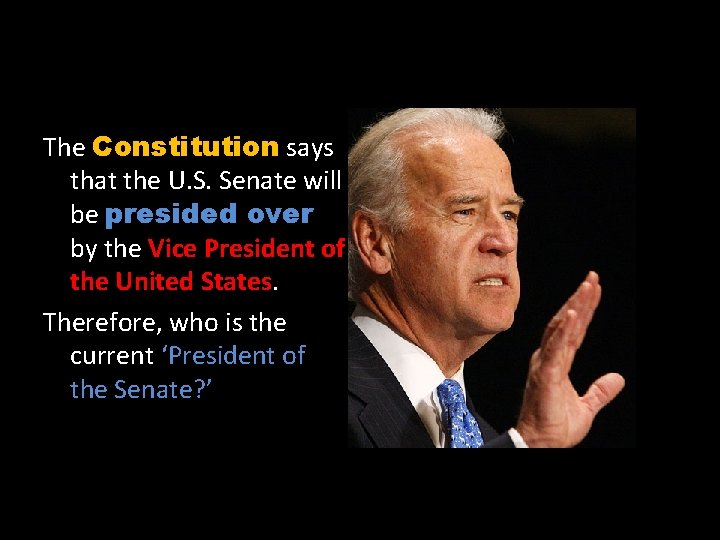
The Constitution says that the U. S. Senate will be presided over by the Vice President of the United States. Therefore, who is the current ‘President of the Senate? ’
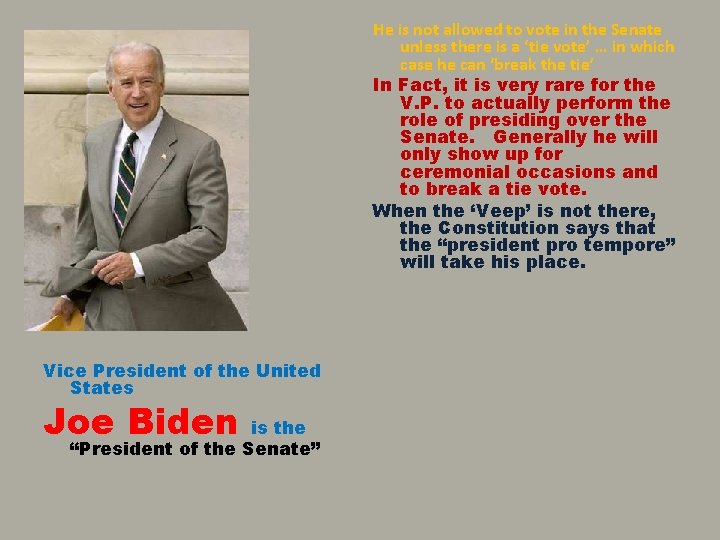
He is not allowed to vote in the Senate unless there is a ‘tie vote’ … in which case he can ‘break the tie’ In Fact, it is very rare for the V. P. to actually perform the role of presiding over the Senate. Generally he will only show up for ceremonial occasions and to break a tie vote. When the ‘Veep’ is not there, the Constitution says that the “president pro tempore” will take his place. Vice President of the United States Joe Biden is the “President of the Senate”
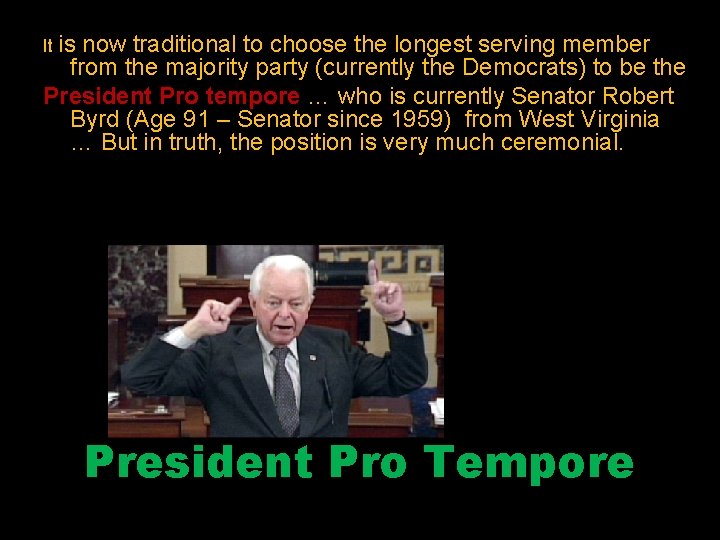
It is now traditional to choose the longest serving member from the majority party (currently the Democrats) to be the President Pro tempore … who is currently Senator Robert Byrd (Age 91 – Senator since 1959) from West Virginia … But in truth, the position is very much ceremonial. President Pro Tempore
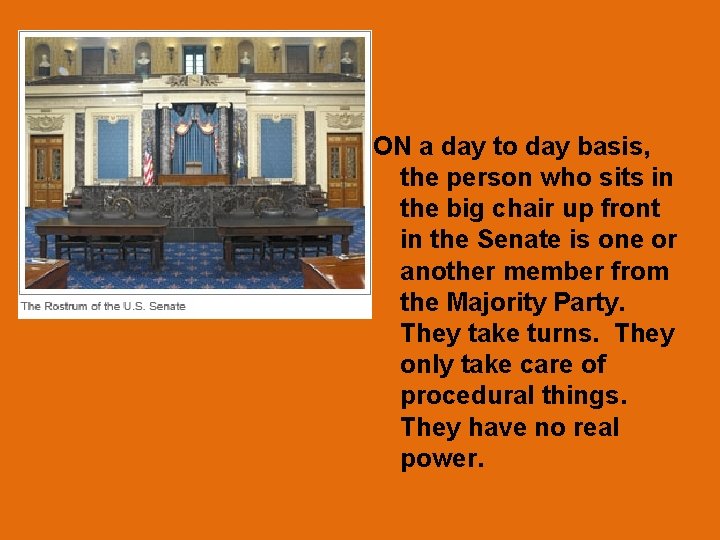
ON a day to day basis, the person who sits in the big chair up front in the Senate is one or another member from the Majority Party. They take turns. They only take care of procedural things. They have no real power.
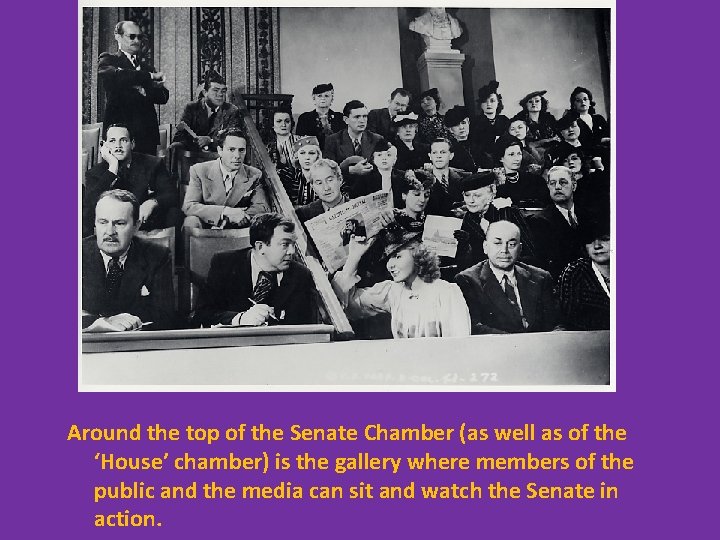
Around the top of the Senate Chamber (as well as of the ‘House’ chamber) is the gallery where members of the public and the media can sit and watch the Senate in action.
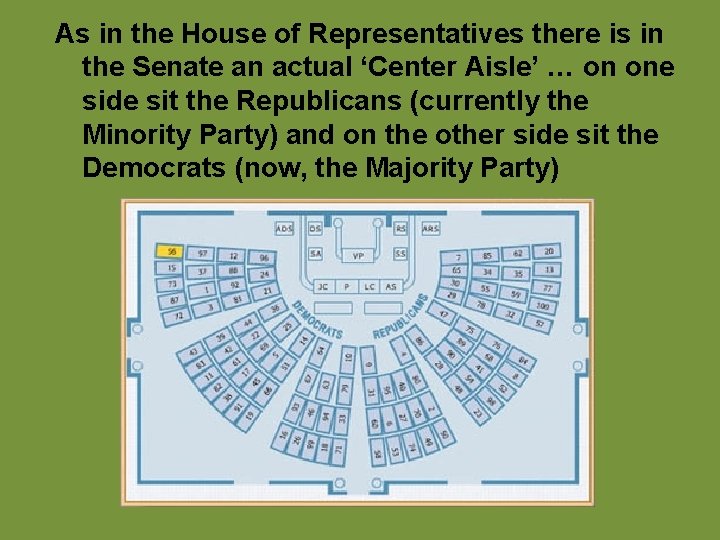
As in the House of Representatives there is in the Senate an actual ‘Center Aisle’ … on one side sit the Republicans (currently the Minority Party) and on the other side sit the Democrats (now, the Majority Party)
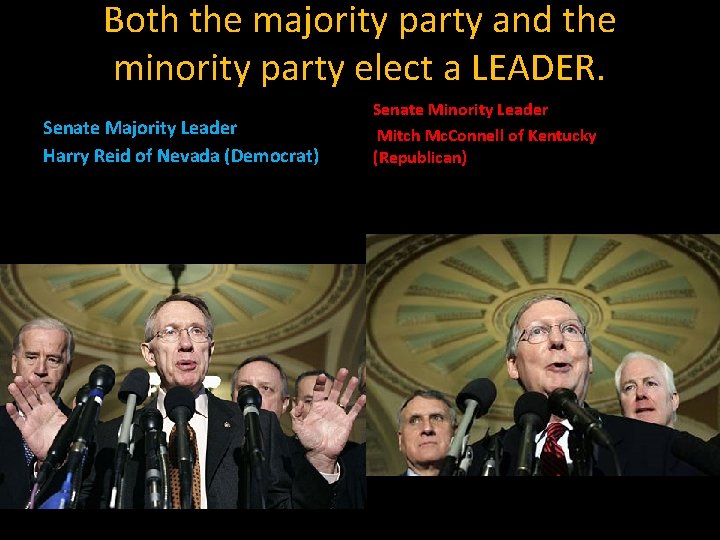
Both the majority party and the minority party elect a LEADER. Senate Majority Leader Harry Reid of Nevada (Democrat) Senate Minority Leader Mitch Mc. Connell of Kentucky (Republican)
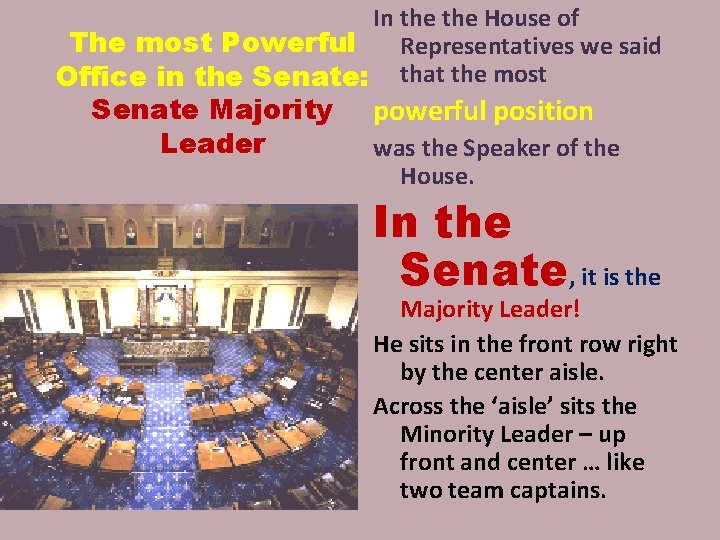
In the House of The most Powerful Representatives we said Office in the Senate: that the most Senate Majority Leader powerful position was the Speaker of the House. In the Senate, it is the Majority Leader! He sits in the front row right by the center aisle. Across the ‘aisle’ sits the Minority Leader – up front and center … like two team captains.
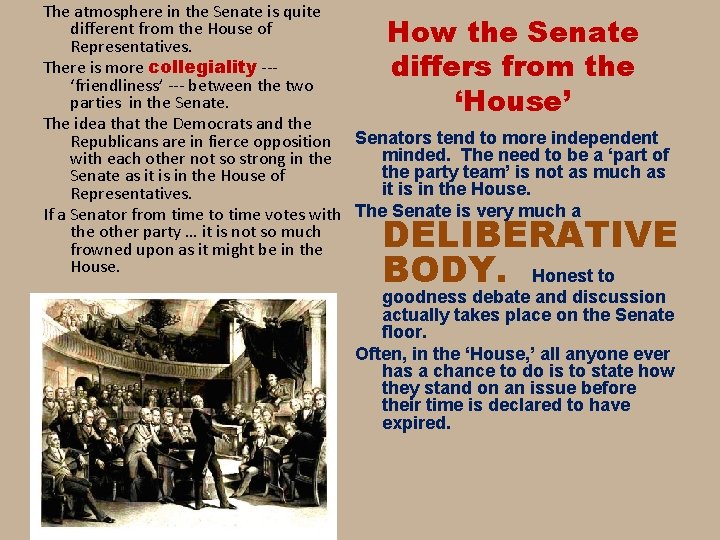
The atmosphere in the Senate is quite different from the House of Representatives. There is more collegiality --‘friendliness’ --- between the two parties in the Senate. The idea that the Democrats and the Republicans are in fierce opposition Senators tend to more independent minded. The need to be a ‘part of with each other not so strong in the party team’ is not as much as Senate as it is in the House of it is in the House. Representatives. If a Senator from time to time votes with The Senate is very much a the other party … it is not so much frowned upon as it might be in the House. Honest to goodness debate and discussion actually takes place on the Senate floor. Often, in the ‘House, ’ all anyone ever has a chance to do is to state how they stand on an issue before their time is declared to have expired. How the Senate differs from the ‘House’ DELIBERATIVE BODY.
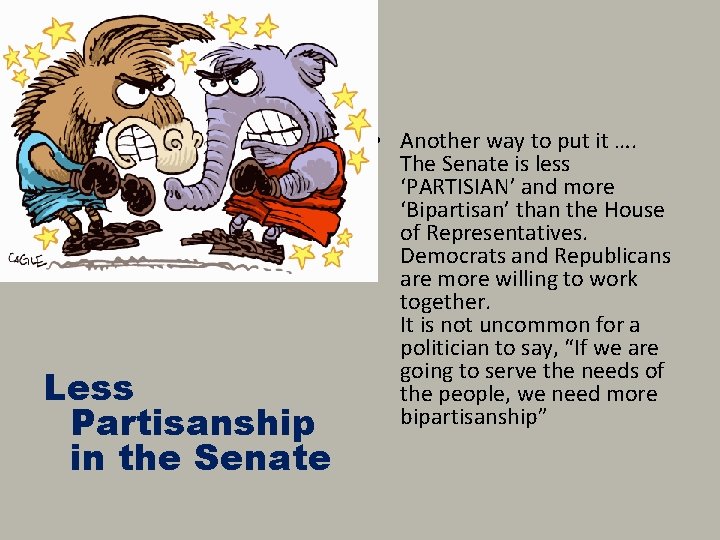
Less Partisanship in the Senate • Another way to put it …. The Senate is less ‘PARTISIAN’ and more ‘Bipartisan’ than the House of Representatives. Democrats and Republicans are more willing to work together. It is not uncommon for a politician to say, “If we are going to serve the needs of the people, we need more bipartisanship”
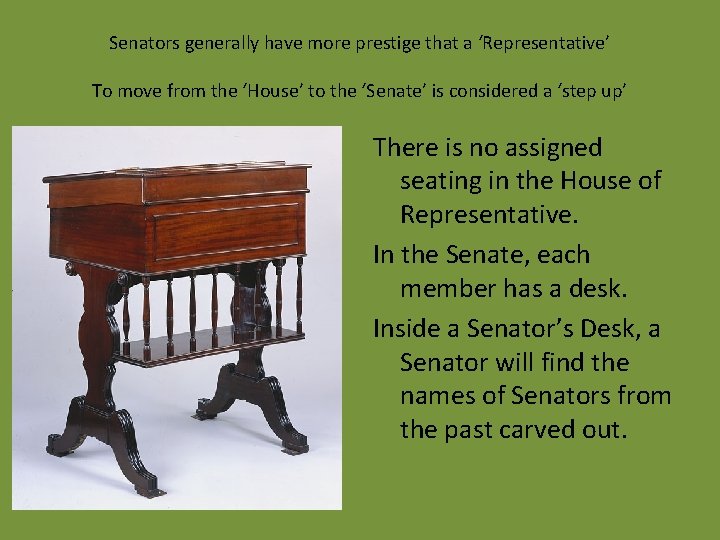
Senators generally have more prestige that a ‘Representative’ To move from the ‘House’ to the ‘Senate’ is considered a ‘step up’ There is no assigned seating in the House of Representative. In the Senate, each member has a desk. Inside a Senator’s Desk, a Senator will find the names of Senators from the past carved out.
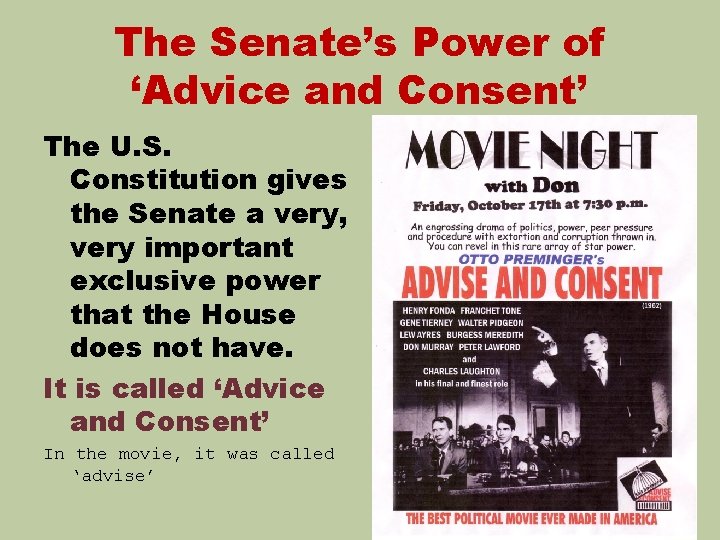
The Senate’s Power of ‘Advice and Consent’ The U. S. Constitution gives the Senate a very, very important exclusive power that the House does not have. It is called ‘Advice and Consent’ In the movie, it was called ‘advise’
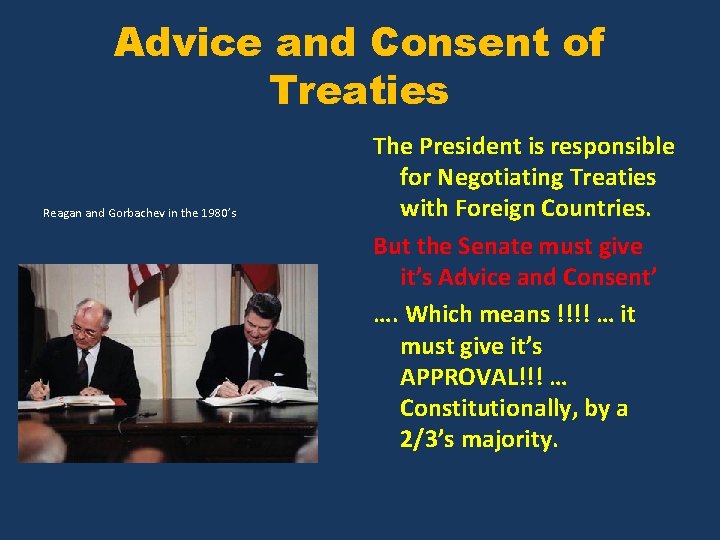
Advice and Consent of Treaties Reagan and Gorbachev in the 1980’s The President is responsible for Negotiating Treaties with Foreign Countries. But the Senate must give it’s Advice and Consent’ …. Which means !!!! … it must give it’s APPROVAL!!! … Constitutionally, by a 2/3’s majority.
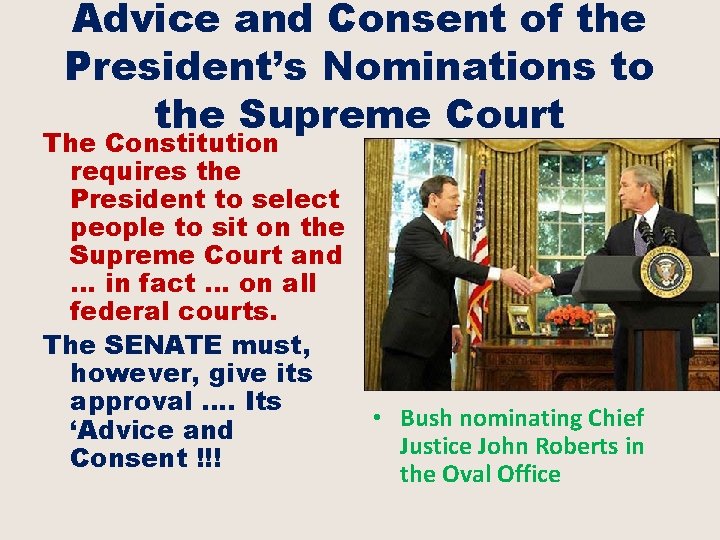
Advice and Consent of the President’s Nominations to the Supreme Court The Constitution requires the President to select people to sit on the Supreme Court and … in fact … on all federal courts. The SENATE must, however, give its approval …. Its ‘Advice and Consent !!! • Bush nominating Chief Justice John Roberts in the Oval Office
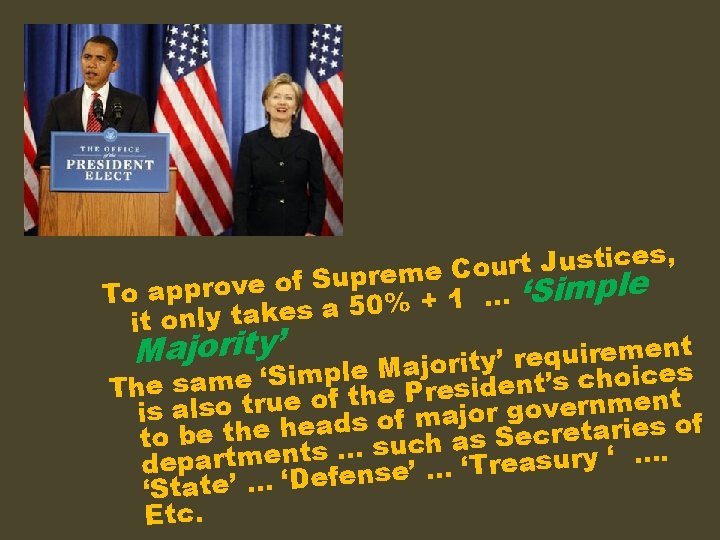
, s e c i t s u J t r u Co e m e r p u S f o e l p m i S ‘ To approve … +1 % 0 5 a s e k a it only t t n e m e r Majority’ i u q e y’ r t i r o j a M e l s p e m c i i S o ‘ h e c m s ’ a t s n e e Th sid e r P e h t f o e is also tru ads of major governmentof to be the hes … such as Secretaries. departmentefense’ … ‘Treasury ‘ … ‘State’ … ‘D Etc.
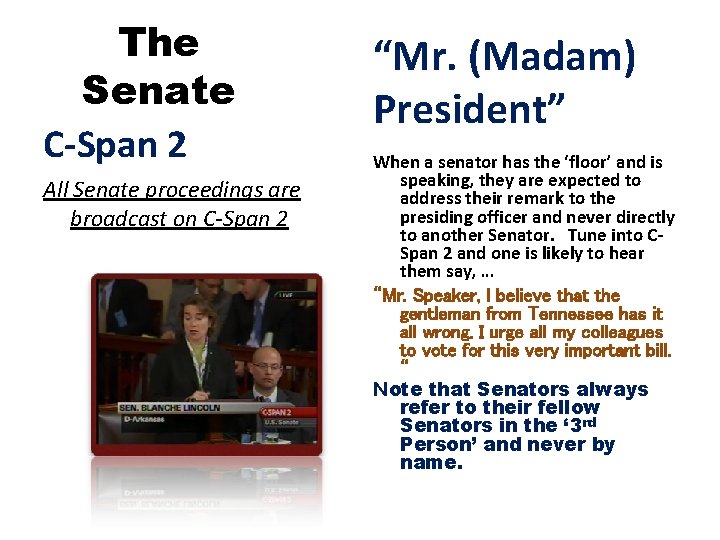
The Senate C-Span 2 All Senate proceedings are broadcast on C-Span 2 “Mr. (Madam) President” When a senator has the ‘floor’ and is speaking, they are expected to address their remark to the presiding officer and never directly to another Senator. Tune into CSpan 2 and one is likely to hear them say, … “Mr. Speaker, l believe that the gentleman from Tennessee has it all wrong. I urge all my colleagues to vote for this very important bill. “ Note that Senators always refer to their fellow Senators in the ‘ 3 rd Person’ and never by name.
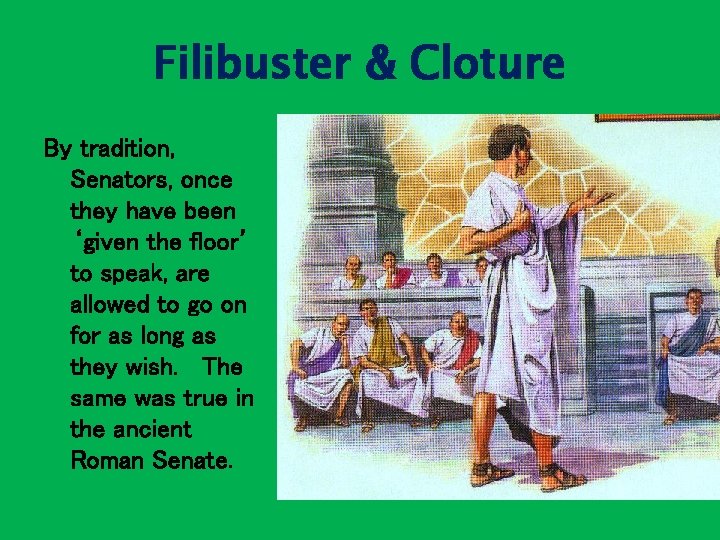
Filibuster & Cloture By tradition, Senators, once they have been ‘given the floor’ to speak, are allowed to go on for as long as they wish. The same was true in the ancient Roman Senate.
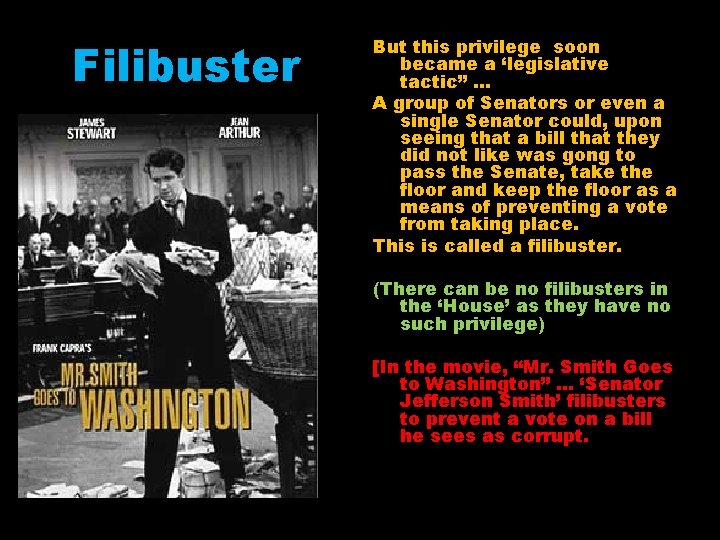
Filibuster But this privilege soon became a ‘legislative tactic” … A group of Senators or even a single Senator could, upon seeing that a bill that they did not like was gong to pass the Senate, take the floor and keep the floor as a means of preventing a vote from taking place. This is called a filibuster. (There can be no filibusters in the ‘House’ as they have no such privilege) [In the movie, “Mr. Smith Goes to Washington” … ‘Senator Jefferson Smith’ filibusters to prevent a vote on a bill he sees as corrupt.
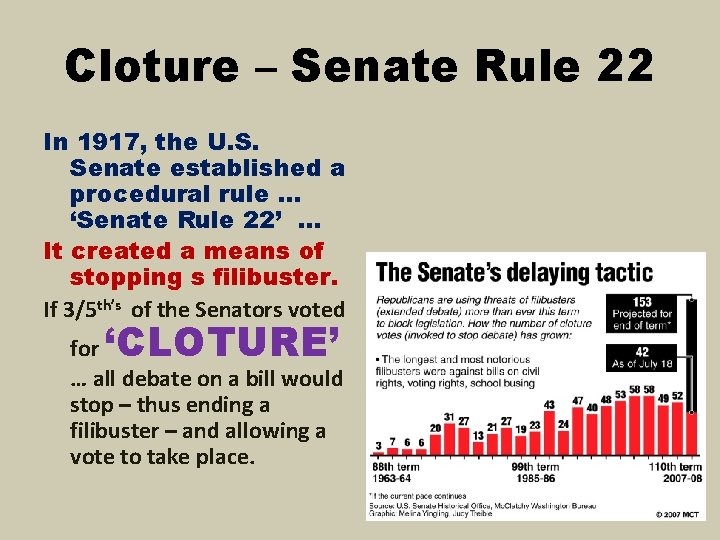
Cloture – Senate Rule 22 In 1917, the U. S. Senate established a procedural rule … ‘Senate Rule 22’ … It created a means of stopping s filibuster. If 3/5 th’s of the Senators voted ‘CLOTURE’ for … all debate on a bill would stop – thus ending a filibuster – and allowing a vote to take place.
The Senate’s ‘Magic Number’ ‘ 60’ So …. What it boils down to is this: In order for anything of any importance to pass the U. S. … there must be 60 votes out of the possible 100. Why? Well, do the math.
The Senate’s ‘Magic Number’ ‘ 60’ *** To stop a FILIBUSTER a Cloture vote must succeed. That requires 3/5 th’s of 100 … That is 60! You can also think of it this 41 way: It only takes Senators to stop any bill.
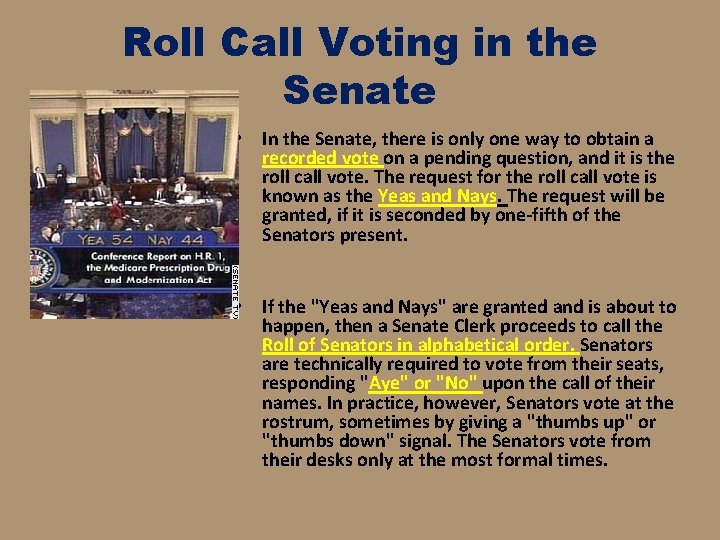
Roll Call Voting in the Senate • In the Senate, there is only one way to obtain a recorded vote on a pending question, and it is the roll call vote. The request for the roll call vote is known as the Yeas and Nays. The request will be granted, if it is seconded by one-fifth of the Senators present. • If the "Yeas and Nays" are granted and is about to happen, then a Senate Clerk proceeds to call the Roll of Senators in alphabetical order. Senators are technically required to vote from their seats, responding "Aye" or "No" upon the call of their names. In practice, however, Senators vote at the rostrum, sometimes by giving a "thumbs up" or "thumbs down" signal. The Senators vote from their desks only at the most formal times.
- Slides: 29