
The United States of America The Roaring 20s
- Slides: 11
The United States of America The Roaring 20’s
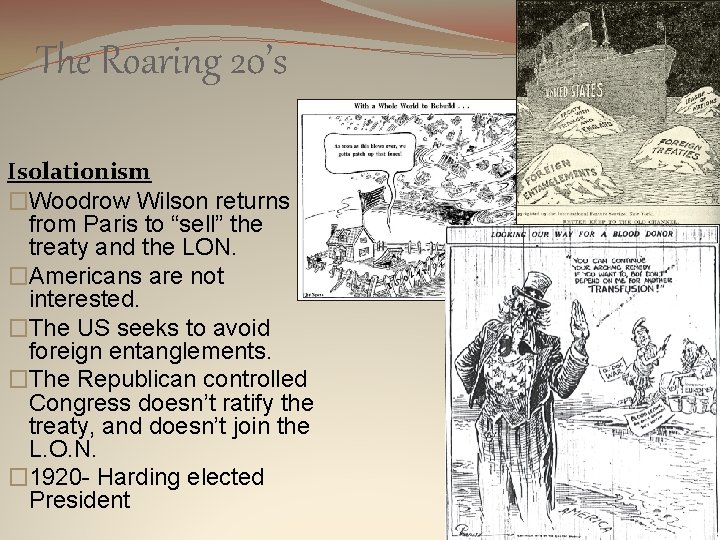
The Roaring 20’s Isolationism �Woodrow Wilson returns from Paris to “sell” the treaty and the LON. �Americans are not interested. �The US seeks to avoid foreign entanglements. �The Republican controlled Congress doesn’t ratify the treaty, and doesn’t join the L. O. N. � 1920 - Harding elected President
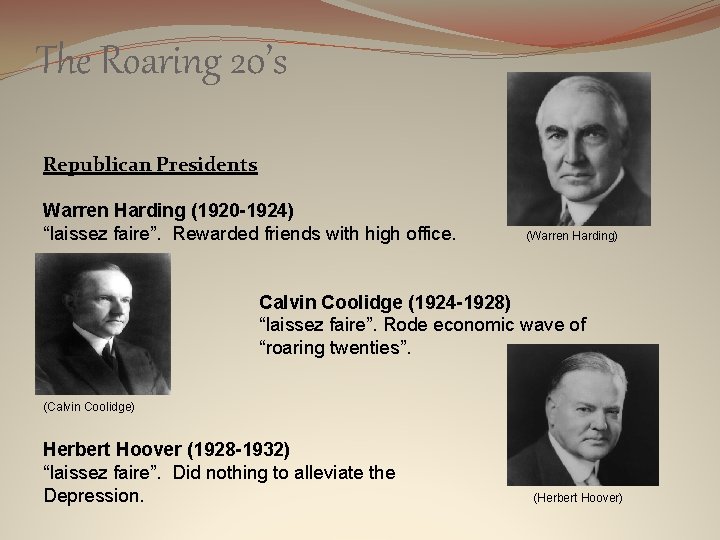
The Roaring 20’s Republican Presidents Warren Harding (1920 -1924) “laissez faire”. Rewarded friends with high office. (Warren Harding) Calvin Coolidge (1924 -1928) “laissez faire”. Rode economic wave of “roaring twenties”. (Calvin Coolidge) Herbert Hoover (1928 -1932) “laissez faire”. Did nothing to alleviate the Depression. (Herbert Hoover)
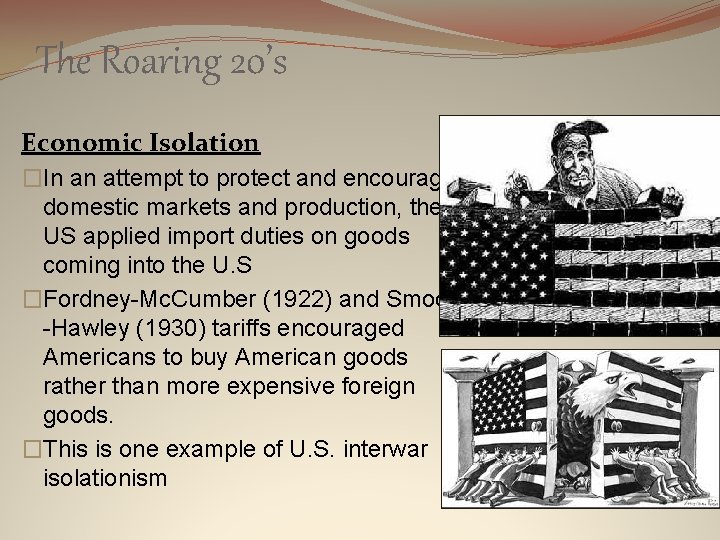
The Roaring 20’s Economic Isolation �In an attempt to protect and encourage domestic markets and production, the US applied import duties on goods coming into the U. S �Fordney-Mc. Cumber (1922) and Smoot -Hawley (1930) tariffs encouraged Americans to buy American goods rather than more expensive foreign goods. �This is one example of U. S. interwar isolationism
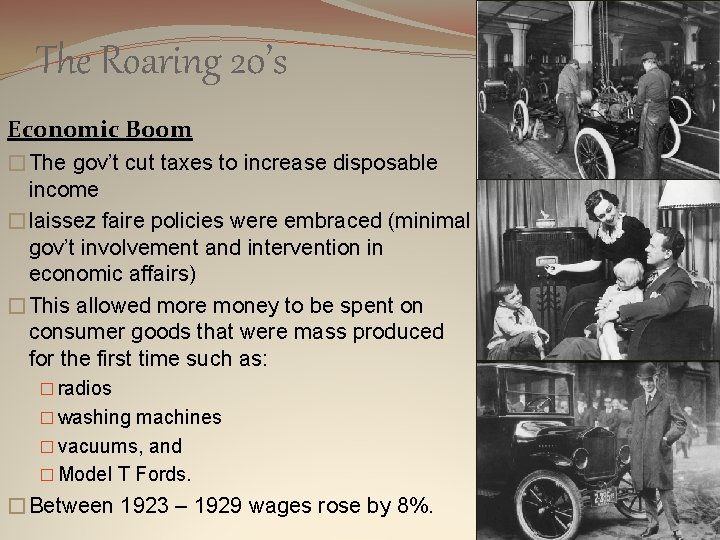
The Roaring 20’s Economic Boom �The gov’t cut taxes to increase disposable income �laissez faire policies were embraced (minimal gov’t involvement and intervention in economic affairs) �This allowed more money to be spent on consumer goods that were mass produced for the first time such as: � radios � washing machines � vacuums, and � Model T Fords. �Between 1923 – 1929 wages rose by 8%.
The Roaring 20’s Economic Warning Signs (not recognized or heeded) �Many bought goods on credit (another 1920’s invention) �This initially helped stimulate the economy as goods continued to sell without money to back up the purchase. �In the 1920’s farmers were overproducing food with new machinery �But they couldn’t sell mass quantities to Europe and other export markets as they enforced retaliatory tariffs.
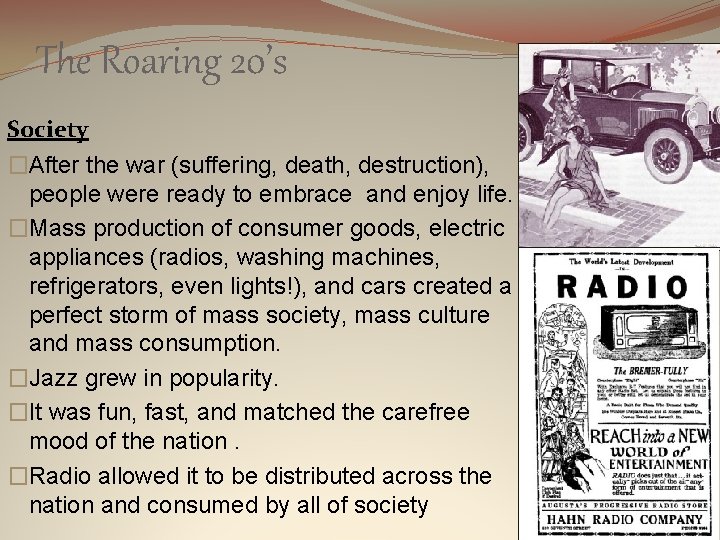
The Roaring 20’s Society �After the war (suffering, death, destruction), people were ready to embrace and enjoy life. �Mass production of consumer goods, electric appliances (radios, washing machines, refrigerators, even lights!), and cars created a perfect storm of mass society, mass culture and mass consumption. �Jazz grew in popularity. �It was fun, fast, and matched the carefree mood of the nation. �Radio allowed it to be distributed across the nation and consumed by all of society
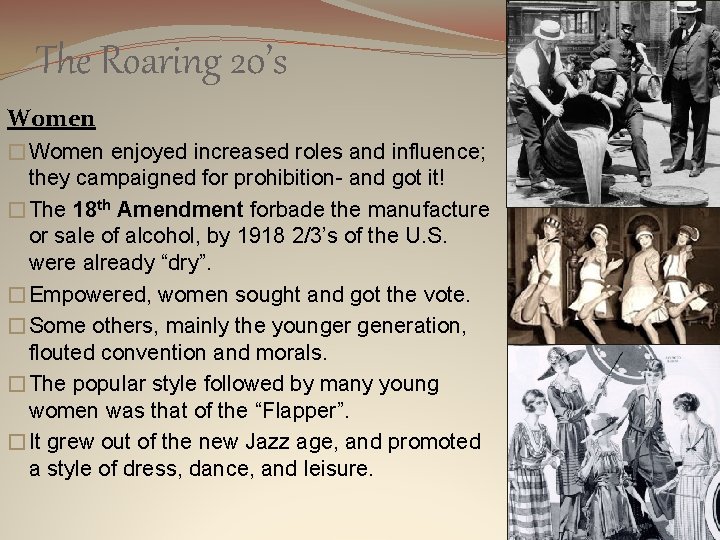
The Roaring 20’s Women �Women enjoyed increased roles and influence; they campaigned for prohibition- and got it! �The 18 th Amendment forbade the manufacture or sale of alcohol, by 1918 2/3’s of the U. S. were already “dry”. �Empowered, women sought and got the vote. �Some others, mainly the younger generation, flouted convention and morals. �The popular style followed by many young women was that of the “Flapper”. �It grew out of the new Jazz age, and promoted a style of dress, dance, and leisure.
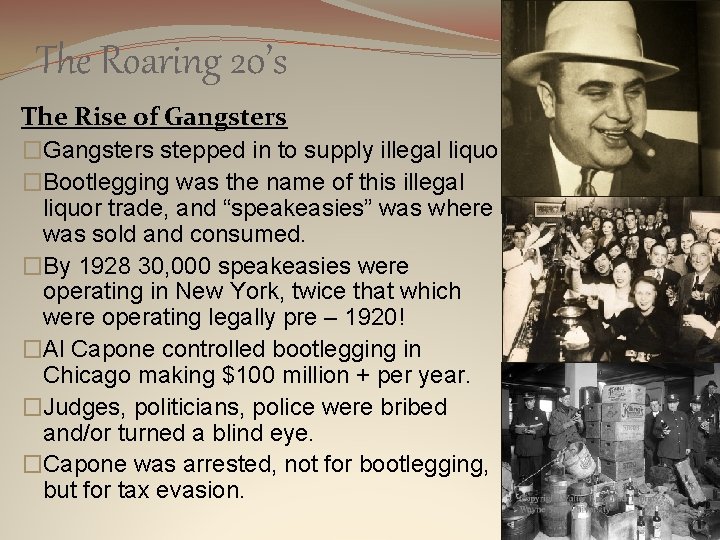
The Roaring 20’s The Rise of Gangsters �Gangsters stepped in to supply illegal liquor. �Bootlegging was the name of this illegal liquor trade, and “speakeasies” was where it was sold and consumed. �By 1928 30, 000 speakeasies were operating in New York, twice that which were operating legally pre – 1920! �Al Capone controlled bootlegging in Chicago making $100 million + per year. �Judges, politicians, police were bribed and/or turned a blind eye. �Capone was arrested, not for bootlegging, but for tax evasion.
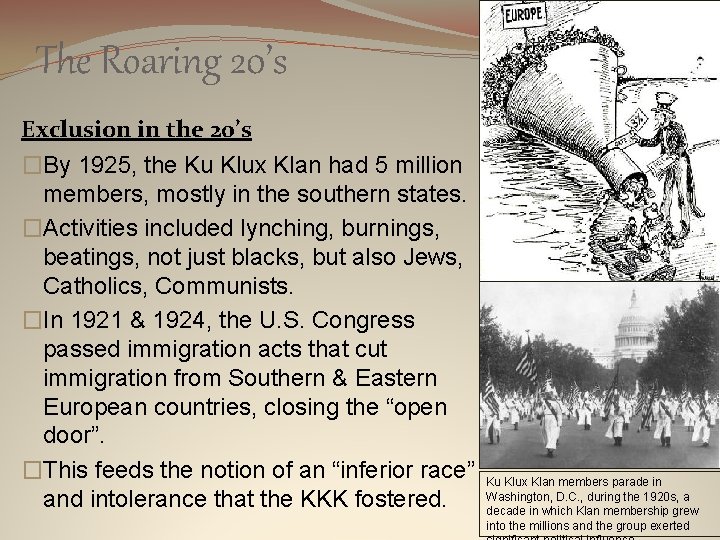
The Roaring 20’s Exclusion in the 20’s �By 1925, the Ku Klux Klan had 5 million members, mostly in the southern states. �Activities included lynching, burnings, beatings, not just blacks, but also Jews, Catholics, Communists. �In 1921 & 1924, the U. S. Congress passed immigration acts that cut immigration from Southern & Eastern European countries, closing the “open door”. �This feeds the notion of an “inferior race” and intolerance that the KKK fostered. Ku Klux Klan members parade in Washington, D. C. , during the 1920 s, a decade in which Klan membership grew into the millions and the group exerted
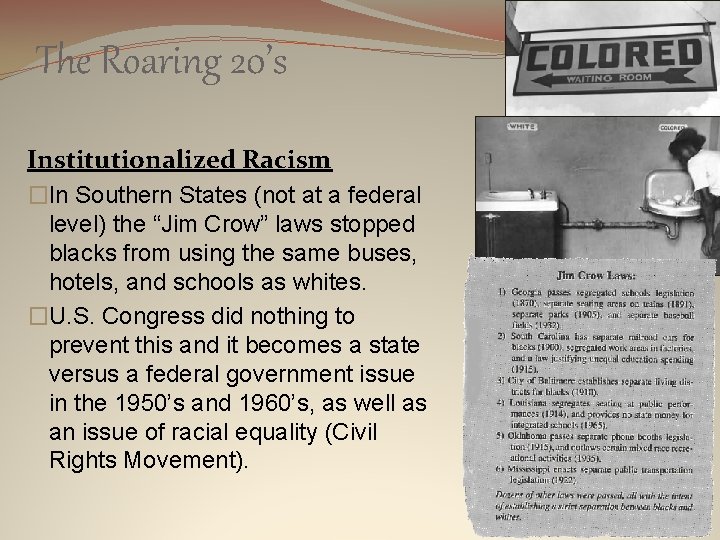
The Roaring 20’s Institutionalized Racism �In Southern States (not at a federal level) the “Jim Crow” laws stopped blacks from using the same buses, hotels, and schools as whites. �U. S. Congress did nothing to prevent this and it becomes a state versus a federal government issue in the 1950’s and 1960’s, as well as an issue of racial equality (Civil Rights Movement).