
The United States Health Care System Combining Business
The United States Health Care System: Combining Business, Health, and Delivery Third Edition Chapter 13 Cultural Competency, Health Literacy, and Health Care Ethics Copyright © 2017, 2012 Pearson Education, Inc. All Rights Reserved
Learning Objectives (1 of 3) 13. 1 Define cultural competency. 13. 2 Describe REALM. 13. 3 Explain the ideal of health literacy. 13. 4 Identify the benefits of health and cultural literacy to the country. Copyright © 2017, 2012 Pearson Education, Inc. All Rights Reserved
Learning Objectives (2 of 3) 13. 5 Assess your own and your family’s health literacy. 13. 6 Discuss and give examples of four health literacy strategies. 13. 7 Discuss ethical issues in cultural competency theories. 13. 8 Identify and describe three major ethical theories. Copyright © 2017, 2012 Pearson Education, Inc. All Rights Reserved
Learning Objectives (3 of 3) 13. 9 Identify four major ethical principles in health care. 13. 10 Discuss the ethical rationale for health care reform. Copyright © 2017, 2012 Pearson Education, Inc. All Rights Reserved
Culture and Health Care (1 of 9) • Culture and cultural values are related to beliefs about health and illness. • Culture is learned and shared by group members. • What you believe, your values, and much of your behavior are culturally determined. Copyright © 2017, 2012 Pearson Education, Inc. All Rights Reserved
Culture and Health Care (2 of 9) • 12 core values of the American culture: – Individualism – Freedom – Democracy – Equality – Achievement and success – Efficiency and practicality Copyright © 2017, 2012 Pearson Education, Inc. All Rights Reserved
Culture and Health Care (3 of 9) – – – Progress Science and technology Material comfort Activity and work Humanitarianism Group superiority Copyright © 2017, 2012 Pearson Education, Inc. All Rights Reserved
Culture and Health Care (4 of 9) • Subcultures – Groups that share many of the elements of mainstream culture, but maintain their own distinctive customs, values, norms, and lifestyles. • Disease and illness occur within a cultural context. Copyright © 2017, 2012 Pearson Education, Inc. All Rights Reserved
Culture and Health Care (5 of 9) • The U. S. has five ethnic minority groups: – Native Americans/Alaskan Native – Hispanics/Latina – Asian – Native Hawaiian – African-American • Our culture influences the way we see the world. Copyright © 2017, 2012 Pearson Education, Inc. All Rights Reserved
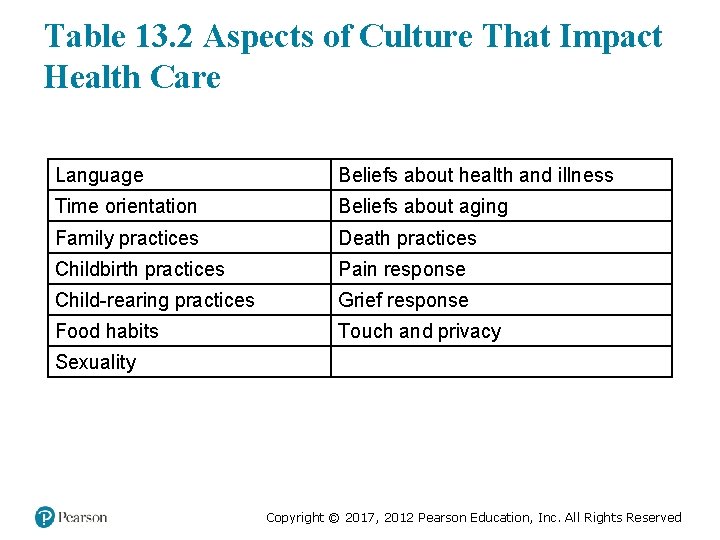
Table 13. 2 Aspects of Culture That Impact Health Care Language Beliefs about health and illness Time orientation Beliefs about aging Family practices Death practices Childbirth practices Pain response Child-rearing practices Grief response Food habits Touch and privacy Sexuality Blank Copyright © 2017, 2012 Pearson Education, Inc. All Rights Reserved
Culture and Health Care (6 of 9) • Ethnocentric – Evaluating others' customs according to values of his or her own cultural group; this can lead to misperceptions and conflict. • Health literacy – The degree to which individuals have the capacity to obtain, process, and understand basic information and services needed to make appropriate decisions about their health Copyright © 2017, 2012 Pearson Education, Inc. All Rights Reserved
Culture and Health Care (7 of 9) • Cultural competence – The ability of health organizations and practitioners to recognize the cultural beliefs, values, attitudes, traditions, language preferences, and health practices of specific cultural groups and to apply that knowledge to produce positive health outcomes Copyright © 2017, 2012 Pearson Education, Inc. All Rights Reserved
Culture and Health Care (8 of 9) • Why Are Cultural Competence and Health Literacy Important? – Health care services that are respectful of and responsive to the health beliefs, practices, and cultural and linguistic needs of diverse patients can help bring about positive health outcomes. – Culture and language may influence: ▪ Health, healing, and wellness belief systems ▪ How illness, disease, and their causes are perceived, both by the patient/consumer and the health care provider ▪ The behaviors of patients/consumers who are seeking health care and their attitudes toward health care providers Copyright © 2017, 2012 Pearson Education, Inc. All Rights Reserved
Culture and Health Care (9 of 9) • How Are Health Care Providers Trained in Cultural Competency and Health Literacy? – Health care providers who are working with specific populations need: ▪ A good orientation to the customs and beliefs of the group ▪ Access to language assistance ▪ A way to rapidly assess health care literacy and appropriate communication tools Copyright © 2017, 2012 Pearson Education, Inc. All Rights Reserved
Tools Used to Assess and Improve Health Literacy • Health Literacy: – Health literacy is not the same thing as regular literacy. – The health care profession has its own language, medical terminology. – Many of the groups are not English language proficient. – REALM ▪ Rapid Estimate of Adult Literacy in Medicine ▪ This tool asks patients to read and pronounce common medical terms Copyright © 2017, 2012 Pearson Education, Inc. All Rights Reserved
Ethical Issues in Health Care (1 of 5) • How does society decide who should get health care benefits and who will be left out? • Health care ethical theories provide a framework to assist patients, health care providers, and policy makers in making ethical decisions. • Ethical issues are those issues in which there are competing values or goods. • In an ethical dilemma, there is always more than one answer. Copyright © 2017, 2012 Pearson Education, Inc. All Rights Reserved
Ethical Issues in Health Care (2 of 5) • Health care ethics addresses large concepts such as: – Respect for autonomy – Nonmaleficency ▪ do no harm – Beneficence ▪ do good – Justice Copyright © 2017, 2012 Pearson Education, Inc. All Rights Reserved
Ethical Issues in Health Care (3 of 5) – Veracity ▪ truth telling – Privacy – Confidentiality – Professional roles Copyright © 2017, 2012 Pearson Education, Inc. All Rights Reserved
Ethical Issues in Health Care (4 of 5) • Autonomy – Self-rule – Requires the health care provider to adhere to the patient's decisions • Nonmaleficency – Requires health care providers not to inflict harm intentionally, or to do no harm Copyright © 2017, 2012 Pearson Education, Inc. All Rights Reserved
Ethical Issues in Health Care (5 of 5) • Beneficence – Requires health care providers to contribute positively to the welfare of others – Do good, not evil • Codes of ethics – Based on a combination of the concepts that health care professionals are held to a higher ethical standard than non-professionals – Demand a certain standard of behavior – Universal principles that are required of health care professionals in every aspect of health care Copyright © 2017, 2012 Pearson Education, Inc. All Rights Reserved
Justice and the Health Care System (1 of 5) • Theories of justice help decide how to distribute fairly the benefits of society. • We cannot just divide health care equally among all citizens because some need more and some don’t need any at all. – Access ▪ As many people as possible should be able to receive health care services. – Quality ▪ The health care services should be of the highest possible quality. – Cost ▪ The health care services should not cost too much. Copyright © 2017, 2012 Pearson Education, Inc. All Rights Reserved
Justice and the Health Care System (2 of 5) • Rights theory – Health care is viewed as a basic human and citizen right. • Utilitarian theory – Health care resources should be allocated where they will do the most good. • Kantian theory – Tells people they ought to treat others as they want to be treated themselves. Copyright © 2017, 2012 Pearson Education, Inc. All Rights Reserved
Justice and the Health Care System (3 of 5) • John Rawls and the Theory of Justice. – A Theory of Justice was published in 1971. – His justice as fairness concepts have been the basis of policy on a large-scale societal level. ▪ Each person has an equal right to basic liberties. ▪ There are natural and social inequalities. ▪ Give the least advantaged as much benefit as is possible Copyright © 2017, 2012 Pearson Education, Inc. All Rights Reserved
Justice and the Health Care System (4 of 5) • Women and Health Care Justice – Health care distribution in the U. S. accounts for 18% of the Gross National Product, or over $8, 000 person. – Women, who make up over 50% of the population, do not enjoy 50% of its benefits. – Women do not enjoy equal access to the opportunities of employment in the health care field. – Women of color are even more disadvantaged. Copyright © 2017, 2012 Pearson Education, Inc. All Rights Reserved
Justice and the Health Care System (5 of 5) • Women and Health Care Justice – Women interact with the health care system at critical points in their lives: ▪ Giving birth ▪ At menopause ▪ In old age – Women’s issues in old age have very low research priority. – Women are consistently treated with disrespect by the health providers. ▪ Have last place on claims for research money to decrease their morbidity Copyright © 2017, 2012 Pearson Education, Inc. All Rights Reserved
Copyright © 2017, 2012 Pearson Education, Inc. All Rights Reserved
- Slides: 26